Exhibition | Reading, Writing, and Publishing Black Books
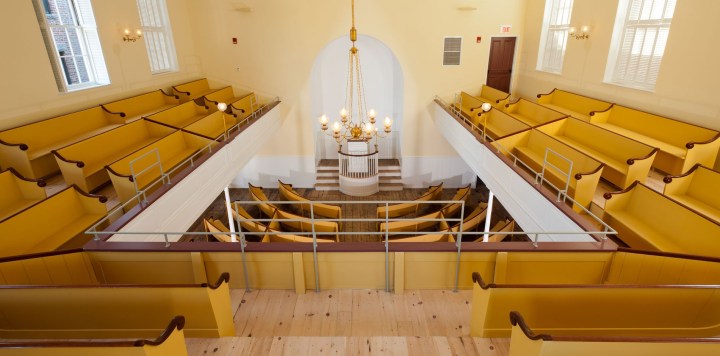
Interior of the African Meeting House in Boston, completed in 1806,
as restored by Shawmut to its 1855 state.
◊ ◊ ◊ ◊ ◊
As noted at History of the Book at Harvard:
Freedom Rising: Reading, Writing, and Publishing Black Books
African Meeting House, Museum of African American History, Boston, 8 January 2015 — May 2016
The Museum of African American History’s Black Books exhibition and complementary programming examine historical and cultural implications of learning to read and write, as well as publishing the works of free and formerly enslaved African American voices. Free black communities from Boston and beyond began sharing books, newspapers, periodicals, poems, and other writings to advance campaigns for freedom from the Colonial period through the 19th century and for personal expression and enjoyment. These pioneering wordsmiths continue to inspire gifted writers to use their published works as agents for social change. To celebrate their passion for free speech and draw parallels across the ages, Black Books places 18th- and 19th-century African American authors from the Museum’s collection of rare books in dialogue with more contemporary works. The exhibit and programs feature a wide array of selected genres, including poetry, fiction, autobiography, medicine, military experience, sociology, and music. Lead partners: National Park Service, Boston African American National Historic Site and Suffolk University’s Mildred F. Sawyer Library, where the Museum’s book collection is housed.
◊ ◊ ◊ ◊ ◊
From a November 2011 press release, celebrating the restoration and reopening of the African Meeting House:
The African Meeting House, built and opened in 1806, is the oldest extant African American church building in the nation constructed primarily by free black artisans. Over more than 200 years, this three-story brick structure has served diverse communities in Boston, as a church, school, and vital meeting place in the 1800s, and a synagogue in the 20th century. In 1967, Sue Bailey Thurman, wife of the Rev. Dr. Howard Thurman, founded the Museum of African American History, which acquired the African Meeting House in 1972. This National Historic Landmark is the crown jewel in the Museum’s collection of historic sites on Boston’s Beacon Hill and Nantucket. . . .
The Museum of African American History is New England’s largest museum dedicated to preserving, conserving and accurately interpreting the contributions of people of African descent and those from Boston and across the nation who found common cause with them in the struggle for liberty, dignity, and justice for all. Founded in 1967 and opened in 1986, its Boston and Nantucket campuses feature two Black Heritage Trails and four historic sites; three are National Historic Landmarks. They tell the story of organized black communities from the Colonial Period through the 19th century. Exhibits, programs, and educational activities showcase the powerful history of individuals and families who worshipped, educated their children, debated the issues of the day, produced great art, organized politically, and advanced the cause of freedom through a strategic network of Northern coastal communities. . . .
Exhibition | Beyond Measure: Fashion and the Plus-Size* Woman
◊ ◊ ◊ ◊ ◊
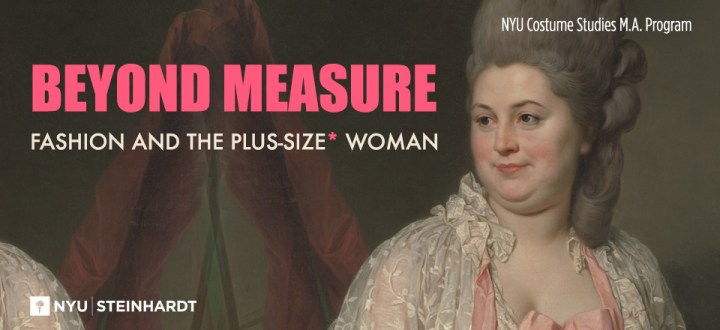
It’s not an eighteenth-century exhibition per se, though the starting point is Joseph Siffred Duplessis’s Portrait of Madame de Saint-Maurice (mention of which also opens Ruth La Ferla’s review of the exhibition for The New York Times) . . . From the exhibition website:
Beyond Measure: Fashion and the Plus-Size* Woman
80WSE, New York University, 13 January — 3 February 2016
Curated by Tracy Jenkins with Dévika Kanadé, Julie Smolinski, Lauren
Wilson, Meg Pierson, Mem Barnett, Shelly Tarter, and Ya’ara Keydar
The Masters of Arts Candidates in New York University’s Visual Culture: Costume Studies Program proudly present their annual exhibition entitled Beyond Measure: Fashion and the Plus-Size* Woman , on view at 80WSE, New York University Steinhardt School’s gallery space, from January 13th to February 3rd, 2016. The exhibition explores the shifting discourse surrounding the plus-size woman in relation to fashion and the body. Through a series of objects, the exhibit will examine the plus-size woman’s place within fashion and its defining entity—the fashion industry—from the perspectives of designers, manufacturers, the general public, and the individual women themselves.

Joseph Siffred Duplessis, Portrait of Madame de Saint-Maurice, 1776 (exhibited in Paris at the Salon of 1776), oil on canvas (New York: The Metropolitan Museum of Art)
As a complicated cultural construct itself, the very term ‘plus-size’ evokes a myriad of reactions, thus, “after careful consideration from the curators of the exhibit, the term ‘plus-size’ is used here for its association with fashion, the primary focus of this exhibition,” said curatorial director of the exhibit, Tracy Jenkins. The fashion industry has played an undeniable role in enabling the stigmatization of larger women’s bodies. Despite consumer needs, plus-size fashion has traditionally been given little sartorial energy. Yet women of all physiques have had to clothe themselves, and thus have stood somewhere in relation to the fashion system. The plus-size woman’s place within the history of the body and her space within the fashion industry is presented here through a diverse set of objects emphasizing her relationship to gender and body politics as well as cultural attitudes toward beauty and health.
These objects, among others, will include an early twentieth-century photograph of A Ticket to Nettie the Fat Girl, representing one of the earliest views of greater weight being equated with greater immorality, and the fetishization of the supposedly deviant body. In a series of advertisements from the mid-twentieth century, women considered undesirably skinny were encouraged to consume dietary supplements to add ‘sex-appealing curves’. Their younger counterparts from the same era who weighed ‘more than average’ were deemed ‘Chubbies’ by pattern companies, presented through the Simplicity Chubbie Pattern in this exhibit. It is not until the 1990s that the plus-size woman in fashion takes center stage when model and muse Stella Ellis took the fashion world into bold new territory as she strode the high fashion runways alongside ‘straight size’ models. Presented in the exhibit is a 1992 photograph of Ellis in bespoke Jean Paul Gaultier, representing her collaboration with the designer, and her photographer, who championed Ellis’s look. Attention will also be paid to the plus-size woman’s relationship with fashion in recent years. These objects will include images of plus-sized models using padding during photo shoots, which has drawn comparisons to the use of Photoshop to create unattainable ideals of beauty. Throughout this presentation of objects and media, ranging from historical to contemporary, this exhibition aims to present the plus-size woman taking her place as a woman of and in fashion.
Thursday, 28 January 2016, 5–9pm
To celebrate the opening of Beyond Measure: Fashion and the Plus-Size* Woman, the NYU M.A. Costume Studies Candidates will host a reception and panel discussion. The opening will be held at the gallery space at 80WSE where attendees are encouraged to explore the exhibit as well as meet with the curators. Starting at 7:00, a panel discussion will be held at NYU (location TBD). The event will include a keynote speech by Professor Leah Sweet, Parsons the New School for Design, and followed by a discussion with plus-size model and muse Stella Ellis, Eden Miller, the first plus-size designer to show at New York Fashion Week and Buzzfeed writer Kaye Toal. Please confirm attendance RSVP@beyondmeasurenyu.com.
In conjunction with Beyond Measure: Fashion and the Plus-Size* Woman, a mobile web app will be available to explore the exhibition beyond the walls of 80WSE. This will include supplemental multimedia material including videos, images, and discussions with the curators.
Beyond Measure: Fashion and the Plus-Size* Woman is organized by curatorial director Tracy Jenkins, a faculty member in NYU’s M.A. Costume Studies Program and by the co-curators: Dévika Kanadé, Julie Smolinski, Lauren Wilson, Meg Pierson, Mem Barnett, Shelly Tarter, and Ya’ara Keydar, Masters of Arts Candidates in New York University’s Visual Culture: Costume Studies Program.
Exhibition | Ships, Clocks & Stars: The Quest for Longitude

Working replicas of John Harrison’s three remarkable timekeepers (H1, H2, H3) are highlights of the Ships, Clocks & Stars exhibition at Mystic Seaport; pictured is a detail of H3. Photo by Andy Price/Mystic Seaport.
◊ ◊ ◊ ◊ ◊
Press release (20 August 2015) for the exhibition, which was earlier on display at the National Maritime Museum in Greenwich:
Ships, Clocks, and Stars: The Quest for Longitude
National Maritime Museum, Greenwich, 11 July 2014 — 4 January 2015
Mystic Seaport, Mystic, Connecticut, 19 September 2015 — 28 March 2016
Mystic Seaport proudly presents Ships, Clocks & Stars: The Quest for Longitude, on tour from England for a limited time only. The award-winning exhibition, produced by the National Maritime Museum in London and sponsored by United Technologies Corp., reveals the race to determine longitude at sea. Spurred on by the promise of rich rewards, astronomers, philosophers, and artisans—including John Harrison and his innovative timekeepers—finally solved one of the greatest technical challenges of the 18th century.
For centuries, longitude (east-west position) was a matter of life and death at sea. Ships that went off course had no way to rediscover their longitude. With no known location, they might smash into underwater obstacles or be forever lost at sea. For a maritime nation such as Britain, growing investment in long distance trade, outposts and settlements overseas made the ability to accurately determine a ship’s longitude increasingly important.
Ships, Clocks & Stars celebrates the 300th anniversary of the British Longitude Act of 1714, which offered a huge prize for any practical way to determine longitude at sea. The longitude problem was so difficult that—despite that incentive—it took five decades to solve it. Through the latest research and extraordinary, historic artifacts—many from the collection of the National Maritime Museum and never before displayed outside the UK—the exhibition tells the story of the clockmakers, astronomers, naval officers, and others who pursued the long ‘quest for longitude’ to ultimate success.
In recent years, John Harrison has been cast as the hero of the story, not least in Dava Sobel’s bestselling book Longitude: The True Story of a Lone Genius Who Solved the Greatest Scientific Problem of His Time. Ships, Clocks & Stars provides a new perspective on this famous tale. While John Harrison makes a good story and his marine sea-watch was vital to finally solving the problem of longitude, this was against a backdrop of almost unprecedented collaboration and investment. Famous names such as Galileo, Isaac Newton, James Cook, and William Bligh all feature in this fascinating and complex history. Crucially, it was Astronomer Royal Nevil Maskelyne’s observations and work on the Nautical Almanac at the Royal Observatory in Greenwich that demonstrated the complementary nature of astronomical and timekeeper methods. Combined, the two methods lead to the successful determination of longitude at sea and changed our understanding of the world.
“Mystic Seaport is very proud to bring Ships, Clocks & Stars to New England to tell this important story of scientific discovery, innovation, creativity, perseverance, and even adventure as different parties raced to find a solution,” said Steve White, president of Mystic Seaport. “This exhibit is more than the story of longitude: it is the story of human problem-solving, and it is as relevant today as it was in the eighteenth century.”
Exhibition | Forbidden Fruit: Chris Antemann at Meissen

Chris Antemann in collaboration with Meissen®, Covet, 2013
©Chris Antemann and Meissen Couture®
◊ ◊ ◊ ◊ ◊
Closing this weekend in Pittsburgh, the exhibition opens in Bellevue next month:
Forbidden Fruit: Chris Antemann at Meissen
Portland Art Museum, Portland, Oregon, 27 September 2014 — 19 April 2015
The Frick, Pittsburgh, 3 October 2015 — 10 January 2016
Bellevue Arts Museum, Bellevue, Washington, 26 February — 29 May 2016
Museum of Arts and Design, New York, 22 September 2016 — 5 February 2017
In 2012, Oregon-based sculptor Chris Antemann was invited to participate in the Art Studio program of the legendary Meissen Porcelain Manufactory. During the program she collaborated with the Meissen master artisans on unique pieces and a series of limited editions of her sculptures, resulting in a grand installation that reinvents and invigorates the great porcelain figurative tradition.
Using the Garden of Eden as her metaphor, the artist created a contemporary celebration of the 18th-century banqueting craze. Inspired by Meissen’s great historical model of Johann Joachim Kändler’s monumental Love Temple (1750), Antemann created her own 5-foot work. Stripping the original design back to its basic forms, she added her own figures, ornamentation, and flowers, as well as a special finial with three musicians to herald the guests to the banquet below. Employing her signature wit and formal references to classic Baroque Meissen figurines, Antemann has invented a new narrative on contemporary morality through her one-of-a-kind porcelain figures in a setting that evokes the decadence of Boucher and Watteau.
Exhibition | Blood in the Sugar Bowl
Opening in the spring at Stanford:
Blood in the Sugar Bowl
Cantor Arts Center, Stanford University, 6 April — 4 July 2016
Curated by Rachel Newman
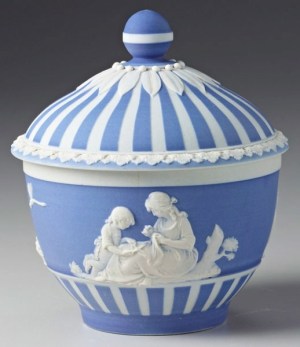
Josiah Wedgwood, Covered Sugar Bowl, ca. 1785–95, stoneware (Cantor Arts Center Collection, 1989.154.a-b)
This exhibition focuses on sugar plantation slavery during the peak of the sugar trade, the late 18th to mid-19th century. On display are sugar bowls from the Cantor’s collection, Henry Corbould’s illustration Fashionable Women Pouring Tea, James Gillray’s caricature The Anti-Saccharites, several volumes from Stanford University Libraries Special Collections including James Hakewill’s beautiful plantation views from his 1821 Picturesque Tour of the Island of Jamaica and William Blake’s depictions of slave torture in his 1777 Narrative, of a five years’ expedition, against the revolted Negroes of Surinam. Personalizing the slave narrative are Benjamin M’Mahon’s Jamaica Plantership and other audio excerpts of texts written by slaves and sugar plantation employees. D. R. Wakefield’s 2004 series Resistance Is Useless: Portraits of Slaves from the British West Indies is also on display.
Student curator: Stanford PhD candidate and Mellon Curatorial Research Assistant Rachel Newman
Exhibition | Portals to the Past: British Ceramics, 1675–1825

William Greatbatch, Tea Canister, Soup Plate, Teapot; Fenton, Staffordshire, England, 1765–1770, cream-colored earthenware, lead glaze (Charlotte: The Mint Museum)
◊ ◊ ◊ ◊ ◊
From The Mint Museum:
Portals to the Past: British Ceramics, 1675–1825
The Mint Museum, Charlotte, North Carolina, opening 16 January 2015 (running for two years)
The Mint Museum’s collection of eighteenth-century British pottery and porcelain is widely respected for its scope and quality. The collection numbers over 2,000 objects and includes important examples of both salt-glazed and dry-bodied stoneware from Staffordshire; tin-glazed earthenware from Bristol, Liverpool, and London; and cream-colored earthenware from Derbyshire, Staffordshire, and Yorkshire. Notable eighteenth-century porcelain factories represented include Chelsea, Bow, and Vauxhall in London, Longton Hall in Staffordshire, Worcester, Bristol, and others. Individual works in the collection are exceptional because of their rarity, craftsmanship, provenance, or as representative examples of particular types or methods of production or decoration.

William Littler, Sweetmeat Stand; West Pans, East Lothian, Scotland, 1765–70, earthenware, lead glaze (Charlotte: The Mint Museum)
British Ceramics 1675–1825 presents more than 200 highlights of this collection in a new installation in the Alexander, Spangler, and Harris Galleries at Mint Museum Randolph. The objects are interpreted through a variety of thematic lenses—function, style, manufacturing technique, maker—to encourage visitors to engage with the objects in ways they find personally meaningful and interesting. The exhibition includes many objects that have never before been on view, as well as contemporaneous works of art in from the Mint’s holdings in other media, including paintings, furniture, fashion, and silver.
The exhibition’s opening follows the December release of a 270-page, illustrated catalogue, British Ceramics 1675–1825: The Mint Museum, produced by the museum in collaboration with D. Giles Limited, London. Both the catalogue and the exhibition honor the fiftieth anniversary of the museum’s purchase of the Delhom Collection of British and European ceramics.
Portals to the Past: British Ceramics 1675–1825 is presented by the Delhom Service League, ceramics affiliate of The Mint Museum, with additional support provided by Moore & Van Allen.
◊ ◊ ◊ ◊ ◊
From Giles:
Brian Gallagher, Barbara Stone Perry, Letitia Roberts, Diana Edwards, Pat Halfpenny, Maurice Hillis, and Margaret Ferris Zimmerman, British Ceramics 1675–1825: The Mint Museum (London: D. Giles Limited, 2015), 272 pages, ISBN: 978-1907804366, £50 / $80.
 British Ceramics 1675–1825 is an important and visually stunning new publication which highlights 200 of the best pieces from the The Mint Museum’s collection, selected on account of their rarity, craftsmanship, notable provenance, or as important examples of particular types, or methods of production, or decoration. Each object is illustrated in colour, and is accompanied by a catalogue entry including title, manufacturer, date, medium, marks, dimensions, description of other unique physical aspects (inscriptions or quote on the body of the vessel), provenance, previous publication history and exhibition history. Descriptive text for each piece covers unusual and pertinent aspects of its manufacture and history.
Brian Gallagher is the curator of Decorative Arts, The Mint Museum. Barbara Stone Perry is the former curator of Decorative Arts, The Mint Museum. Letitia Roberts is an independent scholar and consultant, and the former senior international specialist for European Ceramics and Chinese Export Porcelain at Sotheby’s, New York. Diana Edwards is a prolific writer and lecturer on seventeenth- and eighteenth-century British ceramics, and advises numerous ceramics organizations. Pat Halfpenny is a highly respected expert on Staffordshire pottery, and is curator emerita of Ceramics and Glass and retired Director of Museum Collections at Winterthur Museum, Delaware. Maurice Hillis has published extensively on eighteenth-century English pottery and porcelain, and is the former chairman and current president of the Northern Ceramic Society, United Kingdom. Margaret Ferris Zimmermann lectured on ceramics for the Delhom Service League’s orientation program at The Mint Museum for many years and is the former editor of the American Ceramic Circle Journal.
Exhibition | Light, Time, Legacy: Francis Towne’s Watercolours of Rome
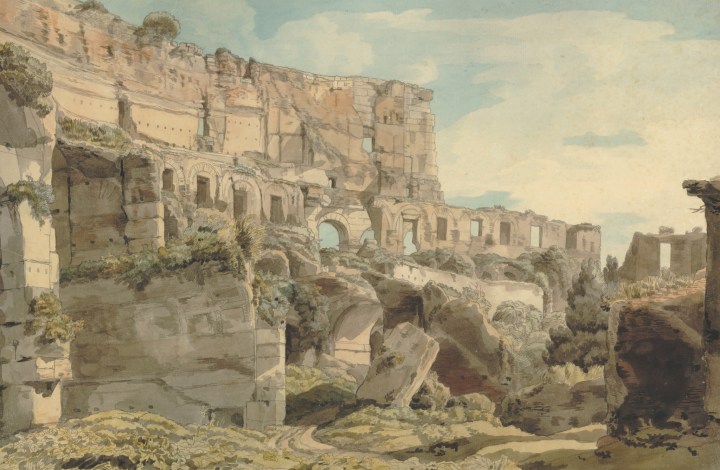
Francis Towne, Inside the Colosseum, 1780
(London: The British Museum)
◊ ◊ ◊ ◊ ◊
Press release for the upcoming exhibition:
Light, Time, Legacy: Francis Towne’s Watercolours of Rome
The British Museum, London, 21 January — 14 August 2016
Curated by Richard Stephens
2016 is the bicentenary of Francis Towne’s death and his historic bequest to the British Museum of 75 uniquely beautiful watercolours made on his visit to Italy in 1780–81. To celebrate this generous gift the watercolours are all on display here—at their heart are 52 views of Rome that have not been shown together since 1805. Towne’s decision to give the Museum such a major group of his drawings, so that they could be seen in the wider context of a collection that charted the history of the graphic arts from its Renaissance beginnings, was both strategic and pioneering as it set a pattern for artists to donate their work that endures to this day, as seen in the recent gift of 200 prints made by the American artist Jim Dine.

Francis Towne, Near the Arco Scuro, 1780, watercolour with pen and ink and some gum arabic, 320 x 467 mm (London: The British Museum)
Towne was born in London in 1739 where he later trained and then moved to Exeter. He tried unsuccessfully to gain recognition in the London art world, and failed to be elected to the Royal Academy on eleven separate occasions. Towne gained artistic recognition in his posthumous legacy at the British Museum. At the start of the 20th century, through these watercolours, Towne became the poster boy for the ‘new Georgian’ revival of interest in 18th-century art. The clarity and abstracted economy of Towne’s watercolours were not only admired by the public but also by early 20th-century modernists, and he is today recognised as one of Britain’s greatest watercolour artists.
Through Towne’s vision, the exhibition will explore Enlightenment Britain’s relationship with the classical past and Ancient Rome. Towne travelled to Rome in 1780–81 during a period of political crisis in England when America was in revolt, a French invasion of England was anticipated and a highly divisive general election had just concluded. Towne, and his social circle, viewed ancient Rome as a catastrophic precedent for what they perceived as a corrupt ruling power in England. The ruins that Towne depicted in his landscapes signified a warning to contemporary society not to suffer the same fate as the fallen Roman Empire.
Italy had a transformational effect on Towne’s work. When Towne first arrived in Rome he started making excursions north of city, making rural sketches instead of focusing on the ancient monuments. Towne’s delicate early studies were eventually replaced with large scale bolder work when Towne depicted such subjects as the Colosseum and other iconic Roman ruins. The experience of Rome was much different in the 18th century, few ruins had been excavated and tourists were free to explore them.
When Towne returned to England in 1781, these watercolours played a central role in his subsequent career. Although he was never accepted by the London art establishment, he organised an exhibition of his life’s work in 1805 with the Museum’s watercolours at its centre. Towne bequeathed the watercolours of Rome and others to the British Museum in 1816, with a further selection by his executors arriving in 1818.
A new open access catalogue raisonné of Francis Towne’s work by the guest curator of this exhibition, Dr Richard Stephens, will be published online in early 2016 by the Paul Mellon Centre for Studies in British Art.
The illustrated leaflet for the exhibition is available as a PDF file here»
◊ ◊ ◊ ◊ ◊
P R O G R A M M I N G
All events are free
Decline and Fall: Francis Towne and the Ruins of Rome
Tuesday, 26 January, 13.15–14.00, Room 90. Just drop in.
A gallery talk by exhibition curator Richard Stephens.
Light, Time, Legacy: Francis Towne’s Watercolours of Rome
Friday, 5 February, 13.30–14.15, BP Lecture Theatre. Booking essential.
Exhibition curator Richard Stephens gives a 45-minute illustrated introduction to the exhibition.
Theory and Practice in Towne’s Watercolours of Rome
Friday, 19 February, 13.15–14.00, Room 90. Just drop in.
A gallery talk by Timothy Wilcox, independent scholar.
The Selective Eye: Francis Towne’s Watercolours of Rome
Thursday, 21 April, 13.15–14.00, Room 90. Just drop in.
A gallery talk by art historian and curator Anne Lyles, independent speaker.
Magick Land? Francis Towne and His Response to Rome
Friday, 6 May, 13.15–14.00, Room 90. Just drop in.
A gallery talk by Jonny Yarker, Director of Lowell Libson Ltd.
Decline and Fall: Francis Towne and the Ruins of Rome
Wednesday, 15 June, 13.15–14.00, Room 90. Just drop in.
A gallery talk by exhibition curator Richard Stephens.
Exhibition | Turner in January
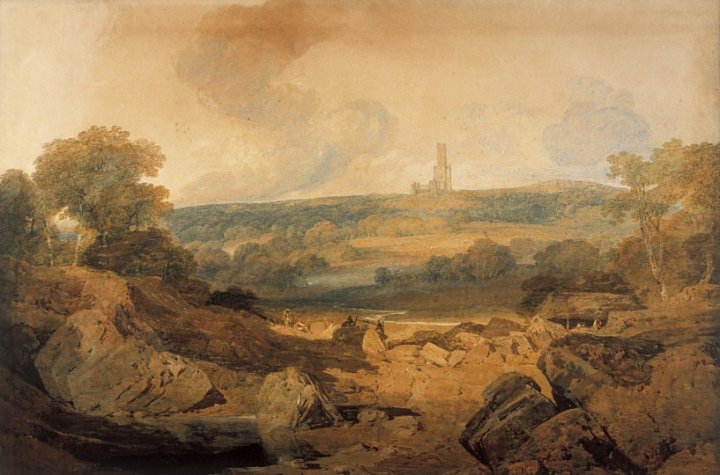
Joseph Mallord William Turner, East View of Fonthill Abbey, Noon, 1800, watercolour on paper
(Edinburgh: Scottish National Gallery)
◊ ◊ ◊ ◊ ◊
Press release for the exhibition:
Turner in January
Scottish National Gallery, Edinburgh, 1–31 January 2016
In keeping with a long-standing tradition now stretching over a century, New Year’s Day at the Scottish National Gallery will be marked by the opening of Turner in January: The Vaughan Bequest, an annual display of works by the artist Joseph Mallord William Turner (1775–1851).
 An outstanding collection by one of the great masters of British painting was bequeathed to the Gallery in 1900 by Henry Vaughan, a London art collector with a passion for Turner and a connoisseur’s eye for quality. Vaughan stipulated that the 38 exquisite works—which encapsulates the artist’s entire career—could not be subjected to permanent display, since continual exposure to light would result in their fading. Instead, these precious works were to be exhibited to the public “all at one time, free of charge, during the month of January,” when daylight in Edinburgh is at its lowest levels. Faithfully following Vaughan’s request, all of the works will be exhibited and Turner in January runs throughout the month, providing a welcome injection of light and colour during the darkest month of the year.
Clara Govier, Head of Charities at People’s Postcode Lottery (PPL), said: “This is the fourth year that players of PPL have supported Turner in January at the Scottish National Gallery, and we’re thrilled—even as relative newcomers in the grand scheme of things—to be involved in such an established tradition. It’s great for players to see that their valuable support is helping to provide thousands of visitors—some who come to see the exhibition every year, some for the very first time—with the opportunity to keep playing a part in this wonderful legacy.”
Recognised as perhaps the greatest of all British artists, Turner was born in London in 1775 and proved himself as an accomplished draughtsman while still a youth, exhibiting at the Royal Academy at the tender age of fifteen. He was a prolific and innovative artist who went on to exploit every possibility of the watercolour medium to create stunning land-and seascapes. Travelling widely, at first with sketching tours in England, Wales and Scotland and then later across Europe, Turner gathered material for masterful watercolours and oil paintings, discovering the awe-inspiring mountainous landscapes which became a major pre-occupation in his work.
Many of the works in the display reveal a youthful Turner’s artistic talents, such as the early wash drawings of the 1790s, while others show how this skill would come to be fused with the peripatetic lifestyle which dominated Turner’s life and career, resulting in colourful and atmospheric watercolour sketches of Continental Europe, such as Chatel Argent, in the Val d’Aosta, near Villeneuve (after 1836) and Falls of the Rhine at Schaffhausen, Side View (ca. 1841).
In his lifetime, Turner also managed three trips to Venice, first arriving there in 1819. The Vaughan Bequest features six of the artist’s stunning views of the city. In The Piazzetta, Venice (ca. 1835), one of Turner’s most spectacular Venetian studies, the Doge’s Palace and renowned St. Mark’s Basilica are dramatically illuminated by a bolt of lightning, an effect innovatively created by the artist by scratching away to reveal the paper once he had painted on it. Often, Turner would use his thumbnail and is reputed to have grown like an ‘eagle-claw’ for such a purpose. His third and final visit to the city in 1840 would see the artist produce a series of incredible works in which light itself appeared to have become the main subject, such as in The Grand Canal by the Salute, Venice (ca. 1840) and Venice from the Laguna (1840) where Turner’s consummate mastery of atmospheric lighting effects is clearly demonstrated.
As with many artists at the end of the 18th century, for Turner the vastness and tumultuous conditions of nature inspired senses of awe and terror. This life-long fascination—of the savageness of elemental forces—poured out of Turner’s art, namely in the form of avalanches, storms and mountainous seas. This can be seen in works from the bequest, such as Loch Coruisk, Skye (1831–34), with its miniature human figures set against a grand, stretching backdrop of painted swirls.
Turner’s Heidelberg (ca. 1846), a glowing, almost hallucinatory image of the ancient university town on the Rhine and one of his finest late works, will also be on display.
Also joining those from the bequest is the work East View of Fonthill Abbey, Noon (1800), a romantic view of the Gothic novelist William Beckford’s extraordinary cathedral-like mansion in rural Wiltshire, which was accepted by HM Government in lieu of inheritance tax in 1988 and loaned to National Trust for Scotland at Brodick Castle.
◊ ◊ ◊ ◊ ◊
Christopher Baker, J.M.W. Turner: The Vaughan Bequest (Edinburgh: National Galleries of Scotland, 2007), 120 pages, ISBN: 978-1903278895, £10.
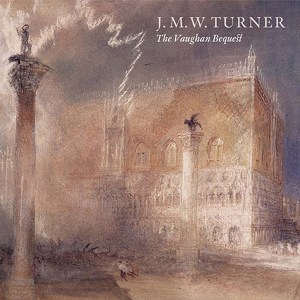 J.M.W. Turner (1775–1851) was perhaps the most prolific and innovative of all British artists. His outstanding watercolours in the collection of the National Gallery of Scotland are one of the most popular features of its collection. Bequeathed to the Gallery in 1899 by the distinguished collector Henry Vaughan, they have been exhibited, as he requested, every January for over 100 years at the National Galleries of Scotland. Renowned for their excellent state of preservation, they provide a remarkable overview of many of the most important aspects of Turner’s career.
This richly illustrated book, provides an authoritative commentary on the watercolours, taking account of recent research, and addressing questions of technique and function, as well as considering some of the numerous contacts Turner had with other artists, collectors and dealers. The introduction concentrates on Henry Vaughan, one of the greatest enthusiasts for British art in the late nineteenth century, whose diverse collections have not previously been fully studied and appreciated. The book accompanies the annual display every January of this bequest of Turner watercolours.
Exhibition | Venetian Painting in Honor of David Rosand
In Light of Venice: Venetian Painting in Honor of David Rosand
Otto Naumann Gallery, New York, 11 January — 12 February 2015

Bernardo Bellotto, Architectural Capriccio with a Self-Portrait in the Costume of a Venetian Nobleman, ca. 1762–65, oil on canvas, 61 x 44 inches.
New York: Otto Naumann and Robert Simon jointly announce that their exhibition In Light of Venice: Venetian Painting in Honor of David Rosand, will open on January 11th, 2016 at the Otto Naumann Gallery, 22 East 80th Street in New York. More than thirty important works of the Renaissance, Baroque, and Rococo periods—many never before seen publicly—will be on view for this milestone event. A portion of the proceeds of sales will benefit the David Rosand Tribute Fund at Columbia University, which was formed last year establishing a Professorship in Italian Renaissance Art History in David Rosand’s honor, as well as to fund other programs important to Venetian studies and to the teaching of art history. These include support for Casa Muraro, Columbia’s residence and study center in Venice, Italy that Professor Rosand first conceived and developed.
Both Naumann and Simon studied art history at Columbia and have continued their scholarly work while operating their eponymous art galleries devoted to Old Master paintings. Simon notes that with the changing focus of academic art history, support is needed to maintain the teaching of the crucial Renaissance period. “With the establishment of the Rosand Professorship in the Italian Renaissance, the subject is insured to be taught in perpetuity by distinguished scholars.”
Adds Naumann: “The exhibition demonstrates that important works by some of the greatest masters of the period are still on the market and many are certain to find homes in private collections, as well as in museums.”
While the exhibition will feature paintings from the fourteenth to the eighteenth centuries, the focus will be on the 1500s, the period most studied by Professor Rosand in his many books and publications. Featured artists include Carpaccio, Giovanni Bellini, Palma il Vecchio, Titian, Tintoretto, Paolo Veronese, and Jacopo Bassano. Other sixteenth-century paintings to be exhibited are by Palma il Giovane, the subject of Professor Rosand’s doctoral dissertation, Bonifazio Veronese, and Paris Bordone. Later Venetian paintings include significant works by Amigoni, Bambini, Guardi, Diziani, and Bernardo Bellotto. All paintings will be for sale.
David Rosand received his undergraduate and graduate education at Columbia, earning his Ph.D. in 1965. He was on the faculty there from that time until his death in August 2014, when he held the title of Meyer Schapiro Professor of Art History Emeritus. His impact on students at Columbia and in the field of Venetian Studies has been enormous—through his teaching, his groundbreaking publications on Venetian art, and his studies on the making of art spanning all periods.
Exhibition | Reigning Men: Fashion in Menswear, 1715–2015
From LACMA:
Reigning Men: Fashion in Menswear, 1715–2015
Los Angeles County Museum of Art, 10 April — 21 August 2016
Powerhouse Museum, Sydney, 3 December 2016 — 12 March 2017
Saint Louis Art Museum, 25 May — 17 September 2017
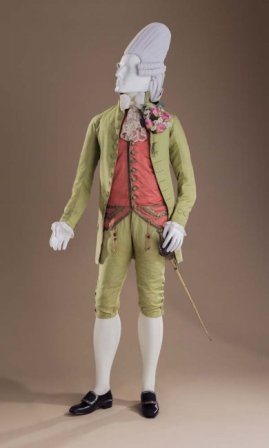
The Macaroni ensemble: Man’s Three-piece Suit, ca. 1770. Sword with Chatelaine, late 18th century. Men’s Pair of Shoe Buckles, late 18th century (LACMA)
Reigning Men: Fashion in Menswear, 1715–2015 explores the history of men’s fashionable dress from the eighteenth century to the present and re-examines the all-too-frequent equation of ‘fashion’ with ‘femininity’.
Beginning with the eighteenth century, the male aristocrat wore a three-piece suit conspicuous in make and style, and equally as lavish as the opulent dress of his female counterpart. The nineteenth-century ‘dandy’ made famous a more refined brand of expensive elegance which became the hallmark of Savile Row. The mid-twentieth-century ‘mod’ relished in the colorful and modern styles of Carnaby Street, and the twenty-first century man—in an ultra-chic ‘skinny suit’ by day and a flowered tuxedo by night—redefines today’s concept of masculinity.
Drawing primarily from LACMA’s renowned permanent collection, Reigning Men makes illuminating connections between history and high fashion. The exhibition traces cultural influences over the centuries, examines how elements of the uniform have profoundly shaped fashionable dress, and reveals how cinching and padding the body was, and is, not exclusive to women. The exhibition features 200 looks, and celebrates a rich history of restraint and resplendence.
This exhibition was organized by the Los Angeles County Museum of Art and made possible by Ellen A. Michelson. Additional support is provided by the Wallis Annenberg Director’s Endowment Fund.
◊ ◊ ◊ ◊ ◊
From Prestel:
Sharon Sadako Takeda, Kaye Durland Spilker, and Clarissa Esguerra, with contributions by Tim Blanks and Peter McNeil, Reigning Men: Fashion in Menswear, 1715–2015 (New York: Prestel, 2016), 272 page, ISBN: 978–3791355207, $55 / £35.
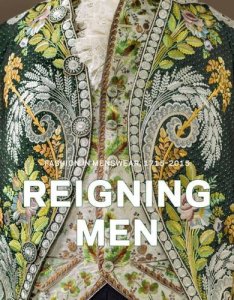
This fully illustrated book accompanies one of the most comprehensive exhibitions dedicated solely to three centuries of men’s fashion. The fashionable male may be making a comeback, but early fashion trends centered around what men—not women—were wearing. This intriguing book traces the history of men’s fashion since the 18th century, when young Englishmen imitated foreign dress and manners after touring the European continent. This phenomenon is only one of many explored in sections titled ‘Revolution/Evolution’, ‘East/West’, ‘Uniformity’, ‘Body Consciousness’, and ‘The Splendid Man’. In addition to numerous illustrations of extant menswear, the book captures the 19th-century dandy, a more restrained brand of expensive elegance which became the hallmark of Savile Row; the post-WWII mod, who relished the colorful styles of Carnaby Street; and the 21st-century man—ultra-chic in a sleek suit by day, wearing a flowered tuxedo by night. Reigning Men illuminates connections between history and high fashion, traces cultural influences over the centuries, examines how uniforms have profoundly shaped fashionable dress, and reveals that women aren’t the only ones who cinch and pad their bodies.
Sharon Sadako Takeda is Senior Curator and Head of the Costume and Textiles Department at the Los Angles County Museum of Art. Kaye Durland Spilker is Curator, and Clarissa Esguerra is Assistant Curator of the Costume and Textiles Department at the Los Angles County Museum of Art. They are the authors of Fashioning Fashion: European Culture in Detail, 1700–1915 (Prestel, 2010).
◊ ◊ ◊ ◊ ◊
Thomas John Bernard, . . . a theatrical costume designer, worked with the curators and conservators of the Costume and Textiles Department at LACMA to draw these patterns approximating the design of garments in the collection.
PDF documents with annotated patterns are available here»










leave a comment