Exhibition | The Jane Austen Reading Room
Now on view at Mia:
Living Rooms: The Jane Austen Reading Room
Minneapolis Institute of Art, 21 November 2015 — 26 June 2016

This installation situates Jane Austen in a unique period room setting. Taking up two of Mia’s well-loved English interiors—the Queen Anne room and the Georgian Drawing room—this display will discuss Austen’s habits as a reader and writer, recreate scenes from her novel Emma (celebrating its 200th birthday in 2015), and invite museum visitors to read works that Austen read, wrote, or inspired. This project is part of Living Rooms, an initiative to present Mia’s historic interiors and decorative arts collections in new ways.
Exhibition | Italian Dreams: Watteau and French Landscape Painting
From the website for Valenciennes:
Réveries Italiennes: Watteau et les paysagistes français au XVIIIe siècle
Italian Dreams: Watteau and French Landscape Painting in the Eighteenth Century
Musée des Beaux-Arts, Valenciennes, 25 September — 17 January 2016
Curated by Martin Eidelberg
 La Ville de Valenciennes a la chance d’avoir vu naître l’un des artistes français les plus illustres : Jean Antoine Watteau (1684–1721). La réouverture de son musée des Beaux-Arts, qui conserve un ensemble d’œuvres du peintre, est couronnée par le don exceptionnel d’une œuvre tout récemment redécouverte d’Antoine Watteau, La Chute d’eau, rare paysage du peintre des fêtes galantes inspiré des cascades de Tivoli près de Rome, qui témoigne de la fascination de l’artiste pour l’Italie, pays où il n’eut pourtant jamais l’occasion de se rendre !
L’exposition Rêveries italiennes, propose ainsi de souligner les emprunts que le maître fit tout au long de sa carrière au modèle italien, soit à travers l’exemple des peintres vénitiens du XVIe siècle qui constituèrent pour l’artiste une source importante d’inspiration, soit à travers le filtre des œuvres réalisées à Rome par ses contemporains. Autour d’un ensemble de peintures et de dessins d’Antoine Watteau, des œuvres des XVIe, XVIIe et XVIIIe siècles montreront comment ce peintre des songes puisa dans la culture artistique européenne pour créer des œuvres qui ouvriront la voie à une nouvelle école de paysage, née au siècle des Lumières, autour de Natoire, Boucher, Fragonard et Hubert Robert. À partir des rêveries italiennes de Watteau, l’exposition valenciennoise souhaite ainsi éclairer sous un jour nouveau la fécondité d’un modèle artistique qui, bien au-delà d’une iconographie séduisante, mena à l’éclosion du Romantisme.
L’exposition s’intègre dans la programmation liée à l’élection de la cité voisine belge de Mons comme capitale européenne de la culture pour l’année 2015. Elle bénéficie également du soutien exceptionnel du Musée du Louvre, qui a accordé pour l’occasion un prêt conséquent d’œuvres et a proposé, dans le cadre de la programmation du Louvre Lens, une exposition venant en écho à l’initiative valenciennoise, consacrée à Antoine Watteau et la fête galante, Dansez, embrassez qui vous voudrez. Fêtes et plaisirs d’amour au siècle de Mme de Pompadour, du 5 décembre 2015 au 29 février 2016.
Commissariat scientifique
Martin Eidelberg, Professeur émérite d’Histoire de l’Art, Rutgers University
Commissariat général
• Emmanuelle Delapierre, anciennement conservatrice du musée des Beaux-Arts de Valenciennes, actuelle conservatrice du musée des Beaux-Arts de Caen
• Vincent Hadot, directeur du musée des Beaux-Arts de Valenciennes
• Virginie Frelin-Cartigny, Attachée de conservation du Patrimoine, musée des Beaux-Arts de Valenciennes
Martin Eidelberg, Réveries Italiennes: Watteau et les paysagistes français au XVIIIe siècle (Heule: Snoeck, 2015), 163 pages, ISBN: 978-9461612397, 29€ / $55.
More information is available at Culture.Fr, and the press release is available as a PDF file here»
Exhibition | Dance, Kiss Whom You Wish

François Boucher, Les Charmes de la vie champêtre, ca. 1735–40
(Paris: Musée du Louvre)
◊ ◊ ◊ ◊ ◊
From the exhibition press materials, via Claudine Colin Communications:
Dansez, embrassez qui vous voudrez: Fêtes et plaisirs d’amour au siècle de la Pompadour
Dance, Kiss Who You Wish: Parties and Pleasures in the Time of Madame de Pompadour
Musée du Louvre-Lens, 5 December 2015 — 29 February 2016
Curated by Xavier Salmon
 Rustic decor, elegant young people and refined leisure pursuits: the 2015–16 winter exhibition at the Louvre-Lens celebrates the genre of the fête galante and the pastoral. Popularised in the first half of the 18th century, first by Antoine Watteau, then by François Boucher, these themes achieved great success until the French Revolution. First adopted by painters, they spread quickly to other disciplines—in particular the decorative arts—and became widespread throughout Europe. Thanks to exceptional loans from the Louvre Museum and around twenty prestigious institutions, this exhibition is able to bring together 220 works.
The bucolic design of the exhibition combines paintings, graphic arts, furniture, ceramics, tapestries, and stage costumes. From the roots to the latest developments, the exhibition traces the fortunes of a delicate, seductive genre, which enchanted Europe in the Age of Enlightenment. A tribute to French taste and the joy of living!
◊ ◊ ◊ ◊ ◊
From ArtBooks.com:
Xavier Salmon, Dansez, embrassez qui vous voudrez: Fêtes et plaisirs d’amour au siècle de Madame de Pompadour (Milan: Silvana, 2015), 320 pages, ISBN: 978-8836631544, $75.
Cet ouvrage rend hommage au genre de la Fête galante, popularisé par Antoine Watteau (1687–1721) et qui connut en France et en Europe un succès non démenti tout au long du Siècle des Lumières. Répondant à une soif de liberté et à un assouplissement des moeurs pendant la Régence, ce thème clamait la joie de vivre, les délices de l’amour, l’alchimie des sentiments et le besoin de paraître. Dans le sillage de Watteau, le genre de la Fête galante fut adopté par son élève Jean-Baptiste Pater ainsi que par ses suiveurs Nicolas Lancret, Bonaventure de Bar ou Pierre-Antoine Quillard. D’autres maîtres en proposèrent à leur tour des variations, pastorales chez François Boucher, mélancoliques chez Jean-Honoré Fragonard ou délicatement sentimentales chez Louis-Joseph Watteau de Lille. Le thème fournit aussi un exceptionnel répertoire de sujets aux manufactures de porcelaine, notamment celles de Sèvres. De Meissen à Venise, il connut en Europe un succès non démenti. Peintres, tel Dietrich, Troost ou Gainsborough, sculpteurs, comme Ferdinand Tietz ou Giovanni Bonazza déclinèrent à l’envi tant en peinture, en dessin, qu’en sculpture, ces sujets aimables qui célébraient les sentiments partagés. Les Arts appliqués s’emparèrent aussi de la thématique et s’attachèrent à la multiplier, en rendant hommage à la fois au goût français et au bonheur de vivre.
Exhibition | Palladian Design: The Good, the Bad and the Unexpected

Chiswick House by Lord Burlington, 1729
(London: RIBA Collections)
◊ ◊ ◊ ◊ ◊
Press release (23 July 2015) for the exhibition now on view at RIBA:
Palladian Design: The Good, the Bad and the Unexpected
Royal Institute of British Architects, London, 9 September 2015 — 9 January 2016
The Renaissance architect Andrea Palladio is the only architect who has given his name to a style, one that is still in use around the world after nearly 500 years. From the US Capitol to a 21st-century Somerset cowshed, Palladian Design: The Good, the Bad and the Unexpected introduces Palladio’s design principles and explores how they have been interpreted, copied and re-imagined across time and continents from his death in 1580 right up to the present day.
Focusing on his legacy, RIBA’s exhibition explores how architects such as Inigo Jones and Lord Burlington turned Palladianism into a national style. The style was adopted in the design of houses, churches, and public buildings around the world from New Delhi to Leningrad. Palladianism became so widespread that it seeped into people’s unconscious references and desires: elements were found popping-up in American Negro Churches and terraced housing and homes in the UK. The 20th century saw a revival of traditional Palladian mansions while the 21st century has seen his design principles being utilised in a more abstract way. The exhibition asks many questions about what makes a building ‘Palladian’. Does a building have to look classical to be Palladian? Is it the design principles or the social and political connotations of tradition, power, and establishment that have led to the enduring popularity of the style? The exhibition is structured chronologically around three themes: revolution, evolution, and the contemporary. It includes 50 original works, including drawings, models, and busts.
The first part of the exhibition introduces Palladio and outlines his unique system of architecture. It charts the development of Anglo-Palladianism from 17th-century England, through to the transformation of Palladianism into a national style by the mid-18th century. It also explores the role of books in spreading Palladio’s ideas—both his own Four Books of Architecture and later publications that spread Palladian style beyond Britain. Highlights include Palladio’s A Design for a Palace (1540s) and projects for low-cost housing in Venice (1550s), original drawings by Inigo Jones include a preliminary design for the Queen’s House at Greenwich (1616), Colen Campbell’s original pen and wash design for Mereworth Castle, Kent (1723), and an original drawing of Lord Burlington’s Chiswick House (1729).
The second part of the exhibition follows Palladio’s legacy worldwide in a series of themes that explore how others have either followed his guidelines to the letter or employed them more creatively. It looks at how Palladian design has been adopted for commercial viability and in the service of politics and religion—both in western countries and in colonial and post-colonial contexts. Away from the centres of power, people turned their hand to Palladian self-builds with anonymous builders using pattern books to fuse Palladian elements with local vernacular traditions. Highlights include the original 1721 model of St Martin-in-the-Fields church by James Gibbs, a perspective of Catherine the Great’s Pella Palace near St Petersburg by Ivan Starov (c.1786), a watercolour perspective of Stormont in Belfast by Sir Arnold Thornely (1927), and Palladio’s original designs for the Villa Valmarana (c.1560) and the Palazzo Antonini (c.1560).
The last section of the exhibition follows the story of 20th- and 21st-century Palladianism. Despite the rise of modernism, Palladianism survived in Britain and America as a domestic style both for landed families and the newly rich who commissioned grand classical homes to evoke a sense of history and confer status. Highlights include a linocut perspective of Kings Walden Bury, Essex by Raymond Erith and Quinlan Terry (1971) and photographs and models of houses built since the 1960s. The exhibition goes on to explore post-modern Palladianism, where the style has been referenced historically, playfully or ironically. Key exhibits include works by Swedish architect Erik Asplund and Belgian architect Charles Vandenhove alongside other new buildings on the continent and in Canada. The exhibition ends by examining contemporary abstract Palladianism—buildings that contain no visual references to classical architecture but follow Palladian design principles in terms of proportion or planning. It asks whether a building has to look like a Palladian building in order to be one? It will include a newly commissioned film comparing Palladio’s Villa Caldogno with Brick House (2005) by Caruso St John and looks at a selection of contemporary buildings, ranging from a model of an underground house in Mongolia by OFFICE Architects to offices in Switzerland by Peter Märkli.
The exhibition coincides with the 300th anniversary of the publication of two books key to the spread of Palladianism worldwide: Giacomo Leoni’s first full translation into English of Palladio’s I Quattro Libri dell’ Architettura and Colen Campbell’s survey of English architecture Vitruvius Britannicus, both published in 1715. These books paved the way for a flood of cheaper pattern books that enabled anyone, from Russian royalty to a American carpenters, to create Palladian designs.
The RIBA Collections contain over 350 drawings and sketches by Andrea Palladio, the world’s largest assemblage of his drawings—85% of all those in existence. The exhibition is designed by Caruso St John Architects. The design takes its inspiration from the interior of Palladio’s villas and the way that his Four Books of Architecture have been used by generations of architects. The palette will reference Villa Caldogno’s frescos. Palladian Design is generously supported by the Blavatnik Family Foundation, The Headley Trust, and the American Friends of the British Architectural Library.
Exhibition | Alessandro Magnasco (1667–1749)
Opening next week at Galerie Canesso:
Alessandro Magnasco (1667–1749), The Mature Years of a Nonconformist Painter
Galerie Canesso, Paris, 25 November 2015 — 31 January 2016
Palazzo Bianco, Genoa, 25 February — 5 June 2016
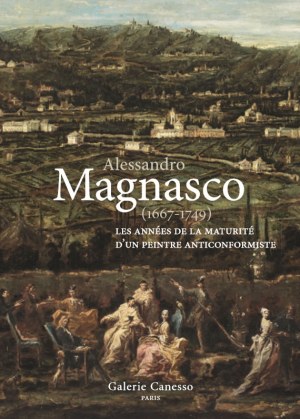 Alessandro Magnasco (1667–1749), les années de la maturité est une exposition centrée sur les plus belles œuvres de la production tardive de ce peintre anticonformiste. L’exposition a le privilège de bénéficier d’un partenariat exceptionnel avec les Musei de Strada Nuova de la ville de Gênes, lieu de naissance de l’artiste. Elle débute à la Galerie Canesso à Paris (du 25 novembre 2015 au 31 janvier 2016) pour faire ensuite étape au Palazzo Bianco de Gênes (du 25 février 2016 au 5 juin 2016).
Artiste à l’œuvre originale et extravagante, Magnasco a été découvert au début du XXe siècle et il est considéré, à certains égards, comme l’un des précurseurs de Goya (1746–1828), des Expressionnistes et l’un des pères du fantastique et du macabre. La fascination de l’artiste pour les atmosphères sombres, la dissolution des formes et un propos moral sévère met en évidence sa dissidence par rapport à la culture figurative contemporaine. Néanmoins, son œuvre riche et variée ne peut se définir par ces seuls caractères. Les réalisations de l’artiste impressionnent, tant du point de vue du langage pictural extrêmement personnel, que de celui des sujets qu’il est le seul à aborder en Europe entre les XVIIe et les XVIIIe siècles. Ses compositions parcourues de petites figures en mouvement nous portent vers l’art de Guardi (1712–1793) et des Vénitiens du Settecento. L’exposition présentera une vingtaine de tableaux, certains à découvrir pour la première fois en France.
Exhibition | Revolution under a King: French Prints, 1789–92
From UCL:
Revolution under a King: French Prints, 1789–92
UCL Art Museum, London, 11 January — 10 June 2016
Curated by David Bindman and Richard Taws
 We are pleased to announce that in January 2016 we’ll be opening the exhibition Revolution under a King: French Prints, 1789–92, featuring a selection of prints from the early, highly volatile years of the French Revolution, curated by Professor David Bindman and Dr Richard Taws, in collaboration between UCL Art Museum and UCL History of Art. It is well known that a chain of key historical events characterised the French Revolution, making it effectively the biggest political media event of its time. These events were communicated extensively throughout Europe in print culture and the combination of image and text, employed extensively in newspapers and graphic works, made for powerful satire and caricature.
It is, however, not always realised that the pivotal moment, the Fall of the Bastille, was in fact followed by three years in which the king of France still nominally presided over the dissolution of the old feudal order. It is this period that is the focus of the exhibition, tracing the early years of the Revolution from the ‘June Days’ of 1789, through the Fall of the Bastille, to the eventual deposition of the Louis XVI in 1792. The exhibition will consist of vivid coloured prints of major events from the period, and a selection of medals, including one made from ‘chains of servitude’ supposedly found in the ruins of the Bastille.
Exhibition | Rise and Fall: The Earl of Mar and the 1715 Jacobite Rising
Press release (9 November 2015) for exhibitions now on view in Edinburgh:
Rise and Fall: The Earl of Mar and the 1715 Jacobite Rising
Calum Colvin: Jacobites by Name
Scottish National Portrait Gallery, Edinburgh, 14 November 2015 — 27 March 2016

Sir Godfrey Kneller, Portrait of John Erskine, 6th Earl of Mar, with His Son Thomas, Lord Erskine (Collection of Earl of Mar & Kellie at Alloa Tower, National Trust for Scotland)
The 300th anniversary of the 1715 Jacobite Rising will be marked by two fascinating new displays at the Scottish National Portrait Gallery this winter. A key player in the rising, John Erskine, 6th Earl of Mar, will be the focus of Rise and Fall, while Calum Colvin, one of Scotland’s leading contemporary artists, will explore the visual imagery and legacy of the Jacobite Risings of 1715 and 1745 in Jacobites by Name.
Responsible for initiating and subsequently ending the Rising, the Earl of Mar (1675–1732) was an extraordinary individual, passionate about both politics and the arts. Born in Alloa, Clackmannanshire, he was a Member of Parliament and later Secretary of State for Scotland, before being deprived of office by the new Hanoverian king, George I, in 1714. Mar raised the standard of rebellion against the Hanoverians, and from September to December 1715 he was effectively ruling Scotland.
The 1715 Rising is a key date in the power struggle between the Protestant Hanoverians and of the exiled Stuarts. It was a major attempt by the Jacobites—the supporters of King James VII (of Scotland) and II (of England) and his heirs—to regain the throne for the Stuart claimant, James Francis Edward Stuart. However victory eluded Mar and he ultimately fled to France with James Stuart in 1716, where he remained until his death in 1732.
At the centre of Rise and Fall will be two large and impressive portraits of the Earl and his wife, Frances Pierrepont (of around 1714), by Sir Godfrey Kneller, the leading portrait painter in England of the time. These imposing paintings usually hang at the National Trust for Scotland property Alloa Tower—the ancestral home of the Earls of Mar and Kellie—and were commissioned by Mar himself. Although he is often defined by his political and military career, Mar was a man of fine taste and an enthusiastic patron of the arts, with a talent for amateur architecture and garden design.
Prints, drawings and miniatures also on show in Rise and Fall bring alive this cataclysmic episode of Scottish history and shed light on the life and interests of the Earl of Mar. Key loans have come from the collection of the current Earl and Mar of Kellie and the National Records of Scotland.

Calum Colvin, Lochaber no More, 2015
The Scottish National Portrait Gallery’s outstanding Jacobite collection has been used to inspire a contemporary intervention which complements Rise and Fall by the renowned Scottish artist Calum Colvin. His Jacobites by Name inventively combines photography with painting and installation. The result includes new works such as Lochaber no More (2015) which links two images of Charles Edward Stuart, commonly known as Bonnie Prince Charlie, the second Jacobite pretender to the throne and instigator of the failed 1745 Jacobite Rising. The first of the images shows Charles as a young man and the other much older.
To make his photographic works, Colvin constructs a set in his studio, using furniture and ornaments, and then paints images on to these three-dimensional objects. When seen through the lens of his camera, a two-dimensional image is formed, a blend of reality and illusion. Lochaber no More is a powerful evocation of the passage of time and the melancholy of lost Jacobite hope, while fragments of burned tartan hint at the tragic outcome of the last rising. In his work, Colvin also alludes to the tradition of secret symbolism and optical illusionism in Jacobite-related art; because support for the exiled Stuarts was dangerous and could lead to accusations of disloyalty to the Crown, ‘secret’ portraits of the Pretenders were to be discovered on folded fans, sewn discreetly onto articles of clothing, or concealed inside the lid of a closed box.
Colvin was born in Glasgow and studied art in Dundee and London, before coming to prominence in the mid-1980s. He has exhibited extensively in Europe and the United States and has worked on commissions for the National Galleries of Scotland.
Christopher Baker, Director of the Scottish National Portrait Gallery said: “The Jacobite struggle remains potent and romantic 300 years after the key events that defined it. These complementary displays connect powerful portraiture of the 18th century with contemporary responses, and remind us in an engaging and inspiring way of a turbulent period in Scottish history. We are especially grateful to the National Trust for Scotland, the Earl of Mar and Kellie and the artist Calum Colvin for their generosity and commitment to the project.”
Calum Colvin commented: “This new body of work investigates the traces of Jacobite material culture, portraiture and visual illusion to be found in Scottish museums up and down the country. I wanted to take a fresh look at this material with a view to re-interpret the matrix of symbols and allusions that they carry and, through a range of different types of contemporary making, bring them into the digital age. The works are contrasted with the existing collection in the Scottish National Portrait Gallery and question the role of this familiar iconography in Scottish national culture.”
About the National Trust for Scotland
One of Scotland’s leading conservation charities, the National Trust for Scotland cares for some of the nation’s most important heritage sites, from grand castles to humble homes and wild coastline. With more than 100 properties packed with paintings, textiles, ceramics, sculpture and fine furniture, the Trust holds Scotland’s biggest collection of in-situ artworks. Amongst its gems include many fine pictures by artists including Raeburn, Batoni and Peploe to name a few. Some of Scotland’s finest contemporary works, including pieces by Ken Currie, Julia Douglas and Julie Roberts, are on currently on display at Drum Castle in Aberdeenshire while Aberdeen Art Gallery undergoes a major refurbishment.
About Alloa Tower
Alloa Tower is the ancestral home of the Erskine family, the Earls of Mar and Kellie. The tower is the largest, oldest keep in Scotland and was originally built to guard the nearby ferry crossing on the River Forth. The Erskines were aides to the Stuart monarchs and guardians to the royal children—Mary, Queen of Scots and James VI both spent part of their early lives at Alloa Tower. It was Mary who granted the earldom to the Erskines in 1565. Since its construction around 1368, Alloa Tower has been altered many times and provides a rich variety of architectural styles and historic collections. Once part of a much larger mansion, with extensive gardens modelled on those of Versailles, among the features within the tower are a sweeping, eighteenth-century Italianate staircase, a medieval oak beamed roof, a dungeon and a well. It also houses collections of important paintings, on loan from the Erskine family, including the two full length portraits by Sir Godfrey Kneller on display here.
In 2015 the fourteenth-century Alloa Tower in Clackmannanshire was acquired by the National Trust for Scotland (NTS), having previously been managed by NTS working in partnership with the Clackmannanshire Heritage Trust, with financial support from Clackmannanshire Council. From 1988, Alloa Tower was restored from a semi-derelict state and first opened to the public in 1996. It is this partnership, and the philanthropic endeavours over many years of the current Earl of Mar and Kellie and his father, that have enabled NTS to secure the tower’s long-term future.
Exhibition | Jean-Étienne Liotard: A Cosmopolitan Artist
Press release (12 November 2015) from the Getty:
Jean-Étienne Liotard: A Cosmopolitan Artist
J. Paul Getty Museum, Los Angeles, 20 October 2015 — 24 April 2016
Curated by Ketty Gottardo

Jean-Étienne Liotard, Portrait of Maria Frederike van Reede-Athlone at Seven Years of Age, 1755–56, pastel on vellum, 54.9 x 44.8 cm (Los Angeles: Getty Museum)
Swiss artist Jean-Étienne Liotard (1702–1789) excelled at the delicate art of pastel. His finest portraits display an astonishing realism achieved through intense observation and remarkable technical skill and feature royalty, aristocrats, and the bourgeoisie. Jean-Étienne Liotard: A Cosmopolitan Artist, comprised of pastels and drawings from the Getty Museum’s collection and two spectacular loans from a private collection, is now open and continues through April 24, 2016, at the Getty Center.
“For most of his very long career, Liotard worked as an itinerant portraitist,” says Timothy Potts, director of the J. Paul Getty Museum. “The works of art in this room testify to the artist’s numerous travels and fame as well as to his astonishing facility in the medium of pastel.”
The remarkable success of pastel in the eighteenth century was due to the high demand for portraits from the nobility and bourgeoisie. The ease and swiftness with which pastel could be used allowed for much shorter sittings that pleased artists and sitters alike. Unlike oil painting, pastel does not need to dry, so drawings could be executed quickly, with changes and corrections easily made. The Portrait of Lord Mountstuart features a young English aristocrat whom Liotard encountered during a brief stay in Geneva in the midst of his Grand Tour to Italy; Mademoiselle Jacquet was a famous singer at the Paris Opera; Jean Tronchin was among Liotard’s cultivated Swiss patrons; and the magnificent Portrait of Baroness Maria Frederike, one of the Getty’s most-beloved treasures, is probably the most famous portrait he executed in Holland.
In his Treatise on Painting (1781), Liotard recommended the use of nine tones—four light, four dark, and one medium—to build up pastel images. Colors were blended with brushes, fingers, a stump, or even his own long beard. Liotard preferred to use vellum—made from calf skin—for his support, which imitated the texture of skin in portraits. “The delicate tone of skin seen in Liotard’s Portrait of Jean Tronchin (1759) is remarkable. Liotard used the texture of the vellum, along with a fine sfumato effect, to define his rich, fleshy, and aged face,” says Ketty Gottardo, associate curator of drawings and curator of the installation.
Liotard innovated a drawing technique that reinforced his compositions with large areas of tone applied to the verso (back), which would create glowing, translucent effects on the recto (front). After drawing the basic outlines of a composition, Liotard would turn over the sheet of paper and hold it against a window or source of light in order to trace it onto the verso with a thin stick of black chalk. Then he would fill in entire areas of the verso with watercolor, chalk, or pastel which served to enhance the colors on the front.
Additional information is available at Iris: The Online Magazine of the Getty.
Exhibition | Art of the Fold: Drawings of Drapery and Costume
Press release (2 September 2015) for the exhibition now on view at the Getty:
Art of the Fold: Drawings of Drapery and Costume
The J. Paul Getty Museum, Los Angeles, 6 October 2015 — 10 January 2016
Curated by Stephanie Schrader
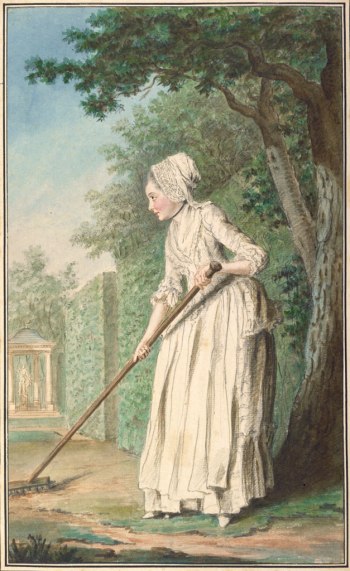
Louis Carrogis de Carmontelle, The Duchess of Chaulnes as a Gardener in an Allée, 1771, watercolor and gouache over black and red chalk (The J. Paul Getty Museum)
Drawn from the J. Paul Getty Museum’s renowned permanent collection, Art of the Fold: Drawings of Drapery and Costume explores how artists harnessed the expressive potential of cloth to convey meaning.
“From the fourteenth to the eighteenth centuries, the convincing depiction of voluminous folds of fabric was a standard part of artistic training and practice,” explains Timothy Potts, director of the J. Paul Getty Museum. “Focusing on the relationship between the body and clothing, artists of this period exploited drapery and costume to enhance the depiction of a figure’s emotional state and place in society. The drawings in this exhibition demonstrate the many ways in which artists employed drapery to evoke moods, shape identities, and tell stories.”
In Standing Female Saint (about 1450), from the Circle of Martin Schongauer, the abstract pattern of drapery folds generates an agitated sense of motion. Rather than outlining the body beneath it, the flowing tunic accentuates an emotional fervor typical of German fifteenth-century devotional imagery.
Drapery also played a crucial part in artists’ characterization of the human figure. In Hans Brosamer’s Study of a Pleated Skirt and Study of a Hanging Drapery (about 1500) the artist accurately depicts the tonal variations and ranges of light and shade created by folded fabric, capturing the natural flow of cloth with a refined linear quality and variegated hatchings. By isolating drapery from a human form, while at the same time making it anthropomorphic, the artist celebrates drapery as an independent subject.
In drawings of soldiers, peasants, nobles, and foreigners, clothing served as a primary indicator of social standing and class. In Jacob Jordaens’ Man Kneeling, Facing Right (about 1630) the artist applied opaque watercolor in thick layers creating angular, broken folds that animate the pose and heighten the sense of piety. Often a figure’s clothing indicates status or rank in the social hierarchy, and the flamboyant uniforms of the mercenary soldiers and the elegant attire of the upper classes convey their status.
In their depictions of costume, artists often departed from strict naturalism and relied upon their vivid imaginations. “Drawings of foreigners suggest how dress is embellished and exoticized, whereas theatrical costumes further illustrate how clothing can mask the identities of individuals represented,” says Stephanie Schrader, curator of drawings at the J. Paul Getty Museum, who organized the exhibition.
A checklist of the 38 works on view is available as a PDF file here.
Exhibition | The Luxury of Time: European Clocks and Watches
From The Met:
The Luxury of Time: European Clocks and Watches
The Metropolitan Museum of Art, New York, 16 November 2015 — 27 March 2016

Clockmaker: Ferdinand Berthoud (French, 1727–1807); Case maker: Balthazar Lieutaud (French, ca. 1720–1780, master 1749). Longcase astronomical regulator (detail), ca. 1768–70. Case: oak veneered with ebony and brass, with gilt-bronze mounts; Dial: white enamel; Movement: gilded brass and steel; Height: 90.5 in. (229.9 cm). The Metropolitan Museum of Art, New York, (1982.60.50).
Time is all around us, displayed on our phones and computers. Today, almost nobody needs to own a watch or a clock to tell the time. Access to the right time is not the luxury it once was. Yet the fascination with clocks and watches persists, and the thriving market for mechanical timekeepers is deeply aware of their history. Clocks and watches have always been about more than just telling time: they have been treasured as objects of desire and wonder, personal items imbued with value that goes beyond pure functionality. As works of art, they represent the marriage of innovation and craftsmanship.
This exhibition explores the relationship between the artistry of the exterior form of European timekeepers and the brilliantly conceived technology that they contain. Drawn from the Museum’s distinguished collection of German, French, English, and Swiss horology from the sixteenth through the nineteenth century, the extraordinary objects on view show how clocks and watches were made into lavish furniture or exquisite jewelry.
The creation of timekeepers required that clockmakers work with cabinetmakers, goldsmiths and silversmiths, enamelers, chasers and gilders, engravers, and even those working in sculpture and porcelain. These craftsmen were tasked with accommodating internal mechanisms by producing cases that, in both shape and function, adapted to timekeeping technologies. Their exteriors are often as complicated as the movements they house. Examining the dialogue between inside and out, adornment and ingenuity, The Luxury of Time
reveals the complex evolution of European clockmaking and
the central place of timekeepers in the history of decorative arts.
◊ ◊ ◊ ◊ ◊
The catalogue is scheduled for publication in February. From Yale UP:
Clare Vincent and Jan Hendrik Leopold, with Elizabeth Sullivan, European Clocks and Watches in The Metropolitan Museum of Art (New York: The Metropolitan Museum of Art, 2016), 288 pages, ISBN: 978-1588395795, $65.
 Among the world’s great technological and imaginative achievements is the invention and development of the timepiece. Examining for the first time the Metropolitan Museum’s unparalleled collection of European clocks and watches created from the early middle ages through the 19th century, this fascinating book enriches our understanding of the origins and evolution of these ingenious works. It showcases 54 extraordinary clocks, watches, and other timekeeping devices, each represented with an in-depth description and new photography showing the exterior as well as the inner mechanisms. Included are an ornate celestial timepiece that accurately predicts the trajectory of the sun, moon, and stars and a longcase clock by David Roentgen that shows the time in the ten most important cities of the day. These works, created by clockmakers, scientists, and artists in England, Germany, France, Italy, and the Netherlands, have been selected for their artistic beauty and design excellence, as well as for their sophisticated and awe-inspiring mechanics. Built upon decades of expert research, this publication is a long-overdue survey of these stunning visual and technological marvels.
Clare Vincent is associate curator, European Sculpture and Decorative Arts, The Metropolitan Museum of Art. J. H. Leopold was former assistant keeper in charge of the horological collections at The British Museum. Elizabeth Sullivan is research associate, European Sculpture and Decorative Arts, The Metropolitan Museum of Art.










leave a comment