Exhibition | Drawn from Courtly India
Press release (6 November 2015) from the Philadelphia Museum of Art:
Drawn from Courtly India: The Conley Harris and Howard Truelove Collection
Philadelphia Museum of Art, 6 December 2015 — 27 March 2016
Curated by Ainsley Cameron
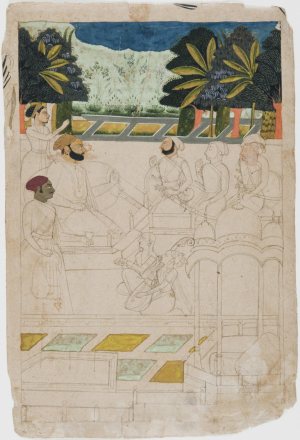
A Prince and Courtiers in a Garden, ca. 1720–30, with later additions, India (Jodhpur or Bikaner, Rajasthan) (Philadelphia Museum of Art, 2013-77-31).
The Philadelphia Museum of Art presents an exhibition of rare and masterful drawings created in the workshops of royal Indian courts over the course of four centuries. Drawn from Courtly India: The Conley Harris and Howard Truelove Collection features a wide range of sketches, preparatory studies, and compositional drawings that vividly depict mythological themes, verdant landscapes and architectural settings, portraits of prominent rulers, and scenes from the lives of Indian nobility. The Museum acquired these important works in 2013, many as a gift, and is presenting the collection in this exhibition for the first time.
While Indian paintings have long been sought after by museums and individual collectors, there has been only a limited interest in drawings. Yet drawings may be wonderful works of art in their own right, yielding a remarkable amount of information about workshop practices and artistic process. Conley Harris, a landscape painter, and the late Howard Truelove, an architectural designer, shared a passion for drawing. They began collecting Indian drawings after being inspired by their travels throughout that country. The collection they assembled over the course of more than a decade provides new insights into the artistic practices of the royal workshops that developed over generations, and offers fresh perspectives on Indian painting. Many of the works to which these collectors were drawn were created during the eighteenth century in the Hindu courts of western India and the Himalayan foothills, an area including the present-day states of Rajasthan, Himachal Pradesh and Jammu-Kashmir.
Timothy Rub, the George D. Widener Director and CEO, stated: “The ongoing development of the Museum’s collection has always represented our partnership with great collectors who have been as passionate as we are about sharing with everyone the finest works of art. In this regard we are especially fortunate to have acquired the marvelous collection assembled by Conley Harris and Howard Truelove, and we are enormously grateful to the collectors. This collection adds a new and important dimension to our holdings of Indian art, which is one of the most important in the country. It also enables us to bring to a broader audience this fascinating and delightful aspect of South Asia’s artistic heritage.”
The first section of the exhibition will feature a group of finished drawings and explore the relationship between court artists and their royal patrons. A second will focus on the innovative workshop process, examining how artists developed and revised drawings through techniques such as white wash corrections, color notations, and pouncing. The drawings in this section will highlight not only the artists’ adept handling of the medium, they will also testify to the collaboration of artists employed within a hierarchical workshop structure, demonstrating how skills were conveyed from master to apprentice. A third section, dedicated to the key moment when brush first meets paper, calls attention to the expressive power of the expert brushstroke. The fourth and final section of the exhibition invites visitors to respond to the works on display by creating their own drawings using workshop techniques.
The exhibition is organized by Ainsley M. Cameron, the Museum’s Ira Brind and Stacey Spector Assistant Curator of South Asian Art. She stated: “These works offer new ways of looking and thinking about Indian courtly drawing. People tend to approach the study of paintings or drawings from the perspective of the patron because so many of the artists’ names are unknown, but we are exploring the perspective of the artist, as maker—the gesture of an artist’s hand, the spontaneity of line, and the process through which ideas are born.”
About Conley Harris and Howard Truelove
Based in Boston, artist Conley Harris (born 1945) is a former faculty member of the department of art and art history at the University of New Hampshire. Harris is known for his lyrical landscapes of New England and the American West. Howard Truelove (1946–2012) was an architectural designer and vice president of design at the firm KlingStubbins in Cambridge, Massachusetts. His interior-design work ranged from public spaces in major office buildings to universities and museums. Harris often uses works in their collection as a source of inspiration, creating paintings that not only absorb motifs from South Asian and Persian miniature paintings, but also play with the idea of multiple layers, the palimpsest found in artists’ working sketches and so creatively reinterpreting the historical drawings for a new generation.
◊ ◊ ◊ ◊ ◊
The catalogue is distributed by Yale UP:
Ainsley Cameron, with an essay by Darielle Mason, Drawn from Courtly India: The Conley Harris and Howard Truelove Collection (Philadelphia: Philadelphia Museum of Art, 2015), 160 pages, ISBN: 978-0300215250, $35.
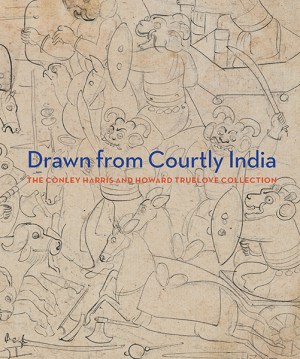 This publication presents the first in-depth survey of the Conley Harris and Howard Truelove Collection of Indian Drawings, which was recently acquired by the Philadelphia Museum of Art. This exceptional collection consists of 65 works on paper created between the 16th and 19th centuries. The Harris-Truelove Collection is uniquely and tightly focused on works from the royal courts of North India, and the majority of these drawings served as preparatory material for the opaque watercolor illustrations that have been widely collected and studied. This catalogue celebrates the assured line of the Indian draftsman and recognizes these drawings as accomplished works of art in their own right. The text details the process and technique involved in their production, and explores what can be revealed by the artist’s hand. The catalogue also contextualizes the role of art production in court culture, and reveals the intricacies of artistic workshop practice.
Ainsley Cameron is the Ira Brind and Stacey Spector Assistant Curator of South Asian Art, and Darielle Mason is the Stella Kramrisch Curator of Indian and Himalayan Art, both at the Philadelphia Museum of Art.
Exhibition | Exotic Creatures

Clara, the Rhinoceros, bronze, second half of the eighteenth century
(London: V&A, A.528-1910)
◊ ◊ ◊ ◊ ◊
Press release (19 August 2015) for the Royal Pavilion exhibition:
Exotic Creatures
Royal Pavilion, Brighton, 14 November 2015 — 28 February 2016
Curated by Alexandra Loske
A new exhibition at the Royal Pavilion, Brighton will explore how animals considered exotic by the Georgians and early Victorians were depicted, kept and presented. Exotic Creatures will look at animals owned by the Royal Family and in menageries and early zoos, as well as the ‘political beasts’ of the period (c.1740–1850). A painting of liger cubs (a cross between a tiger and a lion) born at Windsor in 1824, and presented to Royal Pavilion creator George IV shortly after, will be displayed to the public for the first time. Another rarely-seen painting will tell the story of the UK’s first living giraffe, given to George IV as a diplomatic gift by the Pasha of Egypt in 1826. Other works on show will include satirical prints, original menagerie bills, sculptural and ceramic pieces and paintings and archival material. The exhibition will take a hands-on, playful approach suitable for all the family, and a children’s Royal Pavilion Creature Trail will be available to buy at the admission desk.
The exhibition will be organised around four main themes:
Royal Menageries
George IV, himself considered exotic and unpredictable by many, kept a significant collection of exotic animals in his private menagerie at Windsor Great Park—continuing a tradition dating back to the keeping of lions at the Tower of London Menagerie in the early 13th century. The exhibition will tell the stories of individual exotic animals and explain the transition to public menageries, the establishment of the Zoological Society of London in 1826, and the opening of its Gardens—later known as London Zoo—in 1828.
Public and Travelling Menageries and Early Zoos
Many of the exhibits will have a strong connection with Brighton, whose residents enjoyed regular visits from travelling menageries and animal performances in the Royal Pavilion grounds. A permanent zoological gardens was proposed on the site now occupied by Park Crescent, where lions still top the gateposts of the southern garden wall.The late Georgian period saw a change in attitudes to how and why exotic animals where kept, and in the late 1820s the Zoological Society of London, devoted to scientific research, was founded. This led to the establishment of what is now London Zoo.

Jacques-Laurent Agasse, Nubian Giraffe, ca. 1827, (Royal Collection Trust / Her Majesty Queen Elizabeth II)
Royal Beasts
George’s mother Queen Charlotte kept a zebra in the 1760s and ordered a rhino for her children’s amusement, while George IV gave ostriches as presents to mistresses and kept kangaroos at Windsor Great Park. He also received the first living giraffe on British soil as a diplomatic gift. The young female arrived in August 1827 after a long and strenuous journey from Africa, by which time neither she nor George were in a good state of health. Cartoonists mercilessly poked fun at both, but the portrait by Swiss artist Jacques-Laurent Agasse is more sympathetic, depicting the giraffe in great detail with her keepers in Windsor Great Park. Although two Egyptian cows were drafted in as wet nurses, she struggled and died less than two years later.
Political Beasts
Animals were a popular device for mocking politicians and royals in Georgian satire and caricatures, as depicted in Brighton Museum and the Royal Pavilion’s collections.
The exhibition will demonstrate how the arrival of exotic animals influenced fashion and the decorative arts in Britain, with giraffe-patterned wallpaper, teapots and fabrics becoming hugely popular in the late 1820s. It will also address the challenges of creating anatomically correct images of non-native animals in the Georgian era, and the period’s simultaneous passions for scientific research and the use (and abuse) of animals in entertainment. As well as caricatures and striking Staffordshire figures from Brighton Museum & Art Gallery’s own collection, curator Alexandra Loske has sourced significant loans from the Victoria & Albert Museum, the British Museum, Royal Collection Trust and private collections.
Loske said: “We’re thrilled to have secured the loan of one of the most popular and beautiful animal paintings in British art, a portrait of George IV’s giraffe—commissioned by the king himself and still in the Royal Collection. Another highlight will be the V&A’s exquisite bronze statue of a rhino named Clara, which toured Europe in the 1740s and 1750s—of which only four survive. We’re also very proud to be displaying a painting of liger cubs, attributed to Richard Barrett Davis. The cubs were born in Windsor in 1824 and presented to George IV, and were painted by leading animal painters including Agasse. The painting in our exhibition was recently bought by a local collector and supporter of the Royal Pavilion Foundation, and will be displayed to the public for the very first time.”
Exhibition | Pierre-Jean Mariette and the Art of Collecting Drawings
Opening next month at The Morgan:
Pierre-Jean Mariette and the Art of Collecting Drawings
The Morgan Library and Museum, New York, 22 January — 1 May 2016

Girolamo Francesco Maria Mazzola, called Il Parmigianino, Man Standing Beside a Plinth on which He Rests a Book, and a Study of Saint Luke, ca. 1530, Pen and brown ink, brown wash, on paper. Purchased by Pierpont Morgan in 1909 (The Morgan Library & Museum)
Pierre-Jean Mariette (1694–1774) was one of the earliest and most important collectors of drawings, and he played a pivotal role in shaping our modern conception of the artists who created them. The exhibition—the first ever devoted to the collector at a U.S. museum—will highlight the peculiar ways in which Mariette organized and presented his holdings.
In order to enhance the appearance of the drawings and to improve their legibility, Mariette often restored (completing, cleaning, and even dismembering) his sheets. He cut them, integrated them with additions, completed and assembled together fragmentary sheets, and sometimes split double-sided drawings using his extraordinary ability as a paper restorer. Moreover, Mariette provided his drawings with elaborate frame-like blue mounts, which are still highly prized by collectors. Drawings featured in this show include works from the Morgan’s collection as well as sheets from the Metropolitan Museum of Art and the Princeton University Art Museum. Among the artists represented are such masters as Parmigianino (1503–1540), Annibale Carracci (1560–1609), and Guercino (1591–1666).
This exhibition is a program of the Drawing Institute at the Morgan Library & Museum. Additional support is provided by Lowell Libson, Ltd.
Exhibition| Wordplay: Matthias Buchinger’s Drawings
Press release (19 November 2015) from The Met:
Wordplay: Matthias Buchinger’s Drawings from the Collection of Ricky Jay
The Metropolitan Museum of Art, New York, 5 January — 11 April 2016
Curated by Freyda Spira with Femke Speelberg and Jennifer Farrell

Approximately 22 drawings by the 18th-century German artist Matthias Buchinger (1674–1739), who was born without hands or feet, will be presented in Wordplay: Matthias Buchinger’s Drawings from the Collection of Ricky Jay, opening on January 5, 2016. Despite his disabilities, Buchinger was celebrated in his own time as a draftsman and calligrapher as well as a magician and musician, and poems were written in Europe about his many talents and achievements. Known as ‘the Little Man of Nuremberg’, because he was only 29 inches tall, Buchinger was said to have performed for German emperors, European princes, and for King George I of England. He was also a frequent guest at noble houses in England and Ireland, and performed at local fairs and inns from Amsterdam and Stockholm to Leipzig and Paris.
The Metropolitan Museum’s two drawings by Buchinger will be displayed alongside some 20 works from the collection of Ricky Jay, the celebrated illusionist, actor, and author. Framing Buchinger’s stupendous works, which were composed largely through calligraphy and micrography (employing minuscule script to create abstract shapes or figurative designs), will be works from the Metropolitan Museum’s collection that will demonstrate text as image. These additional works will include late medieval manuscripts, Renaissance typographical prints, 17th-century writing books, and contemporary works on paper.
Wordplay: Matthias Buchinger’s Drawings from the Collection of Ricky Jay is organized by Freyda Spira, Associate Curator with Femke Speelberg and Jennifer Farrell, also Associate Curators, of the Metropolitan Museum’s Department of Drawings and Prints.
The New York Times architecture critic Michael Kimmelman and Ricky Jay will discuss Matthias Buchinger in a ‘MetSpeaks’ ticketed talk on January 21, 2016.
◊ ◊ ◊ ◊ ◊
The accompanying publication is due out next March from Siglio:
Ricky Jay, Matthias Buchinger: The Greatest German Living (New York: Siglio Press, 2016), 160 pages, ISBN: 978-1938221125, $40.
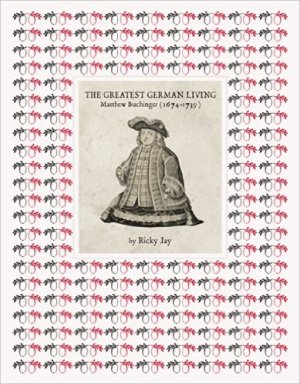 Matthias Buchinger (1674–1739) performed on more than a half-dozen musical instruments, some of his own invention. He exhibited trick shots with pistols, swords and bowling. He danced the hornpipe and deceived audiences with his skill in magic. He was a remarkable calligrapher specializing in micrography—precise handsome letters almost impossible to view with the naked eye—and he drew portraits, coats of arms, landscapes and family trees, many commissioned by royalty. Amazingly, Matthias Buchinger was just twenty-nine inches tall, and born without legs or arms. He lived to the ripe old age of sixty-five, survived three wives, wed a fourth, and fathered fourteen children.
Accompanying the Metropolitan Museum of Art exhibition Wordplay: Matthias Buchinger’s Inventive Drawings from the Collection of Ricky Jay, this book is a cabinet containing a single, multi-faceted wonder, refracted through acclaimed sleight-of-hand master Ricky Jay’s scholarship and storytelling. Alongside an unprecedented and sumptuously reproduced selection of Buchinger’s marvelous drawings and etchings, Jay delves into the history and mythology of the ‘Little Man’, while also chronicling his encounters with the many fascinating characters he meets in his passionate search for Buchinger.
Ricky Jay, one of the world’s great sleight-of-hand artists, has received accolades as a performer, actor, and author. He was recently profiled on the series American Masters and is the subject of the film Deceptive Practice: The Mysteries and Mentors of Ricky Jay. Jay has written frequently on unusual entertainments, and his Learned Pigs & Fireproof Women and Jay’s Journal of Anomalies were both New York Times ‘Notable Books of the Year’. The former curator of the Mulholland Library of Conjuring and the Allied Arts, he has defined the terms of his profession for the Encyclopedia Britannica and the Cambridge Guide to American Theater.
Exhibition | Drawing Versailles: Charles Le Brun
Summary of the exhibition now on view at the Caixa Forum in Barcelona (with thanks to Tobias Locker for noting it) . . .
Drawing Versailles: Studies and Cartoons of Charles Le Brun
Caixa Forum, Barcelona, 18 November 2015 to 14 February 2016
Curated by Bénédicte Gady
In 1682, Louis XIV transferred the French court to Versailles. The artist Charles Le Brun (1619–1690) was responsible for planning this work, to which he applied an ‘orchestral’ treatment, which involved the participation of hundreds of artisans and artists, the best from each discipline. Le Brun personally produced several pieces, including two particularly impressive compositions: the Staircase of the Ambassadors and the Hall of Mirrors, adorned by a series of mature paintings imbued with the most captivating beauty.
A little-known body of original material is conserved from this undertaking: the preparatory cartoons, which illustrate the final phase in the artist’s working process. The cartoons demonstrate Le Brun’s virtuosity as a draftsman, his talent for constructing scenes and his painstaking care, down to the last detail. The drawings include studies of characters, allegorical figures, trophies and animals that formed part of the artist’s compositions, conceived as a great symbolic jigsaw puzzle. Such cartoons were commonly used between the sixteenth and nineteenth centuries, but few have reached our days. Those produced by Le Brun are the exception: three hundred and fifty cartoons in a store of three thousand drawings found at the artist’s studio, requisitioned and added to the royal collections after his death in 1690.
The Staircase of the Ambassadors
Le Brun’s drawings provide a vision of the decoration, now lost, from the Staircase of the Ambassadors, featuring figures on the same scale, enriched with all the gravity and dramatic quality of drawing in black pencil. This staircase, which led up to the grand apartments of the king and queen, was the first space that represented the power of the monarch at Versailles. Designed in around 1671 and decorated between 1674 and 1679, the staircase was destroyed in 1752, during the reign of Louis XIV. In it, Le Brun made exceptional use of a narrow space that only received overhead lighting. Using optical illusion, he increased the sensation of space, mixing fact and fiction to create an allegorical composition that depicted the return of Louis XIV after one of his military victories. Le Brun surrounded the king by representatives from nations in the four continents, the kings of Antiquity, victories, cupids and the arts: a monumental composition to the honour and glory of the absolute monarch. The cartoons reveal that Le Brun worked on the Staircase of the Ambassadors to the last minute, retouching and improving his drawings.
The Hall of Mirrors
The paintings in the Hall of Mirrors enable us to follow, step by step, the artist’s working process, from the first small sketches, their pencil strokes embodying powerful movement, to the final drawings, which are the same size as the paintings themselves. Also conserved are the engraved copies of the overall work, produced for the purpose of making this artistic accomplishment known beyond French borders, adding to the monarch’s fame. In European painting, the figure of the king was traditionally represented by a mythological figure: Apollo, Hercules and so on. Le Brun, however, portrays the king himself, leading his armies to victory, wearing an ancient breastplate and a modern wig, in a dialogue with the gods and allegories. Two of the most important scenes on the ceiling are represented: the king’s decision to rule alone, and the war with Holland. One of the most famous episodes in this war, The Crossing of the Rhine in 1672, is shown through cartoons exactly as they were found in Le Brun’s studio.
From the Louvre Museum to CaixaForum
Over the past few years, the Graphic Arts Department of the Louvre Museum has carefully restored these drawings, enabling us to see them now for the first time in all their original splendour. The exhibition Drawing Versailles: Studies and Cartoons of Charles Le Brun (Dibuixar Versalles / Dibujar Versalles: Charles Le Brun) is the fruit of a strategic agreement between the Louvre Museum and ”la Caixa” Foundation. The purpose of this agreement is to bring to public attention artists, collections and periods in art history that are not represented in our galleries but which occupy eminent positions in the Louvre’s exhibition discourse: Mesopotamian culture, Coptic art, Pharaonic bestiary, women in Ancient Rome, the work of Eugène Delacroix, etc.
Dibujar Versalles: Bocetos y Cartones de Charles Le Brun (Barcelona: Fundació Ciaixa de Pensions, 2015), ISBN 978-8499001425, 232 pages, 35€.
The full press release is available here»

Charles Simonneau, Ceiling of the Great Staircase at Versailles, etching and burin, 38.7 x 70.5 cm. Chalcographic copper plate printing (RMN-Grand Palais, Musée du Louvre).
Exhibition | Neapolitan Crèche at the Art Institute of Chicago

Neapolitan Crèche, mid-eighteenth century
(Art Institute of Chicago)
◊ ◊ ◊ ◊ ◊
From the AIC:
Neapolitan Crèche
Art Institute of Chicago, 20 November 2015 — 3 January 2016
After its widely popular debut in 2013, our spectacular eighteenth-century Neapolitan crèche returns once again this holiday season. One of the very few and finest examples of such a work outside of Naples, the crèche is an intricate Nativity scene that reflects the vitality and artisanship that the city is still known for. The Art Institute’s crèche features over 200 figures—including no less than 50 animals and 41 items of food and drink—all staged in a spectacular Baroque cabinet with a painted backdrop. Elaborate, complex, and wondrous, the Neapolitan creche is a rare example of the genre and a once-in-a-lifetime acquisition for the Art Institute.
 Sacred imagery reenacting the Nativity has its roots in fourth-century Rome but by the thirteenth and fourteenth centuries—in part due to its association with St. Francis of Assisi—such scenes had become a permanent feature of Neapolitan churches. During the eighteenth century, the period from which most of the figures of the Art Institute’s crèche date, these relatively simple tableaux underwent a transformation into highly dramatic and theatrical renderings. Traditional sacred elements of Nativity scenes—the Holy Family, wise men, angels, and shepherds—were combined with profane aspects not of Bethlehem but of contemporary Neapolitan life—rowdy tavern scenes and bustling street activities—in dazzling displays of artistic techniques. Churches, wealthy citizens, members of the nobility, and the royal family all competed to commission the most complex presentations of this popular art form from leading artists and artisans, the same people who were creating monumental sculptures and altars for churches and palaces. These artists rendered figures in oil-painted terracotta to achieve the most realistic expressions in crèches and constructed painstakingly detailed costumes of luxurious fabrics that mimicked the fashions of the time. The Art Institute’s crèche represents the pinnacle of this artistic practice, born of the centuries-old tradition of Nativity scenes yet bursting with the energy of eighteenth-century Neapolitan life.
Sponsors
The Art Institute of Chicago is grateful to the following individuals for their generous support of the Neapolitan crèche: The Nativity and Three Wise Men and Their Courts and Treasures sponsored by Mr. and Mrs. James N. Bay; The Heavenly Host sponsored by Linda and Vincent Buonanno and Family in memory of Vincent Buonanno Jr.; The Taverna sponsored by the Eloise W. Martin Legacy Fund; and La Georgiana and Her Companions sponsored by Mrs. Robert O. Levitt.
Kyle MacMillan reported on the acquisition of the crèche for The Wall Street Journal (29 November 2013).
Exhibition | Schalcken: Painted Seduction
Press release for the exhibition now on view at the Wallraf-Richartz Museum:
Schalcken: Gemalte Verführung / Painted Seduction
Wallraf-Richartz-Museum & Fondation Corboud, Cologne, 25 September 2015 — 24 January 2016

Godefridus Schalcken, Self-Portrait, 1694 (Leamington Spa Art Gallery and Museum)
A lady looking into a mirror in the soft candlelight, proud, a little pert perhaps, but certainly enigmatic. Few artists have matched the ability of Godefridus Schalcken (1643–1706) to capture such magical moments on canvas so powerfully that they still compel attention three centuries later. In autumn 2015 the Wallraf-Richartz-Museum & Fondation Courboud launched in cooperation with the Dordrechts Museum the first-ever exhibition to survey Schalcken’s oeuvre as a whole, inviting a reassessment of this unique painter and seducing visitors to have a detailed look at the charming and enchanting art of Schalcken. More than eighty loans from public and private collections worldwide are on show, a third of his known painted oeuvre. Lenders include the Leiden Collection, New York, The Rose-Marie and Eijk van Otterloo Collection, Naples, Uffizi Florence, Rijksmuseum Amsterdam, Mauritshuis The Hague, National Gallery London, Národní galerie in Prague, Statens Museum Copenhagen, National Gallery of Scotland, Edinburgh, National Gallery of Ireland, Dublin, Ashmolaen Museum, Oxford, Städel Museum, Frankfurt, Hamburger Kunsthalle, Gemäldegalerie Dresden, Staatliche Kunsthalle Karlsruhe and Gemäldegalerie Alte Meister Kassel.
Schalcken will not have seemed predestined for an artistic career when he was born in 1643 into a family headed by a Protestant pastor. At the age of nineteen, following an apprenticeship with Samuel van Hoogstraten, a pupil of Rembrandt, he entered the workshop of Gerrit Dou, the celebrated founder of the school of artists known as the Leiden ‘fine’ painters. Dordrecht, London, The Hague and Dusseldorf were further stages in his impressive career. Despite the political and economic turmoils and an ailing art market: Schalcken established himself as a “self-branded artist”. His paintings fetched top prices and entered the most illustrious collections. Royal clients, such as Florence’s Grand Duke Cosimo III de’ Medici and Elector Palatine Johann Wilhelm in Dusseldorf, helped Schalcken to international fame.
As a master of light, especially candlelight, Schalcken entered the canon of art history and was lauded by art lovers—including even Johann Wolfgang von Goethe. First with the changes in taste that came in the nineteenth century did the ‘typically Dutch’, bourgeois art by painters like Vermeer, Rembrandt and Frans Hals gain in preference. Schalcken’s elegantly painted aristocratic gems languished in obscurity. With the consequence that the artist ranks today among the great unknowns of the Golden Age of Netherlandish painting.
Here in the first ever exhibition of his work, we are invited to set out on a journey of rediscovery. With rarely shown masterpieces, including many works from private collections, it opens up the painter’s rich world of imagery. A world that captivates by its wide range of genres and subjects, its tromp-l’oeil illusionism, and the gallant conversations that Schalcken invites us viewer to join.
The exhibition catalogue, with essays and extensive entries by Guido M.C. Jansen, Wayne Franits, Anja K. Sevcik, Nicole Elizabeth Cook, Eddy Schavemaker, Sander Paarlberg and Marcus Dekiert aims to update the meritorious catalogue raisonée by Thierry Beherman of 1988.
Wayne Franits, et al., Schalcken: Gemalte Verführung (Stuttgart: Belser Verlag, 2015), 312 pages, ISBN: 9783763027217, $88.
Exhibition | Pearls on a String
Press release (24 July 2015) for the exhibition now on view at The Walters:
Pearls on a String: Artists, Patrons, and Poets at the Great Islamic Courts
The Walters Art Museum, Baltimore, 8 November 2015 — 31 January 2016
Asian Art Museum, San Francisco, 25 February — 8 May 2016
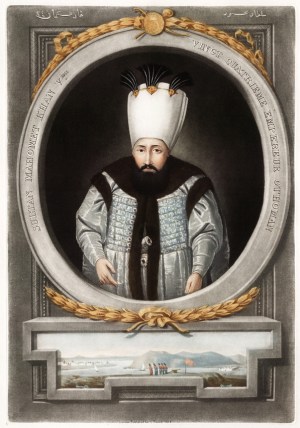
Portrait of Ottoman Sultan Mahmud I, 1815 (Baltimore: The Walters Art Museum)
The great Mughal, Safavid, and Ottoman empires flourished during a time of rapid change and artistic innovation in the Islamic world, as people, ideas, and technologies spread across Europe and Asia. At the heart of the empires’ courts were networks of individuals—writers, poets, artists, craftsmen— who produced extraordinary works of art for the ruling elite. From November 8, 2015, through January 31, 2016, the Walters Art Museum will present Pearls on a String: Artists, Patrons, and Poets at the Great Islamic Courts, the first major exhibition to focus on these influential and often charismatic individuals. The free exhibition features more than 120 works including paintings, calligraphy, textiles, ceramics, and jeweled luxury objects. Dating from the 16th to the 18th century, these exquisite works of art were created in historic India, Iran, and Turkey, a vast geographic area that extends from the Bay of Bengal to the Mediterranean Sea.
“Pearls on a String seeks to broaden public engagement with the cultural histories of Muslim societies by demonstrating how human imagination and collaboration can ignite extraordinary artistic creativity,” said Amy Landau, curator of the exhibition.
Three Vignettes
Pearls on a String is organized in a series of vignettes that spotlight a 16th-century writer, a 17th-century artist, and an 18th-century patron. Through poignant quotes, startling juxtapositions of artwork, and subtle references to the protagonists’ architectural surroundings, the exhibition will offer a rare glimpse into their worlds. The individuals also inform the exhibition’s poetic title: viewed independently, each is a gleaming ‘pearl’, yet collectively they constitute an even more vibrant ‘string of pearls’.
• Writer Abu’l Fazl (1551–1602): A prolific writer, visionary historian and intimate at the court of the third Mughal emperor Akbar in India, he was the most powerful voice in defining Akbar’s policies of political inclusion in the context of a demographically diverse empire.
• Painter Muhammad Zaman (c. 1650–1700): At the court of Safavid ruler Shah Sulayman, this imperial artist radically changed the course of Persian painting by introducing farangi-sazi, a European style, into the Persian tradition.
• Patron Sultan Mahmud I (1696–1754): An Ottoman ruler and active patron of the arts and architecture, this once-forgotten sultan commissioned fanciful jeweled objects as well as lavish libraries and mosques that define Istanbul’s skyline to this day.
“The Walters’ initiative to organize its first international loan exhibition dedicated to Islamic art springs from the quality of the museum’s collection, its intellectual resources and its dedication to providing free access,” said Julia Marciari-Alexander, the Andrea B. and John H. Laporte Director of the Walters Art Museum.
Loans and Support
Loans from national and international institutions include the Victoria and Albert Museum, London; the British Library, London; the Aga Khan Museum, Toronto; the Metropolitan Museum of Art, New York; and the National Gallery of Art, Washington, D.C. Approximately a third of the works are from the collection of the Walters Art Museum, which has one of the most comprehensive collections of Islamic art in North America. The exhibition was organized by the Walters Art Museum in partnership with the Asian Art Museum, and will be on view at the Asian Art Museum in San Francisco February 25 through May 8, 2016.
Pearls on a String has been generously supported by the National Endowment for the Humanities: Celebrating Fifty Years of Excellence; the Institute of Museum and Library Services; the National Endowment for the Arts; the Gary Vikan Exhibition Endowment Fund; Ellen and Edward Bernard; Douglas and Tsognie Hamilton; the Herb Silverman Fund; the Maryland Humanities Council and several anonymous donors.
◊ ◊ ◊ ◊ ◊
The catalogue is distributed by the University of Washington Press:
Amy Landau, ed., Pearls on a String: Artists, Patrons, and Poets at the Great Islamic Courts (Baltimore: Walters Art Museum, 2015), 256 pages, ISBN: 978-0295995243, $60.
 Pearls on a String presents the arts of historical Islamic cultures by focusing on specific people and relationships among cultural tastemakers, especially painters, calligraphers, poets, and their patrons. Through a series of chapters, the book spotlights certain historical moments from across the Islamic world. Each chapter pivots around patrons and their social networks. These independent sections allow different voices and perspectives to emerge, enabling the reader to see that Islamic societies are not monolithic but made up of a tapestry of individuals with distinct and varying views. Pearls on a String pays particular attention to individuals from different sectors of society, giving voice to anonymous artists and translators, merchants, and women of the harem. Islamic historical sources reinforce the book’s themes of writing in Islamic societies, artistic patronage, biographical traditions, and human connectivity.
Amy Landau is associate curator of Islamic and South Asian Art at the Walters Art Museum, Baltimore. Contributors include Paul Losensky, Sussan Babaie, Avinoam Shalem, Glaire Anderson, Mariam Rosser-Owen, Persis Berlekamp, Vivienne Lo, Wang Yidan, Willem Flinterman, Jo Van Steenbergen, David Roxburgh, Qamar Adamjee, Audrey Truschke, Bora Keskiner, Unver Rustem, and Tim Stanley.
Exhibition | Artist and Empire: Facing Britain’s Imperial Past
Opening this week at Tate Britain:
Artist and Empire: Facing Britain’s Imperial Past
Tate Britain, London, 25 November 2015 — 10 April 2016
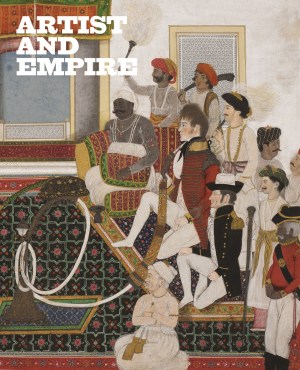 This autumn Tate Britain presents a major exhibition of art associated with the British Empire from the 16th century to the present day. In 21st-century Britain, ‘empire’ is highly provocative. Its histories of war, conquest and slavery are difficult and painful to address but its legacy is everywhere and affects us all. Artist and Empire will bring together extraordinary and unexpected works to explore how artists from Britain and around the world have responded to the dramas, tragedies and experiences of the Empire. Featuring a vast array of objects from collections across Britain, including maps, flags, paintings, photographs, sculptures and artefacts, the exhibition examines how the histories of the British Empire have shaped art past and present. Contemporary works within the exhibition suggest that the ramifications of the Empire are far from over. The show raises questions about ownership, authorship and how the value and meanings of these diverse objects have changed through history, it also asks what they still mean to us today.
Historic works by artists such as Joshua Reynolds and George Stubbs are shown with objects including Indian miniatures and Maori artefacts, as well as contemporary works by Hew Locke and Sonia Boyce. Through this variety of artworks from a complex mix of traditions, locations and cultures the fragmented history of the Empire can be told.
Alison Smith, David Blayney Brown, Carol Jacobi, Artist and Empire: Facing Britain’s Imperial Past (London: Tate, 2015), 240 pages, ISBN: 978-1849763431, $65.
◊ ◊ ◊ ◊ ◊
From Tate Britain:
Artist and Empire: New Dynamics, 1790 to the Present Day
Tate Britain, London, 24–26 November 2015
Tate Britain’s major conference, held in collaboration with Birkbeck, University of London and culture at King’s College London, marks the opening of the exhibition Artist and Empire. Scholars, curators and artists from around Britain and the world consider art created under the conditions of the British Empire, its aftermath, and its future in museum and gallery displays.
Scholarship of art associated with the British Empire has expanded over the last two decades, across a huge span of disciplines and locations. This conference takes the historic opportunity of the exhibition, featuring diverse artists from the sixteenth century to the present day, to bring together people to meet and share the latest research being developed around this subject. The papers, roundtables and audience discussions will consider the cosmopolitan character of objects and images, and the way geographical, cultural and chronological dislocations have in many instances obscured, changed or suppressed their history, significance and aesthetics. We will also explore how approaches to contemporary art, archives, curation and collecting can help develop new ways to look at them now.
T U E S D A Y , 2 6 N O V E M B E R 2 0 1 5
18.00 Opening Conversation
Introduction by Nicholas Serota, Director, Tate
Frank Bowling OBE, Artist and Writer, with Zoe Whitley, Curator, International Art, Tate Modern
W E D N E S D A Y , 2 5 N O V E M B E R 2 0 1 5
9.00 Registration and refreshments
9.30 Introduction
9.40 Panel 1 | Displaced Practices: Artists and Exchanges
Chaired by Felix Driver, Professor of Human Geography at Royal Holloway
• Michael Rosenthal (Emeritus Professor of Art History at the University of Warwick), Augustus Earle: Seeing Straight
• Geoff Quilley (Professor of Art History at the University of Sussex), Inside Empire Looking Out: The View from Dent’s Veranda
• Partha Mitter (Emeritus Professor of Art History at the University of Sussex), Art Education in India
11.20 Refreshment break
11.40 Panel 2 | Moving Objects: Collecting, Archives, Display
Chaired by John Mack, Professor of World Art Studies at the University of East Anglia and Chairman of the Sainsbury Institute for Art
• Alison Inglis (Associate Professor in Art History at the University of Melbourne), Collecting and Displaying British Art in the Australian Colony
• Zachary Kingdon (Curator of the African Collections at the World Museum in Liverpool), Unofficial Exchanges: Investigating West Africans’ Gifts to UK Museums in the Early Colonial Period
• Nick Thomas (Director of the Museum of Archaeology and Anthropology, Cambridge), Artefacts of Encounter: Rethinking Objects and Collections
13.20 Lunch break
14.00 Panel 3 | Face to Face: Figures, Portraits and Identities
Chaired by Elizabeth Edwards, Research Professor in Photographic History and Director of Photographic History Research Centre, De Montfort University
• Temi Odumosu (Marie Curie Postdoctoral Fellow at Copenhagen University), This Is How You See Her? Rachel Pringle of Barbados by Thomas Rowlandson’s Hand
• Gillian Forrester (Senior Curator of Prints and Drawings at the Yale Center for British Art), Noel B. Livingston’s Gallery of Illustrious Jamaicans
• Ruth Phillips (Canada Research Chair in Modern Culture and Professor of Art History at Carleton University), Sir Henry Acland Mi’kmaq Woman from Nova Scotia and a Mi’kmaq Dressed Doll: The Tensions of Imperialism and Indigenous Survivance and Resistance
15.40 Refreshment break
16.00 Plenary: Reflecting on the Future
Chaired by Augustus Casely-Hayford, Historian, Writer and Curator
Catherine Hall, Professor of Modern British Social and Cultural History at University College London
Zareer Masani, Historian and Writer
T H U R S D A Y , 2 6 N O V E M B E R 2 0 1 5
9.00 Registration and refreshments
9.30 Introduction
9.40 Panel 4 | Confronting Empire: Curating Artistic Legacies
Chaired by Sarah Victoria Turner, Assistant Director for Research at the Paul Mellon Centre
• Elisabeth Lalouschek (Artistic Director of the October Gallery)
• Devika Singh (Smuts Research Fellow at the Centre of South Asian Studies, Cambridge University)
10.55 Refreshment break
11.15 Panel 5 | Archived Futures: Mediating Collections and Archives
Chaired by Hammad Nasar, Head of Research and Programmes at the Asia Art Archive in Hong Kong
• Brook Andrew (Artist), Re-envisioning Archives and Aboriginal Culture
• Caroline Bressey (Director of the Equiano Centre, Department of Geography at UCL)
• Shaheen Merali (Writer, Curator and Co-founder of Panchayat), Panchayat
12.55 Lunch break
13.35 Panel 6 | Curating in Transnational Contexts in London
Chaired by Professor Paul Goodwin, Director of the Research Centre for Transnational Art, Identity and Nation (TrAIN) at the University of the Arts London
• The India Festival (Victoria and Albert Museum, June 2015 — March 2016)
Kriti Kapila, Lecturer in Social Anthropology and Law at King’s College, London
• West Africa: Word, Symbol, Song (British Library, October 2015 — February 2016)
Toby Green, Lecturer in Lusophone African History and Culture at King’s College, London, Marion Wallace, Lead Curator, African Collections, British Library, Co-curator
• Artist and Empire: Facing Britain’s Imperial Past (Tate Britain, November 2015 — April 2016)
Javed Majeed, Professor of English and Comparative Literature at King’s College London, Alison Smith, Senior Curator of British Art at Tate Britain
14.50 Refreshment break
15.10 In Conversation: Reflecting on Artists and Empire
Chaired by Achim Borchardt-Hume, Director of Exhibitions, Tate Modern
• Lubaina Himid, MBE (Artist, Curator, Professor of Contemporary Art at the School Art, Design and Fashion University of Central Lancashire)
• Yinka Shonibare, MBE (Artist and Curator)
16.05 Plenary: Reflecting on the Future
Chaired by Paul Gilroy, Professor of American and English Literature, King’s College London
Baroness Lola Young of Hornsey OBE
Mike Phillips, Novelist, Historian and former curator at Tate
Panellist TBC
Exhibition | Olafur Eliasson: Baroque Baroque

Olafur Eliasson, Wishes versus Wonders, 2015, as installed at the Winter Palace of Prince Eugene of Savoy, Vienna, 2015
Photo by Anders Sune Berg
◊ ◊ ◊ ◊ ◊
Press release for the exhibition now on view in Vienna’s Winter Palace:
Olafur Eliasson: Baroque Baroque
Winter Palace of Prince Eugene of Savoy, Vienna, 21 November 2015 — 6 March 2016
With works from Thyssen-Bornemisza Art Contemporary (TBA21), Vienna and Juan & Patricia Vergez private collections, Buenos Aires
Olafur Eliasson: Baroque Baroque brings together a significant selection of artworks by Danish-Icelandic artist Olafur Eliasson from the private collections of Thyssen-Bornemisza Art Contemporary and Juan and Patricia Vergez and presents them within the grand baroque setting of the Belvedere’s Winter Palace. The former city residence of Prince Eugene of Savoy (1663–1736), was an important site of artistic and scientific patronage in baroque Vienna. Baroque Baroque is an encounter between artworks, aesthetics, and worldviews from two vastly different epochs. The exhibition challenges viewers’ habits of perception and proposes that reality can be understood as unstable and evolving, as a process of constant negotiation. Surprising affinities between Eliasson’s works and their temporary settings become evident as the juxtapositions explore the relationships between object and viewer, representation and experience, actual and virtual, giving rise to a concept of the baroque superimposed on itself—the Baroque Baroque.
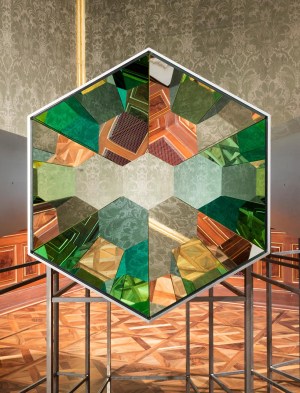
Olafur Eliasson, Seu planeta compartilhado (Your shared planet), 2011, as installed at the Winter Palace of Prince Eugene of Savoy, Vienna in 2015. Photo by Anders Sune Berg.
While emphasizing the way spaces are constructed by history and tradition, Eliasson’s works address the viewer in her embodied experience. Through the use of projections, shadows, and reflections, the artworks foreground the relationship between body, perception, and image. They anchor agency in the body and mind in motion as they invite the viewer’s active engagement by mirroring, fragmenting, and inverting her position within space.
Eliasson says, “I find it inspiring that the baroque exhibited such confidence in the fluidity of the boundaries between models of reality and, simply, reality. The presentation of my works at the Winter Palace is based on trust in the possibility of constructing reality according to our shared dreams and desires and on faith in the idea that constructions and models are as real as anything.”
TBA21 Founder, Francesca von Habsburg says: “This exhibition brings together several elements that I think support the vision of collectors and their responsibility as well as their ability to create art projects that defy traditional categorization. Both Patricia and Juan Vergez and I have been collecting and supporting Olafur Eliasson for many years with great enthusiasm, as he is indeed a renaissance man of many talents! In this presentation we wanted to introduce a parallel, that Olafur himself has mirrored in the exhibition rooms, that juxtaposes the precious Baroque cultural heritage of Vienna with the work of an artist that I feel very close to.”
In the entrance Vestibule, the light installation Die organische und kristalline Beschreibung (1996) floods the walls, floor, and ceiling with swelling washes of blue and yellow light, an ocean of color that loosens the viewer’s sense of the stability of her environment. In Yellow corridor (1997), monofrequency light is used to heighten the precariousness of our relationship to visible space. Eliasson’s optical machines and installations—such as Kaleidoscope (2001), New Berlin Sphere (2009), Your welcome reflected (2003), and Seu planeta compartilhado (Your shared planet, 2011)—reflect the artist’s ongoing investigations of color, perception, transformation, and deconstruction, an inquiry that is particularly interesting in relation to the baroque context. A site-specific intervention in the form of a continuous mirror traversing the enfilade of grand rooms further disorients the viewer by folding and re-folding the complex spaces it produces. Wishes versus wonders (2015), a steel half-ring mounted to the mirror wall in the Hall of Battle Paintings, stages an encounter between reality, illusion, and the elaborate artifice of the surroundings, simultaneously multiplying lines of potentiality.
Within this terrain of doubling and paradox, Eliasson calls into question our received habits of seeing and experiencing space. His artworks make us wonder and reconsider, giving meaning to the enigmatic doubling inherent in Baroque Baroque.
Belvedere–The Winter Palace of Prince Eugene of Savoy
Prince Eugene’s Winter Palace [begun in 1697] is one of the most magnificent baroque edifices in Vienna and is the fourth exhibition venue of the Belvedere Museum. Originally built as a lavish urban residence for Prince Eugene of Savoy (1663–1736), then acquired in the eighteenth century by Empress Maria Theresa before being used for the Court Treasury and later as the Ministry of Finance, this baroque palace underwent extensive renovation before reopening as a public museum in October 2013. Since then the Belvedere has staged numerous exhibitions at the Winter Palace, placing particular emphasis on programs and projects that create a dialogue between the baroque setting and contemporary art. Artistic interventions result in inspiring new artworks created in situ that draw on the palace’s unique ambiance and history. Vital starting points have been the city palace’s architecture, the prince’s former collections, and the holdings of the Belvedere.










leave a comment