The Huntington Acquires Fuseli’s The Three Witches

Henry Fuseli, The Three Witches or The Weird Sisters, ca. 1782, oil on canvas, 25 x 30 inches (San Marino: The Huntington Library, Art Collections, and Botanical Gardens)
◊ ◊ ◊ ◊ ◊
Press release (7 October 2014) from The Huntington:
The Huntington Library, Art Collections, and Botanical Gardens announced today the acquisition of one of the best-known compositions by the Anglo-Swiss painter Henry Fuseli (1741–1825). In private hands since its creation around 1782, The Huntington’s version of Fuseli’s The Three Witches or The Weird Sisters appears to be a finished, full-size study, presumably made before the two other known full-size, final versions Fuseli made of the subjects. These are in the collections of the Kunsthaus Zurich, and the Royal Shakespeare Company, Stratford-upon-Avon, England. After months of conservation treatment at The Huntington, the new acquisition will go on public view for the first time on October 11 in the Huntington Art Gallery.
“Given the fame of The Huntington’s collection of 18th-century British paintings, it may come as a surprise that we did not already have a painting by Henry Fuseli—one of the most celebrated, notorious, and inventive artists of the period,” said Kevin Salatino, Hannah and Russel Kully Director of the Art Collections at The Huntington. “Finally we do, and a great one, a picture full of mystery and suspense. Its powerful composition packs an incredible punch, second in impact only to the artist’s famous painting The Nightmare at the Detroit Institute of Arts, which is from the same period. The acquisition of The Three Witches now fills a major gap in our collection.”
Acquiring a Fuseli has been a longstanding goal at The Huntington, as the finest examples of his work rarely appear for sale. Catherine Hess, chief curator of European art at The Huntington, said that Fuseli’s work has been sought not only because of his importance to the history of art, but also because of his relationships with Sir Joshua Reynolds and, especially, William Blake, both of whom are well represented in Huntington collections. Also, Fuseli’s fascination with the work of William Shakespeare dovetails with The Huntington’s stature as one of the premiere collections of early Shakespeare folios and quartos in the world. The Three Witches reveals a great deal about how the artist worked, said Hess. “Its surface is thickly textured with paint, and the strokes are varied and energetic, betraying a freedom and immediacy that shows Fuseli at his most experimental and expressive.” The painting depicts the pivotal moment in Shakespeare’s tragedy Macbeth (act 1, scene 3) when the protagonist encounters the demonic trio who foretell his fate.
“Fuseli revels in the play’s ominous mood, isolating and tripling the motif of hooded head, extended hand, and sealed lips,” said Hess. The witches’ mannish features are taken directly from the playwright’s description: “… you should be women, And yet your beards forbid me to interpret / That you are so.” They may also have been modeled on the male actors who would have played them on stage in Fuseli’s day.
The Huntington’s painting includes a gilded frame (likely added by early owners) with a quote from Aeschylus’ ancient tragedy, The Eumenides: “These are women but I call them Gorgons.” The quote also appears written on the reverse of the painting and was almost certainly provided by Fuseli, who prided himself on his erudition.
◊ ◊ ◊ ◊ ◊
R E L A T E D I N S T A L L A T I O N S
Wrestling with Demons: Fantasy and Horror in European Prints and Drawings from The Huntington’s Art Collections
The Huntington Art Gallery, San Marino, CA, 30 August — 15 December 2014
This focused exhibition explores the darker side of the imagination through a variety of works on paper depicting death, witchcraft, and the demonic in European art. In this group of 15 works spanning the 16th to the 19th centuries, artists such as Albrecht Dürer, Jan Lievens, Francisco de Goya, and William Holman Hunt tap into human fascination with the macabre in works of art that demonstrate our attempt to wrestle with the unknown.
Eccentric Visions: Drawings by Henry Fuseli, William Blake, and Their Contemporaries
The Huntington Art Gallery, San Marino, CA, 22 November 2014 — 16 March 2015
In an age of great drawing, Anglo-Swiss painter Henry Fuseli (1741–1825) and his circle in Britain helped to push the medium into new areas of expressiveness, invention, and boldness of conception. This small exhibition consists of about 30 works from The Huntington’s exceptional holdings of drawings and watercolors by Fuseli, William Blake, and the artists most closely associated with them, including George Romney, John Flaxman, Joseph Wright of Derby, James Barry, John Brown, and Richard Cosway. It complements the installation of The Huntington’s newly acquired painting by Fuseli, The Three Witches.
Exhibition | Sade: Marquis of Shadows, Prince of the Enlightenment
To the d’Orsay’s exhibition on the Marquis de Sade we can add this one now on view at the Institut des Lettres et Manuscrits:
Sade: Marquis of Shadows, Prince of the Enlightenment
The Spectrum of Libertinism from the 16th to the 20th Century
Institut des Lettres et Manuscrits, Paris, 26 September 2014 — 18 January 2015
Curated by Pascal Fulacher and Jean-Pierre Guéno
Yes, I am a libertine, I admit it freely. I have dreamed of doing everything that it is possible to dream of in that line. But I have certainly not done all the things I have dreamt of and never shall. Libertine I may be, but I am not a criminal, I am not a murderer. –Donatien Alphonse François de Sade
Sade and the Spectrum of Libertinism
Donatien Alphonse François de Sade was doubly a man of letters: a great novelist, a great letter writer, but above all a victim of the very special letters that were the lettres de cachet, often commissioned from monarchs or their ministers by the families of those who wanted to have troublesome offspring removed from the public sphere. Even more than the Marquis of Shadows, even more than his escapades and fantasies of debauchery, it was the Prince of the Enlightenment who never ceased to embarrass both his family, who continually persecuted him, his social caste, and the leading figures of his time, to the point where this troublemaker became a kind of literary man in an iron mask who spent more than half his adult life in prison before dying there. Apart from the fact that he was sentenced to life imprisonment in 1768, and twice to death in 1772 and in 1794, De Sade spent nearly twenty-eight years in prison between 1763 and 1814, between the age of 23 and his death at age 74, and this under three different regimes: the Monarchy, the Republic and the Empire. From the tower at Vincennes to Charenton insane asylum, despite the material means he had to improve his everyday life, he lived mostly in “execrable slums,” in a dozen jails including those of Saumur castle, Pierre-Encise citadel in Lyon, For-l’Eveque prison in Paris, Miolans fort in Savoy, the Bastille fortress, Sainte-Pélagie prison and Bicêtre prison in Paris, not forgetting the gaols of the Revolution. During the seventy-four years and six months of his life as in the two centuries that separate us from his death, it may seem paradoxical that we have demonised the Marquis de Sade to such an extent, and that we have for so long mixed the man with his work, to the point of confusing the man and the novelist with the criminal characters in his fiction.
 Certainly he was a libertine who indulged in licentious and dissolute sexual practices, but the man who lent his name to today’s definition of the word Sadism, “the tendency to derive pleasure from physical or emotional pain intentionally inflicted on others” would have been just one more profligate among the aristocrats of his time, had he not been primarily the eye of a kind of consciousness that managed to convey not just the pain of living, but the “pain of the century” (“mal du siècle”) as defined by Musset in the 19th century: through his escapades and provocations, then through his political writings, as through his philosophical writings, letters and novels, but also by example, or by the counterexample of his life, did Sade ever cease to express the evil that devours men, mostly from the Renaissance to modern times, that is to say, during the second half of the second millennium?
For the last four centuries, are those who call themselves libertines actually Epicureans, delinquents or hyper-aware individuals? Bon vivants, criminals or cursed existentialists? From the Marquis de Sade to Dominique Aury (aka Pauline Réage), author of Histoire d’O (The Story of O), to Théophile de Viau, Crébillon, Choderlos de Laclos and his Liaisons Dangereuses (Dangerous Liaisons), Mirabeau, Casanova, the Chevalier d’Eon, Musset, Maupassant, Baudelaire, Rimbaud, Verlaine, Pierre Louÿs and Joë Bousquet, the great figures of literature, poetry and thought have never ceased to celebrate the cannibalistic wedding of vice and virtue. Vice that feeds on virtue when it transgresses and deflowers it. Virtue that feeds on vice when it denounces and demonises it.
At the boundaries of fantasy, revolution, transgression, emancipation and moral suicide, between the realities of purgatory, the fantasised or dreaded delights of hell and the mythical nostalgia for paradise lost, between cynicism, pragmatism and hope, between Epicureanism and cruelty, between enlightenment and barbarism, between the obsession with God and its denial, do the case studies that adorn the spectrum of libertinism not illustrate the entire tragedy of the human condition, and do they not resemble in this respect all the major intellectual earthquakes of the 19th and 20th centuries, from romanticism to existentialism through surrealism?
The Exhibition
 Long before becoming a moral emancipation movement, libertinism was a terribly subversive spiritual liberation movement, since it questioned the existence of God, the legitimacy of kings’ rule by divine right, and all the dogmas of religion, morals and absolute power. From the outset, the exhibition reveals “The spectrum of libertinism,” leading the visitor from “libertinism of the spirit to libertinism of morals” through a set of subversive texts including the Decameron by Boccaccio, Pensées (Thoughts) by Pascal, Dom Juan by Molière, Contes et nouvelles (Tales and Novels) by La Fontaine, Les Lettres persanes (Persian Letters) by Montesquieu and La Nouvelle Héloïse (The New Heloise) by J.-J. Rousseau. Libertinage in the time of De Sade is also discussed in the letters and works of Crébillon, Casanova, the Chevalier d’Eon, Restif de la Bretonne, Choderlos de Laclos, Mirabeau and more.
Then, pride of place is given to the Marquis de Sade and his masterpiece, Les 120 journées de Sodome ou l’École du libertinage (The 120 Days of Sodom, of the School of Libertinism): the handwritten scroll on which this still-scandalous novel was written is on display here for the first time ever in France. Several letters by De Sade, to his wife, his mother-in-law, his lawyer, an actress, etc. are also displayed around the scroll, and give a better understanding of this enigmatic and highly controversial figure.
The last two parts of the exhibition shed light on the rehabilitation of the Marquis de Sade and his work, as well as the development of libertinism in the 19th and 20th centuries, from romanticism to surrealism through existentialism. The exhibition Sade: Marquis de l’ombre, prince des Lumières, L’éventail des libertinages du XVIe au XXe siècle also features over 120 exceptional pieces, letters and autograph manuscripts, first editions and rare, valuable illustrated books, drawings, photographs, etc.
◊ ◊ ◊ ◊ ◊
From Flammarion:
Gonzague Saint Bris and Marie-Claire Doumerg-Grellier, Sade: Marquis de L’Ombre, Prince des Lumières, L’Eventail des Libertinages (Paris: Flammarion, 2014), 176 pages, ISBN: 978-2081353817, 29€.
Consacré à l’histoire du libertinage, cet album en lien avec l’exposition du même titre, rassemble et présente lettres, manuscrits, livres rares et précieux, portraits et dessins érotiques consacrés aux «Cent vingt journées de Sodome» du marquis de Sade.
Exhibition | Sade: Attacking the Sun
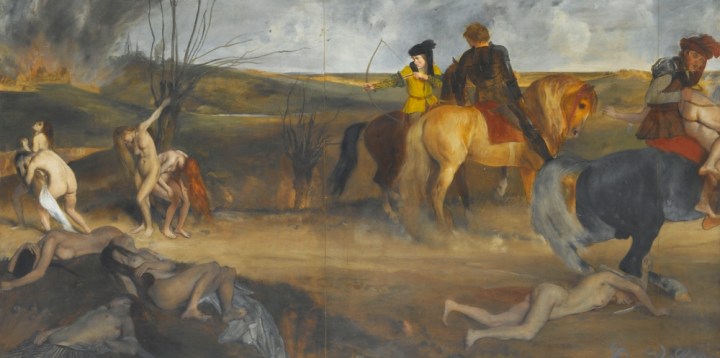
Edgar Degas, Scène de guerre au Moyen-âge, 1865
(Paris, Musée d’Orsay, RF 2208)
◊ ◊ ◊ ◊ ◊
From the d’Orsay:
Sade: Attacking the Sun / Attaquer le soleil
Musée d’Orsay, Paris, 14 October 2014 — 25 January 2015
Curated by Annie Le Brun, Laurence des Cars, and Leila Jarbouaï
Alphonse Donatien de Sade (1740–1814) completely transformed the history of both literature and the arts, first as an underground writer, and later by becoming a veritable legend in his lifetime. Following the analysis of the writer Annie Le Brun, a specialist of de Sade, the exhibition will be focusing on the revolution of representation opened up by the author’s writings. Topics addressed will be the ferocity and singularity of desire, deviation, extremes, the weird and the monstrous, desire as a principle of excess and imaginary recomposition of the world, through works by Goya, Gericault, Ingres, Rops, Rodin, Picasso…
The press release (as a PDF file in French) is available here»
◊ ◊ ◊ ◊ ◊
From Gallimard:
Annie Le Brun, Sade: Attaquer le Soleil (Paris: Éditions Gallimard, 2014), 336 pages, ISBN: 978-2070146826, 45€.
 Le propos de cet ouvrage est de montrer comment, avant d’avoir une importance majeure dans la pensée du XXe siècle, l’oeuvre du marquis de Sade a induit une part de la sensibilité du XIXe siècle, quand bien même le personnage et ses idées y auront-ils été tenus pour maudits. Car si Baudelaire, Flaubert, Huysmans, Swinburne, Mirbeau…, sans parler d’Apollinaire, s’y sont référés à titres divers, tout porte à croire que la force de cette pensée est aussi d’avoir rencontré, révélé, voire provoqué ce qui agite alors en profondeur l’expression plastique, concernant autant l’inscription du désir que son pouvoir de métamorphose. C’est l’image du corps en train d’être bouleversée de l’intérieur, annonçant une révolution de la représentation. Que ce soit évident chez Delacroix, Moreau, Böcklin…, ce qui est en jeu n’est pas sans inquiéter aussi Ingres, Degas ou Cézanne et bien sûr Picasso… Et cela tandis que Félicien Rops, Odilon Redon, Alfred Kubin se rapprochent d’une expression restée jusqu’alors marginale (curiosa ou folie), avant que le surréalisme, se réclamant de Sade, ne reconnaisse le désir comme grand inventeur de forme. A retrouver ce cheminement, il sera possible de mesurer combien à dire ce qu’on ne veut pas voir, Sade aura incité à montrer ce qu’on ne peut pas dire. Ou comment le XIXe siècle s’est fait le conducteur d’une pensée qui, incitant à découvrir l’imaginaire du corps, va amener à la première conscience physique de l’infini.
Annie Le Brun, commissaire général de l’exposition, auteur notamment, chez Gallimard, de Soudain un bloc d’abîme, Sade (1986), On n’enchaîne pas les volcans (2006), Si rien avait une forme, ce serait cela (2010), et Les arcs-en-ciel du noir : Victor Hugo (2012).
Exhibition | The Kama-Sutra: Spirituality and Eroticism in Indian Art
Though thematic rather than chronologically-based, the exhibition seems to include a substantial number of eighteenth-century objects, with some attention to the Western reception of the Kama-Sutra. From the Pinacothèque de Paris:
Le Kâma-Sûtra: Spiritualité et érotisme dans l’art indien
Pinacothèque de Paris, 2 October 2014 — 11 January 2015
Curated by Alka Pande and Marc Restellini

Acrobatic couple, Tamil Nadu; late 18th or early 19th century, carving on wood, 91 x 49 x 14.5 cm
(Collection of Michel Sabatier, La Rochelle)
For its Autumn-Winter season 2014–15, the Pinacothèque de Paris will put on an unusual exhibition: The Kama-Sutra: Spirituality and Erotism in Indian Art. Attributed to a Brahman who might have written it in the 4th century of our era, the Kama-Sutra makes up one of the major texts of medieval Hinduism and is not a pornographic book, as it is often described in the Western world. It is divided up into seven sections (adhikarana): society, social concepts, sexual union, as regards the spouse, as regards extra-marital relationships, as regards courtesans, as regards the arts of seduction.
Around 330 outstanding works including those of Shriji Arvind Singh Mewar, maharana of Udaipur and the remarkable collection of Beroze and Michel Sabatier—sculptures, paintings, miniatures, objects of daily life, and ‘pillow books’, illustrated works that were offered to the newlyweds until the 19th century in order to give them an erotic education—organized according to the seven sections of the Kama-Sutra, will be exhibited in the Pinacothèque de Paris. The exhibition, unadvised for minors, will explain the erotic aesthetics specific to the erotic aesthetics of Indian cultural life and to Hinduism. It will also attempt to understand why the Western world casts such a deformed look on that very unusual book.
From the French Embassy in New Delhi:
Alka Pande, renowned art historian and author of many books on erotic art, has been appointed as the curator for this exhibition. Dr. Alka Pande’s first book was itself an introduction to this great Sanskrit treatise, the Kama Sutra, that she wrote in 1999. Since then, she has been constantly exploring the frontier of love, desire, longing, sexuality and genders in her many books: Indian Erotica, a visual journey along the erotic art of the Indian subcontinent (2002); Ardhanarishvara: The Androgyn, an exploration of the frontiers of the genre, based upon the Hindu concept of Shiva as half-man half woman (2005); The New Age Kama Sutra for Women, her first attempt to transpose this text to the modern times (2008), Kama Sutra: The Quest for Love, a visual journey through some of the most explicit erotic works of art (2008); Leela: An Erotic Play of Verse and Art, an illustrated collection of Indian Poetry (2009); and Shringara: The Many Faces of Indian Beauty, a reflection on the Indian concept of feminine beauty (2011).
Marc Restellini is an art historian and a Modigliani scholar. He has been working in Japan for many years, and has been the artistic director of the Musée du Luxembourg in Paris, where he has exhibited masters like Rodin, Raphaël and Modigliani. In 2007, he has opened the Pinacothèque, the first private art museum in Paris, situated Place de la Madeleine. In less than a decade, it has become one of the most visited museum in Paris, close on the heels of the Louvre and the Pompidou Centre. What sets the Pinacothèque apart is the artistic vision of Marc Restellini whose ambition is to look at art history with an fresh perspective, creating bridges and transversality in the way exhibition are conceptualised, and reaching out to a wider public.
The press release (as a PDF file in French) is available here»
◊ ◊ ◊ ◊ ◊
Exhibiton | The Château de Versailles in 100 Masterpieces
From the exhibition website:
The Château de Versailles en 100 Chefs-d’oeuvre
Musée des Beaux-Arts, Arras, 27 September 2014 — 20 March 2016
Curated by Beatrix Saule
 Major pieces from the Château de Versailles’ collections on show in Arras for 18 months.
Paintings, sculptures, furniture, objets d’art… Visitors will discover works executed by the greatest artists of the seventeenth and eighteenth centuries made from the most precious of materials, like the bust of Louis XIV originally installed on the Ambassadors’ Staircase, the monumental Gobelins tapestries, the Dauphin’s fine writing desk, the original sculpture from the Latona Fountain, Marie-Antoinette’s porcelains, or the sculptural group Apollo Served by the Nymphs, a monument of seventeenth-century French sculpture. These masterpieces line the visitors’ route as they explore the various places and periods of the Château de Versailles. The exhibition is organised into six settings, constituting a veritable private tour of the royal residence:
• Marble, bronze, gold and silver
• Wood panelling and marquetry
• Water and fountains
• Parks and forests
• Flowers and fields
• Festivities and fireworks
Exhibition | Goya: A Lifetime of Graphic Invention

Francisco de Goya y Lucientes, Bulls of Bordeaux.
Spanish Fun. Plate No. 3. 1825, lithograph
(Dallas: Meadows Museum, SMU)
◊ ◊ ◊ ◊ ◊
Press release (18 September 2014) from the Meadows Museum:
Goya: A Lifetime of Graphic Invention
Meadows Museum, Dallas, 21 September 2014 — 1 March 2015
Curated by Alexandra Letvin
The Meadows Museum announces its fall exhibition, Goya: A Lifetime of Graphic Invention. On view from September 21, 2014, through March 1, 2015, the exhibition will launch the Meadows’ 50th anniversary year by presenting the entirety of the Museum’s holdings of printed works by Francisco José de Goya y Lucientes (1746–1828): 222 etchings, four lithographs, and three trial proofs.
The exhibition will provide visitors with a rare opportunity to view complete first edition sets of Goya’s four great print series—Los Caprichos (The Caprices, 1799), Los Desastres de la Guerra (The Disasters of War, 1810–19), La Tauromaquia (Bullfighting, 1816), and Los Disparates (The Follies, 1815–23)—as well as the Museum’s holdings of Goya’s paintings, which will be displayed alongside the prints. Curated by Meadows/Kress/Prado Fellow Alexandra Letvin, Goya: A Lifetime of Graphic Invention will also feature the Museum’s recent gift of a trial proof from Los Disparates, Disparate Puntual (Punctual Folly), and closely follows the Meadows’ acquisition of Portrait of Mariano Goya (1827), one of the artist’s final paintings, in 2013. The Meadows houses one of the largest public collections of Goya’s works in the United States, and the exhibition will enable visitors to experience for the first time the Meadows’ extensive Goya holdings at once, further enhancing the Museum’s role as a leader in the study and presentation of Spanish art.
“Goya’s mastery in prints marked a turning point in the evolution of graphic art and had a profound influence on the work of later artists, such as Manet and Picasso,” says Mark A. Roglán, the Linda P. and William A. Custard Director of the Meadows Museum and Centennial Chair in the Meadows School of the Arts. “As the Meadows Museum’s collection is one of the largest depositories of Goya’s works— including the recent acquisition of a late portrait of his grandson, which was a gift in honor of our anniversary—it seems appropriate to kick off the celebration with an exhibition of his genius.”
Goya, widely regarded as one of the most important artists in Western history, represents both the culmination of the Old Master tradition and the beginning of modernity. A witness to decades of political upheaval and social unrest, he began experimenting with printmaking in the late 1770s. The most ambitious endeavor of his early career was a group of 11 etchings (1599–1660) after paintings by Diego Velázquez housed in the Spanish Royal Collection, three of which will be featured in the exhibition alongside other examples of Goya’s early prints, including a rare trial proof for an unpublished etching. Shortly thereafter, following an illness that left him permanently deaf, Goya produced 28 drawings titled Sueños (Dreams), which formed the initial core and inspiration for the artist’s first large-scale print series, Los Caprichos. These 80 aquatint etchings engage a variety of themes—including the complex relationship between men and women, ignorance, superstitious beliefs, and witchcraft—and offer a view of human weakness and irrationality that is both deeply personal and imbued with critical social commentary.
“Over the course of his career, Goya produced almost 300 etchings and lithographs that reveal his personal vision, tireless invention, and enthusiasm for technical experimentation,” said Roglán. “This exhibition presents his printed oeuvre as an integral—indeed, defining—component of his life and career, and invites visitors to experience the Museum’s paintings by Goya in the context of his lifelong engagement with printmaking.”
Following the Napoleonic occupation of Spain and the abdication of Bourbon King Ferdinand VII in 1808, Goya began working on a group of small, compact etchings meditating on the atrocities of war—its causes, manifestations, and consequences—that underscore the senselessness of violence, which ravaged Spain during this decade of turmoil. Published posthumously as Los Desastres de la Guerra, these prints take on a documentary character, illustrating the effects of the conflict on individual soldiers and citizens, as well as arresting scenes of starvation, degradation, and humiliation. Concurrent to his work on Los Desastres, Goya began developing La Tauromaquia, a series of 33 aquatint etchings examining the art of bullfighting, today regarded as Goya’s largest and most technically accomplished printed works. Bullfighting, recognized as a quintessentially Spanish practice, had regained popularity during this time, and La Tauromaquia tells the story of the bullfighting tradition and culture from its origins in Spain to the legendary performances of contemporary masters. Etchings on the reverse of seven plates indicate that Goya had initially conceived La Tauromaquia in broader terms—Goya: A Lifetime of Graphic Invention will include prints of two of these additional designs to offer unique insight into Goya’s editing and selection process prior to publication. Goya revisited the subject of bullfighting a decade later, producing four large-scale lithographs known as the Bulls of Bordeaux (1825), which will also be on display.
Goya’s final print series, Los Disparates, comprises 22 etchings that depict a range of enigmatic, dreamlike subjects—from the playful to the monstrous—that continue to fascinate scholars and viewers alike. Commonly translated as “The Follies,” these works were created during the last years of the artist’s life and remain without conclusive interpretation. Seeking to match the prints’ thematic ambiguities, Goya’s technical approach pushed the medium of etching to its limits, employing aquatint to manipulate light and shadow to create a sense of haunting otherworldliness. Los Disparates was first published by the Royal Academy of San Fernando in Madrid in 1864, and it is unclear as to whether the artist intended these works to be published as a series. While Goya’s intentions may remain unknown, Goya: A Lifetime of Graphic Invention will illuminate an under-recognized aspect of Goya’s artistic legacy by showcasing the artist’s ongoing thematic and technical experimentation in the medium of printmaking, which helped to push the techniques of the Old Masters into the modern era.
This exhibition has been organized by the Meadows Museum, SMU. A generous gift from The Meadows Foundation has made this project possible.
Exhibition | The Hours of Night and Day: Bronze Reliefs
From the MIA:
The Hours of Night and Day: A Rediscovered Cycle of Bronze
Reliefs by Giovanni Casini and Pietro Cipriani
Minneapolis Institute of Arts, 13 September 2014 — 4 January 2015

Giovanni Casini and Pietro Cipriani, Apollo Descending (Evening), ca. 1720, bronze, 11 x 15 inches (on loan to the Minneapolis Institute of Arts)
The rediscovery of six bronze reliefs allegorically representing the Hours of Night and Day by Giovanni Casini and Pietro Cipriani is the largest and most important ensemble of Florentine bronze sculpture to come to light in a century. This unusual ensemble refers to Michelangelo’s cycle in the New Sacristy of San Lorenzo, and to several other painted and sculpted masterworks of the Baroque period. It demonstrates that Florentine bronze sculpture did not end with Giovanni Battista Foggini, Massimiliano Soldani Benzi, and Antonio Montauti. It reveals Pietro Cipriano as the last master of European rank and influence active in this field. The six reliefs were celebrated at the time of their creation, as attested, for instance, by copies in Doccia porcelain.
◊ ◊ ◊ ◊ ◊
From ACC Distribution:
Eike D. Schmidt, David Ekserdjian, Rita Balleri, and Monica Rumsey. The Hours of Night and Day: A Rediscovered Cycle of Bronze Reliefs by Giovanni Casini and Pietro Cipriani (Minneapolis: Books & Projects and th Minneapolis Institute of Arts, 2014), 208 pages, ISBN: 978-0989371858, $40.
 In this book’s breathtaking images, extensive documentation, and incisive analysis, a cycle of six highly important bronze reliefs representing The Hours of Night and Day is being published for the first time. Made in Florence at the beginning of the eighteenth century, these bronzes epitomize pre-modern notions about time, which are visualized through an elaborate array of mythological and allegorical components. In describing and deciphering the meanings and traditions of the scenes represented in these bronzes, the authors unveil a multi-faceted concept of time that is based upon the human perception of the Hours, while also pointing toward their otherworldly, magical dimension.
The Hours of Night and Day, a celebrated masterwork in its own time, is the result of a fortuitous collaboration between the painter and modeler Giovanni Casini and the bronze sculptor Pietro Cipriani. With the discovery of these long-forgotten bronzes, and of bronze versions after Greco-Roman statuary—most notably the Venus de’ Medici and the Dancing Faun now at the J. Paul Getty Museum, Los Angeles—it becomes apparent that Cipriani was one of the foremost bronze sculptors of his age. Finally, this book documents the legacy of these bronze reliefs in derivative works created for subsequent generations. As further testimony to the enduring appeal of Casini and Cipriani’s extraordinary creation, variations of the reliefs from The Hours of Night and Day became popular as decorations on vases and as porcelain reliefs throughout the eighteenth and nineteenth centuries, and on to the present day.
Eike D. Schmidt is the James Ford Bell Curator of Decorative Arts and Sculpture, and Head of the Department of Decorative Arts, Textiles, and Sculpture at the Minneapolis Institute of Arts. He is the author of numerous books and articles on Renaissance, Baroque, and Neoclassical sculpture. David Ekserdjian is Professor of Art History and the Head of the Department of the History of Art and Film at the University of Leicester, England. He has published extensively on bronze sculpture, the history of collecting, and Renaissance painting, prints, and drawings, with a particular specialisation in the artists Correggio and Parmigianino. Rita Balleri is a research associate at the University of Florence. She has published several articles and catalogue entries on Doccia porcelain and has collaborated with the Doccia Museum in Florence on various research projects and exhibitions. Her doctoral dissertation on the models for Doccia porcelain (2011) was the basis for her recent monograph, Modelli della Manifattura Ginori di Doccia: Settecento e gusto antiquario (2014).
C O N T E N T S
• Eike D. Schmidt, “Sparkles in the Twilight of the Medici: Allegories of the Hours of Night and Day by Giovanni Casini and Pietro Cipriani”
• David Ekserdjan, “Pietro Cipriani’s Venus de’ Medici and Dancing Faun and the Classical Tradition”
• Rita Balleri, “Bronze into Porcelain: The Enduring Legacy of Giovanni Casini’s Reliefs in the Manifattura Ginori di Doccia”
Exhibition | Rare and Precious: The 1763 Treaty of Paris
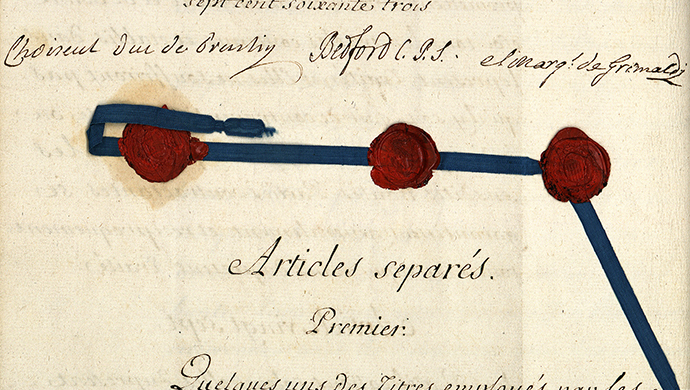
The 1763 Treaty of Paris. Traité définitif de Paix entre le Roi, le Roi de la Grande Bretagne et le Roi d’Espagne, signé à Paris le 10 février 1763. Manuscript, comprises the text in French, Latin, and Spanish.
◊ ◊ ◊ ◊ ◊
Now on view, for ten days only, at the Musée de la civilisation:
Rare and Precious: The 1763 Treaty of Paris
Musée de la civilisation, Québec City, 23 September — 2 October 2014
Rare and Precious: The 1763 Treaty of Paris, a special event is on view now at the Musée de la civilisation. In addition to guided tours and presentations, talks will also be held for the occasion at Musée de l’Amérique francophone. The 1763 Treaty of Paris and its related documents are being presented for the first time ever in North America, at Musée de la civilisation, courtesy of an exceptional loan from the government of the French Republic to the government of Québec.
The peace treaty itself is the centerpiece of the event, but the loan from France also includes Spanish and British instruments of ratification, the minutes of the proceedings surrounding the exchange of ratification instruments, the Cessions envisaged in 1759, a document entitled “Negotiation of the Treaty of Paris: Working Paper,” a 1777 map of the Americas, and another map dating back to 1761. This pivotal historic document marked the end of the Seven Years’ War (1756–1763). Considered the first truly global conflict, the war pitted Great Britain, Prussia, and Hanover against France, Austria, Sweden, Russia, and Spain in land and naval battles fought in Europe, India, and North America. War on North American soil began in 1754 in the Ohio Valley and ended in 1762 when the British captured Martinique.
Documents from the Musées de la civilisation archives are tangible traces left by those who experienced the Conquest firsthand in New France. They offer insights into what the treaty really meant to the people of the colony. For example, in his handwritten journal, Father Richer, a priest in Québec between 1757 and 1759, describes the scene as 180 British ships descended on Québec. He was 38 years old when the Treaty of Paris was signed.
Exhibition | Germany: Memories of a Nation

Johann Tischbein, Goethe in the Roman Compagna, 1787,
(Frankfurt: Städelshes Kunstinstitut)
◊ ◊ ◊ ◊ ◊
From The British Museum:
Germany: Memories of a Nation—A 600-Year History in Objects
The British Museum, London, 16 October 2014 – 25 January 2015
Curated by Barrie Cook
This exhibition will examine elements of German history from the past 600 years in the context of the fall of the Berlin Wall 25 years ago. From the Renaissance to reunification and beyond, the show will use objects to investigate the complexities of addressing a German history which is full of both triumphs and tragedies. Navigate through Germany’s many political changes—from the Holy Roman Empire through unification in the 1870s and the troubled 20th century to today’s economic powerhouse at the centre of Europe. Explore art by Dürer, Holbein and Richter, and marvel at technological achievements through the ages which gave the world Gutenberg’s printing press, Meissen porcelain, the Bauhaus movement and modern design icon the VW Beetle.
◊ ◊ ◊ ◊ ◊
From BBC’s Media Centre:
 Details of a brand new Radio 4 series, Germany: Memories of a Nation, were announced today (Thursday 11 September) at an event hosted by Neil MacGregor, Director of the British Museum and writer and presenter of the series, and the BBC’s Director-General Tony Hall. The series will once again place objects at the heart of the story, letting the memories they evoke tell a fascinating and complex history, this time of Germany. Looking back from the fall of the Berlin Wall 25 years ago, Germany: Memories of a Nation will explore 600 years of the country’s history, over six weeks, in a 30-part Radio 4 series.
From the Brandenburg Gate to Bavarian bratwurst and the Gutenberg Bible, via Volkswagen engineering, fairy tales and degenerate pottery, the series—which begins on BBC Radio 4 on Monday 29 September—will ask how much of what we think about Germany coincides with how Germans see themselves and what touchstones of national identity shape the relatively recently reunited country.
Germany has been in the public consciousness this summer with the centenary of the First World War and the memories of D-Day veterans—and, of course, the World Cup. This series—which will be available online in perpetuity, both on BBC iPlayer Radio and as a download—will examine the key moments that have defined Germany’s past, its great, world-changing achievements and the catastrophes of the 20th century, and explore the profound influence that Germany’s history, culture and inventiveness have had across Europe. Themes covered will include the country’s historical divisions and shifting frontiers, the forging of a national identity and now facing the legacy of a turbulent history.
The series is inspired by an accompanying exhibition at the British Museum: Germany: Memories of a Nation, which will open on the 16 October. The exhibition will include most of the objects featured in the series, alongside many others; objects that tell diverse and fascinating stories which embody the memories shared by all Germans. Important loans from Germany, many of which have been lent for the first time, will augment objects from the British Museum and other UK collections. . .
The full announcement is available here»
◊ ◊ ◊ ◊ ◊
Scheduled for a November publication from Allen Lane:
Neil MacGregor, Germany: Memories of a Nation (London: Allen Lane, 2014), 512 pages, ISBN: 978-0241008331, £25.
 From Neil MacGregor, the author of A History of the World in 100 Objects, this is a view of Germany like no other. Today, as the dominant economic force in Europe, Germany looms as large as ever over world affairs. But how much do we really understand about it, and how do its people understand themselves? In this enthralling new book, Neil MacGregor guides us through the complex history, culture and identity of this most mercurial of countries by telling the stories behind 30 objects in his uniquely magical way. Beginning with the fifteenth-century invention of the Gutenberg press, MacGregor ventures beyond the usual sticking point of the Second World War to get to the heart of a nation that has given us Luther and Hitler, the Beetle and Brecht—and remade our world again and again. This is a view of Germany like no other.
Neil MacGregor has been Director of the British Museum since August 2002. He was Director of the National Gallery in London from 1987 to 2002. His celebrated books include A History of the World in 100 Objects, now translated into more than a dozen languages and one of the top-selling titles ever published by Penguin Press, and Shakespeare’s Restless World.
Exhibition | Porcelain from the Collection of Marino Nani Mocenigo

◊ ◊ ◊ ◊ ◊
From Ca’ Rezzonico:
Porcelain from the Collection of Marino Nani Mocenigo
Ca’ Rezzonico, Venice, 14 June — 30 November 2014
Curated by Marcella Ansaldi and Alberto Craievich
In 1936, Nino Barbantini presented an exhibition at Ca’ Rezzonico dedicated to the porcelain of Venice and Nove to document an aspect that of 18th-century Venetian Art that had hitherto been largely overlooked. The works displayed came above all from Venice’s civic collections and from museums and private collections throughout Italy. The most generous lender however, was a Venetian, Conte Marino Nani Mocenigo, an emblematic collector who had dedicated his existence to forming a collection of porcelain. Such was his obsession that he was given the affectionate nickname of ‘Conte Cicara’ (‘Count Cup’) by his fellow citizens. Following his death, his wife decided to form a memorial to the husband by making accessible the collection he had formed with such passion. The objects were put on display at Ca’ del Duca, a tiny but excellent museum developed, but which it has been impossible to visit for a long time.
On this occasion, by request of the family, the porcelain collection of Marino Nani Mocenigo will be displayed in the rooms of Ca’ Rezzonico. The exhibition will present 338 pieces produced by the most important manufactures of Europe, with a predominant focus on about 100 Venetian articles—including some splendid examples by Vezzi, two very rare coffee-pots by Hewelcke, almost all the figural groups made by Pasquale Antonibon at Nove and Geminiano Cozzi in Venice—constituting the most conspicuous and important part of the exhibition. Perhaps the most famous work in the collection is a delightful Geographer by Geminiano Cozzi.
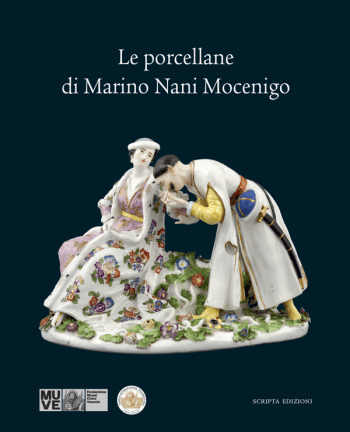
 Visitors can also admire some of the most famous works to have been produced by the Meissen factory, modelled by Johann Joachim Kändler and by Peter Reinicke, such as The Polish Kiss, The Chinese Girl, and The Hunter, together with some astonishing dinner services, also from Meissen, dating from the early 18th century: one of these with gold decorations and another in white porcelain with still lifes of fruit.
The exhibition will also display examples of fine porcelain production from other German-speaking centres: a rare part of a Chinoiserie dinner service made in Vienna by Claudius Innocentius Du Paquier and articles from Ludwigsburg, Frankenthal, Höchst, and Berlin. The exhibition closes with a large selection of cups and saucers by the imperial manufacture of Vienna dating from the Sorgenthal period (1784–1805), all characterised by an astonishing use of colour and bold combination of ornamental motifs.
The exhibition is accompanied by a catalogue published by Scripta Editore – Verona, and produced thanks to a contribution from the Venice International Foundation.
◊ ◊ ◊ ◊ ◊
From Scripta Editore:
Marcella Ansaldi and Alberto Craievich, Le Porcellane di Marino Nani Mocenigo (Verona: Scripta Editore, 2014), 144 pages, ISBN: 978-8898877010, €35.
 All’inizio del Settecento Cina e Giappone detenevano il segreto della produzione della porcellana, sancendo un monopolio di fatto del loro commercio verso l’Europa. Al commercio di oggetti di porcellana, con il consumo di tè e caffè che andava sempre più sviluppandosi in tutto l’Occidente, si sviluppò parallelamente la richiesta di vasellame, tazze, tazzine, diventando un interesse economico sempre maggiore negli scambi economici dell’epoca.
In tutta Europa si cercò sin dal tardo Cinquecento di scoprire il segreto della produzione della porcellana, il cosiddetto ‘arcano’. E i primi a riuscirci nel 1710 furono i sassoni di Meissen che grazie, anche alla padronanza del complesso processo produttivo, crearono la prima manifattura funzionante. Avendo rotto il monopolio orientale, i sassoni si tennero stretto il segreto facendo nascere una prospera industria che esportò la sua porcellana in tutta Europa.










 Enfilade
leave a comment