Exhibition | Treasures from the Royal Archives
Press release (16 May 2014) for the exhibition:
Treasures from the Royal Archives
Windsor Castle, 17 May 2014 — 28 January 2015
From the title deed of Buckingham Palace to George III’s reflections on the loss of America, the Royal Archives contains an unparalleled collection of documents that capture key moments in the history of the British Monarchy. To mark the centenary of the establishment of a permanent home for the Archives in the Round Tower at Windsor Castle, more than 100 documents from the private archive of the Royal Family are published in a new book, Treasures from the Royal Archives, and 25 of the most fascinating items go on display at the Castle from Saturday, 17 May, many for the first time.
In the exhibition, and among the documents on display for the first time, is the title deed for Buckingham Palace. Dated 20 April 1763 and bearing George III’s wax seal, it records the purchase of Buckingham House from Sir Charles Sheffield for the sum of £28,000 (over £2,000,000 today). Named after its previous owner, the sixth Duke of Buckingham, the property was bought by the King for his wife, Queen Charlotte, to accommodate their growing family—they had 15 children.

Often remembered as the monarch who lost the American colonies, George III wrote his personal reflections on Britain’s relationship with America following the end of the War of Independence in 1783. The Crown and Government received much public criticism for the manner in which the conflict was handled; however the King’s essay takes a surprisingly sanguine approach to the defeat. Opening with the words “America is lost!,” it assesses the impact of the independence of America on the wealth of Britain, concluding with the King’s hope that “we shall reap more advantages from their trade as friends than ever we could derive from them as Colonies…”
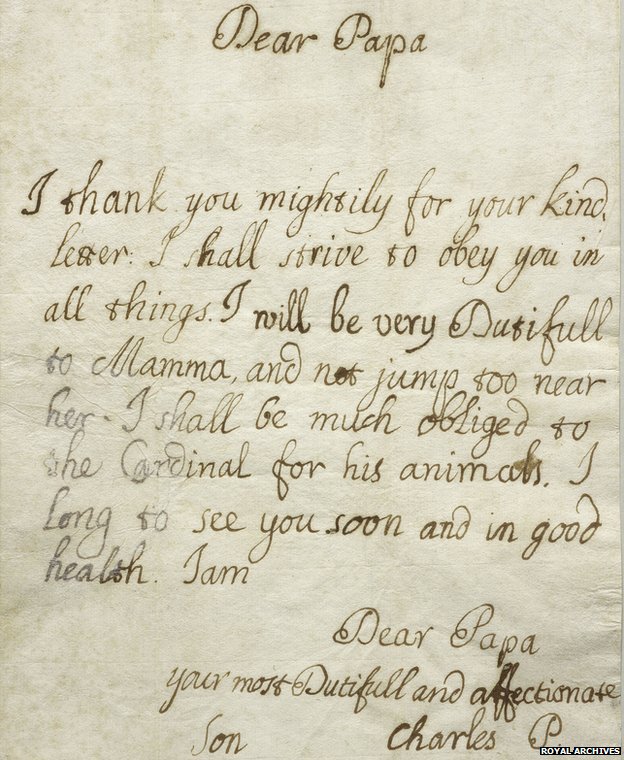 The Royal Archives includes thousands of papers relating to the exiled Stuarts. The documents not only reflect the continuing Jacobite efforts to reclaim the throne for the Stuart royal line, but also shed light on the private lives of the Stuart family. A letter written in 1728 by the seven-year-old Bonnie Prince Charlie will go on display in the exhibition for the first time. Written to his father, Prince James Francis Edward Stuart, from Palazzo Muti, the Stuart residence in Rome, it appears to be the young boy’s response to a reprimand for upsetting his mother. The Prince writes, “Dear Papa, I thank you mightily for your kind letter. I shall strive to obey you in all things. I will be very Dutifull to Mamma, and not jump too near her…”
Also on display for the first time is Major John Chard’s account of the Defence of Rorke’s Drift. Written at the request of Queen Victoria, it describes with the help of sketches and plans the unlikely victory of British troops on the night of 22 January 1879, when Chard’s men successfully defended the field station at Rorke’s Drift from Zulu attack, despite being heavily outnumbered. Chard recalls the moment when they ‘saw them, apparently 500 or 600 in number, come around the hill to our south and advance at a run’ and describes how “many of the men behaved with great gallantry.” Upon his return to England, Chard, along with Lieutenant Bromhead and other officers, was summoned to Balmoral to recount the battle to the Queen, who had followed the progress of the Anglo-Zulu War with great interest.
A report prepared for King George V by the Prime Minister, James Ramsay MacDonald, records a turning point in British politics—the first sitting of the House of Commons under the first Labour Government on 13 February 1924. Describing the occasion as “unique and historical in the annals of the British parliament,” MacDonald concludes that, although it was a “difficult and trying ordeal,” “on the whole it was a very encouraging start.” The report is just one of many examples of correspondence, both formal and private, between monarchs and political leaders held in the Royal Archives, including letters from the President of the United States, Abraham Lincoln, and British Prime Ministers Winston Churchill and Benjamin Disraeli.
Exhibition curator Lauren Porter of Royal Collection Trust said, “The 100th anniversary of the foundation of the Royal Archives at Windsor Castle provides a wonderful opportunity to explore and exhibit some of the greatest treasures in the collection of documents. The wide variety of material held in the Royal Archives—from private correspondence and diaries to official papers—provides a fascinating insight into the history of the British Monarchy, often from a very personal perspective.”
Pamela Clark, Julie Crocker, Allison Derrett, Laura Hobbs and Jill Kelsey, Treasures from the Royal Archives (London: Royal Collection, 2014), 240 pages, ISBN: 978-1909741041, £30.
 Since 1914, the famous ‘Round Tower’ of Windsor Castle has been the secure and honoured home to the Royal Archives—an extraordinary collection of many thousands of documents and records dating back to the reign of Elizabeth I. This publication showcases, for the very first time, the treasures of this fascinating and internationally significant collection, ranging from records of affairs of state to personal letters, diaries and domestic jottings, recounting the stories of kings and queens, politicians, rebels, soldiers and artists in their own words—and painting a remarkable portrait of history through the passions, dilemmas and life-changing moments of the people who shaped it.
Exhibition | The New Georgians
Now on at Orleans House Gallery in Twickenham, just outside of London:
The New Georgians
Orleans House Gallery, Twickenham, 3 May — 27 July 2014

Valena Tzvetanska (Valena Lova) Mademoiselle Cuckó
The New Georgians celebrates the tercentenary of the Hanoverian accession. This exhibition, part of the Richmond upon Thames Georgian Festival, commemorates this historical event through a display exploring the life and local links of Queen Caroline of Ansbach (1683–1737), wife of King George II. Caroline lavishly dined in the Octagon Room on a visit here in 1729. Her husband’s mistress, Henrietta Howard, lived at the nearby Marble Hill House.
The focus of the exhibition is contemporary artwork from across the UK submitted via open submission. Artists explore the impact and relevance of 18th-century history, society, ideas, culture, and styles in the 21st century. Alongside reverent homages and playful pastiches are genres and media revolutionised and popularised in the 18th century, including botanical art, landscapes, portraits, prints and ceramics. Costume, accessories, and the representation and roles of women are also popular themes—fitting as the exhibition honours Queen Caroline, who possessed great intellect, culture, personal charm, and political influence. In her husband’s absences, she acted as Regent or Protector of the Realm.
Also on display are works created for the exhibition by the gallery’s artist in residence Michael Coldman. His constructions made from found, recycled and second hand objects are transformed into three dimensional scenes examining Georgian life and Queen Caroline and her Court. These often humorous works are complemented by a choice selection of 18th-century caricatures by British artists Hogarth, Smith, and Gillray from the Richmond Borough Art Collection.
The Richmond upon Thames Georgian Festival brochure is available as a PDF file here»
Exhibition | Catching Sight: The World of the British Sporting Print
From the VMFA:
Catching Sight: The World of the British Sporting Print
Virginia Museum of Fine Arts, Richmond, 31 August 2013 — 13 July 2014
 This exhibition sheds new light on a common, but often overlooked aspect of British art: the British sporting print. Highly sought after during the 18th and 19th centuries, these prints endure as symbols of English culture. Featuring more than 100 prints, Catching Sight demonstrates the aesthetic sophistication and accomplishments of the genre. The exhibition takes an innovative approach, examining these works of art from an art historical perspective rather than simply as documents of the history of sport and rural culture. Catching Sight demonstrates the qualities of directness, vividness, and even wit for which the genre was prized by both the larger public and artists such as Degas and Géricault, who borrowed extensively from its artistic vocabulary.
Mitchell Merling, with Malcolm Cormack and Corey Piper, Catching Sight: The World of the British Sporting Print (Richmond: Virginia Museum of Fine
Arts, 2013), 112 pages, ISBN: 978-1934351031, $36.
The exhibition is accompanied by an illustrated catalogue by Mitchell Merling, Paul Mellon Curator, with contributions from Malcolm Cormack, Paul Mellon Curator Emeritus, and Corey Piper, former Curatorial Associate for the Mellon Collection.
Catalogue cover: Isaac Cruikshank, London Sportsmen Shooting Flying [from a set of four], ca. 1800, hand-colored etching (VMFA: Paul Mellon Collection, 85.1282.2)
Exhibition | Magna Carta: Cornerstone of Liberty
On the eve of the 800th anniversary of Magna Carta. . . From the MFA press release (7 March 2014). . .
Magna Carta: Cornerstone of Liberty
Museum of Fine Arts, Boston, 2 July — 1 September 2014
Sterling and Francine Clark Art Institute, Williamstown, Massachusetts, 6 September — 2 November 2014
Library of Congress, Washington, D.C., 6 November 2014 — 19 January 2015
British Library, London, 13 March — 1 September 2015
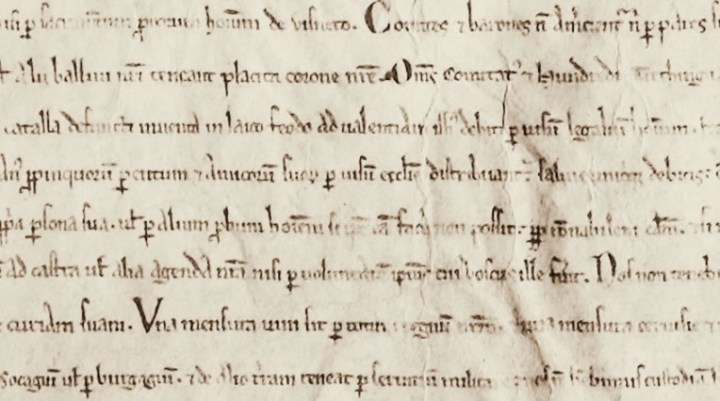
One of only four surviving copies of the original Magna Carta—a document written in 1215 that subsequently served as a symbol for liberty around the world—travels to the Museum of Fine Arts, Boston (MFA), this summer for a special exhibition of approximately 20 works in the Museum’s Art of the Americas Wing. An inspiration for the US Constitution and Bill of Rights, the exemplar owned by the UK’s Lincoln Cathedral and typically housed in Lincoln Castle will be on view in the exhibition, Magna Carta: Cornerstone of Liberty, from July 2–September 1, 2014. In partnership with the Massachusetts Historical Society (MHS) and the Massachusetts House of Representatives, Magna Carta will join historical loans as well as portraits and works of art from the Museum’s collection. The MFA’s Sons of Liberty Bowl (1768) by Paul Revere—which is engraved with the words “Magna/Charta” and “Bill of/Rights”—will be among the works that help tell the story of patriots and revolutionaries who fought for freedom in the face of tyranny across the centuries. Founding Fathers, presidents and abolitionists, inspired by the liberties enshrined in Magna Carta, will be represented in the exhibition through portraits, marble busts and historical documents that celebrate their commitment to civil rights and equal representation under the law.
“Our state’s rich history and preeminent cultural institutions provide a wonderful showcase for Magna Carta,” House Speaker Robert A. DeLeo said. “Massachusetts’ tourism industry is booming and the House of Representatives is proud to provide substantial support for the arts, travel and tourism. Last month we extended this commitment by allocating sizeable funding to bring Magna Carta to Massachusetts. Thank you to the Museum of Fine Arts and my colleagues in the Legislature for their work in securing this momentous historic treasure.”
State Representative Cory Atkins (D-Concord), House Chair of the Joint Committee on Tourism, Arts, and Cultural Development, and Alice Richmond, Deputy Chair of the Magna Carta 800th Anniversary 2015 Committee, worked with the MFA and Lincoln Cathedral to secure the loan of Magna Carta. After being shown in the MFA’s Edward and Nancy Roberts Family Gallery, Magna Carta travels to the Sterling and Francine Clark Art Institute in Williamstown, Massachusetts, and the Library of Congress in Washington, DC, before returning to London for an exhibition celebrating the charter’s 800th anniversary. All four of the original surviving 1215 Magna Carta manuscripts will be brought together for the first time in history at a three-day event at the British Library February 2–4, 2015.
“Massachusetts is a fitting place to learn about the founding of this great nation and the development of civil rights and liberties both here and abroad. I am incredibly proud to bring Magna Carta to Boston, where it inspired so many Sons of Liberty and Founding Fathers to action, and am grateful to the Lincoln Cathedral for this extraordinary loan,” said Malcolm Rogers, Ann and Graham Gund Director at the MFA. “This foundational document will hold a place of honor among American masterpieces and colonial treasures that bring some of the Commonwealth’s most famous patriots to life.”
For centuries, Magna Carta—Latin for “Great Charter”—has had symbolic influence on politicians, judges and revolutionaries who were inspired by its protections against tyranny and arbitrary rule. Written in Latin, the document laid the foundation for modern concepts of justice, due process, trial by jury and civil rights, and was reissued multiple times in the Middle Ages. In the 17th century, its influence was revived during the English Civil War. The concepts enshrined in the document also had a profound influence on the American Colonies, where it influenced the Declaration of Independence and later the US Constitution—particularly the Bill of Rights.
Massachusetts Historical Society President Dennis Fiori added, “This exhibition will be a terrific experience for anyone with an interest in the people and events that shaped our country. In partnering with the MFA, the MHS is pleased to loan a number of documents and artifacts that define our nation’s history. It will be quite something to see the nearly 800-year-old Magna Carta together with important US documents—such as handwritten drafts of the Declaration of Independence and an annotated copy of the Constitution—that were inspired by it. I am sure the Founding Fathers would be pleased.”
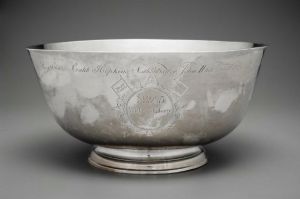
Paul Revere, Sons of Liberty Bowl, 1768 (Boston: MFA).
The exhibition at the MFA will focus on Massachusetts’ and America’s ongoing relationship with Magna Carta—highlighting early presidents, Founding Fathers and patriots whose ideals and philosophies have shaped our nation. Iconic works of art, loans and manuscript material from the MHS and other lenders will tell the story of these remarkable men and women, and the revolutionary acts inspired by Magna Carta. The MFA’s silver Sons of Liberty Bowl, a highlight of the Museum’s renowned collection of art and objects from Revolutionary Boston, honors 92 members of the Massachusetts House of Representatives who refused to rescind a letter protesting the Townshend Acts (1767), which taxed tea, paper, glass and other commodities. This act of civil disobedience by the ‘Glorious Ninety-Two’ was a major step leading to the American Revolution, and demonstrates the legacy and influence of Magna Carta more than 500 years after it was first issued.
“Since the 17th century, Magna Carta has served as a potent symbol for all Americans seeking protection against ‘the insolent menaces of villains in power,’ as the inscription on the Liberty Bowl states,” said Gerald W. R. Ward, New Hampshire State Representative (D-Portsmouth) and the MFA’s Senior Consulting Curator and Katharine Lane Weems Senior Curator of American Decorative Arts and Sculpture Emeritus. “This exhibition offers the rare opportunity, in this digital age, to see the nearly 800-year-old ‘real thing’ that is the ancient underpinning for so many freedoms and rights that we cherish today.”
A number of items from the Museum’s collection will be paired with loans from the MHS. Two manuscript copies of the Declaration of Independence, originally penned by John Adams and Thomas Jefferson, will be accompanied by the MFA’s marble busts of the two Founding Fathers. The MFA’s painting of lawyer Theodore Sedgwick (about 1808) by Gilbert Stuart complements a miniature portrait from the MHS of Elizabeth Freeman (“Mumbet”) (1811), a woman who was enslaved in Massachusetts and was represented by Sedgwick when she successfully sued for her freedom—a case which abolished slavery in the Commonwealth. Other loans from the MHS include a portrait of former Massachusetts Governor and US Vice President Elbridge Gerry and his annotated copy of the US Constitution, as well as two Paul Revere Sword in Hand Notes (currency)—one of which depicts the words “Magna Carta.” (more…)
Exhibition | Goya and the Altamira Family
Press release (10 April 2014) from The Met:
Goya and the Altamira Family
The Metropolitan Museum of Art, New York, 22 April — 3 August 2014
Curated by y Xavier F. Salomon
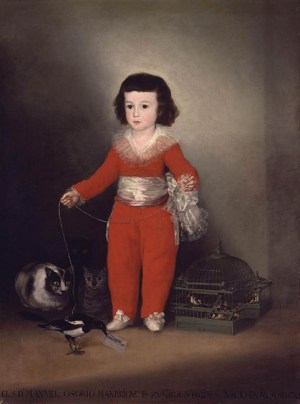
Goya, Manuel Osorio Manrique de Zuñiga, 1787–88
50 x 40 inches (NY: The Metropolitan Museum of Art)
By special arrangement with the Banco de España, from April 22 through August 3, The Metropolitan Museum of Art will reunite for the first time four portraits painted by Francisco de Goya (1746–1828) that were commissioned by the Count of Altamira, who was a director of the bank. Goya and the Altamira Family will consist of
• Banco de España’s Portrait of the Count of Altamira
• the Metropolitan’s beloved Manuel Osorio Manrique de Zuñiga, the so-called ‘Red Boy’
• the beautiful portrait of Manuel’s mother and sister, Condesa de Altamira and Her Daughter, María Agustina, from the Metropolitan Museum’s Robert Lehman Collection
• and a portrait of Manuel Osorio’s brother Vicente Joaquin de Toledo, from a private collection.
All four portraits were painted between 1786 and 1788 when Goya was beginning to experiment with aristocratic portraiture. A fifth portrait depicting Count Altamira’s middle son, Juan María Osorio, was painted around the same time by Agustín Esteve, one of Goya’s pupils, and will be lent by the Cleveland Museum of Art.
The Banco de San Carlos (the present-day Banco de España) commissioned Goya to create a series of portraits of the directors of the bank in Madrid, including the full-length depiction of Vicente Joaquín Osorio Moscoso y Guzmán, Count of Altamira. It was the success of this portrait that led to the subsequent commission to Goya for three portraits of members of the count’s family.
The exhibition is organized by Xavier F. Salomon, Peter Jay Sharp Chief Curator, The Frick Collection, New York. The exhibition is made possible by the Placido Arango Fund. It was organized by The Metropolitan Museum of Art with the assistance of the Consulate of Spain in New York.
◊ ◊ ◊ ◊ ◊
From the museum’s shop:
Xavier F. Salomon, Goya and the Altamira Family, Metropolitan Museum of Art Bulletin (Spring 2014), 48 pages, $15.
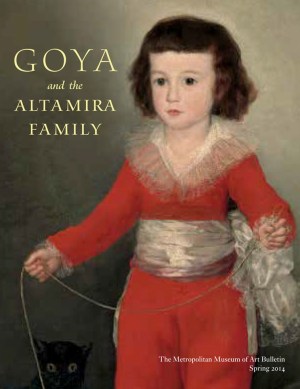 Ever since its arrival at the Metropolitan as part of the outstanding collection of Old Master paintings bequeathed by New York financier and philanthropist Jules Bache, Goya’s portrait of Don Manuel Osorio, the three- or four-year-old son of the conde de Altamira, has ranked as one of the museum’s most popular paintings. In celebration of the reinstallation of the Metropolitan’s European Paintings galleries, inaugurated last May, the condesa de Altamira and her son have been temporarily reunited in a gallery devoted to Goya and his contemporaries in Spain. But from the outset this move was planned as just the first stage of a more eventful family reunion that would also include Don Manuel’s older brother, Vicente Osorio, and their father, Vicente Joaquín Osorio de Moscoso y Guzmán, conde de Altamira: all four pictures outstanding works by Goya.
The publication is made possible through the generosity of the Lila Acheson Wallace Fund for The Metropolitan Museum of Art, established by the cofounder of Reader’s Digest.
Exhibition | Lost Treasures of the Jewish Ghetto of Venice
Press release for the exhibition now on at the Winter Palace in Vienna:
Lost Treasures of the Jewish Ghetto / Schätze des Jüdischen Ghettos in Venedig
The Museum of Fine Arts, Houston, 21 February — 28 April 2013
Ca’ d’Oro, Venice, 1 June — 29 September 2013
Winter Palace, Vienna, 28 April — 6 July 2014

Torah Crown, 1796. Parcel-gilt silver
(Collection of the Comunità Ebraica di Venezia)
◊ ◊ ◊ ◊ ◊
In 2016, the Jewish Ghetto of Venice will celebrate its 500th anniversary. Venice was considered a hub of Jewish culture over the centuries, with its ghetto being home to a flourishing international Jewish community. In order to properly mark this anniversary, the international organisation Venetian Heritage, in cooperation with Maison Vhernier, has organised the temporary exhibition Treasures of the Jewish Ghetto of Venice, which is being presented at the Winter Palace from 28 April to 6 July 2014. Although created as a site of segregation, the Venice ghetto developed into a place of encounter for numerous groups of Jews from different countries and into an important source of inspiration for Jewish culture in many other regions around the globe. From 1516 to 1797—almost over three centuries—a community of various ethnical backgrounds (Germans, Italians, Jews from East and West) coexisted in Europe’s most tolerant town. In 1943, a number of precious objects were hidden by the Nazis. These valuables had then fallen into oblivion, until they were unearthed during the restoration of the Scola Spagnola several years ago. The show illustrates the richness and beauty of practiced Jewry until destroyed by National Socialism; it also keeps track of the conservation of the objects before they were stolen and their recent rediscovery.
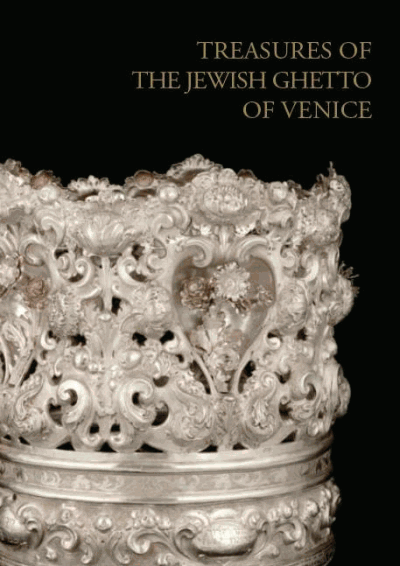 The decorative art objects created by Venetian artisans between the 17th and early 20th centuries belong to a heritage that vividly demonstrates how Venetian culture, with its wide ethnic spectrum and multicultural feel, provided a role model for the rest of Europe. The former Winter Palace of Prince Eugene, who was known for his open-mindedness and far-reaching interests, offers itself as an ideal exhibition venue. The cult objects, which were in a deplorable state when they were found and have now been restored to their former splendour, represent a small part of the collections of the Jewish Museum in Venice and impressively attest to the great significance of the Venetian art of goldsmithing.
Most of the silver and bronze objects on display were used in rituals in Venetian synagogues during mass and on special occasions and holidays. Such liturgical pieces include, for example, the wooden tikim (Torah cases) in which the Torah scrolls are kept when not in use, and the magnificent Thora crowns and pairs of rimmonim adorning the scrolls or the tikim. Hanging above each tik is a lamp called a ner tamid (eternal light) that illuminates the tik or a larger ark in a synagogue. Two spice containers, used in the Havdallah service at the closing of Sabbath to bring worshipers back to reality from the ecstasy of Sabbath, are also on view, along with two yads (pointers helping readers follow a text) used during services. Utensils associated with traditional dietary include, among other things, the jug and bowl for washing one’s hands before meals, and the two Seder plates that were used on the evening of the Seder.
When Italy was occupied by the Nazis in September 1943, these objects were hidden and only surfaced several years ago. Thanks to an initiative by Venetian Heritage and Maison Vhernier, it was possible to restore them and present them to the public. From now on, they will form the heart of the Museo Ebraico di Venezia, which will be reopened on the occasion of the 500th anniversary celebrations of the Venetian ghetto.
Venice in the 18th Century
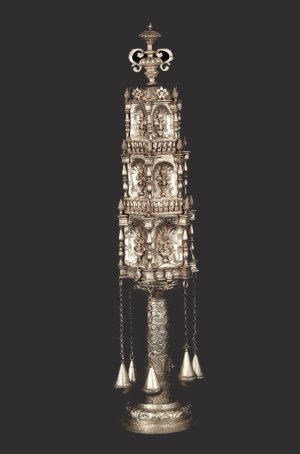
Rimmonim, Italian, silver, 48 x 10 cm, 1747 (Collection of the Comunità Ebraica di Venezia)
In 18th-century Venice, tourism became a booming branch of the economy. The charm of Venice depended not least on the cosmopolitan atmosphere of the town. Vedutists captured its enchanted atmosphere and sights, such as the church of Santa Maria della Salute, the Rialto Bridge, and the Doge’s Palace, their works serving as coveted souvenirs for visitors. The paintings were destined to be prominently installed in drawing rooms as status symbols proving that their owners were among those privileged citizens who could afford to undertake a Grand Tour through Italy.
The Jewish Ghetto of Venice
As Christians were not permitted to lend money to other Christians for interest, Jews played an important role in Venetian society as moneylenders, pawnbrokers, and merchants in second-hand articles. Whereas in earlier days Jews had only been allowed to stay in Venice for a maximum of 15 days a year, they were eventually allowed to settle in the town from 1509 on, if only under strict reservations. They were forbidden to openly practice their religion, purchase land, entertain sexual relationships with Christians, and wear ostentatious yellow or red hats. In 1516, the Senate of Venice declared the premises of a former foundry (geto) as a dwelling zone for Jews, arguing that Jews could impossibly be allowed to live in the city and move around freely. The ghetto was completely secluded: two gates were built that remained blocked for Jews during the dusk-to-dawn curfew. The area was extremely densely populated, with several thousand residents living on 2.4 hectares and five large synagogues accommodating various ethnic groups. In spite of these severe restrictions, Venice was considered one of the best places for Jews to live. In 1797, the Council of Venice handed the town over to Napoleon, and the gates to the Jewish ghetto were demolished to loud calls for freedom. The Jews of Venice were still years away from full equality, but they were no longer locked up in the ghetto.
Venetian Heritage
Venetian Heritage is an international non-profit organisation located in New York and Venice and is part of the UNESCO Private Committees Programme for the Safeguarding of Venice. Venetian Heritage supports cultural initiatives through restoration projects, exhibitions, publications, lectures, studies, and research programmes aimed at raising global awareness of the rich cultural heritage of the Veneto region in Italy and areas once belonging to the Republic of Venice, known as La Serenissima.
Catalogue: Agnes Husslein-Arco and Georg Muzicant, Treasures of the Jewish Ghetto of Venice (Vienna: Belvedere, 2014), 104 pages, ISBN 978-3902805454 (German/English/Italian), €19.
Exhibition | History and Stories of Doges and Dogaressas
From the Palazzo Ducale:
The Serenissimo Prince: History and Stories of Doges and Dogaressas
Doge’s Palace, Venice, 26 January — 30 June 2014
Curated by Camillo Tonini

Giovanni Bonazza, Doge Carlo Ruzzini (1732–35), ca. 1732 (Venice: Museo Correr)
In the renovated space of the Doge’s Apartment in Palazzo Ducale, the exhibition aims to tell—through works from the prestigious collections of the Museo Correr, its library and its drawing cabinet, prints and numismatics—the historical evolution of this symbol, which returns in paintings, sculptures, manuscripts, coins, medals and insignia of traditional power, in memory of the extraordinary life of a world collapsed in 1797 and later immortalized in the size of the myth.
The scenic itinerary starts with three important pictorial representations of the Lion of St. Mark, the work of Jacobello del Fiore (1415), Donato Veneziano (1459) and Vittore Carpaccio (1516), which is the preface to the beautiful portraits of the Doge Francesco Foscari, Alvise Mocenigo and Leonardo Loredan, respectively by Lazzaro Bastiani, Giovanni Bellini and Carpaccio, among which the latter highlighted the image of the prince as a real icon of the Serenissima. The Portrait of Sebastiano Venier by Andrea Vicentino closes the series of the doges that have made grown Venice with the use of weapons, which culminated in the Battle of Lepanto.
A part of the exhibition is dedicated to the figure of the dogaressas such as Morosina Morosini Grimani (1595–1605), of whom is displayed a portrait attributed to Palma il Giovane and a celebrative painting of her coronation, and Elizabeth Querini Valier (1694–1700), the fourth and last wife of a ‘Serenissimo’ to officially receive a public investiture.
Display | Reproducing the 18th Century: Copying French Furniture
Now on at The Wallace:
Reproducing the 18th Century: Copying French Furniture
The Wallace Collection, London, 10 March — 29 August 2014

Secretaire, Pierre-Antoine Foullet, c.1777
(London: The Wallace Collection)
In the second half of the 19th century and the first decade of the 20th century, many of the best pieces of 18th-century French furniture were copied by skilled cabinet-makers in Paris and London. Rather than being dismissed as mere ‘reproductions’, these copies were of great quality and were highly prized by their owners.
In this display in the Conservation Gallery, the Wallace Collection’s desk by Pierre-Antoine Foullet (circa 1777) is compared with one such copy, kindly lent by Butchoff Antiques, enabling visitors to compare the construction techniques and finishes of two different periods of cabinet making.
Much more information is available at The Wallace Collection’s blog»
Exhibition | Gods and Heroes

Jean-Honoré Fragonard, Jeroboam Sacrificing to the Idols,
48 x 62 inches, 1752 (École des Beaux-Arts, Paris)
From the American Federation of Arts:
Gods and Heroes: Masterpieces from the École des Beaux-Arts, Paris
Oklahoma City Museum of Art, 19 June — 14 September 2014
Albuquerque Museum of Art and History, 12 October 2014 — 4 January 2015
The Baker Museum, Naples, Florida, 19 February — 17 May 2015
Portland Art Museum, 13 June — 13 September 2015
This rich overview of masterpieces from the École des Beaux-Arts—the original school of fine arts in Paris and a repository for work by Europe’s most renowned artists since the seventeenth century—will include approximately 140 paintings, sculptures, and works on paper dating from the seventeenth through nineteenth centuries. The focus will be on epic themes such as courage, sacrifice, and death, as well as the ways that changing political and philosophical systems affected the choice and execution of these subjects. Among the featured works will be paintings by Jacques-Louis David, Jean-Honoré Fragonard, Anne-Louis Girodet, and Jean-Auguste-Dominique Ingres; sculpture by Antoine-Louis Barye, Jean-Baptiste Carpeaux, Jean-Antoine Houdon, and François Rude; drawings by François Boucher, Leonardo da Vinci, Nicolas Poussin, Titian, and Jean-Antoine Watteau; and prints by Albrecht Dürer and Rembrandt van Rijn.
The epic deeds of gods and heroes, enshrined in the Bible and the works of Homer, were the primary narratives from which both aspiring and established academicians drew their inspiration. Their ideology was rooted in the study of the idealized human form as envisioned in classical art. At the École, learning how to construct persuasive and powerful paintings from carefully delineated anatomy, expressive faces, and convincing architectural and landscape settings was understood by aspiring artists to be the route to success and recognition.
Gods and Heroes will offer unique insight into the development of an aesthetic ideology that fostered some of western art’s most magnificent achievements. Among the masterworks included will be Fragonard’s Jeroboam Sacrificing to the Idols; Joseph-Marie Vien’s David Resigns Himself to the Will of the Lord, Who Struck His Kingdom of the Plague (1743); Jacques-Louis David’s Erasistratus Discovers the Cause of Antiochus’s Disease (1774); and Jean-Auguste-Dominque Ingres’s Achilles Receiving the Ambassadors of Agamemnon (1801).

Jean Auguste-Dominique Ingres, The Ambassadors to Agamemnon Visiting Achilles,
45 x 58 inches, 1801 (École des Beaux-Arts, Paris)
◊ ◊ ◊ ◊ ◊
From Giles:
Emmanuel Schwartz, Emmanuelle Brugerolles, and Patricia Mainardi, Gods and Heroes: Masterpieces from the École des Beaux-Arts, Paris (London: D. Giles Limited, 2014), 240 pages, ISBN: 978-1907804120, £40 / $60.
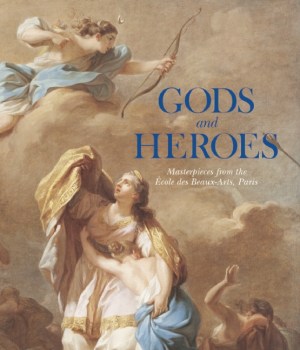 Gods and Heroes: Masterpieces from the École des Beaux-Arts, Paris will be published by D Giles Limited, in association with the American Federation of Arts in June 2014. This fully illustrated volume examines the pivotal role of the École des Beaux-Arts in influencing so much of the history, content and style of late- 17th-, 18th- and 19th-century European art
Not only did the École train generations of artists, but it also served as a repository for work by the most renowned artists in Europe. In three essays, as well as in over 200 catalogue entries and colour plates, the volume tells a fascinating, multi-layered story. On one level it is a study of the role of the epic deeds of classical and biblical gods and heroes in the work of generations of artists in France and beyond. On another level, it explores the impact of the École des Beaux-Arts’ curriculum on Western visual culture, and the persistence of the classical tradition.
From the late 17th through to the mid-19th century, the École was a highly competitive, government school that rigorously trained artists to fulfill the needs of royal, state, and church patrons. In so doing, the École created a particular ‘way of seeing’ that created the established aesthetic and ideological norms in French artistic production right through to the First World War, and provided the backdrop against which the modernist ‘revolution’ from the mid-19th century emerged and developed.
Gods and Heroes features 208 extraordinary art works from the collection of the École, dating from the 17th to the 19th century, including important works by such masters as Antoine- Louis Barye, François Boucher, Jean-Baptiste Carpeaux, Jacques-Louis David, Leonardo da Vinci, Jean-Honoré Fragonard, Jean-Auguste- Dominique Ingres, Charles Le Brun, Charles Natoire, Nicolas Poussin, Carle Van Loo, and Jean-Antoine Watteau
Emmanuel Schwartz is Chief Curator of Heritage at the École des Beaux-Arts, Paris and the author of The Legacy of Homer: Four Centuries of Art from the École Nationale Superieure des Beaux-Arts, Paris (2005). Emmanuelle Brugerolles is Chief Curator of Drawings at the École Nationale Supérieure des Beaux-Arts, Paris. Her most recent publication is The Male Nude: Eighteenth-Century Drawings from the Paris Academy (2013). Patricia Mainardi is Professor Emerita, Doctoral Program in Art History, The Graduate Center of the City University of New York and the author of Husbands, Wives and Lovers: Marriage and Its Discontents in Nineteenth-Century France (2003).
Exhibition | The Gobelins in the Enlightenment
L’Histoire de Don Quichotte de Charles Coypel
Mobilier national / Isabelle Bideau
Now on view at the Galerie des Gobelins in Paris:
Les Gobelins au siècle des Lumières: Un âge d’or de la Manufacture royale
The Gobelins in the Enlightenment: A Golden Age of the Royal Manufactory
Galerie des Gobelins, Paris, 8 April — 27 July 2014
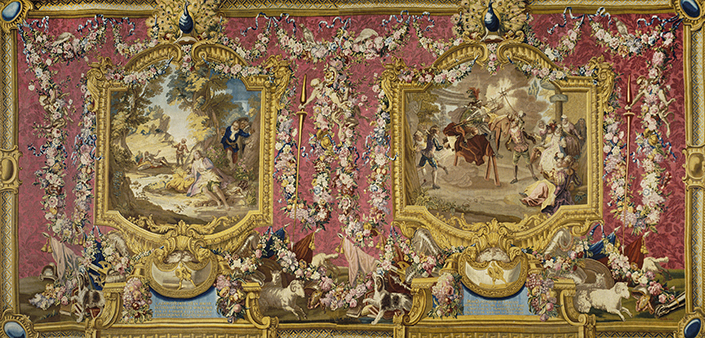
A selection of the best tapestries woven at the Gobelins during the 18th century will be presented along with painted models from the collections of the Mobilier national. The extraordinary impetus to rebuild the second manufactory of the Gobelins in 1662, under the direction of Charles Le Brun, is reflected in the works of 18th century.
Traditional religious subjects (The Old Testament by Antoine Coypel) are woven in parallel with innovative pieces inspired by the undeniable success of Cervantes’ novel. The subject of epic history (History by Marc-Antoine after Charles Natoire) is maintained, while other less edifying series appear, destined for royal apartments (for instance, The Loves of God, after various painters such as François Boucher and Joseph-Marie Vien). Alongside these innovations, replicas after pieces from the 16th century remain sought after. The late years of this century correspond with a return to the national past (History of France tapestry). Upholstered furniture (sofas and armchairs) equally characterizes this era of creative abundance.
Exhibited works: 25 tapestries, 25 original cartoons or models, 25 drawings and prints.










 Enfilade
leave a comment