Exhibition | Gods and Heroes

Jean-Honoré Fragonard, Jeroboam Sacrificing to the Idols,
48 x 62 inches, 1752 (École des Beaux-Arts, Paris)
From the American Federation of Arts:
Gods and Heroes: Masterpieces from the École des Beaux-Arts, Paris
Oklahoma City Museum of Art, 19 June — 14 September 2014
Albuquerque Museum of Art and History, 12 October 2014 — 4 January 2015
The Baker Museum, Naples, Florida, 19 February — 17 May 2015
Portland Art Museum, 13 June — 13 September 2015
This rich overview of masterpieces from the École des Beaux-Arts—the original school of fine arts in Paris and a repository for work by Europe’s most renowned artists since the seventeenth century—will include approximately 140 paintings, sculptures, and works on paper dating from the seventeenth through nineteenth centuries. The focus will be on epic themes such as courage, sacrifice, and death, as well as the ways that changing political and philosophical systems affected the choice and execution of these subjects. Among the featured works will be paintings by Jacques-Louis David, Jean-Honoré Fragonard, Anne-Louis Girodet, and Jean-Auguste-Dominique Ingres; sculpture by Antoine-Louis Barye, Jean-Baptiste Carpeaux, Jean-Antoine Houdon, and François Rude; drawings by François Boucher, Leonardo da Vinci, Nicolas Poussin, Titian, and Jean-Antoine Watteau; and prints by Albrecht Dürer and Rembrandt van Rijn.
The epic deeds of gods and heroes, enshrined in the Bible and the works of Homer, were the primary narratives from which both aspiring and established academicians drew their inspiration. Their ideology was rooted in the study of the idealized human form as envisioned in classical art. At the École, learning how to construct persuasive and powerful paintings from carefully delineated anatomy, expressive faces, and convincing architectural and landscape settings was understood by aspiring artists to be the route to success and recognition.
Gods and Heroes will offer unique insight into the development of an aesthetic ideology that fostered some of western art’s most magnificent achievements. Among the masterworks included will be Fragonard’s Jeroboam Sacrificing to the Idols; Joseph-Marie Vien’s David Resigns Himself to the Will of the Lord, Who Struck His Kingdom of the Plague (1743); Jacques-Louis David’s Erasistratus Discovers the Cause of Antiochus’s Disease (1774); and Jean-Auguste-Dominque Ingres’s Achilles Receiving the Ambassadors of Agamemnon (1801).

Jean Auguste-Dominique Ingres, The Ambassadors to Agamemnon Visiting Achilles,
45 x 58 inches, 1801 (École des Beaux-Arts, Paris)
◊ ◊ ◊ ◊ ◊
From Giles:
Emmanuel Schwartz, Emmanuelle Brugerolles, and Patricia Mainardi, Gods and Heroes: Masterpieces from the École des Beaux-Arts, Paris (London: D. Giles Limited, 2014), 240 pages, ISBN: 978-1907804120, £40 / $60.
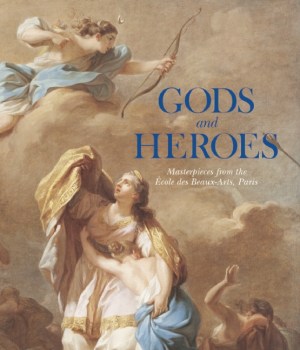 Gods and Heroes: Masterpieces from the École des Beaux-Arts, Paris will be published by D Giles Limited, in association with the American Federation of Arts in June 2014. This fully illustrated volume examines the pivotal role of the École des Beaux-Arts in influencing so much of the history, content and style of late- 17th-, 18th- and 19th-century European art
Not only did the École train generations of artists, but it also served as a repository for work by the most renowned artists in Europe. In three essays, as well as in over 200 catalogue entries and colour plates, the volume tells a fascinating, multi-layered story. On one level it is a study of the role of the epic deeds of classical and biblical gods and heroes in the work of generations of artists in France and beyond. On another level, it explores the impact of the École des Beaux-Arts’ curriculum on Western visual culture, and the persistence of the classical tradition.
From the late 17th through to the mid-19th century, the École was a highly competitive, government school that rigorously trained artists to fulfill the needs of royal, state, and church patrons. In so doing, the École created a particular ‘way of seeing’ that created the established aesthetic and ideological norms in French artistic production right through to the First World War, and provided the backdrop against which the modernist ‘revolution’ from the mid-19th century emerged and developed.
Gods and Heroes features 208 extraordinary art works from the collection of the École, dating from the 17th to the 19th century, including important works by such masters as Antoine- Louis Barye, François Boucher, Jean-Baptiste Carpeaux, Jacques-Louis David, Leonardo da Vinci, Jean-Honoré Fragonard, Jean-Auguste- Dominique Ingres, Charles Le Brun, Charles Natoire, Nicolas Poussin, Carle Van Loo, and Jean-Antoine Watteau
Emmanuel Schwartz is Chief Curator of Heritage at the École des Beaux-Arts, Paris and the author of The Legacy of Homer: Four Centuries of Art from the École Nationale Superieure des Beaux-Arts, Paris (2005). Emmanuelle Brugerolles is Chief Curator of Drawings at the École Nationale Supérieure des Beaux-Arts, Paris. Her most recent publication is The Male Nude: Eighteenth-Century Drawings from the Paris Academy (2013). Patricia Mainardi is Professor Emerita, Doctoral Program in Art History, The Graduate Center of the City University of New York and the author of Husbands, Wives and Lovers: Marriage and Its Discontents in Nineteenth-Century France (2003).
Exhibition | The Gobelins in the Enlightenment
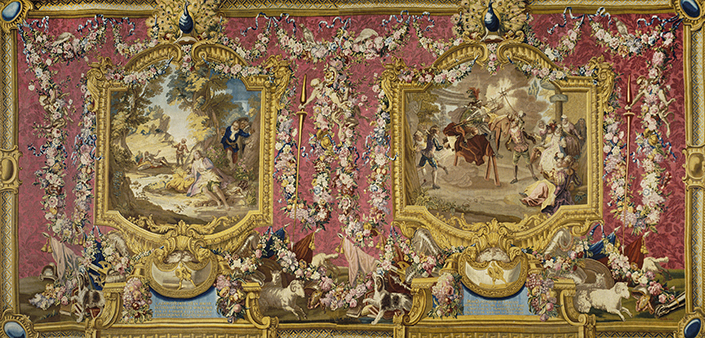
L’Histoire de Don Quichotte de Charles Coypel
Mobilier national / Isabelle Bideau
Now on view at the Galerie des Gobelins in Paris:
Les Gobelins au siècle des Lumières: Un âge d’or de la Manufacture royale
The Gobelins in the Enlightenment: A Golden Age of the Royal Manufactory
Galerie des Gobelins, Paris, 8 April — 27 July 2014
A selection of the best tapestries woven at the Gobelins during the 18th century will be presented along with painted models from the collections of the Mobilier national. The extraordinary impetus to rebuild the second manufactory of the Gobelins in 1662, under the direction of Charles Le Brun, is reflected in the works of 18th century.
Traditional religious subjects (The Old Testament by Antoine Coypel) are woven in parallel with innovative pieces inspired by the undeniable success of Cervantes’ novel. The subject of epic history (History by Marc-Antoine after Charles Natoire) is maintained, while other less edifying series appear, destined for royal apartments (for instance, The Loves of God, after various painters such as François Boucher and Joseph-Marie Vien). Alongside these innovations, replicas after pieces from the 16th century remain sought after. The late years of this century correspond with a return to the national past (History of France tapestry). Upholstered furniture (sofas and armchairs) equally characterizes this era of creative abundance.
Exhibited works: 25 tapestries, 25 original cartoons or models, 25 drawings and prints.
Exhibition | The English Manner: Mezzotint Masterpieces
From the Universalmuseum Joanneum:
The English Manner: Mezzotint Masterpieces
Die Schwarze Kunst: Meisterwerke der Schabkunst
Schloss Eggenberg, Graz, 24 April — 20 July 2014
Curated by Karin Leitner-Ruhe and Christine Rabensteiner
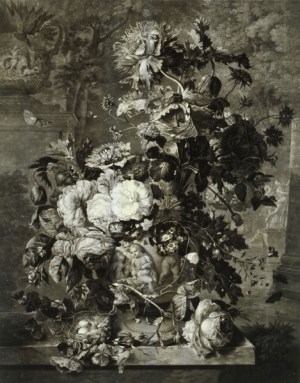
Richard Earlom (1743–1822), Floral Still Life, after Jan van Huysum, mezzotint, 56 x 42 cm (Graz: Alte Galerie)
Mezzotint is one of the most fascinating and elaborate printed graphic techniques in history. Invented in the 17th century by the German Ludwig von Siegen, it is—unlike etching and engraving—the first surface technology in intaglio printing. It was mainly used for the reproduction of paintings and is marked by a velvety and deep black base, in which the artist scrapes the bright lights.
In the Graphic Collection of the Alte Galerie, there are somewhat more than 350 objects to be found, both from English (including James McArdell, Valentine Green, Richard Earlom among others) and German artists circles (Johann Gottfried Haid, Rugendas, Johann Peter Pichler etc.). The Neue Galerie Graz also owns around 20 sheets from the 19th and 20th centuries. 60 works from this rich trove are presented as part of the temporary exhibition in the special exhibition rooms in Schloss Eggenberg, titled The English Manor.
Exhibition | 100 Masterworks of the Albertina

From the Albertina:
The Origins of the Albertina: From Dürer to Napoleon
Dürer, Michelangelo, Rubens: The 100 Masterworks of the Albertina
Albertina, Vienna, 14 March — 29 June 2014
The exhibit Dürer, Michelangelo, Rubens: The 100 Masterworks of the Albertina for the first time shows around 100 top-class masterpieces from the collection of the Albertina in the context of the chequered and exciting life story of its founders, Prince Albert of Saxony, Duke of Teschen and Archduchess Marie Christine. The large-scale presentation unites the highlights of the collection, from Michelangelo through Rembrandt and Rubens to Caspar David Friedrich. The centrepiece of the Albertina, Dürer’s famous Young Hare, is now once again accessible to an interested public in the context of this exhibit after a decade-long period of grace.

Anonymous, Duke Albert of Saxe-Teschen with the Map of the Battle of Maxen, oil on canvas, 1777 (Albertina, Vienna)
The time span documented by the large-scale exhibit extends from 1738 to 1822: from the age of the courtly Baroque under Maria Theresia and the Enlightenment under Joseph II, through the premodern period and the years of the revolutions in America and Europe to the Biedermeier period of the Vormärz (the years leading up to the revolutions of 1848 in Germany) following the Vienna Congress. The stations in life of the founders of the collection, Prince Albert of Saxony, Duke of Teschen and Archduchess Marie Christine, including Dresden, Rome, Paris, Brussels and Vienna, present the leading centres of art and politics, and in the process provide insight into the multi-layered networks of collectors and art dealers, the feudal life of the European aristocracy, as well as the political and intellectual reorientation under the auspices of the Enlightenment.
Loans from throughout the world supplement the holdings of the Albertina in this presentation and convey a poignant picture of the circumstances and the passion for collecting of the namesake of the Albertina. A splendid service, as well as paintings and busts of the Duke and his wife, but also other important documents of the time, such as the hat of Napoleon, worn by him at the Battle of Eylau, originate from, among other sources, the Metropolitan Museum of Art, the Louvre, the Staatliche Kunstsammlungen Dresden, the Vatican and various private collections.
◊ ◊ ◊ ◊ ◊
Display | The Flowering of American Tinware

Tray, made in Pontypool, Wales or Birmingham, England, 1740–60
(Winterthur: Bequest of H.F. du Pont, 1958.2282)
From Winterthur:
The Flowering of American Tinware
Winterthur Museum, Delaware, 18 May 2013 — 4 May 2014
Tinware objects with lively, bright colors and hand painted with fruit, flowers, birds, and borders were once ubiquitous in the young United States. The base material, sheet iron coated with tin, provided an appealing surface for painted or punched ornament to be applied. At first glance, it may look like amateur artwork, but this exhibition examines the professional and practical roots of a material that is still produced by artists today.
The story of antique tinware may be surprising. Useful household objects were created by tinsmiths for myriad home and work purposes, such as to keep paperwork or tobacco dry and safe, to hold dry or liquid cooking ingredients, or to support a candle for light. Tinware objects that survived were often decorated ones, although, unpainted, shiny white tinware once was even more prevalent. American painted tinware has origins in an industry that emerged in the late 1690s in Britain with artistic influences coming from lands as far away as China and Japan.
During that time of developing sea-born trade, imported lacquerwork and other goods from Asia became very desirable to Europeans consumers who could afford them. Experiments in Wales and England led to ‘japanned’ varnishes and colorants that could be baked directly on to the surface of tinware, creating opaque, dark coatings that resembled more expensive imported lacquerwork. Soon after, the colors and designs prevalent in local decorative arts were added with oil paints to ‘flower’ or enhance tinware’s appeal to new markets in Europe and America. This Western process was generically called ‘japanning’, and Americans used the term to describe all manner of painted and varnished items.
This pocket-size exhibition highlights the collection of decorated tinware that Henry Francis du Pont acquired from antiques dealers in New England and Pennsylvania, particularly from Ephrata, Lancaster, Carlisle, and York. These beautiful, hand-painted objects feature decorative techniques that have been in use from the early 1700s to today.
The exhibition website is available here»
New Book | Jodice: Canova

◊ ◊ ◊ ◊ ◊
Accompanying an exhibition of photographs by Mimmo Jodice of works by Canova (Museo Civico di Bassano del Grappa, 15 September 2013 to 23 March 2014), the catalogue will appear in English this September. As reported at the Robb Rebort, in 2009 Silvio Berlusconi presented members of the G8 with copies of the book Antonio Canova: L’invenzione della bellezza, each handmade with a marble cover weighing 21 pounds and 77 photographs by Jodice; only 39 copies were published by Marilena Ferrari House of Fine Art and Foundation (FMR) of Bologna, with 4 copies being donated to museums and 25 copies offered for sale at a whopping $200,000 each (itself interesting for the reception history of Canova). -CH
From ArtBooks.com:
Giuliana Ericani, Jodice: Canova (Venice: Marsilio, 2014), 116 pages, ISBN: 978-8831717571, $47.
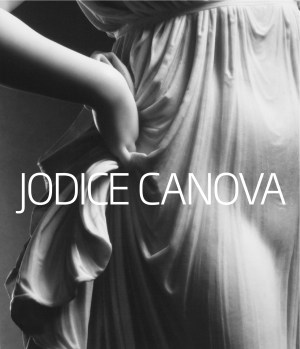 A disquiet expressed with a timeless vision. The decision to pay homage to Antonio Canova could not but start out of the encounter with the man who, back in 1992, had already understood his sculptures and captured their essence in images that have themselves become works of art. This man, this contemporary artist, could only be Mimmo Jodice. He is not only a photographer of art but a person with a keen gaze and vision who has decided to tackle perhaps the most complex sculptor of all time. Jodice chose to approach Canova with love and intellectual nobility and now, through a fascinating series of unprecedented details, is offering us a new, contemporary, conceptually lucid, authoritative, and captivating view of one of the greatest artists in history.
Giuliana Ericani was born in Trieste and graduated in Art History with Rodolfo Pallucchini at the University of Padua. She
is the director of the museums at Bassano del Grappa.
Exhibition | Augustus the Strong’s Festival of the Planets

Johann Friedrich Wentzel, Elector Friedrich Augustus (II) of Saxony
and Archduchess Maria Josepha of Habsburg, 1719.
◊ ◊ ◊ ◊ ◊
From the Staatliche Kunstsammlungen Dresden:
Constellation Felix: Augustus the Strong’s Festival of the Planets and
Thomas Ruff’s Stellar Constellations
Neues Grünes Gewölbe and Residenzschloss, Dresden, 13 March — 9 June 2014
‘Constellation Felix’—a fortunate stellar constellation—is the motto of one of the most significant celebrations of the Baroque era: the 1719 Festivals of the Planets held by Augustus the Strong in Dresden. The king staged the event to mark the marriage of his son Frederick Augustus (II) to Archduchess Maria Josepha of Habsburg, a link on which he pinned the lofty hope of securing the Imperial crown for his royal house. For a whole month in the late summer, every day brought new attractions at various sites in the royal capital and its surroundings. One set of increasingly extravagant highlights were the festivals dedicated to the planets: fireworks for Apollo / Sol; jousting and foot tourneys for Mars, the god of war; Four Elements tilting games for Jupiter; a waterfowl hunt for Luna / Diana, the goddess of hunting; a Banquet of the Nations and fair for Mercury; jousting for ladies’ favours to honour Venus, the goddess of love; and finally a mine festival for Saturn.

Johann August Corvinus after Matthäus Daniel Pöppelmann (?), Fireworks on the Elbe at the Dutch Palace, 1719.
Since ancient times, all life on Earth had been seen as an integral part of a higher cosmic order, leading artists and creative minds to explore the topic of the planets. Our fascination with the stars and yearning for the endless depths of space has not left us today, as Thomas Ruff’s commanding large-format photographic works make tangibly clear. Like no other artist, he explores the limits of visual conceivability, or—to put it another way—the invisibility of the celestial bodies, a topic probed in his series Sterne, Cassini, and m.a.r.s.
In comparing the universal Baroque imagery and contemporary photography of celestial bodies, the exhibition reveals an anthropological constant: our
lingering excitement and awe at the secrets of space,
despite the Enlightenment and modern sciences
Exhibition | Enlightenment and Beauty: Houdon and Clodion
Press release (20 March 2014) from The Frick:
Enlightenment and Beauty: Sculptures by Houdon and Clodion
The Frick Collection, New York, 1 April 2014 — 5 April 2015
Curated by Denise Allen and Katie Steiner with Alyse Muller
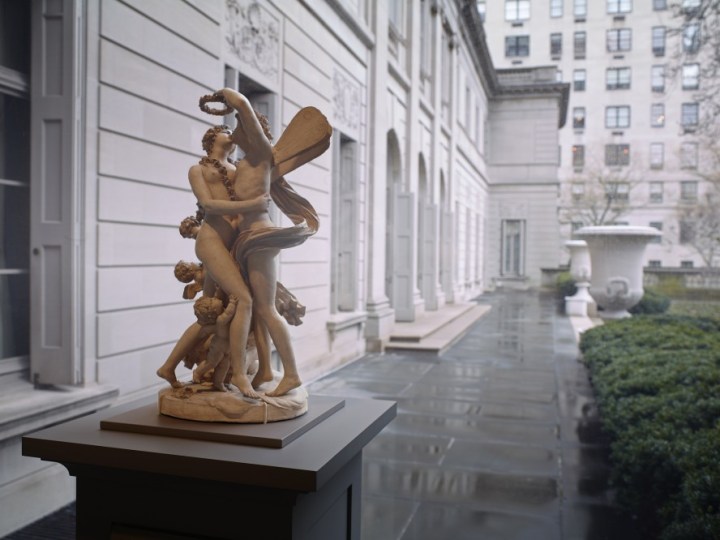
Installation view of Enlightenment and Beauty: Sculptures by Houdon and Clodion in the Frick’s Portico Gallery, with Clodion’s Zephyrus and Flora in the foreground. Photo by Michael Bodycomb.
◊ ◊ ◊ ◊ ◊
The age of Enlightenment, which flourished in France in the eighteenth century, centered on the belief that social and moral advancements stemmed from the application of reason and knowledge. In looking forward to the future, some of the greatest thinkers and artists of the period also looked to the achievements of the ancient past as foundation for modern progress. Two of the foremost French sculptors of the late eighteenth century—Claude Michel, called Clodion (1738–1814), and Jean- Antoine Houdon (1741–1828)—used the language of the antique to articulate the flowing grace and expressive naturalism that typified the contemporary art of the period. These artists are celebrated at The Frick Collection in the exhibition Enlightenment and Beauty: Sculptures by Houdon and Clodion, on view in the Portico Gallery.

Jean-Antoine Houdon, The Comtesse du Cayla, 1777, marble, The Frick Collection; photo: Michael Bodycomb.
The installation illuminates Houdon and Clodion’s defining contributions to the art of the Enlightenment by presenting a selection of their works from the Frick’s holdings. These objects, assembled by Henry Clay Frick, his daughter Helen Clay Frick, and more recent gifts and purchases, will rotate throughout the year- long presentation with rarely seen loans from private collections (twelve objects will be on view at all times, with seasonal changes enhancing the presentation). Among them are portrait busts, reliefs, figure groups, and (for the later part of the show’s run), Houdon’s remarkable, life-size terracotta Diana the Huntress, considered one of the Frick’s masterpieces. Together, the sculptures highlight the freedom of the artists’ responses to classical motifs, which they interpreted in marble and terracotta with the realism, beauty, and astonishing technical facility that testify to the innovative spirit of the age. The exhibition is organized by Denise Allen, Curator, and Katie Steiner, Curatorial Assistant, with Alyse Muller, Ayesha Bulchandani-Mathrani Curatorial Intern. Support for the presentation is generously provided by Margot and Jerry Bogert and Mrs. Henry Clay Frick II.
At the outset of their careers, both Houdon and Clodion followed similar paths, studying at the French Royal Academy in Paris and winning the prestigious Prix de Rome for sculpture. This award enabled them to travel in the 1760s to the French Academy in Rome, where they overlapped for a time and engaged first-hand with the antique. In Italy and during their mature years in the French capital, the two artists adapted their deeply internalized knowledge of classical art to suit distinct creative objectives, exemplified by Houdon’s exquisite marble portrait busts and Clodion’s lively terracottas. They maintained, however, a shared commitment to the models of antiquity as well as direct observation from life.
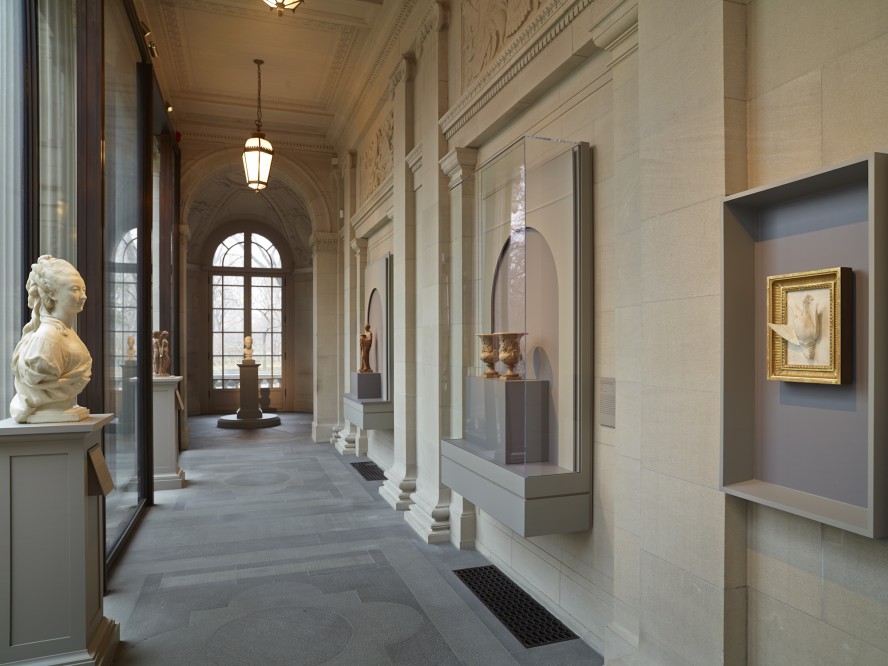
Installation view of Enlightenment and Beauty: Sculptures by Houdon and Clodion in the Frick’s Portico Gallery. Photo by Michael Bodycomb.
◊ ◊ ◊ ◊ ◊
Clodion’s Early Inspiration by the Antique

Claude Michel, called Clodion, The Cupid Seller (La marchande d’amours), c. 1765–70, terracotta, anonymous loan. Photo by Michael Bodycomb.
Works in the exhibition dating to or shortly after Houdon and Clodion’s foundational periods in Rome convey their inventive, rather than dryly imitative, treatment of antique prototypes even in the early phases of their careers. Two related reliefs of La marchande d’amours (The Cupid Seller) by Clodion, who lived in Italy from 1762 to 1771, offer a case in point. The panels portray a youthful vendor who eagerly proffers the promise of love—embodied by a winged cupid—to a buyer and her attendant. Clodion’s composition closely mirrors that of a renowned ancient wall painting discovered near Herculaneum in 1759, which was soon after reproduced in engravings. The artist departs from his two-dimensional source, however, by translating it into low-relief sculpture. In his terracotta relief, he uses raised modeling to emphasize the female figures’ profiles and pleated garments and delicate incising to indicate the graceful contours of their limbs, which recede into space. Clodion’s skillful handing of the clay softens the topical character of the scene in the Roman original, and endows his intimately-scaled work with a charming quality suited to the playful sensibilities of eighteenth-century France. The marble version of the relief attests to the appeal of the Cupid Seller subject as well as the success of Clodion’s terracotta, which likely inspired the subsequent commission in the more costly material. The panel also illustrates the artist’s versatile adaptation of the composition to suit a different medium, as he replaces gestural modeling in clay with refined carving in marble to convey the stately, eternal permanence of his highly classicized figures.
The Impact of the Antique upon Houdon
The earliest sculpture by Houdon in the exhibition, an understated yet remarkable terracotta statuette, suggests the direct impact of the antique on the artist while immersed among the treasures of Rome, where he worked for four years beginning in 1764. His elegant, draped female figure replicates a life-size marble statue in the Capitoline Museum, identified at the time as Pandora or Psyche. Houdon reimagines the figure as a follower of Vesta, the Roman goddess of the hearth whose temple attendants—known as vestals and sworn to a vow of chastity—guarded a perpetual flame. With a serene, blank-eyed expression and draped hands holding an urn of the sacred fire, Houdon’s vestal exhibits the grace and modesty befitting her role. In keeping with the Enlightenment’s emphasis on the individual, the artist downplays the austere, generic qualities of his antique prototype in favor of humanizing the vestal through the subtle, animated sway of her stance and the gentle turn of her head. As a student of anatomy who observed nature as closely as the antique, Houdon suggests the form of the statuette’s figure, (note, especially, her bent knee), beneath the delicately articulated folds of her garment. The work also shares a connection to the Frick family, since a plaster version of the Vestal (now in the Frick Art & Historical Center, Pittsburgh) was acquired in the 1930s by Helen Clay Frick, an ardent admirer of Houdon who praised him as “. . . one of the greatest sculptors of all times” in her unpublished monograph on the artist. On loan from a private collection, the terracotta statuette is featured in the exhibition from its April opening through September 2014.
Endowing Later Works with a Contemporary, Naturalistic Spirit
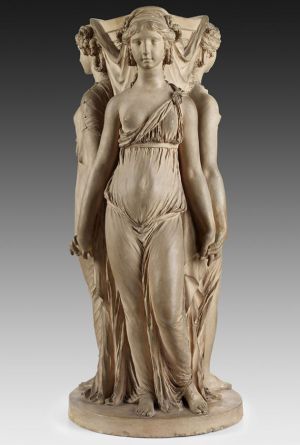
Claude Michel, called Clodion, Three Graces, early 1770s, terracotta, private collection. Photo by Michael Bodycomb.
Back in Paris, both Houdon and Clodion continued to rely on the classical tradition as they explored increasingly ambitious and expressive compositions. Two similar works by Clodion in Enlightenment and Beauty straddle the divide between the artist’s youth and maturity and attest to the development of the heightened lyricism that is the hallmark of his sculpture. The earlier work in this group, likely made in France in the wake of his Italian sojourn, portrays the Three Graces as caryatids, or female figures serving as architectural pillars. Demonstrating his signature skill in highly finished terracotta, Clodion reduces the monumental scale of prototypes from classical buildings while preserving the figures’ weight-bearing function, in this case for a marble basin now lost. The artist, however, embellishes upon the traditional, single-figure caryatid by encircling the Graces, who link hands in accordance with custom, around a central column. Subtle variations in the figures’ poses, elaborate coiffeurs, and classical costumes enliven the ordered rhythm of the composition, endowing it with a contemporary, naturalistic spirit.
Clodion’s continued interest in animated caryatids emerges in a second treatment of this theme in the exhibition, which postdates the Three Graces by nearly twenty years and pushes the nascent experiments it embodies to daring new heights. The artist’s Dance of Time: Three Nymphs Supporting a Clock, acquired by the Frick in 2006, features an extraordinary trio of gamboling figures that serve as a base for an equally spectacular, glass-enclosed timepiece by the renowned French horologist Jean-Baptiste Lepaute (1727–1802). With boldly outstretched limbs, the carefree nymphs of Clodion’s terracotta nearly break free from the fluted pillar they surround, playfully flouting their role as buttresses. The circular momentum of their joyous dance, suggested by their billowing draperies, proceeds in harmony with the rhythm of the clock’s pendulum and the horizontal rotation of its dial. Together, Clodion’s exuberant nymphs and Lepaute’s ingenious device form a unified expression of the grace, modernity, and classicism that epitomize the art of the Enlightenment. At the start of the exhibition, this work will be on view in its customary location in the Fragonard Room, joining the installation in the Portico in July and remaining there through the rest of the run.
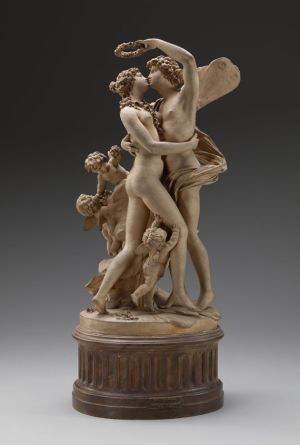
Claude Michel, called Clodion, Zephyrus and Flora, 1799, terracotta, The Frick Collection. Photo by Michael Bodycomb.
The latest work by Clodion presented in the exhibition exemplifies the poise and enchanting beauty for which his statuettes were celebrated. Dating to 1799, the small-scale terracotta figure group on page one of this release depicts Zephyrus, the god of warm, westerly winds, embracing the lithe body of Flora, the goddess of flowers, as he crowns her with a wreath of roses. The attributes identifying the subjects, such as the breeze-blown drapery encircling Zephyrus and the putti scattering flowers near Flora, offer a bravura demonstration of Clodion’s mastery at modeling in clay. Although the artist draws his subjects from the antique, he interprets them using an imaginative approach to nature that expresses the ideals of the period. As a culminating statement, Zephyrus and Flora provides a particularly apt illustration of biographer Antoine Digné’s comments on the artist in 1814: “The admiration that the precious remains of Greek and Roman antiquities inspired in [Clodion] did not close his eyes to the beautiful works that had been created by some of the moderns; and, while studying the great masters, he sought, as they did, truth and beauty in nature.”
The validity with which Digné’s incisive observations apply to Houdon as well as Clodion is striking, especially in reference to the former’s portrait busts. Enlightenment and Beauty features several important examples of Houdon’s work in this genre, for which he achieved great renown. Carved in marble with the same refined skill that Clodion brought to his modeling, Houdon’s portraits adopt the format of truncated classical busts, yet he transcends that convention through his extraordinary mode of naturalistic representation, derived from close observation from life. In Rome, while making careful studies of ancient art and human anatomy, the artist learned the process of plaster casting, which allowed him to create masks of his sitters’ features and enhance the accuracy of his carved likeness. His attention to the distinct qualities of his subjects, as well as the growing demand for portraits, reflect the prominence of the individual during the Enlightenment.
Houdon and the Portrait Bust: A Fluid Approach
Although one of the earlier busts by Houdon in the exhibition is an allegorical representation rather than a portrait, the artist approaches the work with the same specificity that defined his portrayals of his contemporaries. Taking his subject from popular anecdote, Houdon depicts the Young Lise, a provincial girl who arrived in Paris under the naïve assumption that husbands as well as weddings would be offered to eligible maidens during a municipal celebration. Houdon endows his imaginary depiction of Lise, who gazes demurely downward, with
palpable reality through the virtuosic naturalism of his carving. He expertly modulates the textures of her smooth, unblemished features and bountiful hair bound beneath a wide ribbon, rendering the rear bow in daringly thin, pierced marble. By adopting the idiom of a classical bust, Houdon elevates his subject to that of a timeless manifestation of youthful innocence. This special loan is featured in the exhibition from April through June.
In the same way that Houdon’s bust of Lise personifies a concept, his portrait of Élisabeth-Susanne de Jaucourt, comtesse du Cayla (shown on page one), depicts the young noblewoman embodying the role of a bacchante, or female follower of Bacchus. The grape leaves across her breast, as well as her windswept hair and sidelong glance, suggest that she is turning to run or dance in celebration of the god of wine and revelry. Through his use of Bacchic imagery, Houdon not only alludes to the comtesse’s husband’s family name, Baschi, but also explores the possibilities of the portrait bust format to convey motion. The classical guise she adopts and the animation of her pose thus enables the artist to portray her sprightly youth as well as her handsome features, offering a more complete and intimate suggestion of her character to Enlightenment audiences.
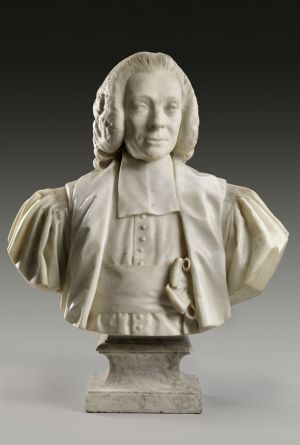
Jean-Antoine Houdon, Armand-Thomas Hue, Marquis de Miromesnil, 1777, marble, The Frick Collection. Photo by Michael Bodycomb.
The contrast between the exuberant Comtesse du Cayla with two other, more restrained busts in the exhibition conveys Houdon’s fluid approach to portraiture and the classical tradition, which he adapted to suit his distinct aims and the individual qualities of his sitters. In his bust of Marie Anne de Vastre, wife of German banker Pierre-François His, Houdon unites the dignity of a Roman portrait with close observation from life to depict his subject’s external appearance as forcefully as her noble bearing and intelligence. In contrast to the downwardly tumbling curls of her elaborate coiffeur and the flowing undulations of her mantle and chemise, Madame His holds her head erect and looks outward with a direct gaze. Through the uncanny realism of her carved eyes, in which minute reserves of marble serve as highlights in the darker recesses of her drilled pupils, Houdon suggests the sharpness of her intellect.
The artist’s use of the classical bust format to convey Madame His’s stately self-possession is echoed in his portrait of Armand-Thomas Hue, Marquis de Miromesnil. With his buttoned cassock, sash, and voluminous robe, the Marquis wears the costume of his august office as France’s Minister of Justice, a role he held for thirteen years
beginning in 1774. The crisp articulation of the garments is distinct from the delicately textured carving that defines the sitters wig and frames his fleeting expression, which conveys Miromesnil’s quickness of mind. The taught lines around the Marquis’s mouth, like the slightly parted lips of Madame His, suggest that he is on the verge of speaking, lending lifelike animation to the bust. As a critic commented in 1783, “M. Houdon lacks only the means to make his portraits speak, since in likeness he lacks nothing.” By pushing the expressive possibilities of marble to new heights, Houdon not only communicates the personalities of his subjects, but also allows them to speak across time about the rationality and admiration of the classical past that were central to the Enlightenment.

Installation view of Enlightenment and Beauty: Sculptures by Houdon and Clodion in the Frick’s Portico Gallery with back view of Houdon’s Young Lise in the Guise of Innocence in the foreground. Photo by Michael Bodycomb.
Exhibition | Pierre-Antoine Demachy (1723–1807)
Adapted from the Office of Tourism of Versailles:
Le Témoin Méconnu: Pierre-Antoine Demachy (1723–1807)
Musée Lambinet, Versailles, 15 February — 18 May 2014
 The Musée Lambinet in Versailles dedicates a unique exhibition to Pierre Antoine Demachy. This little-known artist of the eighteenth century, whose work has never before been showcased in a single exhibition, is a fabulous witness of his time. Strongly influenced by Italian art, Demachy applied to Paris cityscape types practiced by Canaletto and Guardi. He was among the artists whom the Empress Catherine II of Russia in 1768 placed an order through its ambassador to France, and the Count of Angivillers purchased for Louis XVI a view of the Seine at the Salon of 1783.
The work of Demachy will be presented through the following seven themes:
• Architectural whims and fantasy views
• Views related to the Louvre
• Demolition of churches and fire the Foire Saint-Germain
• Church interiors
• Other views in and around Paris
• Historic Events
• Views of the Seine and cityscapes
The press release, which includes a checklist of the major works exhibited, is available here»
◊ ◊ ◊ ◊ ◊
The catalogue is available from Artbooks.com:
Françoise Roussel-Leriche and Marie Petkowska Le Roux, Le Témoin Méconnu: Pierre-Antoine Demachy, 1723–1807 (Paris: Magellan, 2014), 216 pages, ISBN: 978-2350742809, $55.
Exhibition | Things We Do in Bed
From the exhibition description at Art Daily:
Things We Do in Bed
Danson House, Bexleyheath, Kent, 1 April — 31 October 2014
Curated by Tracy Chevalier
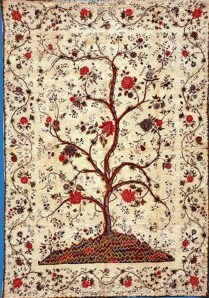
Tree of Life Quilt cropped, detail, c.1810 (Jen Jones Welsh Quilt Centre)
Things We Do in Bed celebrates quilts and their continuing links to what goes on behind the bedroom door. Featuring quilts and quilt works dating from the 18th and 19th centuries, alongside contemporary work, the exhibition is displayed through the five bedrooms in Danson House, with each room focusing on a different bed activity: Birth, Sleep, Sex, Illness, Death.
The exhibition features a lively mix of antique and contemporary quilts including:
• intricate 18th- and 19th-century cot quilts with quilted feathers and flowers and colourful patchwork designs
• a new ‘sleep quilt’ from Fine Cell Work, a charity that teaches prisoners to sew; prisoners all over the UK were asked to make squares exploring their feelings about sleep, and join them together in this quilt
• Karina Thompson’s quilt which captures an echocardiogram examining the maker’s heartbeats
• Grayson Perry’s Right to Life quilt, made as a provocative response to the abortion debate in the USA
 • Sue Watters’ hand stitched quilt, Unchained Melody which she made sitting by her husband’s side while he was in the final stages of Alzheimer’s, with sewing and music as her solace
Tracy Chevalier is an internationally bestselling author of seven novels. In her most recent book, The Last Runaway, her heroine is a quilter. As well as learning a lot about quilts, Tracy learned to quilt by hand. As she says: “Since researching quilts for my last novel, I have fallen hard for the varied and miraculous artistry of quilting. With this show I explore how quilting relates to bedroom activities, in both practical and abstract ways. For traditionalists, there are jaw-dropping examples of antique quilt-making. For contemporary art lovers, there are works that push boundaries and emotions.”
◊ ◊ ◊ ◊ ◊
Hannah Duguid writes about the exhibition for The Independent (8 April 2014).










 Enfilade
leave a comment