Exhibition | Making America: Myth, Memory, and Identity
Next fall at the VMFA:
Making America: Myth, Memory, and Identity
Virginia Museum of Fine Arts, Richmond, 12 September 2015 — 3 January 2016
Other venues to be announced
Making America will be the first full-scale multimedia investigation of America’s most enduring cultural phenomenon—the Colonial Revival. Featuring approximately 200 paintings, sculptures, works on paper, photographs, decorative arts, architectural and landscape designs, costumes, and popular culture ephemera—dating from the late 18th century to the present day—VMFA’s landmark exhibition expands the chronological and geographic boundaries of the regionally diverse, multicultural revival. More than just a style or movement, this ongoing hybrid impulse draws from the historical past to understand the present through the creative use of iconic forms and motifs. Making America will explore how and why this desire to revisit—and reinterpret—the past has shaped America’s visual landscapes, ideologies, and collective memories in times of celebration and crisis.
Making America, which will travel nationally, is organized by the curatorial team of University of Virginia Commonwealth Professor Dr. Richard Guy Wilson; Dr. Sylvia Yount, VMFA Chief Curator and Louise B. and J. Harwood Cochrane Curator of American Art; and her museum colleagues Dr. Susan J. Rawles, Assistant Curator of American Decorative Art, and Christopher Oliver, Assistant Curator of American Art, all of whom will contribute to the accompanying scholarly catalogue.
Exhibition | Rococo to Revolution: 18th-Century French Drawings

Jean-Baptiste Greuze, The Father’s Curse: The Ungrateful Son, ca. 1778
(Los Angeles: The J. Paul Getty Museum)
◊ ◊ ◊ ◊ ◊
From the press release (17 June 2014) for the upcoming exhibition:
Rococo to Revolution: 18th-Century French Drawings from Los Angeles Collections
J. Paul Getty Museum, Getty Center, Los Angeles, 1 July – 21 September 2014
Curated by Edouard Kopp
For nearly three-quarters of a century, from the death of Louis XIV in 1715 to the Revolution of 1789, France’s intellectual and artistic landscape flourished, reaching new levels of splendor and accomplishment. During this period, when inventiveness was greatly valued, drawing exemplified the creative impulse perhaps more than any other artistic medium. Through outstanding examples by of some of the period’s most acclaimed artists, the art of drawing is celebrated in Rococo to Revolution: 18th-century French Drawings from Los Angeles Collections, on view July 1–September 21, 2014 at the J. Paul Getty Museum, Getty Center. The exhibition includes more than 40 drawings from the J. Paul Getty Museum’s collection, complemented by works from distinguished private collections in Los Angeles.
“Drawing contributed to an aesthetic evolution in France, starting with the decorative exuberance of the Rococo, and gradually giving way to the austerity of Neoclassicism,” explains Timothy Potts, director of the J. Paul Getty Museum. “This exhibition tracks that evolution through the work of some of the finest artists of the 18th century, highlighting works in our collection alongside generous loans from local collections. We are fortunate and grateful to be able to exhibit these rarely-seen works.”
Featured in the exhibition is work by artists such as Jean-Antoine Watteau, François Boucher, Gabriel de Saint-Aubin, Henri-Pierre Danloux, Jean-Honoré Fragonard, Jean-Baptiste Greuze, and Jacques-Louis David, among others.

Jean- Antoine Watteau, Woman Seated with a Fan, c. 1717 (Los Angeles: J. P. Getty Museum)
“While drawing was most often used in preparation for paintings, prints, sculpture or architecture, many of the drawings created in that period were works of art in their own right,” explains Edouard Kopp, associate curator of drawings at the J. Paul Getty Museum. “Drawings were avidly collected at the time, as connoisseurs much appreciated the insights into the creative process that such works offered. This pursuit is continued with enthusiasm by the Getty Museum and private collectors in Los Angeles today.”
Indeed, artists during this period elevated drawing to new heights. In The Swing (late 1730s or early 1740s), François Boucher (French, 1703–1770) revives the pastoral genre, portraying figures at play on a log turned seesaw, with their elegant dress belying the country setting in typical Rococo fashion. Boucher shows a virtuosic command of black chalk, creating a wide array of marks from short flicks to zigzags. Among the most dazzling drawings in the exhibition is Two Studies of a Flutist and a Study of the Head of a Boy by Jean-Antoine Watteau (French, 1684–1721). Executed in a spontaneous yet highly sophisticated combination of red, black, and white chalk, the sheet evokes the flow of music and Watteau’s passion for it. A master of suggestion, the draftsman has captured the undulating, rhythmic motion of a flute player in two distinct poses, while a young observer appears to be listening intently, enraptured by the concert.
Some of the works in the exhibition reflect political leanings. Henri-Pierre Danloux (French, 1753–1809) was the most sought-after portraitist by the French aristocracy in the 1780s. In Portrait of a Young Lady in Profile (about 1783–85), Danloux’s skill is apparent in a remarkably lifelike depiction of a woman, her layers of soft curls and striped, ruffled dress rendered with loose black lines. Her parted lips demonstrate immediacy, rather than a static moment. An outspoken rival of the royalist Danloux, Jacques-Louis David (French, 1748–1825) created Portrait of Andre-Antoine Bernard, called Bernard de Saintes (1795) while imprisoned for revolutionary activities. The portrait is a bust-length profile in a medallion format that recalls ancient coins. However, David undermined the classical association with that genre by depicting the sitter crossing his arms defiantly and wearing a distinctive hat and an intense expression that identified him as a revolutionary.
Family drama was also a popular theme in the later 1700s. One of the greatest draftsmen of all time, Jean-Honoré Fragonard (French, 1732–1806) evokes the frenzied joy of family life in Making Beignets (about 1782). Fragonard is able to turn the simple act of making sweets into a celebration, as a roiling mound of forms and faces are imbued with energy using a flurry of rapid-fire graphite lines, a warm brown wash, and the luminous quality of the paper itself. In Jean-Baptiste Greuze’s (French, 1725–1805) The Father’s Curse: The Ungrateful Son (about 1778), a scene of violent family discord is handled with a degree of seriousness and theatricality normally reserved for grand historical subjects: the artist indeed creates dramatic figural poses and strong contrasts of light and shadow.
Conversely, the revolutionary sentiment at the time was slyly referenced in ancient scenes by David such as The Lictors Bringing Brutus the Bodies of His Sons (1787). David illustrates the story of Roman consul Lucius Junius Brutus, who, upon hearing that his sons have conspired to overthrow his government, orders them executed for treason. David chooses the moment when Brutus is presented with their bodies, his own figure placed in the dark foreground. This drawing conveys a sense of struggle between patriotic duty and familial loyalty, which David intended to be morally edifying for the public, not long before France entered years of political turmoil.
Rococo to Revolution: 18th-Century French Drawings from Los Angeles Collections, is on view July 1–September 21, 2014 at the J. Paul Getty Museum, Getty Center. The exhibition is curated by Edouard Kopp, associate curator of drawings at the J. Paul Getty Museum.
For related events see the full press release…Exhibition | How Glasgow Flourished, 1714–1837
◊ ◊ ◊ ◊ ◊
From the Kelvingrove Art Gallery:
How Glasgow Flourished, 1714–1837
Kelvingrove Art Gallery and Museum, Glasgow, 18 April — 17 August 2014
How Glasgow Flourished takes a fresh look at a hugely significant but often overlooked period in Glasgow’s history. Discover how over 300 years ago, Glasgow’s businessmen made their fortunes from trading in colonial goods and through slave labour, and how they manufactured and exported products made in Glasgow, across the world. This was also when ordinary Glaswegians came together in workers’ associations and co-ops to campaign for better working and living conditions for them and their families and paved the way for the Trade Union movement.
The exhibition shows how weaving changed from a cottage industry to a full-blown manufacturing industry and green fields were covered over by some of the largest and most advanced dyeing and smelting factories in the world. You can see a reconstructed weaver’s loom, factory engines and dresses and outfits, which have never been displayed before. Other exclusive displays include new portraits of members of one of Glasgow’s wealthiest families, the Glassfords and a newly conserved music organ made by James Watt, as well as the great man’s steam engine with its condenser unit. There are also many other pieces from Glasgow Museums’ collection that have never been on display before, including art and objects relating to the lives of Glaswegians.
Exhibition | Design and Fashion: Norway 1814
◊ ◊ ◊ ◊ ◊
Now on display in Oslo:
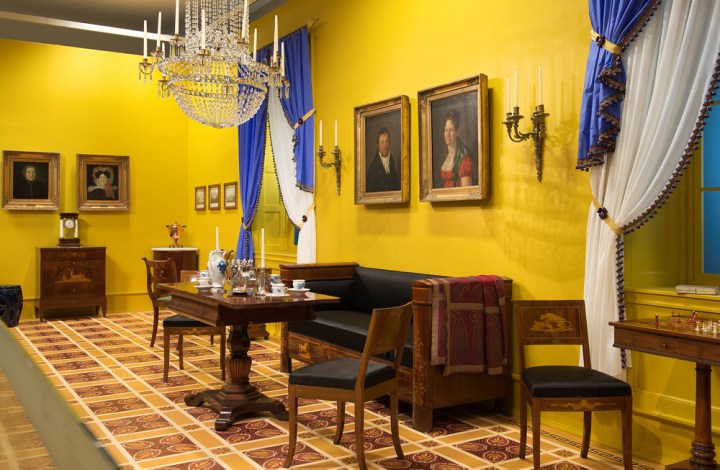
Design and Fashion: Norway 1814
Museum of Decorative Arts and Design, Oslo, 2 February — 31 August 2014
To celebrate the bicentennial of Norway’s constitution, the National Museum presents three historical exhibitions under the common title Norway 1814, in three different venues: the National Gallery, the Museum of Decorative Arts and Design, and the National Museum. These exhibitions will explore the art of the period in a new light. Visitors will be able to view many works that have rarely if ever been shown in public before. The exhibition is accompanied by a packed programme of events aimed at a broad audience, and a variety of educational activities for children and young people.
Furniture, glass, ceramics, fashion and architecture all express new ideas about democracy and national independence in the transitional period from the opulent splendour of the rococo to the simplicity of the Empire style, which built on the ideals of antiquity. Trade relations with foreign countries and the development of Norwegian industry were other important factors that influenced new ideas about design and fashion in these decades.
The exhibition at the Museum of Decorative Arts and Design presents, among other things, the magnificent residence of the Anker family known as the Paleet, which in 1814 became the royal residence of Christian Frederick and, later, of Karl Johan, Norway’s first king during its union with Sweden. The exhibition presents objects from the National Museum’s collection together with artefacts loaned from other national and international collections.
The Burlington Magazine, June 2014
The eighteenth century in The Burlington:
The Burlington Magazine 156 (June 2014)
 A R T I C L E S
• Meredith M. Hale, “Amsterdam Broadsheets as Sources for a Painted Screen in Mexico City, c. 1700,” pp. 356–64.
European print sources for a twelve-panel screen made in Mexico City (c. 1697–1701).
• Alvar González-Palacios, “Giardini and Passarini: Facts and Hypotheses,” pp. 365–75.
New documents on the gold- and silversmith Giovanni Giardini (1646–1721).
• Koenraad Brosens and Guy Delmarcel, “Raphael’s Acts of the Apostles: Italians in the Service of the Habsburg Monarchy and the Leyniers Tapestry Workshop, 1725–55,” pp. 376–81.
A seven-part series of tapestries made by Daniel Leyniers (1752–54) in the Villa Hugel, Essen, based on Raphael’s Acts of the Apostles (woven 1516–21).
R E V I E W S
• Simon Jervis, Review of the exhibition William Kent: Designing Georgian Britain, pp. 391–94.
• Christopher Baker, Review of Christopher Rowell, ed., Ham House: 400 Years of Collecting and Patronage (The Paul Mellon Centre for Studies in British Art and the National Trust, 2013), pp. 398–99.
• Kate Retford, Review of the exhibition catalogue Moira Goff et al, Georgians Revealed: Life, Style, and the Making of Modern Britain (British Library, 2013), p. 401.
• David Pullins, Review of the exhibition From Watteau to Fragonard: Les Fêtes Galantes, pp. 408–10.
• Philippe Bordes, Review of the exhibition Le Goût de Diderot, pp. 413–15.
Exhibition | Satires: Caricatures Genevoises et Anglaises du XVIIIe Siècle
Now on view in Geneva:
Satires: Caricatures Genevoises et Anglaises du XVIIIe Siècle
Musées d’Art et d’Histoire de Genève, 16 May — 31 August 2014
 Dans la seconde moitié du XVIIIe siècle, Genève voit naître plusieurs artistes au talent satirique avéré, tels Jean Huber l’Ancien ou Wolfgang-Adam Töpffer. La France est alors le premier modèle de l’art «sérieux» pour les Genevois, mais ce sont les productions anglaises qui nourrissent leur verve comique et parfois férocement critique à l’égard des mœurs, de la politique ou de la religion de leur temps. Si le lien entre les artistes locaux et leurs illustres contemporains anglais, tel William Hogarth, a souvent été souligné par les historiens de l’art, jamais il n’a été présenté au public sous la forme d’une exposition. Le Cabinet d’arts graphiques se propose de combler cette lacune.
The exhibition flyer is available here»
The press release is available here»
Exhibition | The Fortunes of the Italian Primitives, ca. 1800
From the exhibition website:
La Fortuna dei Primitivi: Tesori d’Arte dalle Collezioni Italiane fra Sette e Ottocento
The Fortunes of the Primitives: Art Treasures from Italian Collections
between the Late Eighteenth and Nineteenth Centuries
Galleria dell’Accademia, Florence, 24 June — 8 December 2014

Libro d’Ore di Lorenzo de’ Medici, Annunciazione (Firenze, Biblioteca Medicea Laurenziana, Ms. Ashb. 1874, c. 13v)
This exhibition is the first ever dedicated to the topic as a whole. It proposes to offer a critical-bibliographic picture of this very important cultural phenomenon concerning the history of taste and collecting in Italy between the late XVIII century and early XIX century. Among other things, this phenomenon exerted a considerable and direct influence on the formation of the major public art collections in the most important European countries.
The exhibition begins with the fundamental contribution of Giovanni Previtali (La fortuna dei primitivi. Dal Vasari ai Neoclassici, Turin, 1964), published exactly fifty years ago. With a scientific committee made up of art historians, historians of collecting and art critics, the exhibition intends to delve into this theme that to date has been relatively neglected. Significant progress has been made since the pioneering studies of Venturi, Previtali, Haskell and Pomian. The time is therefore ripe to reflect on this phenomenon and, especially, on the people who collected works by the primitives, to some extent systematically (and therefore not occasionally), and on those who strove to lay hands on these panel paintings with precious gold grounds (merchants, agents, procurers and restorers). Singling out Florence as the privileged site for an exhibition like this one is practically a foregone conclusion, given the wealth the Tuscan-Florentine area has had historically in the production of artworks in the fourteenth and fifteenth centuries. Almost all the collections of primitives indeed boasted works from this geographic area.
The exhibition will review the principal personalities who were in the forefront of this recovery, exponents of the church (from simple abbots to powerful cardinals), as well as noblemen and scholars who could not resist the attraction of these fragile and precious artistic representations. The rooms will therefore exhibit works of art (paintings, sculptures, objects of sumptuary art and illuminated codices) that were once in the collections of Francesco Raimondo Adami, Stefano Borgia, Angelo Maria Bandini, Alexis-François Artaud de Montor, Joseph Fesch, Teodoro Correr, Girolamo Ascanio Molin, Alfonso Tacoli Canacci, Sebastiano Zucchetti, Anton Francesco Gori, Agostino Mariotti, Matteo Luigi Canonici, Giuseppe Ciaccheri, Tommaso degli Obizzi, Gabriello Riccardi, Giovan Francesco De Rossi and Guglielmo Libri, to cite only the best-known names.
An animated dialogue will accompany visitors along a sort of ideal stroll through the Italy of collectors from the late XVIII century to the early XIX century. Visitors will be encouraged to make quick visual comparisons aimed at grasping the taste, the eye and the aesthetic sensitivity of the various collectors whose collections will be compared for the first time. Alongside paintings that at that time constituted the principal interest of collectors, there are other, equally important sections tied to illuminations and sculpture. The intention is to show the circularity of interests of collectors who with a pioneering approach sought to preserve these historical-scholarly representations, every day threatened by the risk of destruction or abandon.
The very numerous visitors of the Galleria dell’Accademia will thus be able to appreciate a selection of works of art of high and, in many cases, of the highest level, based on a serious scientific project, which will offer yet another confirmation of the heights of quality Italian art attained from the XIII to the XV century. The artists whose work will be on display in this exhibition include, among others, the Master of Magdalene, Arnolfo di Cambio, Bernardo Daddi, Taddeo Gaddi, Nardo di Cione, Lippo Memmi, Ambrogio Lorenzetti, Pietro da Rimini, Beato Angelico, Filippo Lippi, Andrea Mantegna, Cosmè Tura, Piermatteo d’Amelia and Giovanni Bellini. The exhibition catalogue is expected to constitute the till-now inexistent text of reference dedicated to this specific theme taken as a whole.
The catalogue will be available from ArtBooks.com:
Angelo Tartuferi and Gianluca Tormen, eds., La Fortuna dei Primitivi: Tesori d’Arte dalle Collezioni Italiane fra Sette e Ottocento (Firenze: Giunti, 2014), $78.
Exhibition | Art and Politics: The Electress Palatine

From the Museo delle Cappelle Medicee:
Art and Politics: The Electress Palatine and the Final Season of Medici Patronage in San Lorenzo
Museum of the Medici Chapels (Cappelle Medicee) Florence, 8 April — 2 November 2014
Curated by Monica Bietti
There are many reasons for paying due tribute to the Electress Palatine, Anna Maria Luisa de’ Medici (1667–1743), the last descendent of the Grand-ducal branch of the Medici dynasty. Indeed the last years of her life—following the death of her brother the last Medici Grand Duke Gian Gastone—were intimately bound up with the present and future life of her State, for the safeguarding of which she drafted the “Family Pact,” the fundamental document that guaranteed the protection and conservation of the heritage of the Medici within their city and their State.
The idea for the exhibition stemmed from a 2012 project organised in collaboration between the REM museums of Mannheim—which wished to honour the memory of the Electress who lived and reigned in Germany following her marriage to the Elector Palatine Johann Wilhelm von Pfalz Neuburg, from 1691 to 1716—the Museum of the Medici Chapels, the Faculty of Medical Surgery of the University of Florence and the Superintendencies for the Archaeological Heritage of Tuscany, for the Architectural, Landscape, Historic, Artistic and Ethno-Anthropological Heritage of the Province of Florence and the Opificio delle Pietre Dure. This project led, between the 8th and 22nd October of 2012, to the control of the state of conservation of the mortal remains of the Electress and the rehabilitation of the tomb as well as the restoration of part of the important collection of grave goods. The Museum of the Medici Chapels decided to illustrate to the public the results of this research and restoration by organising this exhibition, centred in particular on the last years of life of the Electress.
Among the outcomes of the control of the tomb and the remains of the last descendent of the Medici, the show displays to the public for the first time two gold medals, two coins and the dedicatory plaque. In addition, the exhibition is also intended to cast light on what Anna Maria Luisa did for art and politics in Florence from 1737, when her brother Gian Gastone died up to the year of her own death in 1743. It presents novelties and authentic rarities emerging from the new studies and researches that followed in the wake of the monographic show devoted to the Electress in 2006, curated by Stefano Casciu (The Wise Princess: The Legacy of Anna Maria Luisa de’ Medici, Electress Palatine).

Bartolomäus van Douven, Allegoria degli Elettori Palatini come protettori delle Arti, 1722 (Firenze, Galleria degli Uffizi)
The show is divided into four sections designed to introduce the heterogeneous public of the Museum of the Medici Chapels to the personality of the Princess. The first, Childhood and the Adolescent Years at Poggio Imperiale, briefly illustrates her education and the years of her early youth that she spent at the Medici Villa of Poggio Imperiale with her brothers Ferdinando and Gian Gastone, her uncle Francesco Maria and her grandmother Vittoria della Rovere.
The second section, Youth and Marriage, opens with the fine portrait of Anna Maria Luisa as Flora by Antonio Franchi and deals with the period of her marriage to the Elector Palatine of the Rhine, Johann Wilhelm, celebrated in 1691, and her long sojourn in Germany where the couple were intensely engaged in artistic patronage, well-represented by the works commissioned from Bartolomeo Van Douven, whose famous Allegory of the Electors Palatine as Patrons of the Arts can be admired at the exhibition.
The third section, The Return to Florence and the Commitment to the Family Church, constitutes the core of the exhibition, illustrating the years immediately following the return to Florence of the Electress after the death of her husband in 1716. The events of these years significantly affected the complex of San Lorenzo, which was enhanced by important commissions made by Anna Maria Luisa, presented here in the light of new “political” documents. Following the “Family Pact” of 1737, the Princess indeed launched the final season of Medici patronage in the great complex of San Lorenzo: “Anna Maria set in motion a wide-ranging series of commission initiatives which were focused on San Lorenzo, comprising the construction of the bell-tower, the painting of the cupola of the basilica, the project for the decoration of the ceiling of the Chapel of the Princes (never carried through): it was clearly an attempt on her part to conclude the extensive cycle of operations begun by her distant ancestor Giovanni di Bicci three centuries earlier, in the service of the famous basilica and the public magnificence of the family” (Cristina Acidini).
The show ends with the fifth section, Death, which took place on 18 February 1743, where period engravings and publications illustrate the ceremonies connected with the event. Also displayed in this section are the three-dimensional cast of the head of the Electress, the medals and the other objects found in her tomb.
◊ ◊ ◊ ◊ ◊
From Sillabe:
Monica Bietti, Arte e Politica: L’Elettrice Palatina e l’ultima stagione della committenza medicea a San Lorenzo (Livorno, Sillabe, 2014), 280 pages, ISBN: 978-8883477324, €30.
 La campagna di restauro e indagine che ha avuto per oggetto il monumentale complesso delle Cappelle dei Principi presso la basilica di San Lorenzo a Firenze ha dato esiti a dir poco straordinari, non ultima la riesumazione e la delicatissima ricognizione sulle spoglie mortali della principessa Anna Maria Luisa, evento eccezionale di altissimo profilo scientifico, documentato dal National Geographic, e in questo 2014 il Museo vuole renderne partecipe il pubblico.
Già nel 2006 Firenze ha reso omaggio all’ultima dei Medici con un’altra importante mostra La principessa saggia. L’eredità di Anna Maria Luisa de’ Medici Elettrice Palatina, edito da Sillabe; in questo nuovo evento saranno affrontati temi che approfondiscono la vita di Anna Maria Luisa, moglie dell’Elettore Palatino Johann Wilhelm von Pfalz-Neuburg, e la sua politica dopo il rientro a Firenze, in seguito della morte del fratello Giangastone.
La mostra delle 77 opere di vario genere, alcune delle quali mai esposte al pubblico, offriranno una panoramica aggiornata e approfondita della vita della principessa, le sue committenze artistiche, le sue scelte politiche e di famiglia.
Yorktown Museum Acquires Portrait of Ayuba Suleiman Diallo
Another portrait of Ayuba Suleiman Diallo by William Hoare. . . From the press release (6 June 2014). . .
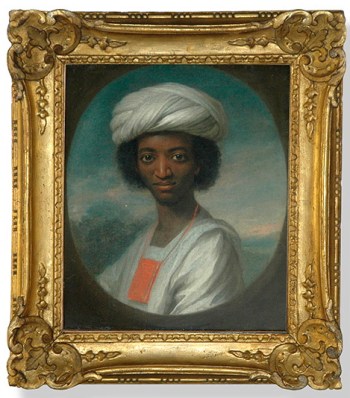
William Hoare, Portrait of Ayuba Suleiman Diallo, ca. 1733
(Jamestown-Yorktown Foundation)
The Jamestown-Yorktown Foundation, a Virginia state agency that operates Jamestown Settlement and Yorktown Victory Center history museums, has acquired a previously unknown oil portrait of Ayuba Suleiman Diallo, a freeborn, educated African who was kidnapped in Africa and sold as a slave in Maryland during the colonial era. Before taking its place as a centerpiece of the future American Revolution Museum at Yorktown (opening late 2016), the rare portrait (ca. 1733) goes on view at the Yorktown Victory Center this summer from June 14 through August 3.
Ayuba Suleiman Diallo was catapulted into fame in the 1730s when the remarkable story of his enslavement and redemption in the North American British colonies was published. From almost the moment he touched ground in London in April 1733, he won the respect of the leading lights of advanced learning in England and ultimately entered the annals of history as a figure embraced by the global abolitionist movement.

William Hoare, Portrait of Ayuba Suleiman Diallo (Job ben Solomon), 1733 (NPG L245, Lent by Qatar Museums Authority/Orientalist Museum, Doha, 2010)
Showing Diallo in a white robe and turban, wearing around his neck a bright red leather pouch probably containing texts from the Qur’an, the Jamestown-Yorktown Foundation portrait is one of two versions painted by William Hoare of Bath, a leading English portrait painter of the 18th century. They are the earliest known portraits done from life of an African individual who was held as a slave in the 13 British colonies that would become the United States of America. The other is currently on view in the National Portrait Gallery of London, on long-term loan following its purchase by the Qatar Museums Authority in 2009.
In a private collection since the 19th century, the Foundation’s portrait came to light following the publicity surrounding an appeal to the British public to keep the Qatar portrait in England. The Jamestown-Yorktown Foundation, Inc., purchased the oil-on-canvas painting with funds raised privately, including a lead gift from Foundation trustee Fred D. Thompson, Jr., of Thompson Hospitality, the country’s largest minority-owned food service company. “This portrait is a powerful symbol of the diversity of colonial America’s population, which included people from many different African cultures,” says Thompson. “Diallo—his image and story—is an ideal teaching opportunity for the American Revolution Museum at Yorktown galleries.”
“For approximately three years now, the Foundation has been in confidential negotiations to acquire this important portrait,” says Thomas E. Davidson, Jamestown-Yorktown Foundation senior curator. “Diallo’s visage speaks for the hundreds of thousands of enslaved Africans and African Americans who remain largely unknown, yet who constituted a major part of late-colonial America’s population.”
“As we plan for the new museum,” Davidson continued, “we hope to convey the way in which the American Revolution represented the beginning of the end for slavery in the United States. While the Revolution did not end slavery by itself, it created an intellectual, moral and political climate in which the practice could not and did not continue forever.”
While there are similarities, neither Hoare portrait is a copy of the other. The painting of Diallo that will be exhibited at the American Revolution Museum at Yorktown is 14 by 12 inches, with the subject’s upper body turned toward his right, against a landscape background, within a painted oval. In the other portrait, Diallo is turned toward his left against a solid background. (more…)
Exhibition | Progress

Left: David Hockney, Bedlam from A Rake’s Progress, 1961–63; Right: William Hogarth, The Madhouse, Plate 8 from A Rake’s Progress, 1735. The images are from the University of Colorado at Boulder, which in 2012 mounted the exhibition Hockney and Hogarth: Selections from the CU Art Museum’s Collection of British Art.
◊ ◊ ◊ ◊ ◊
From The Foundling Museum:
Progress
The Foundling Museum, London, 6 June — 7 September 2014
To mark the 250th anniversary of Hogarth’s death, Progress brings together for the first time three great contemporary responses to his eternally modern moral tale, A Rake’s Progress. David Hockney’s A Rake’s Progress (1961–63), Yinka Shonibare MBE’s Diary of a Victorian Dandy (1998), and Grayson Perry’s The Vanity of Small Differences (2012) are shown alongside Hogarth’s original 1735 prints and joined by a newly commissioned work by Jessie Brennan.
Hogarth’s popularity with both artists and the public has endured for over two hundred years, and his work has provided inspiration to successive generations. Hockney, Shonibare, and Perry not only update Hogarth’s searing social commentary; they also add their own personal concerns to the creative dialogue. Commissioning an emerging female artist to respond to Hogarth’s work, the Foundling Museum further develops the conversation. Exploring issues of sexuality, race, class, vice, temptation, youth, and urban living this exhibition both highlights Hogarth’s continuing relevance and allows us to consider the idea of ‘progress’.
◊ ◊ ◊ ◊ ◊
Rough Music: A Folk at The Foundling Museum
The Foundling Museum, London, 1 July 2014
To accompany the Progress exhibition the Foundling Museum is excited to present a unique event by Dead Rat Orchestra and Jeremy Barlow. Dead Rat Orchestra will perform Rough Music, a new work, incorporating performances on a set of tuned bronze meat cleavers. These specially-commissioned instruments were designed by composer and DRO member Nathaniel Mann as part of his Embedded Residency at The Pitt Rivers Museum and Oxford Contemporary Music working with a professional swordsmith using bronze sword casting techniques. The performance will be preceded by a talk by author and early music expert Jeremy Barlow, author of The Enraged Musician. Barlow will consider Hogarth’s prints and explore the artist’s representations of music and sound.
See more at the event website.










leave a comment