Exhibition | Nepal Natural History Drawings, 1802–03
As recently posted on the ever-informative C18-L, from the new listserv, HEMPS, History of Early and Modern Plant Sciences (1450–1850) . . .
Nepal Natural History Drawings: Francis Buchanan-Hamilton, 1802–03
Embassy of Nepal, 12A Kensington Palace Gardens, London, 7–24 January 2014
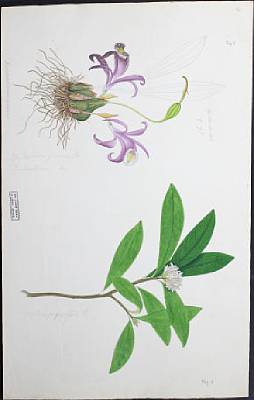 The first natural history collections from Nepal were made by Dr Francis Buchanan (later known as Buchanan-Hamilton) in 1802–03, whilst surgeon-naturalist on the British Mission led by Captain Knox. During his year in the Kathmandu Valley he documented more than a thousand plant species, many of which are now rarely seen. This Scottish ‘father of Nepalese botany’ laid the foundation of botanical knowledge for this Himalayan country, and over 500 new species have been described using his collections.
Buchanan-Hamilton took with him to Nepal a Bengali artist from Calcutta who prepared exquisite coloured watercolour drawings of over a hundred species—27 of which have been selected for this exhibition. On his return to England in 1806, Buchanan-Hamilton gave these drawings, and his other scientific records, to his friend from University days, James Edward Smith, and they have lain virtually unknown in the archives of the Linnean Society of London (which Smith founded) ever since. This exhibition is the first public viewing outside Nepal of Buchanan-Hamilton’s drawings, made by a talented but sadly un-named
Indian artist. Current research is uncovering the scientific and cultural value of these early collections.
Buchanan-Hamilton placed great importance on local names people were using for plants and instructed his Indian pandit, Babu Ramajai Bhattacharji, to record these spoken names and translate them into English. Buchanan-Hamilton frequently used these common names for the new scientific names that he coined and wrote on the drawings—some of these are still in use today. Buchanan-Hamilton is now recognised as the pioneer of biodiversity research in Nepal, but he could not have done this by himself and he needed to collaborate with Nepalese and Indian people. As he was one of the first foreigners to spend any length of time in Nepal, he had an unsurpassed understanding of the people, their cultures and traditions, which later helped underpin the developing relationship between Britain and Nepal. Two centuries on, botanical research continues with British and Nepalese scientists working together on the Flora of Nepal—www.floraofnepal.org. This facsimile exhibition has been produced by the Linnean Society of London and Royal Botanic Garden Edinburgh, with the support of the Embassy of Nepal and the UK Foreign and Commonwealth Office.
Admission free: open to the public 7th to 24th January 2014, Monday to Friday, 10am–1pm, 2–4pm, Embassy of Nepal, 12A Kensington Palace Gardens, London, W8 4QU.
Sponsored by Nature & Herbs UK Ltd. Drawings online here»
Contact: Dr Mark Watson, Royal Botanic Garden Edinburgh, m.watson@rbge.org.uk
Exhibition | Medicine and the Eighteenth Century
As noted by Hélène Bremer, from the Château de Seneffe:
Le XVIIIe et la Médecine
Château de Seneffe, Hainaut, Belgium, 5 October 2013 — 21 April 2014
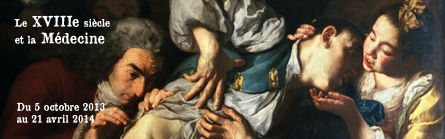 L’exposition « Le XVIIIe et la Médecine » sort des sentiers battus par son contenu et son approche scientifique. Elle présente le thème de la médecine non pas uniquement du point de vue purement médical mais bien dans le contexte de la vie de l’époque. En tant que témoins privilégiés- et avec l’apport des instruments scientifiques, d’objets mis en relation avec les thématiques abordées, d’extraits littéraires,…-nous racontons l’existence d’une société en pleine évolution sociologique.
Découvrir ce que signifie la médecine au XVIIIe siècle c’est lever le voile sur différentes pratiques peu conventionnelles, c’est aborder le corps et l’esprit sous différents angles, c’est observer les avancées en la matière qui vont bousculer les tabous et révolutionner les façons de penser et de voir d’une façon plus rationnelle. C’est comme un kaléidoscope de découvertes inattendues et surprenantes. Le XVIIIe avait à cœur de replacer l’homme, en tant qu’être humain, au centre de la société. Les individus sont alors en quête de bien être, comme aujourd’hui. Et depuis, tout continue.
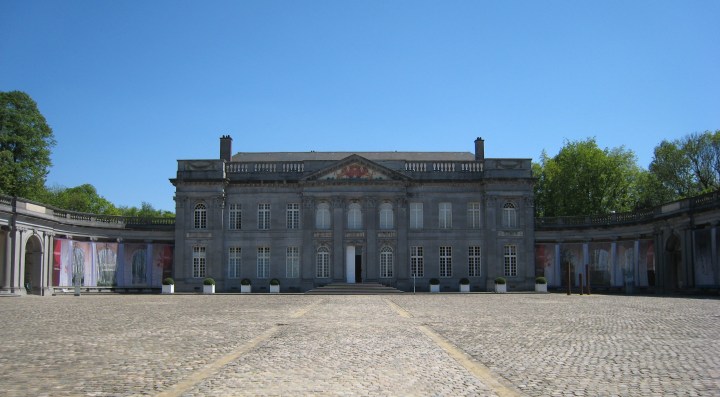
Château de Seneffe
(Photo: Wikimedia Commons, May 2007)
◊ ◊ ◊ ◊ ◊
According to Wikipedia:
In 1758 the ‘Seigneurie de Seneffe’ was bought by Joseph Depestre, a Walloon merchant who earned a fortune by selling goods to the Imperial Austrian troops stationed in the Austrian Netherlands. Depestre’s new status as a wealthy and influential individual was also confirmed by the acquisition of noble titles such as ‘Seigneur de Seneffe’ (Lord of Seneffe) and ‘Count of Turnhout’. The new castle designed by Laurent-Benoît Dewez had to match with Depestre’s new noble status. It was erected between 1763 and 1768 in a novel neoclassical style. When Joseph Depestre died in 1774 the decoration of the château and the embellishment of the park were continued by his widow and his eldest son Joseph II Depestre. . .
Exhibition | Unflinching Vision: Goya’s Rare Prints
From the exhibition press release (August 2013):
Unflinching Vision: Goya’s Rare Prints
Norton Simon Museum, Pasadena, 6 December 2013 — 3 March 2014
Curated by Leah Lehmbeck
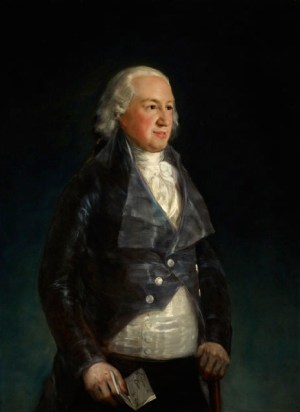
Francisco de Goya y Lucientes, Don Pedro, Duque de Osuna, ca.1790s. Oil on canvas, 54 x 43 x 4 inches (137.8 x 109.2 x 10.2 cm). The Frick Collection; photo: Michael Bodycomb.
In celebration of the rare loan of The Frick Collection’s Don Pedro, Duque de Osuna by Spanish master Francisco de Goya y Lucientes (1746–1828), the Norton Simon Museum presents the exhibition Unflinching Vision: Goya’s Rare Prints. While the majority of the artist’s prints were published posthumously, this exhibition presents a selection of works that Goya himself worked on during his lifetime. More than 30 working proofs, trial proofs and published prints made under his supervision are on view, as well as a small selection of posthumous examples from his later numbered editions. With exceptional examples from his series Los Caprichos, The Disasters of War, La Tauromaquia, and Los Proverbios, these artworks demonstrate Goya’s mastery of printmaking and, most significantly, his care in meaningfully capturing the spirit of his time.
From royal portraiture to scenes in a bullring, Goya infused his keen vision of the observed world with his own creative impulses. This delicate dance is visible throughout the artist’s incredible output of prints. Goya began to experiment with printmaking well after he had established himself as a successful painter to the royal court in Madrid. He started, tentatively, etching a few religious subjects, yet rather quickly he began his first ambitious series of etchings: 11 copies after masterpieces by the father of Spanish painting, Diego Velázquez. Goya’s skill as a draftsman is pronounced in these prints, as is his facility with working on a copper plate, for it is in this series that he first experiments with aquatint, a technique that allows the artist to create subtle tonal areas in the image rather than just scratched lines. “Un Infante de España,” on view in this exhibition, not only presents the formality of Velázquez’s composition but also exhibits Goya’s growing skill with intaglio techniques. Though aquatint is used here primarily in the background, Goya came to master its use, harnessing its subtlety to create depth and even to draw entire compositions.
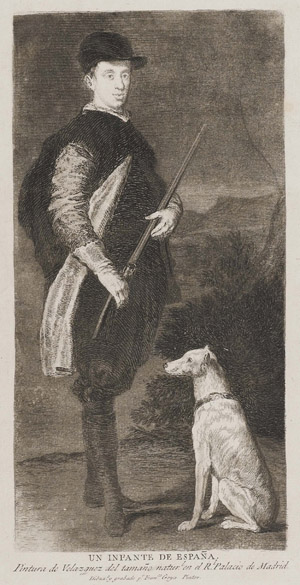
Francisco de Goya y Lucientes, Copies After Velázquez: Un Infante de España, Infante Don Fernando, ca. 1778–79, etching with burnished aquatint and drypoint
(Norton Simon Art Foundation)
By the mid-1790s, Goya began to work on Los Caprichos, the first of four major print series that came to define his career as a printmaker. Images of people, witches and imagined creatures identifying specific social and cultural problems, with titles carefully narrating the scenes, make up this series. An early working proof of plate 6, “Nobody Knows Himself,” presents Goya’s concerns with deception and artifice, and it shows the print before numbering and with the title handwritten in ink. In plate 20, “There They Go Plucked (i.e. Fleeced),” prostitutes sweep out their customers, cowering and pathetic, as the women prepare for the next group of clients who hover above. The drama of the scene is enhanced by the contrast between completely uninked areas and the various gradations of aquatint that define recessional space, but as the edition was printed, this contrast was lost as the aquatint faded nearly completely. Exhibiting the working proof alongside the first, second and eighth editions of the same plate highlights this degradation.
While Los Caprichos describes a time before the turn of the century, when the French monarchy fell and Napoleon rose to power, Goya’s next series tells of the grueling six-year war between France and Spain that began in 1808. In addition to its cruel, disorganized and prolonged combat (the term ‘guerilla’ warfare was coined from this war), it caused a disastrous famine. Many of its battles and events, including torture and starvation, are depicted brutally in the 82 plates of Goya’s print series The Disasters of War. “One Can’t Look,” plate 26, is a triumph of Goya’s compositional acumen. Men and women cower, plead and surrender in desperation within a web of dramatic shadows, and only the tips of the executioners’ bayonets reveal the reason for their suffering.
Perhaps due to the sensitivity of the subject, Goya decided not to publish an edition of The Disasters during his lifetime. Turning instead to a public project that was more benign, Goya prepared a series of bullfighting scenes, equally brilliantly executed and known ultimately as La Tauromaquia. This group of 33 prints traces the history of bullfighting in the country and can be read as being both respectful and critical of the pastime. In plate 20, the theatrical physical feats accomplished by a torero are on display. Yet, in the following plate, Goya reminds us of the deadly nature of the sport. His interest in the popular subject matter and its connection to his national identity were further illuminated when Goya was living in exile in Bordeaux, France. There, in 1825, he used lithography for the first time. The technique is very similar to drawing, and Goya was immediately able to create lively compositions with greater ease than aquatint, in a series of four prints with the same theme, known as The Bulls of Bordeaux.
Whereas the two intaglio series—La Tauromaquia and The Disasters—depict real-life events, Goya continued to create wildly imaginative scenes that comment on contemporary behavior as in Los Caprichos. In the group of 18 prints gathered together and sold as Los Proverbios upon their first publication in 1864, Goya magnificently illustrates a number of human follies. Two-headed women, animals, giants and monsters are all situated in a world with no setting, no real context. The scenes are executed with brilliant technical facility: etched lines creating dynamic scenarios set off against the rich darkness of a field of aquatint, as in “A Way of Flying,” a fantastical illustration of the idea that “Where there’s a will, there’s a way.”
Unflinching Vision: Goya’s Rare Prints is organized by Curator Leah Lehmbeck. It is presented in conjunction with The Frick Collection’s loan of Goya’s Don Pedro, Duque de Osuna, and in anticipation of the scholarly catalogue Goya in the Norton Simon Museum, to be published in 2014.
Exhibition | From Veronese to Casanova: Italian Paintings from Brittany
From the Musée des Beaux-Arts de Rennes:
De Véronèse à Casanova: Parcours italien dans les collections de Bretagne
Musée des Beaux-Arts de Quimper, 19 April — 30 September 2013
Musée des Beaux-Arts de Rennes, 14 December 2013 — 2 March 2014
Curated by Mylène Allano
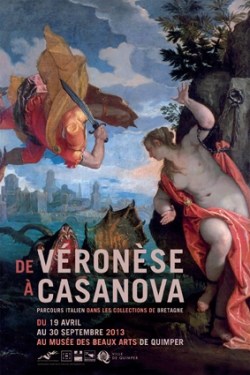 Les musées des beaux-arts de Rennes et de Quimper présentent successivement une grande exposition des peintures italiennes conservées dans la région. La manifestation a pour vocation de mettre en valeur et de faire connaître le patrimoine de la Bretagne historique, en exposant les fleurons des collections italiennes des musées de Brest, Dinan, Morlaix, Nantes, Quimper, Rennes, Vannes et ainsi que les plus belles œuvres des églises bretonnes ; soit 85 peintures de tout premier ordre offrant un panorama représentatif de la peinture italienne des XVIe au XVIIIe siècles.
Didier Rykner provides an exhibition review at La Tribune de l’Art (13 May 2013). . .
. . . L’exposition s’est basée sur une thèse de Mylène Allano—commissaire scientifique de cette exposition—qui cataloguait toutes les peintures italiennes conservées en Bretagne. Le parcours aurait pu être chronologique, par école ou par thèmes. C’est cette dernière présentation qui a été choisie. . .
◊ ◊ ◊ ◊ ◊
The catalogue is available from Artbooks.com:
Mylène Allano, ed., De Véronèse à Casanova: Parcours italien dans les collections de Bretagne (Lyon: Lieux Dits, 2013), 199 pages, ISBN: 978-2362190742, $47.50.
 Italian paintings held in Brittany are well known and appreciated by art specialists, and are characterised by their quality and by the variety of places represented (Venice, Rome, Naples…). This exhibition enables access to a remarkable set of works collected by museums, which have never previously received such attention. There are no less than eighty works which, for the first time, are the subject of an original display underlying the extraordinary vitality of artistic creation in Italy from the 16th century until the end of the 18th century.
Exhibition | Winter Antiques Show in New York to Highlight the PEM
Press release (13 August 2013) from the Winter Antiques Show:
Fresh Take, Making Connections at the Peabody Essex Museum
60th Winter Antiques Show, Park Avenue Armory, New York, 24 January — 2 February 2014

Pair of carp tureens, 1760–80, Porcelain, Jingdezhen, China, with gilded bronze mounts, possibly from Spain (Peabody Essex Museum)
The Winter Antiques Show’s 2014 loan exhibition will celebrate the Peabody Essex Museum (PEM) in Salem, Massachusetts. Fresh Take, Making Connections at the Peabody Essex Museum is comprised of more than 50 paintings, sculptures, textiles, and decorative objects. One of America’s oldest and fastest growing museums, PEM was founded in 1799 and its collection showcases an unrivaled spectrum of American art as well as outstanding Asian, Asian export, Native American, African, Oceanic, maritime, and photography collections. The exhibition will be on view during the run of the Winter Antiques Show, from January 24 to February 2, 2014.
PEM celebrates its 215th year in 2014, and has recently embarked on a $650 million capital campaign and expansion that will place the museum among the top 10 art museums in the country in terms of gallery space and total endowment. The museum’s campus boasts 22 historic buildings celebrating Salem’s rich architectural and garden heritage and Yin Yu Tang, a 200-year old Chinese house that is the only example of its kind in the United States. PEM offers a vibrant schedule of changing exhibitions, a lively contemporary art program, performances, and an interactive education center.

Painted Side Chair, ca. 1795, Salem, MA, wood, paint, reproduction
upholstery (Peabody Essex Museum)
Fresh Take, Making Connections at the Peabody Essex Museum is a microcosm of the PEM experience. Works of art from diverse cultures and time periods are grouped together, uniting and contrasting objects of creative expression in unexpected ways. Highlights of the exhibition range from a spectacular inlaid ivory chair from India (18th century) to a mahogany dressing chest by Thomas Seymour (c. 1810); from an English brass mariner’s astrolabe used to determine time and latitude by the stars (late 1500s) to a stick chart used by Micronesian sailors navigating the Pacific Ocean (early 20th century); from a view of Salem Common by George Ropes (1808) to a Joseph Cornell collage inspired by Magritte’s surrealist landscape (c.1964); from a bronze Japanese reliquary from the Koki-ji Temple, Kawachi-gun, Osaka Prefecture (1679) to a Chinese bridal headdress made of Kingfisher feathers, silk, pearls, and semi-precious stones (c. 1800s).
One of the many highlights is a striking portrait of Nathaniel Hawthorne by Charles Osgood (1809– 1890). The 1840 portrait was painted when Hawthorne worked in the Boston Custom House, ten years before The Scarlet Letter was published. It is the best-known likeness of the young author.
The founding organization of today’s Peabody Essex Museum was the East India Marine Society. A centerpiece of the exhibit is the 1803 sign painted by Michele Felice Cornè (1752–1845) for the original Society’s exhibition hall. The sign depicts Salem Harbor and a ship, probably the Mount Vernon, on which the artist emigrated from Naples to America in 1800. Banner and letters were added in 1825 by sign painter Samuel Bartol for the new East India Marine Hall, where it was placed over the door.
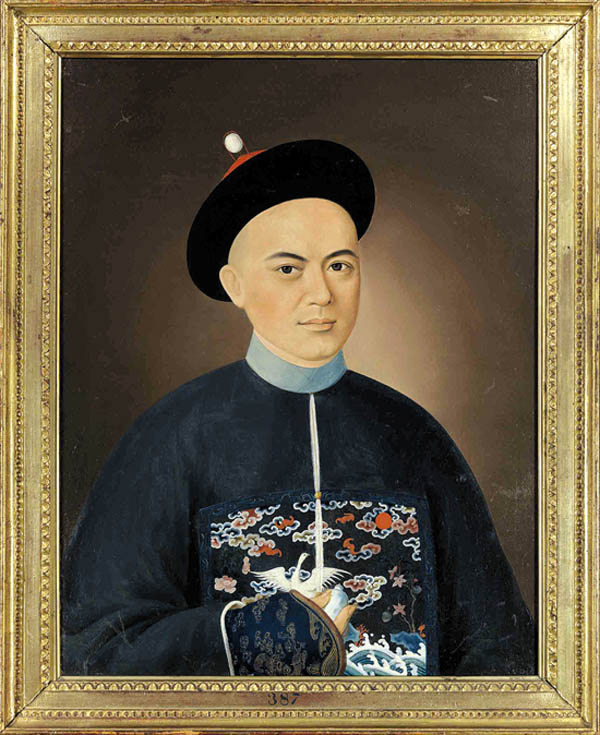
Spoilum, Portrait of Eshing, ca. 1805, Guangzhou (Canton).
Oil on canvas (Peabody Essex Museum)
A Spoilum portrait of a prominent Cantonese silk merchant is also included in the exhibition (1805). Spoilum (active 1785–1810) was one of the first Chinese artists to work in a Western style, and though he never traveled outside of China, his paintings often resemble early American portraiture. The artist is best known for his portraits of English and American merchants, so this portrait of Eshing (a Chinese merchant) is particularly rare. Eshing frequently did business with Salem merchants, and this portrait was acquired as a gift from one of these merchants to the East India Marine Society in 1809.
Demonstrating the wide travels of Salem’s wealthy merchants is a Brazilian headdress collected by Michael W. Shepherd on a trip up the Amazon River in 1847. The mid 19th-century headdress is made primarily of red and blue macaw feathers, an important expression of wealth for many indigenous people of South America. This type of headdress would have been worn by caciques (Native chiefs).
Jeff Daly, formerly senior design advisor to the director at the Metropolitan Museum of Art, will design the Winter Antiques Show’s loan exhibition and plans to create a modern kuntskammer to hold the many treasures from PEM, much like they were displayed in the original East India Marine Society exhibition hall.
The exhibition is sponsored by Chubb Personal Insurance for the 18th consecutive year.
About the Winter Antiques Show
The Winter Antiques Show celebrates its 60th year Diamond Jubilee as America’s most prestigious antiques show, featuring 73 renowned experts in American, English, European, and Asian fine and decorative arts in a fully vetted show. The show was established in 1955 by East Side House Settlement, a social services institution located in the South Bronx. All net proceeds from the show benefit East Side House Settlement. The Winter Antiques Show will run from January 24 to February 2, 2014, at the Park Avenue Armory, 67th Street and Park Avenue, New York City. The Winter Antiques Show hours are 12–8pm daily except Sundays and Thursday, 12–6 pm. Daily admission to the show is $25, which includes the show’s award-winning catalogue. To purchase tickets for the Opening Night Party on January 23, 2014, or Young Collectors Night on January 30, 2014, call (718) 292-7392 or visit the show’s website.
About East Side House Settlement
East Side House Settlement was founded in 1891 to help immigrants and lower income families on the East Side of Manhattan. In 1962, it moved to the South Bronx where it serves 8,000 residents annually within one of America’s poorest congressional districts, the Mott Haven section of the South Bronx. Among the initiatives that focus on educational attainment as the gateway out of poverty is the innovative and highly acclaimed Mott Haven Village Preparatory School.
Exhibition | Fragonard: Poetry and Passion
From the Staatliche Kunsthalle Karlsruhe:
Fragonard: Poetry and Passion / Poesie und Leidenschaft
Staatliche Kunsthalle Karlsruhe, 30 November 2013 — 23 February 2014
You could say that the drawings are the diary of his imagination.
–Edmond and Jules de Goncourt, 1865
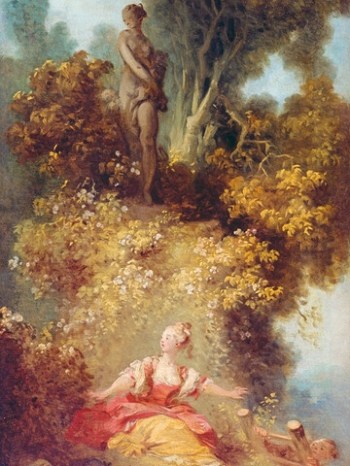
Jean-Honoré Fragonard, La Surprise, ca. 1771
(Musée des Beaux-Arts, Angers)
The work of Jean-Honoré Fragonard (1732–1806) is the embodiment of elegance and expressiveness. The French artist was one of the outstanding masters of the 18th century; and yet his name is relatively unfamiliar to many in Germany today. Born in Grasse, Fragonard spent most of his life in Paris, where he was a pupil of François Boucher. Despite initial successes in the Paris Salon exhibition, he embarked on a path outside the Academy and found his main audience among wealthy private collectors.
First monographic exhibition in Germany of Fragonard’s work
The Karlsruhe exhibition principally features a selection of Fragonard’s drawings, enriched by several oil studies and paintings. With some 80 works in all, the display gives an insight into the dazzling versatility of an oeuvre that includes scenes of cheerful social gatherings, landscapes, narrative scenes, and intimate depictions of great sensuality. The exhibition captures and reflects the artist’s delight in experimentation, his vitality of imagination, and boldness in formal composition. In the same breath, Fragonard demonstrates both how firmly rooted he was in the artistic tradition of the 17th century and his skill in being able to vary and reinterpret the repertoire of forms and subjects of that tradition. Through his handling of chalk and brush, he created compositions of sparkling imagination and great passion.
The exhibition has been made possible thanks to the generous support of international lenders, including the Louvre in Paris, the Albertina in Vienna, the British Museum in London, and the Fundação Calouste Gulbenkian in Lisbon, as well as several private collectors.
◊ ◊ ◊ ◊ ◊
From Artbooks.com:
Juliane Betz, ed., Fragonard: Poesie und Leidenschaft (Munich, Deutscher Kunstverlag, 2013), 272 pages, ISBN: 978-3422072145, $68.50.
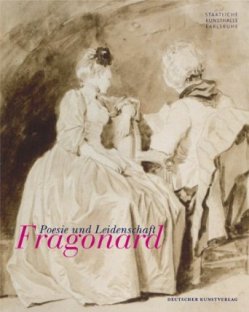 The current exhibition at Staatliche Kunsthalle Karlsruhe focuses on drawings by Jean-Honoré Fragonard, one of the finest French artists of the 18th century. They are juxtaposed against selected paintings that reveal links between his graphic and painterly works. Fragonard developed a unique pictorial idiom, which made use of both painterly and graphic elements and elevated unworked sections of bare paper into a core compositional element.
Exhibition | Houghton Hall: Portrait of an English Country House
As Courtney Barnes noted back in November at Style Court, America’s fascination with England’s country houses will continue into the new year (and 2015). While Houghton Revisited, which brought dozens of paintings back to the house from Russia for display this summer and fall, was awarded Apollo Magazine’s 2013 Exhibition of the Year, pictures and objects still in the Houghton Hall collection will travel to Houston, San Francisco, and Nashville. From the MFAH press release (22 November 2013). . .
Houghton Hall: Portrait of an English Country House
Museum of Fine Arts, Houston, 22 June — 22 September 2013
Legion of Honor, San Francisco, 18 October 2014 — 18 January 2015
Frist Center for the Visual Arts, Nashville, 13 February — 10 May 2015
Curated by Gary Tinterow and Christine Gervais with David Cholmondeley

William Hogarth, The Cholmondeley Family, 1732
(Marquess of Cholmondeley, Houghton Hall)
◊ ◊ ◊ ◊ ◊
Family portraits by Hogarth and Sargent, exquisite examples of Sèvres porcelain, and unique pieces of William Kent furniture from this aristocratic English family chronicle three centuries of art, history, and politics.
Museum of Fine Arts, Houston, Director Gary Tinterow today announced an unprecedented exhibition: Houghton Hall: Portrait of an English Country House, which will be on view at the Museum from June 22 to September 22, 2014. The exhibition marks the first time the renowned collection of the Marquesses of Cholmondeley, housed at Houghton Hall, the family estate in Norfolk, will travel outside of England.

Houghton Hall (Photo: Nick McCann)
The house and much of its collection were built in the early 1700s by Sir Robert Walpole—England’s first prime minister and the ancestor of the current marquess. Renowned as one of the finest Palladian houses and one of the most extensive art collections in Britain, Houghton became notorious when Sir Robert’s collection of Old Master paintings was sold by his grandson to Catherine the Great, in 1779. But the house and all of its furnishings, considered to comprise William Kent’s Georgian masterpiece, remained intact; Walpole’s descendants added considerably to the collection of paintings. From great family portraits by William Hogarth, Joshua Reynolds, and John Singer Sargent, to exquisite examples of Sèvres porcelain, rare pieces of R. J. & S. Garrard silver, and unique furniture by William Kent, the exhibition vividly evokes the fascinating story of art, history, and politics through the collections of this aristocratic English family over three centuries.
Organized by Tinterow; Christine Gervais, associate curator; and Lord Cholmondeley, the exhibition will tour nationally after the Houston presentation, beginning with the Legion of Honor of the Fine Arts Museums of San Francisco (October 18, 2014–January 18, 2015) and the Frist Center for the Visual Arts in Nashville (February 13–May 10, 2015).
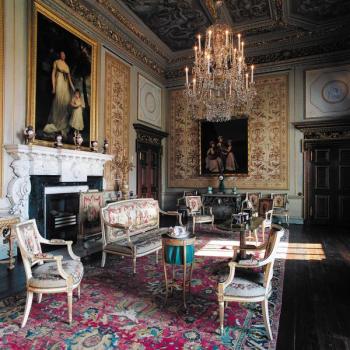
The White Drawing Room at Houghton Hall, with paintings by John Hoppner and George James (Photo: Nick McCann)
“Houghton Hall and its superb collections epitomize the historic legacy of art, architecture, and patronage among the great families and country houses of England,” commented Tinterow. “I am delighted to partner with David Cholmondeley to bring this extraordinary heritage to American audiences. Given our fascination with Downton Abbey and its similar story of a great English house and its family, I know this exhibition will be highly anticipated.”
“I was enormously gratified by the response to Houghton Revisited, the exhibition in which we reunited the paintings sold to Catherine the Great with their home at Houghton Hall,” commented David Cholmondeley on the success of that recent project. “I look forward to working with Gary Tinterow and his colleagues at the Museum of Fine Arts, Houston, to share Houghton Hall and our family’s history with visitors in Houston, San Francisco, and Nashville.”
About Portrait of an English Country House
Houghton Hall: Portrait of an English Country House will assemble more than 100 objects in settings that combine paintings, porcelain, sculpture, costume, metalwork, and furniture to evoke the stunning rooms at Houghton Hall. Bought or commissioned by eight generations of descendants of Sir Robert Walpole, together these objects comprise a fascinating chronicle. (more…)
Apollo Magazine’s 2013 Exhibition of the Year: Houghton Revisited
From Apollo Magazine:
Apollo Magazine’s 2013 Exhibition of the Year
Houghton Revisited at Houghton Hall, Norfolk
 There have been some great international blockbuster shows this year: Inventing Abstraction, 1910–1925 at MoMA and Life and Death in Pompeii and Herculaneum at the British Museum. At Apollo, we also like to celebrate focused exhibitions that enlighten us with the exceptional intelligence of their curation on a smaller scale: Piero della Francesca in America at the Frick Collection brought together most of the panels of the Sant’Agostino altarpiece, while the Ashmolean Museum’s Francis Bacon/Henry Moore: Flesh and Bone tuned into a conversation between two artists that few had previously heard with such clarity. At the St Louis Art Museum, and later the National Gallery in London, Barocci: Brilliance and Grace provided revelations about one artist’s restless inventiveness; while The Springtime of the Renaissance, at Palazzo Strozzi and now the Louvre, brought superb loans together in sharp and surprising ways.
But one exhibition ran away with the laurels this year. Once-in-a-lifetime is a phrase that gets bandied about too much—but this was not just a once-in-a-lifetime exhibition, but something we may have to wait another two and half centuries to see again. It reunited many of the works from Robert Walpole’s magnificent collection, including many simply audacious loans from Russia and elsewhere, recreating their original hang at Houghton Hall in Norfolk, and bringing 114,000 visitors through the doors. I am delighted to present this award to curator Thierry Morel and Lord David Cholmondeley for Houghton Revisited.
Neapolitan Crèche at The Met
From The Met:
Christmas Tree and Neapolitan Baroque Crèche
The Metropolitan Museum of Art, New York, 26 November 2013 — 6 January 2014
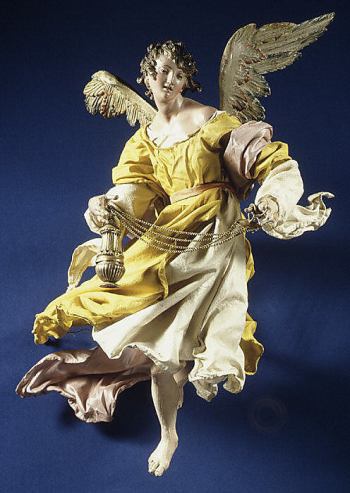
Angel, attributed to Giuseppe Sanmartino (Italian, 1720–1793), polychromed terracotta head; wooden limbs and wings; body of wire wrapped in tow; various fabrics, 14 inches (NY: The Met)
The Museum continues a longstanding holiday tradition with the presentation of its Christmas tree, a favorite of New Yorkers and visitors from around the world. A vivid eighteenth-century Neapolitan Nativity scene—embellished with a profuse array of diminutive, lifelike attendant figures and silk-robed angels hovering above—adorns the candlelit spruce. Recorded music and lighting ceremonies add to the enjoyment of the holiday display.
The annual Christmas installation is the result of the generosity, enthusiasm, and dedication of the late Loretta Hines Howard, who began collecting crèche figures in 1925 and soon after conceived the idea of combining the Roman Catholic custom of elaborate Nativity scenes with the tradition of decorated Christmas trees that had developed among the largely Protestant people of northern Europe. This unusual combination was presented to the public for the first time in 1957, when the Metropolitan Museum initially exhibited Mrs. Howard’s collection. More than two hundred eighteenth-century Neapolitan crèche figures were given to the Museum by Loretta Hines Howard starting in 1964, and they have been displayed each holiday season for nearly forty years. Linn Howard, Mrs. Howard’s daughter, worked with her mother for many years on the annual installation. Since her mother’s death in 1982, she has continued to create new settings for the Museum’s ensemble. In keeping with family tradition, Linn Howard’s daughter, artist Andrea Selby Rossi, joins her mother again this year in creating the display.

The exhibit of the crèche is made possible by gifts to The Christmas Tree Fund and the Loretta Hines Howard Fund.
The Museum’s towering tree, glowing with light, is adorned with cherubs and some fifty gracefully suspended angels. The landscape at the base presents the figures and scenery of the Neapolitan Christmas crib. This display mingles three basic elements that are traditional to eighteenth-century Naples: the Nativity, with adoring shepherds and their flocks; the procession of the three Magi, whose exotically dressed retinue echoes the merchants and travelers one may have encountered in bustling Naples at the time of the crèche’s creation; and, most distinctive, colorful peasants and townspeople engaged in their quotidian tasks. The theatrical scene is enhanced by a charming assortment of animals—sheep, goats, horses, a camel, and an elephant—and by background pieces serving as the dramatic setting for the Nativity, including the ruins of a Roman temple, several quaint houses, and a typical Italian fountain with a lion’s-mask waterspout.
The origin of the popular Christmas custom of restaging the Nativity traditionally is credited to Saint Francis of Assisi. The employment of manmade figures to reenact the hallowed events soon developed and reached its height of complexity and artistic excellence in eighteenth-century Naples. There, local families vied to outdo each other in presenting elaborate and theatrical crèche displays, often assisted by professional stage directors. The finest sculptors of the period—including Giuseppe Sammartino and his pupils Salvatore di Franco, Giuseppe Gori, and Angelo Viva—were called on to model the terracotta heads and shoulders of the extraordinary crèche figures. The Howard collection includes numerous examples of works attributed to them as well as to other prominent artists.
The Museum’s crèche figures, each a work of art, range from six to twenty inches in height. They have articulated bodies of tow and wire, heads and shoulders modeled in terracotta and polychromed to perfection. The luxurious and colorful costumes, many of which are original, were often sewn by ladies of the collecting families and enriched by jewels, embroideries, and elaborate accessories, including gilded censers, scimitars and daggers, and silver filigree baskets. The placement of the approximately fifty large angels on the Christmas tree and the composition of the crèche figures and landscape vary slightly from year to year as new figures are added.
Exhibition | Piranesi’s Antiquity: Findings and Polemics
From the Wallraf-Richartz Museum:
Piranesis Antike: Befund und Polemik / Piranesi’s Antiquity: Findings and Polemics
Wallraf-Richartz Museum, Cologne, 25 October 2013 — 26 January 2014
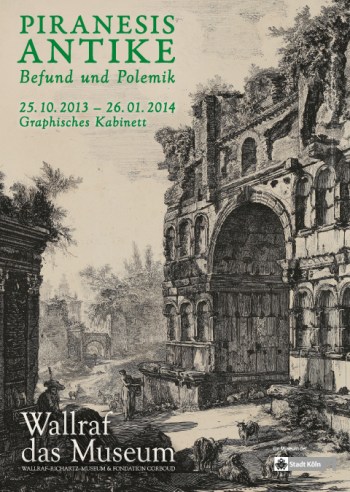 ‘Rome or Athens?’ In the eighteenth century, this simple and yet so complex question was at the heart of a vehement dispute concerning the exemplary function of classical antiquity for contemporary art. One major advocate of Rome was the artist Giovanni Battista Piranesi (1720–1778). Over a period of about 30 years, he produced more than 130 large-format etchings with views of ancient and modern Rome, as well as of buildings from the immediate surroundings. These etchings were compiled into a self-contained series under the title Vedute di Roma. Piranesi uses dramatic perspectives, strong contrasts between light and dark, and gigantic enlargements of sections of ancient buildings in order to convince his contemporaries of the importance of classical Rome.
Some 20 of these fascinating works can now (25 October 2013 to 26 January 2014) be seen in Cologne at the Wallraf-Richartz Museum’s Department of Drawings and Prints under the title Piranesi’s Antiquity: Findings and Polemics.
One of the most versatile Italian artists of the eighteenth century, Piranesi still fascinates us today with his extensive œuvre. During his lifetime he produced more than 1,000 etchings and thus left us impressive witnesses of his age. In addition to his graphic work, Piranesi also wrote numerous theoretical treatises, defending Roman civilization against the claims of Greek culture. The exhibition in Cologne shows how, in the large-format Vedute or views of Rome, the multifarious and contradictory ways in which classical antiquity was appropriated by the eighteenth century are superimposed. Meticulous archaeological investigations stand alongside market-oriented production of prints, and a polemical debate on the true legacy of antiquity (Rome versus Athens). By selling his views of Rome to foreign visitors to the city, Piranesi made a fortune and became well known throughout Europe.
This exhibition is being held to mark the 625th anniversary of the foundation of Cologne University. Together with teachers and students of art history and classical archaeology, the works were selected and researched from among the holdings of the university archives. The archive has 46 views of Rome by Piranesi, an unusual wealth of material for a university collection. It is the result of a donation by the university’s first Professor of Greek Philology, Dr Joseph Kroll.
Information on the exhibition symposium is available here»










 Enfilade
leave a comment