Exhibition | Neapolitan Drawings
As noted at ArtDaily (25 March 2014) . . .
Dessins Napolitain / Neapolitan Drawings
Marty de Cambiaire, Paris, 25 March — 10 April 2014
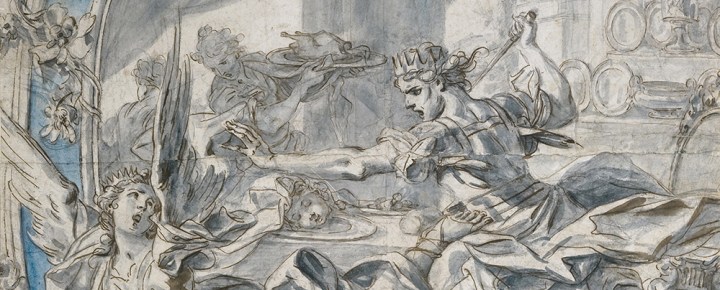
Filippo Falciatore (actif à Naples 1718–1768),
Térée pourchassant Procné et Philomèle
◊ ◊ ◊ ◊ ◊
Marty de Cambiaire’s seventh show takes place in their offices, located on 16 place Vendôme, from 25 March to 4 April 2014. It focuses on a group of forty Neapolitan and Sicilian drawings dating from the 16th to the 18th century. A bilingual exhibition catalogue has been published, similar to their previous catalogues (which can be downloaded from their website). Given the scarcity of the literature on the subject, this publication provides fresh scholarship on a field still relatively unknown to the public as well as connoisseurs. There are very few Neapolitan drawings in public collections. They are equally rare far on the market. Therefore several years were required to build up a coherent group intended to illustrate 350 years of graphic production in Naples and Sicily. The ultimate goal of this venture, quite unprecedented in the old master drawing market, is to make a significant scientific contribution to the field.
Neapolitan drawing has long been a neglected research area. A few sporadic shows—some of which quite recent—have confirmed art historians’ strong interest in an area which remains largely unexplored. There is thus ample room for fascinating discoveries. The Neapolitan school (which includes the Sicilian school) is largely underrepresented in museums. Nor is it clearly identified as a distinct school, especially in comparison with other Italian schools such as the Florentine, Bolognese, Roman or Venetian ones. The Neapolitan school gives us the opportunity to examine draughtsmanship in its various aspects as an active practice, apprehended as a working method and not just as an intellectual concept destined to confer a social status to artists. Consequently their intention is to showcase the specificities of the Neapolitan school, through a group of 40 drawings dating between 1550 and 1800.
The prime concern in gathering them has been to focus on quality, condition and scholarly interest. It turned out to be a challenging venture given the traditional scarcity of Neapolitan drawings on the market. The gallery has decided to bring together artists such as Giordano and Solimena, already well-researched and known from the public, with other artists whose names are not so familiar but who were essential in the genesis of this school. It seemed equally important to illustrate the diversity of: the techniques used; the subjects illustrated; and the purpose of these drawings, which could be preparatory studies either for religious altarpieces or for decorative compositions, for book frontispieces or decorative pieces, or even intended as works of art per se.
The show explores successive periods in the Neapolitan and Sicilian graphic production. The earliest sheet presented is by a rare and precious artist, Leonardo Castellano (circa 1544–1588). This is complemented by two other 16th-century drawings by Francesco Curia (1538–1610), while Belisario Corenzio (circa 1558–1646) takes us into the 17th century. There big names such as Luca Giordano, Matia Preti and Salvator Rosa feature, alongside with lesser-known artists who deserve a reappraisal, including Cesare and Francesco Fracanzano, Battistello Carraciolo. and Aniello Falcone. Francesco Solimena and his pupils, Francesco De Mura, Francesco Celebrano, Giacopo Cestaro, Lorenzo de Caro and Campora are represented with several sheets which demonstrate how profoundly the master renewed the field of decorative painting. Solimena also revived the creative process itself, passing down to his pupils a method on which they firmly grounded their approach and developed their own talent. The final drawing in the collection’s chronology is a large sheet by Giuseppe Camarrano, a neoclassical artist rarely seen on the market. It illustrates the evolution of Neapolitan art towards a more European neo-classical taste.
One of the key criteria in the selection process was the condition of each drawing. However it is important to bear in mind that Neapolitan artists viewed their drawings not only as a mental projection but also as a hands-on device: assembled and pasted together, some sheets were thus pricked for transfer, while others bear the marks of working life in the studio. This show presents a varied and representative overview of the Neapolitan school. New attributions will be put forward, which will shed new light on certain artists. The gallery is thus hoping to provide a panorama of a rich, distinct graphic field.
Exhibition | From Poussin to Monet
This 2015 exhibition will showcase French paintings from the National Gallery of Ireland:
Von Poussin bis Monet. Die Farben Frankreichs
Bucerius Kunst Forum, Hamburg, 10 October 2015 — 17 January 2016
Die gesellschaftlichen und künstlerischen Umbrüche des 18. Jahrhunderts leiteten die Moderne ein. War Frankreichs Gesellschaft und Kunst im 17. Jahrhundert noch durch den königlichen Hof und die königliche Kunstakademie streng zentralistisch reglementiert, so gewann die bürgerliche Öffentlichkeit im Zeitalter der Aufklärung neue Bedeutung und Macht. Die Veränderungen der französischen Gesellschaft vor und nach der Revolution wurden auch zum Motor der Revolutionierung der künstlerischen Mittel. Die Ausstellung Von Poussin bis Monet. Die Farben Frankreichs widmet sich der künstlerischen Befreiung der französischen Malerei von den Zwängen und Regeln des Akademismus hin zur Freilichtmalerei des Impressionismus. Die Ausstellung präsentiert die Sammlung französischer Malerei der National Gallery of Ireland in Dublin. Sie wird durch eine Auswahl von Gemälden aus der Sammlung Rau (UNICEF) in Remagen ergänzt.
Die Ausstellung entsteht in Kooperation mit dem Arp Museum Bahnhof Rolandseck.
Exhibition | Hogarth, Reynolds, Turner: The Dawn of Modernity
From the museum:
Hogarth, Reynolds, Turner: Pittura inglese verso la modernità
The Dawn of Modernity: Painting in Britain in the 18th Century
Fondazione Roma Museo, Palazzo Sciarra, Rome, 15 April — 20 June 2014
Curated by Carolina Brook and Valter Curzi
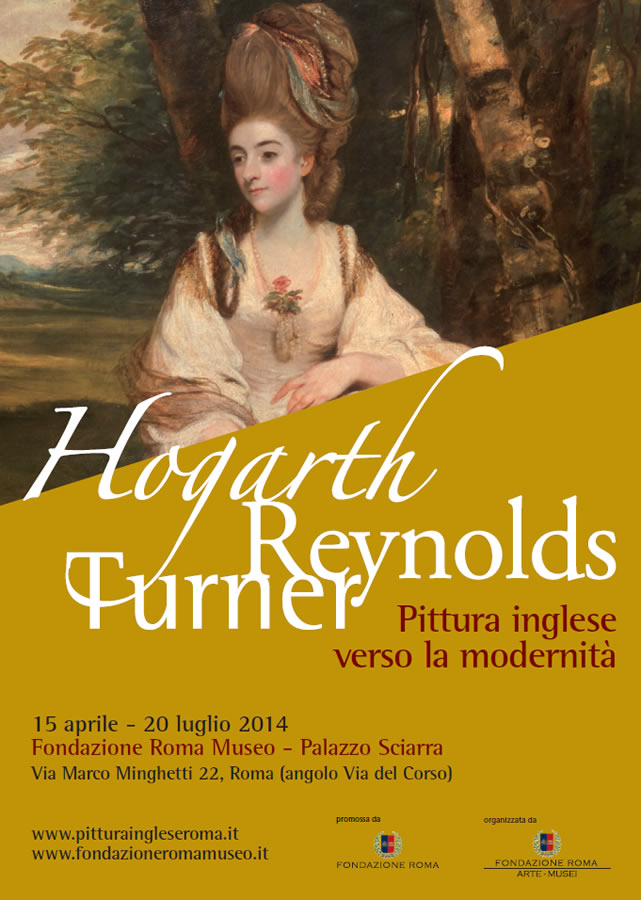 The exhibition offers the public a comprehensive overview of the social and artistic development that took place during the XVIII century in step with the hegemony gained by Great Britain at the historical, political, and economic level. For this purpose a corpus of over one hundred works belonging to prestigious institutions such as the British Museum, the Tate Gallery, the Victoria & Albert Museum, the Royal Academy, the National Portrait Gallery, the Museum of London, and the Uffizi Gallery has been formed and is accompanied by a nucleus of works from the important American collection belonging to the Yale Center for British Art.
During the eighteenth century England became an authentic international power, leader of the Industrial Revolution and of the domination of the sea routes, and thus raised the issue of establishing its own artistic school for the first time. The economic development lead by Great Britain created a new middle-class which included professionals, industrialists, merchants, scientists and philosophers who, having found that visible arts considerably affirmed their new social status, became patrons of those masters who over the century contributed to the definition of a domestic school.
The exhibition is divided into seven sections featuring a selection of works by the most significant English painters, for the purpose of documenting the portrait and landscape genres that found more fortune during this century, creating a figurative language capable of interpreting modernity which, in the nineteenth century, became a reference throughout Europe. Visitors may admire artists such as Hogarth, Reynolds, Gainsborough, Wright of Derby, Stubbs, Füssli, Constable, and Turner. Their works offer a significant cross-section of the peculiarity and originality of English art, an exhibition of which has not been held in Rome since 1966.
Update (added 19 April 2014) — The exhibition press release, which details the seven sections, is available as a PDF file here».
The catalogue is available from Skira:
Carolina Brook and Valter Curzi, Hogarth, Reynolds, Turner: Pittura inglese verso la modernità (Rome: Skira, 2014), 304 pages, ISBN: 8857222707, €40.
Exhibition | Grand Collecting: Richard Wilson and the Ford Collection
One more to add to the list of exhibitions of work by Richard Wilson, on this the 300th anniversary of his birth. The exhibition as described at ArtFund:
Grand Collecting: Richard Wilson and Masterworks from the Ford Collection
Gainsborough’s House, Sudbury, Suffolk, 11 January — 31 May 2014

Richard Wilson, Syon House from Richmond Gardens, Evening, 1761 (?)
(Gainsborough’s House)
◊ ◊ ◊ ◊ ◊
The Ford Collection originated in the 18th century thanks to Benjamin Booth, who amassed the largest set of works by Royal Academician Richard Wilson, held at the time. Booth’s grandson Richard Ford, an author, traveller and connoisseur, continued collecting into the 19th century, and in later years Richard’s great grandson Sir Brinsley Ford strengthened the existing areas of work as well as introducing his own interests.
At the centre of the collection are works by Richard Wilson, one of the leading figures in British landscape painting, whose influence was felt across Europe. Along with artists including Thomas Gainsborough he created the country’s ‘landscape tradition’, with John Hoppner proclaiming: ‘We recollect no painter, who, with so much originality of manner, united such truth and grandeur of expression’.
The works in this exhibition, predominantly collected by Booth, show the breadth of his expression from early drawings in Rome to paintings in the 1770s. Other featured artists include renowned English painter, John Frederick Lewis.
2014 marks 300 years since the birth of Richard Wilson and the beginning of the Georgian age. In celebration, Gainsborough’s House is displaying the 1714 Sudbury Map, hand drawn map on vellum using iron gall ink and various shades of watercolour. It was created by Cornelius Brewer, whose signature can be seen with the inscription and it contains the earliest image of Gainsborough’s House.
Exhibition | Wedding Dresses, 1775–2014
Press release for the upcoming exhibition at the V&A (also see the exhibition blog). . .
Wedding Dresses, 1775–2014
Victoria & Albert Museum, London, 3 May 2014 — 15 March 2015
Curated by Edwina Ehrman
◊ ◊ ◊ ◊ ◊
The V&A’s spring 2014 exhibition will trace the development of the fashionable white wedding dress and its interpretation by leading couturiers and designers, offering a panorama of fashion over the last two centuries. Wedding Dresses 1775–2014 will feature over 80 of the most romantic, glamorous and extravagant wedding outfits from the V&A’s collection. It will include important new acquisitions as well as loans such as the embroidered silk coat design by Anna Valentine and worn by The Duchess of Cornwall for the blessing after her marriage to HRH The Prince of Wales (2005), the purple Vivienne Westwood dress chosen by Dita Von Teese (2005), and the Dior outfits worn by Gwen Stefani and Gavin Rossdale on their wedding day (2002).
Displayed chronologically over two floors, the exhibition will focus on bridal wear. Most of the outfits were worn in Britain, by brides of many faiths. Alongside the dresses will be accessories including jewellery, shoes, garters, veils, wreaths, hats and corsetry as well as fashion sketches and personal photographs. Garments worn by bridegrooms and attendants will also be on display. The exhibition will investigate the histories of the garments, revealing fascinating and personal details about the lives of the wearers, giving an intimate insight into their occupations, circumstances and fashion choices.

Silk brocade gown, hat, and shoes, 1780. Olive Matthews Collection, Chertsey Museum. Photo by John Chase.
The opening section of the exhibition will feature some of the earliest examples of wedding fashion including a silk satin court dress (1775) and a ‘polonaise’ style brocade gown with straw bergère hat (1780) lent by the Chertsey Museum. The preference for white in the 19th century will be demonstrated by a white muslin wedding dress decorated with flowers, leaves and berries (1807) recently acquired by the V&A, and a wedding outfit embellished with pearl beads design by Charles Frederick Worth (1880). As the 19th century drew to a close historical costume influenced fashion. A fine example will be a copy of a Paris model designed by Paquin Lalanne et Cie made by Stern Brothers of New York (1890) for an American bride.
Designs from the 1920s and 1930s will illustrate the glamour of bridal wear which was now influenced by evening fashions, dresses were slim-hipped and made from richly beaded textured fabrics and slinky bias-cut satin. During the Second World War when clothing restrictions were introduced, brides needed to make imaginative and practical fashion choices. They used non-rationed fabrics such as upholstery materials, net curtaining and parachute silk, or married in a smart day dress or service uniform. On display will be a buttercup patterned dress made in light-weight upholstery fabric by London dressmaker Ella Dolling (1941).
Wedding Dresses 1775–2014 will also explore the growth of the wedding industry and the effect of increasing media focus on wedding fashions. Improvements in photography in the early 20th century encouraged photojournalism and society weddings were reported in detail in the national press and gossip columns. Two of the most spectacular wedding dresses on show will be the Norman Hartnell dress made for Margaret Whigham (later Duchess of Argyll) for her marriage to Charles Sweeny (1933), and the Charles James ivory silk satin dress worn by Barbara ‘Baba’ Beaton for her marriage to Alec Hambro (1934). These dramatic dresses will be seen alongside archive film and news clippings of the occasions as examples of society ‘celebrity’ weddings.
The mezzanine level will feature wedding garments from 1960 to 2014, taking the exhibition right up to date with Spring/Summer 2014 designs by Jenny Packham and Temperley Bridal. Emphasising the glamour and spectacle of weddings today, key designers will include Vivienne Westwood, John Galliano, Christian Lacroix, Lanvin, Vera Wang, Jasper Conran, Bruce Oldfield, Osman, Hardy Amies, Bellville Sassoon, Mr.Fish, John Bates and Jean Muir, with millinery by Philip Treacy and Stephen Jones. This section will explore the changing social and cultural attitudes to the wedding ceremony and marriage in the late 20th century and will feature examples of innovative and unconventional wedding outfits including dresses designed by Gareth Pugh and Pam Hogg for the weddings of Katie Shillingford (2011) and Mary Charteris (2012).
A version of the exhibition previously toured to Bendigo Art Gallery, Victoria, Australia (2011), Museum of New Zealand Te Papa Tongarewa (2011–12), National Museum of Singapore (2012), and Western Australian Museum, Perth, Australia (2012–13).
◊ ◊ ◊ ◊ ◊
From the V&A:
Edwina Ehrman, The Wedding Dress: 300 Years of Bridal Fashions, 2nd edition (London: V&A Publishing, 2014), 208 pages, ISBN 978-1851778133, £30 / $50.
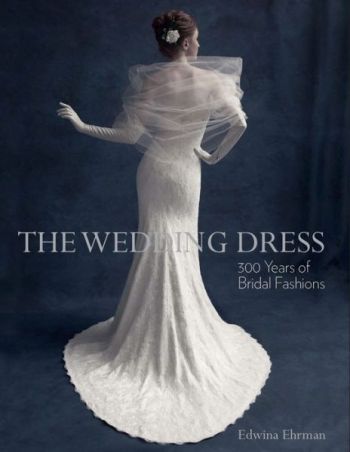 This sumptuous book draws on wedding garments in the V&A’s collection, photographs, letters, memoirs, newspaper accounts and genealogical research to explore the history of the wedding dress and the traditions that have developed around it since 1700. It focuses on the white wedding dress, which became fashionable in the early nineteenth century and is now chosen by women across the world. The book considers the way couturiers and designers have challenged and refreshed the traditional white dress and the influence of the wedding industry, whose antecedents lie in the commercialization of the wedding in Victorian Britain. The Wedding Dress is not only about costume, but also about the cultivation of the image of the bride. This book is a glorious tribute to an exquisite, stylish, glamorous gown, the romance of its evolution and the splendour of its design.
Edwina Ehrman is a curator of Textiles and Fashion at the V&A and of the exhibition The Wedding Dress: 300 Years of Bridal Fashions. She is co-author of The London Look: Fashion from Street to Catwalk and a contributor
to The Englishness of English Dress.
Exhibition | The Coast and the Sea
Press release (4 October 2013) from D. Giles:
Linda S. Ferber, The Coast and the Sea: Marine and Maritime Art in America (London: D. Giles Limited, 2013), 104 pages, ISBN 978-1907804311, $30 / £20.
The Society of the Four Arts, Palm Beach, Florida, 25 January — 9 March 2014
The Baker Museum of Art, Naples, Florida, 19 April — 6 July 2014
Portland Museum of Art, Portland, Maine, January — May 2015
The Mattatuck Museum, Waterbury, Connecticut, 6 June — 13 September 2015
The New York State Museum, Albany, New York, 24 October 2015 — 22 February 2016

A Southeast Prospect of the City of New York, ca. 1756–61. Oil on canvas. 38 x 72 1/2 in. (96.5 x 184.2 cm). Collection of the New-York Historical Society.
◊ ◊ ◊ ◊ ◊
The Coast and the Sea: Marine and Maritime Art in America will be published by D Giles Limited, in association with the New-York Historical Society, in December 2013. It is an appealing and colourful volume which presents over 50 of the best marine paintings and artifacts from the New-York Historical Society’s impressive maritime art collection.
 The works range in date from 1750 to 1940, and are by eminent marine artists like Thomas Birch, John Frederick Kensett, and Charlton T. Chapman. Highlights include large format canvasses of famous sea battles, ships at work, portraits of heroic sea captains, dashing naval officers like James Gordon Bennett Jr. and pioneering merchants, such as the aptly named Preserved Fish of New York, prominent in shipping in the early 19th century. There are also maritime themed objects such as an engraved whale’s tooth from the late 19th century, and a silver presentation urn commemorating acts of bravery from the War of 1812. An essay by curator Linda S. Ferber places the works within their wider historical and cultural narrative.
The works are then arranged thematically rather than by artist or period; there is for example a chapter on the Anglo-Dutch tradition in American marine art: the War of 1812 with its great sea battles and heroes and romantic and idealized visions of the sea. A section on the merchant marine and maritime trade features paintings of major trading posts in and around the Pearl River Delta, including Hong Kong; some of these paintings were by a group of Chinese artists working in the European style specifically for the export market. There are views of the Hudson River and the great Port of New York, as well as Gilded Age nostalgia for the great age of sail, with its clipper ships and majestic wind-jammers.
Linda S. Ferber is Senior Art Historian, the New-York Historical Society.
◊ ◊ ◊ ◊ ◊
Note (added 1 August 2014) — The original version of this posting included only the first two exhibition venues.
Exhibition | From Watteau to Fragonard: Les Fêtes Galantes
The exhibition opens today at the Jacquemart-André. In addition to the remarkably comprehensive 30-page press kit, the exhibition website, available in both French and English, is outstanding. -CH
From Watteau to Fragonard: Les Fêtes Galantes
Musée Jacquemart-André, Paris, 14 March — 21 July 2014
Curated by Christoph Vogtherr and Mary Tavener Holmes

Antoine Watteau, An Embarrassing Proposal, oil on canvas, ca. 1715–20
(Saint-Petersburg, Hermitage Museum)
◊ ◊ ◊ ◊ ◊
The Musée Jacquemart-André is delighted to be holding the exhibition From Watteau to Fragonard, les fêtes galantes. There will be approximately sixty works on display, mostly paintings lent for the occasion by major collections, predominantly public, from countries including France, Germany, the UK and the USA.
The poetical term fête galante refers to a new genre of paintings and drawings that blossomed in the early 18th century during the Regency period (1715–1723) and whose central figure was Jean-Antoine Watteau (1684–1721). Inspired by images of bucolic merrymaking in the Flemish tradition, Watteau and his followers created a new form, with a certain timelessness, characterised by greater subtlety and nuance. These depict amorous scenes in settings garlanded with luxuriant vegetation, real or imaginary: idealised dancers, women and shepherds are shown engaged in frivolous pursuits or exchanging confidences. The poetical and fantastical atmospheres that are a mark of his work are accompanied by a quest for elegance and sophistication characteristic of the Rococo movement, which flourished during the Age of Enlightenment, evidenced in his flair for curved lines and light colours.

Jean-Honoré Fragonard, A Game of Hot Cockles, oil on canvas, ca. 1775–80 (Washington, D.C., National Gallery of Art)
The exhibition offers a chance to rediscover the pioneering nature of Watteau’s output. These are works of great creativity, depictions of life outdoors in some of his finest paintings and most accomplished drawings. Nicolas Lancret (1690–1743) and Jean-Baptiste Pater (1695–1725) were greatly influenced by the master, their works revisiting and refining the codes of the fêtes galantes. Their imaginary scenes are anchored in reality, featuring locations, works of art and multiple details that would have been easily recognisable to their contemporaries.
The flexibility of the fête galante theme proved to be an invitation to experimentation and innovation, and the genre was to inspire several generations of artists, occupying a central place in French art throughout the 18th century. Works by other highly creative painters, such as François Boucher (1703–1770) and Jean-Honoré Fragonard (1732–1806), illustrate their very personal visions of the joys of the fête galante as first imagined by Watteau.
The Musée Jacquemart-André, with its marvellous collection of 18th-century French paintings, is the perfect setting for an exhibition looking at fêtes galantes. We are particularly pleased that several of the finest drawings from the period, from the collection created by Nélie Jacquemart and Édouard André, will also be on display as part of the exhibition.
The Curators
 Currently director of London’s Wallace Collection, Christoph Vogtherr is a specialist in 18th-century French painting. He is the author of an authoritative work on the subject, the catalogue raisonné of paintings by Jean-Antoine Watteau, Jean-Baptiste Pater, and Nicolas Lancret in Berlin and Potsdam, published in 2010. During 2011, he curated two successful exhibitions of works by Watteau at the Wallace Collection.
Mary Tavener Holmes holds a doctorate from the Institute of Fine Arts at New York University. A specialist in 18th-century French paintings and drawings, she has over thirty years’ experience as a curator, author and professor of European art. She has produced numerous publications, including A Magic Mirror: The Portrait in France, 1700–1900 (1986) and Nicolas Lancret: Dance before a Fountain (2006).
◊ ◊ ◊ ◊ ◊
The catalogue is available from Artbooks.com:
Christoph Vogtherr and Mary Tavener Holmes, De Watteau à Fragonard. Les Fêtes Galantes (Antwerp: Mercator, 2014), 224 pages, ISBN: 978-9462300453, €39.
Exhibition | Hatch, Match, and Dispatch, Part II
My nomination for notable exhibition title of the year comes from the current show at the Fan Museum in Greenwich (complete with the use of the older spelling of that third term and the irresistible ‘part II’). -CH
Hatch, Match & Despatch, Part II
The Fan Museum, Greenwich, 11 January — 1 June 2014
 An intriguing display of fans which commemorate births, marriages and deaths…
Covering a period of over 300 years (beginning in the mid seventeenth century), the exhibition reveals how fans recorded not only joyous occasions of national significance such as royal births and weddings but those of a darker, melancholic nature, too. From lavishly crafted examples given as part of a bride’s wedding trousseau to modest commemorative confections produced in quantity and designed to appeal to all pockets, these fans reveal an often subtle undercurrent of dynastic and political intrigue.
Hatch, Match & Despatch celebrates the theatricality of love, life and death—the foundations upon which all human experience is built.
Pictured on the French fan on the right-hand side of the poster is The Marriage of the Dauphin, ca. 1770.
Exhibition | The Exotic at Home: China in Portuguese Ceramics
From Lisbon’s National Azulejo Museum:
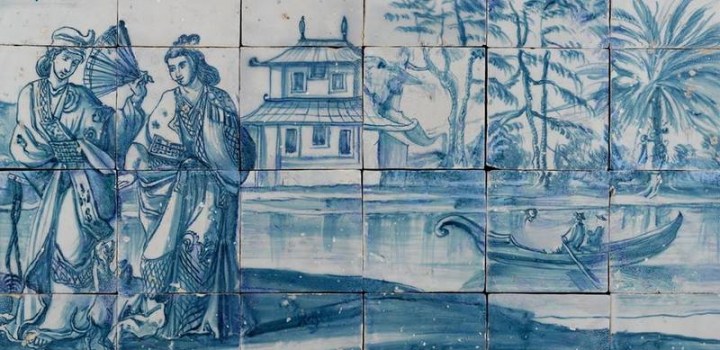
The Exotic is Never at Home? China in Portuguese Faience and Azulejo, 17th–18th Centuries
O Exótico nunca está em casa? A China na faiança e no azulejo portugueses (séculos XVII–XVIII)
Museu Nacional do Azulejo, Lisbon, 17 December 2013 — 29 June 2014
Curated by Alexandra Curvelo
◊ ◊ ◊ ◊ ◊
Since 1513, the Portuguese established a direct and regular contact between China and Europe. Taking on the role of suppliers and commercial brokers, Lusitanian adventurers and merchants progressively penetrated that immense kingdom, which was, perchance, the most exotic of the horizons dreamed and created in Europe since the Middle Ages. Exotic is a term of Latin origin, delivered from ancient Greek, meaning ‘outside’, an essential condition to arise one’s condition to marvel as it only exists after it is discovered. To this purpose the exotic object must always be transferred to a new context, in which it is reinterpreted, assuming another importance and meaning. But is the exotic always away from home, or are there moments in which it is ‘at the door’, if not even ‘in house’? These are the questions this exhibition aims to answer, by presenting the influence of China in Portuguese faience and azulejo in the 17th and 18th centuries.
◊ ◊ ◊ ◊ ◊
Dana Thomas writes about Lisbon in the March 2014 issue of Architectural Digest. . .
Be sure to pay a visit to the Museu Nacional do Azulejo (National Tile Museum), set in the opulent Madre de Deus Convent. Artist Joana Vasconcelos, who represented Portugal at last year’s Venice Biennale, calls it “one of Lisbon’s best-kept secrets.” The gem of the museum’s collection is a 75-foot-long mural from 1738 that’s made up of 1,300 tiles illustrating Lisbon before the earthquake of 1755, a cataclysm that destroyed much of the city and killed as many as 60,000 residents. Another impressive display of azulejos can be found at the São Vicente de Fora Monastery, which is decorated with tile panels depicting French poet Jean de La Fontaine’s fables. The hilltop monastery, in the historic residential neighborhood of Alfama, offers some of the finest views of the city. . .
The full article is available here»
Exhibition | By George! Handel’s Music for Royal Occasions
Press release for The Foundling exhibition:
By George! Handel’s Music for Royal Occasions
The Foundling Museum, London, 7 February — 18 May 2014

Robert Sayer, A Perspective view of the building for the fireworks in the Green Park taken from the reservoir, ca. 1749 (London: The Foundling Museum, Gerald Coke Handel Collection)
◊ ◊ ◊ ◊ ◊
No composer has been more closely associated with the British monarchy than German-born George Frideric Handel (1685–1759). His anthem Zadok the Priest has been performed at every coronation since that of King George II on 11 October 1727, while his Water Music was performed in 2012 on the River Thames for the Diamond Jubilee of Queen Elizabeth II.
In the 300th anniversary year of the coronation of George I, the first Hanoverian king, this fascinating new exhibition explores Handel and his music for royal occasions, drawing on the Gerald Coke Handel Collection at the Foundling Museum and significant loans from major institutions including the British Library, Lambeth Palace, and the National Portrait Gallery.
Handel enjoyed the patronage of three British monarchs during his lifetime: Queen Anne, George I, and George II. Employed by George I in Hanover, Handel had the advantage of knowing the new king before he ascended the British throne in 1714. Although he was not appointed Master of the King’s Musick, Handel was favoured by George I and his family, while the appointed Master was left to compose music for smaller, less significant occasions. Handel tutored the royal princesses and composed music for almost all important royal events. He went on to compose the coronation anthems for George II, as well as the Music for the Royal Fireworks and the famous Water Music.

Philip Mercier, The Music Party (Frederick Lewis, Prince of Wales, and his sisters: Anne, Princess Royal and Princess of Orange; Princess Caroline Elizabeth; and Princess Amelia Sophia Eleanora), 1733 (London: The National Portrait Gallery)
Exhibits include paintings of the royal family and the 1727 Order of Service for the Coronation of George II, annotated by the Archbishop of Canterbury. Musical instruments of the period will be displayed alongside autograph manuscripts including Zadok the Priest, the Ode for the Birthday of Queen Anne, and Lessons for Princess Louisa, which Handel composed to teach the royal princesses to play the harpsichord. Rarely-seen documents from the archives of Westminster Abbey give an insight into the organisation of major royal events.
The Librarian of the Gerald Coke Handel Collection, Katharine Hogg, said: “Handel combined his musical genius with an ability to place himself at the heart of the British establishment, while retaining his independence as an entrepreneur and philanthropist. His identity as part of the British musical tradition and his legacy of quintessentially British music reflects his ability to adapt his musical skills to meet the expectations of his patrons and audiences.”
Handel was a governor of the Foundling Hospital. He donated the organ to its Chapel, composed an anthem for the Hospital, and conducted annual fundraising concerts of Messiah. Today’s charity concerts and fundraising auctions can trace their roots back to the Foundling Hospital and the remarkable creative philanthropy of Handel.
The Foundling Museum’s Director, Caro Howell said: “By exploring Handel’s royal relationships here, in the context of a home for the most vulnerable children, we’re revealing two sides of a remarkable artist. The musician who personally tutored the royal princesses also oversaw the music at the Foundling Hospital’s chapel where illegitimate and abandoned children were christened. The composer who directed the music at lavish and unique royal events, including the Royal Fireworks, exploited the same appetite for scale by conducting fundraising concerts at the Hospital.”
By George! is accompanied by a series of public events, including a concert by the Academy of Ancient Music [on Tuesday, March 18], performances of Handel’s music for nursery children, and eighteenth-century dancing and costume workshops. By George! opens a year of celebration at the Foundling Museum.
The Foundling Museum celebrates its 10th anniversary in June 2014. This milestone year coincides with three significant anniversaries in the story we tell: the 275th anniversary of the establishment of the Foundling Hospital, the UK’s first children’s charity; the 250th anniversary of the death of William Hogarth, whose donation of paintings to the Hospital created England’s first public art gallery; and the 300th anniversary of the coronation of George I, the first Hanoverian king. We will be marking this year of celebration and commemoration with a series of major exhibitions, events and the re-opening our Introductory Gallery after a major refurbishment.
Additional images are available as a PDF file here»










leave a comment