Neapolitan Crèche at The Met
From The Met:
Christmas Tree and Neapolitan Baroque Crèche
The Metropolitan Museum of Art, New York, 26 November 2013 — 6 January 2014
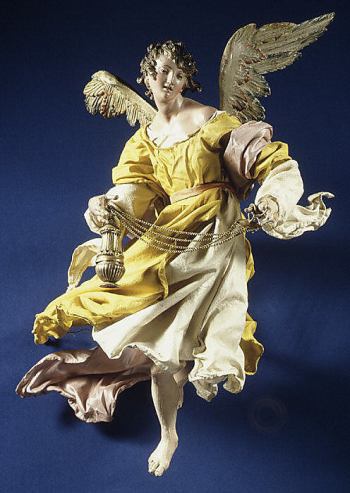
Angel, attributed to Giuseppe Sanmartino (Italian, 1720–1793), polychromed terracotta head; wooden limbs and wings; body of wire wrapped in tow; various fabrics, 14 inches (NY: The Met)
The Museum continues a longstanding holiday tradition with the presentation of its Christmas tree, a favorite of New Yorkers and visitors from around the world. A vivid eighteenth-century Neapolitan Nativity scene—embellished with a profuse array of diminutive, lifelike attendant figures and silk-robed angels hovering above—adorns the candlelit spruce. Recorded music and lighting ceremonies add to the enjoyment of the holiday display.
The annual Christmas installation is the result of the generosity, enthusiasm, and dedication of the late Loretta Hines Howard, who began collecting crèche figures in 1925 and soon after conceived the idea of combining the Roman Catholic custom of elaborate Nativity scenes with the tradition of decorated Christmas trees that had developed among the largely Protestant people of northern Europe. This unusual combination was presented to the public for the first time in 1957, when the Metropolitan Museum initially exhibited Mrs. Howard’s collection. More than two hundred eighteenth-century Neapolitan crèche figures were given to the Museum by Loretta Hines Howard starting in 1964, and they have been displayed each holiday season for nearly forty years. Linn Howard, Mrs. Howard’s daughter, worked with her mother for many years on the annual installation. Since her mother’s death in 1982, she has continued to create new settings for the Museum’s ensemble. In keeping with family tradition, Linn Howard’s daughter, artist Andrea Selby Rossi, joins her mother again this year in creating the display.

The exhibit of the crèche is made possible by gifts to The Christmas Tree Fund and the Loretta Hines Howard Fund.
The Museum’s towering tree, glowing with light, is adorned with cherubs and some fifty gracefully suspended angels. The landscape at the base presents the figures and scenery of the Neapolitan Christmas crib. This display mingles three basic elements that are traditional to eighteenth-century Naples: the Nativity, with adoring shepherds and their flocks; the procession of the three Magi, whose exotically dressed retinue echoes the merchants and travelers one may have encountered in bustling Naples at the time of the crèche’s creation; and, most distinctive, colorful peasants and townspeople engaged in their quotidian tasks. The theatrical scene is enhanced by a charming assortment of animals—sheep, goats, horses, a camel, and an elephant—and by background pieces serving as the dramatic setting for the Nativity, including the ruins of a Roman temple, several quaint houses, and a typical Italian fountain with a lion’s-mask waterspout.
The origin of the popular Christmas custom of restaging the Nativity traditionally is credited to Saint Francis of Assisi. The employment of manmade figures to reenact the hallowed events soon developed and reached its height of complexity and artistic excellence in eighteenth-century Naples. There, local families vied to outdo each other in presenting elaborate and theatrical crèche displays, often assisted by professional stage directors. The finest sculptors of the period—including Giuseppe Sammartino and his pupils Salvatore di Franco, Giuseppe Gori, and Angelo Viva—were called on to model the terracotta heads and shoulders of the extraordinary crèche figures. The Howard collection includes numerous examples of works attributed to them as well as to other prominent artists.
The Museum’s crèche figures, each a work of art, range from six to twenty inches in height. They have articulated bodies of tow and wire, heads and shoulders modeled in terracotta and polychromed to perfection. The luxurious and colorful costumes, many of which are original, were often sewn by ladies of the collecting families and enriched by jewels, embroideries, and elaborate accessories, including gilded censers, scimitars and daggers, and silver filigree baskets. The placement of the approximately fifty large angels on the Christmas tree and the composition of the crèche figures and landscape vary slightly from year to year as new figures are added.
Exhibition | Piranesi’s Antiquity: Findings and Polemics
From the Wallraf-Richartz Museum:
Piranesis Antike: Befund und Polemik / Piranesi’s Antiquity: Findings and Polemics
Wallraf-Richartz Museum, Cologne, 25 October 2013 — 26 January 2014
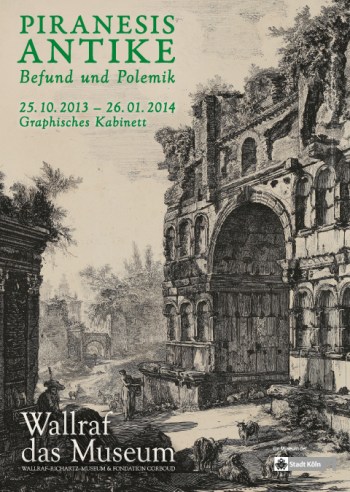 ‘Rome or Athens?’ In the eighteenth century, this simple and yet so complex question was at the heart of a vehement dispute concerning the exemplary function of classical antiquity for contemporary art. One major advocate of Rome was the artist Giovanni Battista Piranesi (1720–1778). Over a period of about 30 years, he produced more than 130 large-format etchings with views of ancient and modern Rome, as well as of buildings from the immediate surroundings. These etchings were compiled into a self-contained series under the title Vedute di Roma. Piranesi uses dramatic perspectives, strong contrasts between light and dark, and gigantic enlargements of sections of ancient buildings in order to convince his contemporaries of the importance of classical Rome.
Some 20 of these fascinating works can now (25 October 2013 to 26 January 2014) be seen in Cologne at the Wallraf-Richartz Museum’s Department of Drawings and Prints under the title Piranesi’s Antiquity: Findings and Polemics.
One of the most versatile Italian artists of the eighteenth century, Piranesi still fascinates us today with his extensive œuvre. During his lifetime he produced more than 1,000 etchings and thus left us impressive witnesses of his age. In addition to his graphic work, Piranesi also wrote numerous theoretical treatises, defending Roman civilization against the claims of Greek culture. The exhibition in Cologne shows how, in the large-format Vedute or views of Rome, the multifarious and contradictory ways in which classical antiquity was appropriated by the eighteenth century are superimposed. Meticulous archaeological investigations stand alongside market-oriented production of prints, and a polemical debate on the true legacy of antiquity (Rome versus Athens). By selling his views of Rome to foreign visitors to the city, Piranesi made a fortune and became well known throughout Europe.
This exhibition is being held to mark the 625th anniversary of the foundation of Cologne University. Together with teachers and students of art history and classical archaeology, the works were selected and researched from among the holdings of the university archives. The archive has 46 views of Rome by Piranesi, an unusual wealth of material for a university collection. It is the result of a donation by the university’s first Professor of Greek Philology, Dr Joseph Kroll.
Information on the exhibition symposium is available here»
Exhibition | Wallpaper from the Deutschen Tapetenmuseums

Orangerie, Kassel
(Wikimedia Commons, November 2005)
◊ ◊ ◊ ◊ ◊
While this exhibition of wallpapers in Kassel addresses primarily the nineteenth century, there are eighteenth-century examples, and it’s useful to draw attention to the collection of the German Wallpaper Museum (Deutschen Tapetenmuseums), which includes some 23,000 objects. With plans for a new home in the works, the current exhibition is mounted in Kassel’s Orangerie, which itself dates to the opening decade of the eighteenth century. From the exhibition description:
Aufgerollt. Tapeten: Vom Entwurf an die Wand
Westpavillon der Orangerie, Kassel, 13 September 2013 — 12 January 2014
 Jeder kennt sie, fast jeder hat sie: Tapeten. Seit dem 18. Jahrhundert begeistern die in allen nur denkbaren Farben und Motiven gedruckten Wanddekore. Ob geometrisch oder malerisch, farbenfroh oder dezent, ob im 18. oder im 21. Jahrhundert entstanden: Bevor die Tapete ihre Wirkung als Wandschmuck entfalten kann, sind zahlreiche Arbeitsschritte notwendig, die von der Inspirations- und Entwurfsphase, über die Produktion bis hin zur Vermarktung reichen. Die Sonderausstellung des Deutschen Tapetenmuseums zeigt Objekte aus dem reichen Schatz der Sammlung, die dieses faszinierende Thema insbesondere für das 19. und frühe 20. Jahrhundert beleuchten. Gezeigt wird eine Vielfalt an Vorlagewerken, Tapetenentwürfen und Handdruckmodeln ebenso wie das fertige Produkt Tapete. Musterbücher und Werbebilder mit gesamten Wandabwicklungen lassen die Möglichkeiten der Vermarktung von Tapeten lebendig werden.
Das Schaufenster bietet einen Einblick in die fantastische Sammlung des Deutschen Tapetenmuseums, die mit fast 23.000 Objekten nahezu lückenlos die Geschichte der Tapete dokumentiert. Von 1976 bis 2008 im Hessischen Landesmuseum ausgestellt, wurde die Sammlung 2010 in ein fachgerechtes Depot verlagert. Ein Museumsneubau ebenso wie eine neue Dauerausstellung sind in Planung.
Exhibition | The Remondini & Eighteenth-Century Print Culture
This is the last week for a small exhibition I worked on with one of my exceptional students, Paula Manni (having graduated with her B.A. in May, she’s currently an intern at the Detroit Institute of Arts). Pedagogically, the project was immensely gratifying and provided more evidence for me of just how much one can do with online projects at basically no (economic) costs whatsoever. While we developed the online component primarily for a popular audience (iPads were available in the gallery), I was thrilled to receive—just one week after the exhibition opened—an email from a UK museum that owns several prints from the same Prodigal Son series and to learn that their images have been manipulated and combined with other prints in really interesting ways, further highlighting the interactive character of these sorts of perspective views. The bibliography for the exhibition provides a useful starting point for anyone working on zograscopes and vue d’optique prints generally. Paula and I shall continue to update the site occasionally , so I would welcome suggestions for sources we should add. As is typically the case with any project involving Google, there are terrific, telling measures of assessment: search for ‘Remondini’ and ‘Prodigal’, and among the top results will be the Prodigal Son among the Harlots. -CH
◊ ◊ ◊ ◊ ◊
A Prodigal Story for the Marketplace: The Remondini and Eighteenth-Century Print Culture
The Center Art Gallery, Grand Rapids, Michigan, 1 November — 17 December 2013
Curated by Craig Ashley Hanson and Paula Manni with Joel Zwart
◊ ◊ ◊ ◊ ◊
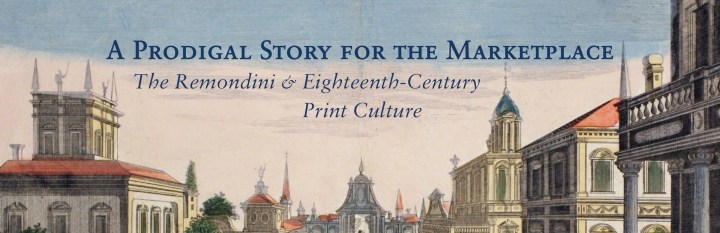
Founded in the mid-seventeenth century, the Remondini publishing firm produced prints and books on a massive scale for nearly two hundred years, marketing their paper commodities not only across Europe but also in the American colonies and parts of Asia. Based in Bassano, Italy (45 miles northwest of Venice), the firm targeted a large, popular audience. By offering a wide array of printed materials, ranging from religious pictures and texts, to genre scenes, to sweeping landscape views (often copying the works of others without permission), the firm appealed to the interests—and budgets—of an emerging middle class audience.
Highlighting Calvin College’s own Prodigal Son series of six etchings produced by the Remondini firm in the 1780s—copies after a series first published by Georg Balthasar Probst around 1770—this exhibition situates the prints within the visual culture of the period. While there is a tendency to address eighteenth-century prints as ‘art’ simply because of their age, exploration of the original publishing context allows us to see these pictures as both belonging within and contributing to an expanding popular culture that conflated entertainment, religion, and the marketplace. Most of the items included in the exhibition were never intended to be framed (much less hung on a gallery wall) but were instead expected to be handled and seen through perspective-enhancing viewing devices—variously described as diagonal mirrors, optical pillar machines, or (most commonly today) zograscopes.
Exhibition | Vincoli d’Amore: Spose in Casa Gonzaga
From the Palazzo Ducale in Mantova:
Vincoli d’Amore: Spose in casa Gonzaga tra XV e XVIII secolo
Museo di Palazzo Ducale, Mantua, 18 October 2013 — 6 January 2014
Curated by Paola Venturelli and Daniela Ferrari
 Si inaugura venerdì 18 ottobre alle ore 16.30 nell’Atrio degli Arcieri la mostra Vincoli d’Amore. Spose in casa Gonzaga tra XV e XVIII secolo, a cura di Paola Venturelli e Daniela Ferrari e promossa dall’Archivio di Stato di Mantova in collaborazione con la Soprintendenza BSAE di Mantova. Insieme alle curatrici intervengono Giovanna Paolozzi Strozzi, Soprintendente e Direttore del Museo di Palazzo Ducale, Francesca Zaltieri, Assessore alla Cultura della Provincia di Mantova e Renata Casarin Presidente del Soroptimist International Club di Mantova.
Spose di casa Gonzaga o spose giunte in casa Gonzaga lungo un arco di tempo che coincide con gli anni del dominio di questa grande dinastia, dagli inizi del XV secolo all’aprirsi del XVIII. Solo di alcune conosciamo le fattezze. Di poche gli interessi, i pensieri e le attitudini, rimanendo la maggior parte quasi priva di spessore storico e relegata nello sfondo della Grande Storia. Pedine, le cui mosse, abilmente studiate, porteranno tuttavia a costruire la Grande Storia dei Gonzaga. I loro matrimoni, voluti per allacciare vincoli di parentela con i principali casati, italiani o d’Oltralpe, erano infatti il frutto di oculate strategie dinastiche. Vincoli, qualche volta “d’amore”, anche spirituale – sull’imitazione del matrimonio mistico di Santa Caterina -, che cambiarono il panorama esistenziale delle nostre protagoniste.
La mostra è allestita negli ambienti in cui alcune delle protagoniste di questa esposizione hanno mosso i primi passi della loro vita coniugale. Presenti le duchesse Eleonora d’Asburgo ed Eleonora de’ Medici, ritratte nella supersite porzione della pala della Santissima Trinità, eseguita da Pieter Paul Rubens (ca. 1605), che domina la Sala degli Arcieri.
The Burlington Magazine, December 2013
The (long) eighteenth century in The Burlington:
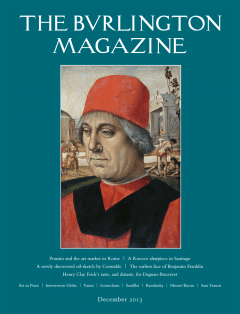
The Burlington Magazine 155 (December 2013)
E D I T O R I A L
• Richard Shone, “Home is Where the Art Is,” p. 807.
 Houses once occupied by distinguished residents are a special strand of the heritage industry that increasingly dominates a nation in thrall to all aspects of the past. We are constantly being exhorted to save and preserve this or that—a factory, a view, a manor house, a pier, a site of outstanding natural beauty, the historic habitat of wildlife, or, indeed, of the famous dead. Some of the shrines we visit are more larded with authenticity than others. Inevitably, the further back in time the illustrious lives were lived, the fewer objects there are likely to be which were familiar to the inhabitants. Was this her chair; was this really his easel? The aspic of preservation continually wobbles between the authentic and the fake. We do not always know—are not always told—whether something is ‘of the same period’ or ‘similar to’ or a ‘replica of’ what may or may not have been originally there, under the eye, the hand, the bottom or the feet of the presiding genius. Much depends on the piety of heirs and descendants, the
changing ownership of the house and the fluctuating stakes of fame. . . .
The latest appeal for an artist’s house has much to recommend it and should attract supporters beyond British shores. It concerns the restoration and preservation of J.M.W. Turner’s rural retreat at Twickenham, west London. This is an exceptional project and not simply a matter of tidying up and putting a blue plaque on the front. Turner designed this house himself, and plans for it abound in sketchbooks of c.1810–12, after he had purchased two plots of land near the Thames. The intention is to remove later additions (not serious) and reveal its compact interior, obviously influenced by his friend John Soane’s house in Lincoln’s Inn Fields. For Turner, Sandycombe Lodge was for rest and recreation such as fishing (when he could ‘angle out the day’) and hosting friends on excursions for picnics, rather than for long residence and staying guests. Turner sold the house in 1826 and the adjoining meadow in 1848 (to the Windsor, Staines and South Western Railway). Under the auspices of the Turner’s House Trust, the appeal for £2 million is well underway, with support already assured from the Heritage Lottery Fund, among many other organisations and private donors, although further funding is still needed.2 It is expected that the public will be able to visit in 2016.
2. For an entertaining and informative account of the house, see C. Parry-Wingfield, with Foreword by A. Wilton: J.M.W. Turner. The Artist and his House at Twickenham, London 2012. Donations can be sent to the Trust at 11 Montpelier Row, Twickenham, tw1 2nq, or at www.turnerintwickenham.org.uk.
The full editorial is available here»
A R T I C L E S
• Gauvin Alexander Bailey and Fernando Guzmán, “The Rococo Altarpiece of St Ignatius: Chile’s Grandest Colonial Retable Rediscovered,” pp. 815–20.
An examination of the Rococo altarpiece of St Ignatius in Santiago, Chile, and of the European influences on this great retablo.
• David Pullins, “Dating and Attributing the Earliest Portrait of Benjamin Franklin,” pp. 821–22.
A re-evaluation of a painting now found to be the earliest known portrait of Benjamin Franklin, added to an earlier figure of a man by Robert Feke (c.1746–48).
R E V I E W S
• Elizabeth Goldring, Review of Laura Houliston, ed., The Suffolk Collection: A Catalogue of Paintings (English Heritage, 2012), p. 835.
• Michael Rosenthal, Review of Leo Costello, J.M.W. Turner and the Subject of History (Ashgate, 2012), p. 836.
• Basile Baudez, Review of the exhibition Soufflot: Un architecte dans la lumière, pp. 850–51.
• Xavier F. Salomon, Review of the exhibition Il Gran Principe Ferdinando de’ Medici (1663–1713) collezionista e mecenate, pp. 851–53.
• Angela Delaforce, Review of the exhibition Da Patriarcal à Capela Real de São João Baptista, pp. 855–56.
• Jamie Mulherron, Review of the exhibition Interwoven Globe: The Worldwide Textile Trade, 1500–1800, pp. 856–58.
Exhibition | Grand Prince Ferdinando de’ Medici, 1663–1713
From the Uffizi:
The Grand Prince Ferdinando de’ Medici (1663–1713): Collector and Patron of the Arts
Uffizi Gallery, Florence, 26 June — 3 November 2013, extended until 6 January 2014
Curated by Riccardo Spinelli

◊ ◊ ◊ ◊ ◊
To mark the 300th anniversary of the death of Grand Prince Ferdinando de’ Medici (1663–1713), the Galleria degli Uffizi is planning to devote a celebratory exhibition to this key figure who was one of the most important collectors and patrons of the arts in the entire history of the Medici Grand Dukes of Tuscany. The son of Cosimo III and of Marguerite-Louise d’Orléans, Ferdinando nurtured two overriding interests, in the theatre and music and in the figurative arts, from a very early age. The exhibition sets out to convey the complexity of his interests and the innovative nature of his approach which drew the leading artists of the era (musicians, instrumentalists, painters and sculptors) to Florence between the end of the 17th century and the first decade of the 18th. The exhibition is broken down into sections illustrating the complex issues surrounding the prince’s cultural inclinations, while also presenting the buildings in which his patronage was played out.
An introductory iconographic section displays likenesses of the prince and of his family, with works by Giovan Battista Foggini, Justus Suttermans and Anton Domenico Gabbiani.
This is followed by a second section illustrating the early years of Ferdinando’s art collecting and patronage which focused in particular on his beloved villa at Pratolino where, alongside musicians, singers, costumiers and composers, he also hosted the Bibbiena family from Bologna, masters in the art of stage design. At the same time, the residence was being transformed in its interior decor and embellished with the work of Ferdinando’s favourite painters at the time, including Livio Mehus, Pier Dandini and Domenico Tempesti, all of whom were Tuscans, but also such “foreigners” as Crescenzio Onofri from Rome or Cristoforo Munari from northern Italy, all of them engaged in producing works closely linked to the villa and to the performances and other leisure activities that were held in it.
The third section is devoted to the renovation of Palazzo Pitti, of the Pergola Theatre and of the cathedral of Florence on the occasion of Ferdinando’s wedding to Princess Violante Beatrix of Bavaria in 1689. The ducal palace underwent radical transformation in its piano nobile, in the bridal couple’s apartments and in the mezzanines above, which were renovated in a spectacularly imaginative way, evinced in the exhibition by the memoirs and preparatory drawings of the artists who executed in the work (Luca Giordano, Diacinto Maria Marmi, Alessandro Gherardini, Giovan Battista Foggini and Anton Domenico Gabbiani). At the same time, the section also explores the ceremonies and festivities held in Florence to mark the prince’s wedding, using drawings and documents for the purpose.
The fourth section illustrates the prince’s growing interest in the figurative arts, both in contemporary sculpture and in painting, with the leading artists active at the time, many of whom were experts in such ‘modern’ late 17th-century genres of as still-life and portraiture. Thus this part of the exhibition contains both religious and secular works (by Carlo Dolci, Carlo Loth, Baldassarre Franceschini and Il Volterrano) and examples of ‘painted nature’ (by Jacopo Ligozzi, Bartolomeo Bimbi, Margherita Caffi, Fardella, Houbracken and Michelangelo Pace da Campidoglio). Of equal interest in the section is the presence of sumptuary objects, pieces of furniture and everyday items testifying to Ferdinando’s sophisticated tastes, with works by the leading engravers, marquetry inlayers and silversmiths then active at court.
The highly significant fifth section explores the tastes of the Grand Prince as collector, with some of the 16th- to 18th-century paintings removed from churches in Tuscany and elsewhere, including Andrea del Sarto’s Madonna of the Harpies, Lanfranco’s Ectasy of St. Margaret of Cortona, Annibale Carracci’s Farnese Altarpiece, and lastly, the Madonna of the Long Neck by Parmigianino, one of Fernando’s most prestigious acquisitions in the field of Renaissance art as the 17th century drew to a close.
The sixth section is devoted to the grand prince’s favourite villa of all, Poggio a Caiano, whose decoration he renovated with the greatest magnificence. He chose a room on its piano nobile to house one of his most original collections comprising ‘works in miniature’, which is eloquently recreated in the exhibition through a selection paintings that once formed part of it, illustrating the prince’s catholic tastes in collecting.
The seventh section of the exhibition illustrates the prince’s taste for major Florentine statuary at the close of the 17th century, while in the sphere of painting it looks at the change in Ferdinando’s taste in favour of ‘foreign’ schools—far more modern than anything local artists could produce—such as the Venetian school (of which he was enamoured in his youth), the Bolognese school and the Ligurian school (with work by Crespi, Cassana, Fumiani, Sebastiano and Marco Ricci, Magnasco and Peruzzini) whose leading painters were summoned to Florence, where they produced some of their masterpieces specifically for the prince.
The final section is devoted to the last years of Ferdinando’s life, exploring the results and repercussions of his art patronage and collecting, and displaying the drawings for a celebratory monument that it was planned to erect in his memory, the sketches for that project, and material relating to his funeral.
Available from Artbooks.com:
Riccardo Spinelli, ed., Il gran principe Ferdinando de’ Medici (1663–1713) Collezionista e Mecenate (Firenze: Giunti, 2013 ), 430 pages, ISBN: 978-8809786103, $77.50.
◊ ◊ ◊ ◊ ◊
This smaller exhibition was on view until recently at the Villa of Poggio a Caiano:
For the Grand Prince Ferdinando:
Still lifes, vedute, bambocciate and caramogi from the Medici Collections
Medici Villa of Poggio a Caiano, 5 July — 5 November 2013
Curated by Maria Matilde Simari

◊ ◊ ◊ ◊ ◊
The Villa of Poggio a Caiano was one of the favourite residences of the Grand Prince Ferdinando de’ Medici (1663–1713), son of the Grand Duke Cosimo III and destined to succeed his father in the government of Tuscany. In concomitance with the major exhibition devoted to the Grand Prince in the Uffizi Gallery, the idea is to recall the figure of Ferdinando in the site of his favourite villa, too. It was here that Ferdinando spent the spring and autumn, riding his Berber horses, attending sophisticated concerts and operas performed in the theatre of the villa and devoting himself to the organisation of his own particular collection of miniature paintings, the so-called ‘Gabinetto di opere in piccolo’ which went on to become a famous example of a late seventeenth-century collection.
Significant evidence of Ferdinando’s commissions for the Villa of Poggio has fortunately survived in the large fresco dating to 1698 by Anton Domenico Gabbiani showing Cosimo de’ Medici being presented to Jupiter by Florence, which can be seen on the ceiling of the dining room on the first floor. This painting shows the celebratory and official side of court taste, but other aspects of the personality of Ferdinando, who was a curious man, interested in a wide range of artistic genres, also deserve to be explored.
An itinerary extending through fourteen rooms of the Still Life Museum is devoted to the Grand Prince as a collector of still lifes, highlighting the works that were certainly part of his collection. At the end of this itinerary is a room devoted to two different aspects of his tastes as a collector: the miniatures and the genre paintings, comprising in the latter group the views, the bambocciate and the grotesque and humorous paintings portraying pygmies and dwarves, or the whimsical caramogi.
The Grand Prince Ferdinando was attracted not only by great figure painting and by the works of the most famous painters of the sixteenth and seventeenth centuries (Titian, Parmigianino and Sebastiano Ricci) but also by artists engaged in collateral aspects and genres that can certainly not be defined as minor, since they made a very particular and novel impression on seventeenth-century taste: the flower painters, the painters of vedute, the Dutch petits maîtres, the bamboccianti painters of everyday life and the caricaturists.
The inventory of the assets of the Grand Prince drawn up at his death in 1713 records no less than sixteen paintings depicting caramogi (deformed, dwarf-like figures) intent upon various games and activities, for one of which the author’s name is specifically mentioned: the Brescia artist Faustino Bocchi, a renowned specialist in ‘the painting of pygmies’ who appears to have sojourned at the grand ducal court, and whom Ferdinando may in any case have met during a trip to Veneto and Lombardy in 1688. His interest in this particular grotesque genre can be linked to the recollections of Ferdinando as a passionate lover of amusing sonnets, ‘burlette burlesche’, of poets in ottava rima, comedians and ham actors.
The small collection of works displayed in the room dedicated to the Grand Prince Ferdinando in the Still Life Museum of the Villa of Poggio a Caiano offers a synthetic overview of the vedute, the bambocciate and the caramogi that he loved, displaying works not normally visible to the public since they are conserved in the repositories of the Florentine Galleries and of other institutions. Also on display is an as yet unpublished painting by Bartolomeo Ligozzi on which the date and signature have been discovered.
The show is rounded off by a selection of ancient manuscripts and printed books connected with the eclectic personality of Ferdinando: a cultured, passionate and curious collector who is also remembered as a cordial and affable man with a great sense of humour. As one of the manuscript memoirs recalls: “With his departure, spirit and joy too took their leave of Florence and Tuscany.”
Exhibition | Joseph Wright of Derby: Bath and Beyond
From The Holburne Museum:
Joseph Wright of Derby: Bath and Beyond
The Holburne Museum, Bath, 25 January — 5 May 2014
Derby Museum and Art Gallery, dates TBA
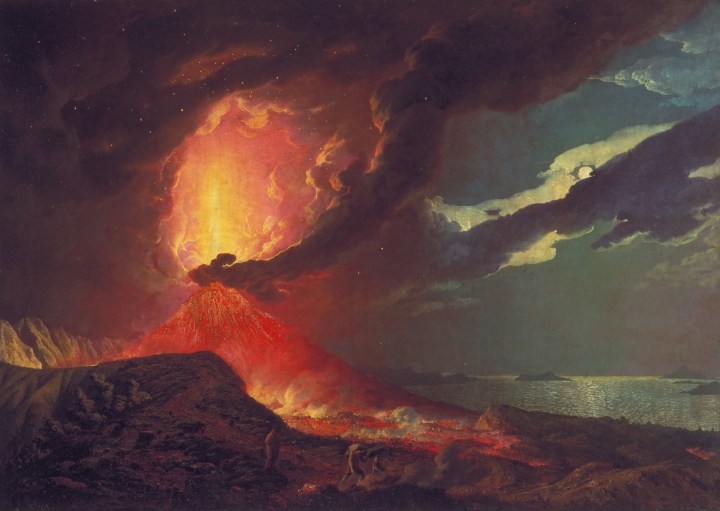
Joseph Wright, Vesuvius in Eruption, with a View over the
Islands in the Bay of Naples, ca. 1776–80 (London: Tate)
◊ ◊ ◊ ◊ ◊
I have taken the Liberty to give this Letter of Introduction to my Friend Mr. Wright of Derby, Who since his Return from Italy is come to Bath, & Designs to settle there.
Erasmus Darwin, 22 November 1775
Joseph Wright ‘of Derby’ (1734–1797) lived and worked in Bath between November 1775 and June 1777. This brief and little-known episode in Wright’s life marked a crossroads in his career; yet it has never been explored in detail. Joseph Wright of Derby: Bath and Beyond will place Wright in the context of the many artists, musicians, writers, business people and scientists living and working in the Georgian spa and present for the first time a comprehensive view of his life and work during those eighteen months. The exhibition and accompanying catalogue will also go ‘beyond’ to examine the effect of his time in Bath and his travels in Italy on Wright’s later work.

Joseph Wright, The Rev. Dr. Thomas Wilson and his adopted Daughter Miss Catherine Sophia Macaulay, 1776 (Chawton House Library)
Wright came to Bath to paint portraits, hoping to build on the success of Thomas Gainsborough who had recently left for London. The exhibition will include the three remaining portraits that the artist certainly made in Bath, including his painting of the elderly Rev. Thomas Wilson with the young daughter of Catharine Macaulay, the radical historian.
Whilst in Bath Wright worked up landscape studies he had made in Italy, producing spectacular views of Vesuvius in Eruption and the dazzling firework displays of Rome, the highlight of a visit to the artist’s studio in Brock Street. It was whilst in Bath that he first began to explore subjects from sentimental contemporary literature, which in turn have a strong impact on his portrait composition, and the exhibition will include some of his most beautiful depictions of figures alone in the landscape.
We are grateful to Derby Museum, which holds the world’s largest and finest collection of Wright’s work, for its generous loans to this exhibition which will include The Indian Widow, The Alchymist and some beautiful drawings. Other lenders include the National Gallery, Musée du Louvre, Tate, the British Museum, the Walker Art Gallery and the Fitzwilliam Museum. This exhibition will travel to Derby Museum and Art Gallery.
A study day is scheduled for 24 February 2014.
◊ ◊ ◊ ◊ ◊
From I. B. Tauris:
Amina Wright, Joseph Wright of Derby: Bath and Beyond (London: Philip Wilson Publishers, 2014), 112 pages, ISBN: 978-1781300213, £16 / $30.
 Joseph Wright (1734–1797) arrived in Bath from his native Derby in November 1775. Recently returned from a tour of Italy, he came to the fashionable spa town to re-establish his business as a portrait painter, hoping to fill the vacancy left by Thomas Gainsborough the previous year. This book, the first to examine Wright’s little-known Bath period, places the artist in the context of a city then at the height of its unique cultural significance. Using rarely-seen illustrations of his work, it considers his attempts to conquer a saturated portrait market with images of local celebrities, and his use of domestic spaces for public exhibition. His celebrated views of fireworks in Rome and the terrors of Vesuvius were first shown in Bath. Beautifully illustrated and highly readable, Joseph Wright of Derby: Bath and Beyond sheds new light on a key moment in this important English artist’s career, deepening our understanding of his life and work as a whole.
Amina Wright is Senior Curator at the Holburne Museum in Bath, UK, and has been Curator of Fine Art there since 2001. She was closely involved in the Holburne’s major redevelopment project, completed in 2011, as well as a number of exhibitions relating to British eighteenth-century painting, drawings and Georgian Bath. Previous publications include the exhibition catalogues Pictures of Innocence: Children in Portraits from Hogarth to Lawrence (2005) and Pickpocketing the Rich: Portrait Painting in Bath 1720–1800 (2002).
Study Day | Joseph Wright of Derby: Bath and Beyond
From the study day programme:
Joseph Wright of Derby: Bath and Beyond
The Holburne Museum, Bath, 24 February 2014
This event will bring together a variety of stimulating speakers from different disciplines to examine in greater
depth Wright’s little-known Bath period and its contexts. The morning session will explore the cultural life of Bath
in the 1770s through recent historical research and ask whether Wright’s place in this complex and creative
society has been misunderstood. In the afternoon the focus will turn to other places: Derbyshire, Liverpool, the
London exhibition galleries and the places of Wright’s literary imagination, and their influence on the artist’s
life and work.
The study day accompanies the major new exhibition Joseph Wright of Derby: Bath and Beyond (25 January 5
May 2014). It has been made possible by a generous grant from the Paul Mellon Centre for Studies in British
Art. The exhibition is sponsored by Lowell Libson Ltd. Price: £45 (Concessions £40, Students £15), to include morning coffee, afternoon tea and a ticket for the exhibition.
Credit card bookings may be made by calling Spencer Hancock at the Holburne on 01225 388560, email
s.hancock@holburne.org, or in person at the Museum’s information desk. Or send a cheque made payable to “The Holburne Museum” to Spencer Hancock, Visitor Services Manager, the Holburne Museum, Great Pulteney Street, Bath BA2 4DB. We can also offer a packed lunch for £6.15. Please purchase when you book. When booking, please supply your name and address so that your tickets can be posted to you.
M O N D A Y , 2 4 F E B R U A R Y 2 0 1 4
9.00 Registration
9.30 Welcome, Alexander Sturgis, Director, Holburne Museum; and introduction, Adrian Tinniswood OBE, Trustee, the Holburne Museum
9.45 Georgian Bath: Images and Realities, Peter Borsay
Session I: Joseph Wright’s Bath
10.30 Toyshops and Tradesmen in Bath, Vanessa Brett
11.00 Coffee
11.30 Anna Miller, Catharine Macaulay and Agnes Witts: Bath hostesses, diarists and travellers, Elaine Chalus
12.00 Henry Sandford’s commonplace books, Susan Blundell
12.25 Wright’s working practices in Bath, Rica Jones
12.50 Questions
1.00 Lunch
2.30 Joseph Wright ‘of Bath’?, Amina Wright
Session II: Joseph Wright beyond Bath
3.15 Joseph Wright and Derby, Stephen Daniels and Alice Insley
3.45 Joseph Wright and Liverpool, Alex Kidson
4.10 Tea
4.50 Wright’s Exhibitions, John Bonehill
5.15 Questions
Exhibition | Metropolitan Vanities: The History of the Dressing Table
Press release (3 July 2013) from The Met:
Metropolitan Vanities: The History of the Dressing Table
The Metropolitan Museum of Art, New York, 17 December 2013 — 13 April 2014
Curated by Jane Adlin

Martin Carlin, combination table, ca. 1775 (New York: Metropolitan Museum of Art,1976.155.99a, b)
Metropolitan Vanities: The History of the Dressing Table at The Metropolitan Museum of Art will explore the evolution of the modern dressing table. Few pieces of furniture have revealed more about social customs, leisure-time pursuits, and popular tastes throughout history. The form of the dressing table—or vanity, as we know it today—began to develop in the late 17th century in Europe. The exhibition will consist of outstanding examples of this furniture form and some 50 related objects, paintings, and drawings selected mainly from the Metropolitan’s collection. Ancient Egyptian decorative boxes used to hold cosmetics, classical Greek and Roman scent bottles, medieval mirror cases, 18th-century nécessaires, and innovative contemporary jewelry and accessories will be on display.
In the late 17th century, European high society began commissioning luxurious specialized furniture from craftsmen and furniture makers. The poudreuse in France, and the low boy, Beau Brummel, and shaving table in England served as models for the dressing table. Jean-Henri Riesener’s Mechanical Table (1780–81) is one of the finest examples of this period in the exhibition. This table, in which the top slides back as the drawer slides forward to reveal a toilette mirror flanked by two compartments, was delivered by the cabinetmaker to Queen Marie Antoinette at Versailles in January 1781.
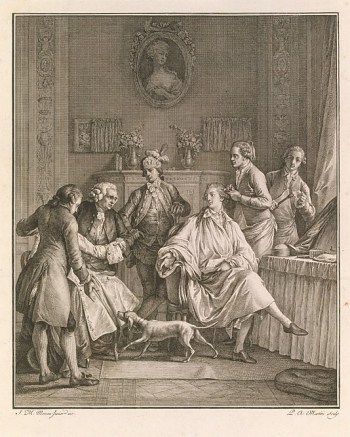
Pietro Antonio Martini, after Jean Michel Moreau the Younger, The Morning Toilet (La Petite Toilette), from Le Monument du Costume, ca. 1777
(New York: Metropolitan Museum of Art, 33.6.28)
In America the designs for dressing tables were simpler, with the Chippendale style among the most popular. During the 19th century, dressing tables were made in many revivalist styles including the Gothic, Elizabethan, Rococo, Renaissance, and Colonial revivals, to name a few. Eventually, in the later 19th century, the dressing table—like other cabinet furniture—became a matching part of the bedroom suite.
It was not until the early part of the 20th century, during the Art Deco period in both Europe and America, that luxurious dressing tables came to epitomize the modern concept of glamour and luxury. Hollywood films of the 1920s and ’30s, with their fantasy world of penthouses atop Manhattan skyscrapers, were hugely popular during this period and often depicted the femme fatale heroine sitting at her supremely elegant vanity table in the bedroom or dressing room. Norman Bel Geddes’s enamel and chrome-plated steel dressing table (1932) is a model for this streamlined and sophisticated style.
More recently, designs for the dressing table have reflected the diversity of new styles, from the modern molded-plastic valet dressing cabinet of Raymond Loewy (1969) to a postmodernist Plaza dressing table and stool by Michael Graves (1981) and a minimalist dressing table of today by the Korean contemporary designer Choi Byung Hoon (2013).
Metropolitan Vanities: The History of the Dressing Table is organized by Jane Adlin, Associate Curator in the Department of Modern and Contemporary Art at The Metropolitan Museum of Art. The exhibition is accompanied by a Bulletin published by the Metropolitan Museum and distributed by Yale University Press (volume 71, Fall 2013).
More images are available here (under additional resources).










 Enfilade
leave a comment