Exhibition | William Kent: Designing Georgian Britain
From the Bard Graduate Center:
William Kent: Designing Georgian Britain
Bard Graduate Center, New York City, 20 September 2013 — 9 February 2014
Victoria & Albert Museum, London, 22 March — 13 July 2014
Curated by Susan Weber and Julius Bryant
 William Kent: Designing Georgian Britain, on view at the Bard Graduate Center: Decorative Arts, Design History, Material Culture from September 20, 2013 to February 9, 2014, is the first major exhibition to examine the life and career of one of the most influential designers in eighteenth-century Britain. Visitors will discover Kent’s genius, through nearly 200 examples of his elaborate drawings for architecture, gardens, and sculpture, along with furniture, silver, paintings, illustrated books, and through new documentary films. As most of his best-known surviving works are in Britain’s great country houses, the exhibition is rich in loans from private as well as public collections. Organized by the Bard Graduate Center in collaboration with the Victoria & Albert Museum in London, the exhibition is curated by Susan Weber (BGC) and Julius Bryant (V&A). It will travel to the V&A where it will be on view from March 22 to July 13, 2014.
Background
William Kent: Designing Georgian Britain explores Kent’s work over three decades (1719–48)—a period when Britain was defining itself as a new nation and overtaking France as a leading world power. Like Robert Adam a generation later, Kent is identified not only with his own prolific and diverse output but also with an entire period style. At a time when most patrons and collectors looked to Italy for their art and design, Kent’s versatility and artistic inventiveness set the style of his age and asserted the status of the modern British artist. From a time when no refined education was complete without the Grand Tour to Italy, the word ‘Kentian’ has come to denote rich, Italianate palatial interiors furnished with gilded sculptural tables, mirrors, and Old Master paintings, elaborately presented on walls lined with the richest silk damasks and velvets, and beneath painted ceilings. Kent devised a style that catered to the Grand Tour alumni, recreating the splendors of Roman palazzi. A jovial house guest of his patrons, ‘Kentino’ (as he was affectionately known) and his creations reminded them of the best days of their lives, before they returned, inherited, and dutifully managed their old family estates.
Many of the ideas we take for granted today about visual education, good design, and national style were established by Kent’s generation. At the start of the eighteenth century, the United Kingdom of Great Britain was established through the Act of Union between England and Scotland (1707). Great expectations of new public buildings followed, especially for a new parliament and royal palace to replace those destroyed by the Whitehall Palace fire of 1698. From the accession of George I in 1714 through the death of Queen Victoria in 1901, the Royal House of Hanover reigned over Britain. With Kent’s help, this German family reinvented themselves. The new nation needed a new sense of style, both to define itself through design (in contrast to the Stuarts and the French) and to improve society at large. Responding to a challenge articulated in the Earl of Shaftesbury’s Letter Concerning the Art, or Science of Design (1712), Lord Burlington is the best- known today of several patrons who took on this responsibility. Kent lived in his London townhouse, Burlington House (today the home of the Royal Academy) for most of his life and was also, in effect, artist-in-residence at Burlington’s new Italianate villa at Chiswick. Essentially, Kent saw that good design is about visual experience, not only dependent on the erudite eye of the connoisseur or the knowledge of architecture’s ancient rules, but also reliant on the emotional response as one moved through and around houses, offices, streets, and gardens.
◊ ◊ ◊ ◊ ◊
The Exhibition
William Kent: Designing Georgian Britain is divided into ten sections that introduce specific aspects of Kent’s work, including signature private and royal commissions, and important periods in his career. William Kent’s life and the historical age in which he worked is the subject of the first section. A highlight is William Aikman’s portrait of Kent that hung over the mantelpiece at Wanstead House, and is now in the National Portrait Gallery, London. The second section focuses on Kent’s formative years on the Grand Tour in Italy where he was sent to hone his painting skills by copying the Old Masters, and to act as a purchasing agent for British collectors. Italian Baroque art, interiors, and furnishings made a lasting impression on Kent. Featured are seldom seen paintings and drawings, including Kent’s copies after Agostino Carracci, Domenichino, and Carlo Maratti, and drawings of Italianate interiors by fellow Grand Tourist John Talman, that document this inspiring period in Kent’s life. While in Italy, Kent met Lord Burlington who became his mentor and collaborator for the next several decades. Together they became early exponents of the designs of the late Renaissance architect, Andrea Palladio, which they eventually incorporated into their own Anglo-Palladian style that came to define the Georgian era.
Kent is best known for the interiors he designed for several grand country estates in Britain, and for his approach in taking responsibility for the design of the entire interior from the painting and furniture to the sculpture and decoration. Visitors to the exhibition will have the opportunity to explore a few of Kent’s best-known early interiors, such as Chiswick House, Wanstead House, and Houghton Hall, Kent’s most important early commission for the grand estate of Sir Robert Walpole, and one of the key buildings in the history of Palladian architecture in England. In addition to drawings and plans of these interiors, the exhibition features rare examples of Kent’s furniture designed specifically for these commissions.
In time, Kent began to receive important royal commissions, particularly from King George II and his son, Frederick, Prince of Wales. A section of the exhibition is devoted to designs for the new monarchy. In 1722, Kent was given a major commission to design the Cupola Room at Kensington Palace, where he was in charge of painting the ceiling and designing the furniture and chimneypieces. One of Kent’s best known and somewhat unusual works was a state barge designed for Frederick. Although the barge is too large to travel, the exhibition will feature Kent’s beautifully rendered designs, along with a detailed model. Other notable royal commissions explored include those for Queen Caroline’s Library and Hermitage in Richmond Garden. Also on view will be several extraordinary pieces of silver, made after designs by Kent. Among these are a chandelier commissioned by George II for the Leineschloss, Hanover, made by Balthasar Behrens, on loan from the Museum of Fine Arts, Boston, and a large centerpiece (or epergne) for Frederick made by silversmith George Wickes.
Another section looks specifically at the work Kent produced in London, both in private residences as well as in public buildings. Among the most prestigious of these commissions was the design of Devonshire House, the residence of the Duke of Devonshire. Although the palatial home was demolished in the 1920s, objects from and related to it survive, and the exhibition will feature drawings and a door designed by Kent. Of his public works, the exhibition examines 10 Downing Street, the Houses of Parliament, the Horse Guards at Whitehall, and the Royal Mews. Also explored are Kent’s contributions to sculpture. Among the works shown are drawings for tomb monuments for Isaac Newton, William Shakespeare, and James Stanhope in Westminister Abbey, and Michael Rysbrack’s terracotta model of Newton.
One section is devoted to Holkham Hall, designed with the assistance of Lord Burlington for Thomas Coke, 1st Earl of Leicester, who was among Kent’s most important patrons. Now considered to be one of the finest examples of the Palladian revival style of architecture in Britain, Holkham Hall is shown through a number of important works that the BGC is fortunate to borrow, including a gilded and elaborately carved settee, drawings of the interior, and Francesco Trevisani’s portrait of Thomas Coke, who built Holkham.
Although known today almost exclusively for his Palladian style, Kent worked in other idioms depending on the wishes of the patron. The exhibition looks at his Gothic works, including projects at Hampton Court and Esher Place, and his illustrations for books, most notably an edition of Edmund Spenser’s The Faerie Queene.
The final section examines Kent’s contributions to the history of landscape and garden design. Through drawings, furniture, and video, visitors will discover how Kent revolutionized garden design and helped usher in a style of natural gardening that came to characterize the English landscape garden. Two of Kent’s most important gardens, at Rousham and Stowe, remain today close to Kent’s original designs. A BGC produced video will offer a virtual journey through these gardens so that visitors will gain a better understanding of his landscape designs.
The Book
William Kent: Designing Georgian Britain, edited by Susan Weber, and published with Yale University Press, presents twenty-one essays by leading scholars of eighteenth-century British art and design, including Julius Bryant (co-curator), Geoffrey Beard, John Harris, John Dixon Hunt, Frank Salmon, and David Watkin. The book is richly illustrated with over 600 color images, including the pieces featured in the exhibition. A chronology of Kent’s projects, an exhibition checklist, and an extensive bibliography round out this scholarly publication.
Support
William Kent: Designing Georgian Britain has been generously supported by The Rothschild Foundation, Edward Lee Cave, Dr. H. Woody Brock, Christie’s, Philip Hewat-Jaboor, John A. Werwaiss, Patricia and Martin Levy, The Paul Mellon Centre for Studies in British Art, Friends of the BADA Trust, Ronald Phillips, Ltd., and two donors who wish to remain anonymous.
Exhibition | François-André Vincent
From Le musée des Beaux-Arts de Tours:
François-André Vincent
Musée des Beaux-arts, Tours, 18 October 2013 — 19 January 2014
Musée Fabre de Montpellier Agglomération, 8 February — 11 May 2014

François André Vincent, Portrait Presumed to be Madame Jeanne-Justine Boyer-Fonfrede and Her Son, Henri (Paris: Louvre)
Le musée des Beaux-Arts de Tours et le musée Fabre de Montpellier s’associent pour concevoir et organiser d’octobre 2013 à mai 2014 la première exposition consacrée au peintre François-André Vincent (1746–1816), à l’occasion de la publication du catalogue raisonné de l’œuvre de l’artiste publié chez Arthéna par Jean-Pierre Cuzin, ancien conservateur général du département des peintures du musée du Louvre.
Le commissariat de l’exposition est constitué, aux côtés de Jean-Pierre Cuzin qui a sélectionné peintures et dessins, de Sophie Join-Lambert et Michel Hilaire, directeurs des deux musées, et de deux conservateurs, Olivier Zeder, conservateur en chef à Montpellier et Véronique Moreau, conservateur en chef au musée des Beaux-Arts de Tours.
Les publications récentes ont montré l’importance d’un artiste, aussi bien pour la peinture que pour le dessin, dont les œuvres, entre deux mondes stylistiques, ont pu être confondues avec celles de Fragonard comme avec celles de David. Il tient une place essentielle dans la peinture française comme promoteur des sujets pris à l’Antiquité comme de ceux pris à l’Histoire de France et peut apparaître, à beaucoup d’égards, comme un “préromantique”. Son rôle dans le domaine du portrait et particulièrement dans celui du portrait-charge apparaît capital.
L’exposition devrait apporter la révélation d’un grand artiste jusqu’ici méconnu et dont les œuvres enrichissent des collections publiques et privées des plus prestigieuses, tant en Europe qu’à l’étranger. Un tel projet ne peut se concevoir sans faire appel aux musées et collectionneurs français et étrangers. Parmi les collections publiques, plusieurs appartiennent au réseau FRAME (French Regional American Museums Exchange, France et Etats-Unis).
◊ ◊ ◊ ◊ ◊
From Art Media Agency:
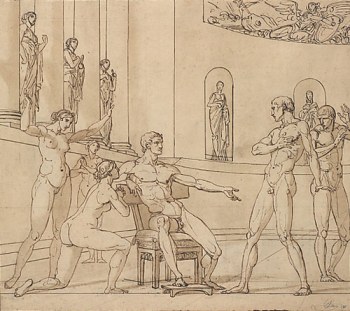
François André Vincent, The Clemency of Augustus (Corneille, Cinna, V, 3) (recto); Knight Restraining a Female Figure (verso), 1788
(New York: Metropolitan Museum of Art)
An exhibition of works by François-André Vincent (1745–1816) is to take place between 19 October 2013 and 19 January 2014 at the Musée des Beaux-Arts in Tours. The exhibitions is to coincide with the publication by Arthéna of a catalogue raisonné devoted to the artist François-André Vincent produced by Jean-Pierre Cuzin, former curator of painting at the Louvre.
Stylistically, Vincent’s works have been compared to those by Fragonard and David, and are sometimes described as pre-Romantic. Inspired by antiquity, the artist’s pieces often return to explore moments in France’s history. The exhibition features over 100 works, gathered from collections in both France and further afield. It is organised with the support of the French state, in collaboration with the Ministry of Culture and Communication, the French Heritage Management association, and the French Museums Service.
Following its close at Tours, the exhibition is to travel to the Musée Fabre in Montpellier, where is is to be on display between 8 February to 11 May 2014. A selection of drawings by Vincent will then be display at the Cognacq-Jay museum from 26 March to 30 June 2014.
Exhibition | Exuberance of Meaning: Catherine the Great’s Patronage
Press release (1 July 2013) from the Georgia Museum of Art:
Exuberance of Meaning: The Art Patronage of Catherine the Great
Georgia Museum of Art, The University of Georgia at Athens, 21 September 2013 — 5 January 2014
Hillwood Museum and Gardens, Washington, D.C., 1 February — 7 June 2014
Curated by Asen Kirin
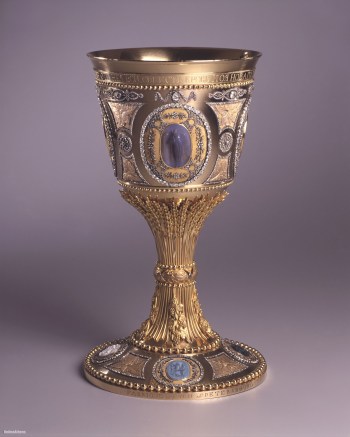
Chalice, Iver Windfeldt Buch (1749-1811), St. Petersburg, 1791, gold, diamonds, chalcedony, bloodstone, nephrite, carnelian, cast glass, height: 33 cm, diameter: 18 cm (Hillwood Museum and Gardens)
The Georgia Museum of Art at the University of Georgia presents Exuberance of Meaning: The Art Patronage of Catherine the Great September 21, 2013 to January 5, 2014. This exhibition features works of decorative art the Russian empress Catherine the Great commissioned for her own use or as gifts for courtiers, including a large chalice created by noted goldsmith Iver Winfeldt Buch.
The Buch chalice, which belongs to Hillwood Museum and Gardens in Washington, D.C., serves as the centerpiece of the exhibition. Adorned with precious gems and eight carved cameos, it demonstrates how Catherine combined Byzantine and classical influences to forge a new direction for Russian culture. Other objects establish the background for the empress’s choices or represent major currents in 17th- and 18th-century Russian art. Dr. Asen Kirin, associate professor of art and associate director of UGA’s Lamar Dodd School of Art, is curator of this exhibition, which borrows objects from the Metropolitan Museum of Art, the Chipstone Foundation, the Walters Museum and private collections, as well as Hillwood.
Marjorie Merriweather Post, the sole heir to the multimillion-dollar Post Cereal Company, purchased the works that formed Hillwood’s Russian collection. Many of the works she purchased while in Russia in the 1930s are on display in this exhibition. Kirin invites audiences “to contemplate the art collections of two extraordinary women, who lived at different times and could not have come from more dissimilar environments. One is Europe’s Old Regime of absolute hereditary monarchies, the other—the modern, industrialized America of free enterprise.”
The exhibition presents a comparison of dazzling and masterful objects that exemplify both medieval Byzantine culture, of which Russia was the successor and guardian, and the Western, neoclassical style that was the hallmark of the Enlightenment. It focuses on the manner in which Catherine applied her knowledge of ancient and medieval glyptic art and incorporated her collection of carved gems in the commission of new works of art, a deliberate continuation of the centuries-old tradition of placing pagan, Greek, and Roman carved stones onto sacred Christian liturgical and devotional objects.
During her reign, the empress worked to reconcile her contemporary scientific and historical frame of mind with the devotional ways of the Orthodox Church, which had long been sanctified by tradition. The title Exuberance of Meaning refers to the crucial characteristic that distinguishes her endeavors in the arts: she conceived her projects in a manner that allowed for multiple complementary interpretations covering a wide spectrum of meanings.
Kirin is particularly interested in the comparison of the two collectors, Catherine and Post, as both women were powerful, accomplished and elevated their respective domains despite a tradition of male dominance. Kirin suggests that audiences contemplate “how the arts enabled them to present themselves to society and to control the perception of their images.”
Kirin has worked with the museum before, perhaps most notably on the exhibition Sacred Art, Secular Context, which examined Byzantine works of art from the collection of Dumbarton Oaks, Washington, D.C.
The museum will publish a catalogue to accompany the exhibition, featuring full-page, full-color illustrations of the objects it includes and scholarly essays on Catherine’s art patronage, the Buch chalice and the empress’ proto-feminist use of vessels to make a statement about gender and power.
Events associated with the exhibition include films, a family day, and a two-day symposium scheduled for November 1–2 featuring noted scholars of Russian art. The museum’s Collectors Group, an upper-level membership group within the Friends of the Georgia Museum of Art, will host an opening for the exhibition September 21 in conjunction with the UGA Performing Arts Center’s presentation of a concert of music the empress favored.
Exhibition | Leipzig 1813, The Battle of the Nations
Leipzig marks the 200th anniversary of the Battle of the Nations (19 October 1813) with a 1:1 scale panorama by Yadegar Asisi, depicting the city in the aftermath of the battle — Europe’s largest prior to World War I, with 90,000 dead and injured. From a press release:
Leipzig 1813, The Battle of the Nations: A Panorama by Yadegar Asisi
Leipzig Panometer, 3 August — December 2013

◊ ◊ ◊ ◊ ◊
Having opened on August 3, Yadegar Asisi’s monumental 360° panorama Leipzig 1813: Amidst the Confusion of the Battle of the Nations is now on display at the Panometer Leipzig. The world’s largest panorama, 3500 m² in size and on a scale of 1:1, shows us the city of Leipzig immediately following the Battle of the Nations, which took place on October 19, 1813. The visitor views the scene from the vantage point of the roof of the church of St. Thomas at the western border of the city, with an excellent view both of the city centre and of the surrounding areas, where the most violent battles took place.
It came as something of a surprise to Yadegar Asisi that he was to spend so much time – since 2009 – working so intensively on this theme. “Having grown up in Leipzig, the Battle of the Nations was present in the form of the monument but not in as far as the actual events were concerned“, says the artist. “For a long time it didn’t really mean anything to me, until I asked myself the question of what Leipzig was like in 1813 and what the battle meant to the city. I came to the conclusion that I would present this European event from the perspective of Leipzig and its citizens. Under no circumstances did I wish to create a battle panorama. In fact, it has turned out to be more of an anti-war panorama.”
Asisi presents Leipzig as it would have looked in 1813, complete with its architecture still relatively intact. The city is struggling to come to terms with the repercussions of the battle: 90,000 dead and injured, countless numbers of refugees from the burned-out villages in the surrounding areas. The crowds in the alleyways and squares are in turmoil as the victorious troops move in and the French take flight, leaving behind them hundreds of thousands of people in a state of despair.
The successful ten-year collaboration between Asisi and the composer Erik Babak, well known for his work in international film and television productions, again bears fruit in Leipzig 1813; the accompanying music features a chorus of 40 voices and passages from the poem “Abroad” by Heinrich Heine. The panoramic experience is rounded off with sound effects reflecting the era and the confusion of the scene.
The complex figuration in the architectural design was the greatest challenge facing Asisi during his work on Leipzig 1813. Troops numbering around 600,000 soldiers, with over 90,000 dead and injured, all had to find their places in and around Leipzig, which had only 35,000 inhabitants at the time. For this purpose alone, it was necessary to stage four lavish photo shootings with several hundred extras in costume, saddle horses, teams of horses and traps. Scenes featuring soldiers, citizens of Leipzig, marketeers, refugees, the wounded and the dead, were re-enacted and coordinated as though a film were being made. To this end, Asisi’s expert advisor Helmut Börner smoothed the way for a cooperation with the “Verband Jahrfeier Völkerschlacht b. Leipzig 1813 e.V.”.
An encounter with the novelist Sabine Ebert led to a piece of special media interaction. Details from the panorama Leipzig 1813 can be discovered in Sabine Ebert’s most recent work 1813 – Kriegsfeuer (1813 – Warfire), just as scenes from the book can be found in Yadegar Asisi’s panorama. For example, the author is depicted in the panorama wearing the same clothes as one of her protagonists on the cover of the book.
The accompanying exhibition introduces the free city of Leipzig on the evening before the battle on an emotional and intuitive level. It leads visitors around the outside circumference of the panorama, presenting Leipzig as a town famous for its trade, learning, publishing and music, before the greatest battle there had ever been breaks out outside its gates. A “making-of” film will be shown in the auditorium, explaining how the complex circular picture was created and documenting the milestones of its production, which covered a period of almost five years.
An extensive mediation programme, including various guided tours, lectures and special events, is scheduled in connection with the panorama. This programme is designed to bring visitors into closer contact with life as it was at the time of the battle, 200 years ago.
Additional information is available here»
◊ ◊ ◊ ◊ ◊
For those of you interested in panoramas generally, see the website of the International Panorama Council. The organization’s conference takes place in November:
2013 International Panorama Conference
Switzerland, 22–24 November 2013
The conference days will include visits to Bourbaki Panorama Lucerne, Alpineum Museum with its Alpine Dioramas and to Glacier Garden Museum with its optical spectacles. On November 25 a post-conference program rounds up the panoramic experience in the beautiful city of Lucerne and includes a trip to Einsiedeln to visit the Crucifixion of Christ Panorama.
Exhibition | Souvenir Nation: Relics, Keepsakes, and Curios
From the Smithsonian’s National Museum of American History:
Souvenir Nation: Relics, Keepsakes, and Curios
Smithsonian Castle, Washington, D.C., 9 August 2013 — 17 August 2014
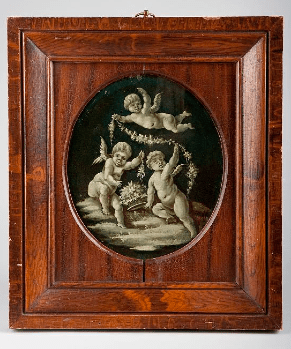
Panel from George Washington’s Coach, 17 x 15 inches. President Washington’s state coach featured four side panels representing the seasons; this panel, encased in an oak frame, depicts ‘Spring’ (Smithsonian)
Souvenir Nation: Relics, Keepsakes and Curios features a selection of diminutive and personal objects that Americans have taken, made and saved as historical mementos from the Early Republic up to the present day. Many of the postcards, structural fragments such as a brick from George Washington’s childhood home, consumer goods, locks of hair and other keepsakes on display are part of the earliest Smithsonian collections now in the museum’s Division of Political History. Highlights include a fragment of Plymouth Rock, presidential hair, wood from George Washington’s coffin and pieces from Joan of Arc’s dungeon, the Bastille, and the Berlin Wall.
◊ ◊ ◊ ◊ ◊
From Princeton Architectural Press:
William Bird, Souvenir Nation: Relics, Keepsakes, and Curios from the Smithsonian’s National Museum of American History (Princeton: Princeton Architectural Press, 2013), 176 pages, ISBN: 978-1616891350, $25.
 Buried within the collection of the Smithsonian Institution’s National Museum of American History exists an astonishing group of historical relics from the pre-Revolutionary War era to the present day, many of which have never been on display. Donated to the museum by generations of souvenir collectors, these ordinary objects of extraordinary circumstance all have amazing tales to tell about their roles in American history. Souvenir Nation presents fifty of the museum’s most eccentric items. Objects include a chunk broken off Plymouth Rock; a lock of Andrew Jackson’s hair; a dish towel used as the flag of truce to end the Civil War; the microphones used by FDR for his Fireside Chats; and the chairs that seated Nixon and Kennedy in their 1960 television debate. This fascinating collection of Americana includes an introductory essay on this nation’s passion for souvenir collecting, as well as a brief history and a glimpse behind the scenes of the Smithsonian.
Exhibition | Bernard Picart: Cérémonies et coutumes religieuses
From the National Gallery in Prague:
Bernard Picart: Slavnosti a náboženské zvyky národů celého světa
Schwarzenberg Palace, Prague, 1 July — 7 October 2013
Curated by Dalibor Lešovský
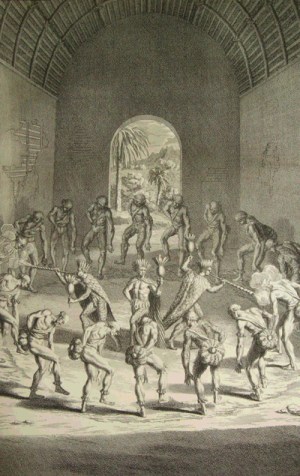 Bernard Picart (1673–1733) byl francouzský rytec, který většinu svého života strávil v Holandsku. Přestože byl autorem řady knižních ilustrací, zcela nezastupitelné místo v jeho tvorbě zaujímá soubor grafik pro knihu Cérémonies et coutumes religieuses de tous les peuples du monde (Slavnosti a náboženské zvyky národů celého světa) [1723–43]. V knize, která se nevěnovala pouze zvykům a tradicím spojeným s duchovním životem monoteistických kultur, s nimiž se grafik mohl seznámit v evropském prostředí, byl věnován velký prostor i náboženským zvyklostem amerických Indiánů, Afričanů, Indů, Číňanů, ale také některým evropským herezím. Přestože Picart nikdy neopustil Evropu, přispěl svými formálně i obsahově nesmírně poutavými ilustracemi ke vzniku díla, které se stalo prvním univerzálním přehledem světových náboženství.
◊ ◊ ◊ ◊ ◊
Translation via Google . . .
Bernard Picart (1673–1733) was a French engraver, who spent most of his life in Holland. Although he was the author of numerous book illustrations, completely irreplaceable in his work occupies a set of prints for the book Ceremonies coutumes Religieuses et de tous les Peuples du monde (Festivals and Religious Customs of Nations around the World) [1723–43]. In the book, which is not only on customs and traditions associated with the spiritual life of monotheistic cultures with which the graphics can get to know the European environment has ample space and religious practices of Native Americans, Africans, Indians, Chinese, but also some European heresies. Although Picart never left Europe, contributed their form and content extremely eye-catching illustrations of the works, which became the first universal overview of world religions.
Exhibition | Emma Hamilton Dancing
From The Lewis Walpole Library:
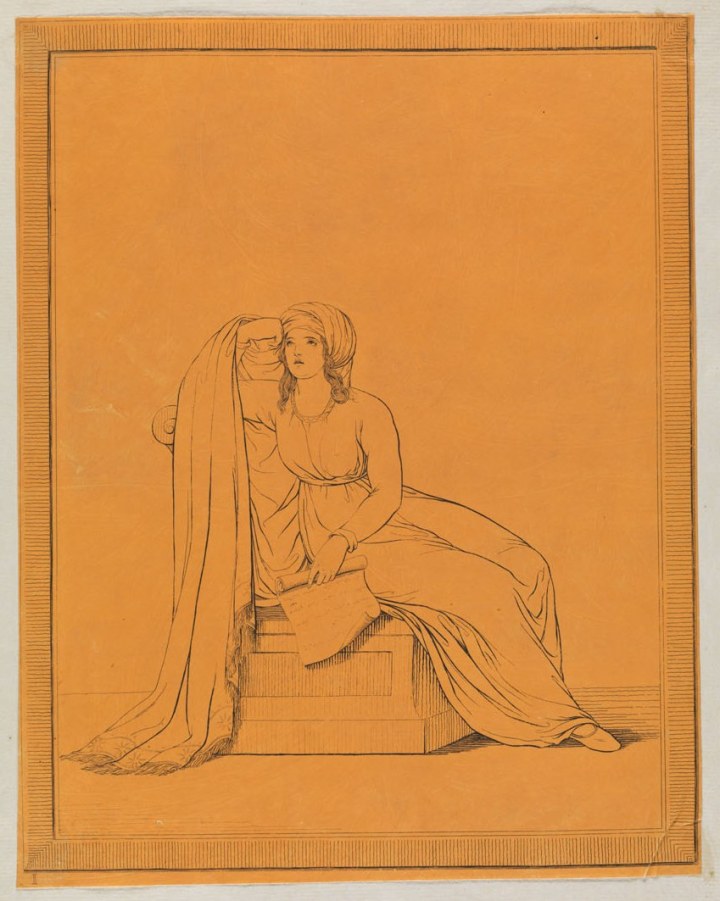
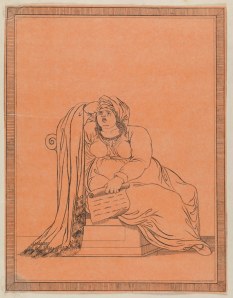
Emma Hamilton Dancing
The Lewis Walpole Library, Farmington, CT, October 2013 — April 2014
Curated by John Cooper
◊ ◊ ◊ ◊ ◊
Emma Hamilton (1761?–1815) first performed the Attitudes in Naples in the 1790s. The twelve neoclassical engravings of the Attitudes by Frederick Rehberg published in 1794 and 1797 and the twelve parodies of the same attributed to James Gillray and published by Hannah Humphrey in 1807 will be the centerpieces of the exhibition. Hamilton’s embodied performances will be presented alongside prints and illustrated books representing a range of social and theatrical dancing in Europe that will include contemporary images of the Neapolitan dance the Taranatella, Greek dance from William Hamilton’s volumes on antique vases, social dances including the Minuet, Cotillion, Quadrille, Allemande and Waltz, as well images of the classical ballet. The exhibition will present a new context for the Attitudes and will open up a new space in which to imagine the connections between art history and performance in Europe before the twentieth century.
The exhibition is curated by John Cooper, a Clare-Mellon Fellow in the History of Art and Graduate Research Assistant at the Yale Center for British Art.
Exhibition | Treasures of the Fan Museum
Thanks to Pierre-Henri Biger for noting this upcoming fan exhibition in Paris. From the press release:
Les Trésors du Musée de l’Éventail
L’Atelier Hoguet Musée de l’Éventail, Paris, 15 October 2013 — 15 February 2014
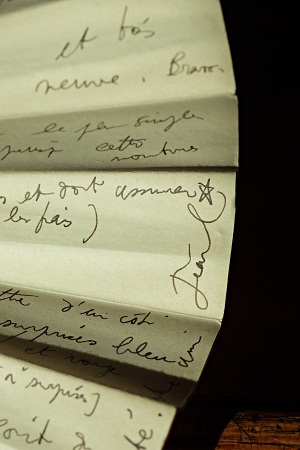 Le Musée de l’Eventail – Hervé Hoguet, seul musée français consacré à cet accessoire, fêtera en octobre 2013 ses 20 ans d’existence. Cette date anniversaire sera d’autant plus symbolique qu’elle célèbrera également les 120 ans de la création du décor du musée et la réinstallation, à l’angle des boulevards Saint-Denis et de Strasbourg, de l’enseigne du XIXème siècle qui doit être remise en état à cette occasion–salon d’exposition et enseigne classés aux monuments historiques en 2004.
Un catalogue sera édité. Il présentera certaines pièces de la collection d’éventails selon l’histoire, les différents styles et les thématiques abordées à travers le temps ainsi que des illustrations et reproductions de documents.
Le musée de l’éventail porte le nom d’Hervé Hoguet, successeur de la Maison Ernest Kees fondée en 1805. Il est le seul musée français exclusivement consacré à l’éventail. Cette initiative est née de la volonté de préserver ce lieu d’histoire, véritable témoin du patrimoine artisanal comme de l’excellence de la capitale française dans l’éventaillerie.
Le musée de l’Eventail est le seul musée en France à conserver dans ses collections des éventails datant du XVIe aux XXe siècles. Plus de deux milles pièces les constituent aujourd’hui. Parmi elles, vingt-deux, datant du XVIIIème au XXème siècle, sont classées à l’inventaire des monuments historiques. Issu en premier lieu des ateliers des maisons d’éventaillistes qui se sont succédées à cette adresse, le fonds constitué par Hervé Hoguet a été considérablement enrichi par le soin de l’association AHME, de la collection d’Anne Hoguet, maître d’art et actuelle directrice du musée. Ce sont aussi des années de dons qui ont permis de les faire croître. Les collections sont régulièrement présentées au public à l’occasion d’expositions temporaires thématiques au sein du musée mais aussi grâce aux prêts effectués lors de manifestations culturelles en France et ailleurs.
Exhibition | Artists & Amateurs: Etching in Eighteenth-Century France
Press release (3 June 2013) from The Met:
Artists and Amateurs: Etching in Eighteenth-Century France
The Metropolitan Museum of Art, New York, 1 October 2013 — 5 January 2014
Curated by Perrin Stein
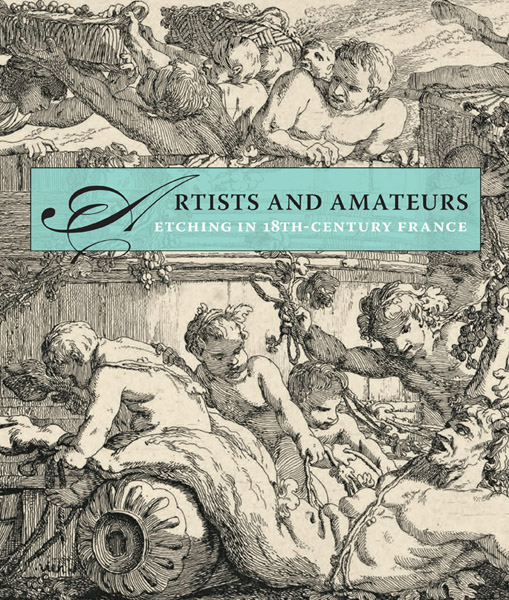 During the eighteenth century in France, a great number of artists—painters, sculptors, draftsmen, and amateurs—experimented with etching, a highly accessible printmaking technique akin to drawing. Featuring 130 works by such artists as Watteau, Boucher, Fragonard, Hubert Robert, and many others, Artists and Amateurs: Etching in Eighteenth-Century France will be the first exhibition to focus on the original etchings created by painters and amateurs in eighteenth-century France. It will present a fresh exploration of how etching flourished in ancien régime France, shedding new light on artistic practice and patronage at that time. In a period when artists strained to navigate the highly regulated Académie Royale and the increasingly discordant public spheres of the marketplace and the Salon, etching afforded them stylistic freedom and allowed them to produce exquisite works of art in a spirit of collaboration and experimentation. The exhibition will present etchings, plus a few drawings and preparatory sketches, from the Metropolitan Museum’s rich holdings, as well as loans from North American museums and private collections. The selection of prints includes a number of rare or unique examples.
While printmaking was dominated by professionals for much of its early history, the technique of soft-ground etching—where a plate was coated in varnish and could then be drawn on with a metal stylus—transformed the practice from a specialized technique practiced by an exclusive group with extensive training, to a highly accessible art form. Some artists, like Antoine Watteau and François Boucher, encountered the process within the thriving commerce of the Paris print trade, where a painter would sometimes be asked to make a preliminary sketch on a prepared copper plate to guide the professional printmaker who would later reinforce the design with engraving. Others, like Jean-Honoré Fragonard and Hubert Robert, first experimented with the technique during their student years in Rome, where Piranesi’s studio was in close proximity to the French Academy. For some, like Jean-Baptiste-Marie Pierre, etching formed a bridge with amateurs, wealthy members of the court or aristocracy who wanted to learn etching as a cultured, leisure pursuit. Because of these relationships, the making of the prints became intermingled with the collecting and studying of prints, creating an environment of cross-fertilization which led to a flourishing of the art form.
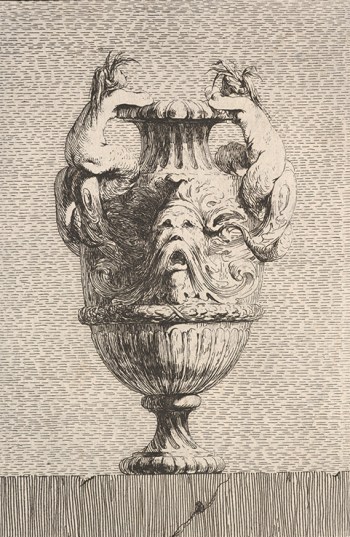
Jacques François Joseph Saly, Design for a Vase with Two Mermaids, from the “Vases” series, 1746 (NY: The Metropolitan Museum of Art)
Artists and Amateurs will highlight the freedom, spontaneity, and creativity of the medium of etching in the hands of artists and collectors. Over the course of the century, etching came to be viewed not solely as a reproduction medium, but also, as one capable of original artistic expression. As the free and improvisational aesthetic of the etching process increasingly was embraced, French artists looked to seventeenth-century masters—such as Rembrandt in the North and Salvator Rosa and Giovanni Benedetto Castiglione to the South—for inspiration. The expressive potential of the technique was also explored in a more experimental manner by artists like Gabriel de Saint-Aubin and Louis Jean Desprez, who harnessed the inky tonalities of the medium to their personal and idiosyncratic vision. The painters who felt the urge to pick up the etching needle were drawn to the freedom and accessibility of the technique, and not necessarily focused on exploiting commercial potential. Their prints tend to be rare and are valued for their qualities of expressiveness and experimentation—in many ways the opposite of the mass production and technical expertise of professional printmakers like Demarteau and Bonnet.
The exhibition will also focus on the French Academy in Rome as a setting that provided the means and freedom to explore this medium; the etchings made by amateurs, both in Rome and in Paris; and, finally, the increasing stylistic engagement with past masters. Overall there will be a balance between works of the most successful painters of the period and lesser known, but equally accomplished figures, including the work of amateurs and the working relationships between them where the influence went both ways.
The exhibition will be organized thematically and will explore how, where, and why artists first learned to etch, their occasional experimentation with marketing their prints for sale, and their technical innovations as they found new ways to manipulate the medium for individual expression. Highlights include Watteau’s Recruits Going to Join the Regiment (ca. 1715-16), Fragonard’s The Satyr’s Family (1763) and The Armoire (1778), Liotard’s Self-Portrait, Boucher’s Andromeda (1734), Gabriel de Saint-Aubin’s View of the Salon of 1753, de Boissieu’s Study of Thirteen Heads (ca.1770), and amateur Ange-Laurent de la Live de Jully’s etching after a drawing by Jacques-François-Joseph Saly of Nicolas Bremont, Cook at the French Academy in Rome (ca. 1754).
From Yale UP:
Perrin Stein, ed., Artists and Amateurs: Etching in Eighteenth-Century France (New York: The Metropolitan Museum of Art, 2013), 240 pages, ISBN: 978-0300197006, $60. With essay by Charlotte Guichard, Rena M. Hoisington, Elizabeth Rudy, and Perrin Stein.
Exhibition | Illuminated Palaces: Extra-Illustrated Books
Press release (15 May 2013) for the exhibition now on at The Huntington:
Illuminated Palaces: Extra-Illustrated Books from The Huntington Library
The Huntington Library, San Marino, 27 July — 28 October 2013
Curated by Stephen Tabor and Lori Anne Ferrell

Image from Mémoires du comte de Grammont (London, 1794)
with extra illustrations added by Richard Bull
◊ ◊ ◊ ◊ ◊
The eccentric art of customizing printed books by adding illustrations is the focus of a new exhibition now on view at The Huntington Library, Art Collections, and Botanical Gardens. Illuminated Palaces: Extra-Illustrated Books from The Huntington Library features more than 40 works dating from the late 1700s to the early 1900s, when the practice was most popular.
Extra-illustration is often referred to as ‘Grangerizing’, after a British clergyman named James Granger, but he did not invent the practice. In fact, extra-illustration has probably been practiced since the beginning of the printed book, says Stephen Tabor, the Huntington’s curator of early printed books and co-curator of the exhibition with Lori Anne Ferrell, English and history professor at Claremont Graduate University. But the practice did not soar in popularity until Granger published his Biographical History of England, from Egbert the Great to the Revolution in 1769. Granger’s book was essentially a catalog of portrait prints of famous English people, arranged by class—from otherwise ordinary commoners “remarkable from only one circumstance in their lives” to scientists, politicians, noblemen, kings, and queens. By creating an organized list of desiderata, Granger unwittingly motivated some collectors to illustrate copies of his own book with the portraits, setting off what one later critic called “a general rummage after, and plunder of, old prints.”
“Without intending to, he began a craze that lasted well into the 1900s, in which people would purchase a book, dismantle it, customize it with inserted illustrations, manuscripts, even other whole printed books, and reconstitute everything in a new form,” says Tabor. The practice gathered popularity at a time when wealthy Englishmen began collecting large numbers of engravings; it then caught on in America. “It’s at once fascinating and horrifying—the idea that someone would purposefully destroy a book, raid other books for illustrations, trim fine prints to size, and clip signatures of famous people in order to build their own custom creation.”
But, in fact, The Huntington has more than a thousand extra-illustrated books. Henry E. Huntington purchased most of them as part of the rare books and manuscripts he assembled in the early 20th century. Perhaps most surprisingly, says Tabor, “extra-illustrated books in the Library are home to more than 90 percent of the artwork at The Huntington. Truthfully, we’re still being surprised by what we find in these books because we’ve never had the resources to catalog them completely. That would take somebody expert in art history, manuscripts, and bibliography, and funds to keep the person on staff for many years.”
In fact, while working on the exhibition, Tabor and Ferrell discovered a pre-Revolutionary letter from George Washington to his brother Samuel. A prominent collector of American autographs bought it in 1886 and had it bound in an extra-illustrated book that Henry Huntington acquired in 1922. Soon after its rediscovery Tabor was able to bring it to the attention of a visiting editor of the ongoing Papers of George Washington project, who was delighted to have traced the missing original.
When important original works of art are found in extra-illustrated books, they are sometimes transferred from the Library to The Huntington’s art collections for cataloging and storage. A watercolor by William Blake, studies by Parmigianino, and numerous drawings by famous illustrators have turned up in the Library’s grangerized books.
Grangerizing became a matter of great intrigue for co-curator Ferrell when she was curating The Huntington’s exhibition The Bible and the People, in 2005. “It turns out that some of the most compelling of the Bibles are those that are extra-illustrated, and for obvious reasons,” she says. The blockbuster object of the Bible exhibition, she says, was the Huntington’s Kitto Bible, probably the largest Bible in the world. A 60-volume set, the Kitto was created in the mid 1800s by James Gibbs, who set out to “extra-illustrate” a regular two-volume Bible. By the time Gibbs finished his project, the Kitto Bible had expanded to hold more than 30,000 prints, engravings, and drawings, and a variety of other inserted materials. The entire Bible was displayed in the exhibition. “It’s an incredible work, absolutely astonishing,” says Ferrell. One volume of the Kitto—a massive tome containing just the books of Romans and I Corinthians—will be included in the Illuminated Palaces exhibition.
There was nothing simple or typical about how people went about the process of extra-illustration. Hobbyists went beyond illustrations to add other materials, including maps, pamphlets, original drawings, manuscripts, and news clippings. To create tidy volumes with leaves all the same size they mounted the added material, and often the leaves of the original book itself, in paper frames. But the process involved cutting and permanently altering the original material, “and for today’s book lovers and book conservators,” says Ferrell, “it’s considered a very questionable practice.” Extra-illustration, popular through the early 1900s, eventually vanished because collecting habits changed, the market for prints dropped, and the Great Depression made it impossible for most collectors to indulge this very expensive hobby.
Shakespeare has a particular appeal to grangerizers. On view in the exhibition will be one grangerized project of nine volumes of Shakespeare’s works expanded to 45. Other examples will include a rare pre-Granger example of extra-illustration, a copy of Virgil’s works from 1492, augmented 200 years later by a suite of German prints keyed to specific passages. “Faced with illustrations that were larger than the book,” says Ferrell, “the owner simply folded them to fit.”
The first and most famous of the grangerizers was a member of parliament, Richard Bull (1725–1806); he produced some 70 extra-illustrated volumes. After Granger published his Biographical History, Bull wrote to congratulate him: “I shall have pleasure in shewing you that I am endeavoring to follow your plan as near as I can.” He then went on to amass more than 14,000 prints and created, from Granger’s original work, 36 “giant bound volumes, using cuttings from the original book as the fragile thread running through the whole,” says Ferrell.
Two short videos produced by The Huntington will accompany the exhibition to help visitors get a richer sense of the ‘internal workings’ of grangerized books. Also, see this blog posting (25 July 2013) from The Huntington on how to inlay a print.










 Enfilade
leave a comment