Exhibition and Book | The Art of Living, Augsburg ca. 1780
The June 2013 issue of The World of Interiors features a remarkable album from the 1780s, believed to the the work of Balthasar Cornelius Koch. It was the subject of a 2010-11 exhibition in Augsburg; the catalogue is available in German.
◊ ◊ ◊ ◊ ◊
Michael Huey, “A Cabinet Curiosity,” The World of Interiors (June 2013): 150-57. The stuff of life, c1780, is laid bare in a handmade album documenting the décor and possessions of a prosperous goldsmith, and his family of servants, in 18th-century Augsburg. From watercolour to scraps of fabric, the enchanting tour, from pantry to salon, literally opens the doors on inner courtyards and armouries. The June issue of The World of Interiors uncovers shoes, nightcaps and lace — but no skeletons — in the closets.
. . . Part pen/ink and watercolour, part découpage (it incorporates copperplate engravings), part scrapbook (it also uses real historical fabrics and papers) and, in a sense, part diary, it records the everyday functions of the rooms of the house in full colour and significant detail. Included are a dining room; five salons (chose from green, white, ladies’, music and tea); five bedrooms (including those for the maids, the maternity room and one for a child); and five public or service spaces (halls, kitchen, pantry), with all their particular floorings, textiles, furnishings and other accoutrements. . . (156).

◊ ◊ ◊ ◊ ◊
From the museum’s website:
Die Kunst zu Wohnen: Ein Augsburger Klebealbum des 18. Jahrhunderts
Deutsche Barockgalerie im Schaezlerpalais, Augsburg, 24 November 2010 — 20 February 2011
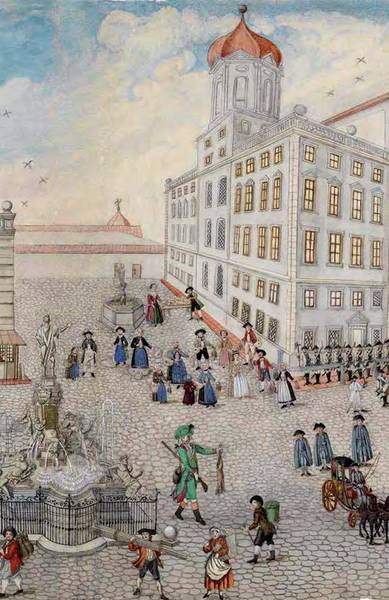 Augsburg war seit dem 16. Jahrhundert nicht nur eine Hochburg für den Buchdruck und die grafischeProduktion, hier entstanden ebenfalls sogenannte “Klebealben”. Diese wurden angelegt, um Kindern und Heranwachsenden aus bürgerlichen Familien die Welt zu erklären.
Die Jugendlichen schnitten aus eigens zu diesem Zweck herausgegebenen Bögen historische oder biblische Figuren, Tiere oderberühmte Bauwerke aus und klebten sie in gedruckte Vorlagen ein. Auch andere Druckgrafiken, Buntpapiere oder sogar Stoffe wurden zerschnitten und in die Klebealben eingefügt.
Das hier ausgestellte Klebealbum wurde nach 1780 für die Juwelierstochter Regina Barbara Waltherangelegt. Teile des Albums wie gezeichnete und kolorierte Figuren und Raumsituationen wurdenvermutlich bei dem Zimmerpolier Balthasar Cornelius Koch in Auftrag gegeben. Auf den Seiten blieb aber genügend Platz, so dass Regina Barbara selbst Figuren ausschneiden und einkleben konnte. Das Album stellt “die Kunst zu Wohnen” vor und verschafft den Betrachtern so bis heute einen Einblick in das Leben des Augsburger Bürgertums im
18. Jahrhundert. . .
More from the museum’s website»
◊ ◊ ◊ ◊ ◊
From the publisher:
Georg Haindl, Die Kunst zu Wohnen: Ein Augsburger Klebealbum des 18. Jahrhunderts (Berlin: Deutscher Kunstverlag, 2010), 240 pages, ISBN: 978-3422070400, 40€.
 Als beliebte Alternativen zu den Puppenhäusern wurden in Augsburg als wichtiger Verlagsstadt des 18. Jahrhunderts so genannte „Klebealben” von liebenden Eltern für ihre Kinder angelegt. Sie zeigen neben zentralen Plätzen Augsburgs auch die Räume idealtypischer Bürgerhäuser, in die ausgeschnittene Darstellungen von Figuren, Möbeln oder Geschirren eingeklebt werden konnten. Als Ressource hierfür dienten nicht nur die Augsburger „Ausschneidebögen”, wie sie von den Verlagen Johann Martin Wills oder Martin Engelbrechts extra für diesen Zweck herausgegeben wurden, sondern auch Modejournale, Buntpapiere, Textilien oder alte Bücher, die zerschnitten wurden.
In der Publikation widmen sich mehrere Autoren einem besonders qualitätsvollen und gut erhaltenen Album, bei dem nicht Kinder, sondern Heranwachsende die Adressaten waren, um ihnen einen perfekt funktionierenden Haushalt vor Augen zu führen. Das Album wurde in den 1780er Jahren vermutlich von dem Zimmerpolier Balthasar Kornelius Koch gefertigt und zeigt durch seine additive Darstellungsweise wichtige Aspekte des bürgerlichen Lebens dieser Zeit in Augsburg – eine unschätzbare kulturhistorische Quelle.
Exhibition | Revisiting The Cottage Door: Gainsborough’s Masterpiece
From The Huntington:
Revisiting The Cottage Door: Gainsborough’s Masterpiece in Focus
The Huntington Library, San Marino, 1 June — 2 December 2013
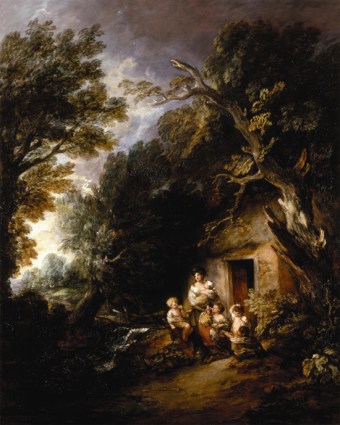
Thomas Gainsborough, The Cottage Door, ca. 1780
(San Marino: The Huntington)
The Cottage Door (ca. 1780), one of the treasures of The Huntington’s collections, is among Thomas Gainsborough’s most famous paintings. The idealized scene of rustic country life was exhibited at the Royal Academy in 1780, but both the subject and the composition continued to haunt the artist, and he repeated the design twice during the course of the decade. All three paintings are shown together for the first time in this special display, providing a unique opportunity to compare the subtle differences among them. Both of the later versions, on loan from private collections, are less finished than The Huntington’s canvas, and there are variations in tone and detail that give each a particular mood and a different emphasis.
A new book by Gainsborough specialist Hugh Belsey, Gainsborough’s Cottage Doors: An Insight into the Artist’s Last Decade, complements the installation. Inspired by the recent attribution of the third version, it examines how Gainsborough freed himself from the constraints of the Royal Academy and was able to make radical changes to his work during the last years of his
life.
Exhibition | Turner and the Sea
From the Royal Museums Greenwich:
Turner and the Sea
National Maritime Museum, Greenwich, 22 November 2013 — 21 April 2014
Peabody Essex Museum, Salem, MA, 4 June — 1 September 2014

J.M.W. Turner, The Battle of Trafalgar, 21 October 1805, 1822-24 (detail)
© National Maritime Museum, Greenwich, London
◊ ◊ ◊ ◊ ◊
This major exhibition is the first full-scale examination of Turner’s lifelong preoccupation with the sea. Including iconic works spanning the artist’s whole career from his transformative Academy paintings of the late 1790s and early 1800s, to the unfinished, experimental seascapes he produced towards the end of his life, this show will re-evaluate the compelling appeal of the sea for Turner and his contemporaries.
By placing his works alongside those by other major British, European and American artists, this exhibition will give viewers the opportunity to see the ways in which Turner responded to the art of the past, while challenging his audiences with a new and exciting maritime vision.
This is a once-in-a-lifetime opportunity to see works gathered together from across the world, including major loans from Europe and the USA; and to reconsider Turner’s extraordinary ability to represent the power of the sea in all its aspects: dramatic, contemplative, beautiful and sublime.
In connection with the exhibition, Greenwich will host a conference, 21–22 March 2014.
Note (added 2 September 2013) — The exhibition press release is available here»
Exhibition | The Loves of Aaron Burr: Portraits in Corsetry and Binding
From the exhibition press release:
The Loves of Aaron Burr: Portraits in Corsetry and Binding
Installation by Camilla Huey
Morris-Jumel Mansion, New York, 2 May — 12 September 2013
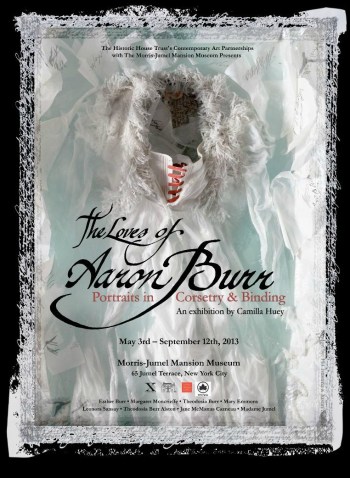 Couture artist Camilla Huey has produced gowns and corsets for celebrities such as Oprah, Janet Jackson, and Katy Perry in her famed garment district atelier, The House of Execution, a magical studio where fashion and history mingle. After almost ten years of extensive research, she began creating corsets to personify eight fascinating but nearly forgotten women writers of the 18th and 19th centuries. Huey has been invited to exhibit these exquisitely constructed pieces in the period rooms of the Morris-Jumel Mansion, Manhattan’s oldest residence, which also serves as the backdrop for many of the women’s eventful lives, truly fulfilling the project’s vision.
The Loves of Aaron Burr: Portraits in Corsetry and Binding resurrects the lives of eight women of letters involved in the adventures of Aaron Burr, Vice President to Thomas Jefferson and the assassin of Alexander Hamilton. Appropriately staged at the Morris-Jumel Mansion, where Burr spent a brief, though ill-fated, marriage to Madame Jumel, the exhibition tells the compelling stories of these women through the craft of bookbinding and the art of couture corsets. Each ‘portrait’ is comprised of a period appropriate corset bound around hand transcribed letters and ephemera, symbolizing each woman’s ‘body of work’ in sheer volume.
• Esther Burr (1732-1758), Aaron Burr’s mother, silk and velvet corset
• Margaret Moncrieffe (1763-?) Aaron Burr’s first love, damask corset cradling a first edition of her book, The Memoirs of Mrs. Coughlan
• Theodosia Burr (1746-1794), first wife of Aaron Burr, corset encased in isinglass
• Mary Emmons (1760-1835), consort of Aaron Burr, leather and quill corset
• Leonora Sansay (1773-?) confidant and mistress, leather caned corset with signatures of onion skin paper, steel and mirrored armature
• Theodosia Burr Alston (1783-1813), daughter of Aaron Burr, silk corset, steel boned with signatures of 100% cotton rag paper stitched in silk
• Jane McManus Cazneau (1807-1878) American journalist and lobbyist, accused as correspondent in Jumel v. Burr divorce
• Eliza Jumel (1775-1865), second wife of Aaron Burr, 10-year-old revolutionary era corset bound within an illuminated boned bodice
Photos are available from an article at the New York Daily News»
◊ ◊ ◊ ◊ ◊
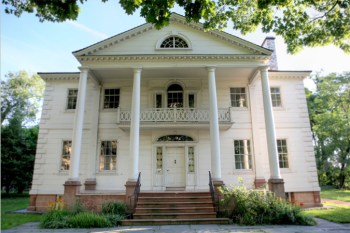 The Morris-Jumel Mansion is Manhattan’s oldest residence, built in 1765 as a summer retreat by British Colonel Roger Morris for his wife, Mary Philipse. The original estate reached from the Harlem River to the Hudson, with commanding views of the New York Harbor, the New Jersey Palisades, and Westchester. During the Revolutionary War the house served as headquarters for General George Washington drawn by the house’s superior military vantage point. In 1810 the estate was purchased by French wine merchant and importer Stephen Jumel and his wife Eliza. Remarkably the Jumel’s are noted as having restored the house to its original grandeur, throwing a party to which all of New York Society was invited to feast on oysters and drink the superb offerings of M. Jumel’s cellar, including excellent champagnes, as noted in the diary of Mayor Philip Hone. The Mansion is a National Historic Landmark and a New York City Landmark, managed by the Historic House Trust of New York City. Now a museum, it’s located between 160th and 162nd Streets east of St. Nicolas Avenue in historic Harlem Heights.
Exibition | Allan Ramsay: Portraits of the Enlightenment
From The Hunterian:
Allan Ramsay: Portraits of the Enlightenment
The Hunterian Art Gallery, Glasgow, 13 September 2013 — 5 January 2014
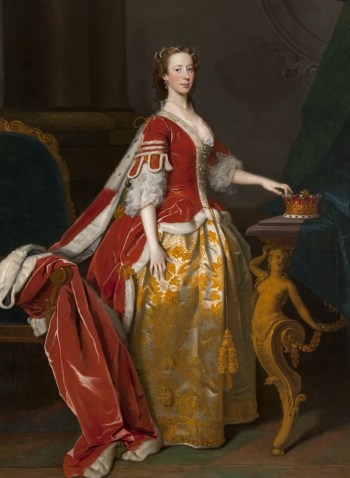
Allan Ramsay, Lady Anne Campbell, Countess of Strafford, 1743 (Glasgow: The Hunterian)
In 2013 The Hunterian will stage a major new exhibition dedicated to one of Britain’s most accomplished 18th-century painters. Allan Ramsay (1713-1784) is best known as a portrait painter whose elegant style set him apart from other portraitists of the time. Born in Edinburgh, his career took him from a small Scottish clientele to the Hanoverian court of King George III. Away from his studio, Ramsay was in close contact with a number of influential figures, and his published writing includes works on taste, politics and archaeology. The exhibition centres on a selection of portraits from across Ramsay’s thirty years as a painter and also features drawings, watercolours, published books, pamphlets, letters and other materials which demonstrate Ramsay’s fascinating place in the intellectual and cultural life of Edinburgh, London, Paris and Rome in the mid 18th century. The exhibition also includes key loans from UK public and private collections and new research, examining the intellectual context in which Ramsay painted a number of his most important portraits, including that of Hunterian founder Dr William Hunter.
◊ ◊ ◊ ◊ ◊
From ArtBooks.com:
Mungo Campbell, ed., Allan Ramsay: Portraits of the Enlightenment (New York: Prestel, 2013), 200 pages, ISBN: 978-3791348780, $60.
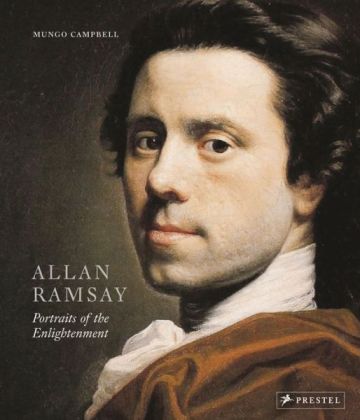 Allan Ramsay’s accomplished canvases and refined drawings offer us some of the defining portraits of the Enlightenment. He was as well equipped to offer a deep sense of engagement with his Enlightenment sitters through his intellectual and cultural upbringing as he was trained to create elegantly constructed paintings through his extended education as a painter in Italy. Establishing himself in London and Edinburgh, Ramsay was admired for his understanding of contemporary political, cultural, and intellectual issues, as well as for his portraits of key protagonists in these debates. This beautiful volume brings together Ramsay’s most celebrated sitters, such as Rousseau, Hume, and William Hunter, along with numerous drawings and prints to consider his critical role in the British Enlightenment. Many of the artist’s rarely seen portraits of women are included. Alongside exquisite reproductions, the volume presents fascinating new research exploring the unique sensitivity of Ramsay’s
painting, the development of his technique, and
familial influences on his work.
Symposium | The Botany of Empire in the Long Eighteenth Century
This fall at Dumbarton Oaks (as noted by Courtney Barnes at Style Court) . . .
The Botany of Empire in the Long Eighteenth Century
Dumbarton Oaks Research Library and Collection, Washington, D.C., 4–5 October 2013

◊ ◊ ◊ ◊ ◊
This two-day symposium will bring together an international body of scholars working on botanical investigations and publications within the context of imperial expansion in the long eighteenth century.
The period saw widespread exploration, a tremendous increase in the traffic in botanical specimens, significant taxonomic innovations, and horticultural experimentation. We aim to revisit these developments from a comparative perspective that will include Europe, the Ottoman Empire, Africa, Asia, and the Americas.
Main themes for discussion are global networks of plant discovery and transfer; the quest for medicinal plants and global crops such as ginseng, tea and opium; the economies of gift, trade, patronage, and scientific prestige in which plants circulated; imperial aspirations or influences as reflected in garden design; and visual strategies and epistemologies. Individual papers will explore the contributions of naturalists such as William Bartram (North America), Paul-Émile Botta (Levant), and François Le Vaillant (South Africa).
The symposium is timed to coincide with the fiftieth anniversary of the Rare Book Room at Dumbarton Oaks, and will feature an exhibit of botanical works from our collections [with an online sample already available]. Registration for the symposium is now open.
◊ ◊ ◊ ◊ ◊
From the program:
Notice sur un Voyage dans L’Arabie Heureuse: Politics and Scientific Authority in the Work of Paul-Emile Botta
Sahar Bazzaz, College of the Holy Cross
Thomas McDonnell’s Opium: Circulating Plants, Patronage and Power in Britain, China and New Zealand, 1830s-1850s
James Beattie, University of Waikato
Botanical Conquistadors: Plants and Empire in the Hispanic Enlightenment
Daniela Bleichmar, University of Southern California
Bricolage of Flowers and Gardens: Agents of Early Modernization in Ottoman Istanbul
Deniz Çalış-Kural, Istanbul Bilgi University
On Diplomacy and the Botanical Gift: France and Mysore in 1788
Sarah Easterby-Smith, University of St. Andrews
François Le Vaillant: Accidental Botanist
Ian Glenn, University of Cape Town
The Geography of Ginseng and the Strange Alchemy of Needs
Shigehisa Kuriyama, Harvard University
Humboldt’s Gifts and a Bountiful Harvest from the Tropical Lowlands of Western South America
Colin McEwan, Dumbarton Oaks
William Bartram’s Drawing of a New Species of ‘Arethusa’ (1796): The Portrait of a Life
Amy Meyers, Yale Center for British Art
Emblems of the Creation and Destruction of All Things: The Lives and Deaths of Robert Thornton’s Medical Plants
Miranda Mollendorf, Harvard University
Making ‘Mongolian’ Nature: Medicinal Plants and Qing Empire in the Long Eighteenth Century
Carla Nappi, University of British Columbia
Ornamental Exotica: Transplanting the Aesthetics of Tea Consumption
Romita Ray, Syracuse University
Visions of Empire: Eighteenth-Century Western Accounts of Chinese Gardens
Bianca Rinaldi, University of Camerino
Echoes of Empire: Redefining the Botanical Garden in Eighteenth-Century Tuscany
Anatole Tchikine, Dumbarton Oaks
New Strategies of Vision in Botanical Illustration and Botanical Art in the Eighteenth Century
Lucia Tongiorgi, University of Pisa
At Auction | Liberty or Death: Relics from the American Revolution
While I generally refrain from editorializing, it seems to me that there’s something dreadful linguistically and maybe conceptually about the phrase “selling exhibition.” On the other hand, the objects included in the sale and the exhibition look interesting enough, and this is the first I’ve heard of the Museum of the American Revolution (further proof of just how much slips past me!). Robert A. M. Stern’s design plans were unveiled last June, and the museum plans to open in 2016. -CH
◊ ◊ ◊ ◊ ◊
From a Sotheby’s press release (6 June 2013) . . .
Liberty or Death: Relics from the American Revolution
Sotheby’s, New York, 1–28 June 2013

Robert A. M. Stern, Architectural Rendering for the Museum of the American Revolution in Philadelphia
Sotheby’s presents Liberty or Death: Relics from the American Revolution, an exciting cross-platform initiative in collaboration with Philadelphia’s Museum of the American Revolution. The selling exhibition features items for sale by Sotheby’s as well as objects on loan from the museum’s extraordinary collection, creating a fresh, multi-dimensional dialogue on America’s struggle for independence. The exhibition will be open to the public through 28 June 2013.
The Museum of the American Revolution will be a national institution that will chronicle the full sweep of the American Revolution – the deadly struggle between British and American forces as well as the growth of the idea of independence. Located in Philadelphia, Pennsylvania, the museum will be built steps away from where the Declaration of Independence was drafted, debated and adopted. Funds are currently being raised to build the institution. “We are delighted to collaborate with Sotheby’s to display these great treasures from our collection. Through this exhibition, people now have a rare opportunity to view these relics as they await display in the new Museum of the American Revolution,” said Michael C. Quinn, President and CEO of the Museum of the American Revolution.
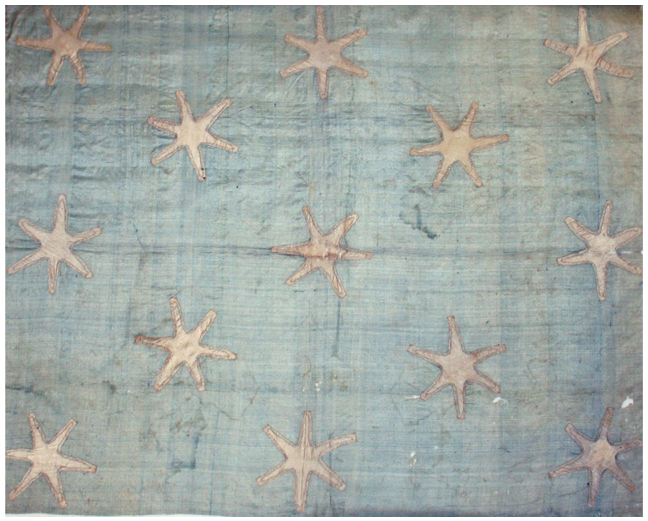
Commander in Chief’s Standard, ca. 1777-83 (Philadelphia: Museum of the American Revolution)
The distinctive thirteen-star blue silk standard circa 1777–83 that marked the presence of the Commander-in-chief on the battlefield and in headquarters is on loan from the museum and currently on view. This rectangular standard has been known for more than a century as George Washington’s Headquarters flag. It descended in the family of Washington’s sister, Betty Washington Lewis, whose son George served as an officer in the Commander-in-Chief’s guard. Also on loan from the museum are ten original silver camp cups from George Washington’s military field equipment with commemorative inscriptions. The original set of twelve cups, used to serve wine to aides and guests at the General’s table, were made in the shop of Philadelphia silversmith Edmund Milne in August 1777.
Sotheby’s selling exhibition will include a rare contemporary printing of the Declaration of Independence, the official printing for Massachusetts Bay, and a fine and rare engraved powder horn from March 22, 1770, owned by Jonathan Leonard Jr. (February 17, 1763 – January 25, 1849), a soldier in the American Revolution. The unique phrase, “Britain to Washington Shall Yield, Freedom Shall Triumph in the Field,” is engraved on the horn, paraphrased from the last verse of the highly popular song of the time, Great News from the Jerseys. Also included in the sale is the William Schuyler American horseman saber with figured maple grip, eagle pommel and original leather scabbard circa 1778–90. Opening hours are Monday – Saturday 10 am – 5pm and Sunday 1 pm – 5pm through 28 June 2013.
The Museum of the American Revolution will tell the complete story of the American Revolution. To be built in historic Philadelphia, just steps from Independence Hall and the Liberty Bell, the museum will feature a distinguished collection of objects, artifacts, artwork, and manuscripts from the period of the American Revolution that will bring to life the original “greatest generation” and engage people in the history and continuing relevance of the American Revolution.
Exhibition | Northern Life and Landscape: Julius Caesar Ibbetson
From Temple Newsam House:
Northern Life and Landscape: Julius Caesar Ibbetson (1759–1817)
Temple Newsam House, Leeds, 12 February – 10 November 2013

Julius Caesar Ibbetson, A Phaeton in a Thunderstorm, 1798 (Leeds Museums and Art Galleries, Temple Newsam House)
This new exhibition looks at works of art made by the Leeds artist Julius Caesar Ibbetson (1759–1817) who painted life and landscape as he saw it – with little interpretation. Today Ibbetson is little celebrated but he was one of the City’s most significant eighteenth-century artists, who became well known for his pictures of rustic scenes, cattle and rural scenery.
As an artist, Ibbetson held a great passion for nature and an intrigue for human oddity, preferring to create factual observations of rural life as he experienced it. In this endeavour his contribution to British history is fascinating as, when we examine his artworks today, they expose a rare view of rural life and begin to reveal some of the realities of living and working in the north of England during the late 1700s. The exhibition brings together a loan collection of Ibbetson drawings recording aspects of his family life and a recent donation of artworks from the Estate of Helen Mackaness to Leeds Museums and Galleries.
More examples of the artist’s work are available at BBC Your Paintings»
Exhibitions | Old Masters, Newly Acquired
Press release (2 May 2013) from The Morgan:
Old Masters, Newly Acquired
The Morgan Library & Museum, New York, 31 May — 11 August 2013

Joseph Ducreux (1735–1802), Portrait of a Gentleman, ca. 1802; black, brown, red, and white chalk (New York: The Morgan Library & Museum, Estate of Brooke Astor)
The Morgan Library & Museum’s collection of drawings from the Renaissance to the nineteenth century has grown dramatically over the last few years. During this period, important gifts, purchases, and bequests have both augmented and transformed the museum’s holdings. More than one hundred of these new additions are being featured in an exhibition titled Old Masters, Newly Acquired. On view through August 11, the show presents major gifts from such notable collectors as former Morgan Director Charles Ryskamp, Trustees Eugene V. Thaw and Brooke Astor, and long-standing supporter Joseph McCrindle. Also exhibited are other works that have entered the collection as gifts and bequests, as well as an important group of recent purchases, including a selection of those made on the Sunny Crawford von Bülow Fund.
Particularly significant is a selection of late-nineteenth-century French drawings by such artists as Manet, Cézanne, Vuillard, and Redon, which greatly strengthen the Morgan’s holdings in Impressionist, Post-Impressionist, and Symbolist works. More than forty Danish drawings form another important group, including sheets by several Golden Age masters, among them C.W. Eckersberg and Johan Lundbye. Outstanding watercolors by British artists, notably John Martin and Samuel Palmer, reveal their mastery of the medium and virtuosity of technique. Highlights among the purchases on view include a delicate sheet of studies by Perino del Vaga, a beautiful pastel by Benedetto Luti, and a dynamic compositional study by Charles-Joseph Natoire. (more…)
Exhibition | East of India: Forgotten Trade with Australia
From the Australian National Maritime Museum:
East of India: Forgotten Trade with Australia
Australian National Maritime Museum, Sydney, 1 June — 18 August 2013
 East of India tracks Australia’s colonial links with India, the power and monopoly of the English East India Company, and its inevitable decline.
It’s a tale of ships and shipwrecks, rice and rum, officers and officials, sailors, soldiers and servants – taking us from the old allure of Asia to modern-day ties between India and Australia.
The exhibition includes over 300 objects including coins, artwork, sculpture, maps, weaponry, ceramics, textiles and clothing from more than 15 local and international lending institutions will feature in the exhibition. Rarely seen artefacts include the bejewelled sword that belonged to the Indian leader Tipu Sultan, killed by East India Company forces at the battle of Seringapatam in 1799, and Indian cargo from the ship Sydney Cove wrecked en route to Australia in 1797.
◊ ◊ ◊ ◊ ◊
From the posting, “Bombay and Calcutta in Sydney” at The British Library’s Asian and African Studies Blog (22 May 2013) . . .

George Lambert and Samuel Scott, Fort William, Calcutta, ca.1731 (London: British Library, Reference: F45)
In 1732 the East India Company commissioned six seascapes of their main trading posts, which were displayed in the Director’s Courtroom of East India House in London. The resulting six paintings showed the East India Company’s trading posts at Bombay, Calcutta, Madras, Tellicherry, the Cape of Good Hope and St Helena. They conjured up the spread of imperial power inside a single room in the City of London. All six of the paintings were by George Lambert (1710-1765), and Samuel Scott (1701/2-1772). . .
281 years after they were commissioned, Lambert and Scott’s seascapes of Bombay and Calcutta have been sent to Australia’s National Maritime Museum in Sydney, where they are being exhibited in East of India: Forgotten Trade with Australia. Their inclusion in this international exhibition is incredibly significant. They were painted to symbolise the world beyond London, and centuries later, they have been sent from London to another part of the world. . .
◊ ◊ ◊ ◊ ◊
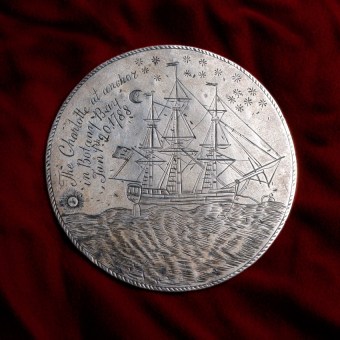
The Charlotte Medal, silver, 1788 (Australian National Maritime Museum, photograph by Andrew Frolows, ANMM)
The exhibition blog is available here»
More images are available here»
Additional information is available from an article in the Indian Herald here»










 Enfilade
leave a comment