Exhibition | Robert Polidori, Versailles
Robert Polidori’s Versailles series is currently on view at Galerie de Bellefeuille in Montréal with some images being exhibited for the first time. In 2008, the Edwynn Houk Gallery in New York mounted a similar show, and Polidori’s three-volume Parcours Muséologique Revisité appeared from Steidl in 2009.
Robert Polidori, Versailles
Galerie de Bellefeuille, Montréal, 1-25 June 2013
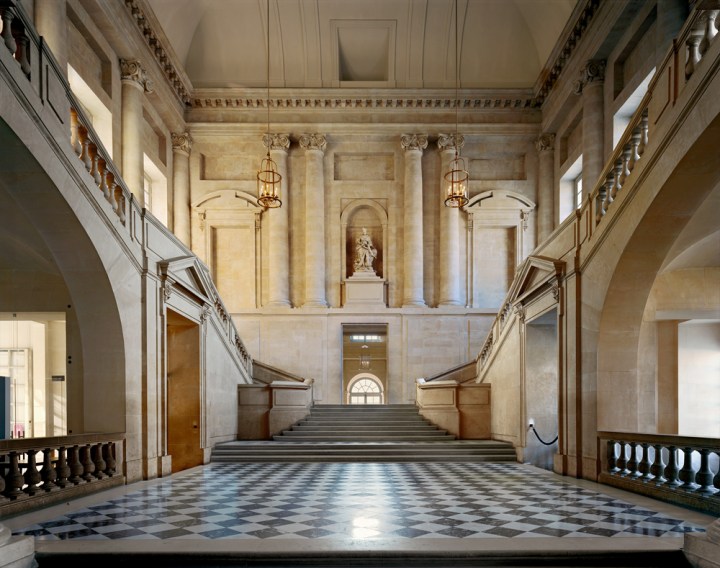
Robert Polidori, Marie Leszczinska en Junon,
MV 6595, by Guillaume Coustou, ca. 1731,
Grand Degré, Escalier Gabriel, 2007.
◊ ◊ ◊ ◊ ◊
Robert Polidori was born in Montréal, Canada, in 1951. At the age of ten he moved to the United States, where he has since remained. From 1970 to 1972 Polidori worked as an assistant to the filmmaker Jonas Mekas at the Anthology Film Archives producing a number of avant-garde films in the early 1970s. The time spent working under Mekas heavily influenced Polidori, helping to shape his unique approach to photography. In 1980 he received an M.A from the State University of New York in Buffalo, where he turned his attention to still photography.
Polidori’s career as a photographer began in earnest in the mid 1980s when he was given permission to document the historic restoration of the Château of Versailles. Since his first visit to Versailles Polidori has returned on a number of occasions, continuing a love affair that endures to this day. Working in opposition to Cartier-Bresson’s notion of the “decisive-moment,” that singular moment in which to capture a truth, Polidori prefers instead to work with the qualities of beauty and stillness of a space effected by its history and its present. As such, his conception of rooms as metaphors and vessels of memory is evident. He produces these interior shots by means of a single long exposure in natural lighting. His tonally rich and seductive photographs are the product of a view camera, long hours waiting for the right light, and careful contemplation of the camera angle. Polidori uses large-format sheet film, which he believes produces superior images to digital photography. While pursuing his career, Polidori also worked as a staff photographer with The New Yorker magazine from 1998 to 2007. (more…)
Exhibitions | Edward Harley: The Great Collector
Press release from The Harley Gallery:
Edward Harley: The Great Collector
The Harley Gallery, Welbeck, Nottinghamshire, 25 May 2013 — May 2014

From opulence and obsession to debt and despair, the exhibition Edward Harley: The Great Collector follows the fortunes of the 2nd Earl of Oxford (1689-1741). Showing at The Harley Gallery from 25 May 2013, it explores Edward Harley’s background, family and marriage through his spectacular collections of fine and decorative art and books.
Lord Edward Harley was a dedicated but extravagant collector. He bought at inflated prices when the desire to possess overrode any sense of the value of the piece or the extent of his resources. In 1738 he found himself in great debt and had to sell his family home and his collections.
The son of Robert Harley, one of the most powerful politicians in the country, Edward Harley married Henrietta Cavendish-Holles – the wealthiest heiress in Britain. Harley filled his family home at Wimpole Hall with a hubbub of activity – writers, poets, artists, bibliophiles would be regular visitors. He was a dedicated collector; his collections were extensive and extravagant as he passionately sourced the rarest and most beautiful things. Harley was surrounded by the finest thinkers and the finest things.
Besides magnificent silver, curios, paintings, and other works of art, he collected English miniature portraits dating from the early 1500s to his own time. These likenesses were intended as precious, jewel-like treasures to be kept in cabinets, brought out to be admired, and then returned to safety. They could be love tokens and gifts, souvenirs between friends and family members. Being so small, they were easily portable. Some were to be designed to be worn by a loved one as a pendant or bracelet. Many of Harley’s miniatures came from branches of his and his wife’s families; others were purchased because of the distinction of the artist or the importance of the sitter. They are the work of the greatest masters in the medium.
Harley rapidly added to the library started by his father, and his collection included pivotal works such as Shakespeare’s Second Folio and Jonathan Swift’s Gulliver’s Travels. Through Harley’s dedication, the library at Wimpole Hall grew at an astonishing rate, with some 12,000 books in the collection by September 1717. By the beginning of the eighteenth century, books and pictures were needing special accommodation in more and more houses. They were to become an essential part of country-house life. It was not until the second half of the seventeenth century that rooms called libraries became more common in country houses. Informed buying of art and literature was virtually non-existent until Charles I and other members of the court circle built up their collections in the 1620s and 30s. It required leisure, knowledge and money and house design grew to accommodate the collections with libraries, picture galleries and cabinet rooms. By the end of his life in 1741 Edward Harley had amassed the largest private library in Britain, but his passion for collecting ranged far beyond books and manuscripts. Edward Harley’s library contained 50,000 printed books, 7,639 manuscripts, 14,236 rolls and legal documents, 350,000 pamphlets, 41,000 prints: “the most choice and magnificent that were ever collected” (Collins).
His wealth gradually dwindled, yet Harley continued to add to his collections, often driving up the price of objects in his lust for ownership. In this obsessive collecting, Harley bankrupted himself and spent much of his wife’s fortune, eventually selling his family home and his collections to pay his debts. The great library, started by his father and described by Dr Johnson as excelling any offered for sale, was dispersed in 1742, but the celebrated Harleian collection of manuscripts was one of the founding collections of the British Library. Harley was also a patron of contemporary writers, including Alexander Pope and Jonathon Swift and of artists and architects.
The Harley Gallery is situated in the countryside of Welbeck, a ducal estate which has been home to the Cavendish-Bentinck family for more than 400 years. Edward Harley, 2nd Earl of Oxford (1689-1741) married into this family around 1713, when he wed Lady Henrietta Cavendish–Holles, uniting one of the most politically powerful families in the country with one of the richest. Edward Harley: The Great Collector will be accompanied by a full colour publication written by Curator Derek Adlam.
The Harley Gallery has recently announced plans to build a new Gallery which will show objects from The Portland Collections, the fine and decorative art collected by this family over the centuries. These collections include many objects purchased by Edward Harley, 2nd Earl of Oxford.
Exhibition | Madame Elisabeth: The Tragic Fate of a Princess
From the exhibition website:
Madame Elisabeth (1764-1794): Une Princesse au Destin Tragique
Domaine de Madame Elisabeth, Versailles, 27 April — 21 July 2013
Curated by Juliette Trey
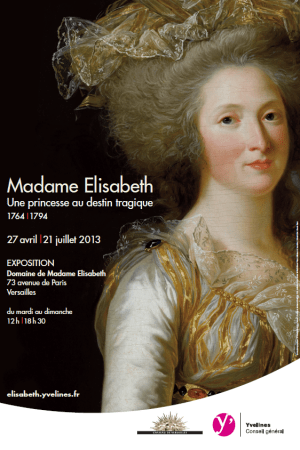 Who was the real Madame Elisabeth, the princess who never married and lived at Versailles with her brother Louis XVI and Marie-Antoinette? When she turned nineteen, the King gave her the estate of Montreuil, a country house very close to the Palace of Versailles. Madame Elisabeth spent her days there in simple pursuits – music, science, painting, embroidery and games – surrounded by her friends. In 1789, when she was twenty-five years old, the age of majority for unmarried women, she was finally entitled to sleep at Montreuil. However, the events of the French Revolution dictated otherwise.
This first major exhibition devoted to Madame Elisabeth is located in two areas of the estate. In the Residence, the furniture and objects with which the Princess surrounded herself have been assembled for the first time, conjuring up the lifestyle at Montreuil. The Orangery traces the life of the princess and the history of the estate.
130 works and objects have been assembled, including paintings, drawings, furniture, objets d’art, costumes, jewellery, and archive plans and documents. They come from the Palace of Versailles and several public and private collections and some exhibits have never previously been displayed. The exhibition space design aims to recreate the intimate atmosphere of Montreuil during the era of Madame Elisabeth. A multi-sensory tour allows visitors to experience this directly via perfumes, music, handling materials, and listening to contemporary accounts.
This tribute to the young princess also offers an opportunity to learn about the art of 18th-century gardens. The grounds are laid out in the English landscape garden style and have retained their original feel, with a grotto and groves of trees. Beds of aromatic and medicinal plants have been recreated in front of the Orangery, conjuring up the figure of Lemonnier, Madame Elisabeth’s physician, who cultivated plants on the estate. The walk between the two exhibition venues is enlivened with topiary representing animals.
◊ ◊ ◊ ◊ ◊
From the Versailles bookstore:
Juliette Trey, ed., Madame Elisabeth (1764-1794): Une Princesse au Destin Tragique (Milan: Silvana Editoriale, 2013), 192 pages, 28€.
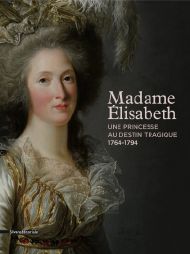 Although she was an obscure princess, Madame Élisabeth had an exceptional destiny. She never married and stayed with her elder brother, Louis XVI, who made her a present of the Montreuil estate on her 19th birthday: a country house only a few hundred metres from the Palace of Versailles.
This matchless horsewoman spent her days pleasantly there, surrounded by her friends who accompanied her on hunting outings or fishing trips. Passionately interested in mathematics and geography, and gifted in drawing, she never really interrupted her studies. Deeply pious, learned and sensible, Madame Élisabeth was also funny, cheerful and incredibly generous to everyone, heaping gifts on her friends and winning the affection of the inhabitants of Montreuil by her many acts of charity.
She showed great courage during the Revolution, refusing to go into exile in order to stay with her family. Imprisoned in the Temple with the royal family, she was guillotined just after reaching the age of thirty. A cult grew up around the memory of Madame Élisabeth which intensified after the Restoration and the return to power of her brothers from 1814 on.
◊ ◊ ◊ ◊ ◊
Exhibition | Living in Style: Five Centuries of Interior Design
From The Met:
Living in Style: Five Centuries of Interior Design from the Collection of Drawings and Prints
The Metropolitan Museum of Art, New York, 18 June – 8 September 2013

Jean Démosthène Dugourc, Wall Elevation of a Salon, ca. 1780. Pen and ink and watercolor; sheet: 9 x 6 3/4 inches (New York: Metropolitan Museum of Art)
Interior design is often thought of as a modern, post-industrial concept, but sculpting our domestic environment became an art form in its own right much earlier. Renowned and highly paid artists from a wide array of disciplines were often involved in the creation and manipulation of living spaces that would meet or even exceed the wishes of their patrons.
Made singlehandedly or by an interpreter in various stages of the manufacturing process, many features of artists’ designs have been captured on paper. This exhibition combines drawings, prints, and objects from all over Europe and the United States as they were collected by the Metropolitan Museum over a period of more than a hundred years. It highlights the ingenuity, beauty, and wit often found in designs for the decorative arts, and follows the dynamic development of shapes, ornaments, and materials alternately governed by issues of comfort, theory, and aesthetics.
At Mallett | Great English Furniture
As noted at ArtDaily (the brochure from Mallett is available as a PDF here) . . .
Great English Furniture
Mallett, London, 21 May — 1 June 2013
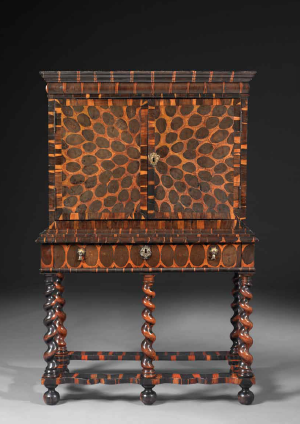 A major exhibition of English furniture which has been in important American private collections for many years is to be held by Mallett, one of the world’s leading antique dealers, at Ely House, 37 Dover Street, London W1 from 21 May to 1 June 2013. Great English Furniture will celebrate the skills of some of the best furniture makers in history and also provide an opportunity for collectors to buy pieces which have not been on the market for at least a quarter of a century.
Highlights of the exhibition will include a magnificent Master’s Chair, probably made for an anti-French society in the 18th century and one of only two known examples, an exceptional giltwood trophy attributed to Sefferin Nelson and made for the Prince Regent’s opulent home at Carlton House in London, a rare William and Mary cocus wood cabinet and an elaborately carved Chippendale period carved giltwood mirror. The majority of the pieces in the exhibition are 18th century and have been sourced by Mallett from private collections in the United States.
 One of the most fascinating pieces in the exhibition is a rare George II Master’s Chair, almost certainly made for the Anti-Gallican Society, founded in 1745 when Britain and France were at war. “For our Country,” the motto of the Society, is inlaid on the imposing walnut armchair, which is almost six feet high. It would have been made ca. 1750 for use in a dining club of the Anti-Gallican Society, which aimed to deter what it called “the insidious arts of the French nation.” Like many 18th-century clubs, its members combined the pursuit of convivial pleasure with promoting a cause – in this case opposing French influence and Anglo-French trade. The chair has broad sloping shoulders ornamented with carved and gilt acanthus and scroll-shaped terminals. The arms end in finely carved lions’ masks. The only other such chair known is in the collection of Temple Newsam, the great country house near Leeds. The price of this rare and historic chair will be in the region of £125,000.
Another highlight of the Mallett exhibition with a fascinating history is an exceptional giltwood trophy, representing the victory of peace over war, attributed to Sefferin Nelson ca. 1795. Nelson worked at Carlton House, the London residence of the Prince Regent, later George IV, as a carver gilder and frame maker. Henry Holland, the architect who turned the house into a palatial home for the heir to the throne, designed a set of giltwood trophies for the throne room at Carlton House. He commissioned them from the famous marchand-mercier Dominique Daguerre, who had the order completed by Nelson. Four of these trophies are now in the throne room at Buckingham Palace, where most of the contents of Carlton House were taken after the latter’s demolition in 1825. These are of the same dimensions and decorated with similar carvings and motifs to the one in the exhibition at Mallett. It will be priced in excess of £100,000.
Great English Furniture will also include a very rare William and Mary cocus wood cabinet on a stand, made in England ca. 1700. This oyster-veneered cabinet has a rectangular top above a moulded cornice and a pair of doors enclosing a fitted interior. Inside are two drawers around a central door with a row of pigeonholes on top. The whole piece stands on barley-twist turned legs joined by a waved stretcher and ending in bun feet. The cabinet will be on sale for more than £100,000.
A fine Chippendale period carved giltwood mirror will be another highlight of the exhibition. The elaborately carved mirror of Rococo design, made in England ca. 1765, has a central cartouche with foliate C-scrolls and bell flowers, elaborately pierced with an unusual double-layered cresting, flanked by hoho birds. This will also be priced in excess of £100,000. A fine Queen Anne double back walnut settee of rich colour and patination made in England ca. 1720 and a rare late 17th-century William and Mary desk decorated with ‘seaweed’ marquetry inlay, primarily in holly, are among the many other magnificent examples of furnituremakers’ art in the exhibition. Both will be on sale for a price in the region of £50,000.
Note (added 13 July 2013): The Master’s Chair sold at Masterpiece London (27 June — 3 July 2013) , as reported here»
Reviewed | Taking Time: ‘Chardin’s Boy Building a House of Cards’
Recently added to caa.reviews:
Juliet Carey, with essays by Pauline Prévost-Marcilhacy, Pierre Rosenberg and Katie Scott, Taking Time: “Chardin’s Boy Building a House of Cards” and Other Paintings (London: Paul Holberton Publishing, 2012), 160 pages, ISBN: 978-1907372339, £30.
Reviewed by Paula Rea Radisich, Department of Art and Art History, Whittier College; posted 16 May 2013.
‘Taking Time: Chardin’s “Boy Building a House of Cards” and Other Paintings’ is the catalogue accompanying an exhibition mounted at Waddesdon Manor, the country house in Buckinghamshire, England, built in the nineteenth century for Baron Ferdinand de Rothschild. Today the manor is run jointly by the National Trust and a charitable Rothschild Family Trust headed by Jacob Rothschild, 4th Lord Rothschild. In 2007, the trust purchased Jean-Siméon Chardin’s ‘Boy Building a House of Cards’ (1735). ‘Taking Time’ celebrates the arrival of Chardin’s painting to Waddesdon Manor, where it joins another famous genre painting by Chardin, ‘Girl with a Shuttlecock’ (1737), on loan from the Rothschild Collection, Paris.
As Lord Rothschild notes in his foreword to the catalogue, this is the first time Waddesdon has organized an exhibition consisting of loans from other countries. The curatorial premise of the show was to display the Waddesdon ‘House of Cards’ with Chardin’s other versions of the same subject belonging to the Louvre, the National Gallery in London, and the National Gallery of Art in Washington, DC. . . .
The full review is available here» (CAA membership required)
Exhibition | Disegno & Couleur: Dessins italiens et français
From L’Officiel Galleries & Musées:
Disegno & Couleur: Dessins italiens et français du XVIe au XVIIIe siècle
Bonnefantenmuseum, Maastricht, 27 November 2012 — 17 February 2013
Musée des Beaux-arts, Tours, 16 March — 27 May 2013
Musées Royaux des Beaux-arts de Belgique, Brussels, October 2013 — January 2014
 L’exposition présentée par le musée des Beaux-Arts de Tours réunit 75 dessins italiens et français réalisés du XVIe au XVIIIe siècle et appartenant aux musées royaux des Beaux-Arts de Belgique, à Bruxelles.
Certaines de ces œuvres n’ont jamais été présentées en France et proviennent de la prestigieuse collection Jean de Grez (1837-1910), offerte à l’état belge en 1911. Ces dessins ont été créés à Florence, à Bologne, à Rome, à Venise et ont permis la réalisation de grands projets comme le Palazzo Vecchio à Florence.
Vous pourrez également découvrir des feuilles d’artistes français rendues à Jean Cousin, Claude Déruet, Laurent de La Hyre, Eustache Lesueur, Charles Le Brun, Antoine Watteau, Joseph Benoit Suvée.
◊ ◊ ◊ ◊ ◊
From ArtBooks.com:
Stefaan Hautekeete, ed., Disegno & Couleur: Dessins italiens et français du XVIe au XVIIIe siècle (Milan: Silvana Edoriale, 2012), 256 pages, ISBN: 978-8836623716, $65.
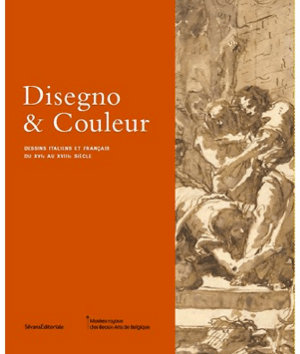 Les Musées royaux des Beaux-Arts de Belgique organisent depuis 2001 d’importantes expositions de dessins autour des chefs-d’œuvre de leur collection : Dessins de Rembrandt et ses élèves en 2005, Dessins du Siècle d’or hollandais en 2007. La troisième manifestation réunira les plus belles feuilles françaises et italiennes du XVIe au XVIIIe siècle, provenant essentiellement de la prestigieuse collection Jean de Grez (Breda, 1837- Bruxelles, 1910) donnée à l’Etat belge en 1911.
Le musée des Beaux-Arts de Tours, première institution française à être associée à ces projets, réunira les plus belles feuilles françaises et italiennes du XVIe au XVIIIe siècle, provenant essentiellement de la prestigieuse collection Jean de Grez (Breda, 1837- Bruxelles, 1910) donnée à l’Etat belge en 1911. Le public tourangeau découvrira 75 feuilles exceptionnelles d’artistes italiens qui ont participé à la décoration de grands projets de décoration à Florence (Palazzo Vecchio), à Rome (salles du Vatican), à Venise….tels que Paolo Farinati, Giovanni Stradano, Frederico Zuccaro, Giovanni Lorenzo Bernini, dit Le Bernin, Tiepolo…. ainsi qu’une sélection française opérée par Pierre Rosenberg, où seront présents les grands noms de la peinture, Jean Cousin, Claude Déruet, Eustache Lesueur, Charles Le Brun, Antoine Watteau… A cette occasion, une vingtaine de dessins français et italiens de la collection du musée de Tours seront confrontés à ces œuvres, notamment ceux de François Boucher, Louis-François Cassas, Jean Cousin, Jacques-Louis David, Prospero Fontana, Augustin-Alphonse Gaudar de Laverdine, Claude Vignons, mais aussi les nouvelles découvertes : Baglione, Bolzoni..
Exhibition | Trapani Coral
From the exhibition:
I Grandi Capolavori del Corallo: I Coralli di Trapani del XVII e XVIII Secolo
Fondazione Puglisi Cosentino, Catania, Sicily, 3 March — 5 May 2013
Museo Pepoli, Trapani, Sicily, 18 May — 30 June 2013
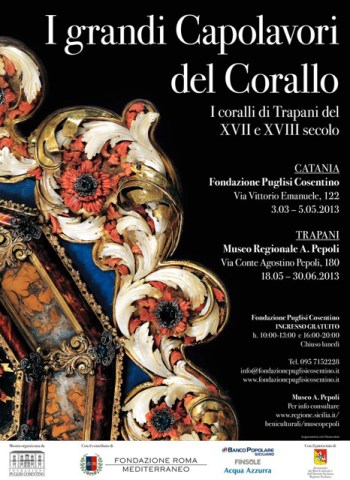 Il Museo Pepoli di Trapani ospiterà una grande mostra sui coralli trapanesi realizzati dai maestri artigiani della citt siciliana tra il XVII e XVIII secolo. Simbolo della bellezza e perfezione del creato, materia prima con l’oro per meravigliosi oggetti di culto, arredi sacri e profani, il corallo al centro di una grande mostra. Esposti per la prima volta capolavori provenienti da collezioni pubbliche e private che testimoniano come la lavorazione di questo straordinario materiale, in Sicilia e in particolare a Trapani, sia assurta a vera e propria arte.
In mostra oltre 120 preziosi manufatti di inestimabile valore selezionati con grande attenzione: gioielli e arredi sacri (calici, ostensori, crocifissi, reliquiari, rosari e presepi) e ancora calamai, saliere e raffinatissimi elementi darredo come specchiere, cornici, tavoli da gioco, scrigni e monumentali stipi destinati a case principesche e regge.
Si tratta di oggetti di grande valore artistico, realizzati con materiali pregiati per essere donati, tra il 500 e il 600, a principi e regnanti. Naturalia e Mirabilia erano esposti nelle Wunderkammer settecentesche, le cos dette stanze delle meraviglie, dove lappassionato collezionista raccoglieva oggetti della natura arricchendoli con materiali preziosi finemente cesellati in base allestro dellartista, filigrana d oro e d argento, splendidi oggetti destinati al godimento di pochi eletti nelle proprie dimore, piccoli musei ante litteram.
◊ ◊ ◊ ◊ ◊
From ArtBooks.com:
Valeria Patrizia Li Vigni Tusa, Maria Concetta Di Natale, Vincenzo Abbate, I grandi capolavori del Corallo: I coralli di Trapani del XVII e XVIII secolo (Milan: Silvana, 2013), 192 pages, ISBN: 978-8836625888, $65.
 Il catalogo presenta ai lettori una rassegna di capolavori in corallo provenienti dalla Sicilia, regione dove la realizzazione di meravigliosi manufatti in questo materiale ha raggiunto nei secoli l’apice della bellezza e della maestria artigianale. Il corallo ha visto fiorire intorno a sè infinite credenze popolari, legate soprattutto alla sua forma e al suo intenso colore: carico di valenze apotropaiche, usato in passato anche in medicina, il corallo è soprattutto simbolo della bellezza e perfezione del Creato e per questo divenne la materia prima, insieme con l’oro, per la produzione di meravigliosi oggetti di culto e arredi sacri. Fra le opere qui documentate, tutte realizzate con il corallo raccolto a Trapani, lungo i fondali delle Egadi e intorno all’isola di Tabarca, spiccano sia gioielli, sia ostensori, crocifissi, reliquari, presepi, nonché elementi di raffinato arredo: specchiere, tavoli da gioco, cornici, scrigni, fino a monumentali trumeaux destinati a case principesche. Queste opere testimoniano la ricchezza e la qualità di alcune collezioni considerate fondamentali nel settore, ovvero quelle della Banca di Novara, del Museo Pepoli di Trapani, della Fondazione Whitaker e del Museo Diocesano di Monreale, qui documentate insieme a singoli pezzi di inestimabile valore apparteneti a raccolte private italiane e straniere.
Exhibition | Revisiting the Picture Gallery of Frederick the Great
From the Prussian Palaces and Gardens Foundation (SPSG):
The Most Beautiful Gallery: Revisiting the Picture Gallery of Frederick the Great
Sanssouci, Picture Gallery, Potsdam, 9 May — 31 October 2013
As for the gallery, after St. Peter’s in Rome, it is undisputedly the most beautiful thing there is in the world. –Marquis d’Argens to Frederick the Great, 1761
 The Picture Gallery in Sanssouci Park ranks among the first and most magnificent buildings in Europe to be erected specifically for an art collection. Together with the paintings and sculptures selected by Frederick the Great, the building, adorned with portrayals of the arts and precious materials, constitutes a unique overall work of art. As a fitting expression of connoisseurship and education, at the same time it pointed to the importance of the Kingdom of Prussia. 250 years after it was first opened, visitors are now being invited to view through the eyes of Frederick this ‘queen’ of all gallery beauties.
The Picture Gallery was finished in 1763, and the cabinet was hung with paintings in 1764. Many of the masterpieces – for example, by Peter Paul Rubens and Carlo Maratta as well as by sculptors such as Jean-Baptiste Lemoyne and Louis-Claude Vassé – still hang here today. The collection of more than 180 paintings and sculptures has undergone powerful changes since its founding, however. The Prussian Palaces and Gardens Foundation Berlin-Brandenburg is now re-introducing the Gallery in a way that corresponds to the original furnishing concept of its royal builder.
 For the first time since 1830, antique sculptures, on loan from the Collection of Antiquities and the Sculpture Collection at the Staatliche Museen zu Berlin as well as the Muzeum Narodowe in Poznan, are coming to Sanssouci, where they may be admired in the Gallery once again. Among the pieces is the famous statuette of the Girl Playing Knucklebones. The Frederician manner of hanging paintings has been visualized in a photograph presentation. Particularly distinctive is the new hanging of the paintings in the small cabinet: With the return of works in 2010 that were long thought to be war losses, a closer approximation to the historical wall-to-wall hanging has been achieved. Thus, it is now possible to experience the overwhelming gallery rooms in a completely new manner as architecture, painting, and sculpture engage with one another in a unique dialogue.
Catalogue: Die Schönste der Welt: Eine Wiederbegegnung mit der Bildergalerie Friedrichs des Großen (Berlin: Deutscher Kunstverlag, 2013), 144 pages, ISBN 978-342207184, €15.
Additional information is available at ArtDaily»
Exhibition | Raynal: Un regard vers l’Amérique
From the Bibliothèque Mazarine:
Raynal: Un regard vers l’Amérique
Bibliothèque Mazarine, Paris, 13 June – 15 September 2013
Curated by Gilles Bancarel and Patrick Latour
 Le nom de Guillaume-Thomas Raynal reste attaché à son œuvre majeure, l’Histoire philosophique et politique des établissements et du commerce des Européens dans les deux Indes. Cette compilation à visée encyclopédique, l’un des grands succès de librairie de la fin du XVIIIe siècle, suscita autant de critiques que d’éloges de la part de ses contemporains. Elle apparaît comme pleinement représentative d’un paysage éditorial marqué par l’évolution du simple récit de voyage vers la réflexion philosophique sur le rôle de l’Europe dans le monde, particulièrement sur le continent américain.
Le tricentenaire de la naissance de l’abbé Raynal (1713-1796) est l’occasion de mettre en valeur la singularité du regard porté par un homme des Lumières sur l’Amérique, regard plongé dans l’actualité du moment – la guerre d’Indépendance dont il se fait le chroniqueur – mais aussi annonciateur des profondes transformations politiques et sociales qu’engagera la Révolution française, notamment l’abolition de l’esclavage. Ce regard est aussi le reflet des lectures multiples dont s’est nourri un auteur qui n’a lui-même jamais
traversé l’Atlantique.
Autour de différentes éditions de l’Histoire philosophique des deux Indes, l’exposition présente les ouvrages emblématiques de la riche production livresque consacrée, du XVIe au XVIIIe siècle, au Nouveau Monde : récits de la découverte et des premiers établissements, relations de colons ou observations de voyageurs. La guerre d’Indépendance, la condition des esclaves dans les colonies européennes, la diffusion et la réception des thèses de Raynal y sont appréhendées par les témoignages, manuscrits ou imprimés, des penseurs des Lumières. Livres rares, journaux, documents d’archives ou simples brochures illustrent ainsi la place éminente occupée depuis 1492 par l’Amérique dans le débat d’idée européen et l’imaginaire collectif.










 Enfilade
leave a comment