Exhibition | Colors of Seduction: Tiepolo and Veronese
This is, unfortunately, the last weekend for the exhibition, though it is slated to be reviewed by The Burlington.
I Colori della Seduzione: Giambattista Tiepolo & Paolo Veronese
Castello di Udine, 17 November 2012 — 1 April 2013
Curated by William Barcham, Linda Borean, and Caterina Furlan

◊ ◊ ◊ ◊ ◊
Un’occasione unica per vedere riunite, dopo quasi duecento anni, le due tele che compongono il Mosè salvato dalle acque di Giambattista Tiepolo. L’opera, tagliata negli anni ’20 dell’800, viene proposta nella sua composizione originaria, riaccostando il Mosè della Scottish National Gallery di Edimburgo con l’Alabardiere della collezione Agnelli di Torino, così come documentato da una copia coeva attribuita a Giandomenico Tiepolo della Staatsgalerie di Stoccarda. Le due parti della tela, che hanno avuto destini conservativi diversi, presentano oggi colori leggermente diversi.
Un sistema di illuminotecnica all’avanguardia renderà possibile vedere l’opera sia come è realmente, che secondo una colorazione uniforme. Ideale risulta l’accostamento al Mosè salvato dalle acque di Paolo Veronese del Musée des Beaux Arts di Digione, per rilevare le assonanze e la personale soluzione adottata da Tiepolo. Il confronto diretto tra le due opere vuole riportare l’attenzione sullo speciale rapporto intessuto da Tiepolo con uno dei più importanti esponenti della tradizione pittorica veneziana del Cinquecento. Tiepolo trovò infatti nell’arte di Veronese lo stimolo al superamento della “maniera scura” e il punto di partenza per la maturazione di un linguaggio che lo avrebbe trasformato in uno dei grandi protagonisti della pittura europea del Settecento.
A partire dagli affreschi del Palazzo arcivescovile di Udine, una sorta di prologo e punto di partenza della mostra, Tiepolo intraprende un percorso di ‘emulazione’ di Veronese. Il critico Francesco Algarotti definì l’amico Tiepolo ‘l’emulo di Paolo’. Guardare a Veronese significò per Tiepolo rivisitarne l’interpretazione di temi religiosi o di storia antica, mediante scenografiche impostazioni di natura teatrale, prospettive architettoniche e opulenza decorativa, ed appropriarsi di una tavolozza squillante di colori puri e ombre colorate.
La mostra è articolata in quattro sezioni nelle quali Tiepolo e Veronese vengono messi a confronto nella trattazione di alcuni temi religiosi, mitologici e della storia antica: il Mosè salvato dalle acque, il Ratto d’Europa, le Cene e i Banchetti e l’Adorazione dei Magi.
Il complesso terreno di confronto tra i due artisti è messo in luce anche dai bozzetti e dai disegni, che illustrano le varie modalità con cui Tiepolo ha riletto l’eredità figurativa di Veronese nei vari momenti del processo creativo. Oltre alle tele, la mostra vanta infatti un gruppo straordinario di fogli di Tiepolo e Veronese, prestati da musei nazionali e internazionali di primo piano (Galleria degli Uffizi, Victoria and Albert Museum di Londra, Ashmolean Museum di Oxford, Département des Arts Graphiques del Louvre, Schlossmuseum di Weimar e Städel Museum di Francoforte). Un dialogo visivo che vede, ad esempio, il disegno d’insieme approntato da Tiepolo per il Banchetto di Antonio e Cleopatra esposto insieme ai pensieri di Veronese sul tema dei banchetti, rappresentati dallo studio preparatorio per le Nozze di Cana e al modello a olio della National Gallery di Londra.
Exhibition | Fans of History: Daily Life and Major Events
From Visit Paris Culture Guide (with thanks to Pierre-Henri Biger for noting it so early!) . . .
Feuilles d’histoires: Vie quotidienne et grands évènements
à travers l’éventail en France au XVIIIe siècle
Musée Cognacq-Jay, Paris, 14 November 2013 — 9 April 2014
Curated by José de Los Llanos and Georgina Letourmy-Bordier
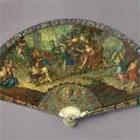 L’éventail est à la fois familier et méconnu. Accessoire de mode et objet d’art, il allie le savoir-faire d’artisans à la création artistique. Soumis à la fugacité des modes, il se renouvelle sans cesse. Importé d’Asie à la Renaissance, au milieu des cargaisons d’épices et de soies, l’éventail est adopté en France sous le règne de Louis XIV. Une corporation spécifique, celle des éventaillistes, assure la domination des artisans français.
Au cours du XVIIIe siècle, Paris devient la capitale de l’éventail. Le choix des décors suit alors la production des peintres à la mode et participe à la diffusion de l’art français en Europe, tout en montrant une singulière diversité. Avec soixante-dix œuvres empruntées à des collections publiques et privées, cette exposition, hommage à l’excellence du savoir-faire des éventaillistes français, essentiellement parisiens, montrera aussi l’extraordinaire inventivité dont témoignent ces objets fragiles et discrets.
Exhibition | French Paintings from the Wadsworth Atheneum
It’s interesting to see how this exhibition has been retitled in various venues: from Old Masters to Impressionists, to Old Masters to Monet, to Court to Café. The exhibition appeared in a fuller version at the Wadsworth Atheneum itself as Medieval to Monet: French Paintings, where it was accompanied by a full catalogue. -CH
◊ ◊ ◊ ◊ ◊
Press release (4 December 2012) from the Mississippi Museum of Art:
Old Masters to to Monet: Three Centuries of French Painting from the Wadsworth Atheneum
The Michele and Donald D’Amour Museum of Fine Arts, Springfield, MA, 13 December 2011 — 29 April 2012
Taft Museum of Art, Cincinnati, 18 May — 16 September 20122
Wadsworth Atheneum, Hartford, CT, 19 October 2012 — 27 January 2013 [expanded version of the exhibition]
Mississippi Museum of Art, Jackson, 23 March — 8 September 2013
Denver Art Museum, 27 October 2013 — 9 February 2014
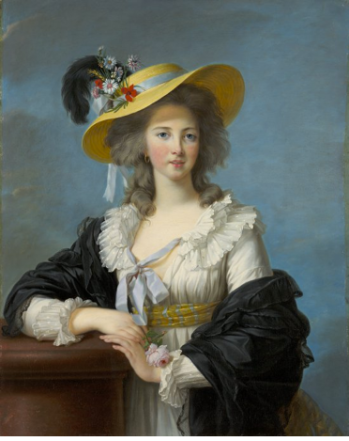
Elisabeth-Louise Vigée Le Brun, The Duchesse de Polignac Wearing a Straw Hat, 1782 (Hartford, CT: Wadsworth Atheneum Museum of Art)
The Mississippi Museum of Art is pleased to present Old Masters to Monet: Three Centuries of French Painting from the Wadsworth Atheneum, on view from March 23 through September 8, 2013. It is the thirteenth presentation in The Annie Laurie Swaim Hearin Memorial Exhibition Series. Established in 1989 to honor the memory of Annie Laurie Swaim Hearin, one of the Museum’s most dedicated patrons and volunteers, the Hearin series showcases exhibitions of world-class art, attracting visitors to Jackson from across Mississippi, the Southeast, and beyond.
Old Masters to Monet features fifty masterpieces from the collection of the Wadsworth Atheneum in Hartford, Connecticut. The outstanding artworks provide a history of French painting, ranging from the seventeenth through the nineteenth centuries and into the beginning of the twentieth century and include religious and mythological subjects, portraits, landscapes, still lifes, and genre scenes.
The Wadsworth Atheneum is America’s oldest public art museum, founded in 1843, and has never presented a full-scale survey of its distinguished collection of French paintings. To honor the recent publication of its
collection catalogue, the Atheneum has launched a tour of fifty of these outstanding masterpieces. “The Mississippi Museum of Art is honored to be one of the select venues to host this important exhibition,” said Betsy Bradley, director of the Mississippi Museum of Art. “In keeping with our mission of engaging Mississippians in the visual arts, this exhibition provides a rare opportunity for our visitors to come face to face with some of the most historically valued French paintings held in any museum collection.”
The exhibition begins with the great seventeenth-century masters, Nicolas Poussin, Claude Lorrain, Simon Vouet, and Jacques Stella, all of whom spent time in Rome and whose work embodies Italianate ideas of beauty, classical sculpture, and ideal landscape. Poussin’s enormous Crucifixion, painted in 1646 for President Jacques-Auguste de Thou, and Lorrain’s Landscape with St. George and the Dragon, commissioned by Cardinal Fausto Poli in 1641, are among the most important French paintings residing in the United States.
The eighteenth-century works present a remarkably rich tapestry of life in France during the rococo age. There are several scenes and portraits of aristocrats, including the Portrait of the Duchesse de Polignac by the era’s leading painter of women, Madame Vigée-Lebrun. Genre scenes rendered during this period exhibit a decidedly risqué bent as well as humorous aspects of life, both of which are evident in paintings on view by Jean Baptiste Greuze, François Boucher, and Louis Leopold Boilly. A more serious approach is evidenced in Still Life by Jean Baptiste Simeon Chardin and in the charming family pictures by Nicolas-Bernard Lépicié and Nöel Hallé. The change in style brought about by the French Revolution is evident in the impressive composition designed by Jacques Louis David, and the creation of a new aristocracy is presented by the two brilliant paintings by Jean Auguste Dominique Ingres. (more…)
Exhibition | Drawing Room: An Intimate Look at French Drawings
This fall, the Denver Art Museum will present Passport to Paris, a trio of exhibitions addressing France. Along with works from the Wadsworth Atheneum, the museum will show Nature as Muse: French Impressionist Landscapes and the following drawing exhibition:
◊ ◊ ◊ ◊ ◊
Drawing Room: An Intimate Look at French Drawings from the Esmond Bradley Martin Collection
Denver Art Museum, 27 October 2013 — 9 February 2014

Antoine Watteau, Standing Woman Holding a Fan, ca. 1719. Red and black chalk with graphite, on paper.
Collection of Dr. Esmond Bradley Martin.
Inspired by the drawings cabinets of gentlemen and connoisseurs, this exhibition will offer a space where visitors can get close to artworks whose intimate nature invites contemplation and close-up viewing. Comprised of approximately 39 works-on-paper, the exhibition includes a range of techniques from rapid sketches to finished pastels. The artworks represent exquisite examples of draughtsmanship by some of the most celebrated French masters and allow an in-depth look into the creative process of artists.
The entire exhibition is drawn from the private collection of Dr. Esmond Bradley Martin. Artists featured include François Boucher, Jacques-Louis David, Théodore Géricault, Jean-Auguste-Dominique Ingres, Henri de Toulouse-Lautrec, Claude Monet, and Alfred Sisley.
Exhibition | Edges of Books
I regret that notice of this exhibition at RIT’s Cary Graphic Arts Collection slipped by me, but the catalogue is still available. -CH
◊ ◊ ◊ ◊ ◊
Edges of Books
Rochester Institute of Technology, Rochester, New York, 1 October — 14 December 2012
 Edges of Books examines a familiar form from an unfamiliar perspective. When books are on display it is usually their spines, covers, text, or illustrations that are featured. These are the familiar parts of the books—the parts that modern readers have come to interact with the most. Edges of Books takes a different approach, uncovering a tradition that extends back centuries in which the edges of books were important sites for information and decoration. A selection of artifacts from 1518 to the present will inspire visitors to view books in new and exciting ways.
Steven K. Galbraith, Edges of Books: Specimens of Edge Decoration from RIT Cary Graphic Arts Collection (Rochester: RIT Press, 2012), 74 pages, ISBN: 978-1933360690, $17.
Steven K. Galbraith is Curator of the Melbert B. Cary, Jr. Graphic Arts Collection. He has a Ph.D. in English Literature from Ohio State University and an M.L.S. from the University at Buffalo. Prior to coming to RIT, he was the Andrew W. Mellon Curator of Books at the Folger Shakespeare Library in Washington, D.C. and the Curator of Early Modern Books and Manuscripts at the Ohio State University. He is the author of works on early English printing, English Renaissance literature, rare book librarianship, and book conservation and digitization.
Exhibition | British Drawings from the Cleveland Museum of Art
Some of the offerings for those of you who will be in Cleveland next month for ASECS. From the museum’s website:
British Drawings from the Cleveland Museum of Art
Cleveland Museum of Art, 8 February — 26 May 2013
The British drawings at the Cleveland Museum of Art have received less attention than the renowned Italian and French drawings but are eminently worthy of such. The collection includes works by some of the best-known artists in the history of English art, such as Thomas Gainsborough, William Blake, J. M. W. Turner, and Edward Burne-Jones. Important recent acquisitions include a highly finished wash drawing exemplary of John Flaxman’s neoclassical style, an 18th-century double-portrait in pastel by Daniel Gardner, and a watercolor in pristine condition describing the Surrey countryside at sunset by Samuel Palmer. The exhibition features approximately 50 works from the collection along with a small group of loans from private collections, ranging from the 18th century through the Edwardian period, and will be accompanied by a collection catalogue. This is the inaugural exhibition of a new series exploring highlights from the Cleveland Museum of Art’s collection of drawings.
◊ ◊ ◊ ◊ ◊
From the publisher:
Heather Lemonedes, British Drawings: The Cleveland Museum of Art (London: D. Giles, 2013), 152 pages, 978-1907804229, $45.
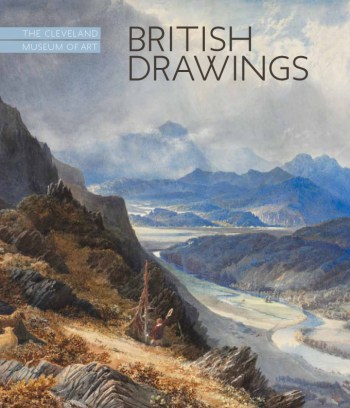 This volume, the first in a new series, presents outstanding drawings from the permanent collection of works on paper at the Cleveland Museum of Art. It features 50 highlights, along with a small group of loans from private collections, ranging from the 18th century through to the Edwardian period. Fragile and light sensitive, opportunities to see such treasures are rare and for that reason are all the more to be celebrated. Many are published here for the first time, such as Francis Cotes’s breathtaking portrait of Lady Mary Radcliffe and an exquisite female nude drawn in coloured chalk by William Mulready.
Heather Lemonedes is curator of Drawings at the Cleveland Museum of Art. Prior to her arrival at the museum in 2002, she worked as a specialist in the Print Department at Christie’s, New York and supervised the Print Study Room at the Metropolitan Museum of Art, New York. She was awarded a Samuel H. Kress
Foundation Travel Fellowship in the History of Art for
research on her dissertation, “Paul Gauguin’s Volpini
Suite,” in 2004.
Exhibition | Stradivarius at the Ashmolean
From the Ashmolean Museum:
Stradivarius
Ashmolean Museum, Oxford, 13 June — 11 August 2013

Ashmolean Museum, Oxford. Photo by Merlin Cooper, 2005, Wikimedia Commons
Antonio Stradivari (c.1644–1737) – or Stradivarius as he is usually known – is the only maker of musical instruments whose name ranks alongside those of the great composers. For the first time will twenty of his instruments, from guitar to cello to violin, be on display together in the UK. While the details of his life are not as familiar as those of Vivaldi or Mozart, his name succeeds in evoking a creative genius in the popular imagination. The Ashmolean’s summer 2013 exhibition will feature twenty of the world’s most important musical instruments, some of which have never been shown in public, on loan from international collections: from the early Silvestre violin of 1666, to the Fountaine violino piccolo, the Boissier-Sarasate of 1713, to his later violins of the 1730s. It will also show a recreation of Stradivarius’s workshop where visitors will be able to follow the creation of a violin from a log of spruce through to the finished instrument.
◊ ◊ ◊ ◊ ◊
From ACC Distribution:
Charles Beare, Peter Beare and Jon Whiteley, Stradivarius (Oxford: Ashmolean Museum, 2013), 200 pages, ISBN:
9781854442758, $40.
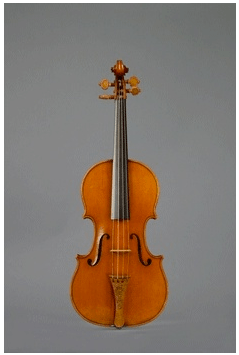 Antonio Stradivari is, perhaps, the only maker of violins who ranks alongside Van Gogh and Turner as an artist. A household name to many, he is associated with secret formulae and mystical processes ensuring his instruments are sought after by the world’s greatest soloists. He excites controversy, although none of his violins have raised so much heated debate as the Ashmolean’s Messiah, making headline news some ten years ago when doubt was cast on its age. Stradivari’s birthplace is unknown, he may have been born in 1644, and even his apprenticeship to Nicola Amati is uncertain. He died rich and famous in Cremona in 1737. Since then his instruments have increased in fame and are now regarded as supreme examples of the violin-maker’s craft. Despite the great fame of Stradivari’s violins, there has never been a monographic exhibition of his work in the UK. It will include 30 instruments, representative of Stradivari’s range and output across the years, alongside exceedingly rare examples of stringed instruments other than those of the violin family.
The prize items to be featured in the exhibition are already in the Ashmolean: The Potter, The Messiah and the guitar of 1688, all works of the greatest rarity. The exhibition and the accompanying catalogue will allow the public to see the work of one of the greatest violin makers of all time. Stradivarius also presents the most recent research on Stradivarius’ instruments.
Contents: Introduction by James Ehnes; essay on Stradivarius by Charles Beare; essay on Stradivarius’ work including dendrachronology of the instruments; “The luthier’s perspective: How Stradivari violins are built and what makes them so good?” by Peter Beare; catalogue entries; technical information.
Charles and Peter Beare are directors at the successful violin dealers Beares. Peter is a qualified luthier. Jon Whiteley is the Senior Assistant Keeper in the Department of Western Art, specializing in paintings drawings and musical instruments.
◊ ◊ ◊ ◊ ◊
From Music at Oxford:
The Dawn of the Stradivarius with James Ehnes and La Serenissima
Sheldonian Theatre, Oxford, 14 June 2013
 In association with The Ashmolean Museum’s extraordinary forthcoming exhibition of the world’s finest Stradivarius instruments, Music at Oxford is proud to present this collaborative concert. Canadian virtuoso and Stradivarius player James Ehnes will perform unaccompanied music by Bach and Paganini on a number of Stradivarius violins and discuss what’s unique about them and the sound they produce. This will be the first time one player has ever had the opportunity to do so in a concert setting. Award-winning period ensemble La Serenissima will follow this by performing a programme of music from the age of Stradivarius by Vivaldi, Valentini and their contemporaries.
This event will open the exhibition, a fascinating exploration of the master maker’s work featuring the largest collection of Stradivarius instruments ever assembled as well as audiovisual footage featuring James Ehnes. Don’t miss this exciting event, our 2012-13 season closer. Tickets are bound to be in great demand so please do book early.
Exhibition | Life at the Château de Prangins in the 18th Century
From the museum’s website:
Noblesse Oblige! Life at a Château in the 18th Century
Swiss National Museum, Château de Prangins, beginning 23 March 2013

Château de Prangins, 2005
(Photo from Wikimedia Commons)
◊ ◊ ◊ ◊ ◊
Château de Prangins is bringing its past to life and showcasing its historical heritage. From 23 March 2013 the former reception rooms, comprising the salon, dining rooms and libraries, will be revealed in their original grandeur as the backdrop for the new permanent exhibition. Boiseries in their original colours, textiles with lustrous motifs and false-marble decorations create the perfect surroundings for 600 objects from the era.
 Noblesse Oblige! Life at a Château in the 18th Century is devoted to the everyday life of a noble family in the Vaud region at the end of the 18th century and explores important issues of cultural history. The exhibition offers an insight into the life of a baron and the way in which he manages his estate, his duties and obligations, his family and social life. Each of the nine rooms is devoted to a specific topic that mirrors its original function: hospitality, wealth and lighting in the salon, servants in the butler’s pantry, and the taste for reading in the library.
Two audioguides – one for adults, the other for younger audiences – and specially produced films featuring the voices of the inhabitants allow visitors to immerse themselves in life at a château.
Project manager: Helen Bieri Thomson
Exhibition and Resource | French Pamphlets at The Newberry
From The Newberry:
Politics, Piety, and Poison: French Pamphlets, 1600–1800
The Newberry Library, Chicago, 28 January — 13 April 2013
This exhibition displays French pamphlets published during the transitional period from the Ancien Régime to the French Revolution. They served as modes of dissemination and diversion, teaching tools and educational models, and the foundation for current and future scholarly projects. The exhibition focuses on the ways in which these pamphlets complement and enhance the Newberry’s other vast collections of primary sources documenting early modern European culture and the history of printing. The Newberry’s outstanding collection of French pamphlets was recently cataloged through a grant from the Council on Library and Information Resources.
◊ ◊ ◊ ◊ ◊
About The Newberry’s cataloging project:
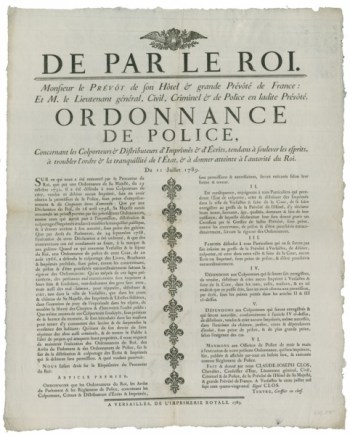
Case Wing Z 144.A1, vol.10 No.87, Ordonance (The Newberry Library)
French Pamphlet Collections at the Newberry Library is a three-year project funded by a Council on Library and Information Resources (CLIR) Cataloging Hidden Special Collections and Archives grant. CLIR administers this national effort with the support of generous funding from The Andrew W. Mellon Foundation. French Pamphlet Collections at the Newberry Library began in January 2010 and will be completed in January 2013. Through the project, the Newberry is creating full, item-level MARC records for 22,000 French pamphlets that date from the 16th to the 19th century.
The Newberry applied for the CLIR grant to support one of its top cataloging priorities of processing hidden collections. A committee comprised of staff with library service, stacks management, curatorial and collection development responsibilities prioritized these uncataloged and undercataloged materials based on its knowledge of researcher requests, scholarship trends, Newberry collection strengths, subject areas in need of development, and strong complementary collections in other institutions. Pamphlet collections were one of the highest priorities. More specifically, the committee identified the French Pamphlet Collections as being an urgent cataloging need. The material complements strengths of the Newberry’s collection and it is in high-demand by researchers. The bulk of the pamphlets date to the period of the French Revolution and are primary sources for legal, social, and cultural history; literary studies; and the history of publishing. These ephemeral documents have often been overlooked and undervalued by past generations of scholars and undercataloged in research collections. They are of particular value to modern scholarship because they move past official histories and contribute to new interpretations. . .
Exhibition | Piranesi, Rome, and the Arts of Design
From the San Diego Museum of Art:
Piranesi, Rome, and the Arts of Design
Giorgio Cini Foundation, Venice, 28 August 2010 — 9 January 2011
Caixa Forum, Madrid, 24 April — 9 September 2012
Caixa Forum, Barcelona, 9 October 2012 — 20 January 2013
San Diego Museum of Art, 30 March — 7 July 2013
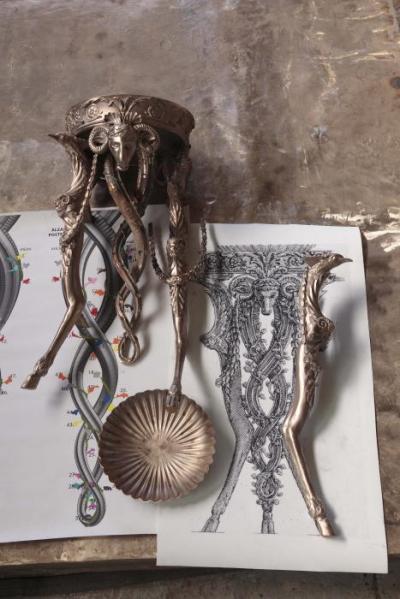 Giovanni Battista Piranesi (1720-1778) was a printmaker, architect, antiquarian, art dealer, theorist, and designer—one of the foremost artistic personalities of the 18th century, whose views of Rome remain the city’s defining image. Fresh, thought-provoking, and innovative, Piranesi, Rome, and the Arts of Design sets out to show the range of the artist’s genius in a 21st-century approach to his creative endeavors. More than 300 original prints have been selected from the world renowned collection of the Fondazione Giorgio Cini in Venice, Italy. These prints are combined with modern-day interpretations in new technologies such as video, photography, and digital modeling. Utilizing the most advanced technologies, the exhibition enables Piranesi’s two-dimensional renderings of a monumental vase, a candelabrum, tripods, a teapot, an altar, and a fireplace to assume their rightful three-dimensional forms. These never-before-seen and never-before-crafted objects take center stage in the exhibition and attest to the creative intellect of Piranesi’s designs. In addition, the exhibition brings to life Piranesi’s most famous works, the Carceri (Prisons), in the form of a virtual reality 3-D installation. The legendary Caffè degli Inglesi is represented as a full scale evocation, and visitors may browse through Piranesi’s sketchbooks using a touchscreen monitor. Strikingly designed by world renowned architect Michele De Lucchi, the exhibition embodies the progressive spirit of Piranesi’s own eclectic visions and his modernity, emphasizing the popular appeal of his work and its continuing relevance to designers and architects. Having previously appeared at the Fondazione Cini in Venice and at the Caixa Forum in Madrid and Barcelona, the show makes its only U.S. stop at The San Diego Museum of Art.
Exhibition conceived by Michele De Lucchi, produced by Fondazione Giorgio Cini, Itatly, together with Factum Arte, Spain, in collaboration with Exhibits Development Groups, USA.
Photos from the installation at the Giorgio Cini Foundation (Le Arti di Piranesi: architetto, incisore, antiquario, vedutista, designer) are available here»
◊ ◊ ◊ ◊ ◊
From Factum Arte:
Michele de Lucchi, Guiseppe Pavanello, John Wilton-Ely, Norman Rosenthal, and Adam Lowe, The Arts of Piranesi: Architect, Etcher, Antiquarian, Vedutista, Designer (Madrid: Caixaforum, 2012), 304 pages, ISBN 978-8461576371, 35€.
 The Arts of Piranesi: Architect, Etcher, Antiquarian, Vedutista, Designer is a catalogue for the homonymous exhibition on the work of Giambattista Piranesi, curated by Michele de Lucchi, Adam Lowe and Giuseppe Pavanello, taking place in CaixaForum Madrid from 25 April to 9 September 2012 and CaixaForum Barcelona from October 2012 to January 2013.
A collaboration between Factum Arte and the Fondazione Giorgio Cini, the exhibition opened in Madrid after receiving great reviews when it was in Venice for the Biennale of Architecture in 2010. In addition to objects realised using traditional and digital modelling from the original designs by Piranesi, the exhibition also contains Gabriele Basilico’s sensitive black and white photographs of the famous Vedute and over 250 etchings by Piranesi.
◊ ◊ ◊ ◊ ◊
From the San Diego Museum of Art:
Symposium: Piranesi, Rome, and the Arts of Design
San Diego Museum of Art, 30 March 2013
Scholars from around the country will offer their insights to contextualize the culture, time period, and artistic concerns of Giovanni Battista Piranesi. Speakers include Christopher M.S. Johns, Norman L. and Roselea J. Golberg, Professor and Chair of the Department of History of Art, Vanderbilt University; John Pinto, Howard Crosby Butler Memorial Professor of Art and Archeology, Princeton University; and Jeffrey L. Collins, Professor and Chair of Academic Programs, Bard Graduate Center; and will be moderated by Dr. John Marciari, Curator of European Art.
◊ ◊ ◊ ◊ ◊
Film | Yo-Yo Ma Inspired by Bach: The Sound of The Carceri
San Diego Museum of Art, 5 April 2013
The Sound of The Carceri explores the deep relationship between music and architecture through a high-tech ‘virtual confrontation’ between Bach and his contemporary, the architect Giovanni Battista Piranesi. Using a striking visual style, director François Girard (The Red Violin and Thirty-Two Short Films about Glenn Gould) places Yo-Yo Ma within a series of computer-generated, three-dimensional recreations of Piranesi’s well-known prison etchings. Through Yo-Yo Ma’s and music producer Steven Epstein’s struggle to recreate and interact with the imaginary space that Ma performs in, the film examines the complexity of illusion, of representation and reality.
◊ ◊ ◊ ◊ ◊
Lecture | Purchasing Piranesi: Buying Art on the Grand Tour
San Diego Museum of Art, 19 April 2013
Buying art was a key element of the British Grand Tour to Italy in the 18th century, and a visit to Piranesi’s workshop was never to be missed. The studio was like a superstore of antiquities where those on the Grand Tour could buy antiquities and prints that recorded them, as well as casts, copies, and forgeries. Making use of unpublished archival research, Dr. John Marciari, Curator, European Art and Head of Provenance Research, will discuss the ways in which travelers set about buying works by Piranesi, Batoni, and others in 18th-century Italy.
◊ ◊ ◊ ◊ ◊
From Factum Arte:
One of the key elements of the exhibition Le Arti di Piranesi: architetto, incisore, antiquario, vedutista, designer (The Art of Piranesi: architect, engraver, antiquarian, vedutista, designer), a 12-minute animation of Piranesi’s Carceri series made by Gregoire Dupond at Factum Arte specifically for the exhibition. This series of 16 visionary images, originally etched by Piranesi when in his late 20s, shows the workings of his imagination, merging his architectural ambitions with his obsessive interest in antiquity. Watching Gregoire Dupond’s animation is literally like entering Piranesi’s mind. A CD containing both high resolution reproductions of the prints and the complete video will be released soon.










 Enfilade
leave a comment