Exhibition | Mozart and Goethe: The Quest of Tone Colours
Press release for the exhibition Im Labyrinth der Farben und Töne at the Mozarthuis (additional information is available at The Art Newspaper). . .
In the Labyrinth of Colours and Sounds: Reflections on Mozart
and Goethe with a Picture Cycle by Bernd Fasching
Mozarthaus Vienna, 24 January 2013 — 12 January 2014
Curated by Gernot Friedel

Johann Wolfgang von Goethe, Colour wheel, 1809
The most extensive special exhibition to date at Mozarthaus Vienna, a member of the Wien Holding group, deals with the investigations of science by Mozart and Goethe. Both were interested in the variety of nature, astronomy and the technical accomplishments of the time and they were fascinated by the connection between light, colours and sounds. The presentation looks at this connection on the basis of documents, letters, portrayals of nature and books from their estates, some of which have never been seen in Vienna before. It is accompanied by new, modern pictures and a sculpture by the Viennese painter and sculptor Bernd Fasching, who will attempt in this way to find a new approach to the image of Mozart.
Goethe’s Thoughts on Music and His Admiration of Mozart
Goethe was one of Mozart’s greatest admirers. As director of the Hoftheater in Weimar he organised 282 opera evenings with works by Mozart including 49 performances of Die Entführung aus dem Serail, 20 of The Marriage of Figaro, 68 of Don Giovanni and 82 of The Magic Flute. In the fragment of his theory of sound he developed a view of music that is still valid today, claiming that it should first be enjoyed with the senses and then judged from intellectual, aesthetic, social and scientific standpoints. Sounds were at the centre of Goethe’s thinking, and Mozart’s music seems to have fitted his theories to a large extent. No other poet has had so many works put to music as Goethe. For him music was the oldest art form from which all others were derived and “to which they should all return” as a sign of its merit. One demonstration of the power of music according to Goethe was the fact that good “old music” in fact never gets old. He was also convinced of the therapeutic effect of music, and his understanding of music was centred on its life-giving and balancing effect.
Goethe’s Theory of Colour
 Goethe’s attempt to devise a theory of sound arose in parallel to his work on colour theory, in which he conducted experiments for years to understand and describe the nature of colour in its entirety. Isaac Newton’s light and colour experiments and his finding that the primary colours exist in sunlight was vehemently contested by Goethe. He believed that sunlight contained only white light and that colours was formed in the human brain. In keeping with the philosophy of the time he based his ideas on his own perception, hence the famous formula: “Colours are the deeds of light that first arise in the human mind and then express themselves only there in deeds and suffering.” In other words they were produced purely by the brain – unlike light, which was just colourless brightness.
From Goethe’s ‘Tone Colours’ to Twelve-Tone Music
In the early 20th century the “physiological complementarity of Goethe’s tone colours” became a structural aspect of chromatic music, leading to twelve-tone music. Emancipating itself increasingly from the major-minor tonality, the music was free and atonal, with compositions based on twelve successive related tones. Ideas like this were developed in Vienna at the turn of the century by Arnold Schönberg, Anton Webern and Josef Hauer.
Even as an old man Goethe recalled a concert by the young Mozart in Frankfurt and spoke of his astonishingly “polychromatic” piano playing. Although Mozart’s music felt as if it had just been invented, he believed that it had been created spontaneously and fully formed in his head. Goethe compared Mozart with master painters like Raphael, Leonardo da Vinci or Michelangelo and looked for links between sound and coloured painting. He said that Mozart had the same abiding importance as a genius as these Italian painters. The sentence “Mozart can be compared with Shakespeare” also comes from him.
A Colour Experience by Mozart and Goethe on One and the Same Day
On 10 December 1777 Mozart wrote to his father from Mannheim that the prince elector did not want to hire him after all and that he would travel to Paris. He later wrote to his friend and patron Michael Puchberg about this devastating “grey experience,” that he had almost fallen into a dark black hole and only his music had protected him from it. At the same time, Goethe was walking on the Brocken, the highest mountain in north Germany, and happily observing the colours of the sky, which ended in the “grey light of evening.” He drew a grey sketch of the landscape, the Brocken by moonlight – two completely different experiences, but both to do with the colour grey and both on the same day!
Mozart, Goethe and the Natural Sciences
Mozart and Goethe were both interested in the latest scientific discoveries. They carried out astoundingly similar observations of animals and nature, as telescopes and measuring instruments continued to be refined. Inspired by the work of J. Ebert, Mozart had gradually acquired a picture gallery of birds and other animals, to which he soon added detailed drawings of plants. The following anecdote is illustrative.
Mozart’s father Leopold died on 28 May 1787 in Salzburg, on the same day as Mozart’s bird, a starling, which he had bought on 27 May 1784 and which had shared his study for three years. It could whistle the first five bars of the Rondo from the Piano Concerto in G major for Barbara Ployer note perfect. Mozart invited friends to an almost macabre double burial procession in memory of his father and the dead bird. Everybody had to follow him and the laid out bird to a small grave that had been dug in the garden. He then wrote a poem dedicated to the starling. He bought another bird, a canary, which kept him company on the many lonely nights while his wife was taking a cure in Baden. Mozart set it free a few hours before he died from this deathbed in a small house at Rauhensteingasse, Stadt 970, Vienna.
The exhibition features original objects such as the only living mask of Goethe made by K. G. Weisser around 1807, Goethe’s fragment “Die Zauberflöte Zweyter Theil” from 1798, and many books from the estates of Mozart and Goethe never before seen in Vienna.
◊ ◊ ◊ ◊ ◊
Gernot Friedel, the curator of this special exhibition, grew up in Innsbruck and studied theatre at the Mozarteum in Salzburg, the Max Reinhard Seminar and the University of Vienna. As assistant director at the Burgtheater and the Salzburger Festspiele he worked with the likes of Herbert von Karajan, Heinz Hilpert, Leopold Lindberg, Fritz Kortner and Otomar Krejca. As a permanent assistant to theatre manager and director Ernst Haeussermann he was responsible for the theatre programme of the Salzburger Festspiele and the Theater in der Josefstadt in Vienna. His first venture as a director was Martin Walser’s Zimmerschlacht at Theater in der Josefstadt with Susi Nicoletti and Curd Jürgens. His work in the theatre includes three new productions of Jedermann by Hugo von Hofmannsthal at the Salzburger Festspiele, with Klaus Maria Brandauer, Helmut Lohner, Gerd Voss and Ulrich Tukur in the main roles. He has received an award from the Province of Salzburg for his work. Friedel has worked as a director for films and television with productions like the documentary Mozart und Da Ponte, Die Zauberflöte, Mozart fragen, a film based on his own play, and Salieri sulle tracce die Mozart, with performers like Wilma Degischer, Heinz Marecek, Klaus Maria Brandauer, Helmut Lohner and Mario Adorf. His work includes plays such as Othello darf nicht platzen with Otto Schenk, scripts, literature programmes, exhibitions and novels.
The painter and sculptor Bernd Fasching, born 1955 in Vienna, created a furore in the year 2000 with his project Westwerk at St Stephan’s Cathedral in Vienna, which was specially opened up for his contemporary exhibition. In a project entitled 12 Days, 12 Nights, the artist created twelve pictures in each of seven cities between 1987 and 2006 inspired by the 12 Labours of Hercules and conversations with the people watching him while he worked. With his walk-in sculpture The Hammer of Thor (1990) in the entrance area of the Museum of Applied Arts (MAK) in Vienna, the project Terra Nova (1996–97) in the Dominican Republic and his latest work A More Complex Reality in Istria the sculptor sends visitors on a personal journey of discovery and brings art to life. The works entitled Mozart Vibrations shown in this exhibition are the result of an intensive study of Mozart.
Exhibition | Indiennes Sublimes
Thanks to Hélène Bremer for noting this exhibition of eighteenth- and nineteenth-century printed textiles at the Musée de la Toile de Jouy (an English description is available here) . . .
Indiennes Sublimes
Villa Rosemaine, Toulon, 13 September 2011 — 31 January 2012
Musée de la Toile de Jouy, Jouy-en-Josas, 21 February — 23 June 2013
 L’exposition Indiennes sublimes est proposée au musée de la Toile de Jouy par la Villa Rosemaine, centre d’étude et de diffusion du patrimoine textile situé à Toulon. Elle présente les indiennes, toiles de coton peintes et imprimées des Indes, de Perse, de Provence mais aussi de Jouy. Moins connues que les fameuses « toiles de Jouy », si on donne à ce terme le sens de « toiles monochromes à personnages », leur production était pourtant bien plus importante.
Nous remontons le temps grâce à cette exposition, aux origines et à l’apparition du coton imprimé en occident à la fin du XVIIe siècle et à la naissance des compagnies d’importation occidentale. Les compagnies des Indes portugaises, anglaises, hollandaises puis françaises vont « déballer » en Europe et à Marseille des produits jusqu’alors inconnus : le café, les épices, les pierres précieuses et… les indiennes, initialement réservées à la noblesse ou à la riche bourgeoisie. Les 1ères impressions françaises et anglaises étaient de simples imitations, pour devenir grâce aux efforts technologiques et esthétiques, de véritables “labels” avec le développement d’importants centres
d’indiennage.

Motif aux écailles imbriquées, circa 1790, Manufacture Oberkampf, Jouy-en-Josas. © Serge Liagre / Villa Rosemaine. Click on the photo for additional images
Indiennes sublimes sera présentée grâce à la passion de collectionneurs provençaux qui ont réuni une sélection de leurs plus belles pièces parmi lesquelles de nombreux costumes. Elle sera enrichie par des œuvres des collections du musée de la Toile de Jouy (costumes, kalemkhar, boutis etc.). Cette exposition a fait l’objet d’un très beau catalogue lors de sa présentation à la Villa Rosemaine (Toulon) qui sera mis en vente à la boutique du musée.
Exhibition | Dalou, Regards sur le XVIIIe Siècle
Press release from the Cognac-Jay:
Dalou, Regards sur le XVIIIe Siècle
Musée Cognac-Jay, Paris, 18 April — 13 July 2013
Curated by Cécilie Champy-Vinas and Benjamin Couilleaux
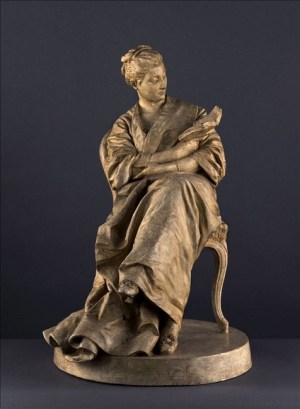
Aimé-Jules Dalou, La Liseuse (Paris: Petit Palais, Musée des Beaux-Arts de la Ville de Paris) © Petit Palais/ Roger-Viollet
À l’occasion de la publication du catalogue raisonné du fonds Dalou conservé au Petit Palais, le Musée Cognacq-Jay accueille une sélection d’œuvres de ce grand sculpteur du XIXe siècle, en les confrontant à ses propres collections du XVIIIe siècle.Trente-cinq terres cuites, plâtres et bronzes, issus des collections du Petit Palais et du musée Carnavalet, sont présentés parmi les collections permanentes. Cette manifestation montre comment un grand artiste républicain du XIXe siècle pouvait puiser son inspiration dans le siècle des Lumières, balançant entre l’exaltation des hauts faits de la Révolution et la nostalgie des grâces de l’art rocaille.
D’une famille parisienne modeste, « communard » en 1871, ce qui lui valut de s’exiler à Londres jusqu’en 1879, le sculpteur Aimé-Jules Dalou (1838-1902) commence sa carrière en France dans les années 1880. Artiste engagé, il eut à cœur de célébrer la République depuis ses origines, c’est-à-dire depuis la Révolution. Sa carrière est jalonnée de monuments ambitieux à la gloire des grands hommes de ce temps, de Mirabeau répondant à Dreux-Brézé le 23 juin 1789, un des épisodes fondateurs de la Révolution, en 1883, au Monument à
Hoche, dernière commande publique passée à l’artiste en 1900.
Pendant son exil à Londres et après son retour à Paris, Dalou a également réalisé de nombreuses œuvres intimistes. Pour celles-ci, il se tourne souvent vers un autre XVIIIe siècle, celui des grâces enfantines, des bacchanales et des intrigues d’alcôves. Ses portraits d’enfants, ses baigneuses et ses groupes mythologiques font écho aux créations de Boucher, Clodion ou Lemoyne.
En parallèle, le Petit Palais, musée des Beaux-arts de la Ville de Paris, présente du 18 avril au 13 juillet Dalou. Le sculpteur de la République, première exposition monographique consacrée à l’artiste. Près de trois cents œuvres seront présentées, en grande partie inédites, provenant de collections publiques et privées en France et à l’étranger.
Exhibition | Plain or Fancy?
Press release (25 February 2013) from The Met:
Plain or Fancy? Restraint and Exuberance in the Decorative Arts
The Metropolitan Museum of Art, New York, 26 February — 18 August 2013
Curated by Luke Syson and Ellenor Alcorn
 The tension in design between austerity and opulence—the simple and the ornate—is a long-standing one. Plain or Fancy? Restraint and Exuberance in the Decorative Arts, on view February 26 through August 18, 2013 at The Metropolitan Museum of Art, invites visitors to consider their own preferences and suggests some of the cultural meanings that have been associated with the two words. The challenge is not to identify quality, or to determine “good taste” versus “bad taste.” Rather the exhibition touches on some historical moments when austerity and flamboyance in design were actively debated. In a departure from a conventional chronological presentation, the show raises a question, encouraging visitors to explore their own reactions. The 40 works of art on view are drawn from the Museum’s holdings of European decorative arts, and include ceramics, metalwork, and works in glass ranging in date from the late 14th to the early 20th century.
The word “fancy” is a shortened form of “fantasy,” which suggests that imagination and exuberance might be seen as prized formal qualities, equally present in a rustic pot and a treasury piece. Fanciness has sometimes been linked to the notion of luxury, and with it, expensive indulgences. In ancient Greece and Rome, costly imported commodities were sometimes seen as a threat to the local economy, and in later centuries condemned as a symptom of an unwelcome social mobility that challenged the existing power structure. But grandeur also had its place in securing the social hierarchy, for example, at the court of Louis XIV. Plainness, by contrast, has tended to be associated with moral virtue and purity.
A century after the Austrian architect Adolf Loos delivered his polemic “Ornament and Crime,” the Modernist aesthetic, which married form with function, remains a dominant influence. But this was not the first time that the merits of ornament had been debated. Court culture in Spain in the 16th century was permeated with the somber gravitas of King Philip II. A contemporary treatise promoting restraint in dress, comportment, and decoration argued: “…a quiet manner is the inevitable mark of a grave and dignified man, ruled by reason rather than by appetite…” These values are expressed in the architecture and metalwork of the period, which is characterized by a distinctive geometric simplicity. Implicit in this taste, which is often referred to as the “Severe Style,” is a rejection of what was seen as the sensuous decadence of Mannerist design.

Coffee and tea service, Sèvres Manufactory. Designer: Hyacinthe Régnier, 1855–61 (New York: The Metropolitan Museum of Art).
Another moment of debate occurred in the 18th century, when the Rococo style was derided by advocates of Neoclassicism. The English artist William Hogarth campaigned for spontaneity and asymmetry, writing in 1753, “Simplicity, without variety, is wholly insipid…” But the same year, the whimsical fantasies of Rococo designers, which were rooted in nature’s capriciousness, were ridiculed as excessive and depraved. The taste for fanciful Chinese subjects was mocked as the “monstrous offspring of wild imagination, undirected by nature and truth.”
Plain or Fancy? points out that aesthetic responses are never neutral. Our judgments have roots in our culture, socioeconomic status, generational values, and aspirations. For some, “plain” is sophisticated, while for others “plain” is dull. The exhibition does not aspire to settle the debate but encourages visitors to consider their own responses to this issue as they experience works of art throughout the Museum. To ask now if people like art “plain” or “fancy” is to ask whether they are aristocrats or revolutionaries, Protestants or Catholics, forward-looking or nostalgic. In looking at works of art, people look at themselves.
The exhibition features an in-gallery and web-based interactive component that encourages visitors to explore, consider, and share their own sensibilities in the decorative arts. Displayed on iPads in the exhibition and as a presentation in MetMedia, it features six works from the installation whose character—whether plain or fancy—can be debated. After viewing the objects, visitors are invited to share their personal opinions in a 120-character tweet (@PlainOrFancy), deciding for themselves whether a work is “plain” or “fancy” and if it suits their personal style.
Plain or Fancy? Restraint and Exuberance in the Decorative Arts is organized by Luke Syson, Iris and B. Gerald Cantor Curator in Charge, and Ellenor Alcorn, Associate Curator, both of the Metropolitan Museum’s Department of European Sculpture and Decorative Arts. Installation design is by Michael Langley, Exhibition Design Manager; graphic design is by Mortimer Lebigre, Graphics Designer; and lighting is by Clint Ross Coller and Richard Lichte, Lighting Design Managers, all of the Metropolitan Museum’s Design Department.
Education programs include exhibition tours and a Friday evening program during which visitors will participate in a multi-sensory exploration of the question of “Plain or Fancy?” through several collection galleries.
◊ ◊ ◊ ◊ ◊
Plain or Fancy? Restraint and Exuberance: A Conversation about Taste
The Metropolitan Museum of Art, New York, 15 May 2013
Wayne Koestenbaum, author, The Queen’s Throat and Humiliation, and Luke Syson, Iris and Gerald B. Cantor Curator in Charge, Department of European Sculpture and Decorative Arts, MMA
The Metropolitan Museum of Art’s exhibition Plain or Fancy? Restraint and Exuberance in the Decorative Arts culls highlights from the Met’s permanent collections to contrast restrained—plain—works of art with richly ornamented—fancy—ones, focusing on those moments in history when pendulum shifts made a sharp swing in one direction or another. Wayne Koestenbaum (The Queen’s Throat, Humiliation), one of today’s most influential and controversial cultural critics, joins Luke Syson, Iris and B. Gerald Cantor Curator in Charge, European Sculpture and Decorative Arts, for a conversation exploring the ways in which stylistic choices may also be moral ones—and how our aesthetic responses are shaped by shame and judgment. Do you like your art “plain” or “fancy”? And what does taste mean, really?
Details for this ticketed event are available here»
Exhibition | Journeys to New Worlds: Spanish and Portuguese Art
Now on at the Philadelphia Museum of Art:
Journeys to New Worlds: Spanish and Portuguese
Colonial Art from the Roberta and Richard Huber Collection
Philadelphia Museum of Art, 16 February — 19 May 2013
Curated by Mark A. Castro and Joseph J. Rishel
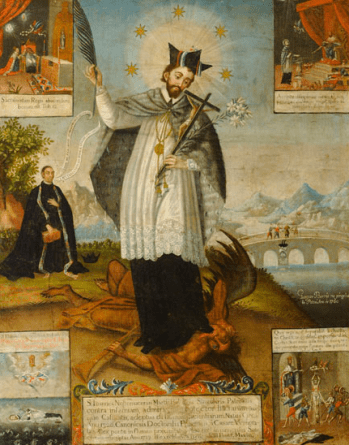
Gaspar Miguel de Berrío, Saint John of Nepomuk, 1760, oil on canvas, 40 x 32 inches (103 x 82 cm)
With a rare group of paintings, decorative arts, and sculptures from the collection of Roberta and Richard Huber, Journeys to New Worlds explores the artistic exchanges between Spain and Portugal and their colonies in the Americas and Asia during the seventeenth and eighteenth centuries. This unique combination of rich visual traditions offers viewers a glimpse into the fascinating history and global influence of Iberian colonial art.
The exhibition includes paintings by Melchor Pérez Holguín (c. 1665–after 1724) and Gaspar Miguel de Berrío (1706–after 1764), two prolific artists from the city of Potosí, Bolivia. Berrío’s Our Lady of Mount Carmel with Bishop Saints of 1764 displays the artist’s ability to present European imagery in a new regional style, emphasizing sumptuous textiles and lush colors. Other paintings on view feature objects of popular devotion, among them the anonymously painted Our Lady of Pomata, which depicts a dressed sculpture of the Virgin Mary housed in a sanctuary on the shores of Lake Titicaca, Peru.

Coquera (Coca Box), Bolivia, first half of the eighteenth century; silver, repoussé, chased and burnished, 9 x 11 x 10 inches (23 x 29 x 26 cm) Roberta and Richard Huber Collection
Potosí sits at the foot of the Cerro Rico (Rich Hill), known for its abundant silver mines, which funded the Spanish empire for many years. The mines also fueled a great metalworking tradition that produced decorative objects for church, public, and domestic use. Among the silver works included in this show are an eighteenth-century coquera (a box used for storing coca leaves) and an elaborately decorated altar plaque.
Sophisticated ivory sculptures created in the Iberian colonies in Asia (the Portuguese colonies of Goa, on the western shores of India, and Ceylon, the modern nation of Sri Lanka; as well as the Spanish-controlled Philippines) are another integral part of the Huber collection. These carved works depict Catholic themes, yet the refined, Asiatic features of the figures show the direct influence of native artistic traditions.
Roberta and Richard Huber began collecting in the 1970s, when the study of Iberian colonial art was in its infancy in the United States. They have purchased works over the years based on their own changing interests, enjoying the thrill of discovering new objects as much as the works themselves. Embodying the passionate interests of two individuals, their collection is one of a handful focused on this material in the country. Journeys to New Worlds celebrates their enthusiasm and reflects the Philadelphia Museum of Art’s continuing commitment to promoting the arts of Latin America.
The exhibition is generously supported by The Annenberg Foundation Fund for Exhibitions, the Arlin and Neysa Adams Endowment, Paul K. Kania, and Mr. and Mrs. Reinaldo Herrera. The catalogue is made possible by The Andrew W. Mellon Fund for Scholarly Publications at the Philadelphia Museum of Art and by Furthermore: a program of the J.M. Kaplan Fund.
Curated by Mark A. Castro, Exhibition Coordinator, and Joseph J. Rishel, The Gisela and Dennis Alter Senior Curator of European Painting before 1900, and Senior Curator of the John G. Johnson Collection and the Rodin Museum.
◊ ◊ ◊ ◊ ◊
From Yale UP:
Edited by Suzanne L. Stratton-Pruitt, with Mark A. Castro, Journeys to New Worlds: Spanish and Portuguese Colonial Art in the Roberta and Richard Huber Collection (New Haven: Yale University Press, 2013), 204 pages, ISBN: 978-0300191769, $60.
Contributions by Luisa Elena Alcalá, David L. Barquist, Mark A. Castro, Margarita M. Estella Marcos, Enrique Quispe Cueva, Joseph J. Rishel, Jorge F. Rivas P., and Suzanne L. Stratton-Pruitt
 This beautifully illustrated catalogue showcases 120 Spanish and Portuguese artworks from the seventeenth and eighteenth centuries, all highlights from the dazzling collection of Roberta and Richard Huber. Featuring works in a variety of mediums and from far-flung places, including paintings, silver, and furniture from South America and sculptures in ivory from the Spanish Philippines and from Portuguese territories in India. Distinguished experts shed light on these significant objects, many of which have not been previously published and which illustrate the unparalleled artistic exchanges between and within these colonial empires. The Andean painters Melchor Pérez Holguín and Gaspar Miguel de Berrío inventively interpreted European iconographies, while similar adaptations took place in Asia, where native craftsmen, carved Christian images in ivory. These works traveled along the trade routes connecting Europe to Asia and the Americas, thus influencing the development of a new visual culture.
Suzanne L. Stratton-Pruitt is an independent scholar specializing in Spanish and Spanish colonial art. Mark A. Castro is an Exhibition Coordinator at the Philadelphia Museum of Art.
Exhibition | The Path of Nature: French Paintings, 1785-1850
From The Met:
The Path of Nature: French Paintings from the Wheelock Whitney Collection, 1785–1850
The Metropolitan Museum of Art, New York, 22 January — 21 April 2013
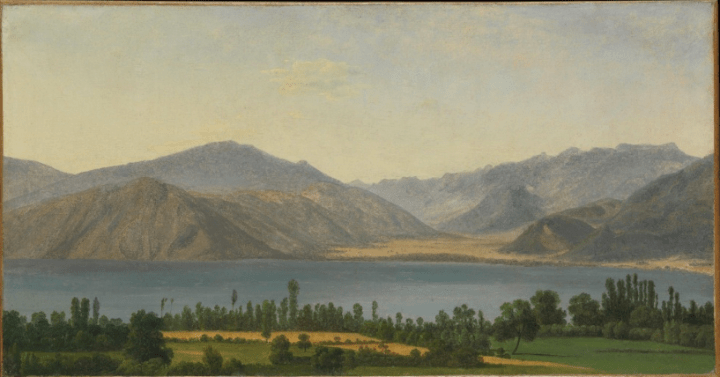
Joseph Bidauld, Lake Fucino and the Abruzzi
Mountains, 10 x 19 inches, ca. 1789 (NY: Met)
◊ ◊ ◊ ◊ ◊
In 2003 the Metropolitan Museum acquired a significant group of paintings spanning a key period in European history, beginning with the advent of the French Revolution and concluding with the reign of Louis-Philippe. Assembled by the New York connoisseur Wheelock Whitney between 1972 and 2000, this collection reveals a rich tradition of painting out of doors nearly a century before Impressionism, thus amplifying the role of the natural world as a source of inspiration to artists on the cusp of the modern epoch. This exhibition of fifty paintings is the first to be devoted entirely to the Whitney collection and includes examples by numerous painters who are thought to be represented in no other American museum.
 The Whitney collection is remarkable for its concentration of plein-air oil studies by artists ranging from Pierre-Henri de Valenciennes to Camille Corot. This is complemented by a strong representation of finished landscapes, history subjects, genre, and portraiture: in short, the full scope of painting that one could expect to find in a Parisian cabinet d’amateur, or private collection, in the first half of the nineteenth century. Crossing the boundaries of subject matter and lying at the heart of the collection is a group of paintings executed by northern artists drawn to Rome by its combination of antiquity and natural beauty. A number of these painters received from the Académie des Beaux-Arts, Paris, the Rome Prize to study painting in Italy, for example, François-Édouard Picot, Léon Pallière, Charles Rémond, and André Giroux. Others traveled there independently, such as Joseph Bidauld, Simon Denis, François-Marius Granet, and Théodore Caruelle Aligny. The exhibition also illuminates one of the most popular developments in French painting during the 1820s, the depiction of Italian peasants, brigands, and clerics, by such representative figures as Claude Bonnefond, Jean-François Montessuy, and Louis-Léopold Robert.
Exhibition | Piranesi’s Paestum: Master Drawings Uncovered
Press release for the exhibition Piranesi’s Paestum, now on at the Soane Museum:
Piranesi’s Paestum: Master Drawings Uncovered
Sir John Soane’s Museum, London, 15 February — 18 May 2013
Tchoban Foundation, Museum for Architectural Drawing, Berlin, 1 June – 31 August 2013
The Morgan Library and Museum, New York, 23 January – 17 May 2015
Curated by Jerzy Kierkuć-Bieliński
 An exhibition of Giovanni Battista Piranesi’s last great graphic project, the highly finished Paestum drawings, is now on view at Sir John Soane’s Museum, London, deepening understanding of the graphic artist whose work has influenced designers from Escher to the makers of the Harry Potter films, and shedding new light on the considerable impact of his work on 18th-century architectural taste. For the very first time since Piranesi’s death, all seventeen drawings will be shown together, uniting the fifteen drawings from Sir John Soane’s Collection with those from the collections of the Bibliothèque nationale de France, Paris, and Amsterdam’s Rijksmuseum. The Paestum drawings were the preparatory work for Piranesi’s Différentes Vues de Pesto finished by his son Francesco and published posthumously in 1778. They depict views of the three great Doric temples in the former Greek colony of Poseidonia, colonised by the Romans and re-named Paestum.
Left abandoned, and later cut off by a malarial swamp, the ruins of the colony were rediscovered in 1746 during the construction of a new road. Its massive and well-preserved Doric temples dedicated to Poseidon, Hera and Athena sparked renewed interest among artists and architects including the celebrated Giovanni Battista Piranesi and inspired drawings, prints, paintings and models which revolutionised understanding of early Greek Classical architecture.
As well as exploring Piranesi’s complex perspectives, the Master Drawings Uncovered exhibition will examine Soane’s relationship with the artist, architect and antiquarian and the influence that visiting Paestum and experiencing Piranesi’s work had on his architecture and teaching. Those wishing to explore Piranesi’s techniques for themselves, will also be able to participate in an evening course and a range of Piranesi-inspired workshops, running alongside the exhibition.

The Paestum drawings are highly unusual in Piranesi’s portfolio. Although the artist usually made preparatory drawings for his famous etchings, much of the composition was often worked directly on to the copper plate at the engraving stage. These drawings contain a level of detail very close to the finished prints, and it is thought that perhaps, aware of his failing health, Piranesi included as much detail as possible for his son Francesco to finish the work he had begun. He uses the full repertoire of his draughtsmanship to create images that both accurately describe the architecture of the Paestum temples and bring out their evocative, rustic setting. Multi-layering of pencil, brown and grey washes and pen and ink, sometimes with the addition of red chalk or white chalk highlights, creates a layered effect which can be compared to the repeated bitings in the resulting etchings. The rough paper used by Piranesi is analogous with the travertine used to construct the temples – echoing its pitted and eroded texture. He also uses the scena per angolo – a feature of Ferdinando Bibiena’s theatrical scenery designs – to give a unique perspective to the drawings; replacing the traditional, central vanishing point with diagonal axes to heighten the three-dimensionality of the temples and add to their dramatic impact.
The Paestum drawings in the Soane collection were purchased by Sir John Soane at auction in March 1817 for £14.5.0, as part of a sale by antiquarian Charles Lambert. It is not known how they came to be in his collection. Dr Jerzy Kierkuć-Bieliński, curator of Master Drawings Uncovered, looks forward to welcoming visitors to a significant exhibition of Piranesi’s work: “We’re delighted to be able to present a focused exhibition which celebrates the impeccable quality and influence of a small selection of drawings. Although six of the Soane drawings have been exhibited in the Die Graber von Paestum exhibition (2007–08) in Hamburg and Berlin, they have never been viewed by the public un-framed, and no exhibition has ever been devoted to their display as a discrete grouping. The fifteen drawings in Soane’s collection have been displayed in the Picture Room of No.13 Lincoln’s Inn Fields, but their position, in Soane’s ingenious picture planes, has not allowed close scrutiny. We hope that the conservation and academic research resulting from the exposure of the drawings will throw considerable light on their history and the architectural legacy left by Giovanni Battista Piranesi.”
Images courtesy of the Trustees of Sir John Soane’s Museum
Top: Exterior of the Temple of Neptune from the North-East
Bottom: Interior of the Temple of Neptune from the West
◊ ◊ ◊ ◊ ◊
From the Soane Museum’s shop:
John Wilton-Ely, Piranesi, Paestum, & Soane (London: Prestel, 2013), 112 pages, ISBN: 978-3791348063, £25.
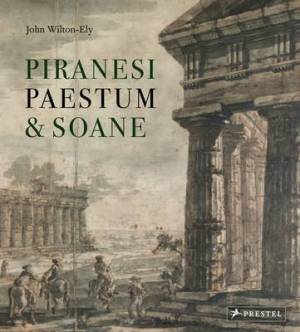 To celebrate the launch of our exhibition Piranesi’s Paestum: Master Drawings Uncovered, the Soane is proud to bring you the accompanying exhibition book, Piranesi Paestum & Soane, beautifully produced in hardback with full colour pictures and illustrations. This newly reprinted and updated book by John Wilton-Ely [the first edition of which appeared in 2002] examines Soane’s extensive collection of Piranesi’s work which Soane incorporated into his theatrical displays at his Lincoln’s Inn home, connecting Piranesi’s own dramatic visions of Paestum with his revivalist architectural practice.
Architect and printmaker, Giovanni Battista Piranesi was a lifelong champion of Rome, publishing more than 1000 etchings of the Eternal City and it’s ancient monuments. When Sir John Soane and Piranesi met they formed a profound and complex, creative and intellectual relationship that nurtured Soane’s later career. Among Soane’s greatest legacies are the preparatory drawings Piranesi developed for a publication on the Greek temples at Paestum.
Exhibition | Beauty and Revolution: Neoclassicism 1770-1820

Press release from the Städel Museum:
Beauty and Revolution: Neoclassicism 1770-1820
Städel Museum, Frankfurt, 20 February — 26 May 2013
Curated by Eva Mongi-Vollmer and Maraike Bücklingy
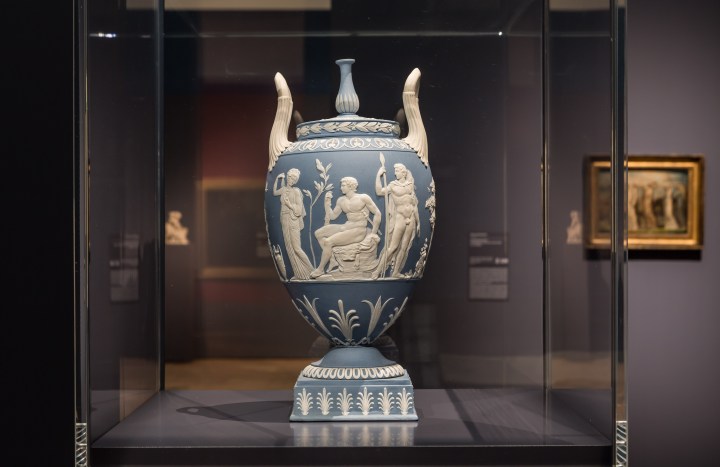
A comprehensive special exhibition presented by Frankfurt’s Städel Museum from 20 February to 26 May 2013 will highlight the art of Neoclassicism and the impulses it provided for Romanticism. Developed in collaboration with the Liebieghaus Skulpturensammlung, the show Beauty and Revolution will assemble about one hundred works of the period from 1770 to 1820 by such artists as Anton Raphael Mengs, Thomas Banks, Antonio Canova, Jacques-Louis David, Bertel Thorvaldsen, Johann Gottfried Schadow, and Jean-August-Dominique Ingres. The major survey, whose range also comprises a number of impressive examples of ‘Romantic Neoclassicism’, will be the first in Germany to convey an idea of the variety of the different and sometimes even contradictory facets of this style.
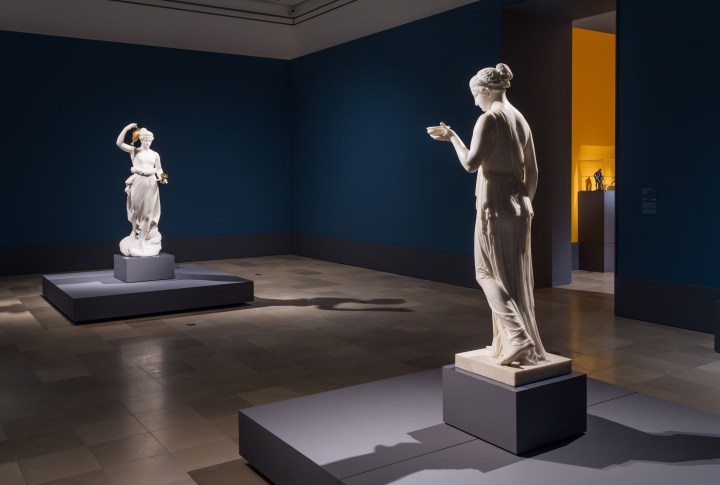 Based on significant sculptures, paintings, and prints from collections in many countries, the exhibition will explore the decisive influence of classical antiquity on the artists of the era. Struggling for a socially relevant art, the artists directed their attention to the aesthetics of Greek and Roman art as well as to their virtues and moral standards conveyed by history and mythology. It will become evident how the viewer could be addressed in many different ways. Two famous marble sculptures of the Greek goddess Hebe, for example, will be confronted with each other in Frankfurt for the first time: a variant by Antonio Canova (1796, The State Hermitage Museum, Saint Petersburg) and another by Bertel Thorvaldsen (designed in 1806, Thorvaldsens Museum, Copenhagen). The two masterpieces have again and again been compared and judged, yet never exhibited together since their creation.
Assembling a wide range of works from Gavin Hamilton’s and Henry Fuseli’s innovative solutions to central works by Antonio Canova and Jacques-Louis David as well as Bertel Thorvaldsen’s masterpieces of ‘Romantic Neoclassicism’, the Städel Museum’s major spring exhibition offers an extensive survey of Neoclassicist art and demonstrates the unexpected vitality of an era often classified as static.
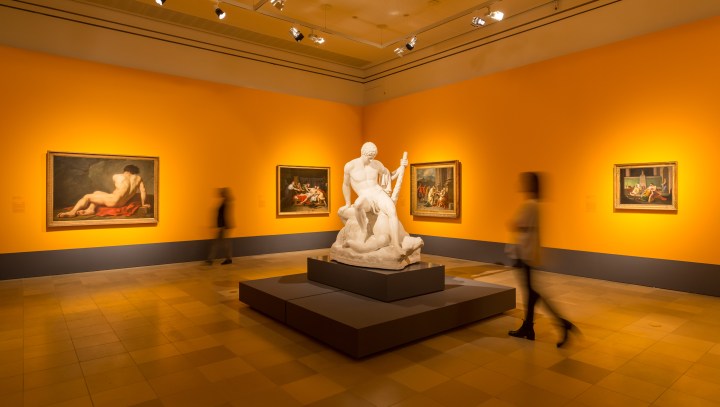 The various aspects of Neoclassicism will be explored along three lines in the Städel’s exhibition. Disregarding a few exceptions, the selection of numerous loans focuses on the production of art in the city of Rome that was considered the first address for studying the ancient world by many artists, writers, and theorists around 1800 and became a center of the art world of that time. The second emphasis of the show is on representations of historical and mythological scenes. In search of a model for moral standards of behavior, the artists fathomed the core of what features as human in the ancient world’s myths, which they read as poetry without religious implications. Jacques-Louis David’s painting The Oath of the Horatii, for example – of which an oil sketch from the holdings of the Louvre in Paris will be presented in the exhibition – upholds a timelessly valid moral code, yet also relates to current political events. The show exemplifies how contemporary motifs increasingly found their way into the range of themes dealt with by Neoclassicist art. The third chapter explores an issue connected with this development, namely how feelings and passions were depicted in Neoclassicist works of art. Artists like Canova or David rendered emotions and pathos in a way unfamiliar to their contemporaries, a way which manifested itself mainly in their figures’ body language. Contrary to the Baroque era, it was not the representation of affectations that artists were primarily concerned with any longer, but internalized emotions in which the viewer was to immerse himself. The artists also clearly detached themselves from the pathos of the ancient world in this way: Canova’s sculpture Theseus and the Minotaur (1783, Museo e Gipsoteca Antonio Canova, Possagno), for example, primarily deals with the aspect of reflection after Theseus’s victory and the hero’s moral consciousness.
Extending across the Städel’s entire Exhibition House, the generously conceived special exhibition begins with the imposing confrontation of the two famous representations of the goddess Hebe by Antonio Canova (1800–05) and Bertel Thorvaldsen (1815–23) on the ground floor. The difference between Canova’s cupbearer hurrying near on a cloud and involved in what is going on and Thorvaldsen’s introverted musing female illustrates the whole stylistic range of Neoclassicist art at the very beginning. Picking up the thread of this confrontation, the presentation in the large ground floor hall impressively visualizes the turbulent development of Neoclassicism until about 1870. The tour starts with a selection of plaster cast and bronze reproductions of antique sculptures dating from the late eighteenth and early nineteenth centuries; these reproductions particularly illustrate the canon of classical antiquity emphasized by the archaeologist and art historian Johann Joachim Winckelmann (1717–68). Artists staying in Rome initially incorporated these famous reproductions into their works as directly as possible. In those years, the return to the ancient world frequently implied a criticism of contemporary systems of rule, especially of the courtly and ecclesiastical formal language of the Baroque age. Anton Raphael Mengs’s appropriation of classical antiquity was of such an extreme degree that the artist was even able to deceive Winckelmann who described Mengs’s fresco Jupiter Kissing Ganymede (1758–59, Galleria Nazionale d’Arte Antica, Palazzo Barberini, Rome) as an original of classical antiquity in one of his writings.
The following section comprises the rebellious works of a group of artists who also lived in Rome for some time, yet felt not inclined to follow Winckelmann’s credo of “noble simplicity and quiet grandeur” – though they too thoroughly studied the antique models. They aimed at capturing the viewer’s attention by dramatizing their subjects, even if this meant putting up with exaggeration and distortion. The English sculptor Thomas Banks (1735–1805) – see his The Falling Titan (1786, Royal Academy of Arts, London) – was one this group’s artists as was the Swiss-born Henry Fuseli (1741–1825), whose Achilles Sacrificing his Hair on the Funeral Pyre of Patroclus (1800–05) from the Kunsthaus in Zurich is included in the exhibition.
The shown works by Antonio Canova (1757–1822) and Jacques-Louis David (1748–1825) and his pupils then ushered in a definitely calmer approach to the motifs rendered. They are characterized by formal austerity and a deliberately pointed dramatic composition. However, both the sculptor Canova and the painter David relied on completely new pictorial and iconographic means for drawing on antique subjects and attitudes – means that were to inform subsequent generations of artists all over Europe.
The presentation on the second floor of the Exhibition House highlights how the new iconography developed not least in response to the political context of the time and particularly the French Revolution. Jacques-Louis David immortalized the dead Marat as the revolution’s first martyr, for example: the exhibition comprises a version by David and his workshop (Musée national des châteaux de Versailles et de Trianon, Versailles) as well as by Joseph Roques (1793, Musée des Augustins, Toulouse).
The works in the following room strikingly illustrate that the young art also held a revolutionary potential in terms of form: the sophisticatedly simplified scenes visualized by the sculptor John Flaxman (1755–1826) in his drawings and engravings, for example, are based on an astounding abstraction. Their reduction to mere contours was to create a furore all over Europe.
The adjacent room sheds light on the slow, yet far-reaching change in the artists’ attitude toward the ancient world that occurred around 1800. The unreachability of its ideal made itself felt with increasing weight. This implied a growing abandonment of its norms on the part of the artists, whereas the viewer was granted more leeway for interpretation. The protagonist’s internalization also came to play a more important role in what was going on in the picture. Consequently, masterpieces such as Bertel Thorvaldsen’s Ganymede (1819–21, Thorvaldsens Museum, Copenhagen) are categorized as works of ‘Romantic Neoclassicism’ today.
The various tendencies brought forth by Neoclassicism within the first decades after 1800 become increasingly clear in the last room of the exhibition. In spite of all discrepancies between the various artists’ decisions, they shared a common denominator in looking for new ways to leave Neoclassicism behind. The idea of the ancient world was regarded with increasing detachment, unconventionally transformed, and largely ignored by more and more nineteenth-century artists. All in all, the exhibition unfolds the age of Neoclassicism as a surprisingly manifold and lively stylistic epoch whose unconditional desire for renewal and improvement became a breeding ground for Romanticism in its return to classical antiquity.
Exhibition photos by Norbert Miguletz
◊ ◊ ◊ ◊ ◊

Maraike Bückling and Eva Mongi-Vollmer, eds., Schönheit & Revolution: Klassizismus 1770-1820 (Munich: Hirmer, 2013), 392 pages, ISBN: 978-3777470115, €40 / $85. — available from Artbooks.com.
A comprehensive catalogue edited by Maraike Bückling and Eva Mongi-Vollmer will be published by Hirmer to accompany the exhibition. It will include contributions by Sergej Androsov, David Bindman, Maraike Bückling, Werner Busch, Christian M. Geyer, Alexander Kaczmarczyk, Thomas Kirchner, Eva Mongi-Vollmer, Johannes Myssok, and Marjorie Trusted. German.
Exhibition | Italian Soup Tureens
Notice of this exhibition at the Hotel Villa Zuccari slipped by me last year, but I see that the catalogue is available from artbooks.com. Eighteenth-century pieces are the minority, but February has me thinking about soup! -CH
◊ ◊ ◊ ◊ ◊
From Good Morning Umbria:
Le Zuppiere dal XVIII al XX Secolo: Collezione Paolo Zuccari
Villa Zuccari, San Luca di Montefalco (Perugia), 22 June — 30 September 2012
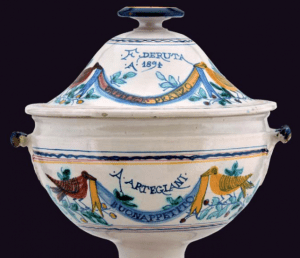 Negli ultimi anni il collezionismo privato ha avuto un notevole sviluppo e gioca un ruolo importante nella nostra cultura e società, in quanto consente di salvaguardare beni di valore artistico, storico e culturale. E’ proprio questo il caso della Collezione di zuppiere di Paolo Zuccari che annovera oltre 500 esemplari alcuni dei quali sono pezzi della fine del ‘700 ed altri –il nucleo principale- dell’800 e del ‘900 di provenienza tutta italiana, dalla Lombardia, all’Emilia Romagna, dalla Toscana all’Umbria alle Marche , agli Abruzzi, dalla Campania al Molise ed alla Puglia. Collezione questa molto originale se si pensa che il collezionista , dopo aver trasformato la sua residenza in un relais a quattro stelle, si è dedicato alla catalogazione di questa sua passione. “Tutti mi chiedono perché, come e quando ho iniziato a collezionare zuppiere.” afferma Paolo Zuccari. “La risposta è semplice, dopo aver vissuto per trenta anni in questa casa, ora Hotel Villa Zuccari, dopo aver sposato Daniela ed avere avuto la prima figlia Federica, ho deciso di andare a vivere a Spoleto dove è nata Lorenza. In occasione di tale trasferimento, per la verità un po’ sofferto, ho portato con me solo poche cose e pochi ricordi della mia casa natale, ma fra queste poche cose c’erano alcune zuppiere. Da queste prime zuppiere, forse per nostalgia, è iniziato il desiderio o la mania di comperarne altre e via via ho iniziato a collezionarle” . Ce ne sono di bellissime e di particolarissime, per esempio la zuppiera realizzata nel 1894 da Angelo Artegiani di Deruta, in cui si legge un cartiglio con l’iscrizione “Buon Appetito” , sicuramente eseguita per qualche ricorrenza speciale. (more…)
Exhibition | Antoine Watteau: The Music Lesson
From the exhibition press materials:
Antoine Watteau (1684–1721): The Music Lesson
BOZAR (Palais des Beaux-Arts), Brussels, 8 February — 12 May 2013
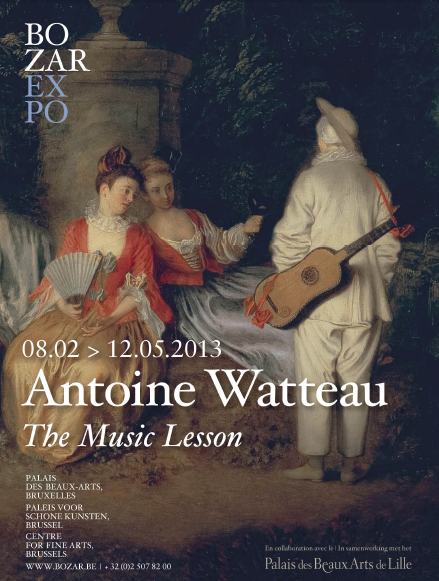 BOZAR EXPO presents, in cooperation with the Palais des Beaux-Arts de Lille, a major interdisciplinary project consisting of an ambitious exhibition, various concerts and debates, devoted to a great French master of the early 18th century, Antoine Watteau, with a particular focus on the musical scenes frequently depicted in the painter’s work. The exhibition’s general curator, the renowned orchestral conductor William Christie, is also at the heart of a cycle of eight concerts that will evoke the sensual atmosphere of Watteau’s canvases.
In the spring of 2013 BOZAR is presenting the first exhibition in Belgium to be devoted to Antoine Watteau (1684–1721). This not only offers an opportunity to see a number of his works; moreover, it sets his pictures to music; it also highlights the correspondence between the arts that was at the heart of his work as an artist. Almost a third of Watteau’s works feature musicians. Born to a humble family, he was a short-lived star of French 18th-century painting, dying at the early age of 37. Despite his short life and limited oeuvre, Watteau’s elegance and
genius left their mark on European art.
Antoine Watteau, father of the fêtes galantes
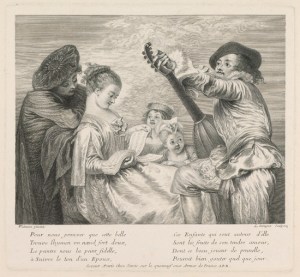
Louis Surugue after Antoine Watteau, The Music Lesson, etching. © Bibliothèque nationale de France
Little is known about his years of training in his native Valenciennes, a town that was open to both Flemish and French influences, as it only became attached to France in 1678. We can, however, be sure of the importance of his master, Claude Gillot (1673–1722). It was through him that Watteau, the “fils du Nord,” discovered Italian painting and the Commedia dell’Arte, which meant so much to him, even though he would never make the journey to Italy.
Watteau passed the bulk of his career in Paris, towards the end of the reign of the Sun King and during the Regency, a period in which the French capital experienced an aesthetic ferment and a renewed commercial enthusiasm for art. It was in that context that, in the 1720s, Watteau became a protégé of Pierre Crozat (1661–1740), one of his great patrons. Crozat helped to bring into being a musical circle in which both Italian and French music were acclaimed. His collection also helped Watteau to find himself as an artist, as he enthusiastically copied drawings it contained by Flemish and Venetian masters (Rubens, Van Dyck, Titian, and Campagnola). Their attention to colour, movement, and sensuality fascinated the young artist, who drew on those qualities to create a new style, less grandiloquent and less formal, imbued with a feigned lightness and an unprecedented elegance.
So there is nothing fortuitous about the presence of other disciplines – theatre, dance, and music, in particular – in Watteau’s paintings. They are very much present in the figures depicted in the fêtes galantes, whose language he invented: scenes of intimacy, conversation, and music set in an enclosed natural setting in which the human condition plays with appearances. Are we looking at aristocrats who have put on the costumes of actors or at theatrical scenes reconstructed in a bucolic setting? Watteau explores, as no one had done before him, a free combination of theatrical characters, whom he places away from the stage, somewhere between life and playing a role. Music is never far away in these fêtes galantes. The titles of works such as La Leçon de musique, Le Concert amoureux, and L’Accord parfait are highly evocative in this context.

Antoine Watteau, L’Enchanteur Huile sur cuivre (Troyes: Musée
des Beaux-Arts) © RMN-Grand Palais – © Jean Schormans
Antoine Watteau (1684–1721): The Music Lesson
The exhibition, which has a particular focus on the musical aspect of Watteau’s painting, brings together a unique selection of fifteen of the artist’s canvases and thirty of his drawings, some of which have not been seen by the European public for more than 50 years. It also presents fifty engravings by his contemporaries, including François Boucher, Benoît Audran II, and Charles-Nicolas Cochin, who produced the finest engravings of the 18th century and spread Watteau’s art throughout Europe. Thanks to them, we have reproductions of paintings of his that have since been lost and it is possible to offer an almost complete overview of his work. This unprecedented combination of original paintings, drawings, and engravings, as well as archival material, scores, and musical instruments of the same period, is a first. The exhibition itinerary is organised chronologically and thematically. The visitor first discovers the silent dimension of Watteau’s art and is thus better placed to appreciate its various musical tones later in the exhibition. The aesthetic experience is heightened as the visitor is immersed in the music of the time thanks to the audioguides and several listening points throughout the exhibition circuit. A special room is set aside for free concerts given by students of various Belgian and French conservatories on Thursday evenings. The intervention by Dirk Braeckman, leading Belgian photographer with an international reputation, establishes connections between Watteau’s work and contemporary art.
For additional information, including lenders, room texts, and programming details, see the 28-page press booklet (PDF).
◊ ◊ ◊ ◊ ◊
Note (added 20 March 2013): The catalogue is available through Artbooks.com:
Florence Raymond, ed., Antoine Watteau (1684-1721): La leçon de musique (Paris: Skira Flammarion, 2013), 272 pages, ISBN: 978-2081295834, $87.50.










 Enfilade
leave a comment