Exhibition | Canaletto: The Venetian Notebook
Thanks to Stacey Sloboda for noting this one that almost slipped by me (a brief English description is available here). From the Palazzo Grimani:
Canaletto: Il Quaderno Veneziano
Palazzo Grimani, Venice, 1 April — 1 July 2012
Curated by Annalisa Perissa Torrini
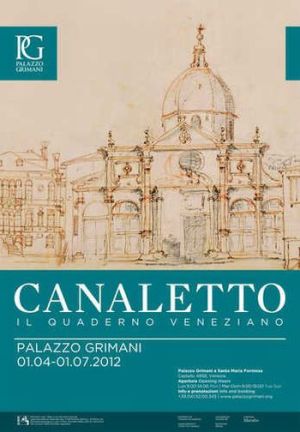 Apre a Venezia il 1 aprile, nella cornice straordinaria delle sale di Palazzo Grimani, la mostra Canaletto. Il Quaderno veneziano dedicata al celebre Quaderno di schizzi di Canaletto, un unicum nella storia dell’arte del Settecento, codice mai visibile al pubblico, ora presentato assieme a ventiquattro disegni di antica provenienza veneziana, appartenenti a collezioni pubbliche e private, per la prima volta insieme.
Il progetto espositivo è a cura del Direttore del Gabinetto dei Disegni delle Gallerie dell’Accademia, Annalisa Perissa Torrini, programmato nell’ambito della valorizzazione del fondo grafico, promosso dalla Soprintendenza Speciale per il Patrimonio storico, artistico ed etnoantropologico e per il Polo Museale della città di Venezia e dei comuni della Gronda lagunare e prodotto da Venezia Accademia con il contributo di Save Venice Inc.
La mostra indaga il modus operandi dell’artista, definendone la concreta operatività nella fase di costruzione grafica e stabilisce il ruolo svolto dalla camera ottica nell’ideazione e realizzazione delle vedute di Venezia.
Il Quaderno di Canaletto è un prezioso piccolo volume (mm 175×235) formato da 7 fascicoli, rilegati nell’Ottocento, ma in origine sciolti, ricolmo di schizzi realizzati probabilmente in un breve arco di tempo, poi riutilizzato dal pittore veneziano negli anni. Ogni fascicolo racconta il processo creativo del suo lavoro: le tipiche annotazioni sui colori, sui materiali e sui luoghi ritratti, le correzioni e abrasioni, i cambi di inchiostro e di penna, lo sporadico uso del righello e l’impiego della punta metallica, la cui presenza è stata osservata nel corso degli studi e delle analisi delle tecniche e della carta.
Insieme al Quaderno, vengono esposti otto fogli, tra cui il cosiddetto “scarabotto” con il Canal Grande di fronte alla Salute e il Traghetto di San Moisé, della raccolta delle Gallerie, sette fogli della Galleria Nazionale d’Arte Antica di Trieste, sette fogli poco noti di collezione privata italiana di provenienza Corniani-Algarotti, il foglio della Fondazione Cini e quello del Museo Correr di Venezia. Importanti dipinti di collezioni pubbliche e private mostreranno poi la realizzazione pittorica di alcuni disegni esposti in mostra: capolavori delle Gallerie dell’Accademia, di Ca’ Rezzonico, degli Uffizi, di Castello Sforzesco e di importanti collezioni private italiane, mentre alcune incisioni, di Visentini e Smith, documentano l’importanza delle stampe sia nell’iter creativo dell’artista, che nella diffusione della sua opera.
In occasione della mostra verrà pubblicato un fac-simile del Quaderno di Canaletto, edito da Marsilio Editori, accompagnato da un saggio storico interpretativo di Annalisa Perissa Torrini e seguito da uno studio sulla fascicolazione e rilegatura condotto da Barbara Biciocchi, da un testo sulla camera ottica a cura di Dario Maran, e documenti sulla vita di Canaletto trovati da Alessandra Schiavon all’Archivio di Stato di Venezia.
Il progetto di allestimento, curato da Annunziata Genchi, comprende supporti audiovisivi e multimediali didattici, fra i quali una riproduzione digitale del Quaderno, realizzata da Mauro Tarantino, che permetterà al visitatore di sfogliare virtualmente tutte le pagine del prezioso codice, mentre diversi filmati illustreranno l’utilizzo e le finalità della camera ottica, i modi di fascicolazione del volume e le tecniche grafiche di esecuzione, un filmato in 3D con il confronto tra i disegni e i dipinti ed un altro sul funzionamento della camera ottica. Un modello funzionante di camera ottica, inoltre, è stato realizzato in collaborazione con il Musée Maillol di Parigi, dove il visitatore potrà guardare le “vedute” come faceva lo stesso Canaletto.
◊ ◊ ◊ ◊ ◊
From Marsilio:
Annalisa Perissa Torrini, ed., Canaletto. Il Quaderno veneziano (Marsilio, 2012), 236 pages, ISBN: 9788831713009, €33.
 In occasione della mostra Canaletto. Il Quaderno veneziano, in programma a Venezia nella splendida cornice di Palazzo Grimani dall’1 aprile all’1 luglio, verrà pubblicato un fac-simile dell’affascinante manufatto, un unicum nella storia dell’arte del Settecento, solitamente non visibile al pubblico. Il prezioso volume formato da sette fascicoli, rilegati nell’Ottocento ma in origine sciolti, ricolmo di schizzi realizzati probabilmente in un breve arco di tempo, venne riutilizzato negli anni da Canaletto come strumento di lavoro. Ogni fascicolo racconta l’operare del maestro veneziano: racchiude le tipiche annotazioni sui colori, sui materiali e sui luoghi raffigurati, le correzioni e le abrasioni, i cambi di inchiostro e di penna, tutte quelle tracce che rappresentano la sua memoria grafica, la registrazione di dati veri, oggettivi, esatti da interpretare e rielaborare nella fase creativa della composizione della veduta. In apparato al fac-simile saranno inseriti, oltre agli interessanti risultati delle recenti analisi sulle cosiddette informazioni “nascoste” – non visibili a occhio nudo – e su fascicolazione e rilegatura dell’opera, anche un saggio storico interpretativo di Annalisa Perissa e un testo di Dario Maran che stabilisce il ruolo svolto dalla camera ottica nell’ideazione e realizzazione delle vedute di Venezia.
◊ ◊ ◊ ◊ ◊
Exhibition | Expanding Horizons: Lusieri and the Panoramic Landscape
From the National Galleries of Scotland, as noted by Hélène Bremer:
Expanding Horizons: Giovanni Battista Lusieri and the Panoramic Landscape
Scottish National Gallery, Edinburgh, 30 June — 28 October 2012
Curated by Aidan Weston-Lewis

Giovanni Battista Lusieri, The Monument to Philopappos, Athens, ca. 1805-07
Giovanni Battista Lusieri (1754–1821) was hailed during his lifetime as one of the most gifted of all living landscape artists and his exquisitely crafted works were eagerly sought by collectors. But within a few years of his death his reputation descended into an obscurity from which it has only recently begun to re-emerge. His name will still be unfamiliar to all but a few specialists, a neglect which this exhibition, the first ever devoted to the artist, aims to redress.
Lusieri was one of very few Italian artists to have adopted watercolour as their favoured medium. From the outset his work exhibits the meticulous detail, precision and faultless perspective that remained the hallmarks of his style throughout his career, combined with a panoramic breadth of vision and an astonishing ability to render brilliant effects of light. The latter part of Lusieri’s career was spent mainly in Athens as Lord Elgin’s resident artist and agent. In that capacity he was closely involved in supervising the removal and shipping of the celebrated marbles from the Acropolis, now in the British Museum.
◊ ◊ ◊ ◊ ◊
Catalogue: Aidan Weston-Lewis with Fabrizia Spirito, Kim Sloan, and Dyfri Williams, Giovanni Battista Lusieri and the Panoramic Landscape: Expanding Horizons (Edinburgh: National Galleries of Scotland, 2012), 236 pages, ISBN: 9781906270469, £25 / $63 — available from Artbooks.com in August
 This is the first publication in English devoted to the extraordinary work of the Italian landscape watercolourist Giovanni Battista Lusieri (1754-1821). His career took him from his native Rome to Naples, then to Sicily and finally to the eastern Mediterranean, where he spent twenty years in the service of the 7th Earl of Elgin as his resident artist and agent in Athens. In that capacity he was closely involved in the removal of the celebrated marbles from the Parthenon and other monuments in Greece. Lusieri’s watercolours combine a broad, panoramic vision, an uncanny ability to capture brilliant Mediterranean light and a meticulous, almost photographic attention to detail. He was widely acclaimed as one of the most accomplished landscape artists of his day, and his works were eagerly sought by British Grand Tourists, but after his death he was soon forgotten, and only recently have his exceptional gifts begun to be recognised once again.
Contents
Foreword
Acknowledgements
Aidan Weston-Lewis — ‘The most exact and eloquent transcriptions of nature I ever saw’: Giovanni Battista Lusieri, Life, and Work
Fabrizia Spirito — Lusieri and his Contemporaries | Drawing on the Spot around Rome and Naples
Aidan Weston-Lewis — Rome | An Early Patron: Philip Yorke; entries 1-13
Kim Sloan — Naples | ‘Naples, where the landscape painter is most truly in his element’; entries 14-59
Fabrizia Spirito — Sicily | Lusieri in Sicily; entries 60-66
Dyfri Williams — Greece | Lusieri in the Eastern Mediterranean, 1800-1821; entries 67-92
Bibliography
Notes and References
◊ ◊ ◊ ◊ ◊
Aidan Weston-Lewis is Chief Curator at the Scottish National Gallery with responsibility for the Italian and Spanish collections. He has organised numerous exhibitions at the Gallery and been closely involved with many major acquisitions. He has a particular interest in north Italian painting and drawing of the sixteenth and seventeenth centuries and has published widely in this area.
Exhibition | Napoleon: Revolution to Empire
Press release from the NGV:
Napoleon: Revolution to Empire
National Gallery of Victoria, Melbourne, 2 June — 7 October 2012
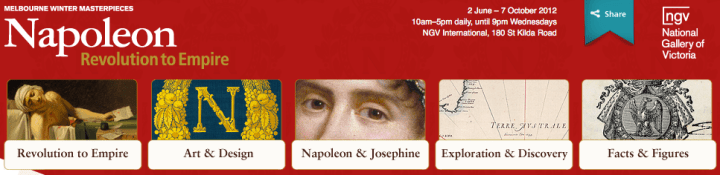
On 2 June 2012 the National Gallery of Victoria will opened this year’s spectacular Melbourne Winter Masterpieces exhibition, Napoleon: Revolution to Empire, examining French art, culture, and life from the 1770s to the 1820s. Its story runs from the first French voyages of discovery to Australia during the reign of Louis XV to the end of Napoleon’s transforming leadership as first Emperor of France.
Premier and Minister for the Arts Ted Baillieu said, “Now a well-established highlight of our major events calendar, the Melbourne Winter Masterpieces series has set the benchmark for blockbuster exhibitions in this country. I’m pleased to welcome the latest installment, Napoleon: Revolution to Empire. Through hundreds of priceless treasures, never before seen in Australia, this exhibition brings to life the legend one of history’s most extraordinary and complex figures. It’s another great Melbourne exclusive, another tourism drawcard for Victoria and another stunning exhibition for the NGV.”
This panoramic exhibition features nearly 300 works, dating from the 1770s to the 1820s, objects of breathtaking opulence and luxury – from paintings, drawings, engravings, sculpture, furniture, militaria, textiles, porcelain, gold and silver, fashion and jewellery.
Dr Gerard Vaughan, Director NGV, said, “Napoleon: Revolution to Empire continues the tradition of spectacular NGV exhibitions which have become a winter highlight in Victoria’s cultural calendar. This year visitors will be intrigued by the life of Napoleon, a man who held the world captive to his ambition. He had a vision of a united Europe, but a Europe controlled by France and united through conquest. Napoleon is well known as a master military strategist; this exhibition reveals that he was also a passionate lover and dedicated patron of the arts, sciences and literature.”
Napoleon: Revolution to Empire explores, amongst other themes, the stormy period of social change forced upon France through the outbreak of the French Revolution, the execution of Louis XVI and Marie-Antoinette, and the rise to power of the young Napoleon Bonaparte and his new wife Josephine, as the couple worked to cement their place as France’s new political and social leaders.
Ted Gott, Senior Curator International Art, NGV said, “World leaders in the Age of Exploration, Napoleon and Josephine were a true power couple- famous and stylish. The stunning artworks and objects in this exhibition illustrate their belief that the advancement of knowledge was integral to social order; they welcomed scientists and artists to receptions and dinners where world affairs were reshaped under their rule.”
Personal items will give visitors a glimpse into an extravagant private world of the couple. Jewels owned by Josephine, Napoleon’s personal weapons, lavish furniture from private residences and a lock of Napoleon’s hair feature alongside spectacular decorative objects, bejewelled gifts given to dignitaries, military uniforms and a beautiful court dress- the only surviving garment worn at Napoleon’s coronation ceremony in 1804.
Napoleon: Revolution to Empire also considers the enormous cultural and scientific contact between Australia and France from the 1770s to the 1820s. This is a story that is not often told. Both Napoleon and Josephine were captivated by Australia, which had newly entered the world’s imagination following the publication of Captain Cook’s travels. The exhibition tells the story of how this fascination spurred Napoleon to fund a voyage in 1805 that collected information about the continent and produced the first map of the southern Australian coastline with the land we now know as Victoria, but which was at the time first named Terre Napoléon (Napoleon Land). French voyages to Australia returned with collection’s of Australian flora and fauna, much specifically earmarked for the hothouses and enclosures of Napoleon and Josephine’s country residence Malmaison. Captivating works in the exhibition show kangaroos, black swans and a range of native Australian plants in the grounds of this quintessentially French estate.
Organised in partnership with the Fondation Napoléon in Paris, who are lending many of their greatest works, the exhibition also features incomparable treasures drawn from Europe’s most important Revolutionary and Napoleonic collections, including the Château de Malmaison, Château de Versailles, Musée Carnavalet and Musée de l’Armée in France, the Napoleonmuseum Thurgau in Switzerland, and the Museo Napoleonico in Rome.
More information is available at the exhibition website.
◊ ◊ ◊ ◊ ◊
From the NGV:
Catalogue: Ted Gott and Karine Huguenaud with contributing authors, Napoleon: Revolution to Empire (Melbourne: National Gallery of Victoria, 2012), 336 pages, ISBN: 9780724103560 (hardback) /978072410355-3 (paperback).
 This panoramic volume tells the story of French art, culture and life from the 1770s to the 1820s: the first French voyages of discovery to Australia, the stormy period of social change with the outbreak of the French Revolution, and the rise to power of the young Napoleon Bonaparte and his wife Josephine. Together the couple defined taste for a new century, and in the age of exploration developed a particular fascination for Australia. As well as telling the remarkable story of France’s close involvement with Australia in the early 1800s, Napoleon: Revolution to Empire showcases hundreds of works of breathtaking opulence and luxury. Featuring insightful writing by world-renowned historians of Napoleonic art and design, this authoritative publication celebrates the vital contributions to the visual arts made by Napoleon as first Emperor of France.
New Title | ‘Don’t Ask for the Mona Lisa’
This small book looks useful not only for those new to working on exhibitions but also as a model for how a conference session with real-world application could be shaped into a publication and made available to a larger audience through print-on-demand (POD) services like Lulu.com. –CH
◊ ◊ ◊ ◊ ◊
From the AAH:
Heather Birchall and Amelia Yeates, Don’t Ask for the Mona Lisa: Guidelines for Academics on How to Propose, Prepare, and Organise an Exhibition (London: Association of Art Historians, 2012), 36 pages, ISBN: 9780957147706, £5 (hardcopy) / £3 (PDF download), available at Lulu.com.
36 pages, ISBN: 9780957147706
The writing and publication of these guidelines was prompted by an event held by the Committee of the Museums & Exhibition Members Group of the Association of Art Historians (AAH), at the AAH Annual Conference at Manchester Metropolitan University in 2009. The session, entitled Curators Don’t Bite, attracted a large crowd of academics and museum professionals eager to hear about the experiences, both positive and negative, of other academics and curators who had organised exhibitions. Following the event, it was clear that there was a demand for some advice on how to propose exhibitions and, once a show had been agreed, the practicalities of working with curators and other museum staff. This publication therefore aims to provide an introduction to key aspects of exhibition curation, from the early planning stages to the design and opening of the show.
Of course, every exhibition is different and, whilst this document cannot cover every aspect of exhibition planning, it does provide assistance to those organising both small-scale and large exhibitions, as well as offering guidance on working with paintings, sculptures, and contemporary installations. Whether your exhibition is to be held at a large venue, such as Tate Britain, with a team of curators, conservators, and technicians, or a smaller institution with only one or two members of staff, the intention of the authors has been to outline the possible eventualities and responsibilities associated with exhibition planning.
The first part of this publication gives guidance on why and how to propose an exhibition, and offers general advice on exhibition planning and installation. It describes the roles performed by certain staff members in galleries and museums, and the responsibilities they carry when an exhibition is being put together. Some technical terms are highlighted in bold in the main text, and defined in the
margin.
The second part comprises case studies by academics who have worked on exhibitions for both large organisations, such as Birmingham Museum and Art Gallery, and small venues, including the Henry Moore Institute. This section also includes an interview with an exhibition designer that sets out some of the demands of fitting the design around the show’s theme, and sheds light on how to create a space that doesn’t overwhelm the exhibits.
At a time when museums and galleries are constantly tightening their budgets, a page at the end of this publication includes a list of funders to be approached if the museum’s budget cannot cover all the costs associated with the show, such as producing a catalogue or organising an associated study day or conference. Although the publication is primarily aimed at academics, and also freelances and students who may be considering putting together an exhibition proposal, we hope that it will also be useful for curators in the early stages of their careers working in a museum or gallery.
Information on ordering a copy is available here»
Display | The Comte de Vaudreuil: Courtier and Collector
I included notice of this display in April, but here’s a bit more information, including a portion of the wall text. -CH
From the National Gallery of Art:
The Comte de Vaudreuil: Courtier and Collector
National Gallery, London, 7 March — 12 June 2012
 The Comte de Vaudreuil (1740–1817) was one of the leading courtiers and collectors of paintings in Paris during the 1780s. This display features Dutch and Flemish Old Master paintings in the National Gallery’s collection that were once owned by Vaudreuil or were in Parisian collections at that time. Vaudreuil’s collection provides an example of the decoration of wealthy homes in pre-Revolution Paris. Reflecting the fashion of the time, the paintings are hung according to their size and symmetry rather than by subject or chronology.
The Paintings
The display features paintings from the Comte’s collections by artists Jan Wijnants, Jacob van Ruisdael, Jan Steen and Adriaen van Ostade. Alongside these are works that were in French collections in the same period by artists Nicolaes Berchem, Aelbert Cuyp, Willem van de Velde and Gabriel Metsu. The paintings show a variety of subjects, from portraits of peasants to social life in 17th-century Holland to landscapes with ruined castles.
From the Wall Text of the Display
Vaudreuil gained his position in Parisian society thanks to his aristocratic status and the wealth generated from his sugar plantations in the French colony of Saint-Domingue (now Haiti). His advancement at court was secured through the purchase of military office and by his friendship with the Duchesse de Polignac, the favourite of the queen, Marie-Antoinette.
Vaudreuil’s collection provides an example of the decoration of wealthy homes in Paris during this period. The largest part of it comprised Dutch and Flemish Old Master Paintings, four of which are displayed here alongside other Northern paintings then in Parisian collections. Reflecting the fashion of the time, they are hung according to size and symmetry rather than by subject of chronology (see also the display of pictures in Danloux’s Baron de Besenval in his Salon de Compagnie, Room 33).
In 1784 Vaudreuil decided to sell his Italian, Dutch, and Flemish works in order to focus his interest extensively on French paintings. His collection comprised both works by fashionable contemporary artists, such as a version of David’s Oath of the Horatii [now in the Toledo Museum of Art], and those from the past, including Poussin’s Bacchanalian Revel before a Term (Room 19).
Checklist
• François-Hubert Drouais, Le Comte de Vaudreuil, 1758
• Willem van de Velde, Dutch Ships in a Calm, ca. 1660
• Aelbert Cuyp, A Herdsman with Five Cows by a River, ca. 1650-55
• Nicolaes Berchem, Peasants with Cattle Fording a Stream, 1670s
• Gabriel Metsu, An Old Woman with a Book, ca. 1660
• Jan Wijnants, A Landscape with a Dead Tree, 1659 [from Vaudreuil’s collection]
• Adriaen van Ostade, A Peasant Holding a Jug and a Pipe, ca. 1650-55 [from Vaudreuil’s collection]
• Jan Steen, Skittle Players outside an Inn, probably 1660-63 [from Vaudreuil’s collection]
• Jacob van Ruisdael, A Ruined Castle Gateway, ca. 1650-55 [from Vaudreuil’s collection]
• Nicolaes Berchem, Peasants by a Ruined Aqueduct, 1655-60
◊ ◊ ◊ ◊ ◊
 Usually on display in Room 15 are paintings by Claude and J.M.W. Turner. Claude’s Seaport with the Embarkation of the Queen of Sheba and Landscape with the Marriage of Isaac and Rebecca are shown with Turner’s Dido Building Carthage and Sun Rising through Vapor, as stipulated in the latter’s will. All four pictures were part of the exhibition, Turner Inspired: In the Light of Claude in the National Gallery’s Sainsbury Wing. The exhibition was itself useful for the eighteenth century in terms of collectors’ interest in Claude and the eighteenth-century origins of Turner’s work.
Exhibition | Measuring the Universe and the Transit of Venus
The last transit of Venus was in 2004, but the next one won’t occur until 2117. From Captain Cook’s first voyage to the construction of the Kew Observatory, these celestial events were enormously important in the eighteenth century: 1761 and 1769 (click on either date for details at the Royal Society’s website). For a sense of just how important, see the eighteenth-century bibliography compiled by Utrecht’s Institute for History and Foundations of Science. -CH
◊ ◊ ◊ ◊ ◊
From Royal Museums Greenwich:
Measuring the Universe: From the Transit of Venus to the Edge of the Cosmos
Royal Observatory Greenwich, London, 1 March — 2 September 2012

Royal Observatory, Greenwich, photographed on 24 July 2006 (Wikimedia Commons)
On 5-6 June 2012 a very rare astronomical event takes place: the planet Venus will pass directly between the Earth and the Sun, appearing as a small black dot against the face of our parent star. These transits of Venus occur in pairs eight years apart, but each pair is separated by more than a century. The last one was in 2004 and, after June 2012, the next won’t be until December 2117.
Historically, transits of Venus were used by astronomers to give the first accurate measure of the distance between the Earth and the Sun. To be sure of observing these twice-in-a-lifetime events expeditions were sent around the world in the 18th and 19th centuries and the story involves many famous characters. Captain Cook was sent to Tahiti to observe the transit of 1769, and King George III had Kew Observatory built so that he could view the transit himself (the telescope he used will be on display in the Royal River exhibition at the National Maritime Museum).
By the 21st century the distance to the Sun was well-established, with confirmation by radar studies and space missions. But the 2004 transit still excited the interest of the press and public and was even the subject of a series of photographs by Turner Prize-winning artist Wolfgang Tillmans, some of which can be seen in the Royal Observatory’s free exhibition Measuring the Universe. And now the idea of transits has acquired a new significance for astronomers as they are used to discover new planets orbiting distant stars.
◊ ◊ ◊ ◊ ◊
As Paul Cockburn writes for Time Out London (28 May 2012) . . .
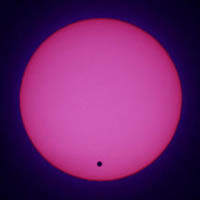
2004 transit of Venus taken from the Royal Observatory
‘This one really is your “last chance to see”,’ explains Dr Marek Kukula, public astronomer at the Royal Observatory, Greenwich. ‘The next one is not until December 2117 – very few, if any, people alive today are going to see that.’
‘When watching a planet slide in front of the Sun, the mechanics of the heavens are laid open for anyone to see,’ Kukula says. And, as the exhibition Measuring the Universe, currently running at the Royal Observatory, explains, the transit of Venus has played an important historical role in helping astronomers calculate the size of the solar system.
‘In the eighteenth century, the transits were among the first examples of international big science collaborations,’ says Kukula. ‘Despite a lot of national tensions within Europe, scientists were communicating with each other across borders. These were also early examples of government-sponsored science; Captain Cook’s first voyage to the South Seas was funded so that he could observe the 1769 transit from Tahiti.’ On the way back, of course, he went on to discover New Zealand and Australia.
There were practical considerations in all this. ‘By measuring the transit accurately, you gained a new level of understanding in how the heavens worked, and that actually was very useful for navigation,’ says Kukula. ‘Even in the eighteenth century, though, the observations were not quite good enough to really nail it. For the nineteenth-century transits – in 1874 and 1882 – you have Greenwich sending out numerous expeditions around the world. Armed with photography, they can at last make accurate observations.’ . . .
The full article, with directions for safe viewing, is available here»
Exhibition | ‘Shelf Lives: Four Centuries of Collectors’
Two of the collectors from this Cambridge exhibition come from the eighteenth century: John Moore (1646-1714) and George Lewis (d. 1729), as noted below. From the exhibition website:
◊ ◊ ◊ ◊ ◊
Shelf Lives: Four Centuries of Collectors and Their Books
Cambridge University Library, 18 January — 16 June 2012
 With more than eight million items on its shelves, Cambridge University Library is one of the largest accumulations of books and manuscripts in Europe, and one of the most important in the world. But its holdings are not a single, uniform entity: instead they consist of a great variety of different collections which, over the centuries, by one route or another, have come to be housed under the same roof. Some of the most remarkable of these are the collections gathered by ardent individual book-lovers, whose intensely personal passions for acquiring rare and beautiful volumes have, through the eventual deposit of their treasures in the Library, gone on to enrich the national heritage.
This exhibition presents ten such collectors, whose lives span the sixteenth to the twentieth centuries. As well as placing on display some of the most splendid, distinctive and—in a few cases—unexpected items held in the Library, it allows us to observe the changing motives, fashions and tastes of book-collectors over the course of four hundred years.
◊ ◊ ◊ ◊ ◊
Great Industry, Accurate Judgement and Royal Favour: John Moore
John Moore (1646–1714), an undergraduate of Clare College and later Bishop of Norwich (1691–1707) and Ely (1707–1714), was one of the greatest bibliophiles of his day, celebrated for his collection of early English ‘black letter’ printing. The range of manuscripts and early printed books he acquired reflected the breadth of his interests, above all in medicine.
After he died, on 31 July 1714 (one day before Queen Anne), the collection was bought by King George I at Lord Townshend’s suggestion and presented to the University as a reward for Cambridge’s loyalty to the Hanoverian succession during the Jacobite rebellion of 1715. It was known henceforth as the Royal Library. The manuscripts include such treasures as the Moore Bede and the Book of Cerne, and number among them some of the most valuable items in the Library. Yet in many cases comparatively little is known about their origins and provenances: the Library’s greatest accession of all remains in large part mysterious.
◊ ◊ ◊ ◊ ◊
The Archdeacon and his ‘Bibliotheca Orientalis’: George Lewis
George Lewis’s valuable collection of 76 manuscripts, mainly in Persian, came to the Library in 1727 in a wooden cabinet inscribed ‘Bibliotheca Orientalis’.
Lewis (d. 1729) was educated at Queens’ College in the 1680s and subsequently entered the Church. He travelled to India in 1692 where he was Chaplain to the East India Company settlement in Madras until 1714. He was a gifted linguist, proficient in Persian, and during his stay in India he collected manuscripts which closely reflected his own interests and expertise. The collection is strong in religious texts (Qur’ans and translations of the Bible into Persian), manuscripts on grammar, and dictionaries, including Lewis’s own unfinished dictionary of Persian. Significantly, there are texts by poets such as Hātifī and Jāmī and a rare volume by Rahā’ī—the literary traditions of the Islamic world were little known in Europe at this date.
Along with the manuscripts came an assortment of curiosities: coins, weights, inscriptions, miniature Indian playing cards on wood and tortoiseshell, and a pair of embroidered slippers.
◊ ◊ ◊ ◊ ◊
For more information, see the exhibition website.
Reviewed | Heidi Strobel on ‘The Look of Love’
Graham Boettcher, ed., with essays by Graham Boettcher, Elle Shushan, and Jo Manning, The Look of Love: Eye Miniatures from the Skier Collection (London: D. Giles Limited in association with the Birmingham Museum of Art, Birmingham, Alabama, 2012), 208 pages, ISBN: 9781907804014, $35.
Reviewed for Enfilade by Heidi Strobel
Drink to me only with thine eyes,
And I will pledge with mine.
– Ben Jonson, “Song to Celia” (1616)
 In the sumptuously illustrated catalogue for The Look of Love: Eye Miniatures from the Skier Collection (on at the Birmingham Museum of Art from 7 February to 10 June 2012 ), Graham Boettcher, Elle Shushan, and Jo Manning highlight the world’s largest collection of eye pictures: small, often jewel-encrusted, paintings of individual eyes of lovers or beloved family members. These synecdochal portraits enjoyed a brief heydey between 1790 and 1850, in large part due to the patronage of the Prince of Wales (later George IV) who famously commissioned several lover’s eye portraits for his forbidden amour, Maria Fitzherbert. Although the best known of such commissions, these were not the first. In antiquity, the Romans and Etruscans produced similar images and, more recently, according to Horace Walpole, the French did so in the eighteenth century (18).
In “The Artist’s Eye,” Elle Shushan describes the evolution of the eye miniature and introduces its practitioners, portraitists such as Richard Cosway, who produced the aforementioned miniatures in his role as Miniature Painter to the Prince of Wales, and George Engleheart, Miniature Painter to the prince’s father, George III. In addition to the latter’s prolific output (4853 portrait miniatures between 1775 and 1813), Engleheart trained several relatives to paint eye miniatures, including his cousin Thomas Richmond and nephew John Cox Dillman Engleheart, whose work is also included in the catalogue. Shushan explains the initial modern popularity of the genre (in England and on the Continent) and describes patrons who later resuscitated the genre, including Queen Victoria who requested eye pictures of her closest friends and relatives from her Royal Miniaturist, Sir William Charles Ross. In closing, Shushan attributes the genre’s demise to its hybrid status — “part portrait, part jewelry, and part decoration” (27).
In “Symbol & Sentiment: Lover’s Eyes and the Language of Gemstones,” Graham Boettcher demonstrates how the jewels that often surrounded an eye portrait provided additional information about the qualities and features of the sitter and its wearer. Since many of these portraits were memorials to a deceased loved one, Boettcher’s discussion of these items as mourning jewelry is particularly useful.
In the third section of the catalogue, Jo Manning contributes five fictional vignettes inspired by items in the Skier Collection, an inclusion stimulated by the lost identities of most of the sitters and artists. Interspersed amid the catalogue entries are brief biographies of specialists George Engleheart and his family protégés, Cosway, Richmond, William Grimaldi, as well as George IV. Some of the entries also supply information about inscriptions and particular sitters.
Although most recent publications on miniatures include a section on eye miniatures, The Look of Love is the first publication devoted to this fleeting genre. While the liminal status of the eye miniature as part jewelry, part decoration, and part portrait may have contributed to the genre’s transience, we might ask whether such images should be considered portraits at all, a point made by Hanneke Grootenboer in her 2006 Art Bulletin article, “Treasuring the Gaze: Eye Miniature Portraits and the Intimacy of Vision.”[1] Perhaps it would be more accurate to describe these small paintings as ‘eye pictures’ (rather than portraits) since they work so differently from traditional portrait conventions grounded in personal identification. And, given that more typical portrait miniatures were also commonly hybrids (part portrait, part jewelry, and part decoration), why was their popularity more enduring than that of the eye pictures? Were eye pictures – often profusely decorated – more expensive than standard portrait miniatures? And if so, did this factor contribute to the genre’s demise?
Notwithstanding such questions, this generously illustrated catalogue marks a significant addition to the study of miniatures and should appeal to a broad audience with its combination of scholarly scrutiny and fictional narratives.
[1] Hanneke Grootenboer, “Treasuring the Gaze: Eye Miniature Portraits and the Intimacy of Vision,” The Art Bulletin 88 (September 2006): 496-507; also see her forthcoming book from the University of Chicago Press, Treasuring the Gaze: Intimate Vision in Late Eighteenth-Century Eye Miniatures (November 2012).
◊ ◊ ◊ ◊ ◊
Heidi Strobel is Associate Professor of Art History at the University of Evansville, in Indiana. Her dissertation research, focused on the promotion of eighteenth-century female artists by female patrons such as Charlotte, wife of King George III of England, is published as The Artistic Matronage of Queen Charlotte (1744-1818) (Edwin Mellen Press, 2011). Other recent publications include articles on twentieth-century topics such as British sculptor Barbara Hepworth, American folklore artist Howard Finster, World War II icon Rosie the Riveter, and women’s scholarship on women.
Exhibition | The Triumph of Pleasure: Vauxhall Gardens
From The Foundling Museum:
The Triumph of Pleasure: Vauxhall Gardens 1729 — 1786
The Foundling Museum, London, 11 May — 9 September 2012
Curated by David Coke
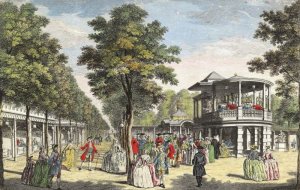
‘Vauxhall Gardens showing the Grand Walk at the entrance of the Garden and the Orchestra with the Musick Playing’, print published in London, 1751
The twenty-first-century public appetite for cultural consumption is unquenchable; but unbeknown to many, mass consumption of contemporary art, popular music and entertainment began over 200 years ago. In 1729 and 1739 two London institutions changed the face of British art forever, Vauxhall Pleasure Gardens under the management of Jonathan Tyers and the Foundling Hospital for abandoned babies and England’s first public art gallery established by Thomas Coram. To ensure the success of the two institutions both men enlisted the help of two great artists of the age, painter and engraver William Hogarth and composer George Frideric Handel.
The Foundling Hospital became the premier venue for London’s polite society to combine socialising and culture with philanthropy whereas Vauxhall Gardens was a place to enjoy contemporary music and art, spectacular design, al fresco dining, beautiful gardens and supper boxes from which to see and be seen. The Triumph of Pleasure: Vauxhall Gardens 1729 – 1786 will explore the Gardens, which for its visitors was an escape from daily realities and a re-affirmation of all the good things that life had to offer.
Drawing from the collections of major museums and galleries across the country, The Triumph of Pleasure: Vauxhall Gardens 1729 – 1786 will display works by Hogarth, Canaletto, Hayman, Rowlandson and Gainsborough. Visitors can view original manuscripts and song sheets which will be supported by a series of specially commissioned concerts. One of the last surviving supper box paintings will be on display alongside objects associated with the Gardens and the Foundling Hospital. This will include an identifying token left by a mother with the baby she left at the Foundling Hospital. This token is a copper 1737 Vauxhall Garden season ticket, attributed to Hogarth. The exhibition will also be the first time François Roubiliac’s three terracotta portrait busts of William Hogarth, George Frideric Handel and Jonathan Tyers have been seen together.
Vauxhall Gardens was an all-embracing sensual experience, becoming an international byword for pleasure and now, over 200 years later, visitors to the Foundling Museum can experience the sights, sounds and tastes of the Gardens once more.
◊ ◊ ◊ ◊ ◊
David Coke, the exhibition’s curator and co-author of Vauxhall Gardens: A History (Yale UP, 2011), offers a preview of the show with his article “Vauxhall Gardens: Patriotism and Pleasure,” in this month’s issue of History Today 62 (May 2012). Also, see Coke’s own immensely useful website for the gardens (this last noted added 1 June 2012).
Marking Frederick the Great’s 300th Birthday
On the 300th anniversary of the birth of Frederick the Great, the Prussian Culture Heritage Foundation has organized a series of nine exhibitions. A few of them are detailed here at Enfilade, but more information is available from the series website:
◊ ◊ ◊ ◊ ◊
Art – King – Enlightenment
Exhibition Series Organized by the Prussian Cultural Heritage Foundation, Berlin, 2012

Johann Gottfried Schadow, “Stettin Monument of Frederick the Great,” 1793 © Staatliche Museen zu Berlin, photo: Achim Kleuker
The 24 January 2012 marked the 300th anniversary of the birth of Frederick the Great. To mark the occasion, the five institutions that make up the Prussian Cultural Heritage Foundation have joined forces to deliver a series of diverse exhibitions and events that will guide visitors through the tercentenary celebrations.
The joint project bears the title Art – King – Enlightenment. The institutions involved are: the Staatliche Museen zu Berlin (National Museums in Berlin), the Staatsbibliothek zu Berlin (Berlin State Library), the Geheimes Staatsarchiv Preußischer Kulturbesitz (Prussian state archives), the Ibero-American Institute and the Staatliche Institut für Musikforschung (an institute for scholarship in music). Together, they highlight various areas relating to the king as a person and the age in which he lived.
Coinage reforms, Montezuma, the image as a mass medium, Jean-Jacques Rousseau, Chinese porcelain service, secret correspondence, and a concert flute are just some of the things that provide a snapshot of what we can expect to see in 2012. This colourful palette of events revolving around the anniversary will provide an insight not just into the life and work of the famous Prussian king, but
also into his historical impact, for Prussia, Germany and Europe.
◊ ◊ ◊ ◊ ◊
War Court in Köpenick! Anno 1730: Crown Prince – Katte – Order of the King
Köpenick Palace, 29 October 2011 — 5 February 2012
It’s Enough for Eight Groschen… Frederick the Great Seen through His Coins and Medals
Bode-Museum, 24 January — 14 October 2012
Frederick’s Montezuma: Power and Meaning in the Prussian Court Opera
Museum of Music Instruments, 27 January — 24 June 2012
On the Edge of Reason: Cycles of Works on Paper in the Age of the Enlightenment
Kupferstichkabinett at Kulturforum, 16 March — 29 July 2012
‘…Old Fritz, Who Lives in His People’: The Image of Frederick the Great in Adolph Menzel
National Gallery, Kupferstichkabinett and Gemäldegalerie in the Old National Gallery, 23 March — 24 June 2012
On the Plurality of Worlds: The Arts of the Enlightenment
Art Library at Kulturforum, 10 May — 5 August 2012
China and Prussia: Porcelain and Tea
Museum of Asian Art, Dahlem Museums, 8 June — 31 December 2012
Porcelain for the Palaces of Frederick the Great
Museum of Decorative Arts in Köpenick Palace, 15 June — 28 October 2012
Homme de lettres – Federic: The King at His Writing Desk
Prussian State Archives and Berlin State Library presented in the Art Library at Kulturforum, 6 July — 30 September 2012










 Enfilade
1 comment