Exhibition | Frederick the Great through His Coins and Medals
From the Staatliche Museen zu Berlin:
It’s Enough for 8 Groschen … Frederick the Great Seen through His Coins and Medals
Bode-Museum, Berlin, 24 January — 14 October 2012

Ludwig Heinrich Barbiez, Medaille auf die Schlacht bei Kesselsdorf, 1745 © Staatliche Museen zu Berlin, Münzkabinett
Coins and medals reflect the history of Prussia and its great king in an immediate way: quite literally in the palms of our hands. No other European monarch wrought such wide-reaching changes to his country’s coinage and monetary system as Frederick II of Prussia. With his coinage reforms of 1750 and 1764, he not only set Prussia on a new course, but also significantly paved the way for later monetary developments in the rest of Germany.
By radically debasing the currency, specifically of specie (by lowering the quantity of precious metals in newly minted coins), he managed to finance the Seven Years’ War (1756-1763). He was just as radical in overhauling the Prussian currency after the war. The mints went from being half-private companies to efficient, state-run money factories. Under Frederick II, gold coins and larger silver coins were standardised across the country in a process that started in 1750. The diversity of territories under Prussian control and their various types of coins and monetary systems are reflected in the coins of the time. The coin portraits of Frederick II reveal a lot about the image of the ruler – from handsome young man in the year of his coronation in 1740 up to his death in 1786, by which time he was dubbed ‘Old Fritz’. Besides his great battles and victories, various other kinds of events that took place during his reign are captured on his medals.
The Numismatic Collection holds over 3500 coins from the time of Frederick the Great, thus making it not only the largest, but also the most complete collection of its kind in the world. This particular collection will be published for the first time in its entirety, in a combination of print and online catalogues to mark the celebrations surrounding Frederick II’s birth. The result means that the public now has unprecedented access to this historical source on the life of Frederick the Great.
The exhibition is being held as part of a wider series of events called Art – King – Enlightenment, coordinated by the Prussian Cultural Heritage Foundation in honour of the 300th anniversary of the birth of Frederick the Great on 24 January 2012.
Exhibition | British Silver: The Wealth of a Nation
Thanks to Courtney Barnes of Style Court for this one. From The Met:
◊ ◊ ◊ ◊ ◊
British Silver: The Wealth of a Nation
The Metropolitan Museum of Art, New York, 15 May 2012 — 20 January 2013
 The production of silver in Britain was understood to be the embodiment of the country’s prosperity—an outward expression of political stability, taste, and industriousness. This exhibition explores some of the ingredients that made the English silver trade such a vigorous success in the sixteenth, seventeenth, and eighteenth centuries. Drawn largely from the Museum’s collections, it also includes extraordinary loans from private collectors, including Paul de Lamerie’s great rococo coffeepot of 1738 and the justly famous Maynard Dish belonging to the Cahn Family Foundation.
Since sterling silver was the coinage of the realm, a silver dinner service was, most literally, worth its weight. But the display and use of silver meant more than riches. Silver was an expression of a patron’s taste and education, designed to celebrate his achievements and complement the architecture of his house.
In England, as in Continental Europe, a rich display of silver was essential to the expression of power. Government officials and emissaries dispatched to foreign courts were expected to entertain in a style that reflected the dignity of the English crown. To ensure that they could set an impressive table, an office holder or ambassador was issued a silver service from the Jewel Office, the division of the royal household responsible for precious metals and jewels. Several examples of silver made for ambassadorial use are included in the exhibition. Although the court was an important source of orders for silversmiths, it did not support workshops of its own, and makers broadened their market by serving the growing professional and merchant classes. (more…)
Exhibition Programming | The ‘Westmorland’
A posting here at Enfilade noted the exhibition last November. Here we include details on the programming at The Ashmolean.
◊ ◊ ◊ ◊ ◊
The English Prize: The Capture of the Westmorland, an Episode of the Grand Tour
The Ashmolean Museum, Oxford, 17 May — 27 August 2012
The Yale Center for British Art, New Haven, 20 September 2012 — 6 January 2013
Curated by Scott Wilcox, Elisabeth Fairman, and María Dolores Sánchez-Jáuregui Alpañés
 The story of the Westmorland, an armed merchant ship sailing from Livorno to London in January 1779, is one of colourful 18th-century personalities and modern detective work. Consigned to the ship, by a cast of characters that included artists, aristocrats and dealers, was a precious cargo of art and antiquities, books, and luxury goods such as 32 wheels of Parmesan cheese. Captured by two French warships on 7 January 1779 and declared a ‘prize of war’, the Westmorland and the goods on board were acquired by King Carlos III of Spain who presented many of the works of art to the Real Academia de Bellas Artes de San Fernando, Madrid. Other items were eventually scattered across Spanish museums; one painting ended up as far away as St Petersburg. Reconstructed with archival discoveries and research in Spanish collections, The English Prize presents 120 objects including paintings, drawings, sculptures, books and maps from the fateful voyage, in a vivid recreation of the Grand Tour and the high seas.
The exhibition is the result of an extraordinary research project begun in the late 1990s, with gaps in the story filled by discoveries made in recent years. It was found, for instance, that the mysterious marking ‘P. Y’ on books and drawings in the Academia indicated ‘Presa Ynglesa’ (‘The English Prize’). The original inventories of the ship’s crates which survive in the archives in Madrid are remarkably thorough and have allowed the identification of many items which were on the Westmorland when it was captured. Using these records and studying the notes and marginalia scribbled on books and maps by their owners, it is now possible to link the objects and works of art to the individuals who were sending them home to Britain.
Amongst the highlights of the exhibition are portraits of Grand Tourists Francis Bassett and George Legge (Viscount Lewisham), by Pompeo Batoni; a group of amazingly fresh watercolours by John Robert Cozens made on his first trip to Italy; and portrait busts by Irish sculptor Christopher Hewetson who was working in Rome. Of the tourists, collectors and dealers who had consigned works of art and souvenirs to the Westmorland, we find the Scottish painter Allan Ramsay; the diplomat and dealer John Udny; a Scottish landowner and lawyer, Sir John Henderson of Fordell; and such a high ranking aristocrat as the Duke of Gloucester, brother of George III.
The exhibition website is available here»
◊ ◊ ◊ ◊ ◊
From The Ashmolean:
P U B L I C S T U D Y D A Y
The Experience of Italy: Travel, Collecting and the Grand Tour
Headly Lecture Theatre, Friday, 8 June 2012, 10am–5pm
This special one-day event looks at the cultural context of the Westmorland and its story. As a rare time-capsule, the ship can help us uncover the concerns and interests of British tourists, collectors and artists, from their musical education to their fascination with volcanoes and excavations. Over the day, six distinguished speakers deliver lectures with the opportunity to ask questions and discuss the varied topics.
The Westmorland and the Mechanics of the Grand Tour in the 1770s
Jonathan Yarker, University of Cambridge
Vases and Volcanoes: Sir William Hamilton and Collecting for Posterity
Kim Sloan, British Museum
Enjoying the Souvenirs of Travel: Art and Antiquities at Home
Clare Hornsby, author of Digging and Dealing in 18th-Century Rome
Music and the Musical Outcomes of the Grand Tour
Roderick Swanston, former Professor, Royal College of Music
Women at Grips with the Grand Tour: Adventure, Authority and Anomaly
Chloe Chard, independent scholar
British Artists in Rome
Martin Postle, Paul Mellon Center for Studies in British Art
Free, spaces limited, to book contact: education.service@ashmus.ox.ac.uk T 01865 278 015
◊ ◊ ◊ ◊ ◊
L E C T U R E S
Uncovering the Westmorland, Step by Step
José María Luzón Nogué, Real Academia de Bellas Artes, Madrid
Thursday, 31 May, 2–3pm
We can reconstruct the extraordinary story of the Westmorland and its cargo thanks to fascinating detective work that began in the 1990s. In this lecture, Prof Luzón, who led the original research project, will take you on the journey which led to the rediscovery of the ship. Free, spaces limited, to book contact E education.service@ashmus.ox.ac.uk T 01865 278015
Marble Mania: Why Was Antique Sculpture So Desirable?
Ruth Guilding, art historian and curator
Wednesday, 20 June, 2–3pm
The Westmorland’s cargo included 23 crates of marble statues, and the ship was one of many which brought the souvenirs of British travellers back to London in the 1770s. Dr Guilding explores the way that antique sculpture was imagined, understood and used by collectors in England at the time. Free, spaces limited, to book contact E education.service@ashmus.ox.ac.uk T 01865 278015
The First English Prize: The Story of the Arundel Marbles
Susan Walker, Keeper of Antiquities, Ashmolean Museum
Wednesday, 27th June, 2–3pm
Dr Susan Walker, Keeper of Antiquities, explores the history of the earliest collection of classical sculptures and inscriptions in Britain, a treasure of the Ashmolean Museum. Free, spaces limited, to book contact E education.service@ashmus.ox.ac.uk T 01865 278015
‘Magick Land’: British Landscape Painters in Italy in the 1770s
Scott Wilcox, Chief Curator of Art Collections and Senior Curator of Prints and Drawings, Yale Center for British Art
Wednesday, 4th July, 2–3pm
Oil paintings and watercolors on the Westmorland by John Robert Cozens, Jacob More, and Solomon Delane point to a community of British landscape painters active in Italy. This lecture examines that community and the impact of Italy, particularly the Roman Campagna, on the development of British landscape art. Free, spaces limited, to book contact E education.service@ashmus.ox.ac.uk T 01865 278015
Carrying off the Colosseum: The Westmorland and Architecture
Frank Salmon, Head of the Department of History of Art, University of Cambridge
Wednesday, 18 July, 2–3pm
The personal treasures that were being shipped by Grand Tourists on the Westmorland included both real and fictitious drawings of Roman antiquities, as well as design drawings intended for building work back in Britain. This lecture will examine those drawings in the light of the wider culture of Neoclassical architecture and interior design in the second half of the eighteenth century. Free, spaces limited, to book contact E education.service@ashmus.ox.ac.uk T 01865 278015
In Conversation — New Discoveries: The Secret Cargo of Relics
Catherine Whistler, curator of the exhibition, and Barry Williamson
Thursday, 19 July, 11.30am –12.30pm
Just before the exhibition catalogue went to press, the Ashmolean was contacted by Barry Williamson who is an authority on the Arundell family of Wardour Castle. The Westmorland had a secret cargo, a box of saint’s relics carefully concealed in a plinth of coloured marbles. This was a gift from the Pope to Henry Arundell, eighth Baron Arundell of Wardour. The international research project had tracked these relics in Madrid in early 1789, but the trail had gone cold. Barry Williamson will talk about his discoveries in the family archives and his quest to find the relics. Free, spaces limited, to book contact E education.service@ashmus.ox.ac.uk T 01865 278015
Exhibition | ‘Fashioning Fashion’
This exhibition from LACMA (on display there from 2 October 2010 to 6 March 2011) is currently on view in Berlin and will travel to Paris in the fall. From the German Historical Museum:
Fashioning Fashion: European Dress in Detail, 1700-1915
Deutsches Historisches Museum, Berlin, 27 April — 29 July 2012
Musée des Arts Décoratifs, Paris, 13 December 2012 — 14 April 2013
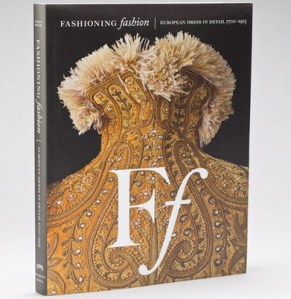 With Fashioning Fashion: European Dress in Detail, 1700-1915 the German Historical Museum is presenting – exclusively in Germany – a unique collection of historical garments and accessories from the Los Angeles County Museum of Art. More than 200 years of European fashion history are on display. The renowned Belgian scenographer Bob Verhelst has specially designed the exhibition architecture for Berlin. Glamorous women’s costumes and elegant men’s suits are adorned with elaborately fashioned trimmings. Luxurious clothing of the wealthy haute-bourgeoisie and nobility are shown, including such highlights as the gold-embroidered dress of a Portuguese queen and the turban of the designer Paul Poiret. Fascinating fabrics, exquisitely tailored raiments and precious décor are all to be seen in the museum’s show.
This spectacular exhibition takes us through four chapters focusing on the aesthetic and technical developments of fashion history:
Timeline shows in chronological sequence the changes in the silhouette of women’s dresses and the evolution of men’s suits from brightly coloured to their traditional dark hue.
Textiles informs us about the variety of surfaces that come about through complex weaving, colouring and printing techniques.
Tailoring deals with the process of turning plain material into clothing, with special emphasis on forming, bracing and constricting techniques.
Trim presents the finery of fashionable clothes: delicate laces, magnificent fine-wire embroidery, artful silk trimmings and colourfully patterned and sequined accessories.
Exhibition | 1740, Un Abrégé du Monde
On at the INHA in Paris this summer, as noted by Hélène Bremer:
1740, Un Abrégé du Monde: Savoirs et Collections autour de Dezallier d’Argenville
Institut National d’Histoire de l’Art, Paris, 4 May — 27 July 2012
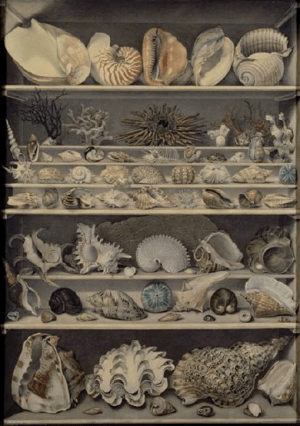
Alexandre Isidore Leroyde Barde (1777-1828), Choix de coquillages, encre noire et gouache, 125cm × 90cm (Paris: Musée du Louvre)
Naturaliste et historien de l’art, Antoine-Joseph Dezallier d’Argenville (1680-1765) fut membre de nombreuses académies scientifiques, auteur d’une théorie du jardinage, de traités sur les pierres et les coquillages (1742), et de l’Abrégé de la vie des plus fameux peintres de toutes les écoles… (1745-1752). Il fut aussi un grand collectionneur qui possédait plus de cinq cents dessins et de rares spécimens naturels. Pour interroger cette figure symptomatique de la dynamique entre arts et savoirs au XVIIIe siècle, l’Institut national d’histoire de l’art a voulu retrouver la fonction première de l’un des espaces-clefs de la Galerie Colbert, une ancienne boutique, car les savants-collectionneurs du siècle des Lumières étaient étroitement liés aux marchés de l’art et des curiosités naturelles.
L’exposition s’organise donc autour d’un comptoir qui évoque non seulement le long meuble à surface plane sur lequel les marchands échangeaient coquillages, estampes, tableaux et dessins, mais aussi les implantations commerciales sur les côtes des colonies d’où provenaient ces étranges objets naturels, lesquels manifestaient à la fois la soif de découverte du monde et l’ambition encyclopédique de ces amateurs.
Les curieux français du XVIIIe siècle furent avant tout des collectionneurs d’objets, que leur goût portait indistinctement sur les produits de l’Art ou de la Nature. Ils prêtaient également une attention remarquable à l’arrangement, la disposition dans l’espace des choses naturelles et artificielles constituant leurs cabinets. À cet égard, il faut noter que Dezallier fut l’un des premiers auteurs français à théoriser, dans un article de 1727, l’arrangement idéal d’un cabinet de curiosités, tout comme il fut le premier à employer en français le terme muséographie, en 1742.
Les années 1740 sont celles de la métamorphose des lieux de savoirs, puisque l’on passe alors des salles dédiées, dans les demeures privées, à la présentation d’objets de collection, à la création de musées, autrement dit de salles publiques d’exposition, où les visiteurs sont invités à s’instruire. C’est aussi l’époque de la mutation des savoirs livresques, dont les formes et les structures sont alors repensées dans le but de dresser des inventaires totalisants, comme l’Encyclopédie ou les catalogues raisonnés illustrés.
The exhibition press release is available (as a PDF) here»
◊ ◊ ◊ ◊ ◊
From Fage éditions:
Anne Lafont, ed., 1740, Un Abrégé du Monde: Savoirs et Collections autour de Dezallier d’Argenville (Paris: Fage éditions) 304 pages, ISBN: 9782849752609, 35€.
Contributeurs: Nebahat Avcioglu, Lise Bicart-Sée, Sarah Boyer, Sabine Cartuyvels, Pascal Dubourg Glatigny, Jennifer Ferng, Isabelle Flour, Catherine Girard, Martial Guédron, Charlotte Guichard, Pierre-Yves Lacour, Anne Lafont, Gaëtane Maës, Marie-Pauline Martin, Dominique Morelon, Aline Pelletier, Jessica Priebe, Chiara Savettieri, Anke Te Heesen, Isabelle Tillerot
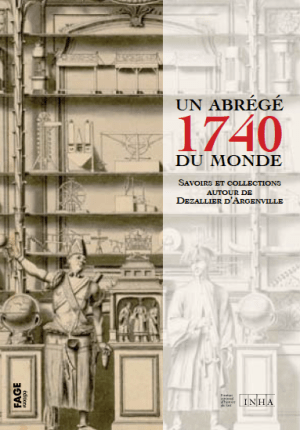 1740 un abrégé du monde traite des modalités de présentation des objets naturels et artificiels au sein des cabinets de curiosités, des relations entre les marchands et les collectionneurs de coquillages, estampes, tableaux, dessins, et des systèmes de classification en vigueur au temps de l’Encyclopédie et de Linné…
Rédigé par vingt spécialistes sous la direction d’Anne Lafont, conseillère scientifique à l’INHA, l’ouvrage gravite autour de la figure du naturaliste, historien de l’art et collectionneur français Dezallier d’Argenville (1685-1765), pivot de la dynamique nature/culture au XVIIIe siècle.
Il est organisé sous la forme d’un abécédaire de vingt-sept articles illustrés abordant des concepts qui sont au cœur de cette enquête sur les arts et les savoirs naturalistes : Abrégé, Amateur, Basseporte, Cabinet, Dessein, École, Fossiles, Grotesque, Histoire naturelle, Illustration, Jardin, Kiosque, Laboratoire, Manière, Numérotation, Ornement, Parterre, Plume, Quartz, Rocaille, Système, Table, Unique, Vernis, Vie, Watteau, Zoomorphose.
Exhibition | Splendeur de la Peinture sur Porcelaine
On at Versailles this summer, as noted by Hélène Bremer:
Splendeur de la peinture sur porcelaine: Charles Nicolas Dodin
et la manufacture de Vincennes-Sèvres au XVIIIe siècle
Château de Versailles, 15 May — 9 September 2012
 Du 15 mai au 9 septembre 2012, le château de Versailles présente l’exposition Splendeur de la peinture sur porcelaine. Charles Nicolas Dodin et la manufacture de Vincennes-Sèvres au XVIIIe siècle dans les appartements de Madame de Maintenon et dans la salle des Gardes du Roi.
Cette exposition est consacrée à un des peintres les plus doués de la Manufacture royale de porcelaine au XVIIIe siècle, Charles Nicolas Dodin, dont les œuvres ont été, de son vivant comme au siècle suivant, recherchées par les plus grands amateurs de porcelaine. L’exposition vise à mettre en évidence à la fois l’évolution artistique et la diversité des sources d’inspiration de Charles Nicolas Dodin.
Au long de ses quarante-neuf années à la Manufacture, Dodin a contribué aux plus grandes commandes passées par les rois et leur entourage, en particulier les maîtresses de Louis XV, et par des souverains étrangers, comme Catherine II de Russie. A travers ces œuvres de prestige, l’exposition retrace l’évolution artistique très lisible et éclairante de l’œuvre de Dodin, à l’instar de celle d’un peintre de chevalet contemporain.
Elle met également en lumière la diversité des sources d’inspiration de Dodin, par la présentation des gravures ou des tableaux qui lui ont servi de sources d’inspiration. Ces œuvres permettent de montrer les correspondances très profondes qui, dans la seconde moitié du XVIIIe siècle, existaient entre les arts (peintures, dessins, estampes, sculptures, médailles, arts du feu) et l’extraordinaire émulation artistique qui devait en résulter.
Dodin a essentiellement été, comme on le disait au XVIIIe siècle, un peintre “en miniature”, ou un peintre de figures, c’est-à-dire qu’il a exercé ses talents dans le genre le plus élevé dans la hiérarchie en vigueur à la Manufacture. Dès leur exécution, ses œuvres ont figuré dans les plus grandes collections d’œuvres d’art, notamment au château de Versailles, et y sont demeurées au siècle suivant.
Exhibition | Trompe-l’œil: Imitations, Pastiches, et Autres Illusions
From the Musée de la Mode et du Textile:
Trompe-l’œil: Imitations, Pastiches et Autres Illusions
Musée de la Mode et du Textile, Paris, 2 February 2012 — November 2013
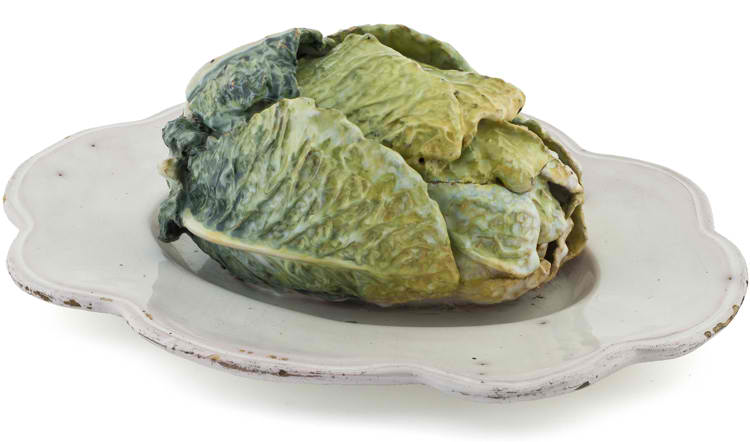
Récipient en forme de chou. Göggingen, Manufacture de Josef I de Hesse-Darmstad, 1748-52, faïence émailée (Paris: Les Arts Décoratifs) Photo: Jean Tholance
In the Musée des Arts Décoratifs’ Study Gallery the public can discover the wealth of its collections via selections of rarely or never previously shown works from its storerooms, shown for an 18-month period. Trompe-l’oeil, as its name indicates, is meant to trick the eye, and originated in painting, in which the illusion created by a painted object relies heavily on perspective and chiaroscuro.
In decorative art, this ‘trickery of the eye’ took very diverse forms. Wallpapers, for instance, proved ideal for this form of expression. From the most modest to the most sumptuous, they all imitate materials: wood, lacquer, tiles, straw, velvet, and even framed pictures. Many imitations were of course done for economic reasons, and in this game of substitutes, one sees that for centuries many materials have been imitated by others: marbled ceramics imitating jasper, glazed ceramics imitating porphyry or gold, paste imitating the diamond, linoleum floorboards, and so on. This game of illusions evolved in the 19th century, when, historicism oblige, it was not only materials that were imitated but motifs too. Owen Jones’ famous The Grammar of Ornament, like its French equivalent, Albert Racinet’s l’Ornement polychrome, provided numerous medieval and Moorish motifs for 19th-century creators.
Fashion was no exception and became the theatre of the most outrageous illusions. In the 18th and 19th centuries, wigs, tournures and faux-cul were worn to give false impressions. In the 20th century, illusion focussed less on form than on the fabric itself, with the appearance of false wears and tears, false pockets, false buttons, etc. Like a treasure hunt traversing centuries and materials, this exhibition invites us into the great game of illusion or the ‘vertigo of imitation’.
More information (in French) is available here»
Exhibition | William Kent, 1686-1748: Designing Georgian Britain
We’ll hear more in the coming months about this exhibition, but I note it here just to whet your appetite. Based on recent exhibitions at The Bard, I’m especially looking forward to the programming and publication. -CH.
◊ ◊ ◊ ◊ ◊
William Kent 1686-1748: Designing Georgian Britain
The Bard Graduate Center for Studies in the Decorative Arts, New York, Fall 2013
V&A, London, Spring 2014
Organized in collaboration with the Victoria & Albert Museum (V&A).
Curated by Susan Weber Director and Founder, BGC and Julius Bryant, Keeper of Word and Image Department, V&A
Exhibition | Gold, Jasper, and Carnelian: Johann Christian Neuber
From The Frick:
Gold, Jasper, and Carnelian: Johann Christian Neuber at the Saxon Court
Grünes Gewölbe, Dresden, 3 March — 2 May 2012
The Frick Collection, New York, 30 May — 19 August 2012
Galerie J. Kugel, Paris, 12 September — 10 November 2012
Coordinated by Dirk Syndram, Jutta Kappel, Ian Wardropper, and Charlotte Vignon

Johann Christian Neuber, Breteuil Table, Dresden, 1779–80, wood, gilded bronze, semiprecious stones, faux-pearls, and Meissen porcelain plaques, H: 32 inches, collection of the Marquis de Breteuil, Chäteau de Breteuil (Choisel/Chevreuse); photo: © Georges Fessy
Johann Christian Neuber was one of Dresden’s most famous goldsmiths. Sometime before 1775 he was named court jeweler to Friedrich Augustus III, elector of Saxony, and in 1785 he was appointed Curator of the Grünes Gewölbe (Green Vault), the magnificent royal collection of Augustus the Strong, the founder of the Meissen Porcelain Manufactory. For more than thirty years, Neuber created small gold boxes, chatelaines, and watchcases decorated with local semiprecious stones such as agate, jasper, and carnelian. He fashioned enchanting landscapes, complex floral designs, and geometric patterns with tiny cut stones, often incorporating Meissen porcelain plaques, cameos, and miniatures. These one-of-a-kind objects, which reflect the Saxon court’s interest in both luxury items and the natural sciences, remain prized treasures today, but have never before been shown together in a monographic exhibition.
In 2012, the public will have their first comprehensive introduction to this master craftsman’s oeuvre through a traveling exhibition that is accompanied by a lavishly illustrated publication (Paul Holberton publishing, London, and Editions d’Art Monelle Hayot, under the direction of Alexis Kugel). The exhibition began in Dresden at the Grünes Gewölbe on March 3, remaining there through May 2, 2012, when it travels to the United Sates for an exclusive engagement at The Frick Collection (May 30 through August 19, 2012). It concludes at Galerie J. Kugel in Paris in the fall (September 12 through November 10, 2012).
Gold, Jasper, and Carnelian: Johann Christian Neuber at the Saxon Court includes some thirty-five boxes and other decorative objects from the Grünes Gewölbe and the Porcelain Collection of the Staatliche Kunstsammlungen Dresden, The Metropolitan Museum of Art, and private collections in Europe and the United States. The exhibition also features Neuber’s masterpiece, the Breteuil Table. This small table is regarded as one of the most extraordinary pieces of eighteenth-century furniture ever made, distinguished not only by the materials used in its construction and for the remarkable skill of its creator, but also for its prestigious history. It was presented in 1781 by Friedrich Augustus III to Baron de Breteuil, a French diplomat, as recognition for the role Breteuil played in the negotiation of the Treaty of Teschen, which officially ended the war of Bavarian Succession fought between the Habsburg monarchy and a Saxon-Prussian alliance to prevent the Habsburg acquisition of the Duchy of Bavaria. The table features a mosaic top of 128 semiprecious stones and Meissen porcelain plaques. Still owned by the family who received it nearly 250 years ago, this stunning object has almost never been exhibited outside the Château de Breteuil (some twenty-five miles west of Paris) and has never before crossed the Atlantic. The Frick exhibition also reunites for the first time two bases designed and crafted by Neuber for the display of Meissen porcelain groups. One is now in the collection of the Walters Art Museum, Baltimore, while the other is from a private collection in Paris. These bases were part of a much larger diplomatic gift from Friedrich Augustus III to Nicolai Wasilijewitsch Repnin, the Russian emissary who helped to negotiate the Treaty of Teschen. The gift originally included a Meissen porcelain service and an enormous centerpiece composed of seven stands of varying heights, each supporting an allegorical group made of Meissen porcelain. Of this extravagant gift, only these two bases have been definitively identified.
The exhibition is co-organized by the Grünes Gewölbe, Staatliche Kunstsammlungen Dresden, The Frick Collection, and Galerie J. Kugel, Paris. The exhibition in Dresden will be shown in a slightly different form as Johann Christian “Neuber à Dresde”: Schatzkunst des Klassizismus für den Adel Europas. It is coordinated by Dirk Syndram, Director of the Grünes Gewölbe and the Armoury, and Jutta Kappel, Senior Curator of the Grünes Gewölbe. The presentation of the exhibition at The Frick Collection is coordinated by Director Ian Wardropper and Charlotte Vignon, Associate Curator of Decorative Arts.
◊ ◊ ◊ ◊ ◊
From Paul Holberton Publishing:
Alexis Kugel, ed., Gold, Jasper and Carnelian: Johann Christian Neuber at the Saxon Court (London: Paul Holberton, 2012), 400 pages, ISBN: 9781907372360, £100.
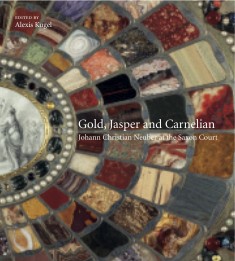 Johann Christian Neuber (1736–1808) was a goldsmith and mineralogist at the Saxon Court. In 1769 he became director of the Grünes Gewölbe, the magnificent State Treasury, and was appointed court jeweler in 1775. He specialized in creating small gold boxes, chatelaines and watchcases decorated with semiprecious stones, such as agate, jasper and carnelian. Neuber fashioned enchanting landscapes, complex floral designs and geometric patterns out of tiny cut stones, often incorporating Meissen porcelain plaques, cameos and miniatures. These one-of-a-kind objects are treasured in public and private collections all over the world today, but have never been brought together.
This book is the first comprehensive introduction to this master craftsman’s oeuvre, presenting boxes and other decorative objects from the Grünes Gewölbe, the Metropolitan Museum of Art as well as public and private collections in Germany, France and New York. One of its highlights is the ‘Breteuil Table’, still owned by the family for which it was made as a diplomatic gift nearly 250 years ago.
Beautiful photographs of all Neuber’s creations adorn this extraordinary book – well over 500 in number. The context and history of the growing interest in mineralogy and its celebration in these works of art are fully investigated. Its distinguished authors include Dr Jutta Kappel, Head of Conservation at Grünes Gewölbe, Dresden; art historians and specialists Sophie Mouquin and Philippe Poindront; marquis de Breteuil, Henri-François Le Tonnelier; and the editor of the book, Alexis Kugel, of the famous Parisian gallery.
There is also a French edition of this book: Le luxe, le goût, la science: Neuber, orfèvre minéarologiste à la cour de Saxe (ISBN 9782903824808).
Exhibition | Women of Achievement in the Early American Republic
From the exhibition website:
A Will of Their Own: Judith Sargent Murray and Women of Achievement in the Early Republic
Smithsonian National Portrait Gallery, Washington, D.C., 20 April — 13 September 2012
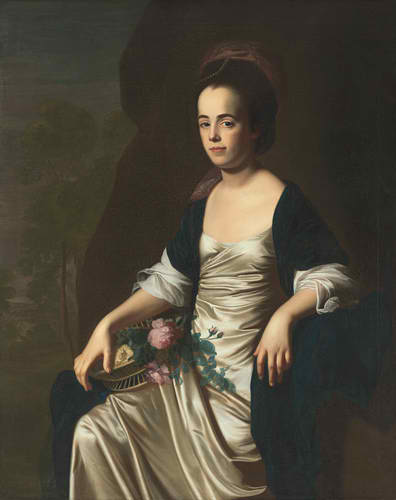
John Singleton Copley, "Judith Sargent Murray,"
1770–72 (Terra Foundation for American Art)
At the time of the American Revolution with Great Britain, women did not share the same status or rights as men. They could not vote or hold political office, enjoyed few property rights, were not equal in marriage, and had limited access to educational opportunities. As the debate about liberty and the rights of men took center stage during the Revolution, some women began to question their position in American society. Whereas many believed that women’s primary responsibility was to raise their children to be productive, moral citizens, some women began to argue for certain legal and economic rights and to pursue various professional careers. The Revolution created new opportunities for women to do work outside the home and to voice their opinions and concerns in public. Given the racial and class divisions that existed during the period, however, not all women were permitted to step forward in this manner. The eight women who are highlighted here did not produce a collective movement for women’s rights, but they were important in sowing the seeds for future progress. While the nature of their achievements differed, each demonstrated through their work that women possessed a will
of their own.










 Enfilade
leave a comment