The Wallace Collection’s Reynolds Research Project
Exciting news from The Wallace Collection (22 July 2011) . . .

X-Ray Image of the Portrait of 'Mrs Jane Braddyll', Wallace Collection, 2011
The Wallace Collection Reynolds Research Project is a three year project funded by The Paul Mellon Centre for Studies in British Art. A collaboration between the Wallace Collection and the Conservation and Scientific Departments at the National Gallery, its purpose is to investigate the techniques and materials used by Reynolds by examining twelve of his paintings, which are in the Wallace Collection; and use this research as a basis for their conservation.
To examine the paintings, images are captured using high resolution digital photography, infrared and x-ray, and small paint samples are taken. Initial results have already revealed how complex Reynolds’ technique really was!
This very exciting project will continue to yield new and surprising results, with all the research being made publicly available later in the project. Alongside this, the Wallace Collection will continue to provide updates as new discoveries are made. The first restored painting has already arrived back at the Collection: Mrs Elizabeth Carnac, which can now be seen in the Great Gallery. The project will culminate in an exhibition, catalogue and scholarly conference at the Collection in 2014, which is sure to be well worth the wait!
Exhibition: Marie Leszczynska, Wife of Louis XV
Whilst not as well-known as her eighteenth-century counterparts — Marie Antoinette, Madame du Barry, or her direct rival Madame de Pompadour — Marie Leszczyńska, the wife of Louis XV, was a fascinating figure, and as Queen Consort of France from 1725 to 1768, she contributed to the period’s artistic culture. From the Château de Fontainebleau:
Parler à l’âme et au coeur: Le Goût de Marie Leszczynska
Musée du Château de Fontainebleau, 18 June — 19 September 2011
Curated by Xavier Salmon

Jean-Marc Nattier, “Portrait of Marie Leszczynska, Queen Consort of France,” detail, ca. 1748
De nombreux éléments de décor des Grands et des Petits Appartements du château de Fontainebleau témoignent encore aujourd’hui du goût de Marie Leszczynska (1703-1768), épouse de Louis XV et reine de France de 1725 à 1768. Fille du roi détrôné de Pologne Stanislas Leszczynski, cette princesse était d’autant plus attachée au château que c’est dans la chapelle de la Trinité de ce palais qu’elle épousa le roi de France, le 5 septembre 1725. C’est aussi dans l’appartement de la cour Ovale à Fontainebleau que, le 20 décembre 1765, s’est éteint son fils unique, le Dauphin Louis.
Malgré la dispersion à sa mort du mobilier, des tableaux, tapis, tapisseries, bronzes et objets d’art constituant l’ameublement de ses appartements à Fontainebleau et à Versailles, nombreuses sont les œuvres revenues au cours des deux derniers siècles et figurant à nouveau au sein des collections des deux châteaux, permettant encore d’évoquer la personnalité singulière et peu connue de cette reine. Acquis par le château de Fontainebleau en 2004, le remarquable ensemble de quatre tableaux peints par Jean-Baptiste-Marie Pierre (1714-1789) illustrant les Quatre Saisons était disposé dans le cabinet de retraite de Marie Leszczynska, disparu depuis la création à sa place du boudoir de Marie-Antoinette (1787). Ces peintures constituent un très bel exemple de son goût.
À l’aide d’œuvres peintes par Oudry, Nattier, les Coypel, Vien ou Pierre – et celles exécutées de la main même de la reine – c’est toute une atmosphère à jamais disparue qui est restituée le temps d’une exposition. À cette occasion est présenté au public pour la première fois le fameux « Cabinet des Chinois » livré pour Versailles. Les sept peintures à sujet exotique furent un véritable travail de collaboration entre Marie Leszczynska et les peintres du Cabinet du roi.
◊ ◊ ◊ ◊ ◊
English gloss from Le nouveau Par!s:
A discreet sovereign, Marie Leszczynska, wife of Louis XV, was a true patron of the arts at court. A great painting and music lover (she painted watercolours herself), throughout her life she surrounded herself with great artists from whom she commissioned works with which to decorate her apartments. The Chateau of Fontainebleau, where she was married and where her son Louis Ferdinand de Bourbon died, still bears witness to her refined taste.
This exhibition brings together numerous works from her residence, from the remarkable collection of paintings by Jean-Baptiste Marie Pierre illustrating the Four Seasons, on display in her personal cabinet to paintings by Oudry, Nattier, Coypel and by the queen herself. You can admire the famous “Chinese Cabinet” commissioned for Versailles, a series of seven paintings on exotic themes which was a true work of collaboration between Marie Leszczynska and the painters of the King’s Cabinet. You can also see the furnishings of her apartments: carpets, hangings, bronzes and other works of art.
Exhibition: French Landscape Prints at the Château de Sceaux
In the eighteenth century the Château de Sceaux was home to Louis Auguste de Bourbon, the Duke of Maine (the son of Louis XIV and his royal mistress, Madame de Montespan). The Duchess of Maine, Louise-Bénédicte de Bourbon-Condé, had her children raised at the nearby Petit Château, the building now serving as an exhibition venue for the Musée de l’Île-de-France. Just south of Paris, the commune of Sceaux is served by the RER Line B. From the website of the Domaine de Sceaux:

Le Dessin français de paysage aux XVIIe et XVIIIe siècles
Musée de l’Île-de-France, Petit Château du Domaine de Sceaux (near Paris), 14 May — 15 August 2011
Donnant sur la ville côté cour, partie intégrante du parc départemental côté jardin, le Petit Château du Domaine de Sceaux complète désormais les espaces du musée de l’Île-de-France ouverts au public. Il devient aujourd’hui le lieu de rendez-vous des amateurs d’arts graphiques. Une première exposition consacrée au Dessin français de paysage aux XVIIe et XVIIIe siècles s’y déroule du 14 mai au 15 août.
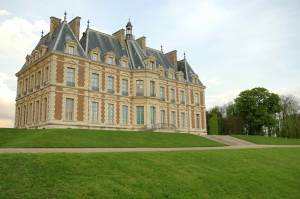
The Château de Sceaux (ca. 1860) houses the Musée de l'Île-de-France. The current château replaced a seventeenth-century house destroyed in the French Revolution. The gardens were laid out by André Le Nôtre in the 1670s.
Préfiguration de la vocation nouvelle du Petit Château, l’exposition consacrée au dessin français de paysage des XVIIe et XVIIIe siècles a permis la réunion d’une cinquantaine d’œuvres provenant de plusieurs grands musées (Besançon, Dijon, Epinal, Marseille, Montpellier, Quimper, Rennes), le Louvre consentant pour sa part à un ensemble de prêts particulièrement important. Le fonds propre du musée de l’Île-de-France vient compléter une sélection valorisant différents types de paysage, servis par une grande diversité de techniques graphiques (pierre noire, sanguine, lavis d’encre, aquarelle…). Que la représentation porte sur des sites rustiques ou urbains, que le cadrage en soit panoramique ou resserré, que l’élément humain y trouve ou non sa place, ces
feuilles se livrent comme autant de visions singulières du
monde, soutenues par des principes esthétiques très affirmés.

Site of the current exhibition of landscape prints, the Petit Château (ca. 1661) is one of the oldest buildings in the park.
Ainsi les dessins de Claude Gellée, de Sébastien Bourdon ou de Pierre Patel, au XVIIe siècle, véhiculent une pensée résolument classique, nourrie de poésie virgilienne appelant à une méditation sereine, tandis que ceux de François Boucher, de Jean-Honoré Fragonard ou d’Hubert Robert, au siècle suivant, cherchent davantage, par leurs rythmes puissants et presque musicaux, à surprendre et déstabiliser le spectateur. Quelques dessins s’imposeront comme d’évidents chefs-d’œuvre, tel l’Ermitage sur un rocher de Jacques Callot, la Vue de Marseille d’Israël Silvestre, ou celle de Rouen par Charles-Nicolas Cochin… Un rendez-vous à ne pas manquer !
En écho à cette exposition, une sélection de 13 dessins du XIXe siècle, issue des collections du musée de l’Ile-de-France, est présentée 1er étage du Château. Avec des feuilles de François-Edme Ricois, Jean-Jacques Champin, Jean-Marie Morel, Jean-Charles Develly, Paul Huet, Jean-Charles Develly, Jean-Lubin Vauzelle et Antoine-Patrice Guyot, la diversité technique et esthétique de la représentation du paysage au XIXe siècle permet de compléter le panorama esquissé au Petit Château.
◊ ◊ ◊ ◊ ◊
More information on the château and the exhibition (including a brief video) is available here»
Exhibition: Reynolds’ Celebrity Portraiture & the Market for Mezzotints
From The Huntington:
Out of the Shadows: Joshua Reynolds’ Celebrity Portraiture
and the Market for Mezzotints in 18th-Century Britain
The Huntington Library, San Marino, CA, 2 July — 26 September 2011

John Raphael Smith after Joshua Reynolds, "Henry George Herbert as 'The Infant Bacchus',” 1776, mezzotint (The Huntington)
One of the most innovative and popular mediums of the great age of 18th-century British art, mezzotint engraving altered the way images were produced and seen by an ever-growing and discerning audience. Building on the tradition of linear printmaking that began with Dürer’s woodcuts in the 15th century, English engravers developed a new tonal technique that provided an unprecedented level of textural refinement and expressive detail through light and shadow, rivaling that of the monumental oil paintings of masters such as Joshua Reynolds, George Romney, and Thomas Gainsborough.
Out of the Shadows: Joshua Reynolds’ Celebrity Portraiture and the Market for Mezzotints in 18th-Century Britain celebrates this rich period of mezzotint with 13 works from The Huntington’s collections. Highlighting the role of mezzotint in the development and dissemination of portraits after those of the most prolific portrait painter of the period, the exhibition includes works by engravers Valentine Green, James Watson, John Dixon, and John Jones, illustrating the popularity, breadth, and richness of mezzotint as a medium, as well as the development and
transformation of artistic production and the role of the artist in
18th-century England.
Exhibition: Revisiting the Regency: England, 1811–1820
From The Huntington:
Revisiting the Regency: England, 1811–1820
The Huntington Library, San Marino, CA, 23 April — 1 August 2011

Thomas Rowlandson, “Vauxhall Gardens,” from "Microcosm of London" (London: T. Bensley, ca. 1808–11)
In October of 1810, England’s King George III slipped into that final madness from which only death would release him, nearly a decade later. The following February, Parliament authorized the king’s estranged and profligate eldest son, the Prince of Wales (the future George IV), to rule in his place as regent. Extravagant, emotional, controversial, and self-indulgent, the prince regent lent his name and many of his characteristics to a glittering era.
In commemoration of the 200th anniversary of this extraordinary decade, The Huntington presents an exhibition titled Revisiting the Regency: England, 1811–1820. Opening April 23 in the West Hall of the Library and continuing through August 1, the exhibition draws on The Huntington’s extensive holdings of rare books, manuscripts, prints, and drawings documenting this historic era.
The term “Regency England” usually evokes Jane Austen’s world of graceful country-house living and decorous village society, the elegance of London’s fashionable elite, or the licentious activities of the prince and his aristocratic Carlton House set. Ladies followed the latest fashions in La Belle Assemblée while gentlemen copied Beau Brummell’s severe elegance. Readers found new works by a generation of England’s greatest poets and novelists: Austen, Lord Byron, John Keats, Samuel Taylor Coleridge, and Sir Walter Scott. Londoners enjoyed a rich theatrical and musical life, watching Edmund Kean’s premiere in Richard III or hearing the first English production of Mozart’s Don Giovanni. Art lovers followed the latest exhibits at the Royal Academy. Under the prince’s patronage, architect John Nash created the fantasy Royal Pavilion at Brighton and remade London’s West End with the new developments of Regent’s Park and Regent Street.
Yet underneath this ordered upper-class surface lay a far more complex and turbulent world: more than a century of intermittent war with France ended at Waterloo, but peace revealed wrenching poverty, social unrest, the strains of rapid industrialization, and growing calls for political reform. The first railroads, gas lighting, and other advances in technology altered the landscape of everyday life. This rich cavalcade of people and events provided irresistible targets for a brilliant generation of visual satirists. The witty, savage, and iconic images of George Cruikshank and his fellow caricaturists, well represented in the exhibition, capture all the vagaries of an extraordinary decade in English arts, letters, science, and society.
Mary Robertson, William A. Moffett Curator,
English Historical Manuscripts
Exhibition: ‘Making History: Antiquaries in Britain’

Making History: Antiquaries in Britain
McMullen Museum of Art, Boston College, 4 September — 11 December 2011
Yale Center for British Art, New Haven, 2 February — 27 May 2012
Making History celebrates the achievements of the Society of Antiquaries of London, the oldest independent learned society concerned with the study of the past. The exhibition, featuring one hundred works selected from the Society’s treasures (with a number of additions from the collections at the Center), focuses on the discovery, recording, preservation, and interpretation of Britain’s past through its material remains. It explores beliefs current before the Society was founded in 1707, and reveals how new discoveries, technologies, and interpretations have transformed our understanding of the history of Britain since the eighteenth century.
 Making History is organized into nine sections. Highlights include antiquities such as a rare Late Bronze Age shield (ca. 1300–1100 BCE) discovered on a farm in Scotland in 1779; an early copy of the Magna Carta (ca. 1225); a medieval processional cross reportedly recovered from the battlefield of Bosworth (1485); the inventory (1550–51) of Henry VIII’s possessions at the time of his death; and a forty-foot-long illuminated “roll chronicle” on parchment detailing the genealogical descent of Henry II from Adam and Eve. Also on display will be an extraordinary collection of English royal portraits painted on panel, from Henry VI to Mary Tudor.
The exhibition is organized by the Society of Antiquaries of London in association with the McMullen Museum of Art, Boston College, and the Center. It will be on display at the McMullen Museum of Art from September 9, 2011, to January 2, 2012, where the organizing curator is Nancy Netzer, Director. The organizing curator at the Center is Elisabeth Fairman, Senior Curator of Rare Books and Manuscripts.
◊ ◊ ◊ ◊ ◊
More information is available at the exhibition website.
Exhibition: Madame Geoffrin
From the Maison de Chateaubriand:
Madame Geoffrin, une femme d’affaires et d’esprit
Maison de Chateaubriand, Vallée-aux-loups, 27 April — 24 July 2011

Entre 1727 et 1766, après Mme de Rambouillet et sa célèbre chambre bleue et avant Mme Récamier, Mme Geoffrin occupe le devant de la scène des salons, éclipsant par son savoir-faire toutes les autres concurrentes de son temps. Aidée dans son entreprise par une fortune confortable que lui procurent ses actions à la Manufacture royale des Glaces, elle crée un cercle qui séduit tous les beaux esprits du temps et connaît un succès au-delà de ses espérances.
Correspondant avec Catherine II, l’impératrice Marie-Thérèse et plus encore Stanislas-Auguste Poniatowski, élu roi de Pologne en 1764, elle fait en 1766 un voyage à Varsovie qui lui octroie une renommée européenne. À Vienne, elle accepte d’être l’ambassadrice de l’impératrice afin de promouvoir en France la renommée de celle que l’on destine au dauphin, Marie-Antoinette. En remerciement, elle reçoit un somptueux service en porcelaine de Meissen, qui sera montré pour la première fois au public, accompagné du grand surtout de glace commandé par Mme Geoffrin afin de pouvoir présenter cette précieuse vaisselle dignement sur sa table.

Jean-Marc Nattier, "Portrait of Madame Geoffrin," 1738 (Tokyo: Fuji Art Museum)
Sans pouvoir évoquer toutes les facettes du personnage, l’exposition permettra d’en mesurer l’envergure par la présentation non seulement de documents d’archives mais de souvenirs lui ayant appartenu ou de tableaux provenant de sa collection, exécutés par François Boucher, Claude-Nicolas Cochin, Joseph Vernet, Carle Van Loo, aujourd’hui conservés essentiellement en collections privées, qui nous livrent les secrets des goûts de cette protectrice des arts. Après un portrait inédit de Mme de Rambouillet par Philippe de Champaigne, l’exposition s’ouvre par des portraits peints de Mme Geoffrin et des portraits psychologiques dressés par sa fille ou les gens de Lettres qui l’ont connue. Suit la section consacrée à la femme d’affaires, évoquée grâce au concours de Saint-Gobain. Puis le visiteur pénètre dans l’intimité de l’hôtel Geoffrin – notamment par deux dessins d’Hubert Robert – et de ses invités. L’exposition s’achève par le retour de Pologne à Paris de notre héroïne, alors au zénith de sa gloire, la fin de sa vie et son rayonnement posthume.
Exhibition: The Eighteenth Century Back in Fashion
From the Palace of Versailles:
Le XVIIIe au goût du jour / A Taste of the Eighteenth Century
Grand Trianon, Château de Versailles, 8 July — 9 October 2011
Curated by Olivier Saillard
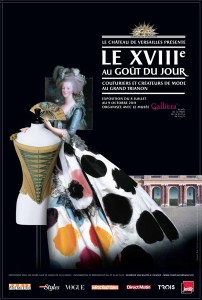 The Palace of Versailles and the Musée Galliera present an exhibition in the apartments of the Grand Trianon dedicated to the influence of the 18th century on modern fashion. Between haute couture and ready-to-wear, fifty models by great designers of the 20th century dialogue with costumes and accessories from the 18th century and show how this century is quoted with constant interest. These pieces come from the archives of maisons de couture and from the Galliera’s collections.
Influencing all the European courts, French culture of the 18th century was embodied by Madame de Pompadour, Madame Du Barry and even more so Marie-Antoinette – paragons of frivolity that has always fascinated the cinema, literature and the fashion world. With its huge powdered hairstyles, whalebone stays and hoop petticoats, flounces, frills and furbelows, garden swings and whispered confidences, the 18th century brought artifice to its paroxysm…
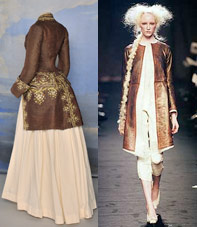 A fantasized style which gives free rein to interpretation: the Boué Sisters in the twenties revive panniers and lace in their robes de style, Christian Dior and Pierre Balmain offer evening gowns embroidered with typically 18th-century decorative patterns, Vivienne Westwood brings back brazen courtesans, fashionable Belles are corsetted by Azzedine Alaïa, Karl Lagerfeld for Chanel invites Watteau with his robes à la française, the Maison Christian Dior adorns duchesses with delicate attires, Christian Lacroix drapes his queens with brocades lavishly gleaming with gemstones and Olivier Theyskens for Rochas summons up the ghost of Marie-Antoinette in a Hollywood film.
While the elegant simplicity in black and white is played by Yves Saint Laurent, Martin Margiela transforms men’s garments into women’s, Nicolas Ghesquière for Balenciaga enhances women in little marquis dressed with lace and Alexander McQueen for Givenchy clothes his marquises in vests embroidered with gold thread. With Yohji Yamamoto, court dresses are destructured and so does Rei Kawakubo with riding coats. While Thierry Mugler hides oversized hoops under the dresses, Jean Paul Gaultier puts them upside down.
Couturiers and fashion designers invite you to discover this 18th century back in fashion, in the Grand Trianon.
◊ ◊ ◊ ◊ ◊
Suzy Menkes’s review for The New York Times (11 July 2011), is available here»
July Issue of ‘The Burlington’
The Burlington Magazine 153 (July 2011)
 • Gerlinde Klatte, “New documentation for the ‘Tenture des Indes’ tapestries in Malta” — Unpublished documents on the Anciennes Indes tapestry set (1708–10) woven by Etienne Le Blond for the Order of St John, Valletta, Malta.
Reviews
• Ann Compton, Review of Rune Frederikson and Eckart Marchand, eds., Plaster Casts: Making, Collecting and Displaying from Classical Antiquity to the Present (Berlin and New York, 2010),
• Rose Kerr, Review of Robert Finlay, The Pilgrim Art: Cultures of Porcelain in World History (Berkeley, 2010)
• Humphrey Wine, Review of the exhibitions, Watteau’s Drawings, Watteau and His Circle
• Todd Longstaffe-Gowan, Review of the exhibition, French Romantic Gardens
• Neil Jeffares, Review of the exhibition, Pastel Portraits
Exhibition: French Romantic Gardens
Thanks to Hélène Bremer for this notice. From the exhibition website:
Jardins Romantiques Français (1770-1840)
Musée de la Vie Romantique, Paris, 8 March — 17 July 2011
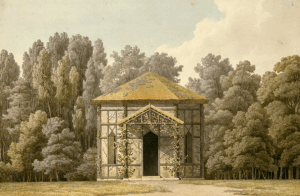
Louis-Hippolyte Lebas, "Le Petit Pavillon du Parc de Malmaison," watercolor (Musée National du château de la Malmaison) © RMN/Gérard Blot -- the building was designed by François Cointereaux around 1790.
Comment proposer aujourd’hui une définition du jardin romantique français, telle est la question que nous nous sommes posée alors que certains des meilleurs spécialistes en réfutent l’appellation. Aussi bien avons-nous usé du pluriel dans le titre « Jardins romantiques » pour évoquer, sans pouvoir être exhaustif, certains parmi les trop multiples reflets du romantisme au jardin.
Au fil des siècles et des saisons, le goût du jardin pittoresque s’est raffiné en un art de vivre à part entière dont les Encyclopédistes puis Beaumarchais avant l’impératrice sont les ambassadeurs écoutés. Au premier rang s’imposent naturellement voyageurs et savants qui rapportent et multiplient, d’un continent à l’autre, moult herbiers
soigneusement conservés au Muséum et rares cultivars
développés dans le secret des pépinières ou à l’arboretum.
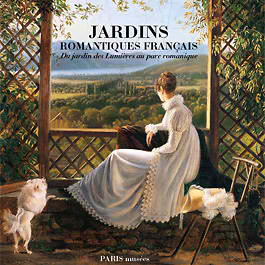
ISBN: 9782759601592, 30€
Au XIXe siècle l’Europe des botanistes résonne tel un bruissant arbre à palabres : on y disserte en latin comme en français sur les principes modernes de la taxinomie et de la dendrologie ; jardinistes et passionnés ouvrent largement les enclos sur la nature environnante et plantent des parcs paysagers. Serres chaudes et palmariums ponctuent les propriétés que leurs commanditaires identifient à leur récente prospérité. Le sentiment du sublime inspire fabriques et cascades, grottes et lacs. Ces nouveaux jardins d’Armide s’ornent de maints caprices secrets : temple de l’amour ou laiterie, chalet ou casino, faux tombeaux ou ménagerie. Pour les délices du vert galant, il n’est pas de sens plus nomade que la vue. Ainsi, la Restauration et la Monarchie de Juillet voient la pratique du jardinage conquérir toutes les couches de la société, et les grands destins du romantisme s’y enracinent. . . .
More information is available here»
◊ ◊ ◊ ◊ ◊
Exhibition catalogue: Daniel Marchesseau, Jardins romantiques français: Du jardin des Lumières au parc romantique (Paris Musées, 2011), 256 pages, ISBN: 9782759601592, 30€.










 Enfilade
leave a comment