Exhibition | The Botanical World of Mary Delany
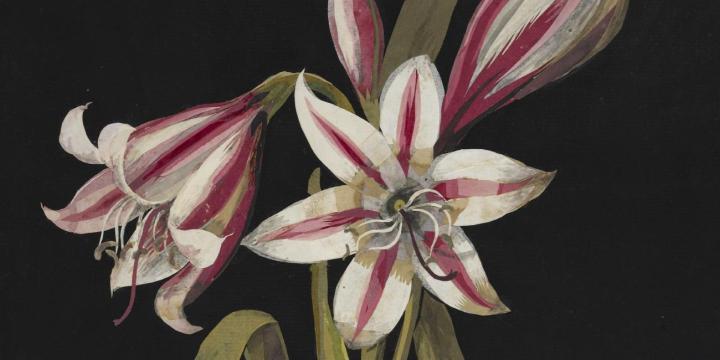
Mary Delany, Crinum Zeylanicum (Hexandria Monogynia), 1778, paper
(London: The British Museum, 1897,0505.248)
◊ ◊ ◊ ◊ ◊
From The British Museum and Beningbrough Hall, where this touring exhibition is first on view:
The Botanical World of Mary Delany
Beningbrough Hall, North Yorkshire, 10 September 2024 – 23 March 2025
The exhibition presents over 30 photographic images of English artist Mary Delany’s pioneering and inspirational ‘paper mosaiks’ of plants and flowers, displayed side by side in a way not possible in real life, due to their fragility and existence in bound volumes. The display encompasses high-resolution photography of some of Delany’s most spectacular works and details the inspiration and drive behind her output, including her original technical process and the legacy she has left. These stunning images reveal Delany’s incredible precision in creating scientifically accurate representations of botanical specimens. Visitors are able to explore and appreciate the delicacy and skill that Delany employed, throughout her impressive oeuvre of work, which she only began at the age of 72.
Also on view at Beningbrough Hall are fascinating historic objects by women artists from the National Trust’s collections. Encounter new sculptures by Rebecca Stevenson in the Great Hall. Immerse yourself in the interactive origami room designed by York artist Kate Buckley, and admire abstract photography collages by York St John Fine Art student Amy Martina.
The British Museum Unseen series is a touring offer that explores a variety of stories about the British Museum collection, loaned as a digital package to provide partners with maximum flexibility.
Exhibition | Jean-Baptiste Oudry and the Royal Hunts of Louis XV
From the press release for the exhibition:
Peintre de courre: Jean-Baptiste Oudry et les Chasses royales de Louis XV
Château de Fontainebleau, 12 October 2024 — 27 January 2025
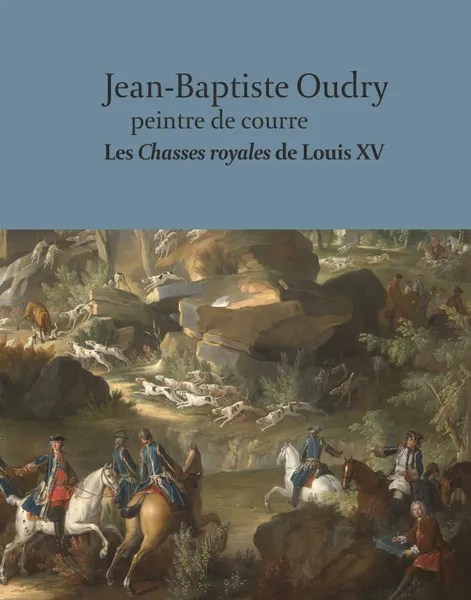 Cette exposition valorisera des trésors méconnus du château : les cartons préparatoires au tissage de la tenture des Chasses de Louis XV, dont quatre cartons tout récemment restaurés.
À l’automne 2024, le château de Fontainebleau mettra en lumière le travail du peintre Jean-Baptiste Oudry, célèbre pour ses représentations des chasses du roi Louis XV et ses portraits animaliers. Peintures, ouvrages, porcelaines, dessins, habits et tapisseries plongeront les visiteurs dans l’univers de la chasse, activité favorite du roi, qu’il souhaita fixer pour l’éternité en passant la commande à Oudry à partir de 1733 d’un ensemble de tapisseries. Cette exposition présentera pour la première fois, côte à côte, les dessins préparatoires, les cartons d’Oudry (œuvres préparatoires à l’échelle réelle qui servent ensuite au lissier à tisser les tapisseries), conservés à Fontainebleau et dont quatre ont été récemment restaurés et les tapisseries qui en sont issues, tissées par la manufacture royale des Gobelins.
Par ailleurs, l’exposition illustrera le goût pour les scènes de chasse dans la peinture et le décor intérieur des demeures royales et aristocratiques du XVIIIe siècle , ainsi que l’« Oudrymania », c’est-à-dire la diffusion des créations de l’artiste dans divers domaines des arts décoratifs, tels que les illustrations de beaux livres, la porcelaine et l’orfèvrerie. L’exposition invite les visiteurs à (re)découvrir la résidence de chasse favorite des rois de France que fut le château de Fontainebleau au fil des siècles.
Un colloque Jean-Baptiste Oudry et la peinture animalière sera co-organisé avec la Fondation François Sommer et se tiendra à Paris et à Fontainebleau mi-décembre 2024.
Vincent Cochet et Oriane Beaufils, eds., Peintre de courre: Jean-Baptiste Oudry et les Chasses royales de Louis XV (Paris: Réunion des Musées Nationaux, 2024), 229 pages, ISBN: 978-2711880423, €49.
The full press release is available here»
Exhibition | Oudrymania
Now on view at the Château de Chantilly:
Oudrymania: Fables, Hunts, Fights
Musée Condé, Château de Chantilly, 8 June — 6 October 2024
Curated by Baptiste Roelly with Oriane Beaufils
 Depicted in hunting scenes, portraiture, and combat, animals feature among the most striking images produced by Jean-Baptiste Oudry (1686–1755). A gifted artist with an unrivalled mastery of his technique, he brings us face-to-face with the animal repertoire as it existed in the 18th century, including in a series of three hunting scenes painted for the Château de Chantilly, works that were scattered after the French Revolution but which have now been brought back together.
Animal scenes were extremely popular with the leading collectors of the 18th century, including the princes of Condé, who commissioned them from the artist. A set of exquisite drawings by Oudry loaned from a private collection feature in the exhibition alongside works from Chantilly’s collections, allowing visitors to see pieces never before displayed in public. These include a large number of illustrations for La Fontaine’s fables, showing how the fabulist and the artist use the animal kingdom to help us laugh at and reflect on human nature. These illustrations were so effective they were copied by the arts and crafts industry and included in their decorative production, examples of which can also be admired in the exhibition. Through paintings, drawings, objets d’art, and rare books, this show shines a light into every corner of the Oudrymania that has gripped art lovers for centuries.
The exhibition is organized by Baptiste Roelly, curator at the Condé museum, in collaboration with Oriane Beaufils, curator and director of collections at the Villa Ephrussi de Rothschild.
Baptiste Roelly and Oriane Beaufils, eds, Oudrymania: Fables, Chasses, Combats (Éditions Faton, 2024), 128 pages, ISBN: 978-2878443585, €22. With contributions by Oriane Beaufils, Claire Betelu, Lucile Brunel-Duverger, Laurence de Viguerie, Juliette Debrie, Mathieu Deldicque, Nicole Garnier-Pelle, François Gilles, Maxime Georges Métraux, Roberta J.M. Olson, and Baptiste Roelly,
The press release (in French) is available here»
Exhibition | Kerry James Marshall and John Singleton Copley
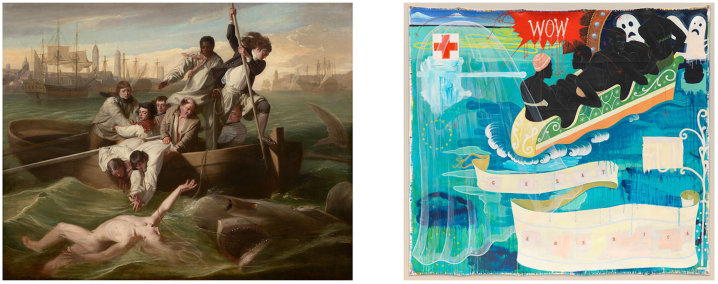
John Singleton Copley, Watson and the Shark, 1778, oil on canvas (DC: NGA, 1963.6.1); and Kerry James Marshall, Great America, 1994, acrylic and collage on canvas (DC: NGA, Gift of the Collectors Committee, 2011.20.1).
◊ ◊ ◊ ◊ ◊
Now on view at the NGA in DC:
Conversations: Kerry James Marshall and John Singleton Copley
National Gallery of Art, Washington DC, 18 November 2023 — 31 January 2025
Two centuries apart, American artists John Singleton Copley and Kerry James Marshall pushed the boundaries of history painting.
A special installation brings together three monumental paintings for a thought-provoking dialogue: Copley’s 18th-century canvas Watson and the Shark and Marshall’s two 20th-century works Great America and Voyager. These paintings—all maritime-themed—address the violent history of the transatlantic slave trade and the Middle Passage, the forced journey of enslaved people across the Atlantic. All three works are part of the National Gallery of Art collection, but this is a rare chance to experience them together in the same exhibition space, in conversation. Compare how Marshall and Copley skillfully wove historical and contemporary events together with cultural, mythological, and spiritual allusions. Take a closer look at these iconic paintings and explore a selection of Marshall’s related drawings for a glimpse into his process.
This is the second installation in our Conversations series, which connects works in our collection from our past and present to reveal how artists help us understand our place in history.
Exhibition | The Birch Trials at Fraunces Tavern
From the press release for the exhibition:
The Birch Trials at Fraunces Tavern
Fraunces Tavern Museum, New York, opening 23 October 2024
Curated by Craig Hamilton Weaver
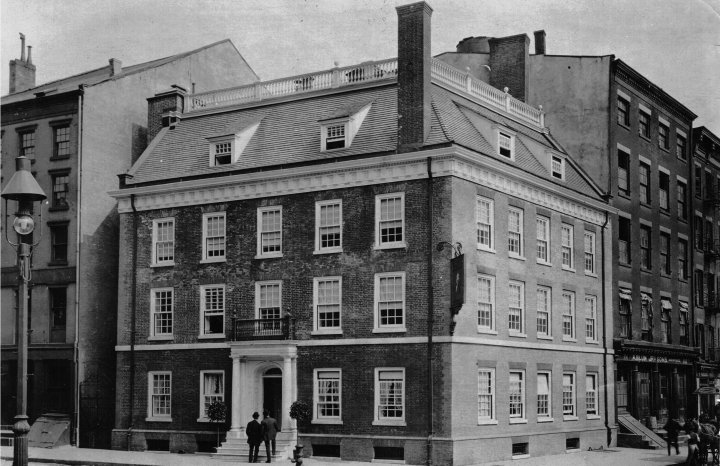
As noted at the museum’s website: “Built by the De Lancey family in 1719, 54 Pearl Street has been a private residence, hotel, and one of the most important taverns of the Revolutionary War.” It is the oldest standing structure in Manhattan.
On 23 October 2024, the Fraunces Tavern Museum, located in the oldest building in Manhattan, will unveil a vastly enlarged permanent exhibition entitled The Birch Trials at Fraunces Tavern. The exhibition highlights the role of Fraunces Tavern in the emancipation of thousands of Black Loyalists at the end of the Revolutionary War (enabling them to leave New York City) and in the creation of the Book of Negroes (the record created of those who departed with the British). The exhibition expands upon one opened at the Museum in June 2023. Recognition is also given to the thousands of Black Patriots who fought to further the cause of American Independence. The previous exhibition attracted a multitude of visitors from around the world, including large numbers of school children. Relocating the exhibition to a larger permanent gallery will enable the Museum to provide a better visitor experience as well as include recent new discoveries of significant information concerning the identities of individuals participating in the Birch Trials and their inclusion in the Book of Negroes.
The exhibition reflects several years of exhaustive research on both sides of the Atlantic in thousands of pages of existing original documents. Museum and Art Committee Co-Chairman and Chief Curator of the exhibition, Craig Hamilton Weaver, emphasizes that “this exhibition is the most comprehensive ever organized on this tremendously significant event in the history of Black emancipation in the United States and is made all the more compelling because it can be viewed within the very walls of the building within which the events occurred.”
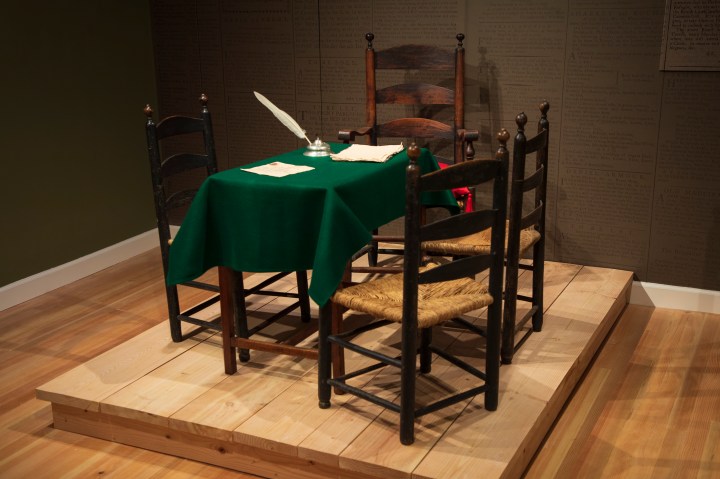
Installation view of The Birch Trials at Fraunces Tavern, 2024.
In 1783, as the Revolutionary War was drawing to a close, a joint British and American Commission met weekly at Fraunces Tavern from April until November. The proceedings of the Commission are known as the ‘Birch Trials’, named after Brigadier General Samuel Birch who oversaw the proceedings. The Commission reviewed and deliberated upon the eligibility of some Black Loyalists to evacuate with the British Army. Testimonies were provided by individuals in person and through documentary evidence to enable the Commissioners to render final decisions. Given that the Commissioners met at Fraunces Tavern weekly and had the responsibility “to superintend all embarkation,” it is reasonable to conclude that the British and American Commissioners reviewed and compiled the lists of names for inclusion in the Book of Negroes during the course of their weekly sessions at Fraunces Tavern. The names would later be inscribed neatly into the final Book of Negroes by staff.
Visitors will observe chairs and a table arranged as if waiting for the Commissioners to enter the room and hear cases. The exhibition also contains reproductions of pages from the Book of Negroes as well as the advertisement in the 30 May 1783 New York Gazette stating that the Commissioners would meet at Fraunces Tavern. Recent discoveries featured in this newly expanded exhibition include the identities of two women, Dinah Archey and Judith Jackson, whose fates were undecided by the Commission at their hearings, but who ultimately were recorded in the Book of Negroes as having evacuated New York City on departing ships.
Major support for this exhibition has been provided by the Robert David Lion Gardiner Foundation. The purpose of the Robert David Lion Gardiner Foundation is to educate, cultivate, and encourage the study and understanding of Long Island and New York’s historic role in the American experience. The Foundation also supports scholarships and historic preservation, including study, stewardship, and promotion of Long Island’s historic educational aspects. The Robert David Lion Gardiner Foundation remains inspired by Robert David Lion Gardiner’s personal passion for Long Island and New York history.
Lecture | Mia Jackson on the Birds of Louis-Denis Armand

Louis-Denis Armand, Parrots, ca. 1750–70
(Paris: Galerie Dragesco-Cramoisan)
◊ ◊ ◊ ◊ ◊
This fall at BGC:
Mia Jackson | Flights of Fancy: The Birds of Louis-Denis Armand (1723–1796)
A Françoise and Georges Selz Lecture on Eighteenth- and Nineteenth-Century French Decorative Arts and Culture
Bard Graduate Center, New York, 11 December 2024, 6pm
Mia Jackson will talk about her recent exhibition, Flights of Fancy, the first ever survey of the life and work of the recently rediscovered Sèvres painter Louis-Denis Armand (1723–1796), now celebrated as one of the foremost painters of birds. Very few artisans from the eighteenth century have left us such a detailed biography; over thirty drawings by Armand survive, and research into the drawings and their inscriptions (by Jackson and collaborator Bernard Dragesco) has revealed a wealth of detail about the artist, his life, his work, and even his political opinions.
Mia Jackson has been curator of decorative arts at Waddesdon Manor since 2017. She studied French and Philosophy at the University of Oxford then completed an MA in eighteenth-century French decorative arts at the Courtauld Institute of Art. Her doctoral thesis entitled “André-Charles Boulle (1642–1732) and Paper: Prints and Drawings in the Workshop of an Ébéniste du Roi” was completed at Queen Mary, University of London in 2016. She previously worked in the Prints and Drawings Department at the British Museum, the Wallace Collection, and English Heritage. Eighteenth-century France is her area of expertise, in particular the links between works on paper and the decorative arts.
Exhibition | Flights of Fancy: Birds at Waddesdon
Now on view at Waddesdon:
Flights of Fancy: Birds at Waddesdon
Waddesdon Manor, Buckinghamshire, 22 May – 27 October 2024
Curated by Mia Jackson

Snuff-box with Sèvres porcelain plaques, 1758, painted by Louis-Denis Armand (Waddesdon Image Library, photo by Mike Fear).
Flock to Waddesdon this summer for a celebration of birds. Throughout the Manor, Aviary, and Gardens discover a range of bird-themed exhibitions, events, and activities for all the family.
Flights of Fancy is a rare chance for bird enthusiasts and art lovers alike to explore this beautiful subject through our birds and remarkable displays of porcelain, paintings, drawings, and prints. The exhibition features the life and work of the recently rediscovered Louis-Denis Armand (1723–1796), a painter at the world-famous Sèvres porcelain manufactory. Widely acknowledged as the most talented bird painter at Sèvres, his birds were initially ‘flights of fancy’, drawn from his wild imagination but as time went on, they gained ornithological accuracy. He also drew exotic birds from life, picking and choosing elements to combine and exaggerate. Waddesdon’s own impressive collection of Sèvres painted by Armand includes ten vases from the 1750s and 60s and important pieces from the Razumovsky dessert service. These are displayed alongside nearly 50 loans from private collections and from the Musée national de céramique at Sèvres.
Exhibition | The King’s Horses: The Marly Horses
From the press release for the exhibition (a companion to the show Horse in Majesty on view at Versailles):
The King’s Horses: The Marly Horses, Masterpieces of Equestrian Art
Musée du Domaine Royal de Marly, 7 June — 3 November 2024
Curated by Karen Chastagnol
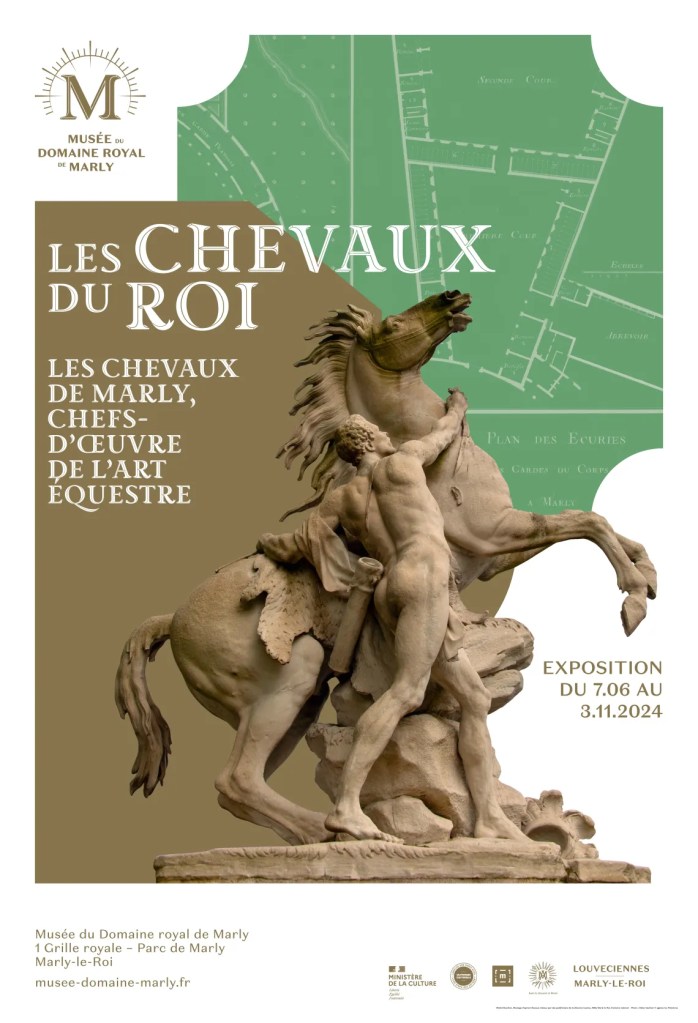 The Royal Estate of Marly, once a hunting residence of kings and the setting for the monumental Marly Horses, has always given an essential role to the horse. From transportation and aristocratic entertainments to military activities, equestrian buildings and artistic representations, horses have taken over the estate in various forms. Through a hundred paintings, sculptures, drawings, engravings, accessories, and archival documents, the Museum of the Royal Estate of Marly presents, on the occasion of the equestrian events of the Paris 2024 Olympic and Paralympic Games, an original exhibition dedicated to the role of the horse at the Estate of Marly, from Louis XIV to the French Revolution.
Karen Chastagnol, ed., Les chevaux du roi: Les chevaux de Marly, chefs-d’œuvre de l’art équestre (Milan: Silvana Editoriale, 2024), 104 pages, ISBN: 978-8836657919, €28. With contributions by Ambre Bozec, Valérie Carpentier-Vanhaverbeke, Annick Heitzmann, Carlos Pereira, and Benjamin Ringo.
The full press release is available here»
The Burlington Magazine, August 2024
The long 18th century in the August issue of The Burlington—and special thanks to The Burlington for making Rosalind Savill’s article available to Enfilade readers for free.
The Burlington Magazine 166 (August 2024) — Decorative Arts
a r t i c l e s

Unidentified artist, Portrait of Paul Crespin, ca.1726, oil on canvas laid on board, 114 × 90 cm (London: Victoria and Albert Museum).
• Lucy Wood and Olivia Fryman, “The 1st Duke of Devonshire’s ‘Queen Mary’ Beds at Devonshire House, Chatsworth, and Hardwick Hall,” pp. 780–809.
In 1696 the 1st Duke of Devonshire purchased two beds that had belonged to Mary II, one of which was made by Louis XIV’s upholsterer, Simon Delobel. Documents and fragments of its crimson velvet embroidered hangings record a lost example of Stuart state furniture of the highest quality.
• Stefano Rinadli, “Six Horses for the King of Poland: Making and Staging a Diplomatic Gift at the Court of Louis XIV,” pp. 810–25.
In July 1715 Augustus the Strong of Saxony-Poland received a splendid present from the Sun King: a team of six Spanish stallions, each equipped with embroidered trappings and a pair of elaborate flintlock holster pistols. Documents published here for the first time help establish the gift’s political context and chronology and provide detailed insight into the payment and the identity of all the craftsmen involved.
• Teresa Leonor M. Vale, “Eighteenth-Century English Silver for King João V of Portugal,” pp. 826–33.
João V of Portugal acquired works of art from Rome and Paris; analysis of diplomatic correspondence illustrates how he also commissioned objects from Britain in the 1720s, notably spectacular examples of silverware. These included and exceptionally large and renowned silver-gilt bath by Paul Crespin, the Huguenot silversmith who lived and worked in Soho, London.

Detail of the bottom tray of worktable mounted with two trays, attributed to Bernard II van Risenburgh, ca.1761–63. Table: wood, green varnish and gilt-bronze mounts, 68.6 × 36.8 × 30.5 cm; trays: Sèvres soft-paste porcelain, green ground, enamel colours and gilding, 32 × 26 cm (New York: Metropolitan Museum of Art, 58.75.45).
• Rosalind Savill, “From Storeroom to Stardom: The Revelations of Two Sèvres Porcelain Trays,” pp. 834–47.
Two porcelain trays set into a Rococo table in the early 1760s, now in the Metropolitan Museum of Art, New York, are reassessed and here confirmed as Sèvres. Their subjects are probably the family of the Marquis de Courteille, Louis XV’s representative at the porcelain factory, and their intimate representation in this manner is almost unique in eighteenth-century Sèvres.
The full article is available for free here»
r e v i e w s
• Elizabeth Savage, Review of two exhibition catalogues: Edina Adam and Julian Brooks, with an essay by Matthew Hargraves, William Blake: Visionary (J. Paul Getty Museum, 2020); and David Bindman and Esther Chadwick, eds., William Blake’s Universe (Philip Wilson Publishers, 2024), pp. 862–65.
• John Pinto, Review of the exhibition catalogue, John Marciari, Sublime Ideas: Drawings by Giovanni Battista Piranesi (Paul Holberton Publishing, 2023), pp. 865–67,
• Gauvin Alexander Bailey, Review of the exhibition catalogue, Rosario Inés Granados, ed., Painted Cloth: Fashion and Ritual in Colonial Latin America (University of Texas Press, 2022), pp. 867–69.
• Camilla Pietrabissa, Review of the exhibition catalogue, Anita Viola Sganzerla and Stephanie Buck, eds., Connecting Worlds: Artists and Travel (Paul Holberton Publishing, 2023), pp. 870–72.
• Giullaume Kientz, Review of the exhibition catalogue, Víctor Nieto Alcaide, ed., Goya: La ribellione della ragione (ORE Cultura, 2023), pp. 872–74.
• Timothy Wilson, Review of Marino Marini, Maiolica and Ceramics in the Museo Nazionale del Bargello, translated by Anna Moore Valeri (Allemandi, 2024), pp. 876–77.
• J. V. G. Mallet, Review of Caterina Marcantoni Cherido, Maioliche italiane del Rinascimento (Fondazione Musei Civici di Venezia, 2022), pp. 877–79.
• Aurora Laurenti, Review of Esther Bell, Pauline Chougnet, Sarah Grandin, Charlotte Guichard, Corinne Le Bitouzé, Anne Leonard, and Meredith Martin, Promenades on Paper: Eighteenth-Century French Drawings from the Bibliotheque nationale de France / Promenades de papier: Dessins du XVIIIe siècle des collections de la Bibliothèque nationale de France (Clark Art Institute and BnF Editions, 2023), pp. 883–84.
• Clare Hornsby, Review of Christopher M.S. Johns, Tommaso Manfredi, and Karin Wolfe, eds., American Latium: American Artists and Travelers in and around Rome in the Age of the Grand Tour (Accademia Nazionale di San Luca, 2023), pp. 884–86.
• Lydia Hamlett, Review of John Laycock, William Kent’s Ceiling Paintings at Houghton Hall (Houghton Arts Foundation, 2021), p. 887.
• Lin Sun, Review of Shane McCausland, The Art of the Chinese Picture-Scroll (Reaktion Books, 2023), pp. 887–88.
Exhibition | Sonya Clark: The Descendants of Monticello

Blinking eyes appear in the windows of Declaration House as part of Sonya Clark’s installation The Descendants of Monticello. Thomas Jefferson resided at the site while writing the Declaration of Independence, together with his enslaved valet Robert Hemmings. The original house was razed in 1883; it was reconstructed in 1975. (Photo by Steve Weinik/Monument Lab).
◊ ◊ ◊ ◊ ◊
From Philadelphia’s Monument Lab:
Declaration House | Sonya Clark’s The Descendants of Monticello
Independence National Historical Park, Philadelphia, 24 June — 1 December 2024
Declaration House is a public art and history exhibition presented by Monument Lab at Independence National Historical Park that explores the site where Thomas Jefferson and Robert Hemmings spent several months in Philadelphia during the drafting of the Declaration of Independence in 1776. The project poses a central question: What does the Declaration of Independence mean to us today? By moving Hemmings to the center of this moment in history, the project seeks to illuminate the entangled legacies of freedom and enslavement at the core of our nation’s founding.
Declaration House presents the exclusive premiere of Sonya Clark’s The Descendants of Monticello, a public artwork that brings the historic house to life through a monumental montage featuring the blinking eyes of Robert Hemmings’ collateral descendants and others who are related to the over 400 people enslaved at Monticello, including descendants biologically related to Jefferson. Declaration House also includes public programs with creative residents Jeannine A. Cook and Ty ‘Dancing Wolf’ Ellis, and a Welcome Station during summer weekend hours at the historic house where visitors are invited to respond to the project’s central question with hand-drawn responses that will be collected by Monument Lab and shared with Independence National Historical Park to inform future programming and reflection ahead of America’s Semiquincentennial in 2026.
◊ ◊ ◊ ◊ ◊
Philip Kennicott wrote about the installation for The Washington Post (12 August 2024). More information, including additional press coverage, is available at Monument Lab.










 Enfilade
leave a comment