Exhibition | Art of Commerce: Trade Catalogs in Watson Library

.
Voss und compagnie, Muster zu Zimmer-Verzierungen und Ameublements, 1794–95, 2 volumes with color illustrations, 27 × 43 cm
(New York: The Watson Library, The Metropolitan Museum of Art).
◊ ◊ ◊ ◊ ◊
Not exactly an 18th-century exhibition, but fun to see the narrative start there. From The Met (where the following text includes links).
Art of Commerce: Trade Catalogs in Watson Library
The Metropolitan Museum of Art, New York, 6 January — 4 March 2025
Art of Commerce: Trade Catalogs in Watson Library features a selection of the library’s extensive holdings of sale catalogs. Watson Library has almost two thousand trade catalogs published in many countries from the eighteenth century to the present. Objects featured include furniture, jewelry, tiles, ironwork, glasswork, lighting, stoves, tableware, textiles, decorative paper, artist’s materials, fashion, typography, automobiles, and musical instruments. Numerous catalogs illustrate works of art or related objects now in The Met collection.
The library has strong holdings of Art Deco trade catalogs including Modern furniture design = Le dessin moderne des meubles—a colorful furniture portfolio by Czech architect Karel Vepřek—and Van Clef Arpels présentent, an elegantly illustrated accessories publication designed by Draeger Frères, the most innovative graphic designers and printers of the period. Both catalogs are on display in the exhibition.
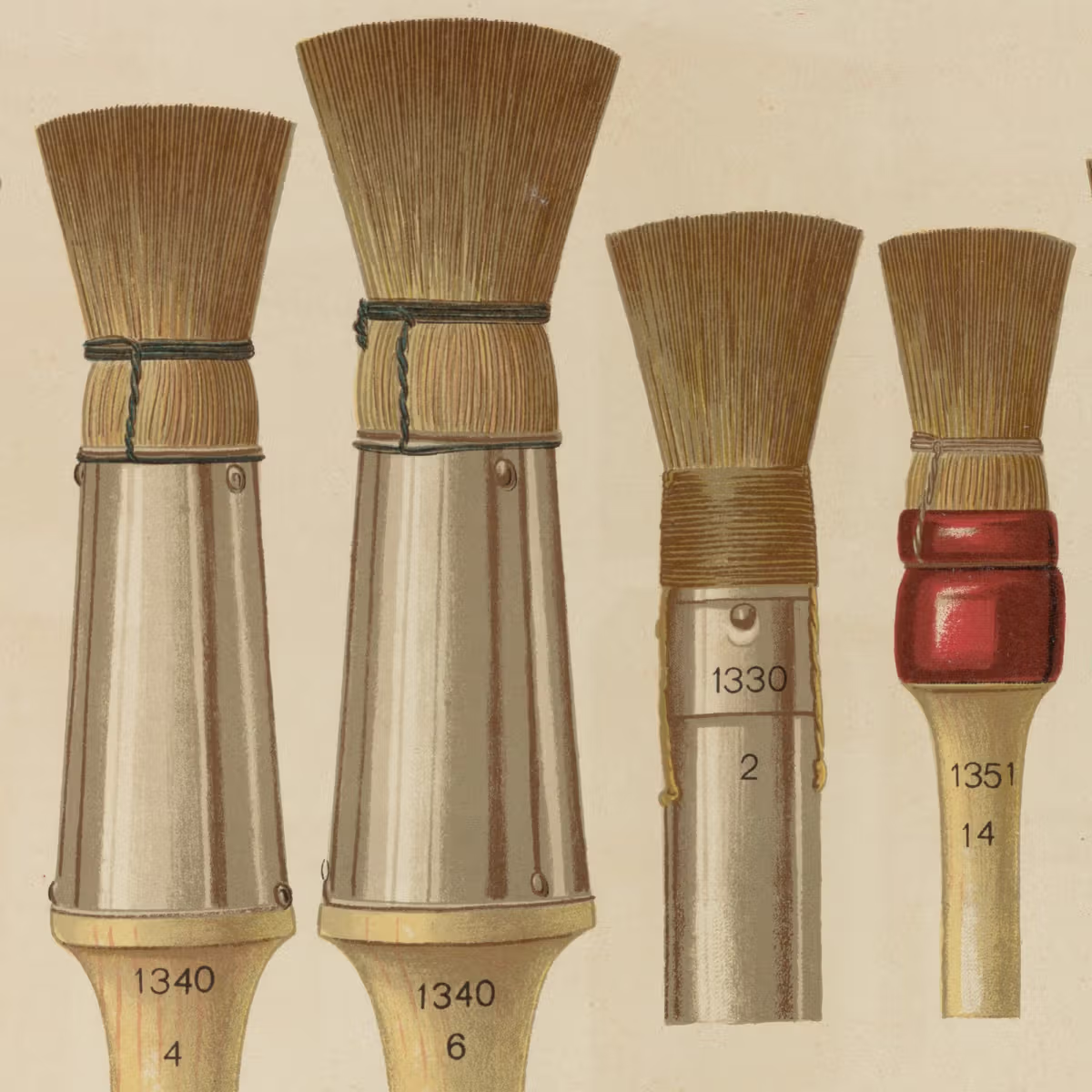
Detail of a page of brushes from Pinselfabrik Ernst Findeisen GmbH. Erstklassige Pinsel-Fabrikate Für Kunst-Handwerk u. Industrie: Ernst Findeisen, Ravensburg (Ravensburg: Ernst Findeisen, early 20th century), illustrated book, 1 volume, 21 × 31 cm (New York: The Watson Library, The Metropolitan Museum of Art).
Trade or sale catalogs—also called commercial or manufacturer’s catalogs—are printed publications advertising products of a particular trade or industry. Sale catalogs were often used in shops or showrooms to promote a company’s products. Examples include the massive Reed and Barton catalog Artistic workers in silver & gold plate from 1885 that illustrates the entire inventory of the company. Since their invention, automobiles have been creatively promoted through catalogs. Automobile catalogs in the library’s collection range from vivid brochures to oversized car showroom copies with moveable diagrams and transparencies to intrigue and persuade the customer, including 1953 Chevrolet and 1961 Buick.
Sale catalogs are valuable sources for determining the date and authenticity of objects and are often highly expressive of their historical moment. They frequently represent the most innovative and creative examples of printing and graphic design, used by manufacturers and publishers to best illustrate their products. Watson’s trade catalogs include striking illustrations reproduced in lithography, chromolithography, embossing, and pochoir. Many of the catalogs in the exhibition have striking designs and demonstrate graphic innovation that can be as compelling as the objects they promote.
Among the more unusual and appealing trade catalogs in the exhibition is a German Art Nouveau-inspired cake decorating book from 1910 and a baby carriage catalog from 1934 offering Art Deco styled tubular steel baby prams. These trade catalogs demonstrate the distillation of major art movements applied to quotidian objects.
The earliest trade catalog in the exhibition is Muster zu Zimmer-Verzierungen und Ameublements, a neo-classical interior design catalog by luxury German manufacturer Voss und Compagnie, offering entire rooms that can be bought en masse or as separate pieces. It is illustrated with richly toned hand-colored engravings that detail the design and color of the objects.
One of the library’s most fragile and weighty catalogs is Album des principaux modeles de verres: produits spéciaux en verre coulé. It is a magical trade catalog with sixty-five intact glass samples manufactured by French glassmaker Saint-Gobain. Founded during the time of Louis XIV, the company remains a manufacturer of glass for construction.
The majestic ironwork catalogue of Maison Garnier has pink-tinted papers and was bound in Morocco leather as a special copy for Rémy Garnier, the son of the firm’s founder. The firm’s initials are boldly blind stamped on the cover.
The most unusual and perhaps unexpected catalog, Urinoirs, illustrates the decorative ironwork structures of urinals (or pissoirs) that adorned the streets of Paris from the 1840s to the mid-twentieth century. The ornamentation of these structures demonstrates an impulse to beautify the animated street life of Paris and other cities.
Many of the trade catalogs have been digitized. All of the trade catalogs in Watson Library are accessible and can be consulted in the Florence and Herbert Irving Reading Room. The thirty-three on display will be available immediately after the exhibition’s closing in early March 2025. Information on using the library is here.
Master Drawings, Winter 2024
In the latest issue of Master Drawings:
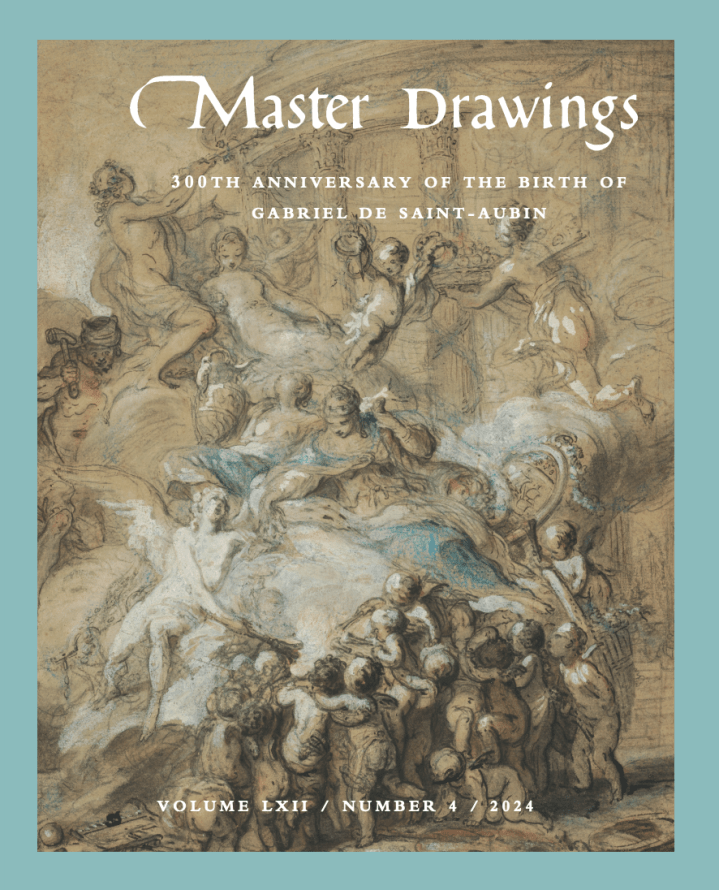
Master Drawings 62.4 (Winter 2024)
 a r t i c l e s
• Perrin Stein, “The Crown, the City, and the Public: Saint-Aubin’s Images of Paris.”
• Kim de Beaumont, “A Curious Swan Song for Gabriel de Saint-Aubin: The Comte d’Estaing’s New World Naval Exploits.”
• Margaret Morgan Grasselli, “A Drawing by Hubert Robert and Jean Robert Ango: Correcting a Technical Description.”
• Sarah Catala, “Signed ‘Roberti’: Drawings by Hubert Robert and Jean Robert Ango.”
• Kee Il Choi Jr., “Learning to Draw: The Éducation visuelle of Alois Ko and Étienne Yang.”
r e v i e w s
• Aaron Wile, Review of the exhibition catalogue Claude Gillot: Satire in the Age of Reason, by Jennifer Tonkovich.
• Eduoard Kopp, Review of the exhibition catalogue, Promenades on Paper: Eighteenth-Century French Drawings from the Bibliothèque Nationale de France, edited by Esther Bell, Sarah Grandin, Corinne Le Bitouzé, and Anne Leonard.
• Ashley E. Dunn, Review of the exhibition catalogue Impressionists on Paper: Degas to Toulouse-Lautrec, by Ann Dumas, Leïla Jarbouai, Christopher Lloyd, and Harriet Stratis.
o b i t u a r y
• Perrin Stein, Obituary for Alaster Laing.
Exhibition | L’Isle-Adam across Three Centuries
Now on view:
Trois siècles à L’Isle-Adam
Musée d’art et d’histoire Louis Senlecq, L’Isle-Adam, 20 October 2024 — 21 September 2025
 À vingt-cinq kilomètres à vol d’oiseau de Paris, L’Isle-Adam se trouve aux portes du parc naturel régional du Vexin français, du Pays de France et du département de l’Oise. Qualifiée de « paradis terrestre » par Honoré de Balzac dans une lettre qu’il écrit à sa soeur en 1819, la ville bénéficie d’un environnement exceptionnel situé entre rivière et forêt domaniale. Avec l’exposition Trois siècles à L’Isle-Adam, les visiteurs sont invités à un voyage à travers l’histoire et le patrimoine de la cité adamoise et de son territoire.
Organisé de manière chronologique et couvrant une période allant du XVIIIe au milieu du XXe siècle, le parcours s’articule autour des grandes thématiques représentées dans les collections du musée. L’histoire et l’évolution urbaine de L’Isle-Adam y sont évoquées : des fastes des princes de Conti au développement de la villégiature et des loisirs. Le passé industrieux de la ville est également mis en avant, avec les manufactures de terres cuites décoratives qui ont fait la célébrité de L’Isle-Adam de la fin du XIXe au début du XXe siècle.
La région ayant attiré de nombreux artistes, c’est aussi à travers l’oeil des peintres que l’on découvre les paysages des bords de l’Oise et de la campagne environnante, par les toiles de Jules Dupré (1811–1889), Léon Victor Dupré (1816–1879), Auguste Boulard père (1825–1897), Renet-Tener (1846–1925), Fernand Quignon (1854–1941) et Emilio Boggio (1857–1920).
L’exposition rassemble peintures, sculptures, aquarelles, gravures, affiches publicitaires, cartes postales et photographies anciennes, toutes issues du fonds du musée.
The Burlington Magazine, January 2025
.
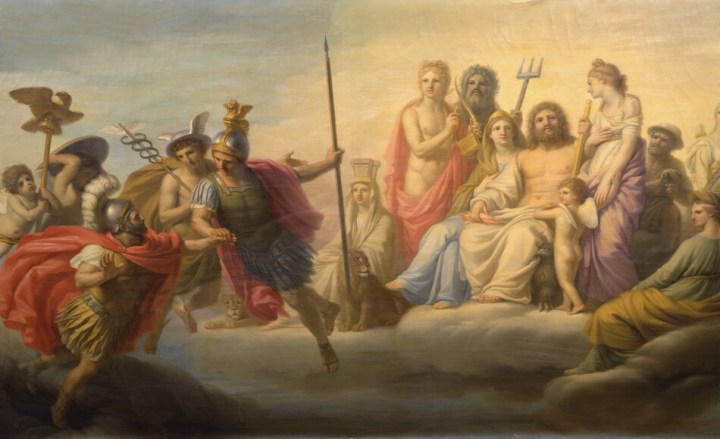
Stefano Tofanelli, Apotheosis of Romulus before the Gods of Olympus, 1790, oil on canvas, 208 × 318 cm
(Rome: Palazzo Altieri)
◊ ◊ ◊ ◊ ◊
The long 18th century in the January issue of The Burlington:
The Burlington Magazine 167 (January 2025)
e d i t o r i a l
• “A One Billion Pound Gift,” p. 3.
“Now you can gasp,” said the Chairman of the Trustees of the British Museum to guests at a recent fundraising dinner. He had just revealed the valuation of £1billion for the magnificent collection of Chinese ceramics that has been given to the museum by the Sir Percival David Foundation. Munificence on this scale is normally only associated with the richest of American museums, so a new record seems to have been set in the European context by this extraordinary gesture.
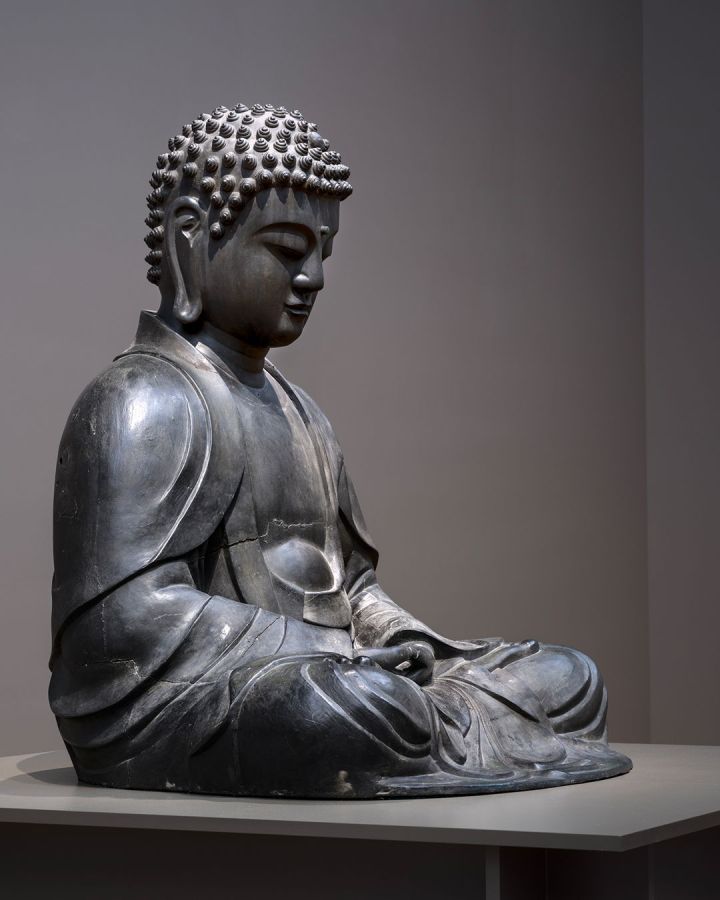
Buddha Amida (Amitabha), Japan, 1716 (Collection Wereldmuseum). Included in the exhibition Asian Bronze: 4,000 Years of Beauty.
s h o r t e r n o t i c e s
• Pilar Diez del Corral Corredoira, “A Project for the Church of Menino Deus, Lisbon, by Vieira Lusitano,” pp. 26–29.
• Alessio Cerchi, “Stefano Tofanelli’s Deification of Aeneas by Venus Rediscovered,” pp. 29–31.
r e v i e w s
• Lori Wong and Sujatha Arundathi Meegama, Review of the exhibition Asian Bronze: 4,000 Years of Beauty (Rijksmuseum, 2024–25), pp. 35–37.
• Delphine Bastet, Review of Grands décors restaurés de Notre-Dame de Paris, edited by Caroline Piel and Emmanuel Pénicaut (Silvana Editoriale, 2024), pp. 62–63.
• Peter Humfrey, Review of Anne Nellis Richter, The Gallery at Cleveland House: Displaying Art and Society in Late Georgian London (Bloomsbury, 2024), pp. 71–72.
Conference | Nature into Art
From ArtHist.net:
Nature into Art
Schloss Nymphenburg, Munich, 11–12 February 2025
Registration due by 2 February 2025
From 26 November 2024 to 16 March 2025, the Alte Pinakothek in Munich is hosting the world’s first major monographic exhibition on Rachel Ruysch. The exhibition is a collaborative effort between the Alte Pinakothek, the Toledo Museum of Art, and the Museum of Fine Arts, Boston. Rachel Ruysch (1664–1750) has always been regarded as one of the most important flower painters in European art, but her life and work have remained insufficiently researched to date. In addition to her perfected fine painting technique, her still lifes—featuring flowers, leaves, fruits, and insects rendered in the finest detail—reflect her interest in botanical and scientific subjects.
In conjunction with the exhibition Rachel Ruysch: Nature into Art and the CODARTfocus in Munich, the workshop Nature into Art will take place February 11–12 at Schloss Nymphenburg in München. The workshop aims to deepen new perspectives gained from the exhibition, particularly regarding the interplay between art and science. The speakers represent the interdisciplinary approach of the exhibition, which are derived from different scientific fields, such as art history, conservational sciences, postcolonial studies, and gender studies, as well as researchers with a botanical focal point. The workshop is intended to sustainably deepen the network of scholars with unique scientific approaches and from different countries, universities, research institutions, and museums. Participation of students from the University of Konstanz will involve the next generation of scholars and raise awareness for current research in the field of early modern painting.
Participation in the event is free of charge, but registration is requested. For more information and to register for the workshop, please contact laura.kromer@uni-konstanz.de until 2 February 2025.
Organizers
Christopher Atkins (Center for Netherlandish Art at the Museum of Fine Arts in Boston), Robert Felfe (University of Graz), Karin Leonhard (University of Konstanz), and Thijs Weststeijn (University of Utrecht)
t u e s d a y , 1 1 f e b r u a r y
9.00 Arrival
9.30 Opening Remarks
10.00 Morning Talks
• Marlena Schneider (Doerner Institut – Bayerische Staatsgemäldesammlungen) — Art Technological Insights on Five Paintings by Rachel Ruysch from the Former Wittelsbach Electoral Collections
• Kirsten Derks (University of Antwerp) — Tried and Tested? Rachel Ruysch’s Working Methods in Her Mature and Late Works
• Larissa van Vianen (University of Amsterdam) — From Observation to Publication: Pierre Lyonet and the Art of 18th-Century Natural History
• Jaya Remond (Ghent University) — Printing Floral Imagery in Northern Europe, c. 1590–1610: Pictorial Discourses and Frames of Representation
13.30 Lunch
14.30 Afternoon Talks
• Marie Amélie Landrin (Sorbonne University) — Rachel Ruysch: Botanical Art at the Intersection of Science and Patronage
• Laura Kromer (University of Konstanz) — The Companion Pieces of Rachel Ruysch: Intertwinings of Pictorial Combination
• Catherine Powell-Warren (KU Leuven) — TBA
17.00 Closing Remarks
17.30 Reception
18.00 Judith Noorman (University of Amsterdam) — Presentation
w e d n e s d a y , 1 2 f e b r u a r y
10.00–12.00 Study day in the exhibition Rachel Ruysch: Nature into Art at the Alte Pinakothek, Munich
Students from the University of Konstanz will offer tailored guided tours.
Research Seminar | Artists and the East India Company, 1760–1830
Upcoming at the Mellon Centre:
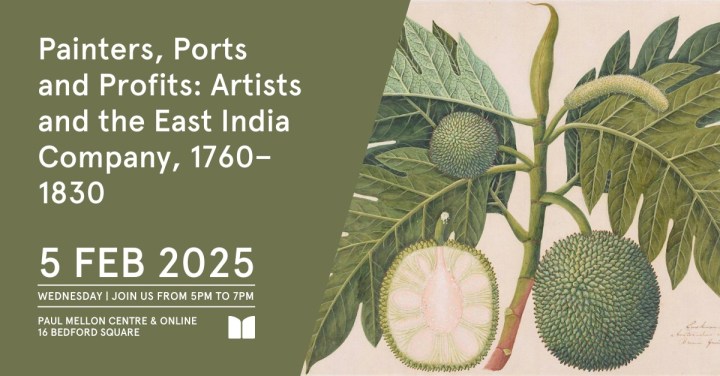
Holly Shaffer and Laurel Peterson | Painters, Ports, and Profits: Artists and the East India Company, 1760–1830
Online and in-person, Paul Mellon Centre, London, 5 February 2025, 5pm
In January 2026, the Yale Center for British Art (YCBA) will open Painters, Ports, and Profits: Artists and the East India Company, 1760–1830. This exhibition explores the interactions between artists trained in India, China, and Britain amid the relentless commercial ambitions of the East India Company at key ports and centres of trade in Asia. Featuring over a hundred objects drawn from the YCBA collection in various media—including architectural drafts, opaque watercolours, hand-coloured aquatints and small- and large-scale portraits—the exhibition highlights works by artists who are no longer well known alongside those of well-established ones. Brought together for the first time, these works tell a story of artists compelled by new subjects, styles and materials in expanding markets, profoundly affecting art within and beyond Asia.
As the power of the British empire waned in the twentieth century, ‘Company painting’ became a prevalent umbrella term to describe works made for Company officials, specifically by Indian artists, and ‘Export art’ became a descriptor for works created by Chinese artists for a European market. Painters, Ports, and Profits challenges and critically rethinks these terms while also putting the arts into dialogue. It presents an expanded conception of arts made under the auspices of the Company by focusing on artists trained in different ways who worked for Company patrons as well as commercial markets in India, China, and Britain; the types of subjects in which they specialised; and the artistic materials with which they experimented. By examining the range of arts and relationships developed during the Company’s relentless pursuit of profits, the exhibition sheds light on aesthetic and colonial discourses that were formed in the eighteenth and nineteenth centuries and persist today. Co-curators Laurel Peterson and Holly Shaffer will preview the themes and objects explored in the exhibition and the related catalogue.
Book tickets here»
Holly Shaffer is Robert Gale Noyes Assistant Professor of Humanities in the department of history of art and architecture at Brown University. Her research focuses on eighteenth- and nineteenth-century arts in Britain and South Asia, and their intersections. Her first book, Grafted Arts: Art Making and Taking in the Struggle for Western India, 1760–1910 (London and New Haven: Paul Mellon Centre with Yale University Press, 2022), was awarded the Edward C. Dimock Jr. Prize in the Indian Humanities and an Historians of British Art Book Award. In 2011, she curated Adapting the Eye: An Archive of the British in India, 1770–1830 at the YCBA, and in 2013, Strange and Wondrous: Prints of India from the Robert J. Del Bontà Collection at the National Museum of Asian Art. She has published essays in Archives of Asian Art, The Art Bulletin, Art History, Journal 18, Modern Philology, and Third Text, and recently edited volume 51 of Ars Orientalis on the movement of graphic arts across Asia and Europe.
Laurel O. Peterson is the Assistant Curator of Prints and Drawings at the Yale Center for British Art. She specialises in British works on paper produced during the long eighteenth century. She served as the organising curator of John Singer Sargent: Portraits in Charcoal in 2019 and as co-curator of Architecture, Theater, and Fantasy: Bibiena Drawings from the Jules Fisher Collection in 2021, both at the Morgan Library and Museum. She received her PhD in the history of art from Yale and her research has been supported by the Sir John Soane’s Museum Foundation, the Paul Mellon Centre for Studies in British Art, and the Lewis Walpole Library. She has held positions at the British Museum and the Morgan Library.
Image: Unknown artist (Company style), Breadnut (Artocarpus camansi), ca. 1825, watercolor, gouache, and graphite (New Haven: Yale Center for British Art, Paul Mellon Fund, B2022.5).
Exhibition | Carved Couture: 18th-Century British Wooden Fashion Dolls
Opening in January at the Barry Art Museum:
Carved Couture: 18th-Century British Wooden Fashion Dolls
Barry Art Museum, Old Dominion University, Norfolk, Virginia, 28 January — 31 July 2025
 In 2025, the Barry Art Museum will continue its series of historical doll exhibitions by taking a closer look at English wooden dolls.
Popular among affluent consumers between the seventeenth and eighteenth centuries, these dolls acted as three-dimensional fashion plates for viewers, their simple bodies a backdrop for showcasing elegant clothing in miniature. Centuries before Barbie dazzled the world with her extensive wardrobes and accessories, English wooden dolls modeled the latest fashions for their privileged viewers. In keeping with the Barry’s commitment to showcasing the richness of Hampton Roads’ art and material culture, this show will highlight not only works from our permanent collection but also objects from Colonial Williamsburg and local private collectors.
The full press release is available here»
◊ ◊ ◊ ◊ ◊
Note (added 5 February 2025) — The posting was updated to include a link to the press release.
Exhibitions at the Prado in 2025
From the press release:
The Museo Nacional del Prado has announced an exciting program for 2025, promising a year of rich artistic exploration. From monographic exhibitions of Old Masters to a fascinating look at the impact of Mexican iconography in Spain, and a celebration of women’s contributions to art history, the Prado’s 2025 season offers something for everyone.

Antón Rafael Mengs, Self-Portrait, 1761–69, oil on panel, 63 × 50 cm (Madrid: Museo Nacional del Prado).
Following a 2024 season focused on thematic exhibitions, the Prado is returning to the intimate study of individual artists. Three giants from its collection will be the focus of major solo shows: El Greco and Veronese in the first half of the year, followed by Anton Raphael Mengs in the latter half.
A Reunion for El Greco’s Masterpiece
Kicking off the year is El Greco: Santo Domingo el Antiguo (18 February — 15 June), an exhibition that will reunite, for the first time since 1830, the majority of works El Greco created for the Monastery of Santo Domingo el Antiguo in Toledo. This significant commission, which included a grand altarpiece and two side altarpieces, has seen its components scattered across the globe. Thanks to a special agreement with the Art Institute of Chicago, the breathtaking Assumption of the Virgin will return to the Prado after more than a century, joining other works from the museum’s collection and various other holdings.
Veronese: A Venetian Master in the Spotlight
Next up is Paolo Veronese (1528–1588) (27 May — 21 June), an exhibition that culminates the Prado’s ongoing study and re-evaluation of its world-renowned Venetian Renaissance painting collection. Following successful shows on the Bassanos, Titian, Tintoretto, and Lorenzo Lotto, this exhibition shines a light on Veronese’s importance, particularly his influence on Spanish art during the Golden Age. The exhibition will explore Veronese’s creative process, his workshop’s organization, and his remarkable ability to capture the aspirations of Venetian elites, a style that resonated with European courts.
A Journey Across the Atlantic: Guadalupe in Spain
Shifting gears, the Prado will present So Far, So Close: Guadalupe of Mexico in Spain (10 June — 14 September). This exhibition will trace the remarkable journey of the Virgin of Guadalupe’s image from New Spain (colonial Mexico) to Spain, examining its profound impact on art on both sides of the Atlantic. This exhibition builds on the Prado’s ongoing exploration of the artistic exchange between Spain and the Americas, continuing the work started with the 2021 exhibition Tornaviaje.
The Sculptural World of Juan Muñoz
Later in the year, the Prado will focus on contemporary sculpture with an exhibition dedicated to Juan Muñoz (18 November 2025 — 8 March 2026). Curated by Vicente Todolí, the exhibition will explore Muñoz’s dialogue with art history, particularly his inspirations drawn from Renaissance and Baroque masters like Velázquez and Goya. The exhibition will examine Muñoz’s use of theatricality, illusionism, and architecture, and how he captured fleeting moments in time, echoing the styles of his artistic predecessors.
Mengs: A Major Retrospective
Closing out the monographic exhibitions is Anton Raphael Mengs: The Greatest Painter of the 18th Century (25 November 2025 — 1 March 2026). This will be the most comprehensive exhibition of Mengs’ work to date, featuring approximately 150 pieces, including paintings, watercolors, pastels, drawings, and even his fresco Jupiter and Ganymede. The exhibition promises a complete overview of Mengs’s artistic practice, his influences, and his connections to other great masters like Raphael, Correggio, and Pompeo Batoni.
Celebrating Women’s Contributions to Art History
The Prado remains committed to highlighting the often-overlooked contributions of women to art history. The third edition of The Prado in Feminine will focus on the 18th century, exploring the legacy of influential women who played a crucial role in shaping the museum’s collections. The exhibition will focus on figures like María Luisa Gabriela de Saboya, María Luisa de Parma, and especially Queen Isabel de Farnesio, a key figure in both politics and art collecting in 18th-century Europe.
A Hub for Research and Learning
Beyond the exhibitions, the Prado’s Center for Studies will offer a rich program of lectures and residencies. Lecture cycles like Spanish Intellectual Women and the Museo del Prado will explore the museum’s role in the intellectual and social awakening of Spanish women in the 19th century. The Writing the Prado residency, in partnership with the Loewe Foundation and Granta in Spanish, will host acclaimed writers Helen Oyeyemi and Mathias Énard. There will also be a Pérez-Llorca Conference by Robert Lane Fox on classical antiquity and the Prado Chair led by Astrid Schmidt-Bukhardt on genealogical diagrams in art history. The Prado’s 2025 program promises to be a vibrant and engaging exploration of art from various periods and perspectives.
Exhibition | Monstrous Beauty: A Feminist Revision of Chinoiserie
Opening in March at The Met:
Monstrous Beauty: A Feminist Revision of Chinoiserie
The Metropolitan Museum of Art, New York, 25 March — 17 August 2025

Monstrous Beauty: A Feminist Revision of Chinoiserie radically reimagines the story of European porcelain through a feminist lens. When porcelain arrived in early modern Europe from China, it led to the rise of chinoiserie, a decorative style that encompassed Europe’s fantasies of the East and fixations on the exotic, along with new ideas about women, sexuality, and race. This exhibition explores how this fragile material shaped both European women’s identities and racial and cultural stereotypes around Asian women. Shattering the illusion of chinoiserie as a neutral, harmless fantasy, Monstrous Beauty adopts a critical glance at the historical style and its afterlives, recasting negative terms through a lens of female empowerment.
Bringing together nearly 200 historical and contemporary works spanning from 16th-century Europe to contemporary installations by Asian and Asian American women artists, Monstrous Beauty illuminates chinoiserie through a conceptual framework that brings the past into active dialog with the present. In demand during the 1700s as the embodiment of Europe’s fantasy of the East, porcelain accumulated strong associations with female taste over its complex history. Fragile, delicate, and sharp when broken, it became a resonant metaphor for women, who became the protagonists of new narratives around cultural exchange, consumption, and desire.
The catalogue is distributed by Yale University Press:
Iris Moon, ed., Monstrous Beauty: A Feminist Revision of Chinoiserie (New York: The Metroplitan Museum of Art, 2025), 256 pages, ISBN: 978-1588397928, $35. With additional contributions by Marlise Brown, Patty Chang, Anne Anlin Cheng, Elizabeth Cleland, Patricia Ferguson, Eleanor Hyun, Cindy Kang, Ronda Kasl, Joan Kee, Pengliang Lu, Lesley Ma, David Porter, Joseph Scheier-Dolberg, Elizabeth Kowaleski Wallace, Chi-ming Yang, and Yao-Fen You.
Exhibition | Recasting the Past: The Art of Chinese Bronzes, 1100–1900

Incense Burner in the Form of a Goose, Ming dynasty (1368–1644), early 15th century, bronze
(New York: The Metropolitan Museum of Art).
◊ ◊ ◊ ◊ ◊
From the press release (9 January) for the exhibition:
Recasting the Past: The Art of Chinese Bronzes, 1100–1900
The Metropolitan Museum of Art, New York, 28 February — 28 September 2025
Shanghai Museum, 3 November 2025 — 8 March 2026
Curated by Pengliang Lu
In ancient China, bronze vessels were emblems of ritual and power. A millennium later, in the period from 1100 to 1900, such vessels were rediscovered as embodiments of a long-lost golden age that was worthy of study and emulation. This ‘return to the past (fugu) was part of a widespread phenomenon across all the arts to reclaim the virtues of a classical tradition. An important aspect of this phenomenon was the revival of bronze casting as a major art form. Opening at The Metropolitan Museum of Art on 28 February 2025, Recasting the Past: The Art of Chinese Bronzes, 1100–1900 aims to be the most comprehensive study of Chinese bronzes during this period. This exhibition, co-organized by The Met and the Shanghai Museum, where it will open following its display in New York, will present the new aesthetic represented by these creative adaptations of the past, while exploring their cultural and political significance throughout China’s long history.
 “While bronze as an art form has long held a significant role throughout China’s history, this exhibition explores an often-overlooked time period when a resurgence of craftsmanship and artistic achievements revitalized the medium,” said Max Hollein, The Met’s Marina Kellen French Director and Chief Executive Officer. “Bringing together major loans from institutions in China alongside works from The Met collection, this exhibition offers viewers an important opportunity to better understand the lasting aesthetic and cultural impact of bronze objects.”
The exhibition will be divided into five thematic and chronological sections that explicate over 200 works of art—an array of bronze vessels complemented by a selection of paintings, ceramics, jades, and other media. Some 100 pieces from The Met collection will be augmented by nearly 100 loans from major institutions in China, Japan, Korea, Germany, France, the United Kingdom, and the United States to present the most comprehensive narrative of the ongoing importance of bronzes as an art medium throughout China’s long history. Featured in the exhibition are around 60 loans from institutions in China, including major works such as a monumental 12th-century bell with imperial procession from the Liaoning Provincial Museum, documented ritual bronzes for Confucian temples from the Shanghai Museum, and luxury archaistic vessels made in the 18th-century imperial workshop from the Palace Museum, Beijing.
The exhibition begins with the section “Reconstructing Ancient Rites,” which introduces how emperors and scholar-officials commissioned ritual bronzes from the 12th to the 16th century as part of an effort to restore and align themselves with antique ceremonies and rites. The exhibition continues with “Experimenting with Styles,” illustrating how the form, decoration, and function of ancient bronzes were creatively reinterpreted from the 13th to the 15th century. The next section, “Establishing New Standards,” will explore further transformations in both the aesthetic and technical direction of bronze making from the 15th to the 17th century. The fourth section, “Living with Bronzes,” will feature a display in the Ming Furniture Room (Gallery 218) to demonstrate how bronzes were used in literati life from the 16th to the 19th century. The last section, “Harmonizing with Antiquity,” will examine how the deep scholarly appreciation of archaic bronzes during the 18th and 19th centuries led to a final flourishing of bronze production.
Pengliang Lu, Brooke Russell Astor Curator of Chinese Art at The Met, said: “This exhibition attempts a long-overdue reevaluation of later Chinese bronzes by seeking to establish a reliable chronology of this art form across the last millennium of Chinese history. The exhibition will also distinguish outstanding works from lesser examples based on their artistic and cultural merits.”
Later Chinese bronzes have long been stigmatized as poor imitations of ancient bronzes rather than being seen as fundamentally new creations with their own aesthetic and functional character. This exhibition redresses this misunderstanding by showcasing their artistic virtuosity, innovative creativity, and wide cultural impact. Through archaeologically recovered examples and cross-medium comparisons to a wide range of objects, the exhibition demonstrates the ongoing importance and influence of bronzes as well as how they inspired the form and function of works in other media. Recasting the Past: The Art of Chinese Bronzes, 1100–1900 is curated by Pengliang Lu, Brooke Russell Astor Curator of Chinese Art at The Metropolitan Museum of Art.
The catalogue is distributed by Yale University Press:
Pengliang Lu, Recasting the Past: The Art of Chinese Bronzes, 1100–1900 (New York: The Metropolitan Museum of Art, 2025), 320 pages, ISBN: 978-1588397904, $65.










leave a comment