Exhibition: The Tragic Muse in Chicago
From the Smart:
The Tragic Muse: Art and Emotion, 1700-1900
Smart Museum of Art, University of Chicago, 10 February — 5 June 2011
Curated by Anne Leonard

Noël Hallé, detail of "Joseph Accused by Potiphar’s Wife," c. 1740–44 (Chicago: Smart Museum of Art)
Art is often appreciated for its ability to delight our eyes and refresh our minds. But it can also serve as a powerful vehicle for exploring darker emotions, such as fear, sadness, and grief. And while these themes have a history dating back to the ancients, the ways in which they have been represented in art has changed dramatically over time.
This exhibition examines two centuries of works intertwined with emotion—from the sacrifice of classical heroines to the grief of ordinary people, from martyred saints to actors in tragic roles—and explores how art’s cathartic power grows or fades for new generations of viewers. With over forty paintings, sculptures, and prints, The Tragic Muse combines works from the Smart’s collection—both long-held treasures and new acquisitions—with important loans from the Art Institute of Chicago, Milwaukee Art Museum, National Gallery of Art, and Tate. Together with an accompanying catalogue, the exhibition draws on the scholarship of University of Chicago faculty to offer fresh insight into the visual representation of tragedy and art’s power to express and elicit intense emotions.
This exhibition is one in a series of projects at the Smart Museum of Art supported by an endowment from the Andrew W. Mellon Foundation that fosters interdisciplinary use of the Museum’s collections by University of Chicago faculty and students in both courses and special exhibitions. The Tragic Muse exhibition catalogue has received additional grant support from the Samuel H. Kress Foundation.
◊ ◊ ◊ ◊ ◊
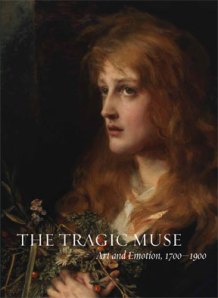 Anne Leonard with contributions by Joyce Suechen Cheng, Glenn W. Most, Erin Nerstad, Sarah Nooter, and Thomas Pavel, The Tragic Muse: Art and Emotion, 1700-1900, exhibition catalogue (Chicago: Smart Museum of Art, 2011), 128 pages, ISBN: 9780935573497, $30.
Published to coincide with the Smart Museum of Art’s exhibition The Tragic Muse, the publication draws on the work of several distinguished scholars to examine the richly varied representation of tragedy in the European artistic tradition over the course of two centuries. This catalogue is generously illustrated with full-color reproductions of all the works contained in the exhibition, and the fascinating contributions offer new insights into the approaches taken by the visual arts, as well as literature and drama, in expressing and eliciting strong emotions.
Exhibition: Baroque Ivory at the Court of Vienna
From the Liebieghaus Skulpturensammlung:
Ivory: Baroque Splendor at the Viennese Court / Elfenbein: Barocke Pracht am Wiener Hof
Liebieghaus Skulpturensammlung, Frankfurt am Main, 3 February — 26 June 2011
Curated by Maraike Bückling and Sabine Haag

Ignaz Bendl (1682–1730) "Medaillon commemorating the erection of the mercy columm," ca. 1692
Ivory has been one of the most popular materials since ancient times. Its origins in unknown faraway lands and its rarity account for its costliness. It was particularly the Baroque era that had an extraordinarily high demand for ivory. In the seventeenth century, ivory work reached its culmination in Vienna in the days of Prince Karl Eusebius of Liechtenstein and Emperor Leopold I. The shimmering appearance of the polished material served princely-imperial claims to prestige, as its possession testified to its owners’ power and wealth. The exhibition Ivory: Baroque Splendor at the Court of Vienna, presented in the Liebieghaus Skulpturensammlung from February 3 to June 26, 2011, will focus on this heyday of ivory art. It will feature thirty-six splendid, virtuoso carvings impressively documenting the artisans’ great skill, among them masterly executed statuettes, pitchers, goblets, tankards, and bowls of ivory, objects created for display in so-called cabinets of curiosities and not intended for any practical use. The show comprises works by the most famous ivory artists of the Baroque period, such as Adam Lenckhardt, Johann Caspar Schenck, and Matthias Steinl. It was prepared together with the Kunsthistorisches Museum in Vienna, whose world-renowned Cabinet of Wonders is closed for the time being because of comprehensive restoration measures. This presented the Liebieghaus with the unique opportunity to show a high-caliber selection of masterpieces from the Kunstkammer of the Kunsthistorisches Museum in Frankfurt before the items will be on display again on a permanent basis in Vienna after the Cabinet’s reopening in late 2012. Eight additional high-carat loans come from the Reiner Winkler Collection.

Matthias Steinl (1643/44–1727) "Allegory of the Elements of Water and Air," ca. 1688
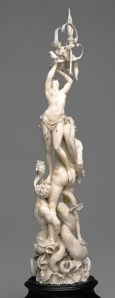
Matthias Steinl (1643/44–1727) "Allegory of the Elements of Water and Air," ca. 1688
In Ancient Greece, Phidias already created large statues of gods whose skin was executed in ivory, and the Bible describes Solomon’s throne as made up of ivory parts. It was above all in the Middle Ages and in the Baroque era that ivory was held in high esteem as a material. The great demand finally resulted in the emergence of new ports of entry in the seventeenth century; both the East India Company and the West India Company furthered the transport of African ivory in particular. The concentration on necessarily small-format ivory works fit in well with the fact that there were hardly any or no commissions at all conferred for large-size church or palace interiors during the Thirty Years’ War and the plague epidemics. Sculptors and their clients increasingly or entirely dedicated themselves to small mobile sculptures.
In the Renaissance and Mannerist periods, bronze was preferred for small sculptures. Yet, ivory outstripped the material in the course of the seventeenth century. People appreciated its combination of elasticity and hardness, as well as its gleaming transparency and delicate veining resembling the tone of flesh. The heyday of the production of ivory works in the seventeenth century was based on sixteenthcentury ivory turnery, on such early examples as those by the Master of the Furies. Besides the major bourgeois towns, the secular and ecclesiastical capitals became centers of ivory production from about 1650 on – a development that did not come to an end before the early eighteenth century. Ivory carvers were to be found mainly in Munich and Augsburg, but also in Schwäbisch Hall, Ulm, Mechlin, Amsterdam, Dresden, and Düsseldorf. (more…)
Exhibition: 300 Years of Exuberant Menswear
Press release from the Philadelphia Museum of Art:
The Peacock Male: Exuberance and Extremes in Masculine Dress
Philadelphia Museum of Art, 22 January — June 2011
Curated by Kristina Haugland
This lively exhibition contradicts the notion of men’s apparel as staid and restrained, especially when compared to women’s fashions. The Peacock Male: Exuberance and Extremes in Masculine Dress, drawn primarily from the Museum’s collection of Western fashion, examines 300 years of men’s sartorial display and includes flamboyant clothing as well as colorful accessories. It will be on view from January 22 through June 2011. “It’s a pleasure to be able to look at men’s clothing from a different perspective, as it is a subject that is often overlooked, even though menswear is now so creative and diverse,” said Kristina Haugland, Associate Curator of Costume and Textiles and Supervising Curator for the Study Room and Academic Relations. “Most people are surprised to find just how eye-catching men sought to be in the past, sporting extravagant floral embroidery, feathers, and flashy patterns. The exhibition is a great chance to show the wild side of masculine wear, from fur-crested helmets to high-tech sneakers.”
The exhibition opens with a look at the rich clothing worn by the eighteenth-century elite, from lavishly embroidered suits to zigzag-patterned silk stockings. During the nineteenth century, menswear tended to be sober by comparison, but could be accented with colorful accessories such as waistcoats, slippers or suspenders. Thematic sections in the exhibition highlight those occasions when even the most reserved man could don eye-catching clothes. A section dedicated to men’s costumes includes a star-spangled “Uncle Sam” outfit from the early twentieth century, a fuchsia silk satin fancy-dress ensemble from the late nineteenth century, and two mummers’ costumes – an English example from 1829 and a “Handsome Costume” made for Philadelphia’s famous parade in the 1990s, which represents a resplendent peacock with a ten-foot-wide tail. (more…)
Conference at Tate Britain: ‘British Art 1660-1735, Close Readings’
From the University of York:
British Art 1660-1735: Close Readings
Tate Britain, 20 May 2011
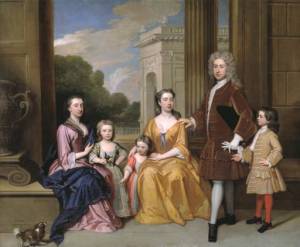
Sir Godfrey Kneller, "The Harvey Family," 1721 (Tate Britain)
This conference will showcase some of the latest scholarship on art and artists in this dynamic period. Focusing on the detailed study of works of art, the event is designed to open up new perspectives on their place within British culture. This is the second of a series of major scholarly events hosted by the AHRC-supported research project Court, Country, City: British Art 1660-1735. This three-year project runs from October 2009 to September 2012, and is led by Professor Mark Hallett of the University of York and Professor Nigel Llewellyn and Dr Martin Myrone of Tate Britain.
- Anthony Geraghty (University of York), Robert Streeter at the Sheldonian
- Helen Pierce (University of Aberdeen), Francis Barlow: The political animal
- Christine Stevenson (Courtauld Institute), Court, city, cosmos: meditations of London’s second Royal Exchange
- Sarah Monks (University of East Anglia), Drawing fire: the van de Veldes, and the imagery and implications of late Stuart naval conflict
- Jacqueline Riding (University of York), Joseph Highmore’s ‘David Le Marchand’ and the search for Kneller’s heir
- Mark Hallett (University of York), Genres and Transformations: Reflections on the first ‘Court, Country, City’ display
The conference is free, but you must register to attend. Please email Clare Bond, at cecs1@york.ac.uk, or write to the Centre for Eighteenth Century Studies, University of York, The King’s Manor, Exhibition Square, York Y01 7EP, with your name, address, and affiliation, if any.
There will be an opportunity at lunch time to see the Court, Country, City Display in Room 3 (see below).
◊ ◊ ◊ ◊ ◊
Court, Country, City: British Art 1660-1735
Tate Britain, November 2010 — November 2011

Edward Collier, "Still Life," 1699 (Tate Britain)
This display introduces a major new research project, Court, Country, City: British Art 1660-1735, which will explore how the visual arts developed in these years. The period 1660-1735 was a dramatic time. Many people’s lives were transformed by the restoration of the monarchy, the establishment of a modern economy and government, and the expansion of global trade and empire. In art historical terms, the period covers the time between the appointment of Peter Lely as court painter to Charles II, and the emergence of a new form of modern British art with Hogarth and the St Martin’s Lane Academy in the 1730s.
The ways in which art was commissioned, practiced, viewed and experienced changed dramatically over these decades, as the balance of power between the Court (centred on the monarch), the Country (the land-owning elite) and the City (the urban middle class) shifted. The display divides paintings into groups according to genre – history, portraiture, landscape and still life. These groups may suggest how the
styles and forms of art changed between 1660 and 1735.
The research team would welcome your comments about the works of art you see here, and what you think they tell us about this key period of British history. Please send comments to cccresearch@tate.org.uk. The display can be seen in Room 3, Tate Britain, London, from November 2010 to November 2011.
Additional information and links to the images included in each genre are available here»
Royal Academy of Arts: Object of the Month, Kauffman’s ‘Design’
From the Royal Academy of Arts in London:
Royal Academy of Arts, Object of the Month — January 2011
Angelica Kauffman, Design, oil on canvas, 1778-80
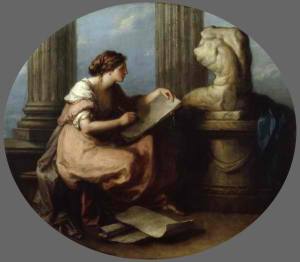
Angelica Kauffman RA, "Design," oil on canvas, 1778-80 ©Royal Academy of Arts, London
. . . This painting is part of a set of the four ‘Elements of Art’ represented by female allegories of Invention, Composition, Design and Colour which were commissioned by the Royal Academy in 1778 to decorate the ceiling of the Academy’s new Council Chamber in Somerset House. The present painting shows the figure of Design as an imposing allegorical female dressed in white and pale red with a purple mantle, seated beside two Roman columns. The figure is copying a fragment of an Antique male nude statue, commonly called the Belvedere torso. The original statue was first documented in Rome in the 1430s and is now in the Vatican Museum, Rome. However a cast of this torso was in the Royal Academy’s collection at the time of Kauffman’s commission and was for the use of the students of the Royal Academy Schools.
This composition alludes to one of the cornerstones of artistic academic training at that period which focused on proportion, scale and form based on antique prototypes. This training was also echoed in Kauffman’s own study, which was based on copying Antique statues and the Renaissance great masters. . . .
The full essay is available here»
◊ ◊ ◊ ◊ ◊
Usually on display in the Front Hall of the Royal Academy, the painting can be seen until 6 March 2011 in the exhibition, Rome and Antiquity: Reality and Vision in the Eighteenth Century at the Museo of the Fondazione Roma.
Royal Academy of Arts: Artist of the Month, John Bacon
From the Royal Academy of Arts in London:
Royal Academy of Arts, Artist of the Month — January 2011
John Bacon RA (1740-1799)
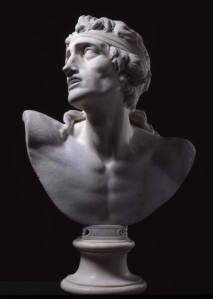
John Bacon, "Sickness," marble, 1778 Diploma Work given by John Bacon, R.A., accepted 1778 © Royal Academy of Arts, London (Photo by Paul Highnam)
Bacon was the son of a cloth-worker, and was originally apprenticed to Nicholas Crispe, the owner of a porcelain factory, in 1755. Here he learnt to create designs for small scale productions in both ceramic and metalwork. In 1759 he was ambitious enough to enter the first of many sculptures into the Society of Arts premium competitions. He was successful in winning 11 premiums as well as being awarded the Society’s gold medal. Bacon went on to work with Josiah Wedgwood, Matthew Boulton and James Tassie. By 1769 the establishment of the Royal Academy Schools provided further opportunities and Bacon enrolled as a student by June of that year. He was again successful in the RA Schools competitions and won a gold medal in his first year there. His rise in the Royal Academy was rapid as he was elected as Associate of the Royal Academy in 1770 and a full Royal Academician in 1778.
His Diploma Work, given to the Royal Academy on his election to full Membership, was Sickness which is a copy of the head of figure which forms part of the monument to Thomas Guy in Guy’s Hospital Chapel, London (1779). Completed in 1779 the founder of the Hospital is depicted life size,
in contemporary dress, bending down to help an emaciated, ailing man. Unlike his contemporary and rival Thomas Banks, Bacon never visited Rome and was not greatly interested in looking to classical prototypes. The tortured expression of Sickness is more naturalistic than the Neo-classical ideal of noble simplicity would allow. . . .
The full essay is available here»
◊ ◊ ◊ ◊ ◊
The bust of Sickness can be seen in the Louvre exhibition Antiquity Rediscovered: Innovation and Resistance in the 18th Century until 14 February 2011.
New Acquisition at The Brooklyn Museum: Painting by Brunias
Press release from the Brooklyn Museum (as noted at ArtDaily) . . .

Agostino Brunias, "Free Women of Color with their Children and Servants in a Landscape," oil on canvas, ca. 1764-96 (Brooklyn Museum)
The Brooklyn Museum has acquired, by purchase from the London Gallery Robilant + Voena, Agostino Brunias’s (1730–96) painting Free Women of Color with Their Children and Servants in a Landscape (circa 1764–96), a portrait of the eighteenth-century mixed-race colonial elite of the island of Dominica in the West Indies. Brunias, a London-based Italian painter, left England at the height of his career to chronicle Dominica, then one of Britain’s newest colonies in the Lesser Antilles. The painting depicts two richly dressed mixed-race women, one of whom was possibly the wife of the artist’s patron. They are shown accompanied by their mother and their children, along with eight African servants, as they walk on the grounds of a sugar plantation, one of the agricultural estates that were Dominica’s chief source of wealth. Brunias documented colonial women of color as privileged and prosperous. The two wealthy sisters are distinguished from their mother and servants by their fitted European dresses.
The painting is a Caribbean version of contemporaneous English works made popular by artists such as William Hogarth and Thomas Gainsborough, whose art often depicts the landed gentry engaged in leisurely pursuits. Free Women of Color with Their Children and Servants in a Landscape and other Caribbean paintings by Brunias celebrate the diversity of European, Caribbean, and African influences in the region. (more…)
Furniture: ‘Inspired by Antiquity’ Highlights Thomas Hope
From a Carlton Hobbs press release:
Inspired by Antiquity: Classical Influences on 18th- and 19th-Century Furniture and Works of Art
Carlton Hobbs, New York, 20 January — 14 February 2011

One of a pair of wall lights in the form of a griffin, related to a design by Thomas Hope, bronze, ca. 1802
The opening night reception, on January 19th, benefited the Sir John Soane Museum Foundation. Tim Knox, the Soane Museum’s eminent director, lectured on the subject of the exhibition and elaborated on some of the highlights on view. “We are honored to have Sir John Soane’s Museum Foundation as the opening night beneficiary,” said Carlton Hobbs. “We are particularly enthusiastic to present forty magnificent pieces inspired by antiquity, including the important group of Thomas Hope pieces from the Philip Hewat-Jaboor collection of Regency furniture and works of art,” he said. “It is the single largest collection of Thomas Hope pieces to come onto the market since the Christie’s auction of the contents of Deepdene, Hope’s country estate, in 1917.” Thomas Hope, the fabulously successful banker, connoisseur collector and designer, revolutionized British taste of the late 18th, early 19th century with his radical, classically inspired design ideas and came to be one of the key figures shaping the Regency taste.
In the continuous effort to deepen our understanding of the decorative arts of the 18th and 19th centuries we wanted to further explore the visual and philosophical inspirations that gave rise to the multitude of fascinating designs, which are now broadly described as Neoclassical,” said Stefanie Rinza. “We are thrilled to collaborate with some of today’s leading academics in identifying the ancient design sources for our pieces and in interpreting the symbolism of the decorative devices used. We hope our clients, colleagues and friends will much enjoy the catalog accompanying the exhibition.
Carlton Hobbs is most grateful for the contributions and collaboration of some of today’s leading experts in the field of decorative arts and in the compilation of the catalog accompanying the exhibition, including Martin Levy, former chairman of the British Antiques Dealers Association, author and specialist in 19th-century furniture and works of art, Tim Knox, Director of the Sir John Soane Museum, Philip-Hewat Jaboor, the authority on Thomas Hope and independent art consultant to private and institutional collectors, and John Hardy, the long-time director of Osterley Park House Museum, who added his insights into the meaning of the symbolism of the classical design elements to every entry.
Exhibition: Paper Dresses of Isabelle de Borchgrave
From the Legion of Honor Museum:
Pulp Fashion: The Art of Isabelle de Borchgrave
Legion of Honor, Fine Arts Museums of San Francisco, 5 February — 5 June 2011
Curated by Jill D’Alessandro
 Belgian artist Isabelle de Borchgrave is a painter by training, but textile and costume are her muses. Working in collaboration with leading costume historians and young fashion designers, de Borchgrave crafts a world of splendor from the simplest rag paper. Painting and manipulating the paper, she forms trompe l’oeil masterpieces of elaborate dresses inspired by rich depictions in early European painting or by iconic costumes in museum collections around the world. The Legion of Honor is the first American museum to dedicate an entire exhibition to the work of Isabelle de Borchgrave, although her creations have been widely displayed in Europe.
Pulp Fashion draws on several themes and presents quintessential examples in the history of costume—from Renaissance finery of the Medici family and gowns worn by Elizabeth I and Marie-Antoinette to the creations of the grand couturiers Frederick Worth, Paul Poiret, Christian Dior, and Coco Chanel. Special attention is given to the creations and studio of Mariano Fortuny, the eccentric early-20th-century artist who is both a major source of inspiration to de Borchgrave and a kindred spirit.
Catalogue: Jill D’Alessandro, Pulp Fashion: The Art of Isabelle de Borchgrave (Prestel, 2011), 104 pages, ISBN: 9783791351056, $29.95.
◊ ◊ ◊ ◊ ◊
From the artist’s website (worth visiting for lots more amazing images). . .
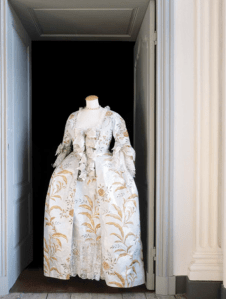
Isabelle de Borchgrave, "Madame de Pompadour paper dress," inspired by a 1755 painting by Maurice Quentin de la Tour, 85 cm x 65 cm x 165 cm, 2001 (Photo: René Stoeltie).
. . . . Following a visit to the Metropolitan Museum in New York in 1994, Isabelle dreamed up paper costumes. While keeping her brushes in hand and her paintings in mind, she worked on four big collections, all in paper and trompe l’œil, each of which set the scene for a very different world. “Papiers à la Mode” (Paper in Fashion), the first, takes a fresh look at 300 years of fashion history from Elizabeth I to Coco Chanel. “Mariano Fortuny” immerses us in the world of 19th century Venice. Plissés, veils and elegance are the watchwords of that history. “I Medici” leads us through the streets of Florence, were we come across famous figures in their ceremonial dress. Figures who made the Renaissance a luminous period. Gold-braiding, pearls, silk, velvet … here, trompe l’œil achieves a level of rediscovered sumptuousness. As for the “Ballets Russes”, they pay tribute to Serge de Diaghilev. Pablo Picasso, Léon Bakst, Henri Matisse, … all designed costumes for this ballet company, which set the world of the 20th century alight. These dancing paper and wire figures play a very colourful and contemporaneous kind of music for us.

Isabelle de Borchgrave, "Madame de Pompadour paper dress," detail
It’s true that, today, Isabelle de Borchgrave has become a name that is readily associated with fashion and paper. But her name is also closely linked to the world of design. By working together with Caspari, the potteries of Gien, Target, and Villeroy and Boch, Isabelle has turned her imagination into an art that’s accessible to anyone who wants to bring festivity into their home. Painted fabrics and paper, dinner services, curtains, sheets, decor with a personal touch for parties and weddings,… All this tells of the world in which she has always loved to move.
But in a 40-year career, she has never put to one side the thing that has always guided her in her life: painting. She still exhibits her paintings and her large folded paper works all over the world. With an imagination increasingly stimulated by her knowledge and interpretation of art, Isabelle, a follower of the Nabis movement, has a fresh perspective of a world that flies around her like a dream.
Exhibition: ‘Rome and Antiquity, Reality and Vision’
From the Fondazione Roma:
Rome and Antiquity: Reality and Vision in the Eighteenth Century
Museo della Fondazione Roma, Palazzo Cipolla, Rome, 30 November 2010 — 6 March 2011
Curated by Carolina Brook and Valter Curzi
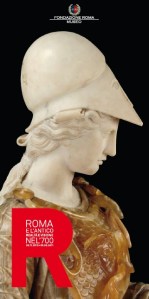
"Orsay Minerva," 2nd century AD (marble replaced late 18th century), Paris: Louvre
Both artistic and archaeological, the exhibition aims to illustrate the way in which ancient monuments, excavations, museums and artistic institutions were able to nourish the arts and education and spread the love for classic art throughout Europe which, at the end of the eighteen century, became an indispensible model. The exhibition, Roma e l’Antico. Realtà e visione nel ’700, intends to bring into focus the major factors that that generated Rome’s cultural wealth and fame: Classic Antiquity. Especially in the second half of the century Rome was an authentic crossroads for artists who came from all over Europe in order to study Antiquity. As investigations today reveal, the Papal capital became the most important centre for culture due to the abundance of classical figurative models which are fundamental for artistic training. The Roman classical heritage, described as an unparalleled resource for the renaissance of Europe, was actually the result of an invariable strategy pursued by Popes and civic authorities during the eighteen century, which the exhibition will explore by illustrating the chief elements. A large section of exhibition will be dedicated to the training syllabus for artists in Rome and the way this model was spread through the Accademia Romana di San Luca, the Academy of San Fernando in Madrid and the Museo Riminaldi in Ferrara. Another section addresses museums of Roman Antiquity
with the aim of illustrating their educational role and power to promote tourism in the
Eternal City.
◊ ◊ ◊ ◊ ◊
A full description of the exhibition is available at View from the Bow, a blog for the arts and music in the early modern period (7 January 2011) and at Deborah Swain’s Living in Rome (7 January 2011).










leave a comment