Royal Academy of Arts: Artist of the Month, John Bacon
From the Royal Academy of Arts in London:
Royal Academy of Arts, Artist of the Month — January 2011
John Bacon RA (1740-1799)
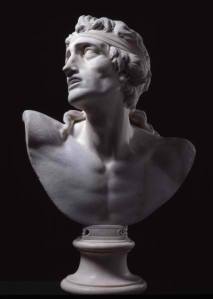
John Bacon, "Sickness," marble, 1778 Diploma Work given by John Bacon, R.A., accepted 1778 © Royal Academy of Arts, London (Photo by Paul Highnam)
Bacon was the son of a cloth-worker, and was originally apprenticed to Nicholas Crispe, the owner of a porcelain factory, in 1755. Here he learnt to create designs for small scale productions in both ceramic and metalwork. In 1759 he was ambitious enough to enter the first of many sculptures into the Society of Arts premium competitions. He was successful in winning 11 premiums as well as being awarded the Society’s gold medal. Bacon went on to work with Josiah Wedgwood, Matthew Boulton and James Tassie. By 1769 the establishment of the Royal Academy Schools provided further opportunities and Bacon enrolled as a student by June of that year. He was again successful in the RA Schools competitions and won a gold medal in his first year there. His rise in the Royal Academy was rapid as he was elected as Associate of the Royal Academy in 1770 and a full Royal Academician in 1778.
His Diploma Work, given to the Royal Academy on his election to full Membership, was Sickness which is a copy of the head of figure which forms part of the monument to Thomas Guy in Guy’s Hospital Chapel, London (1779). Completed in 1779 the founder of the Hospital is depicted life size,
in contemporary dress, bending down to help an emaciated, ailing man. Unlike his contemporary and rival Thomas Banks, Bacon never visited Rome and was not greatly interested in looking to classical prototypes. The tortured expression of Sickness is more naturalistic than the Neo-classical ideal of noble simplicity would allow. . . .
The full essay is available here»
◊ ◊ ◊ ◊ ◊
The bust of Sickness can be seen in the Louvre exhibition Antiquity Rediscovered: Innovation and Resistance in the 18th Century until 14 February 2011.
New Acquisition at The Brooklyn Museum: Painting by Brunias
Press release from the Brooklyn Museum (as noted at ArtDaily) . . .

Agostino Brunias, "Free Women of Color with their Children and Servants in a Landscape," oil on canvas, ca. 1764-96 (Brooklyn Museum)
The Brooklyn Museum has acquired, by purchase from the London Gallery Robilant + Voena, Agostino Brunias’s (1730–96) painting Free Women of Color with Their Children and Servants in a Landscape (circa 1764–96), a portrait of the eighteenth-century mixed-race colonial elite of the island of Dominica in the West Indies. Brunias, a London-based Italian painter, left England at the height of his career to chronicle Dominica, then one of Britain’s newest colonies in the Lesser Antilles. The painting depicts two richly dressed mixed-race women, one of whom was possibly the wife of the artist’s patron. They are shown accompanied by their mother and their children, along with eight African servants, as they walk on the grounds of a sugar plantation, one of the agricultural estates that were Dominica’s chief source of wealth. Brunias documented colonial women of color as privileged and prosperous. The two wealthy sisters are distinguished from their mother and servants by their fitted European dresses.
The painting is a Caribbean version of contemporaneous English works made popular by artists such as William Hogarth and Thomas Gainsborough, whose art often depicts the landed gentry engaged in leisurely pursuits. Free Women of Color with Their Children and Servants in a Landscape and other Caribbean paintings by Brunias celebrate the diversity of European, Caribbean, and African influences in the region. (more…)
Furniture: ‘Inspired by Antiquity’ Highlights Thomas Hope
From a Carlton Hobbs press release:
Inspired by Antiquity: Classical Influences on 18th- and 19th-Century Furniture and Works of Art
Carlton Hobbs, New York, 20 January — 14 February 2011

One of a pair of wall lights in the form of a griffin, related to a design by Thomas Hope, bronze, ca. 1802
The opening night reception, on January 19th, benefited the Sir John Soane Museum Foundation. Tim Knox, the Soane Museum’s eminent director, lectured on the subject of the exhibition and elaborated on some of the highlights on view. “We are honored to have Sir John Soane’s Museum Foundation as the opening night beneficiary,” said Carlton Hobbs. “We are particularly enthusiastic to present forty magnificent pieces inspired by antiquity, including the important group of Thomas Hope pieces from the Philip Hewat-Jaboor collection of Regency furniture and works of art,” he said. “It is the single largest collection of Thomas Hope pieces to come onto the market since the Christie’s auction of the contents of Deepdene, Hope’s country estate, in 1917.” Thomas Hope, the fabulously successful banker, connoisseur collector and designer, revolutionized British taste of the late 18th, early 19th century with his radical, classically inspired design ideas and came to be one of the key figures shaping the Regency taste.
In the continuous effort to deepen our understanding of the decorative arts of the 18th and 19th centuries we wanted to further explore the visual and philosophical inspirations that gave rise to the multitude of fascinating designs, which are now broadly described as Neoclassical,” said Stefanie Rinza. “We are thrilled to collaborate with some of today’s leading academics in identifying the ancient design sources for our pieces and in interpreting the symbolism of the decorative devices used. We hope our clients, colleagues and friends will much enjoy the catalog accompanying the exhibition.
Carlton Hobbs is most grateful for the contributions and collaboration of some of today’s leading experts in the field of decorative arts and in the compilation of the catalog accompanying the exhibition, including Martin Levy, former chairman of the British Antiques Dealers Association, author and specialist in 19th-century furniture and works of art, Tim Knox, Director of the Sir John Soane Museum, Philip-Hewat Jaboor, the authority on Thomas Hope and independent art consultant to private and institutional collectors, and John Hardy, the long-time director of Osterley Park House Museum, who added his insights into the meaning of the symbolism of the classical design elements to every entry.
Exhibition: Paper Dresses of Isabelle de Borchgrave
From the Legion of Honor Museum:
Pulp Fashion: The Art of Isabelle de Borchgrave
Legion of Honor, Fine Arts Museums of San Francisco, 5 February — 5 June 2011
Curated by Jill D’Alessandro
 Belgian artist Isabelle de Borchgrave is a painter by training, but textile and costume are her muses. Working in collaboration with leading costume historians and young fashion designers, de Borchgrave crafts a world of splendor from the simplest rag paper. Painting and manipulating the paper, she forms trompe l’oeil masterpieces of elaborate dresses inspired by rich depictions in early European painting or by iconic costumes in museum collections around the world. The Legion of Honor is the first American museum to dedicate an entire exhibition to the work of Isabelle de Borchgrave, although her creations have been widely displayed in Europe.
Pulp Fashion draws on several themes and presents quintessential examples in the history of costume—from Renaissance finery of the Medici family and gowns worn by Elizabeth I and Marie-Antoinette to the creations of the grand couturiers Frederick Worth, Paul Poiret, Christian Dior, and Coco Chanel. Special attention is given to the creations and studio of Mariano Fortuny, the eccentric early-20th-century artist who is both a major source of inspiration to de Borchgrave and a kindred spirit.
Catalogue: Jill D’Alessandro, Pulp Fashion: The Art of Isabelle de Borchgrave (Prestel, 2011), 104 pages, ISBN: 9783791351056, $29.95.
◊ ◊ ◊ ◊ ◊
From the artist’s website (worth visiting for lots more amazing images). . .
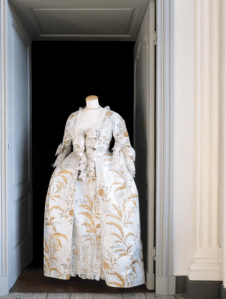
Isabelle de Borchgrave, "Madame de Pompadour paper dress," inspired by a 1755 painting by Maurice Quentin de la Tour, 85 cm x 65 cm x 165 cm, 2001 (Photo: René Stoeltie).
. . . . Following a visit to the Metropolitan Museum in New York in 1994, Isabelle dreamed up paper costumes. While keeping her brushes in hand and her paintings in mind, she worked on four big collections, all in paper and trompe l’œil, each of which set the scene for a very different world. “Papiers à la Mode” (Paper in Fashion), the first, takes a fresh look at 300 years of fashion history from Elizabeth I to Coco Chanel. “Mariano Fortuny” immerses us in the world of 19th century Venice. Plissés, veils and elegance are the watchwords of that history. “I Medici” leads us through the streets of Florence, were we come across famous figures in their ceremonial dress. Figures who made the Renaissance a luminous period. Gold-braiding, pearls, silk, velvet … here, trompe l’œil achieves a level of rediscovered sumptuousness. As for the “Ballets Russes”, they pay tribute to Serge de Diaghilev. Pablo Picasso, Léon Bakst, Henri Matisse, … all designed costumes for this ballet company, which set the world of the 20th century alight. These dancing paper and wire figures play a very colourful and contemporaneous kind of music for us.

Isabelle de Borchgrave, "Madame de Pompadour paper dress," detail
It’s true that, today, Isabelle de Borchgrave has become a name that is readily associated with fashion and paper. But her name is also closely linked to the world of design. By working together with Caspari, the potteries of Gien, Target, and Villeroy and Boch, Isabelle has turned her imagination into an art that’s accessible to anyone who wants to bring festivity into their home. Painted fabrics and paper, dinner services, curtains, sheets, decor with a personal touch for parties and weddings,… All this tells of the world in which she has always loved to move.
But in a 40-year career, she has never put to one side the thing that has always guided her in her life: painting. She still exhibits her paintings and her large folded paper works all over the world. With an imagination increasingly stimulated by her knowledge and interpretation of art, Isabelle, a follower of the Nabis movement, has a fresh perspective of a world that flies around her like a dream.
Exhibition: ‘Rome and Antiquity, Reality and Vision’
From the Fondazione Roma:
Rome and Antiquity: Reality and Vision in the Eighteenth Century
Museo della Fondazione Roma, Palazzo Cipolla, Rome, 30 November 2010 — 6 March 2011
Curated by Carolina Brook and Valter Curzi
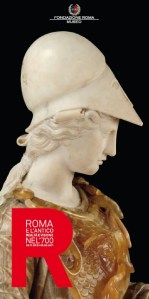
"Orsay Minerva," 2nd century AD (marble replaced late 18th century), Paris: Louvre
Both artistic and archaeological, the exhibition aims to illustrate the way in which ancient monuments, excavations, museums and artistic institutions were able to nourish the arts and education and spread the love for classic art throughout Europe which, at the end of the eighteen century, became an indispensible model. The exhibition, Roma e l’Antico. Realtà e visione nel ’700, intends to bring into focus the major factors that that generated Rome’s cultural wealth and fame: Classic Antiquity. Especially in the second half of the century Rome was an authentic crossroads for artists who came from all over Europe in order to study Antiquity. As investigations today reveal, the Papal capital became the most important centre for culture due to the abundance of classical figurative models which are fundamental for artistic training. The Roman classical heritage, described as an unparalleled resource for the renaissance of Europe, was actually the result of an invariable strategy pursued by Popes and civic authorities during the eighteen century, which the exhibition will explore by illustrating the chief elements. A large section of exhibition will be dedicated to the training syllabus for artists in Rome and the way this model was spread through the Accademia Romana di San Luca, the Academy of San Fernando in Madrid and the Museo Riminaldi in Ferrara. Another section addresses museums of Roman Antiquity
with the aim of illustrating their educational role and power to promote tourism in the
Eternal City.
◊ ◊ ◊ ◊ ◊
A full description of the exhibition is available at View from the Bow, a blog for the arts and music in the early modern period (7 January 2011) and at Deborah Swain’s Living in Rome (7 January 2011).
Exhibition: The Landscape of Tivoli in the Eighteenth Century
Tivoli: Variations sur un paysage au XVIIIe siècle
Cognacq-Jay Museum, Paris, 18 November 2010 — 20 February 2011

Joseph Vernet, "La cascade," ca. 1748 (Photo: Roger Viollet)
L’exposition Tivoli. Variations sur un paysage au XVIIIe siècle propose une réflexion originale sur l’évolution du paysage, de 1720 à 1830, autour d’un motif particulier : le site de Tivoli et son célèbre temple dit de la Sibylle.
Lieu de villégiature fameux depuis l’Antiquité, Tibur (le nom latin de Tivoli) fut mise à la mode par l’empereur Auguste et par Mécène, le fastueux ami des arts, et célébrée par les poètes Horace et Catulle (Ier s. av. J.-C.). La Sibylle Albunea y exerçait son art divinatoire. Le site est exceptionnel : bâtie sur les premiers contreforts des Apennins, à une trentaine de kilomètres à l’est de Rome, Tivoli se présente comme une ville à flanc de montagne, dominant la plaine qui s’étend de là jusqu’à la mer. Une rivière, l’Aniene, s’y précipite en multiples cascades. Une petite acropole s’élève au bord du gouffre : les ruines de deux temples sont encore conservées, l’un quadrangulaire, l’autre rond. Ce dernier surtout est devenu célèbre, sous le nom de temple de la Sibylle ou de Vesta.

ISBN : 9782759601462, 30€
Au XVIIIe siècle, Tivoli et son temple sont progressivement devenus l’un des motifs les plus représentés dans l’histoire de la peinture, singulièrement dans la peinture française. La perfection architecturale du monument, son emplacement au coeur d’un paysage sublime et terrifiant, la richesse incomparable de son histoire, de ses légendes, en ont fait un motif adulé par les peintres et leurs collectionneurs. C’est aussi l’époque où l’on décline le temple de Tivoli sous forme de fabriques édifiées dans les jardins.
En cinquante oeuvres, peintures, dessins et gravures, l’exposition propose de confronter le regard porté par les plus grands artistes de l’époque sur ce motif : une brève introduction présente l’origine de son succès, au début du XVIIe siècle, dans l’entourage de Paul Bril et de Gaspard Dughet. Pour le XVIIIe siècle, Vanvitelli, Boucher, Vernet, Hubert Robert, Piranèse… se succèdent autour du même motif. Puis Valenciennes, Simon Denis ou Granet qui furent en France les précurseurs du paysage moderne. Composées ou plus spontanées, caprices, variations poétiques, études faites en plein air, les oeuvres présentées posent de manière contradictoire la question du sujet dans la peinture de paysage. Le plus singulier est sans doute qu’un même motif ait intéressé tous les artistes sur une période aussi longue, des plus traditionnels aux plus modernes.
L’exposition sera accompagnée par un catalogue en couleurs. En plus de notices détaillées sur chaque oeuvre, des essais confiés à plusieurs auteurs traiteront notamment du site de Tivoli, de sa fortune dans l’histoire de l’art ou dans les récits de voyageurs, et de l’importance de certains artistes particulièrement associés à Tivoli (Joseph Vernet, Hubert Robert).
◊ ◊ ◊ ◊ ◊
Didier Rykner’s review of the exhibition (in French) for La Tribune de l’Art (30 November 2010) is available here»
Settecento Paintings in New York
The following press release comes from Sperone Westwater (as noted at Art Daily) . . .
Italian Paintings from the 17th and 18th Centuries
Sperone Westwater Gallery, New York, 7 January — 19 February 2011
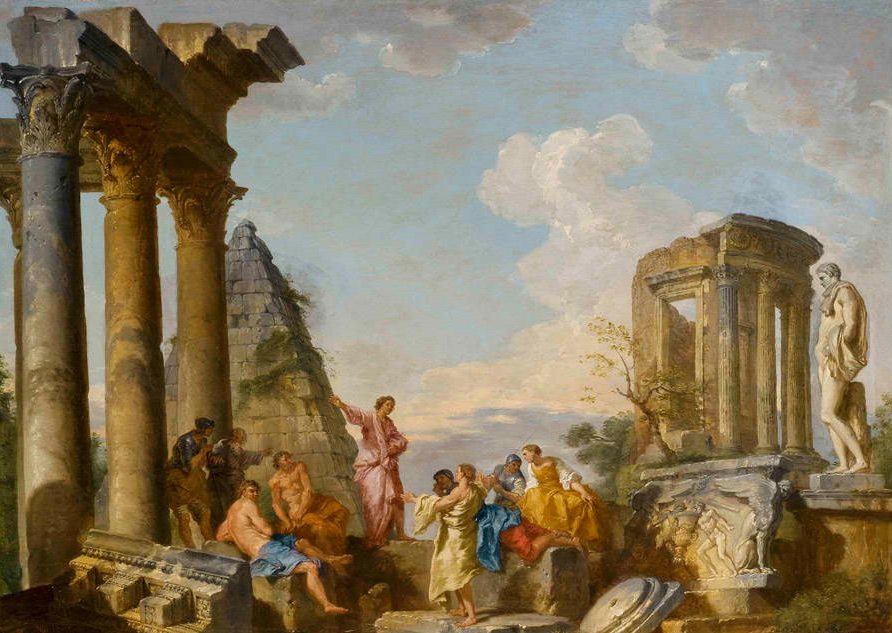
Giovanni Paolo Panini, "Architectural Capriccio with an Apostle Preaching," 1755-60, oil on canvas, 20 7/8 x 28 7/8 inches (52.9 x 73.5 cm). Courtesy Sperone Westwater, NY.
Sperone Westwater is pleased to announce an exhibition of Italian Paintings from the 17th and 18th Centuries in partnership with Robilant + Voena. This survey of Italian Old Master paintings, with notable masterpieces by painters such as Canaletto (1697-1768), Cavalier d’Arpino (1568-1640), Artemisia Gentileschi (1593-1653), and Michele Marieschi (1710-1743), intends to reassert the historical importance of Italian painting in the centuries following the Renaissance – a period which was to become an important foundation for modern art.
The exhibition unveils several new discoveries. One highlight is a very uncommon signed Portrait of an Unidentified Man (1630-1640) by Artemisia Gentileschi, among the most highly regarded female artists of the Baroque. It is exhibited alongside Tiberio Titi’s Portrait of Ferdinando Gonzaga, Duke of Mantua (ca. 1617) – also a new addition to his body of work. An early Francesco Guardi, Piazza San Marco, looking West, from the Campo di San Basso (1757-1758), a newly discovered work from the late 1750s, represents a period when he was still very much under Canaletto’s influence. When comparing this to Guardi’s later and previously unpublished painting, Venice. The Lagoon and the Fort of San Niccolo at Lido (1775-1785), it is possible to see how far the artist took his own individual interpretation of the Venetian veduta. Canaletto’s small and exquisite View of Dolo at the bank of the Brenta (1763) completes this set of important additions.
Other early masterworks will include two rare paintings by Cavalier d’Arpino, who first hosted Caravaggio in his studio after his arrival in Rome. The first, David with the Head of Goliath (1598) is a signed and dated work from the extensive Aldobrandini collection that was treasured by several papal Cardinals since its creation. It contrasts forcefully with d’Arpino’s Venus and Cupid (1602-1603), executed a few years later. Works by Battistello Caracciolo, Angelo Caroselli and Carlo Dolci further exemplify the prominence of religious narrative during the 17th century. Paintings by Marieschi, Panini and Joli also underline the 18th-century fascination with the veduta.
By jointly exhibiting Italian Baroque paintings and vedute from the 17th and 18th centuries in New York, Sperone Westwater and Robilant + Voena inaugurate a closer partnership between the two galleries. In 2011 both galleries will open a new shared space in London, 2nd Floor at 38 Dover Street, W1, with a joint show in 2011.
A fully illustrated, scholarly catalogue is being published on the occasion of the show. There will be an opening reception on 7 January from 6-8 pm. For more information, please visit www.speronewestwater.com or contact Maryse Brand at +1 (212) 999-7337 or maryse@speronewestwater.com.
Watteau and His Circle at The Wallace
From The Wallace:
Esprit et Vérité: Watteau and His Circle
The Wallace Collection, London, 12 March — 5 June 2011

Jean-Antoine Watteau, "A Lady at her Toilet (La toilette)," ca. 1716-18 (London: Wallace Collection)
In two exhibitions of great paintings, the Wallace Collection celebrates Antoine Watteau, the artist who died in his prime yet changed the course of French painting, and Jean de Jullienne, his publisher and one of France’s greatest collectors; a perfect accompaniment to the concurrent exhibition of Watteau drawings at London’s Royal Academy of Arts.
The exhibitions will consist of a redisplay of the great Watteau canvasses in the Wallace Collection, in the intimate setting of the West Gallery at Hertford House; and downstairs, in the Collection’s Exhibition Galleries, significant masterworks of the 17th and 18th centuries by artists, including Rembrandt, Rubens, Greuze and Vernet, drawn from the collection of Watteau’s publisher and most important dealer, Jean de Jullienne.
The relationship between Watteau, the most influential artist of his time, and Jean de Julienne, one of France’s most significant art collectors, represents a key moment in the development of French 18th-century painting and patronage. Within his short career, Watteau (1684-1721) changed the course of painting. He revitalized the Baroque style, and invented the fête galante, a novel category of genre painting depicting pastoral and idyllic compositions where stage characters of the French and Italian comedies mingle with fashionable contemporaries.
Jean de Jullienne (1686-1766), supported 18th-century contemporary artists. His strong interest in French art and Netherlandish painting, led the way for a new generation of rich Parisian collectors who had only loose connections with the French court. As a result, the 18th century saw the establishment of a new cultural avant-garde.
Jean de Jullienne is famous for his role as editor of and dealer in Watteau’s work, but a unique illustrated inventory of his collection from 1756, lent to the exhibition by the Morgan Library & Museum in New York and on display for the first time, demonstrates the breadth of his tastes. ‘Esprit et Vérité: Watteau and His Circle includes works by: Rubens, Rembrandt, Wouwermans, Netscher, Bourdon, Carle Van Loo, Greuze and Claude-Joseph Vernet from Jullienne’s collection; the Wallace Collection’s group of eight Watteau paintings, and two Watteau paintings from the Sir John Soane’s Museum, London and York Art Gallery. The Watteau paintings present a rare opportunity to reassess this artist’s impact on the course of art history.
Watteau’s artistic innovations went beyond his invention of the fête galante. The French tradition of depicting the female nude in a domestic setting, rather than as a goddess or a nymph, began in the 18th century. Watteau’s A Lady at her Toilet in the Wallace Collection is an early example of what might have been considered a controversial painting in its day and is one of only three surviving paintings by the artist in this new erotic genre. Watteau is said to have later repented and ordered that these paintings should be destroyed on this death.
Watteau died of tuberculosis, probably aged thirty-seven, and Jean de Jullienne was responsible for distributing engravings of Watteau’s work after his death, thus ensuring the artist’s longevity.
The exhibition will provide an opportunity to present new research on the Wallace Collection’s Watteau paintings and view them in the context of more recent developments in Watteau studies.
Watteau’s Drawings in London
From the Royal Academy of Arts:
Watteau’s Drawings: Virtuosity and Delight
Royal Academy of Arts, London, 12 March — 5 June 2011

Jean-Antoine Watteau, "Three Studies of a Young Girl Wearing a Hat," ca. 1716. Red and black chalk, graphite on paper. 138 x 246 mm. Collection of Ann and Gordon Getty
In March 2011, the Royal Academy of Arts will present the first retrospective exhibition of the drawings of Jean-Antoine Watteau (1684–1721) to be held in the UK. The display will contain over 80 works on paper produced by the French artist. Watteau is perhaps best known for his invention of a new genre: the fêtes galantes, small pictures of social gatherings of elegant people in parkland settings. He was also an exceptional draughtsman. His drawings were praised for their subtlety, freedom of execution, lightness of touch and grace, and remain widely admired today.
Watteau is particularly renowned for his mastery of the ‘three chalks’ or trois crayons technique, the subtle manipulation and expert balancing of red, black and white. The drawings on display will be presented chronologically to give a sense of the artist’s stylistic development. Together they will demonstrate the full range of his subject-matter, from theatre pieces, portraits, and shop interiors to fêtes galantes.
Chardin Exhibition in Ferrara and Madrid
Roderick Conway Morris reviews the Chardin exhibition currently in Ferrara for The New York Times, 22 December 2010, “Chardin’s Enchanting and Ageless Moments” . . .
Chardin: The Painter of Silence
Ferrara, Palazzo dei Diamanti, Ferrara, 17 October 2010 — 30 January 2011
Museo Nacional del Prado, Madrid, 1 March — 29 May 2011
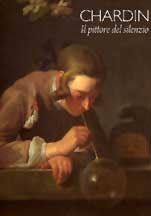
ISBN: 9788889793107, $90
“We stop in front of a Chardin as if by instinct,” wrote Diderot in his review of the Paris Salon of 1767, “like a traveler weary of the road choosing, almost without realizing, a place that offers a grassy seat, silence, water and cool shade.”
Jean-Siméon Chardin’s small still lifes and genre scenes have been working their magic ever since the 18th century. And trying to explain how Chardin created his enchanting effects has never ceased to exercise writers on art.
The Louvre has the world’s largest collection of Chardins, and Pierre Rosenberg, formerly the director of the museum, has made a lifelong study of the painter. He is now the curator of “Chardin: Painter of Silence,” the first exhibition devoted to the French artist ever to be staged either in Italy or Spain (the show will travel on to the Prado in February). The event brings together 52 pictures (with four additional works and a few substitutions in the Madrid version). . . .
The full article is available here. Didier Rykner reviewed the exhibition for The Art Tribune in October. The catalogue is available at artbooks.com.










leave a comment