Exhibition: Paper Museums at the Louvre
From the Louvre:
Musées de papier: L’Antiquité en livres, 1600-1800
Musée du Louvre, Paris, 25 September 2010 — 3 January 2011
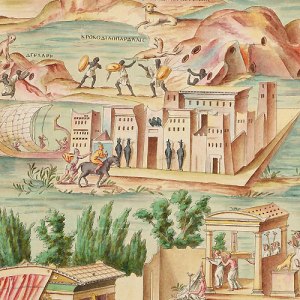
Pietro Santi Bartoli Receuil de peintures antiques trouvées à Rome © Bibliothèque nationale de France, Paris
Les antiquaires des XVIIe et XVIIIe siècles ont souvent rassemblé leur savoir dans d’imposants recueils figurés d’antiquités, sortes de « musées de papier » donnant à voir, sous forme de gravures ou de dessins, un nombre considérable d’œuvres antiques. Les images de l’art antique contenues dans ces musées de papier ont directement alimenté une série de phénomènes majeurs dans l’histoire de l’art du XVIIIe siècle : essor du goût pour l’antique et mode néoclassique, naissance de l’historiographie de l’art, élargissement de la notion d’Antiquité à des aires géographiques et culturelles nouvelles.
L’exposition révèle l’extrême fécondité de ces recueils de dessins et gravures. Elle mène le visiteur du Museo cartaceo de Cassiano dal Pozzo (1588-1657) – érudit qui rassembla une célèbre collection de reproductions d’œuvres antiques – jusqu’aux années 1760-1800, marquées par les ouvrages illustrés de Caylus, de Winckelmann et de Séroux d’Agincourt. Elle donne un aperçu des systèmes de classement de ces recueils et montre comment, à la suite notamment des fouilles d’Herculanum, la littérature antiquaire s’enrichit de publications somptueuses. Enfin, elle présente les multiples objets et instruments qui ont accompagné le travail antiquaire et ainsi préparé la naissance de deux disciplines modernes : l’histoire de l’art et l’archéologie.
Cette exposition a été réalisée avec le concours exceptionnel de la Bibliothèque nationale de France.
Vasi Exhibition Opens at the University of Oregon
The following is an edited version of the UO press release:
Giuseppe Vasi’s Rome: Lasting Impressions from the Age of the Grand Tour
Jordan Schnitzer Museum of Art, University of Oregon, Eugene, 25 September 2010 — 3 January 2011
Princeton University Art Museum, 2011
Curated by James Tice and James Harper
 Giuseppe Vasi’s Rome: Lasting Impressions from the Age of the Grand Tour opens this fall at the Jordan Schnitzer Museum of Art at the University of Oregon. Vasi was an eighteenth-century Italian engraver and architect who is best known for his cityscapes of Rome. The exhibition is curated by UO faculty members James Tice and James Harper. Tice is an architecture professor and a research fellow at Studium Urbis, an international study center in Rome devoted to study of the city’s urban history. Harper is associate professor of art history. He worked at the Philadelphia Museum of Art, the National Gallery of Art and the Fogg Art Museum at Harvard University before joining the UO faculty in 2000.
Giuseppe Vasi’s Rome is the first major exhibition to be devoted solely to Vasi’s work. Coinciding with the 300th anniversary of his birth, the exhibition combines graphic imaging technology with new research on how he observed and documented his city. Vasi lived and worked in Rome, where he was a contemporary of such other notable vedutisti as Giovanni Paolo Panini, his student Giovanni Battista Piranesi, and cartographer Giovanni Battista Nolli.
The exhibition traces the emergence of Vasi’s graphic chronicles within their cartographic and artistic traditions, and explores their impact on ways of seeing and interpreting the city as a work of art. Also featured in the exhibition is a new media component that builds on two websites designed by Tice and Erik Steiner, who was assistant director of the InfoGraphics Lab in the UO Department of Geography at the time he worked on the sites. The exhibition invites viewers to use touch screens and iPads to view Vasi’s work, compare them to those of other artists of the period and explore Rome, then and now, through georeferencing.
A 200-page catalogue features essays from Mario Bevilacqua, Vincent Buonanno, Allan Ceen, Adrianne Hamilton, Read McFaddin, John Moore, John Pinto, and the curators. In conjunction with a series of educational programs, the museum will host a symposium on November 12; “Una Roma Visuale: New Research on Giuseppe Vasi and the Art, Architecture and Urbanism of Rome” will bring together scholars to address the topics of prints, painting, sculpture, architecture, urbanism and cartography. John Pinto will deliver the keynote address.
Following its presentation at the Schnitzer Museum, the exhibition will be on view at the Princeton University Art Museum.
The Fabric of Their Lives
I’m delighted to welcome Courtney Barnes of Style Court as a guest contributor to Enfilade. With a B.A. in art history and an M.A. in education, Courtney has worked as a docent at the High Museum of Art in Atlanta and has contributed to Southern Accents, among other publications. Established in 2006, Style Court has won praise from Time, Elle Decor, Domino, Atlanta Homes & Lifestyles, 1stdibs, Country Living, and Apartment Therapy L.A. Courtney’s site does a particularly good job of bringing together a wide variety of people interested in design and the arts. While Enfilade has previously included postings that were sparked by coverage at Style Court, it’s a treat to hear from Courtney directly – and on textiles, a topic that’s of special interest to her. As a HECAA member, Courtney (I hope) will have more postings to share from time to time in the future. -CH
◊ ◊ ◊ ◊ ◊
Threads of Feeling
The Foundling Museum, London, 14 October 2010 — 6 March 2011
B y C O U R T N E Y B A R N E S
In 2003 I ventured down into the densely packed textile and costume archives of the Atlanta History Center to meet with curator Susan Neill. At the time, she was preparing for the opening of Gone With the Girdle: Freedom, Restraint and Power in Women’s Dress, an exhibition that used the familiarity and allure of fashion to engage a general audience in the social, economic, and political history of women living in the southeastern United States from the nineteenth century up to the present.
In addition to the always crowd-pleasing couture, Neill brought into the galleries more common garments including a restrictive maternity corset, a domestic worker’s evening uniform, the first pantsuit designed for Delta Airlines flight attendants, a mini skirt half slip, and jeans — all to tell a story of radical change. Not surprisingly, such everyday articles of clothing worn on the job by waitresses and domestic workers were harder for Neill to obtain since they were typically discarded due to wear and tear or lack of interest. And examples of clothing worn by slaves during the antebellum era eluded Neill completely.

"Sleeves red and white speckl’d linen turn’d up red spotted with white." A baby’s sleeve made from linen © Coram
This simple but profoundly ironic rule of material culture — that the most common and mundane traces of the past, especially when associated with the working classes and the poor — are the least likely to survive makes an upcoming exhibition at The Foundling Museum in London all the more remarkable. Threads of Feeling showcases women’s and children’s textile tokens from the middle of the eighteenth century. The exhibition curator, John Styles, a specialist in the material culture of eighteenth-century Britain, has assembled a selection of fabric tokens that have survived some 250 years in the archives of The Foundling Hospital. Beginning in the 1740s, the institution served as a last resort for many of London’s impoverished, unmarried women who found themselves unable to care for their infants. A single identifying record, usually a clipping of fabric, was typically left at the
Foundling when the child was accepted.

"A bunch of 4 ribbons narrow – Yellow, Blue, Green, & Pink." Silk ribbons tied in a bunch with a knot © Coram
As noted at the Museum’s website:
In the cases of more than 4,000 babies left between 1741 and 1760, a small object or token, usually a piece of fabric, was kept as an identifying record. The fabric was either provided by the mother or cut from the child’s clothing by the hospital’s nurses. Attached to registration forms and bound up into ledgers, these pieces of fabric form the largest collection of everyday textiles surviving in Britain from the 18th Century.
Because the babies were essentially adopted by an institution (rather than a particular family) and were rarely reclaimed, Threads of Feeling provides both a material and emotional window into the past. Styles comments on his own website:

"Flowered lawn." Lawn printed with flowers © Coram
The textiles are tangible evidence of babies abandoned, many destined to die within a few days or weeks. To see them is a poignant, emotional experience. But the textiles are also beautiful objects in their own right. Most are colourful, patterned fabrics that served as tokens precisely because they were visually arresting. At the same time, they witness a rich social history. They show how ordinary people conducted their romances, clothed their babies, and engaged with fashion, providing a market for the cotton fabrics that were fundamental to the Industrial Revolution of the later 18th century.
For anyone who would like to learn more about the antique textile tokens, the September-October 2010 issue of the British-based textile magazine, Selvedge, features a terrific, in-depth cover story on the exhibition written by Shelly
Goldsmith. Selvedge is available at select bookshops in the
U.S. and by subscription, in digital or traditional paper formats.
At The Frick Next Summer: The French Court à la Turc
Press release (PDF) from The Frick:
Turkish Taste at the Court of Marie-Antoinette
The Frick Collection, New York, 8 June — 11 September 2011
Curated by Charlotte Vignon

Small Console Table with Supporting Figures of Nubians (one of a pair), c.1780, gilded and painted wood and marble slab (NY: The Frick Collection), photo by Michael Bodycomb
By the late eighteenth century, France had long been fascinated by the Ottoman empire. Trade with Turkish territories had gone on for centuries, bringing precious velvets, brocades, carpets, arabesque-decorated leathers, and metalwork to the Continent. In the fall of 1776, a performance of Mustapha and Zeangir, a tragedy in five acts by Sebastien-Roch Chamford that played in Paris, seems to have launched a taste for interiors “à la Turc,” or “in the Turkish style.” Soon after, boudoirs turcs were created in several royal residences, especially in the circle of Marie-Antoinette and the comte d’Artois, Louis XVI’s younger brother. This taste seems to have been confined largely to the royal court and the French aristocracy, and few objects from such rooms survive today. In the summer of 2011, the Frick will present a dossier exhibition on the subject, bringing together several examples that have rarely—or, in some cases never—been on view in New York City.
This exhibition was inspired by a pair of French console-tables at the Frick, whose exceptional quality suggests a royal origin. The tabletops are supported by two Nubian slaves who wear pearl-bedecked turbans; each figure holds a floral garland surrounding a medallion depicting a Sultan. The Turkish iconography is complemented by a frieze of crossed crescents, a symbol of the Ottoman empire. Such objects were not literal copies of Turkish models. Rather, they were created by interior decorators, architects, designers, and craftsmen inspired by an imaginary Ottoman empire, such as that depicted in A Thousand and One Nights and in the aforementioned tragedy Mustapha and Zeangir. Although the objects often featured turbaned figures, camels, palm trees, cornucopias, arabesques, crossed crescents, pearls and jewel-like ornaments, elaborate draperies, and heavy garlands of fruits and flowers, their form and function remained essentially French. Having been made for the royal family or wealthy aristocrats, the objects were usually of the highest quality, and can be attributed to the best artists and craftsmen of the time. Turkish Taste at the Court of Marie-Antoinette is being organized by Charlotte Vignon, the Frick’s Associate Curator of Decorative Arts.
◊ ◊ ◊ ◊ ◊
The exhibition might bring to mind the forthcoming book by Nebahat Avcioglu, Turquerie and the Politics of Representation, 1728-1876 (Aldershot: Ashgate, 2011), a description of which is available here»
Prints of the Rustic Life at The Huntington
From The Huntington:
Picturesque to Pastoral
The Huntington Library, San Marino, CA, 31 July — 1 November 2010

Thomas Gainsborough, "Wooded Landscape with Herdsman Driving Cattle over a Bridge, Rustic Lovers, and Ruined Castle," ca. 1780, soft-ground etching (The Huntington Library, Art Collections, and Botanical Gardens)
Many of the greatest practitioners of landscape painting in Britain also were actively engaged in printmaking. Picturesque to Pastoral explores the graphic side of landscape in British art from the 18th through the 20th century. From the rustic countryside depicted by Thomas Gainsborough (1727–1788) to the visionary dreamscapes of Graham Sutherland (1903–1980), this focused installation of about a dozen prints showcases the variety of techniques the medium affords—wood engraving, etching, aquatint, drypoint, and mezzotint—as well as the many ways the view of landscape changed over time. In their shift from rural to urban subjects and from poetic description to interior vision, these rarely seen items from The Huntington’s art collections reveal how artists reworked this subject matter to express their own sensibilities.
Raphael Tapestries and Cartoons Briefly Reunited at V&A
 For the implications of the Raphael cartoons during the eighteenth century, see Arline Meyer, Apostles in England: Sir James Thornhill & the Legacy of the Raphael’s Tapestry Cartoons, exhibition catalogue (New York: Columbia University, 1996); and more recently, Cathleen Hoeniger, The Afterlife of Raphael’s Paintings (Cambridge: Cambridge University Press, 2010), especially chapter 5, “The English Reception and Restoration of Raphael’s Cartoons, c. 1525-1800” (this latter text is also useful for Raphael’s reception in France and Germany). The following description of the exhibition in London comes from the V&A’s website:
◊ ◊ ◊ ◊ ◊
Raphael: Cartoons and Tapestries for the Sistine Chapel
Victoria & Albert Museum, London, 8 September — 17 October 2010
This is a display of four of the ten tapestries designed by Raphael for the Sistine Chapel in Vatican City. These are the original tapestries from the only series designed by Raphael of which examples survive, and are comparable with Michelangelo’s Sistine Chapel Ceiling as masterpieces of High Renaissance art. The tapestries are displayed alongside the full-size designs for them – the famous Raphael Cartoons . This is the first time that the designs and tapestries have been displayed together – something Raphael himself never witnessed. The tapestries have not been shown before in the UK.
The tapestries of the Acts of St Peter and St Paul, The Miraculous Draught of Fishes, Christ’s Charge to Peter, The Healing of the Lame Man, and The Sacrifice at Lystra, were made for the Sistine Chapel almost 500 years ago. Raphael was commissioned by Pope Leo X to design these great tapestries, which were woven in Brussels, Europe’s leading centre for tapestry-weaving, and then sent to Rome for display. As the cartoons remained in Brussels, Raphael himself never saw the cartoons beside the tapestries woven from them. Several European monarchs, including Henry VIII, later commissioned copies of the tapestries which were made from the cartoons in Brussels. In 1623 Charles I, while Prince of Wales, had the Cartoons brought to England to have his own set woven in the Mortlake tapestry workshops, and they have remained in England ever since. (more…)
Enlightenment Art in China
It’s interesting to see the politics of the Enlightenment play out two centuries later. From the the Staatliche Kunstsammlungen Dresden:
Art of the Enlightenment
National Museum of China, Beijing, 1 March 2011 — 31 March 2012
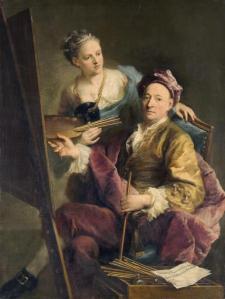
Georg Desmarées "The Artist with His Daughter, Antonia," 1750-1774 © Bayerische Staatsgemäldesammlungen München
The Staatliche Museen zu Berlin, the Staatliche Kunstsammlungen Dresden, and the Bayerische Staatsgemäldesammlungen Munich are to collaborate in presenting the largest exhibition on European art from the Enlightenment period ever to go on show in Asia. In the spring of 2011 the three museums will be exhibiting more than 350 works of art in an area covering 2,700 square metrers at the National Museum of China. The focus will be on major works of art which demonstrate the great ideas of this period, their influence on the fine arts and the history of their reception from the artistic revolutions of the 18th century down to the present day.
The exhibition presents the image world of a period on the threshold of modernity, the ideas of which are of programmatic significance for art today. Paintings, drawings, prints, costumes, furniture and spatial art, sculptures and books will bring all the various facets of the Enlightenment period and its reception history to life for a Chinese audience. Among the masterpieces on display will be works by Watteau, Boucher, Pesne, Piranesi, Chodowiecki, Hogarth and Goya, thus illustrating the wide range of works and the themes which informed the culture of this era, from the Ancien Régime to the Modern period.
The catalogue, which will be published in Chinese and English, will present the latest research findings concerning the art of the Enlightenment and other aspects of this period. This joint exhibition is being financed primarily by the German Foreign Office. It marks the high point of the programme of German-Chinese cultural exchange that was agreed in 2005.
The exhibition Art of the Enlightenment at the National Museum of China will be on display for 18 months. The National Museum on Tiananmen Square in Beijing is currently being refurbished and expanded according to plans drawn up by the Hamburg firm of architects Gerkan, Marg and Partners (gmp). When completed, it will have a total floor area of approximately 200,000 square metres. With its redesigned building, the museum is intended to become a centre for the world’s cultures, a venue in which outstanding guest exhibitions from all over the world will be presented.
◊ ◊ ◊ ◊ ◊
One hint of the politics at work surrounding the exhibition (at least on the German side) can be gleaned from the efforts of Stiftung Mercator (for information on the group, see below) . . .
Stiftung Mercator is currently planning a series of events to officially accompany the “Art in Enlightenment” exhibition which is to be shown in the National Museum of China in Beijing in 2011. In cooperation with the Berlin State Museums, the Dresden State Art Collections, the Bavarian State Painting Collections in Munich and the Federal Foreign Office, Stiftung Mercator will be organizing a series of events entitled “Enlightenment in Dialogue” within the framework of the National Museum of China exhibition “The Art in Enlightenment” in Beijing.
The events will comprise a number of dialogue blocks which will continue for the entire duration of the exhibition. The dialogue blocks will take place in parallel to the exhibition, addressing various facets of a contemporary examination of the subject of enlightenment. Each dialogue consists of a lecture and a panel discussion.
The objective of the series of events is to perceive enlightenment as part of a universal “global heritage of ideas” and to stimulate an open dialogue on the importance of enlightenment in modern times. Stiftung Mercator wishes to bring together Chinese and European scholars, writers and artists and, in particular, to highlight the value of enlightenment for key questions relating to identity and the future.
As described on the foundation’s website:
Stiftung Mercator is one of the largest private foundations in Germany. It pursues clearly defined objectives in its thematic clusters of integration, climate change and arts education and it achieves these objectives with a combination of socio-political advocacy and practical work. Stiftung Mercator implements its own projects and supports external projects in its centres for science and humanities, education and international affairs. It takes an entrepreneurial, professional and international approach to its work.
◊ ◊ ◊ ◊ ◊
This recap comes from ArtDaily.com (note added 1 April 2012) . . .
With a joint ceremony on March 25th 2012, Cornelia Pieper, Minister of State in the Foreign Office, and Zhao Shaohua, Deputy Minister of Culture for the People’s Republic of China, officially concluded the exhibition The Art of the Enlightenment at the National Museum of China. For the past year the exhibition has been on view in Beijing. So far, more than 450,000 visitors have attended. . . .
The full article is available here»
Exhibition: Qianlong and the Forbidden City in the Eighteenth Century
The history of the Peabody Essex Museum, as summarized on the museum’s website, is itself interesting for scholars of the eighteenth century —
The roots of the Peabody Essex Museum date to the 1799 founding of the East India Marine Society, an organization of Salem captains and supercargoes who had sailed beyond either the Cape of Good Hope or Cape Horn. The society’s charter included a provision for the establishment of a “cabinet of natural and artificial curiosities,” which is what we today would call a museum. Society members brought to Salem a diverse collection of objects from the northwest coast of America, Asia, Africa, Oceania, India and elsewhere. By 1825, the society moved into its own building, East India Marine Hall, which today contains the original display cases and some of the very first objects collected.
All the more so with this fall’s exhibition, explained here in a press release from PEM (thanks once again to Courtney Barnes of Style Court for her coverage) . . .
The Emperor’s Private Paradise: Treasures from the Forbidden City
Peabody Essex Museum, Salem, MA, 14 September 2010 — 9 January 2011
Metropolitan Museum of Art, New York, 31 January — 1 May 2011
Milwaukee Art Museum, 11 June — 11 September 2011
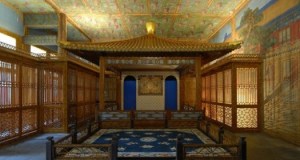 When the last emperor of China, Puyi, left the Forbidden City in 1924, the doors closed on a secluded compound of pavilions and gardens deep within the palace. Filled with exquisite objects personally commissioned by the 18th-century Qianlong (pronounced chee’en lohng) emperor for his personal enjoyment, the complex of lavish buildings and exquisite landscaping lay dormant for decades. Now for the first time, 90 objects of ceremony and leisure – murals, paintings, furniture, architectural and garden components, jades and cloisonné – will be on view at the Peabody Essex Museum (PEM) in Salem, Massachusetts. The Emperor’s Private Paradise: Treasures from the Forbidden City will reveal the contemplative life and refined vision of one of history’s most influential rulers with artworks from one of the most magnificent places in the world.
A model of international cooperation, the exhibition was organized by the Peabody Essex Museum in partnership with the Palace Museum, Beijing, and in cooperation with World Monuments Fund (WMF). “This is the first time that the Palace Museum has authorized such a large-scale and comprehensive traveling exhibition of original historic cultural heritage objects and interiors, all of which represent the apex of the Qianlong period,” said Zheng Xianmiao, Director of the Palace Museum, Beijing. . . .
A Garden of Elegant Repose
A jewel in the immense Forbidden City complex, the Qianlong Garden had remained untouched for more than 230 years when in 2001 the Palace Museum and WMF began the restoration of the 27 buildings, pavilions and outdoor elements including ancient trees and rockeries. Built when China was the largest and most prosperous nation in the world, the garden complex was part of the emperor’s ambitious commission undertaken in anticipation of his retirement. Buddhist shrines, open-air gazebos, sitting rooms, libraries, theaters, and gardens were interspersed with bamboo groves and other natural arrangements. In the garden’s worlds within worlds, the Qianlong emperor would retreat from affairs of state and meditate in closeted niches, write poetry, study the classics, and delight in his collection and artistic creations.
“The Qianlong Garden project is the centerpiece of our conservation work in China. World Monuments Fund is honored to be part of both the history and the future of this important site, and delighted to be working with the Peabody Essex Museum and bringing the Qianlong Garden to a public audience,” said Bonnie Burnham, President of World Monuments Fund.
The Emperor’s Private Paradise includes a film and other interactive elements highlighting the conservation process undertaken by the Palace Museum and WMF, as well as the gifted artisans who restored the objects and architecture to their original condition. A computerized walk-through will offer visitors a vicarious experience of one of the principal structures, the Juanqinzhai building, conservation of which has just been completed. Museum-goers will be able to try their hand at calligraphy with a touch station that will lead them through the brush strokes.
An Emperor of Exceptional Influence
Reigning from 1736 to 1796, the Qianlong emperor led China to sweeping administrative, military, and cultural achievements while far surpassing European monarchs of his day in wealth and power. As the fourth emperor of the Qing (pronounced ching) dynasty to rule China, his 60-year reign spanned the American and French Revolutions, and the reigns of a veritable parade of Georges, Fredericks, and Catherines of Europe. The Qianlong emperor was a multi-faceted monarch – an aggressive military conqueror of vast territories and a passionate patron of the arts. Many of our impressions of imperial China’s splendor date from the 18th century and owe much to the tastes, fashions, and style of the Qianlong court. While incorporating classic Chinese design features such as elements of nature and expressions of Confucian morality, the Qianlong emperor also added new concepts from European painting styles. His desire to innovate within the Chinese aesthetic touched the objects, architecture, and landscapes that he commissioned, transforming what we recognize as Chinese art.
Objects of Imperial Contemplation
The artworks crafted for the Qianlong emperor echoed and supported his dedication to Buddhist spiritual pursuits, Confucian morals, love of literature and reverence for nature. “Visitors to this exhibition will be invited to walk through our galleries the way the Qianlong emperor would have strolled through his rooms and gardens. Around each corner are opportunities to encounter objects of beauty and exceptional craftsmanship,” said Nancy Berliner, exhibition curator and curator of Chinese art at the Peabody Essex Museum. . . .
China and the Peabody Essex Museum
PEM’s relationship with China extends nearly to the Qianlong emperor’s reign and is the longest of any museum in North America. Dating to the close of the 18th century, PEM’s holdings in Chinese art and Asian export art represent some of this country’s first efforts to reach outward and establish mutually enriching, lasting exchanges with other nations.
The Emperor’s Private Paradise is the next step in PEM’s ongoing commitment to bringing new discoveries in Chinese art and architecture to the public. Yin Yu Tang, an 18th-century merchant’s house acquired by the museum in 2003, is the jewel of the museum’s collection and the only example of historic vernacular Chinese architecture in North America. The building was meticulously dismantled at its original site in southeastern Anhui province and re-constructed piece by piece at the museum in Salem. Yin Yu Tang remains a great source of pride for the museum, a deep and abiding connection to China and a rare trove of living scholarship.
Small Show at the V&A: Fashion Plates and Fashion Satire
From the V&A:
Fashion Fantasies: Fashion Plates & Fashion Satire, 1775-1925
Victoria & Albert Museum, London, 21 June 2010 — January 2011

Robert Dighton, "May," from the series "Allegorical Representations of the Months," watercolour, bodycolour and ink on paper, ca. 1785 (London: V&A, Museum No. E37 - 1947)
This display juxtaposes two genres of print that fantasise fashion on paper: fashion plates and graphic social satire. The fashion plate communicated changes in fashion but also encouraged viewers to engage with a luxurious fantasy. At the same time fashionable dress was subject to imaginative distortions in the hands of graphic satirists interested in exposing social foibles. From the oversize wigs of the 1770s to the short skirts and fur stoles of the 1920s, the display charts the dialogue between fashion plate and fashion satire.
V&A Goes Underground: Plan to Expand under Boilerhouse Yard
From the V&A:
Architectural Studies for the V&A
Victoria & Albert Museum, London, 21 June — 19 September 2010
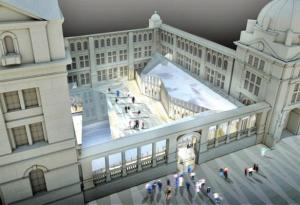
Proposal from Francisco Mangado (Mangado + Asociados)
Eight internationally renowned architects present concept designs for a hypothetical redevelopment of the V&A’s Boilerhouse Yard. The designs, comprising architectural models and plans respond to a brief to create temporary exhibition space below ground and a courtyard at street level off Exhibition Road. The participating practices are:
Jamie Fobert Architects
Tony Fretton Architects Ltd.
Heneghan Peng Architects
Amanda Levete Architects
Francisco Mangado (Mangado + Asociados)
The Office for Metropolitan Architecture (OMA)
Sutherland Hussey Architects
Snøhetta
◊ ◊ ◊ ◊ ◊
As reported by Jay Merrick in The Independent (14 July 2010) . . .
The last time the Victoria and Albert Museum tried to build an extension, the design was likened to an exploding cardboard box and sparked an eight-year battle for approval and funding which ended in a resounding no. The episode must have left a bad taste in the mouth as, once Daniel Libeskind’s Spiral design crashed and burned spectacularly after being denied Heritage Lottery funding, the extension was never mentioned again.
Until now. The museum’s project and design director, Moira Gemmill, has revealed that the V&A will hold a design competition this autumn for a major extension on the very site where the bitterly controversial £70m Spiral was intended to go. But there seems little chance that the V&A will risk anything that is architecturally radical; the Spiral may be history, but it still casts a long and very dark shadow.
That eight-year nightmare ended on 16 September 2004 when the V&A’s director, Mark Jones, was forced to concede that the Spiral odyssey had turned into the architectural equivalent of Monty Python’s dead parrot sketch. The scheme was to have been built on the V&A’s Boilerhouse Yard site, a shambles of offices and plant rooms that lies behind the classical screen along Exhibition Road, designed by Aston Webb in 1891. . . .
The V&A now wants the polar opposite of the upwardly exploding, five-storey Spiral – a flat piazza on the same level as Exhibition Road, with 1500 square metres of new exhibition space beneath it. Costing £30m at most, it will carry less than half the Spiral’s price-tag and, much more significantly, will unlock the second 10-year phase of the V&A’s FuturePlan development strategy.
“We want to create a new semi-public space,” said Ms Gemmill. “The new piazza needs to be absolutely beautifully designed. It can be a place for temporary art, or all sorts of activity” . . . .
The full article is available here»










 Enfilade
leave a comment