Prince Eugene of Savoy
From The Art Newspaper:
Agnes Husslein-Arco, ed., Prince Eugene: General-Philosopher and Art Lover (Munich: Hirmer Verlag), ISBN 9783777425511, $75.
Reviewed by Theodore K. Rabb, Professor Emeritus, Princeton University; posted 29 June 2010
. . . Ruling a multitude of languages and peoples, the Habsburgs were unique among Europe’s monarchs in their enthusiasm for foreign aristocrats at their court and as commanders of their armies. None repaid that welcome as handsomely as Eugene. In a few decades, he not only launched a once shrinking dynasty into an expansive era of conquest, but he helped make Vienna into one of the most dazzling capitals and cultural centres in Europe.
This catalogue records an exhibition (until 6 June) that pays tribute to the prince’s many achievements. It is held in the lower half of the Belvedere in Vienna, a two-part palace that is a contender for the title of the most imposing townhouse ever built, and which Eugene spent over a decade completing during the 1710s and 1720s. Although more than 300 objects are on display, ranging from sculptures to manuscripts, weapons to portraits, they barely scratched the surface of his possessions. His library alone, now owned by the national library, contained some 15,000 volumes. He had two Van Dycks, seven Guido Renis, and hundreds of Dutch and Italian paintings. At the heart of the Albertina’s collection of prints, the largest in the world, are the 255 volumes of engravings by masters such as Dürer that ultimately came from Eugene. . . .
For the full review, click here»
◊ ◊ ◊ ◊ ◊
The exhibition as described at EuroMuse (sorry that this one slipped by me until just recently). . .
Prinz Eugen: Feldherr, Philosoph, und Kunstfreund / General, Philosopher, and Art Lover
Lower Belvedere, Vienna, 11 February — 6 June 2010
Of Italian descent and a native French, Prince Eugene of Savoy (1663-1736), following his meteoric rise and splendid career as a military leader, became one of the most influential Austrians who had a long-lasting impact on the country’s fate and its art and cultural history. As a diplomat and counsel to the emperors Leopold I, Joseph I, and Charles VI, he travelled across Europe from one theatre of war to the next, playing a decisive role in determining the future of the House of Habsburg.
In 2010, the Vienna Belvedere, with its two palaces and Baroque gardens built by Johann Lucas von Hildebrandt in the early eighteenth century as a summer residence for Prince Eugene of Savoy, will be the venue of an exhibition presenting the prince as a general, statesman, and patron of the arts and sciences. Throughout his lifetime, he devoted himself to the compilation of a comprehensive collection of paintings, copper engravings, incunabula, illuminated manuscripts, and books, which he displayed in his Viennese palaces. From ever changing war sites, Prince Eugene corresponded with artists and artisans, landscape designers and architects, as well as the most influential thinkers of his time.
His acquisitions went down in the annals of European art and cultural history and facilitated the transfer of works of art from the court of the French king Louis XIV to Vienna. His interest in the natural sciences – in matters of which he relied on the expertise of the philosopher and scientist Gottfried Wilhelm Leibniz – is reflected in a large collection of exotic animals and plants.
The exhibition will showcase exhibits from Prince Eugene’s art collections – predominantly paintings from the Galleria Sabauda in Turin and cimelia from the Bibliotheca Eugeniana – in an ambience simulating period interiors, thus conveying to the visitors the complex decoration of those buildings where Prince Eugene, as president of the Imperial War Council and member of the Privy Council, received such illustrious guests as the ambassador of the Ottoman Empire.
◊ ◊ ◊ ◊ ◊
Additional information on the exhibition is available at The Luxury Traveler.
Sport and Panelling at the Bowes
From the Bowes Museum’s website:
British Sporting Art
Bowes Museum, County Durham, England, 11 May — 10 October 2010
 British Sporting Art, will explore the genre of Sporting Art in Britain, from horseracing and hunting to boxing, football and cricket. Central to the theme of the exhibition, which will include works by George Stubbs, Sir Alfred Munnings and George Morland, is John Bowes, the founder of the Museum and the first man to lift the renowned Triple Crown. Inspired by Bowes’ love for horseracing and its importance to the story behind The Bowes Museum, this exhibition will explore his prolific racing career and the wider genre of Sporting Art.
The branch of painting which has come to be known as British Sporting Art was at its height during the 18th Century, when horseracing fervour swept the nation. It was a golden age for sporting artists, the most famous of which was Stubbs, with an urge to immortalise winners on canvas. Despite it being rejected by connoisseurs as a low form of art, and by Sir Joshua Reynolds as
genre painting, Stubbs was a significant presence at the Royal Academy annual exhibitions, to huge critical acclaim.
Featured in the display will be the Museum’s painting, Cotherstone, by J F Herring Jnr, and John Ferneley’s Beeswing. The former was bought at auction from Christie’s in New York in 2006, Cotherstone being one of Bowes’ most successful racehorses, while the latter is on long term loan to the Museum. Beeswing won 51 from 64 races, becoming quite a celebrity, with several public houses named after her.
Artists such as Gillray, whose work also features in the exhibition, were quite different from those depicting field sports. They produced detailed portraits of boxers and comical sporting scenes, which were reproduced in popular print form. The exhibition will consider whether this in itself is a statement about the class system in the 18th Century, particularly as the print industry became prominent. It will also consider the next generation of painters – Herring Snr & Jnr and Henry Alken, who faced less prejudice than their predecessors, and will conclude with more recent sporting paintings by Munnings, whose hunting scenes are instantly recognisable. Lifelike bronzes of racehorses, deer and gundogs, by sculptor Sally Arnup, will enhance the sporting art.
◊ ◊ ◊ ◊ ◊
As noted at Art Daily (27 July), the Bowes Museum’s ‘Object of the Month’ for August is the panelling from the London townhouse of Philip Dormer Stanhope, 4th Earl of Chesterfield.
 Chesterfield, best known for his letters to his [illegitimate] son, giving advice on how to behave and get on in society, was also an international diplomat who desired a house fully up-to-date in style. His house was the first in England to show the ornate rococo style imported from France in the mid-18th Century. . . . Chesterfield House was demolished in 1937 and parts of the ante-room were brought up to Sunderland. The panelling was presented by Sir Nicholas Williamson of Whitburn Hall in 1968. It forms the centrepiece of the Museum’s new galleries devoted to English Interiors 1500-1900.
Collection of Early Drawing Instruments
The following 2007 press release from Columbia University regarding the Alpern Collection of drawing instruments notes that “an exhibition and catalogue are in preparation.” Well, here they are (nearly so anyway). . .
◊ ◊ ◊ ◊ ◊
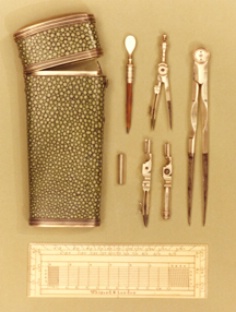
A pocket set of silver instruments with an ivory scale/protractor, housed in a silver-mounted case covered in shagreen – the skin of a sting ray. English, 2nd half of the 18th c.
February 28, 2007 An outstanding collection of early architectural drawing instruments has been donated to the Avery Architectural and Fine Arts Library at Columbia University by noted New York architectural historian Andrew Alpern.
The collection comprises 170 English, Continental and American sets and individual pieces spanning over 250 years of exquisite craftsmanship in silver, ivory, steel and brass. Sets range from small portable sharkskin or tortoise-shell cases containing the architect’s essential tools – pen, scales, dividers, compass and protractor – to large mahogany cases containing every aid imaginable for the aspiring draftsman. Assembled over a 40-year span, the collection is fully functional. According to Alpern, “Preparing construction drawings (as I have) employing 18th-century solid silver instruments of superb quality is vastly more satisfying than using ordinary modern ones.”
“We are tremendously grateful to Andrew Alpern for his gift of these rare and precious instruments” said Avery Library’s Director, Gerald Beasley, who added that “Computer-aided design has entirely supplanted their manufacture and use, but this only increases their research value to historians of architectural design.”
The collection, which also includes numerous trade catalogues and other rare books about the instruments, is available to researchers by appointment at Avery Library’s Department of Drawings and Archives. An exhibition and catalogue are in preparation.
◊ ◊ ◊ ◊ ◊
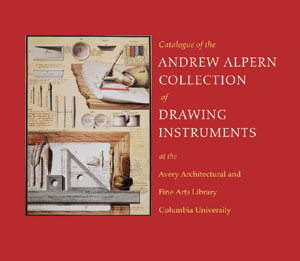 This elegant volume documents three hundred years of exquisite drawing tools, richly photographed and described, for architects, draftsmen, and engineers. Crafted in silver, ivory, steel, and brass, the instrument sets catalogued here range from small silver-mounted tortoiseshell pocket étuis to multitiered mahogany cases housing every professional aid imaginable. Computers have supplanted their manufacture and use, yet these exquisite traditional instruments are still fully functional. ISBN 9780978903732, $60 (September 2010).
Exhibition Marks the 300th Birthday of Johann Evangelist Holzer
The following comes from the website of the Domschatz- und Diözesanmuseum; there’s also a fine site dedicated to the exhibition (I’m sorry that all are only in German). . .
Johann Evangelist Holzer (1709-40), Painter of Light
Augsburg, 28 March — 20 June 2010
Eichstätt, 14 July — 31 October 2010
Innsbruck, 3 December — 13 March 2011
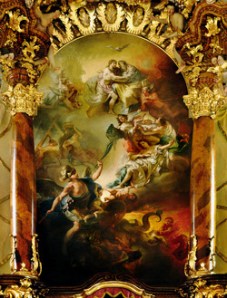
- Johann Evangelist Holzer, altarpiece in Eichstätt Schutzengelkirche
Johann Evangelist Holzer (1709-1740) gehört zu den großen Meistern des 18. Jahrhunderts. Kirchen und Klöster in Süddeutschland stattete er mit prächtigen Fresken und Altarblättern aus. Nach nur wenigen Schaffensjahren hatte der in Burgeis in Südtirol geborene Künstler, der lange in Augsburg wirkte und mit nur 31 Jahren in Clemenswerth an der niederländischen Grenze starb, ein bedeutendes Werk hinterlassen.
Seine Zeitgenossen setzten Holzer gar dem italienischen Maler Raffael gleich, heute ist sein Werk eine wahre Entdeckung. Vier Museen in Deutschland und Österreich haben sich das gemeinsame Ziel gesetzt, mit unterschiedlichen Schwerpunkten Leben und Werk dieses Malers und Grafikers des Spätbarock in einer Werkschau mit etwa 160 Exponaten erstmals umfassend vorzustellen.
In der barocken Residenzstadt Eichstätt wird die Kunst Holzers in ihrer ursprünglichen städtebaulichen und künstlerischen Atmosphäre besonders gut erlebbar. In der ehemaligen Jesuitenkirche präsentieren sich dem Besucher frisch restauriert, drei Altarblätter Holzers, darunter der Hochaltar als sein größtes Leinwandgemälde. Weitere Altarbilder sowie eine Computersimulation der Kuppel von Münsterschwarzach sind im Kuppelraum der ehemaligen Klosterkirche Notre Dame zu besichtigen. Im Festsaal der ehemaligen fürstbischöflichen Sommerresidenz bildet das zauberhafte Deckengemälde Holzers einen weiteren Höhepunkt.
 Das Domschatz- und Diözesan als zentrale Anlaufstelle in Eichstätt präsentiert eine reiche Schau zu Holzers Früh- und graphischem Werk. Ein vielfältiges Veranstaltungsprogramm rundet die Werkschau ab, zu der ein umfangreicher Katalog erscheint.
Current Issue of ‘Eighteenth-Century Studies’
Selections from Eighteenth-Century Studies 43 (Summer 2010):
Stacey Sloboda, “Displaying Materials: Porcelain and Natural History in the Duchess of Portland’s Museum,” pp. 455-72.
Abstract: Porcelain in eighteenth-century aristocratic collections was associated with both the curious and the foreign. The Duchess of Portland’s Museum contained large amounts of porcelain along with thousands of natural history specimens. The material and geographic plurality of the collection mirrored its totalizing claims to have a comprehensive display of the world’s natural and artificial materials. This essay explores the relationship between porcelain and natural history, arguing that Portland’s collection attempted to bridge conceptual distinctions between science and art in the eighteenth century, and that this project was particularly important to making sense of eighteenth-century female collecting practices and their sociable display.
Dorothy Johnson, “Review Article — The Matter of Sculpture,” pp. 505-08.
- Erika Naginski, Sculpture and Enlightenment (Los Angeles: Getty Research Institute, 2009).
- Martina Droth and Penelope Curtis, eds., Taking Shape: Finding Sculpture in the Decorative Arts (Leeds and Los Angeles: Henry Moore Institute and the J. Paul Getty Museum, 2008-09).
- Anne Betty Weinshenker, A God or a Bench: Sculpture as a Problematic Art during the Ancien Régime (Bern: Peter Lang, 2008).
Clorinda Donato, “Review Article — Fresh Legacies: Giovanni Battista Piranesi’s Enduring Style and Grand Tour Appeal,” 508-11.
- Mario Vevilacqua, Fabio Barry, and Heather Hyde Minor, eds., The Serpent and the Stylus: Essays on G. B. Piranesi (Ann Arbor: University of Michigan Press, 2006).
- Andelka Galic and Vladimir Malekovic, eds. Piranesi: Vasi candelabri cippi sarcofagi tripodi lucerne ed ornamenti antichi, exhibition catalogue, translated into Italian by William Klinger (Zagreb: Museum of Arts and Crafts, 2007).
A Visual Puzzle at the Yale Center for British Art
Notice of the exhibition appeared here in April, but now that the show is actually on view, here it is again:
Seeing Double: Portraits, Copies, and Exhibitions in 1820s London
Yale Center for British Art, New Haven, 24 June — 19 September 2010
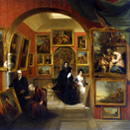
John Scarlett Davis, "Interior of the British Institution Gallery" detail 1829 (YCBA)
In 1829, the young artist John Scarlett Davis sought to make a splash on the London art scene with his painting, Interior of the British Institution. An image of an art exhibition, the painting is also an elaborate visual puzzle. Seeing Double: Portraits, Copies and Exhibitions in 1820s London invites viewers to decode this puzzle and in the process explore the relationship between display and replication in early nineteenth-century Britain. Davis’s painting has long been recognized as a valuable record of an early nineteenth-century exhibition venue, representing in miniature works by Sir Joshua Reynolds and Thomas Gainsborough, among others. What has less often been recognized is that the figures who chat amiably or stoop to examine canvases are themselves replicas of paintings: Davis copied the figures from pre-existing portraits, notably by Sir Thomas Lawrence. By examining this practice, the exhibition reveals hitherto unknown connections between works in the Center’s collection. Seeing Double has been organized by the Yale Center for British Art and curated by Catherine Roach, Postdoctoral Associate, Department of the History of Art, Cornell University. The organizing curator at the Center is Cassandra Albinson, Associate Curator of Paintings and Sculpture.
Engraving Watteau
Antoine Watteau et l’art de l’estampe / Antoine Watteau and the Art of Engraving
Musée du Louvre, Paris, 8 July — 11 October 2010

Exhibition catalogue by Marie-Catherine Sahut and Florence Raymond, ISBN: 9782847421521 ($50)
A hundred engravings from the oeuvre of Antoine Watteau, mostly from the Edmond de Rothschild collection, illustrate the art of engraving in the 18th century. Before his premature death at age thirty-seven, the painter, engraver, and tireless draftsman Antoine Watteau (1684–1721) set his seal on the 18th century with the grace and spontaneity of his art. The oeuvre was engraved almost at once—between 1724 and 1735—on the initiative of his friend and protector Jean de Julienne. This remarkable venture—four volumes totaling some six hundred plates after his drawings and paintings—was entrusted to fifty engravers. A crucible for young talents including François Boucher and Laurent Cars, the project played its part in the Europe-wide development of the Rocaille style, of which Watteau was one of the main instigators.
Curators: Marie-Catherine Sahut (Department of Paintings) and Pascal Torres-Guardiola (Department of Prints and Drawings)
◊ ◊ ◊ ◊ ◊
N.B. — The catalogue is available through artbooks.com (a full description, in English, is available here). The latest mailing from Artbooks.com also includes the forthcoming title edited by Christiane Naffah, Watteau et la fête galante (Paris: Musées nationaux, 2010), ISBN: 9782711856541 ($90).
Thomas Lawrence Exhibition and Conference
Thomas Lawrence: Regency, Power and Brilliance
A Conference at the National Portrait Gallery and The Paul Mellon Centre, London, 18-19 November 2010
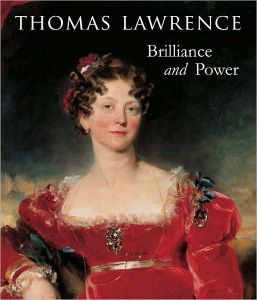
Ed. by Cassandra Albinson, Peter Funnell, Lucy Peltz ISBN: 9780300167184 (YCBA, 2010), $70
This conference accompanies the exhibition Thomas Lawrence: Regency, Power and Brilliance at the National Portrait Gallery, London (20 October 2010–23 January 2011) which will be shown at the Yale Center for British Art, New Haven, (24 February–5 June 2011). This will be the first exhibition in the United Kingdom since 1979 to examine Lawrence’s work and the first substantial presentation of this artist in the United States. It will present Lawrence as the most important British portrait painter of his generation and will explore his development as one of the most celebrated and influential European artists of the late eighteenth and early nineteenth centuries. By his untimely death in 1830 Lawrence had achieved the greatest international reach and reputation of any British artist. Based on new research and fresh perspectives, this exhibition will introduce Lawrence to a new generation of museum visitors and students. It will also contextualise his work in the light of recent scholarship on the art, politics and culture of the period. The exhibition will include the artist’s greatest paintings and drawings alongside lesser known works in order to provide a fresh understanding of Lawrence and his career. It will contrast his approach to sitters according to age and gender, juxtapose the power and impact of his public works with the intimacy and intensity of those portraits of his friends and family, trace his innovations as a draughtsman and painter, and place him within the broader contexts of the aesthetic debates, networks of patronage and international politics of his day.
Thursday, 18 November 2010, National Portrait Gallery (2:00pm–8:30pm)
Session One will address issues relating to Lawrence, gender and representation, and will include papers by Marcia Pointon (Professor Emerita, University of Manchester), Shearer West (Arts and Humanities Research Council and the University of Birmingham) and Sarah Monks (School of World Art Studies and Museology, University of East Anglia).
Evening: At 6pm, delegates are invited to attend a guest lecture by Richard Holmes, the biographer and author of The Age of Wonder: How the Romantic Generation Discovered the Beauty and Terror of Science (2008) and formerly Professor of Biographical Studies at the University of East Anglia. The lecture will be followed by a wine reception hosted by the curators, and free admission to the exhibition.
Friday, 19 November 2010, Paul Mellon Centre (9:15am–7:15pm)
Session Two, devoted to Lawrence and his contemporaries, will include papers by Viccy Coltman (University of Edinburgh) and Martin Myrone (Tate).
Session Three will explore technical aspects of Lawrence’s career, particularly his studio practice and relationship with engravers, and will include papers by Jacob Simon (National Portrait Gallery) and Sally Doust (Independent Scholar).
Session Four will address Lawrence’s reputation and historiography into the later nineteenth century, and will include papers by Philippa Simpson (Tate) and Pat Hardy (Walker Art Gallery, National Museums Liverpool).
The conference will conclude with a roundtable discussion, including Mark Hallett (University of York), Ludmilla Jordanova (King’s College, London), David Solkin (Courtauld Institute of Art), and the curators of the exhibition, which will consider themes arising from this exhibition and conference. The discussion will be followed by a wine reception at 5:45pm.
Full conference fee for both days, including coffee, lunch and tea on 19 November, and receptions: £40. Student and Senior concessions £20. To register for the conference please check availability with Ella Fleming at The Paul Mellon Centre: Email: events@paul-mellon-centre.ac.uk, Tel: 020 7580 0311, Fax: 020 7636 6730.
200th Anniversary of Napoleon’s Second Marriage
Press release (PDF) from the Musée national du château de Compiègne:
1810: The Politics of Love — Napoleon I and Marie-Louise in Compiègne
Musée national du château de Compiègne, 28 March — 19 July 2010

Exhibition catalogue, ISBN: 9782711857029
This first exhibition in France to evoke Marie-Louise, Empress of the French, intends to celebrate the two hundredth anniversary of the second marriage of Napoleon I to the young Archduchess of Austria, Marie-Antoinette’s grand-niece. It describes the extraordinary preparations for the arrival of the new Empress at the Palace of Compiègne, the splendours of the wedding ceremonies in Paris and the subsequent honeymoon in Compiègne. More than 200 works, wedding gifts, commissions for the sovereign’s trousseau and items of furniture, have been brought together: paintings, drawings, prints, sculptures, objets d’art, clothes, silks and jewellery. The exhibition has special loans from French museums (Louvre, Versailles, Fontainebleau, Fondation Napoléon and Fondation Thiers, etc) as well as international loans (Italy, Switzerland, Germany etc).
Napoleon I chose to receive his second wife at the Palais de Compiègne, just as Marie-Antoinette had been received here in 1770 by Louis XV and the Dauphin, the future Louis XVI. This event took place on 27 March 1810 and, on the orders of the Emperor who in his impatience brushed aside all protocol, the official meeting planned for Soissons was cancelled. 1810: la politique de l’amour: Napoléon Ier & Marie-Louise à Compiègne sets out to show the sumptuous refurbishment of the palace and the park before 1810.
The works started in 1807 under the direction of the architect Louis-Martin Berthault, and were hurried forward for the arrival of the Archduchess. Large portraits of the great figures of the Empire were presented in the new Galerie des Ministres (Prud’hon, Fabre, Lefèvre, etc), paintings by great masters from many different schools (Le Dominiquin, Patel, Flinck, etc) were brought together in the new Galerie des Tableaux de l’Impératrice, and Canova’s famous marbles on the theme of Psyche and Love (the standing version of this is on special loan from the Louvre), were placed at the entrance to the imperial apartments. The furniture, made by cabinetmakers Jacob-Desmalter and Marcion, as well as the Sèvres porcelain ordered for the palace, illustrates one of the high point of decorative art at a time when the Empire style was at its peak.
The grandeur of the civil and religious wedding celebrations at the Palace of Saint-Cloud then in the Salon Carré of the Louvre, together with the festivities organised in Paris up to 1st July 1810, reflecting an Emperor at the height of his power, created a wealth of iconographic images (Rouget’s painting inspired by David’s Coronation of Napoleon, drawings by Zix and Prud’hon, portraits by Gérard, Isabey, etc). (more…)
An Eighteenth-Century Synagogue from Suriname in Jerusalem
Press release (24 May 2010) from the Israel Museum:
Rare and Newly Restored 18th-Century Synagogue from Suriname to be Highlight of Israel Museum’s New Synagogue Route

Interior of the 18th-century Suriname Synagogue Zedek-ve-Shalom at the Israel Museum. Photo by Eli Posner. Courtesy of the Israel Museum, Jerusalem.
A newly restored 18th-century synagogue from Suriname – one of only two remaining examples – will be a highlight of the Israel Museum’s newly installed Mandel Wing for Jewish Art and Life, on view beginning July 26, 2010, when the Museum opens its expanded and renewed campus to the public. This rare and striking South American synagogue will stand alongside synagogue interiors from Italy, Germany, and India as part of the Museum’s new Synagogue Route, which will offer visitors the opportunity for a notably rich experience with Jewish ritual traditions from around the world. On display with its original furniture and decorations and a sand floor, the Tzedek ve-Shalom Synagogue will offer visitors a glimpse into Suriname’s once vibrant Jewish community.
Built in 1736 in the capital city of Paramaribo, Suriname, Tzedek ve-Shalom ceased to function as a place of worship in the 1990s. In order to rescue this important example of the Jewish life of this remote Jewish community, the Israel Museum approached its leaders with the aim of restoring and preserving the synagogue on its campus for the benefit of future generations of visitors from around the world. The synagogue’s interior and its original ceremonial objects and furnishings were transferred to the Museum in 1999, where it has now been meticulously refurbished. (more…)










 Enfilade
leave a comment