Richard Wilson Exhibition in New York
From a press release from Richard Feigen:
Richard Wilson and the British Arcadia
Richard L. Feigen & Co., New York, 29 April – 25 June 2010

Richard Wilson, "View of Caernarvon Castle, Wales," 1744-45 (Detroit Institute of Arts)
Richard L. Feigen & Co. will present Richard Wilson and the British Arcadia, a loan exhibition dedicated to the first great British landscape artist, Richard Wilson (c.1713-1782). This will be the first exhibition to be devoted to the artist in North America in over 25 years.
Richard Wilson and the British Arcadia will feature approximately a dozen of the painter’s works from both public and private US collections. One of the highlights of the exhibition will be the great Destruction of the Children of Niobe, the key picture of Wilson’s career and a landmark in the history of British landscape paintings, which is being loaned by the Yale Center for British Art. Also included will be Wilson’s earliest known view of his native Wales, Caernarvon Castle, on loan from the Detroit Institute of Arts, as well as several seminal pictures painted during the artist’s sojourn in Italy, among them, The Temple of Clitumnus from a private US collection.
Wilson’s second English period will be represented by his perhaps most famous landscape, The White Monk, loaned by the Toledo Museum of Art, and a magnificent view of Tivoli from the Kimbell Art Museum. The exhibition will also feature several pictures by some of the seventeenth-century landscape masters whose work influenced Wilson’s. Claude Lorrain’s exquisite Pastoral Landscape, a small copper being lent by the Yale University Art Gallery, and Aelbert Cuyp’s idyllic Landscape with the Flight into Egypt from the Metropolitan Museum will be among the pictures shown in this context.
The exhibition will be accompanied by a fully illustrated catalogue, to which the distinguished scholar of British art, Andrew Wilton, has contributed the introductory essay. Mr. Wilton is Visiting Research Fellow at Tate Britain, having formerly been Keeper of the British Collection and Curator of the Turner Collection in the Clore Gallery. The most recent of his many publications are Turner in His Time, Turner as Draughtsman, and Five Centuries of British Painting: From Holbein to Hodgkin. All proceeds from the sale of the catalogue will be donated to the Richard Wilson catalogue raisonné project, which is being undertaken by Dr. Paul-Spencer-Longhurst on behalf of the Paul Mellon Centre for Studies in British Art in London, the sister institution to the Yale Center for British Art in New Haven.
Palladio and His Legacy at the Morgan
From The Morgan’s website:
Palladio and His Legacy: A Transatlantic Journey
The Morgan Library and Museum, New York, 2 April — 1 August 2010

Villa Rotunda, from “The Architecture of A. Palladio,” 1715-20 (RIBA Library)
Palladio and His Legacy: A Transatlantic Journey features thirty-one original Palladio drawings from the Royal Institute of British Architects. These exquisite drawings, which were exhibited only once before in America and never in New York, will be on view to the public for the first time in over thirty years. They are being presented with rare architectural texts to illustrate the journey from Italy to North America of Palladio’s design principles of proportion, harmony, and beauty.
Palladio’s work has significantly influenced American architecture from colonial times to the present day. Focusing on the artist’s original drawings and following the trajectory of his ideas, the show also traces the story of American Palladianism. The drawings are supported by numerous architectural models. Three large examples—the Pantheon, Villa Rotunda, and Jefferson’s unrealized design for the White House—programmatically illustrate the journey from Rome to America. Smaller models, along with rare architectural texts and pattern books through which Palladio’s ideas were primarily transmitted, reinforce the themes of the exhibition.
◊ ◊ ◊ ◊ ◊
 This book has been written to accompany the exhibition Palladio and His Legacy: A Transatlantic Journey and shows drawings, books and images from the peerless Palladio collections of the Royal Institute of British Architects. It shows how Palladio studied and reinterpreted the architecture of antiquity, how he developed his ideas, how his message spread, and how Palladianism developed and spread across America, where Palladio’s legacy has remained longest and most widespread. Andrea Palladio lived and worked some 500 years ago in the Veneto. Yet his international influence, and particularly his impact on American architecture, has been greater than that of any architect since. Simplicity and proportion formed the basis of his idea of architecture; the villas he created in the Veneto around Venice, together with his writings, which were widely disseminated after his death, have helped shape European and American buildings for more than 400 years.
◊ ◊ ◊ ◊ ◊
As noted by The Art History Newsletter, the exhibition was reviewed in The New York Times by Nicolai Ouroussoff on 8 April 2010. There’s also an interview by Suzanne Stephens and William Hanley at Architectural Record.
The Chapel at Versailles Turns 300
Une Chapelle pour le Roi / A Chapel for the King
Château de Versailles, 20 April — 18 July 2010
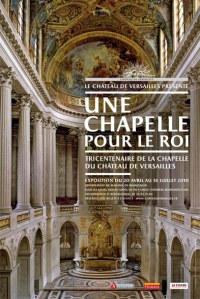 To mark the tercentenary of the Royal Chapel, the Château de Versailles is devoting an exhibition that presents the genesis of this building and the highlights of its history. Among the works exhibited, the liturgical furniture donated by Louis XIV to the Church of the Holy Sepulchre in Jerusalem will be exceptionally on view to the public. The work was undertaken by Jules Hardouin-Mansart in 1687 and completed in 1710 by Robert de Cotte, and the Royal Chapel of Versailles, a masterpiece of sacred art, became the theatre of the religious ceremonies of the Court. In accordance with the tradition of the Palatine Chapels, it has two levels. The principal gallery, above the entrance, was reserved for the royal family, while the side galleries were for the princes of royal blood and principal dignitaries of the Court; the other faithful were on the ground floor. The organ was placed in the loft over the high altar. Designed by Clicquot, its most famous organist was François Couperin.
The exhibition is divided into four sections:
- An evocation of the first Chapel (1672), a brilliant prefiguration of the definitive building.
- The Chapel of 1682, particularly well known from paintings and engravings because it was the religious building used for the longest time in the reign of Louis XIV. Located on the present site of the Salon d’Hercule, it was the scene of the Court’s religious life until 1710.
- The designing of the definitive Chapel, with drawings and engravings relating to the astonishing project for the dome in the centre of the north wing, up to the final magnificent drawings of the architectural office of Jules Hardouin-Mansart.
- The decor and the furniture of the Chapel when completed in 1710: sketches and preparatory paintings for the sumptuous compositions of La Fosse, Jouvenet and Coypel will be presented alongside drawings of the carved trophies on the ground floor and documents enabling visitors to get a clearer idea of the furniture that has not survived.
To accompany the celebration of this tercentenary, the annexes of the Chapel will be opened for guided visits (in French): the sacristies, the oratory of Madame de Pompadour, as well as the rooms used by the choristers and the members of the King’s orchestra. These preserved annexes will enable visitors to get a glimpse of the conditions of the daily life of the various incumbents of the Royal Chapel during the Ancien Régime.
Houdon Exhibition in Montpellier
From the Musée Fabre’s website:
Jean-Antoine Houdon, la sculpture sensible
Musée Fabre de Montpellier, 17 March — 27 June 2010
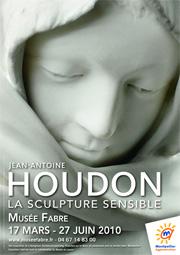 Portraitiste à succès, Jean-Antoine Houdon a exécuté les bustes des personnalités les plus éminentes de l’Europe et de l’Amérique des Lumières : Voltaire, Diderot, Buffon, Franklin, Glück, Condorcet, Cagliostro… mais aussi l’impératrice Catherine II de Russie, Louis XVI, Napoléon Ier… On louait ainsi son talent inégalé pour saisir la vie, l’esprit et le caractère de son modèle. Houdon traitait aussi avec virtuosité les sujets religieux, antiques et allégoriques.
Près d’une cinquantaine de pièces sont exposées, dont dix-huit sculptures de Houdon, au premier étage des collections permanentes (salles 19-20-21). Le coeur de cette rétrospective unique est constitué autour de trois chefs-d’oeuvre : les allégories en marbre de l’Hiver, appelé la Frileuse (1783), et de l’Eté (1785) appartenant au musée Fabre, puis sa version en bronze réalisée en 1787 prêtée par le Metropolitan Museum of Art de New York. Ces statues sont parmi les plus célèbres de son temps et révèlent admirablement le passage du Baroque aux Lumières. Un ensemble de sculptures, gravures, peintures de Houdon, Clodion, Greuze… les accompagne pour expliciter ces représentations liées à l’Amour et à la Mort. (more…)
Early Modern Art Markets: Flemish & Dutch Paintings in Geneva
From the Geneva museum’s website:
L’art et ses marchés: La peinture flamande et hollandaise, XVIIe et XVIIIe siècles
Les Musées d’art et d’histoire, Geneva, 1 October 2009 – 29 August 2010
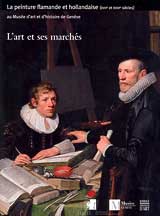
Frédéric Elsig (Paris: Somogy, 2009), ISBN: 9782757202500
This exhibition is in follow-up to La naissance des genres (2005-2006), and it similarly has two objectives. On the one hand, it will present a part of the Museum’s collection that is as important as it is little known: a selection of Flemish and Dutch paintings from the 16th to the 18th centuries that have been treated for purposes of conservation and restoration, and of which the catalogue raisonné will be published on the same occasion. On the other hand, it will illustrate a consequential phenomenon that first emerged during this period in the former Low Countries: the rapid expansion of the art market. With different sections devoted to what were then perfectly constituted categories, the display will highlight the new development’s principal characteristics as well as the predilection of Geneva collectors for Dutch paintings of the Siècle d’Or.
Walpole and Strawberry Hill
The March issue of Apollo Magazine includes a review by Hugh Belsey of the Walpole exhibition now at the V&A in London:
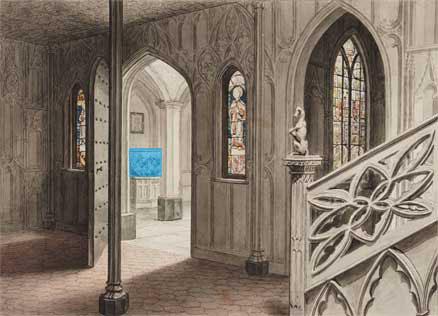
John Carter, "View from the Hall at Strawberry Hill," 1788, pen and ink, and watercolour on laid paper, from Horace Walpole’s extra-illustrated copy of "A Description of the Villa…at Strawberry-Hill" (Strawberry Hill, 1784). Lewis Walpole Library, Yale University. Folio 49 3582, fol. 24.
In 1818 William Hazlitt cruelly remarked that Horace Walpole’s ‘mind as well as his house, was piled up with Dresden china, and illuminated through painted glass’. Twenty-four years later the contents of his house, Strawberry Hill on the banks of the Thames at Twickenham, including the china, were sold. It took the auctioneer, George Robins, 24 days to complete the sale and gave the public the last opportunity to sample Walpole’s mind and taste – or not quite the last opportunity, as many of the rich, strange and beautiful lots have been reassembled in an exquisite exhibition . . . It is a display that sparkles, enchants and entrances. . . .
The full review can be found here»
◊ ◊ ◊ ◊ ◊
In conjunction with the exhibition, there is an outstanding digital component that includes virtual tours and immensely useful search functions for the database (including provenance). As noted on the site:

John Carter, "Tribune from Strawberry Hill", 1789
Horace Walpole’s Strawberry Hill Collection was initially developed by the Lewis Walpole Library to support research for the exhibition Horace Walpole’s Strawberry Hill and for the renovation of the house itself, undertaken by the Strawberry Hill Trust. Dispersed since the famous sale in 1842, Walpole’s collection was one of the most significant in eighteenth-century Britain, numbering several thousand items. This database encompasses the entire range of art and artifacts from Walpole’s collections, including all items whose location is currently known and those as yet untraced but known through a variety of historical records. This information is now made available for public access. The database is an ongoing project: the Library will continue to add and enhance records as further discoveries are made. Queries and comments are invited.
◊ ◊ ◊ ◊ ◊
Finally, it’s worth noting that Strawberry Hill will itself be open to visitors, starting in September, after extensive renovations (projected to cost £8.9 million). For details, see the website of the Strawberry Hill Trust.
Small Show of Watercolours in London
Eighteenth-Century Watercolours from the Royal Academy Collection
Royal Academy of Arts, Burlington House, London, 9 March — 16 May 2010
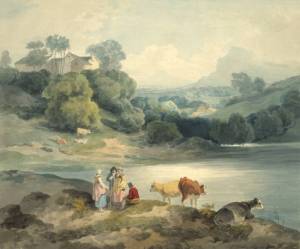
Francis Wheatley "Figures and Cattle by a Lake," 1795. Pencil and watercolour. Photo © Royal Academy of Arts, London.
This display features watercolours by leading British artists of the eighteenth century including J. M. W. Turner, Paul Sandby and Michael ‘Angelo’ Rooker. The works on display were originally part of a collection assembled by the architect John Yenn RA (1750–1821) who bought watercolours, prints and drawings from his friends and fellow artists. Yenn gravitated towards topographical scenes and the display includes impressive views of Durham Cathedral and Battle Abbey. He also shared in the late eighteenth-century enthusiasm for historic ruins, represented here by watercolours of Valle Crucis Abbey and Kenilworth Castle.
Upcoming: A Visual Puzzle at the Yale Center for British Art
Seeing Double: Portraits, Copies, and Exhibitions in 1820s London
Yale Center for British Art, New Haven, 24 June — 19 September 2010
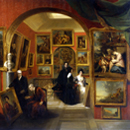
John Scarlett Davis, "Interior of the British Institution Gallery" detail 1829 (YCBA)
In 1829, the young artist John Scarlett Davis sought to make a splash on the London art scene with his painting, Interior of the British Institution. An image of an art exhibition, the painting is also an elaborate visual puzzle. Seeing Double: Portraits, Copies and Exhibitions in 1820s London invites viewers to decode this puzzle and in the process explore the relationship between display and replication in early nineteenth-century Britain. Davis’s painting has long been recognized as a valuable record of an early nineteenth-century exhibition venue, representing in miniature works by Sir Joshua Reynolds and Thomas Gainsborough, among others. What has less often been recognized is that the figures who chat amiably or stoop to examine canvases are themselves replicas of paintings: Davis copied the figures from pre-existing portraits, notably by Sir Thomas Lawrence. By examining this practice, the exhibition reveals hitherto unknown connections between works in the Center’s collection. Seeing Double has been organized by the Yale Center for British Art and curated by Catherine Roach, Postdoctoral Associate, Department of the History of Art, Cornell University. The organizing curator at the Center is Cassandra Albinson, Associate Curator of Paintings and Sculpture.
Trade Cards, as Fleeting and Fragile as Butterfly Wings
The trade card collection from Waddeston Manor is a fascinating collection of advertising images. Searchable, high-resolution images accompanied by notes are available here. The following description comes from The Warwick Eighteenth-Century Center.

Card of Didier Aubert, Printseller & Engraver
Advertising has long been known to be both the reflection of and means to create desire for commodities. The study of historical advertising is, therefore, a key means to understand consumers and consumer markets in early modern society. Despite an extensive literature on the proliferation of new goods and their consumers between 1760 and 1800, there has been little research on the part played by advertising in creating consumer markets. Furthermore, research has tended to focus on texts and the English-speaking world.
Waddesdon Manor has a unique collection of French and German trade cards dating from the seventeenth and eighteenth centuries. Trade cards, prints with a combination of image and text, provided information about the location, goods and services of a given business. A thorough study of these objects can inform us about early modern attitudes to the burgeoning world of goods and the inter-relationship between commercial and fine art.
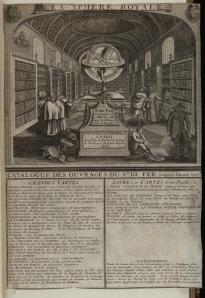
Card of Nicolas de Fer, Geographer and Map-seller, A La Sphere Royale, 1705
‘Selling Consumption,’ is a three-year Leverhulme funded project that seeks to catalogue and analyse these cards using approaches from social history, material culture, art history and the history of collections to provide a resource based on this rich, but under-studied, form of commercial ephemera. The catalogue will be published in the form of an on-line database in Spring 2009, providing scholars with a vital resource to continue the study and understanding of this material. The database has been designed to allow scholars to search by trade or product as well as by decorative motif or iconographic subject. A further field entitled ‘Research Concepts’ aims to facilitate searching the database through the lens of contemporary research interests.
This project has led on to the organisation of an exhibition, to be held at Waddesdon Manor from March to October 2008. The exhibition ‘Selling Shopping in Paris 1680-1820’ will introduce visitors to the unique collection of French trade cards and allow them to learn what and how the cards tell us about the production of advertising, the imagery of consumption, the types of products on sale, the location of trades, as well as what it was like to go shopping in Paris of the long eighteenth century. The items on display: trade cards, textiles, drawings, books, and other objet d’art reflect the interdisciplinary nature of the project.
Marvels in the Marketplace: the Germanic trade cards at Waddesdon Manor
In the course of digitising, cataloguing and investigating the rare collection of trade cards at Waddesdon Manor, the uniqueness of a particular part of the collection has come to light. The last of the four volumes does not contain French prints, nor is it arranged in the broad chronology used to organise the rest of the material. A group of cards relating to hotels and inns, as well as a significant number representing dealers in paintings, antiquities and silverware, provides evidence of links between French mercantile travel and the formation of the collection. Another group of cards illustrating human prodigies and fair-ground entertainers indicates that this ‘French’ view of Germanic cultural activity was figured through the spectacle of abnormal bodies. Currently, it is believed that the French collections of ephemera were driven by nostalgia for the Paris of the Ancien Regime. These cards indicate that other interests helped to shape the collection. A three-month British Academy grant will allow the cataloguing of this volume using the methodologies developed in the ‘Selling Consumption’ project, as well as allowing discreet research to be carried out on these cards . . . .
For additional information, including a bibliography, click here»
The Circle of Tiepolo
From the cultura italia site:
Bortoloni, Piazzetta, Tiepolo: il ‘700 Veneto
Pinacoteca di Palazzo Roverella, Rovigo, 30 January — 13 June 2010

Mattia Bortoloni "Giunone chiede a Eolo di liberare i venti"
Finally, a major exhibit to ‘reveal’ Mattia Bortoloni, juxtaposing Piazzetta, Tiepolo, Balestra, Ricci and other greats from 18th-century Veneto. Some only know him for a Guinness-type work: the widest single fresco of all times and places – 5,500 square meters of delicate painting covering the entire, enormous elliptical dome, the largest in the world, of the Vicoforte Sanctuary, in Piedmont. A colossal work, more or less the dimension of an entire football field, considered the masterpiece of the Piedmontese Baroque period, frescoed in celebration of the Blessed Virgin, while at the same time, glorifying the House of Savoy.
Mattia Bortoloni (Canda di Rovigo, 1696 – Bergamo, 1750), famous, and quite sought-after during his lifetime, then faded into oblivion, considered ‘merely’ one of the best of Giovan Battista Tiepolo’s assistants, to the point that in not a few of the great master’s most celebrated pieces, it is to this day difficult to distinguish which brushstrokes to credit to which artist.
Over the last twenty years, more and more detailed studies have brought about a rediscovery of the breadth of Bortoloni’s own talent. Today it is possible to say, without qualifications, that he was an extraordinary and rather original artist, “suffocated” during his lifetime and by his notoriety as an assistant to the titans of 18th-century artists from the Veneto region, from the Veronese Balestra (who was his teacher) to Tiepolo himself. This major exhibit, entitled Bortoloni, Piazzetta and Tiepolo: 18th-Century Veneto will offer a selection of Bortoloni’s masterpieces juxtaposed with around thirty extraordinary works by Pellegrini, Piazzetta, Ricci and Tiepolo, the ‘titans’ of 18th-century Veneto.

Giambattista Pittoni "Diana e le ninfe"
Among the masterpieces on display, some early works by Tiepolo are worth special mention, including the Glory of St. Dominic and the Temptations of St. Anthony, next to essays into mythological subjects such as Diana and Actaeon and The Judgement of Midas, made available courtesy of the Galleries of the Academy of Venice. Of Piazzetta to be displayed is a rather moving altar piece depicting The Ecstasy of St. Francis, a work on loan from the Civic Museum of Vicenza, next to an early attempt by Sebastiano Ricci depicting Hercules at the Crossroads, on loan from the historic Palazzo Fulcis in Belluno. By Giambattista Pittoni are two works placed next to each other, the first inspired by the tales by Torquato Tasso depicting Olindo and Sofronia and, also of 17th-century layout, the second, Diana and the Nymphs, which shows an already rocailles flavour.

Giambattista Tiepolo "Digntario della Serenissima"
By Bortoloni’s teacher, Antonio Balestra, will be exhibit a never-before-seen Nativity and two extraordinary paintings, on loan from the Benedictine monastery of St. Paul of Argon, following a lengthy restoration project. The exhibit will be further enhanced by a valuable sketch section featuring works by the greatest fresco artists of the 18th century: besides Tiepolo (Giambattista and Giandomenico), Piazzetta and Bortoloni himself, as well as Diziani, Crosato Fontebasso Guarana, who were the great followers of this art form in later years. For the first time, completing this snapshot of the group is one of the key players, unduly forgotten for many years: Mattia Bortoloni, around whom this major exhibit pivots.
Bortoloni was a revered artist, so much so that at just twenty years of age he earned a much sought-after commission – that of frescoing the interior of Villa Cornaro in Piombino Dese, one of Palladio’s masterpieces. An undertaking in which he, albeit extremely tender in years, wisely anticipated the rococo style, which his friend in later years,
Giovanbattista Tiepolo, would then articulate with aplomb.
Light and shadow accompanied his extensive career in which, together with others but often alone, saw his busy with a kind of tunnel-vision (even for those days) with major works in Venice, and throughout the Regions of Veneto, Lombardy and Piedmont. Among his masterpieces are the series of frescoes at the Cathedral of Monza, for the Sanctuary of the Consolata (“The Consoled”), and for Palazzo Barono in Turin, for Palazzo Clerici and Palazzo Dugnani in Milan, Villa Vendramin Calergi in Fiesso Umbertino, Villa Albrizzi in Preganziol, Villa Raimondi in Birago di Lentate and Visconti-Citterio in Brignano d’Adda, the Venetian Churches of Saints John and Paul, and of St. Nicholas in the Tolentini, Ca’ Sceriman and Ca’ Rezzonico, also in Venice, through to his unquestionable masterpiece, the formidable series for the Vicoforte Sanctuary, more than five-thousand square meters of the finest fresco for the world’s largest elliptical dome.
In addition to his work as a fresco painter, Bortoloni was also a wonderful historical-painting artist, works in which storytelling ability goes hand in hand with original interpretive skill. For obvious reasons, this important production was the first to be delved into at the highly anticipated exhibit at Palazzo Roverella. These are works often being studied for the first time, with credits and attributions assigned for the first time as well, pieces never before shown to the public (and others that are ordinarily quite difficult to access), works that restore Bortoloni to a well-deserved prominence, which he enjoyed during his life, before being eclipsed by the magnificence of Tiepolo’s art work.

Catalogue available from Artbooks.com
In this panels, Bortoloni proves himself an inspired and original painter. These are compositions that are laid out in an anti-academic way, ironic and sometimes irreverent, which unquestionably ran against the grain with respect to the era’s other sacred painting. The piece with St. Thomas of Villanova of the Concordi Academy represents, in this light, one of Bortoloni’s highest accomplishments. Bortoloni, indeed, marked the passage from the late 17th century tradition, well ahead of his time even with respect to the great Tiepolo and – as demonstrated by the two historical paintings with the Adoration of the Magi and of the Shepherds of Fratta Polesine – much in line with Pittoni and Ricci’s innovations.
Exhibition Catalogue: Alessia Vedova and Fabrizio Malachin, eds., Bortoloni Piazzetta Tiepolo: il ‘700 veneto (Milan: Silvana, 2010), 255 pages, ISBN: 978883661503, €30 / $59.










 Enfilade
leave a comment