Recent Reviews: ‘The Intimate Portrait’ and ‘Fuseli’s Milton Gallery’
Reviews from the current issue of The Journal for Eighteenth-Century Studies 33 (March 2010),
◊ ◊ ◊ ◊ ◊
The Intimate Portrait: Drawings, Miniatures and Pastels from Ramsay to Lawrence, curated by Kim Sloan and Stephen Lloyd, Scottish National Portrait Gallery, 25 October 2008 — 1 February 2009; British Museum, 5 March — 31 May 2009.
Reviewed by Kate Retford, Birkbeck College, University of London.
This exhibition brought together nearly 200 portrait drawings, pastels and miniatures from the rich collections of the British Museum and the Scottish National Portrait Gallery, billed as “more intimate types of Georgian and Regency portraiture.” These were not regularly exhibited works. Miniatures are hard to display, particularly in a way that will convey full experience of their qualities and functions. Drawings can only ever be shown for limited periods of time, owing to the threat of fading. The show included some exceptional images, not least Thomas Lawrence’s 1789 drawing of Mary Hamilton, enhanced with red and black chalk, used for the publicity materials. It was the export licence deferral and subsequent acquisition of this beautiful portrait by the British Museum which prompted the show. . . .
◊ ◊ ◊ ◊ ◊
Luisa Calè, Fuseli’s Milton Gallery: ‘Turning Readers into Spectators’ (Oxford: Oxford University Press, 2006), 273 pages, ISBN: 0199267383, $125.
Reviewed by Martin Myrone, Tate Britain.
The Swiss-born history painter Henry Fuseli (1741-1825) was a central figure in London’s cultural scene from the 1770s through to his death, both acclaimed and reviled for his extravagant paintings of supernatural, heroic and uncanny scenes. Approaching Fuseli from the perspective of a literary scholar armed with the lessons of narrative theory and reception studies, Luisa Calè’s new study makes a highly significant contribution to the literature on this artist, and seeks to establish his work in the context of a commercial culture of art that fostered complex dependencies and exchanges between the visual and the textual, the social and the aesthetic. The book focuses on Fuseli’s Milton Gallery – a scheme of ambitious paintings based on subjects drawn from the poet’s writings and life that preoccupied the artist through the 1790s – which opened, to almost complete public indifference, in 1799 and 1800. Calè offers an impressively thoughtful reconsideration of this major artistic project which has wide implications for our understanding of narrative painting and the commerce of art at the end of the eighteenth century. . . .
The Last Guillotine
Crime et châtiment / Crime and Punishment
Musée d’Orsay, Paris, 16 March – 27 June 2010

Théodore Géricault, "Etude de pieds et de mains," 1818-1819 (Montpellier, Musée Fabre)
The exhibition Crime and Punishment looks at a period of some two hundred years: from 1791, when Le Peletier de Saint-Fargeau called for the abolition of the death penalty, to 30 September 1981, the date the bill was passed to abolish it in France. Throughout these years, literature created many criminal characters. The title of the exhibition is itself taken from a work by Dostoyevsky. In the press, particularly the illustrated daily newspapers, the powerful fantasy of violent crime was greatly increased through novels.
At the same time, the criminal theme came into the visual arts. In the work of the greatest painters, Goya, Géricault, Picasso and Magritte, images of crime or capital punishment resulted in the most striking works. The cinema too was not slow to assimilate the equivocal charms of extreme violence, transformed by its representation into something pleasurable, perhaps even into sensual pleasure.

It was at the end of the 19th century that a new theory appeared purporting to establish a scientific approach to the criminal mind. This tried to demonstrate that the character traits claimed to be found in all criminals, could also be found in their physiological features. Theories like these had a great influence on painting, sculpture and photography. Finally, the violence of the crime was answered by the violence of the punishment: how can we forget the ever-present themes of the gibbet, the garrotte, the guillotine and the electric chair? Beyond crime, there is still the perpetual problem of Evil, and beyond social circumstances, metaphysical anxiety. Art brings a spectacular answer to these questions. The aesthetic of violence and the violence of the aesthetic – this exhibition aims to bring them together through music, literature and a wide range of images.
Exhibition catalogue by Jean Clair (Editions Gallimard, 2010) ISBN: 978-2070128747, 49€
◊ ◊ ◊ ◊ ◊
As reported at History Today (17 March 2010),
One of the last guillotines to exist in mainland France went on display yesterday in a new exhibition entitled ‘Crime et châtiment’ at the Musée d’Orsay in Paris. The model was designed by Léon Alphonse Berger in 1872. The curator of the exhibition is former justice minister, Robert Badinter, who successfully abolished the death penalty in the first year of Mitterrand’s presidency in 1981. The last person to be guillotined in France was Hamida Djandoubi at Baumettes prison in Marseille in 1977. The guillotine is displayed alongside over 450 works of art, including sculptures by Rodin and paintings by Degas and Munch, in this exhibition which explores attitudes to crime, rehabilitation and punishment from the French revolution onwards.
The Art of Glass
Bernard Perrot (1640-1709): Secrets et chefs-d’oeuvre des verreries royales d’Orléans
Secrets and Transparencies: Bernard Perrot, Glass Artist, and His Production in Orléans
Musée des Beaux-Arts d’Orléans, 13 March — 27 June 2010
 Découvrir le maître verrier le plus célèbre du siècle de Louis XIV, qui a contribué aux innovations techniques et artistiques du 17e siècle, c’est ce que propose le musée des Beaux-Arts en présentant une exposition consacrée à Bernardo Perrotto (1640-1709), né en Italie, immigré en France et naturalisé en 1666. Il crée la verrerie royale d’Orléans en 1668 rue Notre-Dame de Recouvrance. À l’opposé d’un inventeur isolé, Bernard Perrot, issu de la migration des verriers italiens depuis le 15e siècle, est le fruit de la longue tradition de l’art du verre pratiqué dans la péninsule.
À l’occasion du tricentenaire de son décès, l’exposition rassemble, pour la première fois, autour de la collection du Musée historique et archéologique de l’Orléanais, près de 200 pièces prêtées par des musées et des collectionneurs français et européens. Cette manifestation est l’occasion d’ouvrir un débat scientifique sur la production orléanaise du verre, à la lumière de découvertes historiques et d’analyses pratiquées par le Centre de recherche et de restauration des musées de France et le Centre national de la recherche scientifique.
Aujourd’hui, les études des spécialistes permettent de dévoiler au public le résultat de leurs recherches sur Perrot et l’histoire de la fabrication du verre au 17e siècle : de nouvelles données remettent en question d’anciennes attributions et révèlent les secrets de fabrication jalousement gardés sur la technique du verre plat coulé ou encore sur le fameux rouge des anciens perdu depuis le Moyen Âge, et dont Perrot obtient l’exclusivité de la fabrication. Ornement avec de simples filets rouges décorant des pièces, puis verre rouge teinté dans la masse, la production d’objets en verre se développe : grâce à ses innovations, la cathédrale d’Orléans est le premier monument à retrouver des vitraux rouges.
Il perfectionne aussi la porcelaine de verre et les émaux sur cuivre et, en 1687, invente le procédé du verre coulé pour réaliser divers objets, dont les grands médaillons représentant le roi et sans doute le duc d’Orléans. Sa production d’objets de luxe est souvent liée au raffinement des arts de la table : flacons, gobelets, vases, aiguières, chandeliers, surtouts de table, manches de couverts et atteint un luxe inégalé avec une table ornée d’un plateau en marqueterie de verre qui a fait partie des collections du roi.
Un colloque est organisé les 28 et 29 mai 2010, en collaboration avec l’Association française pour l’archéologie du verre:
- Vendredi 28 mai : Perrot et l’influence des verriers d’Altare et de Venise sur les productions françaises et européennes des 17e et 18e siècles.
- Samedi 29 mai : actualité de la recherche sur l’histoire et l’archéologie du verre, de la plus haute Antiquité aux périodes contemporaines, en France et à l’étranger.
Indian Portraiture in London
The Indian Portrait, 1560-1860
National Potrait Gallery, London, 11 March – 20 June 2010
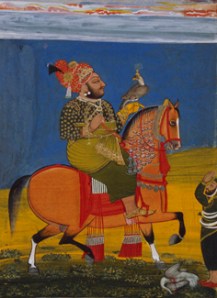
"Kunwar Anop Singh of Devgarh Riding with a Falcon" Devgarh, Mewar, Rajasthan attributed to Bakhta, ca. 1776 © Museum Rietberg Zurich.
This exhibition, the first of its kind in the UK, tells the story of the Indian portrait over three centuries, exploring the fascinating ways in which Indian artists have approached the depiction of the human form and the changing role of portraiture in Indian history. Bringing together 60 stunning works from international collections, the exhibition will celebrate the beauty, power and humanity of these works of art. The exhibition begins with works from the Mughal Court, including some of the earliest realistic portraits made for the Emperors Humayun (r.1530–56) and Akbar (r.1556–1605) and the magnificent court portraits made for their successors Jahangir (r.1605–27) and Shah Jahan (r.1628–58), as well as studies of Mughal courtiers, holy men and servants. The distinctive regional styles from Rajasthan and the Punjab Hills are also shown alongside the European–influenced works produced by Indian artists under British rule. These paintings are a record of a rich and complex history, embracing influences from Iran and Europe as well as local Hindu and Muslim traditions, showing that the Indian portrait can stand shoulder to shoulder with outstanding examples of portraiture from around the world.
◊ ◊ ◊ ◊ ◊
Two-Day Conference: Portraiture in South Asia
National Portrait Gallery and the School of Oriental and African Studies, London, 21-22 May 2010
This conference will assess the character of portraiture, visual and literary representations of the individual in South Asia from 1500 to 1900. Though widespread in Europe, studies of portraiture in Asia are more unusual because of the common perception that it is largely a Western phenomenon. Speakers include Ebba Koch, Chris Pinney, J.P. Losty and Crispin Branfoot. First day at the National Portrait Gallery, second day at SOAS. Tickets: £50/£40 concessions and £20 students.
◊ ◊ ◊ ◊ ◊
Press coverage of the exhibition can be found at the London Times and the BBC. Kathryn Hadley provides a useful summary at History Today.
Eighteenth-Century Highlights from Amiens
De Fragonard à Hubert-Robert: Chefs-d’oeuvre du XVIIIe siècle des musées d’Amiens
Musée Départemental de l’Oise, Beauvais, 5 February — 14 June 2010
 Le Conseil général de l’Oise et Amiens Métropole se sont associés pour organizer à Beauvais, au sein du Musée départemental de l’Oise, l’exposition d’une sélection de chefs-d’oeuvre du XVIIIe siècle appartenant aux collections des musées d’Amiens. Cette manifestation est le résultat d’une étroite collaboration entre les deux établissements. Elle illustre les liens nécessaires et fructueux qui unissent aujourd’hui ces deux musées picards, et intervient alors que le premier étage du Musée de Picardie, consacré en grande partie aux peintures, est fermé pour travaux jusqu’en 2012. Cette exposition offre l’opportunité de redécouvrir, dans un accrochage spécialement pensé et réalisé pour cet événement, quelques-unes des plus belles pièces des collections amiénoises ; elle donne aux visiteurs du Musée départemental de l’Oise l’occasion de voir, peut-être pour la première fois, des oeuvres de grande qualité, caractéristiques d’une période de création foisonnante.
La collection
Les oeuvres du XVIIIe siècle constituent l’une des grandes richesses des collections des musées d’Amiens. La plupart des tableaux exposés à Beauvais proviennent de la collection des frères Lavalard, donnée au musée en 1890 – les quelques 271 pièces concernées intégrèrent les lieux quatre ans plus tard. Originaires de Picardie, Olympe, Ernest et Émile Lavalard vécurent longtemps à Paris où ils fréquentèrent assidûment l’Hôtel Drouot. Ils y achetèrent entre 1850 et 1870 une très grande partie des tableaux qui constituèrent leur galerie. Boucher, Fragonard, Greuze, Vanloo, Hubert-Robert… : à une époque où l’école française du XVIIIe siècle n’était guère en vogue, la sûreté de leur gout – largement tributaire des conseils du docteur La Caze, célèbre amateur d’art qui fit quant à lui don de ses oeuvres au musée du Louvre en 1869 – leur permit de constituer une fort belle collection.
À une exception près – le Napolitain Giacomo del Po – tous les artistes représentés dans cette sélection sont français. Il n’est pas anodin de le préciser, tant l’origine géographique des artistes joue souvent un rôle décisif dans leur manière et dans le choix même des sujets illustrés. L’arrière-plan historique a en effet son importance : la mort de Louis XIV, en 1715, change profondément les modes de représentation dans la peinture française. Le temps est à la légèreté, les fastes versaillais laissent place à un art plus délicat. Les peintres commencent en outre à s’attacher davantage à la peinture de la vie quotidienne qui, sous leur pinceau, se pare d’une certaine poésie.
Toutefois, dans la continuité des siècles précédents, la hiérarchie des genres n’est guère contestée, qui place au sommet les sujets tirés de l’Histoire et de la fable, tandis que, dans un ordre de dignité décroissant, viennent ensuite le portrait, les animaux, les paysages et les natures mortes. La peinture de figures tirées de la vie quotidienne, ou peinture de genre, ne constitua que tardivement une catégorie distincte au sein de cette classification adoptée et défendue par l’Académie royale de peinture et de sculpture.
Les sections de l’exposition
L’exposition se découpe en sept sections. À l’image de l’exposition, ces sections sont toutes de taille modeste, mais elles présentent toujours des oeuvres particulièrement emblématiques, au sein des collections des musées d’Amiens, des différentes facettes de la production picturale du XVIIIe siècle. Ce découpage permet de brosser un large panorama de l’art tout en contrastes de ce siècle : aux côtés des petits tableaux gracieux témoignant du climat de fête qui régnait pendant la Régence (1715-1723) voisinent des oeuvres religieuses plus austères mais tout aussi caractéristiques des modes de représentation de l’époque.
- Thème 1 : Paysages et fêtes, un art placé sous le signe de la légèreté où l’art brillant, théâtral et fantaisiste qui voit le jour sous la Régence est à l’honneur.
- Thème 2 : Le goût des collectionneurs : scènes de genre et natures mortes. Deux modes de représentation très emblématiques de la production picturale du XVIIIe siècle.
- Thème 3 : Fragonard, artiste singulier. Cette section présente un ensemble d’oeuvres de Fragonard significatif des différentes facettes de son talent.
- Thème 4 : un ensemble décoratif exceptionnel : les Chasses exotiques de Louis XV. Un des cycles les plus spectaculaires de la peinture décorative de la première moitié du XVIIIe siècle.
- Thème 5 : Le maintien du grand genre : peintures allégoriques et mythologiques, réalisées dans la continuité de l’art majestueux et solennel du XVIIe siècle.
- Thème 6 : Le renouveau de la peinture religieuse met l’accent sur le traitement nouveau de sujets éminemment traditionnels.
- Thème 7 : La nature au service du sentiment. Cette dernière section revêt des accents pré-romantiques, en illustrant le traitement nouveau de la nature au fil du siècle.
Trio of Shows on Queen Luise of Prussia
Luise: The Life and Legend of the Queen
Charlottenburg Palace, Berlin, March 6 – May 30, 2010
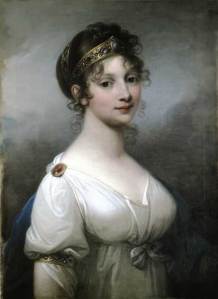
Josef Grassi, "Queen Luise," 1802
Femininity – beauty – power: This combination has fascinated mankind for millennia. It is a mixture that was and is the basis of countless myths. On the threshold of the modern age, the myth of the Prussian Queen Luise (1776–1810) first originated through media-related means and it lives on to this day. The 200th anniversary of the death of the most popular woman in Prussia in 2010 is providing the Prussian Palaces and Gardens Foundation Berlin-Brandenburg (Stiftung Preußische Schlösser und Gärten Berlin-Brandenburg) with an opportunity to trace one of the most obstinate legends of German history. Three exhibitions set at her personal, historical locations illuminate the most diverse aspects of Luise’s life and the legends surrounding her.
The exhibition at Charlottenburg is dedicated to various facets of Luise. Her beauty and grace, her naturalness and her harmonious family life turned her into a legend within her own lifetime. Her efforts towards decisive political reforms and her opposition to Napoleon made her into a symbol of hope during Prussia’s “difficult period” at the beginning of the 19th century. Following her early death at age 34, a legend developed around her, which is without precedent in Germany and which reached its climax in the Empire after 1871.
More than 200 paintings, sculptures and historical documents, including masterpieces by Karl Friedrich Schinkel, Johann Gottfried Schadow and Christian Daniel Rauch, invite visitors to become more familiar with the life and legacy of the queen.
◊ ◊ ◊ ◊ ◊
Luise: The Queen’s Island World
Peacock Island, Park Buildings and the Dairy, Berlin, 1 May – 31 October 2010
The romantic Havel River island, regarded as one of Queen Luise of Prussia’s and her family’s favorite locations, was used to enjoy life in the great outdoors. In 2010, the park landscape designed by Peter Joseph Lenné will be the scene of an innovative exhibition project, where international artists, under the direction of the artist Michael Lukas (Munich), deal with the history, the atmosphere of the location and Queen Luise as a person. In addition to the Palace and the Dairy, in Luise’s Year in 2010, park buildings that were not accessible to the public will open their gates for the first time. Today, Peacock Island is a UNESCO World Heritage site, a protected landscape and a Habitats Directive of the EU.
◊ ◊ ◊ ◊ ◊
Luise: The Queen’s Clothes
Paretz Palace and Royal Coach House, 31 July – 31 October 2010
Queen Luise, famous for her beauty, was quite conscious of her charms. She knew how to underscore her physical advantages in a natural, sensuous and occasionally liberal way with graceful, Empire-style dresses inspired by the forms of antiquity. The exhibition at Paretz Palace, once the summer residence of the royal family, shows outfits and accessories that belonged to the queen, as well as a selection of her portraits and further artifacts in the form of sculptures, graphic folios and letters. The intimate surroundings of the royal living spaces with their precious wallpapers allow the fascination with Luise to come alive, while simultaneously spanning a panorama of that epoch’s fashions.
◊ ◊ ◊ ◊ ◊
Coverage in The Art Newspaper is quite positive:
Readers should not be put off by the press and marketing hype, with its inevitably crass journalistic references and comparisons to the late Diana, Princess of Wales, the Empress Sisi von Habsburg, beauty contestants, “celebrities” and “icons.” This is a well researched exhibition about a minor historical figure on whom were projected so many aspirations and ideals as to make her more significant than her own life and deeds warrant.
For the full description, click here»
The Netherlands, Part II
Tulip Prints and Drawings from the Rijksmuseum Collection
Rijksmuseum in partnership with Keukenhof, March 2010
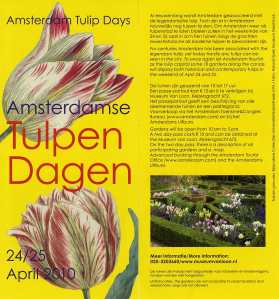 Starting on 2 March, the Rijksmuseum will exhibit its most beautiful prints and drawings of tulips from the 17th and 18th centuries. Individual tulips, tulips in bouquets, in the garden, as the design for a silver ornament, and featured in allegorical scenes. The highlight of the presentation will be the tulip book created by Jacob Marrel between 1637 and 1639. Complete tulip books are extremely rare, and the Marrel is seldom exhibited in public.
Jacob Marrel’s tulip book was probably a kind of catalogue used by customers for ordering their tulip bulbs. The book, still in its original binding, contains around 80 pages depicting scores of tulips, predominantly in red and purple. In the 17th century, ‘variegated tulips’ were the most popular. These ‘flaming’ tulips were not one single colour, but had white or yellow as the base colour, with red or purple as a second colour. They were given
names such as Spinnekoop, Condé de Flandez, Bruit van Leide
and La Bella Sultana.

Keukenhof (Photo: Wikimedia Commons)
Tulip bulbs were a valuable commodity throughout the 17th century, and the bulb speculation business sometimes reached incredible heights, only to fully collapse again afterwards. Agneta Block’s flower book from around 1690 shows just how much this rich Baptist widow was prepared to pay for a single tulip bulb. She purchased a large country house in the region along the river Vecht, where she was an enthusiastic gardener and had a book made containing pictures of all of the plants in her garden. The tulip called Root en geel van Leyden (‘Red and yellow from Leiden’) alone cost 100 guilders, but an Anvers bulb beat the lot at 510 guilders. By way of comparison: the annual salary of a 17th-century schoolteacher was around 200
guilders. (more…)
Enlightenment Travel
The following exhibition includes a well-illustrated digital dimension:
Traversées: récits de voyage des Lumières / Crossings: Narratives of Travel from the Enlightenment
Bibliothèque Universitaire Droit-Lettres de l’Université de Poitiers, 11 January — 27 March 2010
 Les voyageurs des Lumières se trouvent à un moment particulièrement intéressant à observer car tous les modes de voyage cohabitent : découverte, colonisation, dépaysement. L’exposition présente différents types de voyages et de manières de les raconter dans trois parties du monde au XVIIIe siècle : la découverte et l’utopie dans le Pacifique, l’installation et les missions en Asie, en Afrique et en Amérique du Sud et l’émergence du genre du récit de voyage en Europe.
Conférences
- Yasmine Marcil, “L’attrait des journaux pour les récits de voyages (1750-1789),” le 23 février à 18h
- Fabrice Vigier (Maître de conférences, Université de Poitiers), “Les voyageurs et les auberges du Centre Ouest aux XVIIe et XVIIIe siècles,” le 20 avril à 18h
- Jean-Jacques Tatin-Gourier (Professeur, Université de Tours), “Le rachat des captifs en terre barbaresque : une légitimation traditionnelle du voyage au XVIIIe siècle,” le 27 avril à 18h
Un catalogue illustré sera bientôt disponible. Il est édité et mis en vente par les Cahiers d’histoire culturelle de Tours. Il a été rédigé par des enseignants-chercheurs et des étudiants des université de Poitiers, de Rouen et de Nantes.
Spanish Enlightenment: The Collection of Carlos IV
From Artdaily.org (7 March 2010)
Royal Splendor in the Enlightenment: Charles IV of Spain, Patron and Collector
Meadows Museum, Southern Methodist University, Dallas, TX, 7 March — 18 July 2010

Francisco de Goya, "Carlos IV," 1789 (Madrid: Royal Academy of History), Inv. No. 76
The Meadows Museum at Southern Methodist University will present “Royal Splendor in the Enlightenment: Charles IV of Spain, Patron and Collector”, the first major exhibition to showcase the exceptional art collection and refined taste of King Charles IV of Spain (1748-1819), from March 7 through July 18, 2010.
The Meadows Museum will be the only venue outside of Spain for the exhibition, the result of a unique collaboration between the museum and Patrimonio Nacional, the Spanish government institution that manages the artistic holdings created through the patronage and sponsorship of the Spanish monarchs. The exhibition is curated by Patrimonio Nacional curators Dr. Javier Jordán de Urríes y de la Colina and Dr. José Luis Sancho.
Charles IV and his wife, Queen María Luisa, reigned from 1788 to 1808 (when they were forced into exile by Napoleon), at the end of the Enlightenment period. They had a special passion for the arts and collected avidly throughout their lives.

Royal Workshops, "Sedan Chair of Queen María Luisa of Parma," 1795 (Madrid: Royal Palace, National Heritage), Inv. No. 10008050
“During his reign, Charles IV created a highly sophisticated, refined and cosmopolitan court for which the arts played a major role,” said Dr. Mark Roglán, museum director. “The combination of collecting works from the past as well as investing in those of the present, especially in the field of decorative arts, became part of the daily life of this king, whose artistic taste was among the finest in his time and in the history of the Spanish monarchy. The exhibition also shows the development of Charles’ artistic interests; he was not only influenced by the Spanish tradition, but had a special fondness for Italian art because of his childhood origins in Naples, and for French art, due to the dense network of dynastic relations that linked the Bourbons of Versailles to those of Madrid in the 18th century.”
The exhibition includes more than 80 examples of furniture, textiles, clocks, porcelains, paintings and sculptures selected from the casas de campo (country estates) and royal palaces of Madrid, Aranjuez, El Escorial and El Pardo. The majority of works are from Patrimonio Nacional (the Spanish National Heritage), and most of them have never before traveled to the U.S. The collection includes some of the finest examples of art styles of the day, from Rococo paintings to a stunning Neoclassical dessert centerpiece of semi-precious stones, lapis lazuli, gilded bronze and enamel. Other highlights include the queen’s ceremonial throne with its 18-foot-tall canopy, an elaborate sedan chair in which she was carried by footmen, a gilded bronze, porcelain and enamel bird cage clock, and a shotgun of wood, steel, gold and silver belonging to the king, an avid hunter. Also included are works by Francisco de Goya, the first court painter under Charles IV; his 1789 portrait of the king is making its only appearance outside of Madrid in 200 years. A painting by Diego Velázquez, Portrait (miniature) of the Count-Duke of Olivares, c. 1638, collected by Charles, will also be featured, as well as paintings by Luis Meléndez, Juan de Flandes, Anton Mengs and Giovanni Panini, among others.
The exhibition, which will be shown in the Jake and Nancy Hamon Galleries, will be accompanied by a scholarly, fully illustrated catalogue in English produced by the Meadows Museum. Also included will be a documentary that will feature, in HD video, the rooms and gardens of the palaces highlighted in the exhibition, bringing to life the splendid residences of the King. (more…)
More on the ‘Art and Theatre’ Exhibition in Toronto
Artdaily.org (11 March 2010) includes more information on the ‘Art and Theatre’ show as it will appear at the AGO, starting in June (interesting to see how it will be presented in Toronto, complete with “a life-size 18th-century set”).
De la scène au tableau / Drama and Desire: Artists and the Theatre
Musée Cantini, Marseille, 6 October 2009 — 3 January 2010
Museo di Arte Moderna e Contemporanea, Rovereto, 6 February — 23 May 2010
Art Gallery of Ontario, Toronto, 19 June — 26 September 2010
Lust. Passion. Murder. Many of the greatest artists of the 19th century shared a profound fascination with the theatre and its themes of triumph and destruction, love and despair. This summer, the Art Gallery of Ontario gives centre stage to key artworks by these artists in a major international exhibition titled Drama and Desire: Artists and the Theatre, opening June 19 and continuing through September 26.
Conceived by Guy Cogeval, president of the Musée d’Orsay in Paris, the exhibition includes over 100 paintings, drawings and theatrical maquettes, by masters such as Edgar Degas, Eugène Delacroix, Jacques-Louis David, Jean Auguste Dominique Ingres, William Blake, Aubrey Beardsley, Henri de Toulouse-Lautrec, and Édouard Vuillard. The works were selected from the collections of some of the world’s greatest museums, including the Louvre, the Metropolitan Museum of Art, the Musée d’Orsay, the British Museum, and the Victoria and Albert Museum.
The AGO has commissioned Gerard Gauci, set designer for Toronto’s Opera Atelier, to make Drama and Desire an experience like no other. Visitors will enter the exhibition by walking ‘onstage’ through a life-size 18th-century set; the works will be displayed using enhanced lighting, sound and video components as well as innovative theatrical devices; and a full-scale re-creation of an early 20th-century theatre maquette will mark the finale of the exhibition. (more…)










 Enfilade
leave a comment