Margaret Grasselli Speaks on Sunday
This Sunday at 2pm, in conjunction with the exhibition of French drawings in Washington, Margaret Grasselli will deliver the lecture Playing Favorites: A Personal Selection of French Drawings from the National Gallery of Art. For details of the exhibition, Renaissance to Revolution: French Drawings from the National Gallery of Art, 1500–1800.
For more information, click here»
Trompe l’oeil in Florence
From the Palazzo Strozzi’s website:
Art and Illusions
Palazzo Strozzi, Florence, 16 October 2009 – 24 January 2010
Curated by Annamaria Giusti
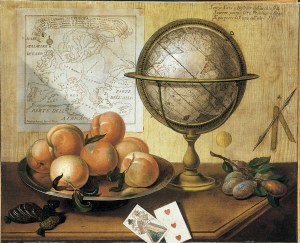
Sebastiano Lazzari, "Still Life with Peaches and Armillary Sphere on 'Trompe l’oeil Board' Ground," second half of the 18th century (Venice, Gallerie dell’Accademia)
From ancient Greco-Roman mosaics and frescoes to European masterpieces of the 1300s to today, two hundred works from Italian and international museums and private collections tell the intriguing and spectacular history of trompe-l’oeil, the art of deceiving the eye. The theme of deception, illusion, and the eternal tension between fiction and reality is shown not only in painting, but in the richness it has always enjoyed: sculpture, intarsia, scagliola, pietre dure, porcelain, etc. Examples exhibited include faux armoirs, half-open, with books inside, wood intarsia of small Renaissance studios, scagliola tabletops and stones portraying seemingly prehensile objects, soup tureens and table furnishings in the shape of vegetables, anatomical and botanical wax models.
The exhibit also dedicates a significant amount of space to wall decorations and interiors (detached frescoes from Ancient Rome, where the theme of deception gave life to a school) and to Flemish artists and their innovations in the trompe-l’oeil genre. . .
Section 4: Paperwork

Giuseppe della Santa “‘Deception’ with Papers, Cameos, and a Medal,” 1777 (Florence: Fondazione Longhi)
The popularity of paper objects in trompe l’œil was due both to their two-dimensional nature, which increased their effectiveness as illusions, and to their being such a normal part of daily life, where paper was essential for study, messages, business, art and games. This varied paper repertoire which was part and parcel of the daily experience of clients, collectors or more simply the public at large, lent itself to fanciful combinations and painterly simulation, from the mastery of Gijsbrechts’ grand Letterboard to the meticulous 18th-century compositions by the Florentine Della Santa family comprising engravings, printed paper and stucco bas-reliefs. Nor does it come as a surprise that this favourite theme found an even more realistic home on table surfaces displaying collections of paper objects designed to deceive both the eye and the touch, or that paper fleetingly came to rest on porcelain plates, just waiting for a hand to pick it up. . .
Section 6: Three-Dimensional Deception: Plastic Art between Realism, Artifice, and Instruction

Waxworks Workshop of the Imperial and Royal Museum of Natural History and Physics of Florence, “Model of a ‘Persica flore magno’ (prunus persica, or ripe and juicy peach),” late 18th century, polychrome wax, wood
Sculpture, too, allowed itself to be seduced by the idea of perfecting its potential for illusion, favoured by its true three-dimensional nature and rendered even more realistic by the use of colour. On the other hand, sculpture’s physical quality also limited the game of allusion and illusion on which trompe l’œil’s intellectual and technical appeal was based, keeping it pegged to the threshold of hyperrealism down the ages. Thus we move from the poignantly realistic polychrome terracotta work of Guido Mazzoni, to the Baroque artifice that produced unsettling and vaguely grotesque “clones” in the field of portraiture, foreshadowing the irony in the contemporary versions of this ancient genre, manufactured using plastic resin. Wax’s tried and tested potential for imitation was exploited for educational purposes from the 18th century onwards, to produce study aids that conjugate scientific clarity with artistic mastery in the anatomical waxworks from La Specola, while it provides the added value of individual pieces of décor in the botanical waxworks contained in false books or in real porcelain cachepots. . .
◊ ◊ ◊ ◊ ◊
Rachel Spence reviews the exhibition for the Financial Times (28 October 2009). Andrea Gáldy’s review (excerpted below) appears in the December issue of Apollo Magazine:

Magdalena Margrethe Bärens, “Melon,” embroidery on fabric, mounted on cardboard, second half of the 18th century (Copenhagen: National Museum of Denmark)
Trompe l’oeil is art that willingly deceives the senses, most of all the eyes. It plays with its audience and invades their space. There are different kinds of trompe l’oeil, ranging from depictions so naturalistic that one could take them for the real thing to familiar objects made of unexpected materials, such as a convincing-looking melon, lent by the National Museum of Denmark, that is actually made from card and embroidery (1737-1808). The exhibition is challenging in more than one sense: it invites you to look, think and be deceived, to look once again, and finally to get the joke (which is firmly on the spectator).
The art displayed is a manifestation of the artifex ludens, the artist at play. . . This exhibition includes some 150 works of art, from classical antiquity to the present day, in media that range from needlework to holograms. This startling profusion reveals that trompe l’oeil is an important as well as a neglected genre. . .
Gáldy’s full review can be found here»
Lost and Found
From the website of Sue Bond, Public Relations: Specializing in Fine Art, Antiques, and Cultural Events:
Burlington House Commodes Return after 150 Years
Royal Academy of Art, Burlington House, London, 27 July — 31 December 2009

John Mayhew and William Ince, attributed
Securely recorded in the collection of the Hon. Charles Compton Cavendish (1793-1863), later 1st Lord Chesham, who inherited Burlington House in 1834, the commodes were almost certainly made for his father, Lord George Cavendish (1754-1834), later 1st Earl of Burlington, who moved to Burlington House following his marriage in 1782 and who is known to have commissioned a quantity of related satinwood and marquetry furniture at this period. There is also evidence that the commodes were specifically altered as part of the remodelling of the state apartments at Burlington House for Lord George Cavendish in the early 19th century, having added side panels of that date which are shaped to match the re-configured profile of the walls and skirting in these interiors.
Removed from Burlington House when it was sold in 1854, the commodes remained in the Cavendish family at Latimer, the family seat in Buckinghamshire, until they were sold by John Compton Cavendish (1894-1952), 4th Baron Chesham, at Sotheby’s in 1945 when it was clearly stated in the catalogue that they came from Burlington House. The commodes then entered the collection of the 2nd Lord Glenconner who sold them at Christie’s in 1957 (£5,040) when the Burlington House provenance was overlooked and the connection was lost and not recovered when they were sold again at Christie’s in 1984 (£59,400). It is only thanks to Joseph Friedman who spotted a label on the reverse of one of the commodes that their history has again come to light. (more…)
Finding the Perfect Gift
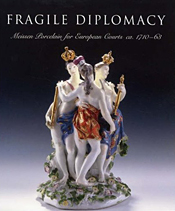
Edited by Maureen Cassidy-Geiger
Just Published
The Court Historian 14.2 (December 2009), published by The Society for Court Studies
Special Issue: Gift-Giving in Eighteenth-Century Courts — Papers from the conference Fragile Diplomacy: Meissen Porcelain for European Courts, c. 1710-1763, held at the Bard Graduate Center, New York, 17 November 2007, in conjunction with the eponymous exhibition (reviewed at artnet by N. F. Karlins).
◊ ◊ ◊ ◊ ◊
Table of Contents
 Andrew Morrall (Bard Graduate Center), Introduction
- Cordula Bischoff (State Art Collections, Dresden), Complicated Exchanges: The Handling of Authorised and Unathorised Gifts
- Christopher M. S. Johns (Vanderbilt University) The ‘Good Bishop’ of Catholic Enlightenment: Benedict XIV’s Gifts to the Metropolitan Cathedral of Bologna
- John Whitehead, Royal Riches and Parisian Trinkets: The Embassy of Saïd Mehmet Pacha to France in 1741-42 and Its Exchange of Gifts
- Michael Yonan (University of Missouri-Columbia), Portable Dynasties: Imperial Gift-Giving at the Court of Vienna in the Eighteenth Century
- Guy Walton, Emeritus (New York University), Ambassadorial Gifts: An Overview of Published Material
- Maureen Cassidy-Geiger (Cooper-Hewitt Museum/Parsons School of Design), Afterthoughts on Fragile Diplomacy: Meissen Porcelain for European Courts, c. 1710-1763
- Book Reviews / Exhibition Reviews

Looking Ahead: Art of the Austrian Table
From the Met’s website:
Vienna Circa 1780: An Imperial Silver Service Rediscovered
Metropolitan Museum of Art, New York, 13 April — 7 November 2010
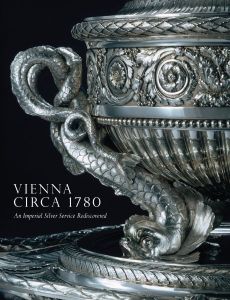
Wolfram Koeppe, ISBN-10: 0300155182 ($35)
Following the acquisition in 2002 of two Viennese silver wine coolers from the Sachsen-Teschen Service, most of the set’s surviving parts were discovered in a French private collection. This superb ensemble was last displayed at the beginning of the twentieth century. Wine coolers, tureens, cloches, sauceboats, candelabra, candlesticks, dozens of plates, porcelain-mounted cutlery, and other kinds of tableware totaling over 350 items, represent the splendor of princely dining during the ancien régime. It was made for Duke Albert Casimir of Sachsen-Teschen (1738-1822), and his consort, Archduchess Maria Christina of Austria (1742-1798) by the Imperial court goldsmith Ignaz Josef Würth. The Sachsen-Teschen Silver Service, an embodiment of Viennese neo-classicism, will be shown in the context of contemporary silver from other countries.
Accompanied by a catalogue to be published by the MMA.
Worth Talking About: Before and After Zoffany
Buckingham Palace offers an immensely satisfying show anchored by Zoffany (works include the The Academicians of the Royal Academy and The Tribuna of the Uffizi). From the website of the Royal Collection:
The Conversation Piece: Scenes of Fashionable Life
Palace of Holyroodhouse, Edinburgh, 27 March — 20 September 2009
Queen’s Gallery at Buckingham Palace, London, 30 October 2009 — 14 February 2010
 The Conversation Piece: Scenes of Fashionable Life is now on view at The Queen’s Gallery, Buckingham Palace. The exhibition presents a fascinating insight into high-society fashions, interiors and manners from the time of Charles I to the reign of Queen Victoria. While a portrait primarily records the sitter’s appearance, the Conversation Piece depicts their way of life, often conveying the impression that the subject has been caught off-guard. Typically a work shows a family group or a gathering of friends participating in informal activities. The genre was popular amongst Dutch painters in the seventeenth century and was subsequently developed in England. It is best known through the work of artists William Hogarth and George Stubbs during the eighteenth century and Sir Edwin Landseer in the nineteenth century. The exhibition brings together outstanding paintings by the greatest exponents of the Conversation Piece. The centrepiece is a remarkable series of portraits produced by Johan Zoffany for his royal patron George III, including the artist’s masterpiece The Tribuna of the Uffizi, 1772-7. The exhibition is accompanied by the catalogue The Conversation Piece: Scenes of Fashionable Life by Desmond Shawe-Taylor, the first publication on the subject for over 30 years.
◊ ◊ ◊ ◊ ◊
An informative exhibition microsite accompanies The Conversation Piece. In the London Times and Sunday Times, the show is reviewed by Anna Burnside, Rachel Campbell-Johnston, and Waldemar Januszczak, while Richard Cork supplies a summary for The Financial Times.
The Female Academy
From the exhibition website — for the eighteenth century, see especially the two sections on ‘The Imagined Female Acaemy’ and ‘The Real Female Academy’ :
Rooms of Our Own: The Female Academy from Margaret Cavendish to Lucy Cavendish College
Lucy Cavendish College, Cambridge, England, 17 — 31 October 2009

Richard Samuel, "Portraits in the Characters of the Muses in the Temple of Apollo," 1778 (London: NPG)
‘A woman must have money and a room of her own if she is to write fiction; and that, as you will see, leaves the great problem of the true nature of woman and the true nature of fiction unsolved’ —A Room Of One’s Own
The original manuscript of Virginia Woolf’s ‘A Room Of One’s Own’ will be the centrepiece of an exhibition at Lucy Cavendish College.
Charting the development of education for women over the last three centuries, the Rooms of Our Own exhibition will also feature cartoons, correspondence and documents from the College Archives. It will look at the women in the seventeenth century who fantasised about the possibility of women’s education through to the men and women who scorned and parodied it. Concluding the exhibition will be the vision of the women who sought to create a space in Cambridge for women to study at the time in their lives which suits them.
Before any women’s colleges existed in England, Margaret Cavendish, Duchess of Newcastle (1623-1673), imagined them in The Female Academy (1662) and The Convent of Pleasure (1668). Despite her elevated social status, ‘Mad Madge’ was mocked by men and women for her fascination with science and her desire to publish in her own name .
Blake at the Morgan
From the Morgan website:
William Blake’s World: “A New Heaven Is Begun”
Morgan Library & Museum, New York, 11 September 2009 — 3 January 2010

William Blake, “Behemoth and Leviathan,” ca. 1805–10 (NY: Morgan)
Visionary and nonconformist William Blake (1757–1827) is a singular figure in the history of Western art and literature: a poet, painter, and printmaker. Ambitiously creative, Blake had an abiding interest in theology and philosophy, which, during the age of revolution, inspired thoroughly original and personal investigations into the state of man and his soul. In his lifetime Blake was best known as an engraver; he was later recognized for his innovations across many other disciplines.
In the Morgan’s first exhibition devoted to Blake in two decades, former director Charles Ryskamp and curators Anna Lou Ashby and Cara Denison have assembled many of Blake’s most spectacular watercolors, prints, and illuminated books of poetry to dramatically underscore his genius and enduring influence. William Blake’s World: “A New Heaven Is Begun”—the subtitle a quote from Blake referring to the significance of his date of birth—is on view from September 11, 2009, to January 3, 2010.
The show includes more than 100 works and among the many highlights are two major series of watercolors, rarely displayed in their entirety. The twenty-one watercolors for Blake’s seminal illustrations for the Book of Job—considered one of his greatest works and revealing his personal engagement with biblical texts—were created about 1805–10. Also on view are twelve drawings illustrating John Milton’s poems L’Allegro and Il Penseroso, executed about 1816–20. Both series were undertaken for Blake’s principal patron, Thomas Butts. (more…)
At the Watteau Show with a Dance Critic
In today’s New York Times, Alastair Macaulay considers Frederick Wiseman’s new documentary La Danse alongside the Watteau exhibition now at the Met:

Nicolas Lancret, "La Camargo Dancing” ca. 1730 (DC: National Gallery)
. . . Many of us who love ballet have found our feelings on this film to be conflicted. By chance, I saw it a few hours before I attended the Metropolitan Museum’s exhibition “Watteau, Music and Theater.” What a difference! If you love dance, “La Danse” isn’t the place to see why; “Watteau, Music and Theater” certainly is. The display fills only two rooms. Many of its pictures, especially those by Watteau himself, are not related to dance. Yet it spans, and often illuminates, the first century of existence of the institution in the film, the Paris Opera Ballet. True, ballet then was almost a different species. The paintings here help show the impact of the most famous achievement of the celebrated Paris Opera ballerina Marie Camargo, seen in a classic Nicolas Lancret painting from about 1730: the shortening of her skirts to give full exposure to her ankles and lower calves. “Watteau, Music and Theater” makes the dance of that era feel pristine. Here is the sunrise of a tradition. . .
For the full article, click here»
Surveying Decadence
Exhibitions that trace broad themes back to the eighteenth century can be both instructive and delightful. I’m thinking, for instance, of the show, Rococo: The Continuing Curve, 1730-2008.
I have my doubts that the following exhibition on Decadence, now on view at the Dunkers Kulturhus in Sweden, lives up to such high standards, but it’s perhaps notable all the same. I apologize for the feeble translation. Since I was unable to find a description in English, I simply plugged the Swedish into Google’s translator. I was surprised the text came out as sensible as it did, though it’s still humorously rough. Indeed, it struck me as consistent with the apparently playful spirit of the show. -CAH
◊ ◊ ◊ ◊ ◊
Decadence: A Rake’s Progress
Dunkers Kulturhus, Helsingborg, Sweeden, 31 October 2009 — 28 February 2010
 The word Decadence tickle in your mouth and into the tank. But what does it actually mean? Is that all you want but do not dare? Is it leather, whips and sex? Is it a luxury, pearls and swine? There are probably as many preliminary proposals as people.
Dekadens is also the title of one of Dunkers Kulthurhus’s major autumn exhibitions. It has its origin in a picture story of William Hogarth from the 1700s London, A Rake’s Progress. We follow a young heir by sudden wealth, betrayal, gambling, women, poverty, betrayal again, new wealth, drugs, prison, insane asylum and death. A story that tells positions. Which way of life should we choose? The security of challenging the faithful or shameless? Sometimes one or the other but never both at once.
This story has inspired many artists through the ages, as Igor Stravinsky, Ingmar Bergman, David Hockney and Paula Rego. They are all in Dekadens as well as a few of our most interesting young artists: Nathalie Djurberg and Jockum Nordstrom. They are involved with new works created for the exhibition. Cartoonist Gunnar Krantz gives his version of The Rake’s Progress and let the center be moved from London to Yuppie Future Stureplan in Stockholm. Decadence are everywhere and anytime.
Exhibition form breathable rubber, tar and rose petals. We will find the place we never knew of and that will always occupy our minds. Jonas Lindvall has designed an exhibition that is impregnated by everything from the asceticism of pomp! Welcome to the challenges posed maze!










 Enfilade
leave a comment