Thomas Wright’s Menagerie & Gervase Jackson-Stops
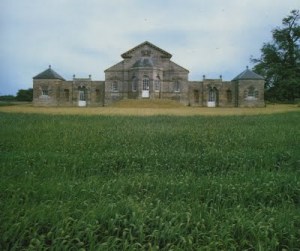
Thomas Wright, The Menagerie, Horton Park, Northamptonshire, 1750s (Photo: Bruno de Hamel, "Architectural Digest: Chateaux and Villas," 1982)
Earlier in the week, An Aesthete’s Lament included a posting on The Menagerie, the Grade II listed building acquired by Gervase Jackson-Stops (1947-95) in the 1970s. After a three-year studentship at the Victoria and Albert Museum, Jackson-Stops joined the National Trust, first as a research assistant and then (starting in 1975) as an architectural advisor. It’s difficult to overstate his importance for the organization. As noted in numerous obituaries — including those from the Society of Antiquaries of London, The Independent, and Architectural History (available through JStor) — he played important roles in the Trust’s acquisition of Canons Ashby House, Kedleston Hall, and Fountains Abbey. His commitments to restoration were evinced not only at Stowe but also at his personal labor of love, The Menagerie.
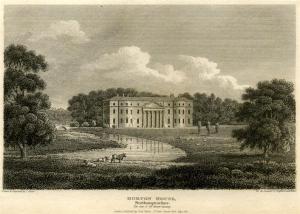
Horton Hall, destroyed 1936
This mid-eighteenth-century banqueting house, by Thomas Wright (1711-86), at Horton Park, Northamptonshire is actually just one of just thirteen listed buildings attached to the property (the main house, Horton Hall, was destroyed in the 1930s). The Horton Park Conservation Group (HPCG) was founded in 2008 to campaign for the ongoing conservation of the park and these structures. The park is likely to receive increased attention over the next two years as Wright’s three-hundredth birthday approaches.
The Menagerie appears in Paige Rense, Architectural Digest: Chateaux and Villas (Knapp, 1982); Timothy Mowl and Claire Hickman, Historic Gardens of England: Northamptonshire (History Press, 2008), and Chippy Irvine, The English Room (Bullfinch Press, 2001). For details regarding visits, see The Menagerie website.
 Finally, no evocation of Jackson-Stops is complete without mention of his role in organizing the seminal Treasure Houses of Britain exhibition at the National Gallery of Art in Washington (1985-86). For his work on the show, he received the Presidential Award for Design in 1986 and was made an Officer of the British Empire (O.B.E.) — all before turning 40! A full list of publications, including dozens of contributions for Country Life, can be found at the end of the obituary compiled by Oliver Garnett and Tim Knox for Architectural History 39 (1996): 222-35.
[The photograph of The Menagerie comes from An Aesthete’s Lament; the print of Horton Hall comes from the website of the Horton Park Conservation Group. Thanks to both.]
Marguerite Gérard in Paris
From Hôtels Paris Rive Gauche:
Marguerite Gérard: Artiste en 1789 dans l’atelier de Fragonard
Cognacq-Jay Museum, Paris, 10 September – 6 December 2009
 This exhibition concentrates on the astonishing, little-known work of Marguerite Gérard (1761-1837), who was the sister-in-law of the great painter Jean-Honoré Fragonard (1732-1806). Having moved to Paris in the mid-1770s — living in Fragonard’s apartment in the Louvre — she became the painter’s student and subsequent collaborator.
Becoming a recognised female painter in the society of the era was not simple at all. Knowing this, Marguerite made some clever marketing moves, taking advantage of the wobbling Old Regime to carve a niche for herself in this newly-formed society. Soon, her portraits, often donated to her models, carried her name far and wide, helping to make her well known and sought after.

Jean-Honoré Fragonard and Marguerite Gérard, "The Stolen Kiss," (St. Petersburg, Hermitage)
The exhibition has sixty portraits and drawings borrowed from all over Europe and the United States. As well as the work of Marguerite Gerard and Fragonard, including one seminal collaborative effort, the exhibition will also show contemporary portraits which explain the artist’s sources and the success of the fashion of intimist portraits that took hold at the beginning of the nineteenth century, ending with the arrival of photography. A catalogue will also be published to accompany the exhibition.
The exhibiton Marguerite Gérard: artiste en 1789 dans l’atelier de Fragonard runs from 10th September to 6th December 2009 at the Musée Cognacq-Jay.
Watteau at the Met
Press release from the Met:
Watteau, Music, and Theater
Metropolitan Museum of Art, New York, 22 September – 29 November 2009

Catalogue ed. Katharine Baetjer (Yale University Press)
Watteau, Music, and Theater, the first exhibition of Jean-Antoine Watteau’s paintings in the United States in 25 years, will demonstrate the place of music and theater in Watteau’s art, exploring the tension between an imagery of power, associated with the court of Louis XIV, and a more optimistic and mildly subversive imagery of pleasure that was developed in opera-ballet and theater early in the 18th century. It will demonstrate that the painter’s vision was influenced directly by musical works devoted to the island of Cythera, the home of Venus, and to the Venetian carnival, and will shed new light on a number of Watteau’s pictures.
Made possible by The Florence Gould Foundation, the exhibition will feature more than 60 works of art, consisting of major loans of paintings and drawings by Watteau and his contemporaries from collections in the United States and Europe. The balance of the paintings will be drawn from the Metropolitan Museum’s collections, together with most of the works on paper, and all of the musical instruments, gold boxes, and ceramics. Watteau, Music, and Theater will honor Philippe de Montebello, Director Emeritus of The Metropolitan Museum of Art.
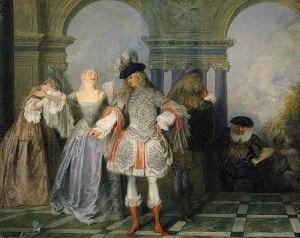
Watteau, “The French Comedians,” 1720–21, (New York: Metropolitan Museum)
Born in 1684 in Valenciennes in the Hainault (French, but formerly part of the Spanish Netherlands), Jean-Antoine Watteau is widely considered the most important artist in early eighteenth-century France. A solitary, ill-educated, self-taught, largely itinerant figure, he was a supremely gifted painter and draftsman whose surviving works of art are his testament. Most of them are so-called fêtes galantes, idyllic scenes that have no specifically identifiable subject. Only one of Watteau’s paintings, The Embarkation for Cythera (1717), was publicly exhibited in his lifetime. Watteau died in 1720 at the age of 36 after a long illness. While relatively little is known about Watteau, an expanding body of literature relating to Paris opera-ballet, plays, and the less formal and more traditional seasonal théâtres de la foire relates to specific works in the exhibition, and these can now be mined more deeply to examine the artist’s life and work.
Among the many highlights of Watteau, Music, and Theater will be the Metropolitan Museum’s Watteau paintings Mezzetin and French Comedians; the Städel Museum’sThe Island of Cythera; Pleasures of the Dance from the Dulwich Picture Gallery; Love in the French Theater and Love in the Italian Theater, both from the Gemäldegalerie in Berlin; and The Alliance of Music and Comedy (private collection), which has not been on view in any museum in decades.
The exhibition will mark the first time the painting La Surprise (private collection) will be seen in a museum. Lost for almost 200 years and presumed to have been destroyed, La Surprise was rediscovered last year in a British country house and later sold at auction. (more…)
Gemmae Antiquae, Part II
From the website of the Hermitage:
The Fate of One Collection
500 Carved Stones from the Collection of the Dukes of Orléans
State Hermitage Museum, St. Petersburg, ongoing exhibition

Gillas, "Head of Olympic Zeus of Phidias," sardonyx, 1st Century BCE (Hermitage)
On October 30, 2001 an exhibition entitled The Fate of One Collection: 500 Carved Stones of the Collection of the Dukes of Orléans opened in the Golden Room of the Winter Palace. The exhibition continues the series of temporary exhibits dedicated to famous European collections, the foundation of the Hermitage art collections. The exhibition showcases 500 gems, dating from the 4th century B.C. to the mid-18th century, which represents one-third of the collection of the Dukes of Orléans.
In 1787 Catherine the Great ordered to acquire from Louis Philippe Joseph of Orléans the collection of 1500 gems of the familial collection of the Dukes of Orléans, representatives of the junior branch of the French royal dynasty.
The collection’s central exhibit is the collection of Heidelberg Castle gems. The collection was started by Count Palatine Otto-Heinrich (1502-1559). Antique gems comprise the largest part of the Heidelberg Castle collection. It includes rare pieces of the Hellenic epoch and pieces dating back to
masters of Republican and Augustine Rome and the time of Soldier Emperors.

"Jupiter, Mercury and Cupid, Mars and Neptune Surrounded by Zodiac Signs," 16th-century Italy (Hermitage)
In 1685 the collection was inherited by Elisabeth-Charlotte, Princess Palatine, who married Duke Philippe of Orléans. Thanks to this dynastic marriage the Gemmae Study passed on to the Dukes of Orléans. Elisabeth-Charlotte continued adding to the collection, and acquired the gems representing different stages of ancient glyptics, including works by famous masters, such as Aulus, Rufus, Sostrates, and Trypho. A larger part of the works dates back to Renaissance and Baroque epochs.
In 1741 the grandchild of Elisabeth-Charlotte, Duke Louis III of Orleans, acquired the Paris collection of carved stones, which had belonged to Pierre Crozat, one of the most famous collectors in Europe. Of special interest in his collection are the cameos of the pure Byzantium style. A large collection of entails and cameos demonstrates the glyptics of Italy, France, Germany and the Netherlands of the 15th – early 18th centuries. Among the masterpieces of the European portrait is the portrait of Henry II of France by A. Cesati, poetized by Giorgio Vasari.
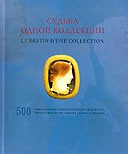
"The Fate of One Collection: 500 Carved Stones from the Room of Duke of Orleans."
Among the Dukes of Orléans, last owners of the gem collections, there were no such art connoisseurs as Elisabeth-Charlotte and Pierre Crozat. However, during this time rare Etruscan scarabs and gems of the 15th – 18th centuries were added to the collection along with several glyptic portraits, talismans and grillae (human heads and animal bodies). Sassanian Iran and European Renaissance are represented by one work each.
The exhibition includes descriptions, catalogs of collections and engravings, dedicated to gems of the Dukes of Orléans, and pictures of castles and palaces where the collection was kept at various times. Sections of the exhibit reconstructing separate collections of the 16th – early 18th centuries, which belonged to the Dukes of Orléans, are highlighted. Slavia Publishers presents The Fate of One Collection. 500 Carved Stones from the Room of Duke of Orleans. Introduction is by Y. O. Kogan and O. Y. Neverov.
[Credits: Images and text (with minor spelling modifications) taken from the Hermitage website]
Gemmae Antiquae, Part I
From the Getty Villas’s website:
Carvers and Collectors: The Lasting Allure of Ancient Gems
Getty Villa, Los Angeles, 19 March – 7 September 2009
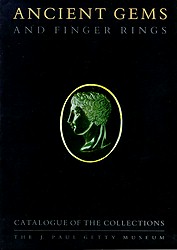
Jeffrey Spier, Ancient Gems and Finger Rings: Catalogue of the Collections (Getty Museum, 1993), ISBN 978-0-89236-215-8 ($70)
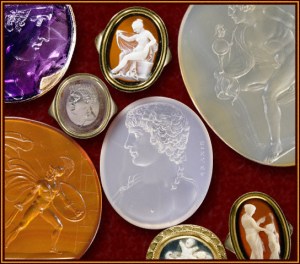
Gems from the collection of the J. Paul Getty Museum (For individual identifications, click on the image)
The beauty of carved gemstones has captivated collectors, connoisseurs, and craftsmen since antiquity. Precious markers of culture and status, gems were sought by Greek and Roman elites as well as modern monarchs and aristocrats. This exhibition features intaglios and cameos carved by ancient master engravers along with outstanding works by modern carvers and works of art in diverse media that illustrate the lasting allure of gems. . . .
In antiquity, gems were engraved with personal or official insignia that, when impressed on wax or clay, were used to sign or seal documents. Carved gems were valued not only for their distinctive designs, but also for the beauty of their stones, some of which were believed to have magical properties. From the Middle Ages to the nineteenth century, rulers, nobles, and wealthy merchants sought and traded classical gems, and carvers produced replicas and forgeries.

Augustin de Saint-Aubin after Charles-Nicolas Cochin II, engraving in François Arnaud, Description des principales pierres gravées du cabinet de S.A.S. Monseigneur le duc d'Orléans. . . (Paris, 1870) The Getty Research Institute 85-B16748
Sumptuous engraved catalogues of gem collections were published in the days before photography. Like the gems they illustrated, these volumes functioned as luxury objects. The engravings in these books sometimes improve upon the already excellent carving of the gems themselves. Louis Philippe d’Orléans (1725–1785), the great-grandson of King Louis XIV of France, published his gem collection in an elaborately engraved volume dedicated to his cousin King Louis XVI. The frontispiece, shown here, depicts the duke himself and also represents the superiority of gems over other art forms: in the foreground, two cupids inspect the contents of drawers pulled from a large gem cabinet, while symbols of architecture, sculpture, and painting are relegated to the upper right and lower left corners. . . .
Since the Renaissance, gem carvers have attempted to equal and surpass their ancient counterparts. Because of the high demand for classical gems, some carvers, dealers, and collectors sought to pass off modern works as ancient. Some even forged the signatures of famous Greek and Roman carvers. No scientific method exists for proving the antiquity of gems, and quality is no proof of authenticity. Thus it is usually some deviation in style or imagery that reveals a piece to be modern. . . .
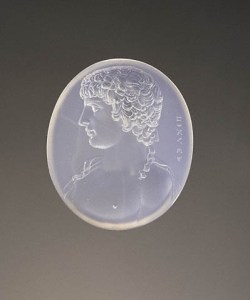
Engraved Gem, signed by Giovanni Pichler or Luigi Pichler, ca. 1750-1850
Austrian carver Antonio (Johann Anton) Pichler worked in Rome in the 1700s copying ancient gems. His son Giovanni also became an accomplished gem carver, as did Giovanni’s half-brothers Giuseppe and Luigi and Giovanni’s son Giacomo. Luigi was the most renowned: he received commissions from the Vatican and the French and Austrian courts to carve both classical and contemporary subjects. This intaglio is modeled after a famous relief of Antinous (the beloved of the Roman emperor Hadrian) housed in the Villa Albani, Rome. The fact that the gem is signed “Pichler” in Greek indicates no intention to deceive but rather an emulative spirit, the artist vying with his ancient predecessors.
[Text and images from the Getty Villa exhibition website]
New World Missions
From the San Antonio Museum of Art website:
The Art of the Missions of Northern New Spain
San Antonio Museum of Art, 17 October 2009 – 3 January 2010
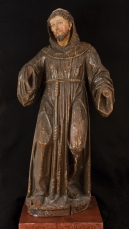
Saint Francis of Assisi, seventeenth century, carved, polychromed, and gilded wood, 51” high (Tepotzotlán, Mexico: Museo Nacional del Virreinato)
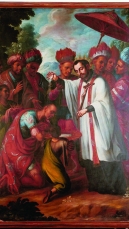
Antonio de Torres, “Saint Francis Xavier Baptizing the Nations of the World,” ca. 1720 (Mexico City: Museo del Colegio de San Ignacio de Loyola Vizcaínas)
The Art of the Missions of Northern New Spain is the first exhibition to explore the rich artistic legacy of the Franciscan and Jesuit mission churches in northern Mexico and the American Southwest. An integral part of Spain’s colonization of the New World, the missionary enterprise was integral to the crown’s effort. Franciscans arrived in Mexico shortly after Cortes’s capture of Tenochtitlan, Mexico to spread Christianity and were soon joined by the Dominicans, then the Augustinians, and, later, by the Jesuits. From shortly after the Conquest until Mexico obtained its independence from Spain in 1821, hundreds of missions were founded by the Franciscans and Jesuits in northern reaches of the Viceroyalty, in present-day states of Durango, Chihuahua, Coahuila, Tamaulipas, Sinaloa, Sonora, and Baja California in Mexico; and California, Arizona, New Mexico, Texas, and Florida in the United States. Nearly all of these Franciscan and Jesuit missions were richly decorated with paintings, sculpture, furniture, liturgical objects and liturgical vestments which have received little critical public attention. Many of the works were made by the most prominent artists in Mexico City and elsewhere in New Spain, while others came from Europe and as far away as Asia. Indigenous artists also made works of art found in the missions. In short, there are extensive visual remains of a spiritual and cultural undertaking that was, although part of an immense worldwide effort, quite nearly unique to the New World. The exhibition will include approximately 125 objects from collections in Mexico, the United States, and Europe, including many from the missions themselves, most of which have never left their original locations.
The fully illustrated catalogue in Spanish and English will contain essays by prominent historians, anthropologists, archaeologists, and art historians for the U.S. and Mexico. They discuss the art and architecture of the missions; native and Pre-Columbian art and cultures and the reception of European-based art brought to the missions; contrasts in native and Spanish conceptions of space and their impact on Spanish-Indian relations at the missions; the cultural and linguistic diversity of indigenous people of northern New Spain and their effect on missionaries’efforts; and the later impact of the missions on art, literature, and film in the U.S. and Mexico.
◊ ◊ ◊ ◊ ◊
[The Art of the Missions of Northern New Spain (El arte de las misiones del norte de la Nueva España, 1600–1821) was on view at the Antiguo Colegio de San Ildefonso in Mexico City earlier this summer. It will travel to the San Antonio Museum of Art, October 17 to January 3, 2010, followed by the Museo de Historia Mexicana, Monterrey; the Centro Cultural de Tijuana, Baja California; and the Oakland Museum of California. The exhibition is co-curated by Michael Komanecky and Clara Bargellini of the Instituto de Investigaciones Estéticas of the Universidad Nacional Autónoma de México in Mexico City. The July issue of Magazine Antiques featured an instructive article by Michael Komanecky, along with fifteen photographs. The two images used here are from that slideshow.]
Masculin, féminin
Member News

Anne-Louis Girodet, "Self Portrait with Julie Candeille"
Heather Belnap Jensen, Assistant Professor of Art History at Brigham Young University, participated this past June in the colloquium, Historiennes et critiques d’art à l’époque de Juliette Récamier, which was organized in conjunction with the exhibition on Juliette Récamier and her circle, held at the Musée de Beaux-Arts in Lyon. Jensen’s talk, “Quand la muse parle: Julie Candeille sur l’art de Girodet,” questioned androcentric interpretations of Girodet’s life and art. Papers from the journée d’étude are to be published by the Institut national d’histoire de l’art (IHNA).
In addition, Jensen is co-editing a collection of essays (together with Temma Balducci and Pamela Warner), entitled Interior Portraiture and Masculine Identity in France, 1789-1914 (Ashgate, 2010). As a pendant, she and Balducci next turn their attention to the role of women in public: they’re chairing a session at CAA on the topic (“Women, Femininity, and Public Space in Nineteenth-Century Visual Culture”), and plans are in the works for a second edited volume.
 Jensen’s essay “Diversionary Tactics: Art Criticism as Political Weapon in Staël’s Corinne, ou l’Italie (1807),” appeared in Women Against Napoleon: Historical and Fictional Responses to his Rise and Legacy (Campus Verlag, 2008), and she recently reviewed Ruth Iskin’s Modern Women and Parisian Consumer Culture in Impressionist Painting for French Studies (volume 63, Spring 2009).
[HECAA members Mechthild Fend, Melissa Hyde, and Mary Sheriff also participated in the Récamier colloquium. A summary of the event and exhibition will be published as a separate posting in the near future.]
Prints of War
 James Clifton, Leslie Scattone, Emine Fetvaci, Ira Gruber, and Larry Silver, The Plains of Mars: European War Prints, 1500-1825, from the collection of the Sarah Campbell Blaffer Foundation (Yale University Press), 254 pages, $65 (hardback) ISBN 9780300137224
Last week’s Art Newspaper includes a review by Alexander Adams of The Plains of Mars, the catalogue from a show that appeared at the Museum of Fine Arts, Houston earlier this year, February 7 – May 10, 2009.
◊ ◊ ◊ ◊ ◊
Editors have organised a diverse spectrum of material into themes, within which prints are sequenced chronologically. The catalogue section is preceded by enlightening essays dealing with the imagery of the Landsknecht (German mercenary of the 15th to 17th centuries), the recurrence of the Turk—as symbol of alien despotism and the exotic Orient—and the mixture of pictorial, cartographic and topographic modes in war prints. A concise survey by Professor Gruber deftly covers military developments in conflicts of this period. The catalogue section, complete with comparative figures, includes extensive commentaries necessary to contextualise individual prints . . .
The Plains of Mars presents a wealth of socially and historically important sources (some of them great artistic achievements) in a clear and authoritative fashion. A glossary, index and biographical notes of all featured artists conclude this impressive volume.
Read the full review at The Art Newspaper›
Time at the Louvre
Breguet and the Louvre: An Apogee of European Watchmaking
Exhibition curated by Marc Bascou
Musée du Louvre, Sully Wing, La Chappelle exhibition hall, June 25 – September 7, 2009
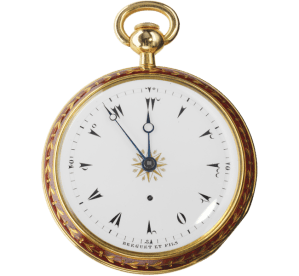
Turkish Watch – The name was used to denote watches produced specially for the Turkish market. They have enamel dials and very distinctive numerals in Turkish characters. The cases are also highly distinctive: often richly decorated with floral motifs and landscapes.

'Souscription' Watch – Launched through a publicity brochure in 1797, watches of this sort were sold on a subscription basis, with a down-payment of a quarter of the price when the order was placed. Called “Souscription” in the sales ledgers, they were reliable and proved a great success.
Abraham-Louis Breguet was born in Neuchâtel, Switzerland, in 1747 but moved to Paris in 1775. A peerless technician, Breguet invented mechanisms that constituted wonderful advances in watchmaking, notably the tourbillon regulator, an astonishing device that corrected the effect of gravity on the balance wheel. Watches, clocks, and measuring instruments, accompanied by portraits, archive documents and patent applications, shed light on the developments pioneered by Breguet from his early years in Paris to the period when he handed the business over to his son, Antoine-Louis.
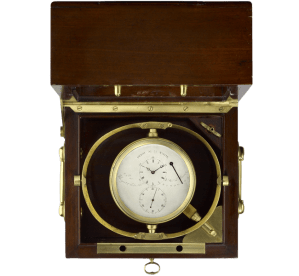
Marine chronometers took the form of a movement of fairly large volume enclosed in a cylindrical brass casing. The latter was attached to a sturdy wooden box by means of brass gimbals serving as stabilizer and shock absorber. Fitted with handles and a glass face, the marine chronometer was placed at the heart of the vessel; among other functions, it was used to calculate longitude at sea.
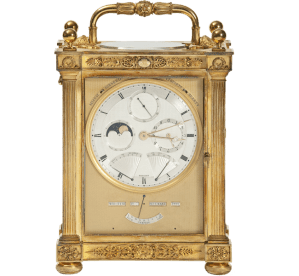
In 1796, Breguet built the first modern carriage clock. It is equipped with a Breguet overcoil – which offered major advantages over the pendulum balance it replaced, which was not adapted to being moved – glazed on four sides and of small dimensions. Some of the carriage clocks of the first half of the nineteenth century are veritable tours de force, endowed with various advanced features.
Combining items from the lavish collections of the Louvre and of the Musée Breguet, this exhibition of historic Breguet timepieces also includes masterpieces on loan from private collections and prestigious institutions such as the British Royal Collections, the Musée des Arts et Métiers de Paris, the Kremlin Museum and the Swiss National Museum.
Published in conjnction with the exhibition is the catalogue, Breguet au Louvre, un apogée de l’horlogerie européenne, edited by Marc Bascou and Emmanuel Breguet, 39 € (also available in English as Breguet and the Louvre, An Apogee of European Watchmaking)
[N.B. – Text, images, and captions are drawn from the exhibition website at the Louvre. Portions of the text also comes from the Breguet website.]
Jefferson in the Library
Thomas Jefferson’s Library, an ongoing exhibition that opened 11 April 2008 at the Library of Congress in D.C., is featured in a recent article from Smithsonian.com:
◊ ◊ ◊ ◊ ◊
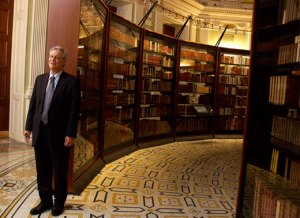
Library of Congress curator Mark Dimunation stands among the fruits of his endeavor; over 4,000 books have been acquired but nearly 300 titles have yet to be located. Photo by Molly Roberts.
On the Hunt for Jefferson’s Lost Books
A Library of Congress curator is on a worldwide mission to find exact copies of the books that belonged to Thomas Jefferson
By Ashley Luthern
Smithsonian.com, August 11, 2009
For more than a decade, Mark Dimunation has led a quest to rebuild an American treasure—knowing he will likely never see the complete results of his efforts.
On an August day 195 years ago, the British burned the U.S. Capitol in the War of 1812 and by doing so, destroyed the first Library of Congress. When the war ended, former President Thomas Jefferson offered to sell his personal library, which at 6,487 books was the largest in America, to Congress for whatever price the legislators settled upon. After much partisan debate and rancor, it agreed to pay Jefferson $23,950.
Then another fire in the Capitol on Christmas Eve of 1851 incinerated some 35,000 volumes, including two-thirds of the books that had belonged to Jefferson. And although Congress appropriated funds to replace much of the Library of Congress collection, the restoration of the Jefferson library fell by the wayside.
Since 1998, Dimunation, the rare-books and special collections curator for the Library of Congress, has guided a slow-moving, yet successful search for the 4,324 Jefferson titles that were destroyed. The result of his labor thus far is on view at the library in the Jefferson Collection Exhibition. . . .
 ◊ ◊ ◊ ◊ ◊
Visit the Smithsonian website for the full article; there’s also a video to complement the story. In addition, LibraryThing includes a catalogue of Jefferson’s books (or at least 5418 of them), complete with useful tags (and if you’ve not yet seen LibraryThing, you must click here—tout de suite! -CAH).










 Enfilade
leave a comment