Conservation on Display in St. Louis
For this series on conservation issues, our first stop is the St. Louis Art Museum, which is incidentally celebrating a century of free admission! (the achievement is especially impressive as museums across the country are raising prices). From the musuem’s website:
Reviving Antiquity:
Restoring Hubert Robert’s Views of Ancient Ruin
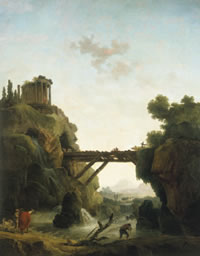
Hubert Robert, "Fantastic View of Tivoli," 1789; oil on canvas; 95 x 75"
This summer, one of the Museum’s main level galleries will become a painting conservation lab, where conservator Mark Bockrath of Philadelphia will clean and restore three large 18th-century landscapes by the French painter Hubert Robert (1733–1808). The three paintings—The Obelisk, The Ruin, and Fantastic View of Tivoli—are part of four landscapes commissioned during the 1780s by unknown Russian clients. Museum visitors may recall that the group of four Robert paintings hung for many years in the corners of Grigg Gallery. Ever since the reinstallation of Grigg Gallery in 2006, the paintings have been in storage, awaiting conservation.
In 1996, Museum Paintings Conservator Paul Haner cleaned and inpainted one of the four (The Column). The Column is currently on loan to the Pulitzer Foundation for the Arts, where it is on view as part of the Pulitzer’s current exhibition, Ideal (Dis-) Placements: Old Masters at the Pulitzer.

Paul Haner at work on "The Column"
Curated by Judith Mann, curator of European Art to 1800, Reviving Antiquity: Restoring Hubert Robert’s Views of Ancient Ruins, supported by a grant from the Samuel H. Kress Foundation, will be on view in gallery 205.
◊ ◊ ◊ ◊ ◊
Bockrath will be at work in the museum from August 25th until September 6th. He’s available for visitors’ questions on Fridays, Saturday, and Sundays from 2:30 until 3:00. A brief interview with Paul Haner can be found here.
Size Matters in Omaha
Midwest Art History Society Call for Session Proposals (due 23 August)
8-10 April 2010 – Omaha, Nebraska
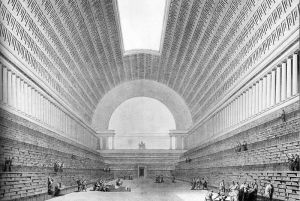
Étienne-Louis Boullée, "Projet de Bibliothèque Royale," 1785
The Midwest Art History Society is currently accepting session proposals for its annual conference, to be held next spring in Omaha. The meeting’s timely theme – Exploring Monumentality: Re-Thinking Scale Relationships in Art – comes on the heels of the remarkable 2008-09 exhibition, Grand Scale: Monumental Prints in the Age of Dürer and Titian (organized by Larry Silver with Elizabeth Wyckoff), and precedes an exhibition at the Getty that will pursue the subject into the seventeenth century; Grand Manner: Charles Le Brun and the Monumental Prints of the Ancien Régime (organized by Louis Marchesano) opens May 18 and runs through October 17.
The MAHS conference might provide an ideal venue for asking how oversize scale functioned in the eighteenth century (one thinks perhaps of Vanbrugh, Boullée, or Piranesi). Conference organizers will include some topics not related to the theme of monumentality, so other session ideas are welcome, too. Here’s the official call for proposals:
◊ ◊ ◊ ◊ ◊
For its 37th annual conference in Omaha, Nebraska (April 8-10, 2010), the Midwest Art History Society will devote the majority of sessions to a central topic–Monumentality. All cultures and periods have generated works of large relative scale. Well-known examples include the Colossus of Rhodes, the monumental heads of Easter Island, Mount Rushmore, the enormous statuary at Buddhist temple complexes throughout Asia, Michelangelo’s David, and the oversized creations of contemporary artist Jeff Koons. We invite session proposals devoted to the impact and meaning of size; logistical considerations for large and small-scale works; famous and/or important monumental works; and other issues related to scale. Because we will still offer open sessions for conference papers that do not address the central issue, we also invite proposals for sessions on other topics apart from that of our central theme. (more…)
‘Love Art’ app from the National Gallery
"Love Art" $2.99 from the iTunes Store
June 2009 Press Release from the National Gallery, London:
The National Gallery is the first ever gallery to make its paintings accessible through a downloadable iPhone application, making it possible to take a mini tour of the Gallery anywhere in the world.
The Gallery, in partnership with Antenna Audio and Apple Inc., has designed a new application for iPhones and iTouch devices that enables people to explore a sample of the collection while they’re on the move. Designed to appeal to art enthusiasts and fans of the Gallery, this application is the first of its kind to be released by a major gallery.
This Pentimento application, called “Love Art,” features 250 paintings from the collection along with around 200 minutes of audio and video content, including interviews with National Gallery Director Dr Nicholas Penny, dramatist Robin Brooks, artist Maggie Hambling and Girl with a Pearl Earring author Tracy Chevalier.
Making use of special iPhone features such as its large touch-screen, zoom, Rolodex and scrollable menus, “Love Art” offers a playful exploration of the collection, together with informative commentaries. The paintings are showcased to the best advantage using high-resolution images on the iPhone’s excellent-quality screen. Due to a tactile interface the experience gained through this application is not only highly enjoyable, but also lets you zoom in to see details that are often missed. (more…)
Sèvres in London
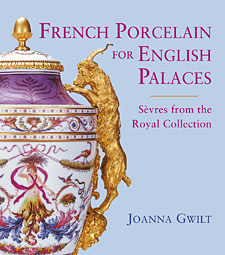
200 pages, 185 ills. Joanna Gwilt is Assistant Curator of Works of Art at the Royal Collection. Formerly of the Wallace Collection, she specialises in French eighteenth-century decorative arts, in particular Sèvres porcelain.
From the website of the British Royal Collection:
23 May — 11 October 2009
The Queen’s Gallery, Buckingham Palace — London
French Porcelain for English Palaces:
Sèvres from the Royal Collection
This exhibition brings together around 300 pieces created by the pre-eminent European porcelain factory of the 18th century. The finely painted and gilded works by Sèvres were loved by royalty, aristocrats, connoisseurs and collectors. The factory’s unrivalled techniques and complex methods of production appealed to their liking for the rare, exotic and extravagant.
The assemblage of Sèvres in the Royal Collection is considered to be the world’s finest. Much of it was acquired between 1783 and 1830 by George IV, who popularised the taste for French porcelain in Britain. The King’s choice of Sèvres was greatly influenced by his admiration for and extensive knowledge of France and the French royal family. The French Revolution brought on to the market a vast quantity of furniture, porcelain and other works of art that had been the property of the French Crown and France’s erstwhile ruling classes, and there was an active trade in souvenirs of the old political and social system.

Sèvres Flower Vase, c.1760 (RCIN 36073). The Royal Collection ©2009. The cuvette Mahon is named to commemorate the seizure by the French of the British-held port of Mahon on the island of Menorca in May 1756, at the start of the Seven Years War between France and England (1756-63). The painted scene depicting peasants drinking – one of whom stands brandishing an empty pitcher in the direction of a serving wench – may be inspired by a detail taken from "La Quatrième Fête Flamande," engraved by Philippe Le Bas (1707-83) after David Teniers the Younger.
Among the highlights of the exhibition are a garniture of three vases first bought by Marie-Antoinette and recently reunited through an acquisition by Her Majesty The Queen; a vase that was probably bought by Louis XV’s mistress Madame du Barry and is decorated with a youthful profile of the French king, and the Table of the Grand Commanders, which was made for Napoleon and given to George IV by Louis XVIII.
Sèvres suited George IV’s taste for lavish and colourful decoration, particularly at his London residence Carlton House. In 1783, at the age of 21, he made his first purchase from the factory and continued to buy as Prince of Wales, Regent and King. He bought ornamental vases to place on chimneypieces and furniture in the richly decorated principal rooms of Carlton House. Pieces were often grouped together by colour, shape or painted decoration. George IV also followed the French practice of displaying practical tablewares, such as broth basins and déjeneurs (tea sets), as bibelots or trinkets. To this day, dinner services bought by George IV continue to be used for State Banquets and ceremonial occasions.
◊ ◊ ◊ ◊ ◊
[Text and photos from the exhibition website; information on the Flower Vase, as presented on the Royal Collection site, is adapted from the catalogue, French Porcelain for English Palaces, Sèvres from the Royal Collection (London, 2009). Historical-fiction author Catherine Delors includes an informal review on her website, usefully noting that Sèvres remains an active state-owned manufacture of porcelain.]
Adam the Romantic
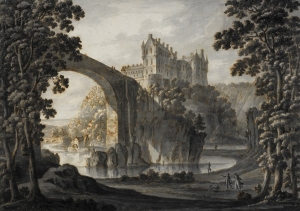
Robert Adam, "Cullen Castle, Banffshire," ca. 1770s (Edinburgh: National Gallery)
25 April – 2 August 2009
Robert Adam’s Landscape Fantasies:
Watercolors and Drawings from the Permanent Collection
National Gallery of Scotland, Edinburgh
This is the final week for an exhibition in Edinburgh that explores a less familiar dimension of Robert Adam’s oeuvre. As noted from The Magazine Antiques:
The Scottish architect, interior designer, and furniture designer, who designed such neoclassical masterpieces as Kenwood House, Osterley Park, and Stowe, created the landscape watercolors and drawings on view toward the end of his life for his own private enjoyment. While some, such as this detailed depiction of Cullen Castle in Banffshire, painted about 1770 to 1780, portray real sites, the majority depict picturesque fantasies, evoking in an entirely Scottish guise the capricci of Giovanni Battista Piranesi, with whom Adam had studied while in Rome on an extended grand tour in the 1750s.
The more than thirty watercolors by Adam on view are accompanied by drawings by his sketching partners: his brother-in-law, John Clerk of Eldin, and Paul Sandby, an English landscape artist who traveled extensively through Scotland. These brooding, atmospheric renderings of steep cliffs, ancient castles, and gushing waterfalls offer up a cooling tonic to summer’s heat.
 The show stands as a fine complement to an exhibition from 2000 mounted by the John Soane Museum, Robert Adam’s Castles, which included a catalogue by Stephen Astley. As described in the archives seciton of the museum’s website, the London show sought to
cast Robert Adam, Scotland’s most celebrated architect, in a dramatic new light, reassessing an important but much neglected element of his architectural portfolio, his designs in ‘the castle style’. Robust and sublime, Adam’s castles make a startling contrast to the refined and delicate decorative schemes for which the architect is principally known, and comprise over 10 percent of his career output. Of the realised castle projects, many have now gone and others lie in ruins – an unjust fate for a group of buildings representing the most personal expression of Adam’s art. (more…)
Prints in Valencia: Goya and Piranesi

June 10 — July 26, 2009
This is the final weekend of an exhibition of Goya’s Tauromaquia at the Bancaja Cultural Center in Valencia. Produced around 1815, these prints dedicated to the history of bullfighting are discussed in Andy Schulz’s recent article, “Moors and the Bullfight: History and National Identity in Goya’s Tauromaquia,” Art Bulletin 90 (June 2008).
In the fall, the Bancaja Center will host an exhibition of Piranesi’s prints on loan from the Museu de Montserrat. The show opens on September 10 and runs until November 8.
Summer Seascapes
28 May — 18 October, 2009
“An Allegory of Empire,” — Benjamin Genocchio, New York Times (26 June 2009)
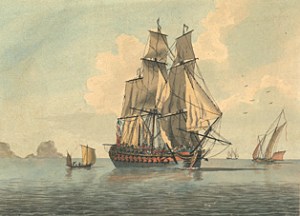
Samuel Atkins (fl. 1787-1808), "H.M.S. Bounty Setting Sail," pen, ink and watercolor painting (New Haven: YCBA)
A small exhibition of marine paintings and watercolors from the Dutch ‘Golden Age’ and by noted British artists — including scenes of famous naval battles, warships, privateers and historical vessels — is featured in a summer exhibition at the Yale Center for British Art.
Seascapes: Marine Paintings and Watercolors from the U Collection includes works attesting to Great Britain’s maritime capabilities, interest in scientific exploration and imperial expansion. On view through October 18, the exhibition features approximately 20 works from a recent major gift to the Yale Center for British Art that span the seventeenth to nineteenth centuries and attest to the visual and cultural significance of the sea in Britain and the Netherlands. The center is the only venue for the exhibition. (more…)
Spanish Still Life in D.C. — then L.A. and Boston
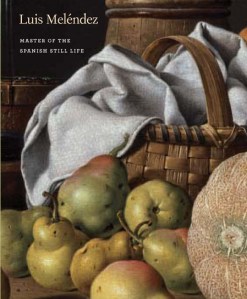
Catalogue by Gretchen Hirschauer and Catherine Metzger with Peter Cherry and Natacha Seseña

Luis Meléndez, Self-Portrait, 1746, oil on canvas, 38 x 32 inches (Paris: Louvre)
May 17 — August 23, 2009
Delights of the Spanish table depicted by the eighteenth-century painter Luis Meléndez (1715-1780) are presented to American audiences for the first time in nearly twenty-five years at the National Gallery of Art, Washington, May 17 through August 23, 2009. In a rare opportunity to explore the artist’s working method, the exhibition Luis Meléndez: Master of the Spanish Still Life showcases 31 paintings, some of which have never been shown publicly, and nine examples of eighteenth-century kitchenware similar to those used as studio props by Meléndez.
Organized by the National Gallery of Art, Washington, the exhibition will travel to the Los Angeles County Museum of Art, on view September 23, 2009, through January 3, 2010, and to the Museum of Fine Arts, Boston, on view February 1 through May 9, 2010. Fourteen of Meléndez’s still-life paintings now in American collections will be shown with 17 relevant works by him from collections abroad, exploring the artist’s creative process and celebrating his compelling artistic achievements. Loans of paintings come from major museums such as the Museo Nacional del Prado, Museé du Louvre, and the Museum of Fine Arts, Boston.
[Press release from the National Gallery]
Diplomacy in 1762
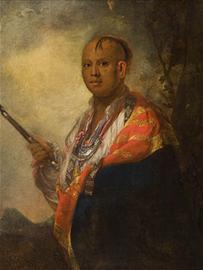
Joshua Reynolds, Syacust Ukah, 1762
Gilcrease Museum of the Americas – Tulsa, Oklahoma
July 4, 2009 – January 10, 2010
Emissaries of Peace: The 1762 Cherokee and British Delegations recounts the story of British and Cherokee diplomatic missions to each other’s capitals in 1762. The exhibition takes a look at British and Cherokee societies through the eyes of first-time observers. Two of the most important works related to this story, portraits of Ostenaco by Sir Joshua Reynolds and Cunne Shote by Francis Parsons painted in June and July 1762, are reunited with the ethnographic and archaeological material that provide their historical context.
In the mid-eighteenth century, the Cherokee were considered by Great Britain to be strong allies and trading partners. The alliance was broken in 1758 and a destructive three-year war followed. The Cherokee and British peace delegations in 1762 attempted to re-establish the military and economic alliance.
Providing insights into how British and Cherokee societies viewed each other during the pre-Revolutionary war era, Emissaries of Peace relies heavily on the memoirs of Lt. Henry Timberlake, a British officer sent to the Cherokee capital of Chota after a peace treaty was concluded in November 1761. His memoirs provide one of the best accounts of Cherokee life and society in the late-eighteenth century and were published about the time of his death in 1765. An original copy, considered to be one of the rarest books in America is part of the Gilcrease Museum archives.
Archaeological materials excavated from eighteenth-century Cherokee sites, historical documents, and British artifacts from the period are matched with illustrations and artwork (including a portrait of George III by Allan Ramsay on loan from the Indianapolis Museum of Art) to tell the story of these two nations and their representatives who made diplomatic missions to each other’s capitals in 1762. (more…)
Le quatorze juillet – Bonne fête!
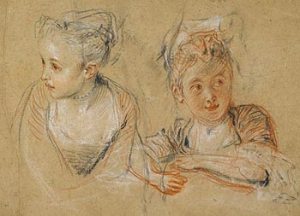
Antoine Watteau, Two Studies of the Head and Shoulders of a Little Girl, ca. 1717 (gift of J. P. Morgan, Jr., 1924)
As noted on the Morgan’s website, this fall the New York library and museum will host an exhibition of over eighty exceptional works on paper in conjunction with Rococo and Revolution: Eighteenth-Century French Drawings. Artists featured will include Antoine Watteau, Jacques-Louis David, François Boucher, Jean-Honoré Fragonard, Claude Gillot, Nicolas Lancret, Hubert Robert, Pierre-Paul Prud’hon, Anne-Louis Girodet, and Pierre-Narcisse Guérin.
The exhibition runs from October 2, 2009 until January 3, 2010.










 Enfilade
leave a comment