Study Day | Spectacle and Representation during the Régence
From the Carnavalet:
Spectacle et représentation royale durant la Régence, 1715–1723
Orangerie du musée Carnavalet, Paris, 16 November 2023
 Dans le cadre des manifestations organisées autour de l’exposition La Régence à Paris (1715–1723): L’aube des lumières, le Centre de musique baroque de Versailles et le musée Carnavalet – Histoire de Paris proposent une journée d’études pluridisciplinaire sur les divertissements du jeune Louis XV. Cette journée réunit historiens, historiens de l’art, historiens de la danse et musicologues pour une journée d’études pluridisciplinaire autour des trois ballets dansés devant toute la cour par le jeune Louis XV aux Tuileries en 1720 et 1721 (L’Inconnu, Les Folies de Cardenio, Les Éléments), peu de temps avant sa majorité, son sacre et donc sa prise de souveraineté. S’inscrivant à la fois dans la lignée des grands divertissements royaux du Grand Siècle, mais dans des inspirations et une esthétique plus modernes, annonciatrices des Lumières, ces spectacles royaux ont participé à la construction de l’image publique du jeune souverain. Au-delà des aspects musicaux, littéraires, chorégraphiques et esthétiques, ces spectacles de cour, seront ainsi envisagés au travers de la question, transversale, de la représentation du pouvoir royal durant la Régence.
Réservation recommandée, jcharbey@cmbv.com.
m o d e r a t e u r s
Alexandre Dupilet
Petra Dotlačilová (Stockholm University, CMBV-CESR)
Thomas Leconte (CMBV-CESR)
i n t e r v e n a n t s
• José de Los Llanos (Conservateur en chef, responsable du Cabinet des Arts graphiques et du département des Maquettes, Musée Carnavalet – Histoire de Paris) et Ulysse Jardat (Conservateur du patrimoine, responsable du département des Décors, Mobilier et Arts décoratifs, Musée Carnavalet – Histoire de Paris), commissariat scientifique de l’exposition La Régence à Paris (1715–1723): L’aube des Lumières
• Laurent Lemarchand (Université de Rouen, GHRis) — Louis XV et Philippe d’Orléans : l’Union sacrée
• Vivien Richard (Musée du Louvre) — Les Tuileries : résidence du jeune Louis XV, 1715–1722
• Thomas Leconte (CMBV-CESR) — Le roi en sa capitale, 1715–1722 : l’image de la majesté à travers le cérémonial royal et le maillage urbain
• Pascale Mormiche (CY Cergy Paris Université) — Louis XV aimait-il danser ?
• Nathanaël Eskenazy (Université Paul-Valéry-Montpellier III, IRCL) — Convaincre, persuader, exhorter : repenser le discours encomiastique et la célébration de la figure royale dans les trois ballets dansés par Louis XV
• Barbara Nestola (CMBV-CESR) — Réunir pour mieux régner ? Fusion et collaboration entre troupes de cour et de ville pour la représentation des ballets dansés par Louis XV, 1720–1721
• Petra Dotlačilová (Stockholm University, CMBV-CESR) — Terpsichore durant la Régence : entre la tradition de cour et la danse théâtrale
• Mickaël Bouffard (Sorbonne Université, Théâtre Molière Sorbonne, CELLF) — Les habits des ballets de Louis XV : goût nouveau ou recyclage de vieilles idées ?
Exhibition | On the Reverse

Installation view of Reversos / On the Reverse, at The Prado in Madrid, 2023.
◊ ◊ ◊ ◊ ◊
Now on view at The Prado:
On the Reverse
Museo Nacional del Prado, Madrid, 7 November 2023 — 3 March 2024
Curated by Miguel Ángel Blanco
Until 3 March 2024, the Museo Nacional del Prado and Fundación AXA are undertaking a journey that moves beyond the surface of artistic masterpieces to allow for the contemplation of a fascinating reality: the hidden side of the work of art, its reverse. Alongside works from the Prado’s own collection, On the Reverse includes generous loans from other national and international institutions. They include Assemblage with Graffiti by Antoni Tàpies from Fundación Telefónica, Cosimo I de’Medici by Bronzino from the Abelló Collection, Self-Portrait as a Painter by Van Gogh from the Van Gogh Museum, Amsterdam, Artist in His Studio by Rembrandt from the Museum of Fine Arts, Boston, and The Empty Mask by Magritte from the Kunstsammlung Nordrhein-Westfalen, Düsseldorf. In all, about a hundred works are on display.
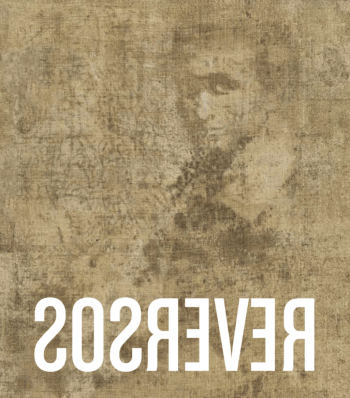 For the exhibition, curated by artist Miguel Ángel Blanco, rooms A and B of the Jerónimos Building have been painted black for the first time. On the Reverse takes the form of an open survey that gives maximum freedom to the spatial relationship between the works, devoid of any hierarchy or chronological ordering and including the presence of creations by contemporary artists such as Vik Muniz, Sophie Calle, and Miguel Ángel Blanco himself, who is represented by three of his box-books from the Library of the Forest. Taking his starting point from a contemplation of Las Meninas—in which the reverse of the vast canvas on which Velázquez is working occupies a large portion of the pictorial surface—Blanco proposes an unusual approach to painting by turning the works around in order to encourage visitors to establish a new and more complete relationship with the artists whose work is included.
Numerous studies have been undertaken to date on individual works that have interesting backs for different reasons, and some museums have explored this aspect in a partial manner through small exhibitions focused on the reverse of works in their collections. However, with the collaboration of Fundación AXA, it is the Museo Nacional del Prado that is now approaching this subject with the necessary ambition. In addition to undertaking a complete reassessment of the backs of works in its collections, the Museum has also located examples in some of the world’s leading museums that reveal how an appreciation of works of art is enriched when their contemplation is not limited to the front.
Structured thematically, the exhibition includes artists never previously seen at the Prado, among them Van Gogh (1853–1890), René Magritte (1898–1967), Lucio Fontana (1899–1968), Pablo Palazuelo (1915–2007), Antoni Tàpies (1923–2012), Sophie Calle (b. 1953), Vik Muniz (b. 1961), Michelangelo Pistoletto (b. 1933), José María Sicilia (b. 1954), Wolfgang Beurer (active 1480–1504), Louis-Léopold Boilly (1761–1845), Carl Gustav Carus (1789–1869), Vilhelm Hammershøi (1864–1916), Martin van Meytens (1695–1770), Wallerant Vaillant (1623–1677), Ernst Ludwig Kirchner (1880–1938), and Max Liebermann (1847–1935).
On the Reverse opens with ‘The Artist behind the Canvas’, crossing that dimensional threshold to which Velázquez draws our attention with the enigmatic reverse of the canvas depicted in Las Meninas. Painters frequently portrayed themselves behind a picture, but even when these backs are not so directly associated with the artist’s activity, they acquire a prominent presence as objects of special significance in painters’ studios.
The depiction of the back returns in ‘This Is Not a Reverse’, a section that paraphrases Magritte in order to bring together various trompe l’oeils that represent backs of paintings. This meta-artistic subject reveals the enormous significance that the hidden side of works could acquire for artists, leading them to imitate the annotations, inscriptions, drawings, etc, habitually found on picture backs.
One of the elements that makes up the pictorial support is the subject of ‘The Stretcher as Cross’, the exhibition’s third section. This concealed structural element normally takes the form of a wooden cross that can be used to carry the painting from one place to another. When—in a habitual, everyday action that also emphasises the three-dimensional status of the work which this exhibition analyses—an artist picks up the cross of the stretcher in order to move the work in the studio or take it outside for the purpose of painting outdoors he/she is performing a type of ‘Via Crucis’ that symbolises the effort and difficulties of artistic endeavour.

Martin van Meytens, Kneeling Nun, obverse and reverse, ca. 1731, oil on copper, 28 × 21 cm (Stockholm: Nationalmuseum, NM 7036; purchased in 2006 with the Axel och Nora Lundgren Fund). The painting was also included in the 2017–18 exhibition Casanova: The Seduction of Europe.
◊ ◊ ◊ ◊ ◊
The exhibition’s central section, ‘B-Sides’, focuses on works that can be termed ‘two-sided’. Here the back has its own artistic status and complements the principal image in various ways. It may feature the back of a figure seen from the front on the other side, a landscape or allegorical scene that modifies the meaning of the principal representation, heraldic information, associated religious themes, portraits, and more. Continuing this theme, the section ‘The Hidden Side’ includes works in which the back reveals traces of the creative process in the form of drawings, geometrical designs, or expressive whimsies.
‘More Information on the Back’ looks at a classic problem in painting. Although word and image coexisted relatively easily until the Middle Ages, a moment arrived when artists entrusted all the weight of the narrative to the latter. Furthermore, when they needed to convey information, identify subjects or individuals, or include additional information or commentaries on the execution of the work, they almost invariably wrote on the back. In some cases information has been added to backs at a later date in the form of labels and stamps or seals that help us to trace the history of the works: the collections they belonged to, the palaces they adorned, their changes of location, and any restoration undertaken on them.

Zacarías González Velázquez, Reverse of Two Fishermen, One with a Rod and the Other Seated, 1785, oil on canvas (Madrid, Cuartel General del Ejército, depósito del Museo Nacional del Prado). The back of the painting reveals a strip of canvas that was folded over the stretcher at some date in order to fit the work into a narrower space.
In other cases, as seen in ‘Ornaments and Ghosts’, the backs reveal stories contained in the works’ actual materials: textiles that had domestic uses or patterned weaves that contain unintentional ghosts which appear when oil soaks into the cloth. In addition, the section ‘Folds, Cuts, and Cutouts’ shows how old restorations and alterations made to adapt paintings to new locations or functions are visible on reverses that include repairs, cuts, and folds that result in part of the image being relegated to facing the wall.
It is easy to simplify the experience of ‘facing’ a painting to a question of fronts: the work’s and the viewer’s. Looking at a painting implies locating ourselves before it with our ‘front side’, where our eyes are located. However, for some time now, the experience of art has been understood as something more physical; our entire body in all its dimensions participates in it. In fact, in both depictions of artists working in their studios and in images of the public looking at art in museums and exhibitions these figures are often seen ‘From behind, In front of the Painting’.
Finally, ‘Nature in the Background’ investigates the unusual or less common materials that have been used over the centuries as the supports for paintings in the Museum’s collection. This research has identified copper, tin, slate, alabaster, cork, brick, porcelain, and ivory. Furthermore, dust is always present. Regular cleaning is, of course, undertaken at the Museum, but the largest and heaviest works are less frequently moved. A short time ago the Museo del Prado removed The Transfiguration by Giovanni Francesco Penni from the wall, allowing Miguel Ángel Blanco to collect some of the dust accumulated on its reverse, which he has used to make three box-books for his Library of the Forest.
Miguel Ángel Blanco, ed., Reversos (Madrid: Museo del Prado, 2023), 336 pages, ISBN: 978-8484806042, €38. With additional contributions by Ramón Andrés, Ana González Mozo, Antonio Muñoz Molina, and Victor I. Stoichita.
Exhibition | Amber: Treasures from the Baltic Sea
On view at Galerie Kugel:
Amber: Treasures from the Baltic Sea, 16th–18th Century
Galerie Kugel, Paris, 18 October — 16 December 2023
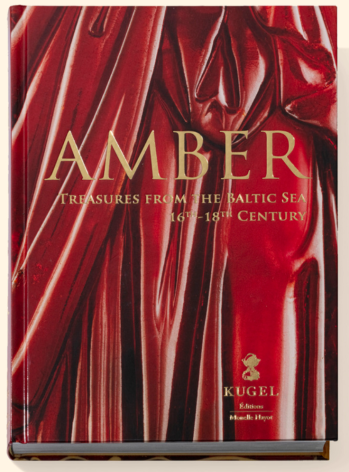 From Roman times to the 18th century, many recognised the inherent value of amber and hypothesised its origin, some assuming it to be whale sperm, others, solidified lynx urine. Its mystery endowed it with medicinal virtues. Amber was recommended as a powder to cure melancholy, toothache, and epilepsy, among other ailments, and as a love filter. The occasional inclusions of insects and small animals found trapped in amber have also made it a symbol of immortality. Pliny the Elder was the first to unveil its nature as the result of plant resin, but it wasn’t until 1757 that the Russian scientist Mikhail Lomonossov determined its true origin.
Amber is a fossilised resin originating, in the case of the objects exhibited, from a prehistoric forest dating back to some 30 to 40 million years, located under the Baltic Sea, between the towns of Danzig (today Gdansk in Poland) and Königsberg (today Kaliningrad in Russia), then, in East Prussia. In the 16th century, Grand Master Albert of Brandenburg-Ansbach (1490–1568) converted to Protestantism and transformed the territories of the Order of the Teutonic Knights in the Duchy of Prussia. This marked the beginning of a tremendous expansion in the trade and production of amber works of art. They became Prussia’s diplomatic gifts par excellence and were sought after to adorn the ‘Kunstkammern’ of Europe’s sovereigns and princes. It took nearly 20 years to collect the fifty pieces on display in this exhibition. Combining sculptures, caskets, tankards, and game boards, the wide variety of objects presented illustrate the fascination for amber through the 16th, 17th, and 18th centuries.
Alexis Kugel and Rahul Kulka, Amber: Treasures from the Baltic Sea, 16th to 18th Century / Ambre: Trésors de la mer Baltique du XVI au XVIIIe siècle (Saint-Remy-en-l’Eau: Éditions Monelle Hayot, 2023), 376 pages, €85. Available in French and English.
Exhibition | Drawing on Blue
Opening in January at The Getty:
Drawing on Blue
Getty Center, Los Angeles, 30 January — 28 April 2024
Curated by Edina Adam and Michelle Sullivan
Made from blue rags, blue paper has fascinated European artists from its earliest use in Renaissance Italy to Enlightenment France and beyond. Through new technical examination of drawings in the Getty’s collection, this exhibition offers fresh insight into the physical properties of blue paper and its unique contribution to artistic practice from the 15th through 18th centuries.
◊ ◊ ◊ ◊ ◊
From Getty Publications:
Edina Adam and Michelle Sullivan, eds., Drawing on Blue: European Drawings on Blue Paper, 1400s–1700s (Los Angeles: J. Paul Getty Museum, 2024), 160 pages, ISBN: 978-1606068670, $35. With contributions by Mari-Tere Álvarez, Thea Burns, Marie-Noelle Grison, Camilla Pietrabissa, and Leila Sauvage.
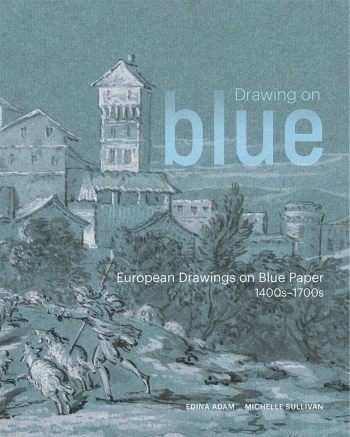 This engaging book highlights the role of blue paper in the history of drawing. The rich history of blue paper, from the late fifteenth to the mid-eighteenth centuries, illuminates themes of transcultural interchange, international trade, and global reach. Through the examination of significant works, this volume investigates considerations of supply, use, economics, and innovative creative practice. How did the materials necessary for the production of blue paper reach artistic centers? How were these materials produced and used in various regions? Why did they appeal to artists, and how did they impact artistic practice and come to be associated with regional artistic identities? How did commercial, political, and cultural relations, and the mobility of artists, enable the dispersion of these materials and related techniques? Bringing together the work of the world’s leading specialists, this striking publication is destined to become essential reading on the history, materials, and techniques of drawings executed on blue paper.
Edina Adam is assistant curator of drawings at the J. Paul Getty Museum. Michelle Sullivan is associate conservator of drawings at the J. Paul Getty Museum.
Exhibition | Michail Michailov’s Dust to Dust at the Belvedere

Michail Michailov, Dust to Dust, as installed in the Carlone Hall of the Upper Belvedere in 2023.
(Photo by Johannes Stoll)
◊ ◊ ◊ ◊ ◊
From the press release (via Art Daily) for the exhibition:
Michail Michailov: Dust to Dust
Upper Belvedere, Vienna, 19 October 2023 — 14 April 2024
Curated by Stella Rollig with Johanna Hofer
As part of the Belvedere’s Carlone Contemporary series, Michail Michailov presents Dust to Dust, an 18-part trompe l’oeil drawing, previously exhibited at the Bulgarian Pavilion of the 2022 Venice Biennale. The modular work captures incidental, often overlooked vestiges of time, such as dust, hair, imprints, and stains, calling into question the value and existence of things.
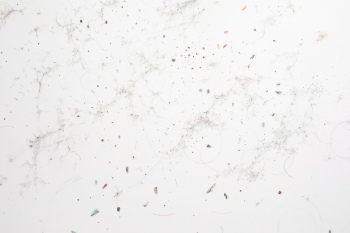
Michail Michailov, Dust to Dust, detail, colored pencil on paper, 2022 (Photograph by Lisa Rastl).
Upon first glance, Dust to Dust may seem like a minimalist installation amid the baroque ambiance of the Carlone Hall. However, upon closer inspection, the display’s space-consuming surface reveals profound poetry. Michailov has meticulously crafted an 18-part series of colored pencil drawings that capture the often unnoticed and incidental vestiges of time. The work is a microcosm touching on fundamental questions of value, transience, and existence with striking simplicity. The realism of Michailov’s trompe l’oeil technique can also be observed above the installation, in the Triumph of Aurora ceiling fresco, which portrays the victory of light over darkness.
Michail Michailov states: “While science explores matter through its composition, I try to understand its meaning through art.”
General Director Stella Rollig states: “Michail Michailov is interested in providing his audience with an experience that only art can make possible. The old master technique of trompe l’oeil that he employs in the Carlone Hall seeks to amaze, amuse, and fascinate. Whether in a large-scale installation or a sheet of paper, Michailov’s work challenges the senses to set the mind in motion.”
Michail Michailov was born in 1978 in Veliko Tarnovo, Bulgaria, where he studied fine arts. Since 2002, he has lived and worked in Vienna, where he completed a degree in art history. His artistic practice moves fluidly between the fields of drawing, installation, film, and performance. The Carlone Contemporary Series showcases contemporary works in the Carlone Hall of the Upper Belvedere. From the frescoed ancient world of the deities Apollo and Diana to the present day, artists bridge the Baroque pictorial program with fresh artistic perspectives.
Exhibition | Objects of Addiction
Now on view at Harvard Art Musesums:
Objects of Addiction: Opium, Empire, and the Chinese Art Trade
Harvard Art Museums, Cambridge, 15 September 2023 — 14 January 2024
Curated by Sarah Laursen, with contributions from Emily Axelsen, Allison Chang, and Madison Stein
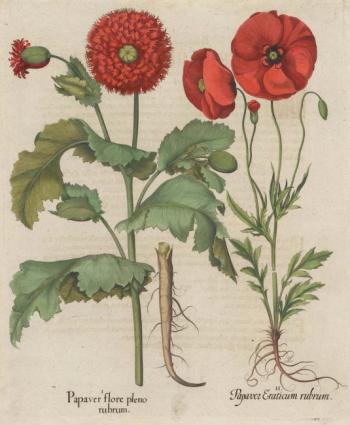
Basilius Besler, Papaver flore pleno rubrum, Papaver eraticum rubrum (plate 290), from Hortus Eystettensis, 1613 or 1713, hand-colored print (Economic Botany Library of Oakes Ames, Harvard University, Julio Mario Santo Domingo Collection, TL42499.1).
How did the sale of opium in China by Massachusetts merchants in the 19th century contribute to a growing appetite for Chinese art at Harvard at the start of the 20th century?
Objects of Addiction explores the entwined histories of the opium trade and the Chinese art market between the late 18th and early 20th centuries. Opium and Chinese art, acquired through both legal and illicit means, had profound effects on the global economy, cultural landscape, and education—and in the case of opium, on public health and immigration—that still reverberate today.
The first section of the exhibition examines the origins of the opium trade, the participation of Massachusetts traders, and opium’s devastating impact on the Qing dynasty (1644–1911) and the Chinese people. Works presented here include smoking paraphernalia, an opium account book, and photographs, along with mass media illustrations critiquing the use and sale of opium.
The second section highlights the history of imperial art collecting in China and demonstrates the growing appetite for Chinese art in Europe and the United States after the Opium Wars (1839–42 and 1856–60). Artworks from Massachusetts-based private and public collections show the shift in taste at this time from export ceramics and paintings to palace treasures and archaeological materials, including ancient bronzes and jades unearthed from tombs and Buddhist sculptures chiseled from cave temple walls. Through the histories of museum directors, professors, and donors, this section looks critically at the sources of Harvard’s Chinese art collection.
A special section of the exhibition investigates parallels between China’s opium crisis and the opioid epidemic in Massachusetts today. We invite visitors to share their thoughts and personal experiences in this space. A range of public programs throughout the fall will encourage community discussion around the opioid crisis, the effects of the Opium Wars on U.S.–China relations, the role of opium in Chinese exclusion in the United States, and art collecting practices. In addition, the artist collective 2nd Act will present a series of substance use prevention workshops, and the Cambridge Public Health Department and Somerville Health and Human Services Department will host trainings on the use of naloxone (Narcan) to reverse opioid overdoses.
This exhibition features works from the collections of the Harvard Art Museums. In addition, loans have been generously provided by the Peabody Museum of Archaeology and Ethnology, Fine Arts Library, Harvard-Yenching Library, Economic Botany Library of Oakes Ames, Houghton Library, and Baker Library (all at Harvard), as well as by the Forbes House Museum, the Ipswich Museum, and Mr. and Mrs. James E. Breece III.
Curated by Sarah Laursen, Alan J. Dworsky Associate Curator of Chinese Art, Harvard Art Museums; with contributions from Harvard students Emily Axelsen (Class of 2023), Allison Chang (Class of 2023), and Madison Stein (Class of 2024), who were instrumental in the early development and planning of this exhibition. We are also grateful to the community members, students, and scholars who lent their time and expertise.
Exhibition | Portrait Miniatures from the Grantchester Collection
On view at Compton Verney:
Portrait Miniatures: Highlights from the Grantchester Collection
Compton Verney Art Gallery and Park, Warwickshire, 10 September 2022 — 31 December 2023
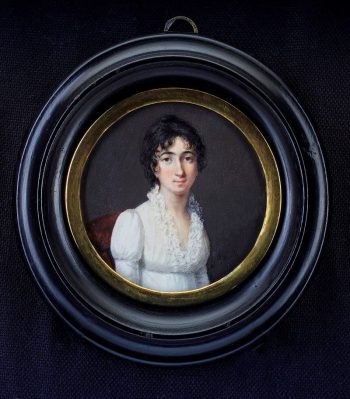
Henriette Rath, Portrait of Madame Argand, 1799, watercolour on ivory, 1799 (Compton Verney Art Gallery and Park, photograph by Jamie Woodle). Together with her sister, Jeanne-Françoise, Henriette founded the Musée Rath in Geneva, the first purpose-built art museum in Switzerland, constructed between 1824 and 1826.
We are excited to present highlights from the Grantchester Miniatures Collection in Compton Verney’s British Portraits gallery. The Grantchester Collection of portrait miniatures was gifted to Compton Verney in 2019. It is a highly personal collection developed by the late Lady Grantchester [Betty Suenson-Taylor], the sister of our founder Sir Peter Moores, who established the Compton Verney House Trust in 1993. Showcasing over 40 exquisite miniatures from the sixteenth, seventeenth, and eighteenth centuries, this will be the first time that many of these works have been shown in public. The collection includes portraits in miniature by Isaac Oliver, Richard Cosway, George Engleheart and John Smart.
A guide to the exhibition is available here»
Exhibition | History in the Making
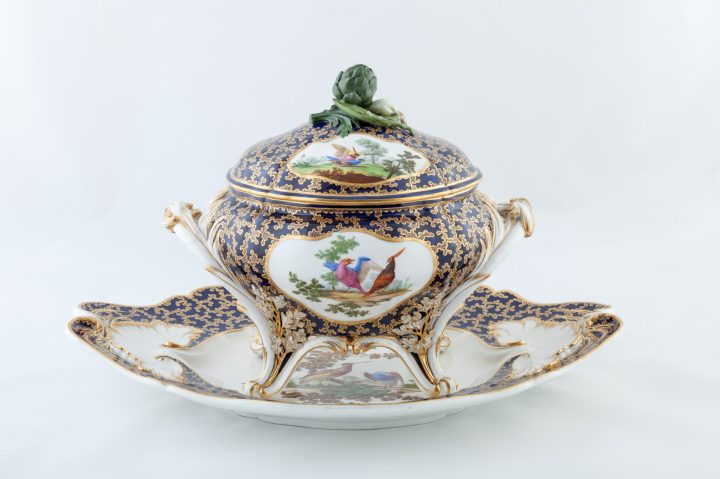
‘Bedford Gift Service’ tureen and stand, Sèvres, decoration by Jean-Pierre Ledoux, 1761–63
(Woburn Abbey Collection)
◊ ◊ ◊ ◊ ◊
From the press release (via Art Daily) for the exhibition at Compton Verney:
History in the Making: Stories of Materials and Makers, 2000BC to Now
Compton Verney Art Gallery and Park, Warwickshire, 21 October 2023 — 11 February 2024
Curated by Oli McCall and Hannah Obee
History in the Making: Stories of Materials and Makers presents the stories of the people and processes behind outstanding examples of historic and contemporary craft by bringing together a treasure-trove of objects in a unique exploration and celebration of materials and making. Installed in both suites of temporary exhibition galleries at Compton Verney, the exhibition presents historic craft masterpieces from Woburn Abbey and Compton Verney alongside contemporary creations by some of the most exciting makers working today, many of which are being loaned for the first time by the Crafts Council, the UK’s national charity for craft.
 Works on display include ancient Chinese ceramics from Compton Verney’s internationally renowned Chinese collection, 18th-century Indian bed textiles from Woburn Abbey, painted silks by award-winning artist and designer Christian Ovonlen, and glazed stoneware vessels by rising star ceramic artist Shawanda Corbett. By displaying the historic in dialogue with the new, the exhibition uncovers the skilful craft processes, technical innovations, and material properties of decorative objects across the ages, while also highlighting the environmental and ethical considerations around the use of natural materials. Each gallery focuses on a different material group—textile, organic, metal, stone, clay, and wood—providing a framework within which contemporary issues such as globalisation and colonial economies, social class and the importance of craft traditions in diverse cultures will be explored.
A highlight of History in the Making is the chance to see one of Woburn Abbey’s newly conserved Mortlake Tapestries. Dating from the 1660s, these huge wall hangings have been painstakingly conserved over a period of five years. Inspired by Raphael’s cartoon for The Miraculous Draught of Fishes (ca. 1515–16, on loan to the V&A from His Majesty The King), originally commissioned by Pope Leo X for the Sistine Chapel, the tapestry shows two boats on the waters of lake Galilee; on the left Christ is seated, with the Apostles Peter and Andrew in astonishment before him, their boat full of miraculous fish. The Mortlake manufactory was established in 1619 in the village of Mortlake, west of London. Under royal patronage, the workshop was able to rival continental centres such as Brussels and Paris for high-quality textiles. The tapestry from Woburn Abbey is being displayed in a gallery with pieces by textile artist and ceramicist Matt Smith, who has reworked vintage tapestries by unpicking and re-stitching elements—often faces—to illustrate how historical narratives are never objective accounts of truth, alluding to the marginalisation of queer people in society. His work often reshapes objects from their original uses to highlight marginalised points of view and hidden stories.
The exhibition includes examples of the Sèvres dinner service given by Louis XV of France to the Duke and Duchess of Bedford in 1763. The Sèvres ceramics have provided an intriguing opportunity for the exhibition’s co-curator Hannah Obee to delve into the iconic French manufacturer’s archives. She notes that “in the 18th century, luxury porcelain was about enhancing the prestige and wealth of nations. The individuals who made it were not part of the narrative, unlike today. However, the Sèvres archives provide a rich resource of information; so, we can now put names and sometimes faces to the objects they created. This is a unique feature of the show at Compton Verney.”
The exhibition also contains a set of bed textiles made in the 1750s in Gujarat, India. “Even now their colours are amazing and so vibrant,” observes Compton Verney senior curator Oli McCall. “The Bedford family had an agent in India who reported back to them about the people making them, who were all women. From these letters we gain valuable insights into the textile trade in the 18th century, anticipating modern globalisation.”
History in the Making also includes objects, once prized, but now seen as problematic, made from natural materials such as coral, tortoiseshell, and ivory. McCall, Obee, and their colleagues decided to include several of these pieces to reflect how makers once saw artistic and creative potential, without questioning the environmental damage that would result from the huge demand for such items. To demonstrate this, History in the Making showcases the work of contemporary makers who are sourcing sustainable materials for their work.
The display of historic silverware such as 18th-century candlesticks and tableware, acts as a reminder of the importance of human migration in the dissemination of craft expertise and techniques and the challenges faced by new arrivals. Huguenot silversmiths, for example, were members of the French Protestant faith who faced persecution in their homeland with over 50,000 Huguenots coming to Britain through the 16th to 18th-centuries. Their work and that of the people who made the Mortlake Tapestries, worked in the Sèvres factory, and produced the Indian bed textiles are just a handful of examples of how Britain connected with the wider world. The exhibition demonstrates and reminds us of this, whilst shining a spotlight on the things that people created for themselves as part of everyday life. Adi Toch’s 2020 print Precious Disposables, on loan from the Crafts Council, depicts a pair of the maker’s latex gloves covered in golden-hued brass dust. Made during the Coronavirus pandemic, the work invites us to think about how what is considered valuable shifts depending on social, political, and environmental concerns.
In the final room, pieces by some of the most exciting young makers working at the forefront of scientific and material innovation are displayed, highlighting the environmental responsibility that has become a focus of contemporary craft practices proposing more planet-friendly materials and methods. Diana Scherer uses plant roots to create ‘living fabrics’, which she fashions into wall hangings and framed works of art. Nicky James, meanwhile, makes garments in wool, but has found a way to make them more resilient by mimicking strong structures found in nature, such as the giant squid beak. Other makers are using cutting-edge innovation to work with ‘leather’ made from mushrooms, and even using silk worm cocoons to create furniture.
Geraldine Collinge, Director of Compton Verney, states: “We are delighted to be able to collaborate with Woburn Abbey and the Crafts Council on this ambitious exhibition, which will give visitors a unique opportunity to explore outstanding examples of craft by many of the leading makers past and present and reflect on the universal importance of materials and making. This exhibition reflects the bringing together of the historic and contemporary to tell stories, which is something we aim to do across our creative programme at Compton Verney. Throughout the winter and into the start of 2024 we will be providing a host of hands-on craft workshops and activities where visitors can get creative and pick up new skills.”
Colloquium | Léopold Robert and Aurèle Robert
From the conference programme:
Frères d’art: Léopold et Aurèle Robert
Neuchâtel / La Chaux-de-Fonds, 9–10 November 2023
 Dans le cadre de l’exposition Léopold et Aurèle Robert présentée conjointement au Musée des beaux-arts de La Chaux-de-Fonds et au Musée d’art et d’histoire de Neuchâtel du 14 mai au 12 novembre 2023, l’Institut d’histoire de l’art et de muséologie de l’Université de Neuchâtel souhaite encourager la réflexion et l’échange d’idées à propos de ces deux figures artistiques à l’occasion d’un colloque international. Celui-ci se tiendra en présentiel le jeudi 9 novembre 2023 au Musée d’art et d’histoire de Neuchâtel, et le vendredi 10 novembre 2023 au Musée des beaux-arts de La Chaux-de-Fonds.
j e u d i , 9 n o v e m b r e 2 0 2 3
10.00 Accueil et café
10.30 La fabrique de l’œuvre: Léopold Robert au travail
• Léopold Robert au prisme de la conservation-restauration: État des lieux, nouvelles investigations et perspectives — Léa Gentil (Musée des beaux-arts de La Chaux-de-Fonds)
• La notion d’« œuvres de jeunesse » touchant Léopold Robert: Un réexamen des premières orientations de l’artiste — Cecilia Hurley (École du Louvre / Université de Neuchâtel)
• Les Brigands de Robert, ou l’art d’accommoder les restes de l’histoire de l’art — Pascal Griener (Université de Cambridge / École du Louvre)
12.30 Pause déjeuner
14.00 La fabrique de l’œuvre: Aurèle Robert au travail
• Un sens aigu de l’observation: Corpus d’études d’après nature d’Aurèle Robert conservé au Musée des beaux-arts du Locle — Anaëlle Hirschi (Chargée de projet de recherche en collaboration avec le Musée des beaux-arts du Locle)
• Les hors-champs de l’image: L’Atelier de Léopold Robert à Rome en 1829 par Aurèle Robert — Lucie Girardin Cestone (Musée d’art et d’histoire de Neuchâtel)
15.30 Pause café
16.00 Conférence
• Quand le folklore devient désirable: La mise en scène de la vie populaire entre représentation, collection et recherche — Federica Tamarozzi (Musée d’ethnographie de Genève)
v e n d r e d i , 1 0 n o v e m b r e 2 0 2 3
10.00 Accueil et café
10.30 Les stratégies de Léopold Robert, ou comment prendre sa place sur la scène artistique
• Une histoire de regards — Walter Tschopp (Fondation Ateliers d’Artistes)
• Léopold Robert et l’apparition de la grande scène de genre italienne en France — Laurent Langer (Musée d’art de Pully)
• Petit genre et grand format: Quelle grandeur pour représenter le peuple ? — Olivier Bonfait (Université de Bourgogne Franche-Comté, LIR3S)
12.30 Pause déjeuner
14.00 Regards contemporains sur Léopold Robert
• Léopold Robert et les écrivains de son temps (suite) — Alain Corbellari (Universités de Lausanne et de Neuchâtel)
• The legacy of Léopold Robert in 19th-century cosmopolitan Rome — Giovanna Capitelli (Università degli Studi Roma Tre)
15.30 Pause café
16.00 Conférence
• Et in Italia ego: Le voyage des peintres femmes à Rome et en Italie au XIXe siècle — Martine Lacas (Auteure, chercheuse et commissaire d’exposition indépendante)
The Burlington Magazine, October 2023
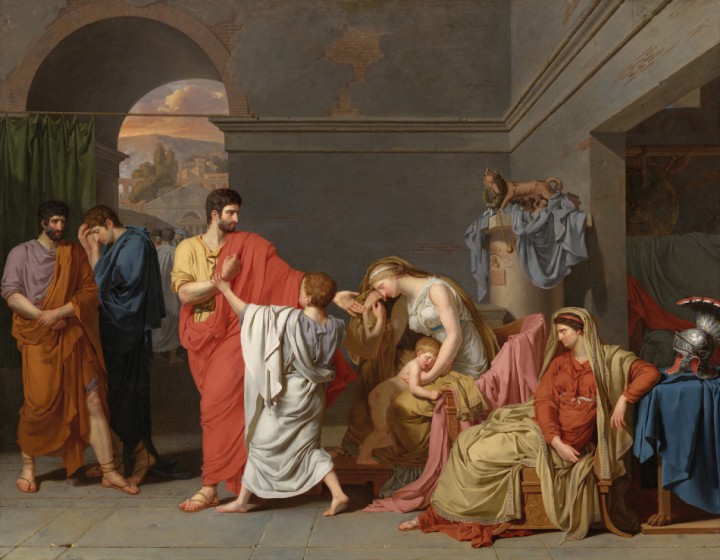
Anne-Louis Girodet de Roussy-Trioson, Coriolanus Taking Leave of His Family, 1786, oil on canvas, 114 × 146 cm
(National Gallery of Art, Washington)
◊ ◊ ◊ ◊ ◊
The eighteenth century in the October issue of The Burlington:
The Burlington Magazine 165 (October 2023)
a r t i c l e
• Aaron Wile, “Girodet’s Coriolanus Taking Leave of His Family Rediscovered,” pp. 1094–1105.
In 2019 Girodet’s lost entry for the 1786 Grand prix de peinture came to light and was acquired by the National Gallery of Art, Washington. The painting, which depicts a rarely represented incident from the story of Coriolanus—a subject that may have had contemporary political relevance—was not awarded the prize, probably because Girodet was regarded as being too close to Jacques-Louis David, a relationship to which the work may allude.
s h o r t e r n o t i c e
• Antoinette Friedenthal, “Image of a Connoisseur: An Unknown Portrait of Pierre Jean Mariette,” pp. 1106–10.
Among the unpublished miniatures in the Victoria & Albert Museum, London (V&A), is an eighteenth-century bust-length portrait of a middle-aged gentleman. A basic unillustrated inventory sheet for this work appeared in 2020 on the museum’s website. It stated that the portrait represents Pierre Jean Mariette (1694–1774) but gave no reasons for this identification and did not provide any information on the object’s provenance. It will be argued here that a combination of visual and documentary evidence confirms the identification.
r e v i e w s
 • Mark Bill, Review of the exhibition Reframing Reynolds: A Celebration (The Box, Plymouth, 2023), pp. 1124–27.
• Stephen Lloyd, Review of the refurbished Medieval, Renaissance, and Baroque galleries at the Walker Art Gallery, Liverpool, pp. 1130–33.
• Beth McKillop, Review of the exhibition China’s Hidden Century (The British Museum, London, 2023), pp. 1136–38.
• Satish Padiyar, Review of the exhibition Sade: Freedom or Evil (CCCB, Barcelona, 2023), pp. 1143–46.
• Malcolm McNeill, Review of Anne Farrer and Kevin McLoughlin, eds., Handbook of the Colour Print in China, 1600–1800 (Brill, 2022), pp. 1150–52.
• Edward Cooke, Review of Elisa Ambrosio, Francine Giese, Alina Martimyanova, and Hans Bjarne Thomsen, eds., China and the West: Reconsidering Chinese Reverse Glass Painting (De Gruyter, 2022), pp. 1152–53.
• David Ekserdjian, Review of the catalogue, Denise Allen, Linda Borsch, James David Draper, Jeffrey Fraiman, and Richard Stone, eds., Italian Renaissance and Baroque Bronzes in the Metropolitan Museum of Art (The Metropolitan Museum of Art, 2022), pp. 1156–58. The book is available as a free PDF The Met’s website.
• Rowan Watson, Review of Christopher de Hamel, The Posthumous Papers of the Manuscripts Club (Allen Lane, 2022), pp. 1160–62.
• Stefan Albl, Review of Francesco Lofano, Un pittore conteso nella Napoli del Settecento: L’epistolario e gli affari di Francesco de Mura (Istituto Italiano Studi Filosofici, 2022), pp. 1163–64.










 Enfilade
leave a comment