Exhibition | Eternal Medium: Seeing the World in Stone
From the press release for the exhibition:
Eternal Medium: Seeing the World in Stone
Los Angeles County Museum of Art, 20 August 2023 — 11 February 2024
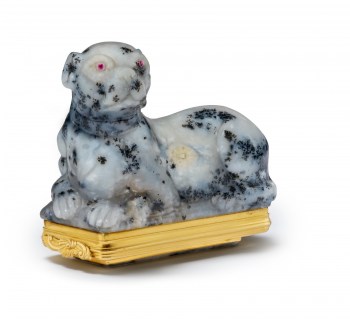
Snuffbox in the Shape of a Dog, ca. 1740–50, Dresden (LACMA, gift of The Rosalinde and Arthur Gilbert Foundation and the 2022 Decorative Arts and Design Acquisitions Committee).
The Los Angeles County Museum of Art presents Eternal Medium: Seeing the World in Stone, an exhibition that focuses on the role of the imagination in perceiving images in the natural markings of stones. The product of a collaboration between LACMA, the Rosalinde and Arthur Gilbert Collection, and the Victoria and Albert Museum in London, this exhibition brings together objects that utilize the natural features of stones and places them alongside similar works in other mediums for context and comparisons. Objects range from historical to contemporary, from ca. 2200–1800 BCE to recent pieces by Analia Saban, Alma Allen, and Ben Gaskell. Featuring a selection of 125 works, the exhibition is drawn from LACMA’s collection with loans from the Rosalinde and Arthur Gilbert Collection on loan to the V&A and the V&A’s own collections, as well as public and private collections in California.
“Making sense of enigmatic visual phenomena such as the moon, clouds, and inkblots is a fundamental human ability that excites curiosity and inspires creativity,” said Rosie Mills, The Rosalinde and Arthur Gilbert Foundation Associate Curator, Decorative Arts and Design. “Stone, especially vividly colored and richly patterned stone, is an impressive medium because the right stone can be difficult to source and carve. Eternal Medium: Seeing the World in Stone invites visitors to look for themselves as well as consider the works in their cultural and historical contexts.”
“This exhibition is the result of a meaningful collaboration between LACMA, the Rosalinde and Arthur Gilbert Collection, and the Victoria and Albert Museum in London,” said Michael Govan, LACMA CEO and Wallis Annenberg Director. “Through the sharing of collections and expertise, this partnership has facilitated new approaches to established subjects. The LACMA/V&A Staff Exchange Program was created in 2017, thanks to the generous support from The Rosalinde and Arthur Gilbert Foundation in Los Angeles, and the Gilbert Trust for the Arts in London. This exchange program is intended to encourage the exploration of new models for research, audience engagement, and scholarship. Eternal Medium is the result of this groundbreaking program.”

Dagger of Emperor Aurangzeb, India, Mughal Empire, 1660–61, nephrite (LACMA).
Tristram Hunt, Director of the V&A and Gilbert Trust for the Arts Trustee said, “The Gilbert collection of works of art made of stone is iconic and comprehensive. It is wonderful to see so many of these treasures come back to LACMA for this exhibition, alongside other works of art from the V&A, and all set in a wider context where visitors can understand the visual and artistic power of stones across continents and centuries.”
The exhibition is comprised of nine interrelated sections: ‘Hard’ stones, Sourcing Specimens, Manipulating Multicolored Stones, Seeing Images in Stones, Fooling the Eye, Flora and Fauna, Heaven and Earth, Stone for Stone, and Transcending Stone. Each section considers where the materials came from, demonstrates how their innate characteristics were translated into illusionistic stone pictures and coloristic stone sculptures, and encourages visitors to understand the works in relation to similar images in other media as well as use their own imaginations to complete the imagery suggested by the stones and their markings.
Claus Benjamin Freyinger and Andrew Holder of The Los Angeles Design Group (LADG) have created an immersive and contemplative installation design that supports an intimate viewing of the sumptuous and detailed artworks in the exhibition. The collaboration between LACMA and LADG is one of many examples of the museum working with renowned L.A. architects on exhibition design.
Exhibition Highlights
Dagger of Emperor Aurangzeb, India, Mughal empire, 1660–61
Imperial khanjars, like this one belonging to the Mughal Emperor, were typically made of precious materials. This particular specimen of nephrite jade retains its burnt-orange skin to add contrast to the horse’s meticulously delineated mane.
Snuffbox in the Shape of a Dog, Germany, ca. 1740–50
In the 18th century, Dresden’s lapidary artists incorporated the naturally occurring patterns of Saxony’s unusually rich and varied minerals into some of the most ingenious designs. For this exquisite snuffbox in the shape of a dog, the stone specimen was carefully selected for the shape and distribution of its dark inclusions that evoke the hound’s spotted fur.
Table, Italy, ca. 1870
Contoured stone mosaics are pieced together like a jigsaw puzzle, except that each piece is individually shaped to correspond to the image’s outlines (making the joins invisible). The still life on this tabletop demonstrates the extraordinary illusionism achieved using this technique.
Ben Gaskell, Breakbox with Split Crystal, United Kingdom, London, 2016
The exceedingly beautiful fracture in the transparent rock crystal cube was achieved by applying immense force at just the right angle. It celebrates the material’s physical properties as well as the artist’s technical mastery.
Exhibition | Black Atlantic: Power, People, Resistance
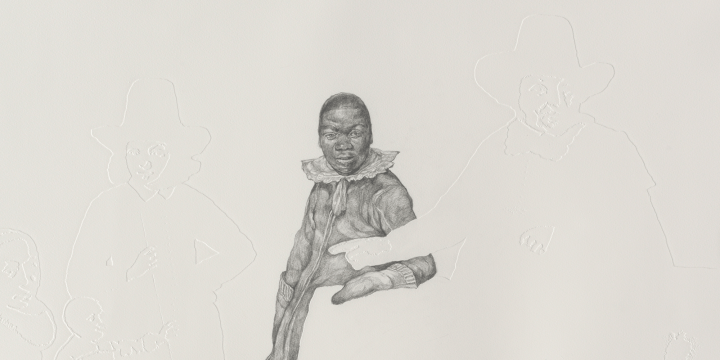
Barbara Walker, Vanishing Point 29 (Duyster), 2021 / © Barbara Walker, 2023.
More information on the Vanishing Point series is available here»
◊ ◊ ◊ ◊ ◊
Opening soon at The Fitzwilliam:
Black Atlantic: Power, People, Resistance
The Fitzwilliam Museum, Cambridge, 8 September 2023 — 7 January 2024
Curated by Jake Subryan Richards
A landmark exhibition exploring the impact of the Black Atlantic staged in the Museum’s historic Founder’s Galleries, which were built using the profits from enslavement and exploitation.
Black Atlantic: Power, People, Resistance brings together significant national and international loans with collections from across the University of Cambridge’s museums, libraries, and colleges to tell both a Cambridge story and a global one. Using as its starting point the story of the Museum’s founder, Viscount Richard Fitzwilliam, whose family wealth came in part from the South Sea Company and East India Company, the exhibition charts a history from pre-colonial Africa and the Caribbean, the rise and racialisation of Atlantic enslavement, and histories of resistance by enslaved people and their allies. Artworks and other objects illustrating the financial, scientific, and commercial transformations in seventeenth- and eighteenth-century Britain that came about because of enslaved labour are shown in dialogue with modern and contemporary artworks by artists including Donald Locke, Barbara Walker, Keith Piper, and Jacqueline Bishop that respond to hidden histories and reveal stories of courage, resistance, hope, and repair.
Black Atlantic is curated by Dr Jake Subryan Richards, acclaimed early career historian of law, empire, and the African diaspora in the Atlantic world at the London School of Economics. It is the first in a series of exhibitions and gallery interventions planned for 2023–2026.
The catalogue is published by Bloomsbury:
Victoria Avery and Jake Subryan Richards, eds., Black Atlantic: Power, People, Resistance (London: Philip Wilson Publishing, 2023), 192 pages, ISBN: 978-1781301234, £30 / $40.
Published to accompany the landmark exhibition on view at the Fitzwilliam Museum in autumn 2023, the catalogue contains contributions by curators, historians, and artists.
 Black Atlantic: Power, People, Resistance brings together significant national and international loans with exhibits from the Fitzwilliam’s collection and from other University museums, colleges, and libraries. Objects and artworks illustrating the financial, scientific, and commercial transformations in seventeenth- and eighteenth-century Britain that came about because of enslaved labour are shown in dialogue with modern and contemporary artworks by artists including Donald Locke, Barbara Walker, Keith Piper, and Jacqueline Bishop that respond to hidden histories and reveal stories of courage, resistance, hope, and repair.
c o n t e n t s
Contributor Biographies
Acknowledgements
Foreword by Luke Syson
Introduction
Section 1 | Before Atlantic Enslavement
• Africa: Akan Region
• Indigenous Islands in the Caribbean Sea
• Europe: Slavery before Racism, Blackness before Slavery
Section 2 | Cambridge Wealth from Atlantic Enslavement
• Royal Patronage
• Making Money: Dutch Connections
• Technology for the Transatlantic Trade
• Warfare between the British, Dutch, and Spanish Empires
Section 3 | Fashion, Consumption, and Racism
• Blackness in European Art
• Enslavement and Fashion
Section 4 | Plantations: Production and Resistance
• Production, Knowledge Generation, and Exploitation
• Plantation Violence
• Remembering
Further Reading
Image Credits
Index
Exhibition | Portraits of Dogs

Jean-Jacques Bachelier, Dog of the Havana Breed, detail, 1768, oil on canvas, 70 × 91 cm
(The Bowes Museum, Barnard Castle, BM 913)
◊ ◊ ◊ ◊ ◊
For anyone celebrating, a very happy National Dog Day to you and yours! Now on at The Wallace Collection:
Portraits of Dogs: From Gainsborough to Hockney
The Wallace Collection, London, 29 March — 15 October 2023
The exhibition Portraits of Dogs: From Gainsborough to Hockney explores our devotion to four-legged friends across the centuries. Through carefully selected paintings, sculptures, drawings, works of art and even taxidermy, the exhibition highlights the unique bond between humans and their canine companions. Dog portraiture developed as an artistic genre contemporaneously with its human counterpart—dogs are represented in the earliest cave paintings alongside humans—and it flourished, particularly in Britain, from the 17th century onwards. More than any other nationality perhaps, the British have both commissioned and collected portraits of dogs. Bringing over 50 works of art to Hertford House, Portraits of Dogs presents a broad range of portraiture showing dogs in all their different shapes and sizes, with each painter or sculptor challenging themselves how best to represent mankind’s most faithful and fearless friend.
From Giles:
Xavier Bray and Bruce Fogle, Faithful and Fearless: Portraits of Dogs (London: Giles, 2021), 160 pages, ISBN: 978-1913875015, £25 / $35.
 Throughout history, dogs and humans have had a special relationship based on trust, loyalty, and friendship—a relationship frequently immortalised in art. Faithful and Fearless: Portraits of Dogs features 50 works of art depicting the bond between people and their beloved pet—from members of the British Royal Family, to artists themselves. Organised in a series of thematically grouped sections—the dog as hero, as a companion to royals, aristocrats and artists, or as an allegory of the human condition—the book explores the canine portrait in its many guises and features dogs belonging to many celebrated figures, including Queen Victoria’s Tilco, Lucian Freud’s Pluto, and David Hockney’s portraits of his dachshunds, Stanley and Boodgie. The pieces are all drawn from major British collections including the Royal Collection, the V&A, Tate Britain, the British Museum, and a wealth of regional museums and private collections. In “A Vet’s Point of View,” renowned clinical veterinarian Bruce Fogle examines the many reasons for the extraordinary bond between dogs and their owners. At a time of rising dog ownership, this enchanting volume is a welcome reminder of our devotion to our four-legged friends.
c o n t e n t s
Director’s Foreword
Faithful and Fearless: Portraits of Dogs by Xavier Bray
Catalogue: Introduction
• The Aristocratic Dog
• The Royal Dog
• Kylin and AhCum: Two Pekinese
• The Artist’s Dog
• The Allegorical Dog
• The Heroic Dog
• The Dog Immortal
• Until Death
A Vet’s Point of View by Bruce Fogle
Notes
Index
Photo credits
Exhibition | Drawings by Giambattista and Domenico Tiepolo
Opening this fall at The Morgan:
Spirit and Invention: Drawings by Giambattista and Domenico Tiepolo
The Morgan Library & Museum, New York, 27 October 2023 — 28 January 2024
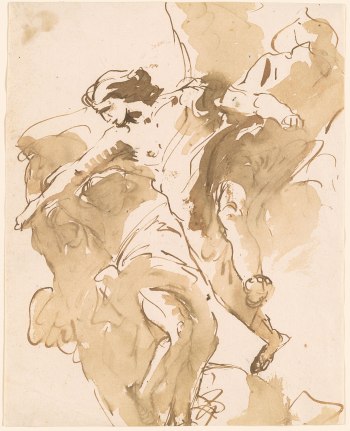
Giovanni Battista Tiepolo, Three Angels in Flight, 1754, pen and brown ink, with brown wash on paper, 26 × 20 cm (New York: The Morgan Library & Museum, IV, 95a).
The Morgan is home to one of the world’s largest and most important collections of drawings by Giambattista Tiepolo (1696–1770) and his eldest son Domenico (1727–1804), with more than 300 representative examples of their lively invention and masterful techniques. Combining highlights from the Morgan’s collection with carefully selected loans, this exhibition will provide a comprehensive look at the the Tiepolos’ work as draftsmen, focusing on the role of drawing in their creative process and the distinct physical and stylistic properties of their graphic work.
At the core of the collection and exhibition are substantial groups of Giambattista’s drawings that relate to major ceiling fresco projects of the 1740s and 1750s. A fresh look at the style, function, and material properties of these working drawings has yielded new insights into their purposes. Most significantly, the exhibition presents for the first time extremely rare pen studies for Tiepolo’s magnum opus, the ceiling fresco above the staircase of the Würzburg Residenz of 1752, and a group of bold sketches newly connected with his ceiling fresco of 1754 at the Venetian church of Santa Maria della Pietà. Other sections of the exhibition highlight the introduction of Domenico to the family workshop, the exchanges between father and son, and the great series drawings by both: Giambattista’s fantastic heads and figures seen di sotto in su, and Domenico’s drawings of animals, biblical scenes, and contemporary life. The exhibition will end with a wall including striking examples from Domenico’s late Punchinello series.
r e l a t e d p r o g r a m m i n g
Friday, 27 October 2023, 6.00pm
Lecture by John Marciari (Charles W. Engelhard Curator, Drawings and Prints), A Magical Performance: Drawings by Giambattista and Domenico Tiepolo
Thursday, 16 November 2023, 7.30pm
Concert — I Gemelli, A Room of Mirrors: Music by d’India, Marini, Frescobaldi, Calestani, and Gregori | Emiliano Gonzalez Toro, director and tenor; Zachary Wilder, tenor
Since 1980, the Boston Early Music Festival has been at the forefront for excellence in the field of Early Music throughout North America; BEMF began co-presenting concerts and opera productions at the Morgan in 2006.
Friday, 15 December 2023, 5.30pm
Gallery Talk by John Marciari (Charles W. Engelhard Curator, Drawings and Prints)
Exhibition | La Serenissima: Drawing in 18th-Century Venice
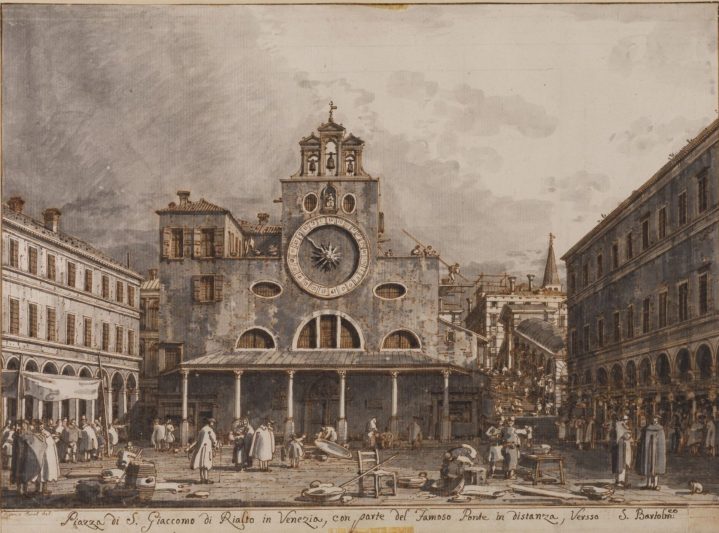
Giovanni Antonio Canaletto, Piazza San Giacomo di Rialto, 1760–69
(London: The Courtauld)
◊ ◊ ◊ ◊ ◊
Opening in October at The Courtauld:
La Serenissima: Drawing in 18th-Century Venice
The Courtauld, London, 14 October 2023 — 11 February 2024
Curated by Marco Mansi with Ketty Gottardo
La Serenissima: Drawing in 18th-Century Venice presents an outstanding group of around twenty Venetian drawings from The Courtauld’s collection. They evoke the energy and creativity of Venice at a time when the city flourished as one of the great cultural capitals of Europe. At the dawn of the 18th century, Venice was a magnet for visitors from across Europe, drawn by its architecture, history, and cosmopolitan atmosphere. Many of the artists featured in this exhibition produced works for an international clientele, who avidly collected images of the city, its inhabitants, and its colourful traditions. Landmarks such as St Mark’s Square and the Grand Canal set the stage for Canaletto’s celebrated views of the city’s lively streets and waterways. Piazzetta’s evocative head studies and Giambattista Tiepolo’s playful caricatures depict an early modern metropolis populated by a myriad of characters of different social backgrounds, while Guardi’s panoramic Feast of Ascension Day records the formal splendour and ceremony of the city known as La Serenissima—the most serene.
The display is curated by Marco Mansi, PhD candidate and Print Room Assistant at the Courtauld, under the supervision of Ketty Gottardo, Curator of Drawings.
Exhibition | Allegories for Learning: Italian Works on Paper

Guido Reni, Allegory of Learning (Seated Woman Holding a Tablet and Compass, alongside a Winged Putto), detail, ca. 1600–40, etching, Bartsch XVIII.289.16 (Athens: Georgia Museum of Art).
◊ ◊ ◊ ◊ ◊
Now on view at the Frost Art Museum in Miami:
Allegories for Learning:
16th- to 18th-Century Italian Works on Paper from the Georgia Museum of Art
Patricia & Phillip Frost Art Museum, Florida International University, Miami, 10 June — 10 September 2023
Curated by Nelda Damiano
Drawing became valued as an independent art form in Europe around the end of the 14th century. In studios and academies, apprentices repeatedly copied prints and drawings to improve their observational skills and hone their technique. With increased proficiency came more challenging exercises, such as using plaster casts and live models for arts instruction. This exhibition of works on paper illuminates how a drawing’s appearance reflects its geographical origin and the hand of an artist. The work’s formal qualities—media, support, variation of the lines—can point to a specific region in Italy. The location then makes it easier to narrow the list of contenders for authorship. This attribution process illustrates how influential artists who primarily lived in cultural centers, such as Florence, Bologna, and Venice, shaped generations of pupils and followers throughout Italy and beyond. Drawing played a central role in the creative process, the transmittal of ideas, and the spread of artistic styles. The works included here reinforce the power of drawings as a rich and varied medium. The exhibition is curated by Nelda Damiano, the Pierre Daura Curator of European Art at the Georgia Museum of Art in Athens.
New Book | Drawn from Nature: The Flowering of Irish Botanical Art
The related exhibition was on view in Dublin at the National Gallery of Ireland in 2020. Forthcoming from ACC:
Patricia Butler, Drawn from Nature: The Flowering of Irish Botanical Art (Woodbridge: ACC Art Books, 2023), 256 pages, ISBN: 978-1788842365, £35 / $40.

For centuries, artists of all disciplines have expressed delight in nature through the highly skilled and captivating medium of botanical art. The distinguished contributions of Irish botanical artists include records of plants from 17th-century Ireland, early illustrated floras, and botanical art found in the field of design. Drawn from Nature: The Flowering of Irish Botanical Art also covers the importance of botanical art to the Ordnance Survey of Ireland during the 19th century, as well as the vital plant portraits produced by Irish women. These portraits assisted generations of botanists in understanding and describing the natural world but received scant recognition. Published for the first time, these outstanding examples of Irish botanical art, from both public and private collections, demonstrate a shared desire by botanical artists to observe, illuminate, and record Ireland’s unique flora. This book finally affords them the recognition they deserve.
Patricia Butler is an art historian and gardener. The author of Irish Botanical Illustrators & Flower Painters (2000), she curated the exhibition Drawn from Nature: Irish Botanical Art, on view in Dublin at the National Gallery of Ireland in 2020. She owns the historic garden at Dower House, Rossanagh, Ashford, Co Wicklow.
Exhibition | Seduction and Power

Now on view at Marly:
Séduction et Pouvoir: L’art de s’apprêter à la Cour
Musée du Domaine royal de Marly, 14 April — 27 August 2023
Curated by Anne Camilli and Karen Chastagnol
Une exposition consacrée à l’art du paraître aux 17e et 18e siècles.
Se vêtir et accessoiriser sa tenue révèle les usages sociaux et politiques des élites. Si l’usage de la parure et l’envie d’embellir le corps sont présents dans toutes les sociétés et à toutes les époques, il s’accompagne sous Louis XIV d’une véritable stratégie d’affirmation du pouvoir motivée par la centralisation politique. Le règne du Roi-Soleil se caractérise par un souci de l’apparence et de la représentation. L’accessoire, tout comme le vêtement, contribue à la nécessité de paraitre et de tenir son rang.
Qu’on les appelle ornements ou encore parures, les accessoires du vêtement, de la coiffure et de la beauté deviennent les outils d’une communication non verbale entre les individus et le lieu d’un investissement symbolique. Ces ornements et ces parures reflètent les courants de la mode mais témoignent également des valeurs et des préférences de la société française de l’époque.
 Chaque accessoire, chaque geste, chaque attitude répond à des normes, à des codes qui ne cessent d’évoluer attestant ainsi des changements de modes et de mœurs. Cette construction de l’apparence requiert de connaître les usages et les règles et de s’y conformer pour bénéficier de la faveur royale et attester de son identité sociale.
Aussi, cette culture du paraître s’accompagne d’une parfaite maîtrise de soi et des expressions du visage : fards, poudres, mouches et parfums concourent à une monotonie d’apparence. L’impératif de séduction s’inscrit dans un double mouvement : un mimétisme envers le roi et le pouvoir d’une part, et la nécessité de s’en affranchir pour se faire remarquer et mieux révéler son rang d’autre part. Le corps se pare alors de divers artifices : perruques, maquillage, bijoux, parfums, dentelles, et objets de poche et de galanterie. Les costumes sont complétés par différents atours : broderies, dentelles, rubans qui rivalisent de sophistication et de raffinement.
Objets luxueux, réalisés par des métiers d’art, ces accessoires subliment le vêtement, deviennent des objets de distinction et s’accompagnent pour certains d’une gestuelle propre qui révèle un langage codifié et marquent le corps modifiant la posture, le déplacement, la prestance du courtisan. Qu’elles soient rhétoriques ou esthétiques, ces armes de séduction servent l’esprit d’une société élitiste où se mêlent des enjeux amoureux, politiques et religieux.
L’exposition vous emmène à la découverte de ces objets qui participent à ce jeu de la séduction et du pouvoir à la cour. Éléments de la mise en scène du théâtre de la cour, les accessoires de mode, les produits de beauté et l’art du parfum révèlent les attentes des femmes et des hommes nobles tout au long des XVIIe et XVIIIe siècles. Le visiteur découvre les œuvres dans un parcours qui évoque de la tête au pied les différents objets auquel recourt le courtisan et reflète les évolutions de ces accessoires au cours des règnes successifs de Louis XIV, Louis XV et Louis XVI, période d’activité du château de Marly, instrument de la politique royale.
Anne Camilli and Karen Chastagnol, eds., with additional contributions by Alice Camus, Georgina Letourmy-Bordier, Grégory Maugain, and Corinne Thépaut-Cabasset, Séduction & Pouvoir: L’art de s’apprêter à la Cour (Fine éditions d’art, 2023), 104 pages, ISBN: 978-2382031179, €25.
Entre les règnes de Louis XIV et de Louis XVI, Versailles puis Paris se disputent le titre de capitale de la mode. Entre désir de séduction, affirmation du pouvoir et désir de signifier un statut social, les accessoires de mode et de beauté viennent appuyer sous l’Ancien Régime une nouvelle mise en scène de soi. Chaque parure, chaque geste, chaque attitude répond à des codes qui ne cessent d’évoluer et accompagnent ainsi les modes et les mœurs. Le corps est paré de divers artifices qui rivalisent d’audace et de distinction. Quels rôles jouent ces ornements dans le contexte de la cour ? L’exposition du Musée du Domaine royal de Marly retrace les usages de ces objets, de la tête aux pieds : coiffes, perruques, maquillage, parfums, ornements du vêtement, bijoux, objets de galanterie, chaussures.
s o m m a i r e
• Introduction — Être et paraître : Accessoires de mode, parures & ornements — Karen Chastagnol
• Boucles, dentelles, bonnets et édifices de la mode capillaire — Corinne Thépaut-Cabasset
• Mouche et rouge : Les attributs de la mode et de la beauté — Corinne Thépaut-Cabasset
• L’apparat olfactif du courtisan — Alice Camus
• Orner le vêtement et ses accessoires à la cour : Dentelles, broderies et boutons — Géraldine Bidault
• Le bijou et la montre pour briller à la cour — Anne Camilli et Grégory Maugain
• La galanterie de poche — Anne Camilli et Georgina Letourmy-Bordier
• Le soulier et ses parures — Anne Camilli
Annexes
Notices des œuvres exposées
Sources & bibliographie
Crédits photographiques
Exhibition | Luxury and Passion: Inventing French Porcelain
Now on view at The Nelson-Atkins:
Luxury and Passion: Inventing French Porcelain
The Nelson-Atkins Museum of Art, Kansas City, 13 August 2022 — 12 August 2024
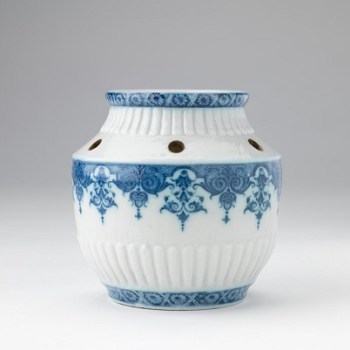
Designed by Louis Poterat, made by Louis Poterat Manufactory (Rouen, France, 1690–1696), potpourri jar, ca. 1690–96, soft-paste porcelain with underglaze enamel decoration, 12.4 × 11.4 cm (Kansas City, Missouri: The Nelson-Atkins Museum of Art, 2021.10).
Luxury and Passion celebrates the debut of a new acquisition, one of the earliest pieces of soft-paste porcelain made in France in the late 17th century. A potpourri jar, one of the handful of experimental pieces made by the Poterat Manufactory in Rouen, France, is one of only about a dozen surviving works by this brief-lived company, and only the second example in a US museum–only four exist in museums worldwide. The new acquisition gives us the opportunity to feature almost the entire collection of the museum’s important 18th-century French porcelain holdings. In this focus installation, the Nelson-Atkins explores how France launched itself into the domestic porcelain industry in the 17th and 18th centuries. This beautiful, durable type of ceramic was the focus of intense competition among European superpowers, all who raced to discover how to make this ‘white gold’ for themselves, after falling in love with imported Asian wares.
Exhibition | UFO 1665
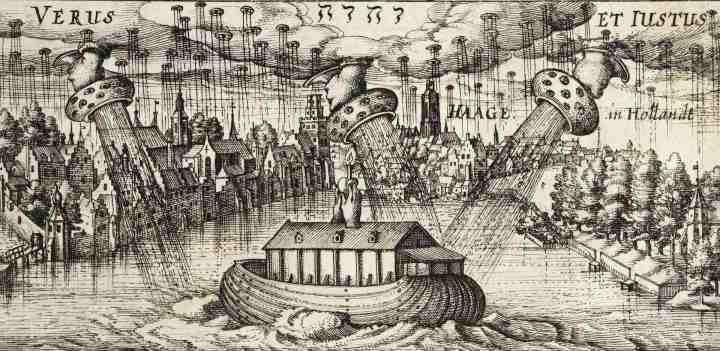
So Sehr War Nei Erzürnet Gott / Never Was God So Full of Wrath, detail, emblematic representation from Daniel Meisner, Politica – Politica, Newes Emblematisches Büchlein, I–VIII (Nürnberg, ca. 1700), engraving (Staatliche Museen zu Berlin, Kunstbibliothek).
◊ ◊ ◊ ◊ ◊
I was fortunate to see this exhibition a few weeks ago and can’t recommend it highly enough: it’s thoughtfully conceived, brilliantly installed, incredibly engaging, and deeply satisfying. It’s also just a lot of fun! A model for how to make the history of visual conventions (overlapping with history of ideas generally) broadly accessible (my thirteen-year-old daughter was riveted). It’s a reminder of how many of our categories for making sense of the world emerged in the seventeenth and eighteenth centuries. The catalogue is certainly worth ordering. –CH
UFO 1665: The Air Battle of Stralsund / Die Luftschlacht von Stralsund
Kunstbibliothek, Staatliche Museen zu Berlin, 5 May — 3 September 2023
Curated by Moritz Wullen
In April 1665, six fishermen witnessed an unexplained celestial phenomenon: an aerial battle in the skies above the Baltic Sea near Stralsund. As evening broke, a dark-grey disk appeared high above the city centre. UFO 1665 is the first exhibition of its kind to focus on this historical UFO sighting. With reference to contemporaneous visual and textual sources, the exhibition reconstructs the way this event was portrayed in the media and exposes certain paradigms and communications strategies that are still used today to determine how we report on ‘unexplained aerial phenomena’ (UAPs).
 The exhibition takes visitors on an expedition into a strange and unfamiliar world of images that otherwise remains concealed from the museum’s general audience in archives or between the pages of old books. Those who are familiar with 17th-century art only from the grand galleries of paintings may be taken aback: upon entering the exhibition space, visitors might feel they are entering a baroque parallel universe with strange symbols in the sky, airships, space rockets, and flying saucers. Everything is centred around one of the most spectacular celestial phenomena of the modern era: at 2pm on 8 April 1665, six men fishing for herring off the coast of Stralsund watch as great flocks of birds in the sky morph into warships and engage in a thunderous air battle. The decks teem with ghostly figures. When, at dusk, “a flat, round shape like a plate” appears above the St. Nicholas Church, they flee. The following day, they find that they are trembling all over and complain of pain.
Media Transformation
The media spread the news like wildfire, with the publishers of various leaflets and newspapers locked in fierce competition with each other to concoct the most colourful versions and interpretations of events. It was religious convictions in particular that were most responsible for determining how the event was transformed by the media. The general public could not have known that what had actually been witnessed was an atmospheric reflection of a sea battle that was raging just beyond the horizon. Instead, they were convinced that the universe was ruled by a god who had the power to project visions of impending disaster into the sky. The air battle was likewise perceived as a prodigium (Latin for ‘omen’ or ‘portent’).
The visual themes of the 17th century were likely also decisive in terms of determining how the media shaped depictions of the air battle, with futuristic visions of airships—which the people of the 17th century were incredibly enthusiastic about—playing a special role. More than 100 years before the first manned hot air balloon flight was conducted, Francesco Lana Terzi (1631–1687) had published his design for a flying boat borne aloft by vacuum spheres, which caused a great sensation throughout Europe. The fact that the project could never actually be realised did little to detract from the general fervour. Humankind continued to dream of conquering the skies.
The Power of Myths
Another theme of the exhibition is the power of myths: when, on 19 June 1670, lightning struck—of all places—the St. Nicholas Church, the building above which the grey disc had loomed so ominously five years earlier, the celestial phenomenon was subsequently interpreted as a sign of God’s wrath. The descriptions and accounts of the day invoked a mystical link to the destruction of Babylon at the hands of a great millstone, as it is described in the Book of Revelation. However, the popular perception of the air battle over Stralsund was not only shaped by the media, beliefs, designs, and myths of the baroque era; it also reveals the kinds of things that humans of the era were unable to envisage and comprehend. There are no 17th-century sources, for example, that mention extraterrestrials in connection with the unexplained aerial phenomena. Yet at the same time, the human imagination was already so far advanced that it could well conceive of expeditions to other inhabited planets and the kinds of propulsion systems that would be required to carry these out. Why nobody considered for a moment that extraterrestrials might appear in our skies with their own flying machines is one of the many mysteries this exhibition endeavours to solve.
An Excursion into the Present
This cultural and media-historical investigation culminates in an excursion into the present, which focuses on the videos and accounts of sightings of mysterious ‘Unidentified Aerial Phenomena’ (UAPs) made by the US military that went viral in 2019 and even made their way onto the front cover of an issue of Der Spiegel two years later. The sightings in question have given rise to a maddeningly broad spectrum of interpretations. Are they physically explicable natural phenomena, sophisticated high-tech drones made in China or Russia, extraterrestrials, or even visitors from the future? Even NASA and the Pentagon seem completely baffled. We can, however, be sure of one thing: the factors that were so crucial to the media success of the UFO of 1665 lack none of their that same potency today.
The exhibition is curated by Moritz Wullen, director of the Kunstbibliothek.
Moritz Wullen, UFO 1665: The Air Battle of Stralsund / Die Luftschlacht von Stralsund (Cologne: Wienand Verlag, 2023), 112 pages, ISBN 978-3868327502 (bilingual edition, German and English), €24.










leave a comment