Exhibition | Making Her Mark
Opening this fall at the BMA:
Making Her Mark: A History of Women Artists in Europe, 1400–1800
Baltimore Museum of Art, 1 October 2023 — 7 January 2024
Art Gallery of Ontario, Toronto, 30 March — 1 July 2024
Curated by Andaleeb Badiee Banta and Alexa Greist
 For centuries, women artists in Europe were considered rare and less talented than their male counterparts. Women who achieved professional artistic careers were deemed anomalous or exceptional, while those who engaged in creative pursuits in the home were dismissed as amateurs, and their works were categorized as material culture rather than art.
Making Her Mark: A History of Women Artists in Europe, 1400–1800, the BMA’s much anticipated major exhibition opening 1 October 2023, aims to correct these broadly held but mistaken beliefs through more than 200 works of diverse media and scale. From royal portraits and devotional sculptures to embroidered objects, tapestries, costumes, wax sculptures, metalwork, ceramics, graphic arts, furniture, and more, Making Her Mark will feature objects from the 15th to 18th centuries that reflect the multifaceted and often overlooked ways that women contributed to the visual arts of Europe.
The exhibition’s focus on displaying exclusively objects made by women or toward which women contributed their labor distinguishes this project by putting women makers of all social levels in conversation with each other through their works. Examples by artistic heroines such as Sofonisba Anguissola, Artemisia Gentileschi, Judith Leyster, Luisa Roldán, Rosalba Carriera, Rachel Ruysch, and Élisabeth Vigée Le Brun will join exceptional products of female artisanal collectives and talented amateurs who operated outside of the male-dominated professional arena and often remained anonymous in the historical record. Further, sublime examples of ceramics, metalwork, and cabinetmaking from this era will reflect women’s involvement in major manufactories and workshops.
Organized by the Baltimore Museum of Art and the Art Gallery of Ontario, Making Her Mark is curated by Andaleeb Badiee Banta, Senior Curator and Department Head, Prints, Drawings & Photographs at the BMA, and Alexa Greist, Curator and R. Fraser Elliott Chair, Prints & Drawings at the AGO. The exhibition is generously supported by the National Endowment for the Humanities, The Gladys Krieble Delmas Foundation, the Samuel H. Kress Foundation, and Sheela Murthy/MurthyNAYAK Foundation.
Andaleeb Badiee Banta and Alexa Greist, with Theresa Kutasz Christensen, Making Her Mark: A History of Women Artists in Europe, 1400–1800 (Fredericton, New Brunswick: Goose Lane Editions, 2023), 264 pages, ISBN: 9781773103181, $60.
Exhibition | Ingenious Women, 16th to 18th Centuries

Angelika Kauffmann, Clio, Muse of History, detail, ca. 1770–75 (Augsburg: Schaezlerpalais–Deutsche Barockgalerie; photo by Andreas Brücklmair).
◊ ◊ ◊ ◊ ◊
Opening this fall at the the Bucerius Kunst Forum:
Ingenious Women: Women Artists and Their Companions
Geniale Frauen: Künstlerinnen und ihre Weggefährten
Bucerius Kunst Forum, Hamburg, 14 October 2023 — 28 January 2024
Kunstmuseum Basel, 2 March — 30 June 2024
With the exhibition Ingenious Women: Women Artists and Their Companions, the Bucerius Kunst Forum traces the careers of outstanding women artists (Künstlerinnen) from the sixteenth to the eighteenth century. For the first time, the family context in which the women artists pursued their careers is addressed and made visible through juxtaposition with works by their fathers, brothers, husbands, and fellow painters. Today often forgotten, female artists of their time were able to achieve extraordinary success in a wide variety of family constellations: they became court painters, teachers, entrepreneurs, and even publishers and were awarded the highest honours.
 The exhibition presents around 140 works by 26 women artists, including Sofonisba Anguissola, Judith Leyster, Marietta Robusti (Tintoretto’s daughter), and Angelika Kauffmann. Masterful portraits, still lifes, and historical scenes in painting, along with drawings and prints from across Europe, ranging from the Renaissance and Baroque periods to early Neoclassicism, will be brought together in Hamburg. For the first time, works by women artists will be juxtaposed with those of their male colleagues in such a pointed way that both formal and stylistic similarities and differences will come to the fore.
In the early modern period it was not altogether impossible for women to pursue a career as an artist, but it was definitely outside the norm and therefore always subject to special challenges. Anyone wishing to practice a freelance profession had to join a guild, but some regions denied membership to women, and in others it entailed considerable hurdles and costs. A conspicuous number of women artists of this period came from or married into artistic families. They worked for their fathers, brothers, and husbands, and often in secret. At the royal courts of Europe, the situation was different: with an open mind to artistic achievement—regardless of origin or gender—women were able to work openly as artists at court. Women such as Lavinia Fontana, Anna Dorothea Therbusch, and Rachel Ruysch asserted themselves against social norms, capturing the attention and earned the esteem of their contemporaries. The fact that they fell into oblivion is also due to the history of art scholarship, in which a male gaze dominated until the advanced twentieth century.
The exhibition shows the unique careers of these pioneering women artists and offers new insights into their lives and work, as well as thought-impulses on contemporary issues such as equality and the reconciliation of work and family.
Bodo Brinkmann and Katrin Dyballa, eds., with contributions by Beiträge von B. Brinkmann, K. Dyballa, S. Engel, A. Mensger, R. Müller, S. Salomon, A. Tacke, S. Pisot, I. Wenderholm, and S. Werthemann, Geniale Frauen: Künstlerinnen und ihre Weggefährten (Munich: Hirmer Verlag, 2023), 300 pages, ISBN: 978-3777442365, €45.
Exhibition | Out of the Shadows: Women Artists
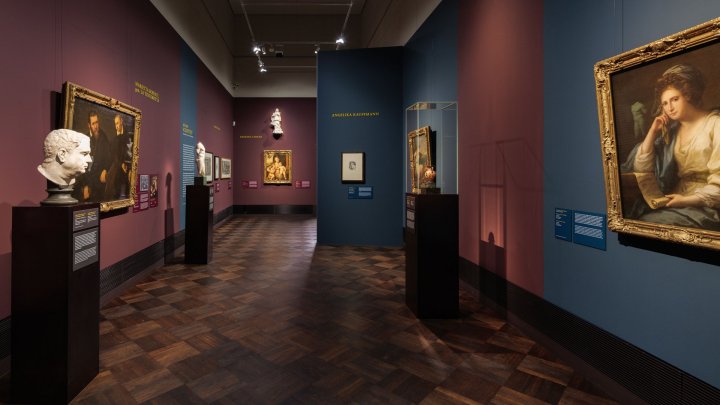
Installation view, Out of the Shadows: Women Artists from the 16th to the 18th Century, Gemäldegalerie Alte Meister at Dresden’s Zwinger, 2023.
◊ ◊ ◊ ◊ ◊
This installation on view at the Zwinger closes in a few weeks:
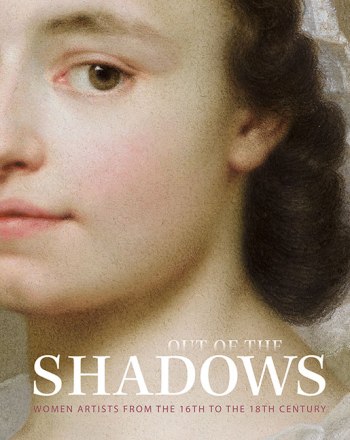
Out of the Shadows: Women Artists from the 16th to the 18th Century
Aus dem Schatten: Künstlerinnen vom 16. bis zum 18. Jahrhundert
Gemäldegalerie Alte Meister, Zwinger, Dresden, 12 May — 20 August 2023
With this cabinet exhibition, the Gemäldegalerie Alte Meister turns its attention to women artists (Künstlerinnen) from the 16th to the 18th century, who for a long time have been overshadowed by the ‘Great Masters’ of art history. With their works represented in the collection, they are a minority, and to this day their names are far less familiar than those of their male counterparts. This is not due to inability, but to a structural discrimination that is perpetuated in art historiography.
 Women generally were not allowed formal academic training nor drawing from live (nude) models. Only a few women were lucky enough to grow up and be promoted in an artistic environment, so that institutional and social structures did not necessarily hinder their advancement. In many cases, they were the daughters of artists trained in their father’s workshop.
The cosmopolite Angelika Kauffmann (1741–1807) achieved widespread recognition in her lifetime and is also represented here with five works. In a time when only men were seen as true artists and women were credited, at most, with talent but never genius, the painter managed to assert herself by also being a shrewd strategist and self-promotor. She produced numerous history paintings with references to antiquity in which women take the leading roles.
Lavinia Fontana (1552–1614) was one of the first women of the modern period to work as an independent artist. She painted numerous portraits and history paintings of mythological and biblical themes, some of them in large format. The devotional painting in Dresden, The Holy Family, is an early work by the Bolognese artist which, after undergoing restoration, will be included in the show in mid-August.
This concentrated presentation also features copperplate engravings by Diana Scultori from the holdings of the Kupferstich-Kabinett as well as paintings and prints by other noteworthy women artists such as Elisabetta Sirani, Barbara Longhi, Rachel Ruysch, Maria van Oosterwijck, and Theresa Concordia Mengs.
Stephan Koja and Iris Yvonne Wagner, Out of the Shadows: Women Artists from the 16th to the 18th Century (Dresden: Staatliche Kunstsammlungen Dresden, 2023), 144 pages, ISBN: 978-3954987559 (German edition) / ISBN: 978-3954987696 (English edition), €34.
The Burlington Magazine, June 2023
The eighteenth century in the June issue of The Burlington (with apologies for being so slow to post, –CH) . . .
The Burlington Magazine 165 (June 2023)
 e d i t o r i a l
• “The Future of the RIBA Drawings Collection,” p. 583.
a r t i c l e s
• Tessa Murdoch, “Roubiliac and Sprimont: A Friendship Revisited,” pp. 600–11.
Recent research into the circles of Huguenot artists and craftsmen working in London in the mid-eighteenth century has provided new evidence about the friendship and working relationship between the sculptor Louis-François Roubiliac and the goldsmith Nicholas Sprimont. This lends weight to the belief that Roubiliac provided small models for casting in silver and bronze as well as for the porcelain manufactory co-founded by Sprimont in Chelsea in 1745.
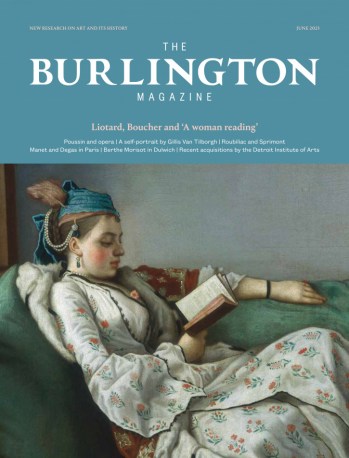
• Perrin Stein, “Liotard and Boucher: A Question of Precedence,” pp. 612–19.
There has been much debate about whether Liotard or Boucher invented the motif of a woman in Turkish costume reading a book while reclining on a sofa, which appears in both their work in the 1740s. New evidence that resolves the question highlights the very different ways these two artists constructed exoticism.
• Ann Gunn, “Titian’s Perseus and Andromeda: A Missing Link in the Chain of Provenance,” pp. 620–22.
• Simon Spier and Judith Phillips, “Joséphine Bowes’s Gift to Napoleon III: Antoine-Jean Gros’s Napoleon Distributing the Cross of the Legion of Honour to Artists during His Visit to the Salon of 1808,” pp. 626–29.
r e v i e w s
• Alexandra Gajewski, “The New Museum in the Bibliothèque Nationale, Paris,” pp. 630–37.
When in 1995–98 the books of the Bibliothèque nationale, Paris, were moved to their monumental new home in the west of the city, the library’s historic collections of antiquities, coins, medals, and other precious objects remained in the original complex of buildings in central Paris where they had been shown since the eighteenth century. Their reinstallation in the library’s newly restored museum rooms was opened last year.
• Kirstin Kennedy, Review of the exhibition Treasures from Faraway: Medieval and Renaissance Objects from The Schroder Collection (Strawberry Hill, 2023), pp. 641–43.
• Aileen Dawson, Review of the exhibition English Delftware (Bristol Museum and Art Gallery (from February 2023), pp. 652–54.
• Belinda Thomson, Review of the exhibition Berthe Morisot: Shaping Impressionism (Dulwich Picture Gallery, 2023), pp. 654–57. [In Paris, the show is entitled Berthe Morisot et l’art du XVIIIe siècle: Watteau, Boucher, Fragonard, Perronneau]
• J. V. G. Mallet, Review of Lilli Hollein, Rainald Franz, and Timothy Wilson, eds., Tin-Glaze and Image Culture: The MAK Maiolica Collection in its Wider Context (Arnoldsche Art Publishers, 2022), pp. 660–62.
• Clare Hornsby, Review of Andrew Robinson, Piranesi: Earliest Drawings / I primi disegni (Artemide Edizioni, 2022), pp. 666–67.
• G. A. Bremner, Review of Gauvin Alexander Bailey, The Architecture of Empire: France in India and Southeast Asia, 1664–1962 (McGill-Queen’s University Press, 2022), pp. 667–68
o b i t u a r y
• Peter Hecht, Obituary for Ger Luijten (1956–2022), pp. 675–76.
s u p p l e m e n t
• Recent Acquisitions (2016–22) of European Works of Art at the Detroit Institute of Arts
Display | Works by José Campeche and Francisco Oller at MFA, Boston
From the press release (20 June 2023) . . .
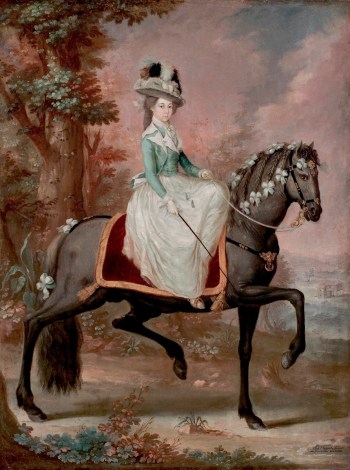
José Campeche y Jordán, Lady on Horseback, 1785, oil on panel, 40 × 30 cm (Museo de Arte de Ponce, Luis A. Ferré Foundation).
Paintings by legendary Puerto Rican artists José Campeche and Francisco Oller are presented in dialogue with art from the same period in the MFA’s collection. The Museo de Arte de Ponce continues to share its collection with museums worldwide as it rebuilds its Edward Durell Stone-designed building damaged by the January 2020 earthquakes.
The Museum of Fine Arts, Boston (MFA) and the Museo de Arte de Ponce (MAP) jointly announce that important works by José Campeche y Jordán (1751–1809) and Francisco Oller y Cestero (1833–1917)—the most influential Puerto Rican artists of the 18th and 19th centuries—are now on display at the MFA (as of 29 June 2023). This special installation features five paintings by Campeche and Oller from MAP’s collection, including one of the most iconic works in the history of Puerto Rican art, Campeche’s Lady on Horseback (1785). Oller’s famed Hacienda Aurora (1898), as well as two rare paintings on ceramic plates, open conversations about histories of the Puerto Rican landscape and artistic exchanges across Europe and the Americas.
“This partnership with the Museo de Arte de Ponce creates an unprecedented opportunity for us to introduce our audiences to Campeche and Oller, two deeply significant Puerto Rican painters who remain understudied outside of the island,” said Matthew Teitelbaum, Ann and Graham Gund Director. “Displayed in our Art of the Americas Wing alongside important works of colonial art and landscape painting from our collection, these special loans from MAP will highlight the contributions of Puerto Rican artists and offer a new point of connection for Boston’s vibrant Puerto Rican community.”
The paintings will be highlighted during tours at the MFA’s annual Latinx Heritage Night on September 21 as well as through additional programs.
The collection of the Museo de Arte de Ponce consists of approximately 4,500 works of art and is recognized for important examples of Baroque, Pre-Raphaelite, and Victorian art. The renowned collection of Puerto Rican art makes up about one-third of the museum’s holdings, including works from the 18th to 21st centuries. Following a catastrophic series of earthquakes in January 2020 that damaged the internationally recognized Edward Durell Stone-designed building, the main galleries of MAP have remained closed to the public.
As the galleries are rebuilt, MAP remains committed to keeping the collection accessible through collaborations with institutions on the island and beyond. In New York City, the Metropolitan Museum of Art is currently displaying five Victorian masterpieces, including Flaming June by Frederic Leighton, John Everet Millais’s The Escape of a Heretic, 1559, and Edward Burne-Jones’s Small Briar Rose series. From September 2022 to June 2023, Chicago’s National Museum of Puerto Rican Arts and Culture exhibited Nostalgia for My Island: Puerto Rican Painting from the Museo do Arte de Ponce (1786–1962). Additional loans are expected to be announced in other major cities in the United States, as well as in Europe.
“Not only is the museum a cultural institution ingrained in the fabric of Puerto Rican society, but it is also internationally renowned because of the extraordinary collections it houses, “said Cheryl Hartup, Director of the Museo de Arte de Ponce. “When the works travel, a conversation is created within the ecosystem of international art institutions and their collections and audiences. We couldn’t be more thrilled to share iconic paintings by Puerto Rican artists with the MFA, Boston as the museum is repaired.”
The Museo de Arte de Ponce expects to fully reopen in 2024.
Exhibition | New Nation, Many Hands
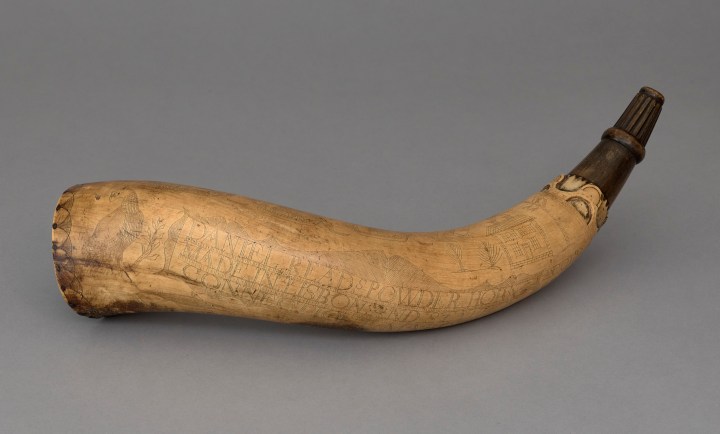
Unidentified maker, Powder Horn, 1802, Lisbon, Connecticut, cow horn, pine, and iron (Wadsworth Atheneum Museum of Art, James L. Goodwin Art Purchase Fund, 2023.22.1).
◊ ◊ ◊ ◊ ◊
Now on view at the Wadsworth Atheneum:
New Nation, Many Hands
Wadsworth Atheneum Museum of Art, Hartford, Connecticut, June 29–ongoing
Curated by Philippe Halbert
Political independence from Great Britain in 1783 transformed American society, and citizens celebrated the promise of their young republic through art. Acknowledging the complexities and contradictions of the era, New Nation, Many Hands presents a cross-section of objects from the permanent collection that shaped emerging American identities and the ongoing fight for freedom. Household goods, from ceramics and furniture to metalwork and textiles, combined practicality with patriotism in the early years of the United States. Some of the objects reflect changing fashions, distinct regional styles, and expanded trade networks. Others express pride in the new nation and hope for its future. All reveal stories of the people who created, used, cherished, and benefited from them during a formative moment in American history.
Exhibition | Porcelain from Versailles: Vases for a King & Queen
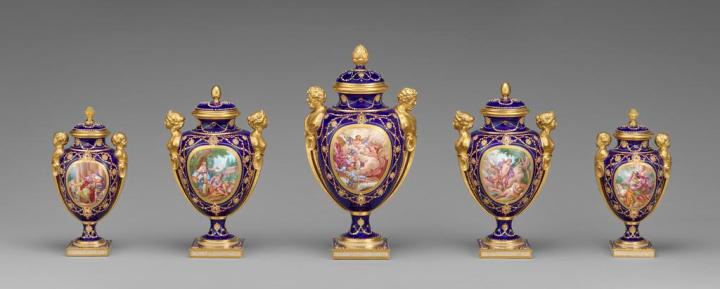
Five Lidded Vases, 1781, Sèvres porcelain manufactory; soft-paste porcelain. A set of vases des âges (‘vases of the ages’), this garniture of five vases, originally owned by King Louis XVI, includes three sizes referencing different stages of life: a large central vase with handles in the shape of bearded male heads, a pair of smaller vases with heads of young women, and a pair of still smaller vases with the heads of boys. The scenes painted on the fronts of the vases show episodes from The Adventures of Telemachus, one of the king’s favorite books. The Getty Museum owns three of the original five vases, while the two smallest now belong to the Walters Art Museum in Baltimore. More information is available here»
◊ ◊ ◊ ◊ ◊
Now on view at The Getty:
Porcelain from Versailles: Vases for a King & Queen
Getty Center, Los Angeles, 14 February 2023 — 3 March 2024

Lidded Vase, 1775–76, Sèvres porcelain manufactory; hard-paste porcelain with gilt-bronze mounts (National Museum of the Palaces of Versailles and Trianon). This is the center vase from a garniture of three vessels owned by Queen Marie-Antoinette.
This exhibition brings together two of the most extraordinary surviving sets of vases owned by King Louis XVI and Queen Marie-Antoinette of France during the late 1700s. The vases are among the highest achievements of the Sèvres porcelain manufactory made before the French Revolution, becoming personal treasures of the royal family at the time. They were initially kept at the Palace of Versailles outside Paris, the royal family’s primary residence, and are a testament to the exemplary skills of the artists who took part in their creation. This exhibition reunites all eight vases, which were separated during the Revolution, offering the rare opportunity to appreciate the craftsmanship and design of the ensembles.
The loan of the queen’s vases is part of an artistic exchange between the J. Paul Getty Museum and Versailles, where an important desk made for Louis XVI from the Museum’s collection is currently on long-term loan. This exhibition is presented in English and Spanish. Esta exhibición se presenta en inglés y en español.
Exhibition | The Petit Trianon during the Empire
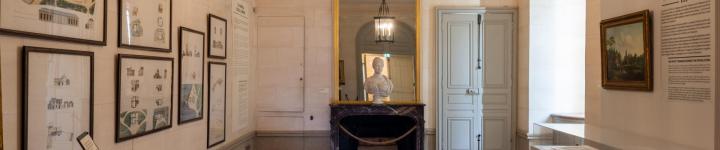
Installation view of The Petit Trianon during the Empire, 2023
(Photo by Sebastien Giles)
◊ ◊ ◊ ◊ ◊
On view this summer at the Château de Versailles:
The Petit Trianon during the Empire
Petit Trianon, Château de Versailles, 13 May — 17 September 2023
Presented by the Palace of Versailles, The Petit Trianon during the Empire tells the story of the restoration undertaken to turn Trianon into a country residence for Napoleon and Marie-Louise. The exhibition explains the work ordered by the emperor to restore the houses in the Hamlet, the farm, and the orangery—work that had become essential after twenty years of neglect.
During the Empire, the Petit Trianon was chosen as a country residence by Napoleon Bonaparte and his wife, Marie-Louise of Habsburg. Two decades of neglect, however, had left the houses in the Hamlet, the farm, and the orangery in urgent need of restoration. The work was carried out between 1805 and 1811, overseen by the architect Guillaume Trepsat and his assistant, Alexandre Dufour.

Installation view of The Petit Trianon during the Empire, 2023 (Photo by Sebastien Giles).
The working dairy, the barn, and the farmer’s cottage were all demolished. The farm was converted into a guard house, while the rest of the structures were restored and the thatched rooves repaired. The external staircases were removed, apart from the spiral staircase on the Queen’s House, which was replaced by a straight, covered staircase. The houses in the Hamlet reverted to the same use as under the Ancien Régime, with all the furniture and wall hangings replaced by classical, Empire-style pieces made by the cabinet-makers Jacob-Desmalter and Marcion, and the bronze-worker Galle.
Napoleon and Marie-Louise hosted several parties at the theatre and in the French Garden between 2 and 11 August 1810, and again, the following year, on 25 August, in the English Garden and the restored Hamlet, to celebrate the birth of their son. These parties harked back to the wonderful celebrations organised by Marie-Antoinette. The restoration work meant the heritage of the Petit Trianon was both protected and revived.

The Petit Trianon with the French Pavilion in the foreground at the left (Photo: Thomas Garnier).
During the French Revolution, from 1792, the Petit Trianon and the Queen’s Hamlet were emptied of their inhabitants and all their contents. The furniture, artworks, and everyday household items, such as mattresses, sheets, and cookware, as well as the fish in the lakes, were all auctioned off. The palace was rented to a restaurateur, while the garden became a public recreation area. The French Pavilion was turned into a café, the farm was rented to and worked by a farmer, and another restaurateur moved into the Queen’s House in the Hamlet.
By the beginning of the 19th century, the Hamlet was overgrown and decrepit. The roofs of several of the houses had collapsed and the external staircases were rotten. Two of the agricultural buildings—the barn and the working dairy—lay in ruins and the farm had been partially destroyed by fire. Sketches made by the English traveller and draughtsman John Claude Nattes in 1802 illustrate this state of neglect.
Exhibition | 1923 —The Domaine de Sceaux: Origins of a Renaissance
From Silvana Editoriale:
1923 — The Domaine de Sceaux: Origins of a Renaissance
Musée du Domaine départemental de Sceaux, 10 March — 9 July 2023
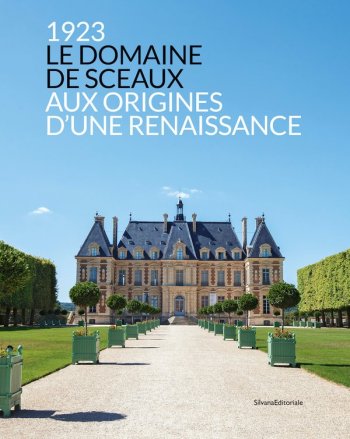 The Domaine de Sceaux was acquired in 1923 by the Hauts-de-Seine department, leading to the estate’s restoration and its opening to the public. This exhibition (installed in the former stables) brings together archival documents, posters, photographs, drawings, and paintings to tell the story of the place during this last eventful century. The exhibition traces the history of the estate from its first major transformation to the 1950s.
L’histoire du Domaine de Sceaux entre 1850 et 1950 reste peu connue du grand public. Après la Révolution, la propriété traversa plusieurs phases de déclin et de renouveau. Les aménagements d’aujourd’hui s’inspirent donc à la fois du parc ancien et des ouvrages classés du XVIIe s., et ils intègrent aussi le décor du XIXe s., introduit par les ducs de Trévise. Si vous êtes familier des lieux ou en quête d’histoire sur le Grand Paris, vous ressentirez d’autant plus cette métamorphose : celle d’un somptueux château à la campagne devenu un site muséal préservé et ouvert à tous.
Site historique et patrimonial majeur de la région parisienne, le Domaine départemental de Sceaux fut créé en 1670 par Jean-Baptiste Colbert, qui y appela les plus grands artistes de son temps, d’André Le Nôtre à Charles Le Brun, de Jules Hardouin-Mansart à Antoine Coysevox. Passé entre les mains du marquis de Seignelay, fils du ministre de Louis XIV, puis entre celles du duc et de la duchesse du Maine, du duc de Penthièvre et enfin du duc et de la duchesse de Trévise, cet ensemble remarquable, bientôt menacé par l’extension galopante de la banlieue, était appelé à une disparition quasi certaine lorsqu’en 1923, à la suggestion du maire de Sceaux, il fut acquis in extremis par le département de la Seine à la princesse de Cystria, née Trévise, dernière propriétaire. 2023 marque ainsi le centenaire du passage de ce domaine exceptionnel du statut de propriété privée à celui de bien public, devenu en 1970 l’un des fleurons du département des Hauts-de-Seine qui en assure depuis l’entretien et la valorisation. L’exposition revient sur le contexte, sur les raisons et sur les conditions de cette acquisition qui permit l’heureuse renaissance du domaine de Sceaux.
David Baurain and Céline Barbin, eds., 1923 — Le Domaine de Sceaux: Aux origines d’une renaissance (Milan: Silvana Editoriale, 2023), 208 pages, ISBN: 978-8836654239, €30.
Exhibition | Black Founders: The Forten Family of Philadelphia
Now on view at the Museum of The American Revolution:
Black Founders: The Forten Family of Philadelphia
Museum of The American Revolution, Philadelphia, 11 February — 26 November 2023
 When James Forten (1766–1842) walked the streets of Philadelphia as a young man in the 1770s, he was surrounded by the sights and sounds of transformation. He heard the words of the Declaration of Independence read aloud for the first time in 1776 before setting sail to fight for independence in 1781. Born a free person of African descent, Forten built upon his coming-of-age in a revolutionary city and his wartime experience to forge himself into a changemaker in Philadelphia and the young United States, becoming a successful businessman, philanthropist, and stalwart abolitionist.
In our new special exhibition Black Founders: The Forten Family of Philadelphia, the Museum introduces visitors to Forten and his descendants as they navigated the American Revolution and cross-racial relationships in Philadelphia to become leaders in the abolition movement in the lead-up to the Civil War and the women’s suffrage movement. Using objects, documents, and immersive environments, Black Founders: The Forten Family of Philadelphia explores the Forten family’s roles in the Revolutionary War, business in Philadelphia, and abolition and voting rights from 1776 to 1876.
The exhibition features more than 100 historical artifacts, works of art, and documents from 38 different lenders, including both institutions and private collectors, as well as the Museum’s own collection. Rare historical objects on loan from descendants of the Forten family are on view for the very first time in a public exhibit.
The unique journey and exceptional story of this family of Revolutionaries explores the legacy of the American Revolution, the history of the American experiment of liberty, equality, and self-government, and the ongoing work to improve the nation’s dedication to the principle that “all men are created equal.”
Black Founders: The Forten Family of Philadelphia (Philadelphia: Museum of the American Revolution, 2023), ISBN: 978-1933153445, $38.










leave a comment