Exhibition | Feminine Power: The Divine to the Demonic
Closing this month at The British Museum:
Feminine Power: The Divine to the Demonic
The British Museum, London, 19 May — 25 September 2022
Curated by Belinda Crerar and Lucy Dahlsen
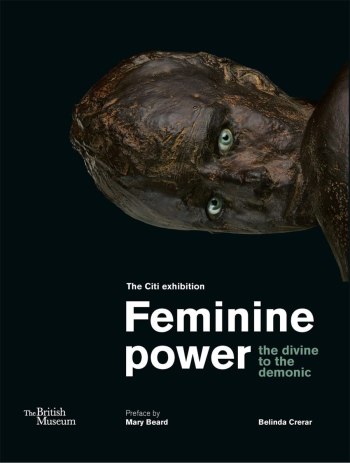 The first exhibition of its kind, Feminine Power takes a cross-cultural look at the profound influence of female spiritual beings within global religion and faith. Explore the significant role that goddesses, demons, witches, spirits and saints have played—and continue to play—in shaping our understanding of the world.
How do different traditions view femininity? How has female authority been perceived in ancient cultures? For insights, the exhibition looks to divine and demonic figures feared and revered for over 5,000 years. From wisdom, passion and desire, to war, justice and mercy, the diverse expression of female spiritual powers around the world prompts us to reflect on how we perceive femininity and gender identity today.
Worship of Pele, the Hawaiian goddess of volcanoes, reveals how her destructive capacity is venerated alongside her ability to create. The Buddhist bodhisattva of compassion, who transcends gender and is visualised in male form in Tibet and female in China and Japan, uncovers the importance of gender fluidity in some spiritual traditions. And the terrifying Hindu goddess Kali, depicted in art carrying a severed head and bloodied sword, is honoured as the Great Mother and liberator from fear and ignorance.

Porcelain Figure of Guanyin, China, 18th century, 41 cm high (London: The British Museum, 1980,0728.93).
Enhanced by engagement with contemporary worshippers, faith communities and insights from high-profile collaborators Bonnie Greer, Mary Beard, Elizabeth Day, Rabia Siddique, and Deborah Frances-White, the exhibition considers the influence of female spiritual power and what femininity means today.
Bringing together sculptures, sacred objects and artworks from the ancient world to today, and from six continents, the exhibition highlights the many faces of feminine power—ferocious, beautiful, creative or hell-bent—and its seismic influence throughout time.
Belinda Crerar, Feminine Power: The Divine to the Demonic (London: The British Museum, 2022), 272 pages, ISBN: 978-0714151304, £30 / $45.
C O N T E N T S
Introduction
1 Forces of Nature
2 Passion and Desire
3 Evil
4 Justice and Defence
5 Compassion and Salvation
Conclusion
Notes and Bibliography
Acknowledgements and Credits
Exhibition | Fuseli and the Modern Woman
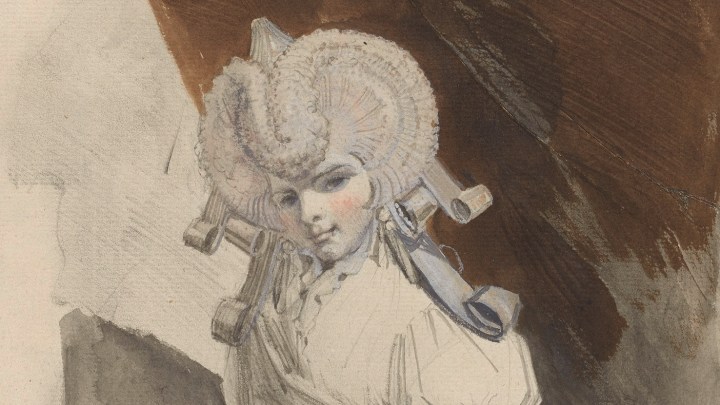
Henry Fuseli, Sophia Fuseli, Her Hair in Large Rolls, with Pink Gloves, in Front of a Brown Curtain, detail, 1790
(Kunsthaus Zürich, Collection of Prints and Drawings)
◊ ◊ ◊ ◊ ◊
From The Courtauld:
Fuseli and the Modern Woman: Fashion, Fantasy, Fetishism
The Courtauld Gallery, London, 14 October 2022 — 8 January 2023
Kunsthaus Zürich, 24 February – 21 May 2023
One of the most original and eccentric artists of the 18th century, Henry Fuseli (1741–1825) will be the subject of a new exhibition at The Courtauld, opening 14 October 2022.

Henry Fuseli, Half-length Figure of a Courtesan with Feathered Head-dress, ca. 1800–10 (Kunsthaus Zürich, Collection of Prints and Drawings).
Born in Zurich, Switzerland, Fuseli spent a formative period in Rome in the 1770s before settling in London, where he was elected Professor of Painting at The Royal Academy and served for 21 years as Keeper of the RA Schools, working and living at Somerset House in what is now The Courtauld Gallery.
While Fuseli was famous in his lifetime for stylised paintings depicting fantastic and supernatural scenes drawn from his imagination and literature, The Courtauld’s exhibition explores an altogether different dimension to his art. Fuseli and the Modern Woman: Fashion, Fantasy, Fetishism will reveal the artist’s secret lifelong obsession with the female figure through fifty of his strange and striking private drawings, many of which depict the spectacularly extravagant hairdos and fashions of the day. The exhibition will explore Fuseli’s fascination with female sexuality and the modern woman—as a figure of mystery, transgression, and dangerous allure—and provides an insight into late 18th- and early 19th-century anxieties about gender, identity, and sexuality during a transformative period in European history.
Organised in collaboration with the Kunsthaus Zürich, the exhibition will showcase drawings brought together from international collections. Following its presentation at The Courtauld, the exhibition will travel to Zürich, the city where Fuseli was born.
The catalogue is published by PHP and distributed by The University of Chicago Press:
David Solkin, ed., with contributions by Jonas Beyer, Mechthild Fend, and Ketty Gottardo, Fuseli and the Modern Woman: Fashion, Fantasy, Fetishism (London: Paul Holberton Publishing, 2022), 168 pages, ISBN: 978-1913645298, £30 / $40.
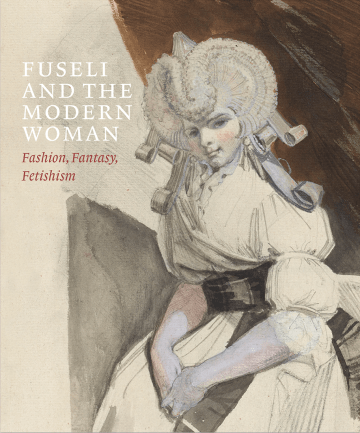 Best known for his notoriously provocative painting The Nightmare, Fuseli energetically cultivated a reputation for eccentricity, with vividly stylised images of supernatural creatures, muscle-bound heroes, and damsels in distress. While these convinced some viewers of the greatness of his genius, others dismissed him as a charlatan, or as completely mad.
Fuseli’s contemporaries might have thought him even crazier had they been aware that in private he harboured an obsessive preoccupation with the figure of the modern woman, which he pursued almost exclusively in his drawings. Where one might have expected idealised bodies with the grace and proportions of classical statues, here instead we encounter figures whose anatomies have been shaped by stiff bodices, waistbands, puffed sleeves, and pointed shoes, and whose heads are crowned by coiffures of the most bizarre and complicated sort. Often based on the artist’s wife Sophia Rawlins, the women who populate Fuseli’s graphic work tend to adopt brazenly aggressive attitudes, either fixing their gaze directly on the viewer or ignoring our presence altogether. Usually they appear on their own, in isolation on the page; sometimes they are grouped together to form disturbing narratives, erotic fantasies that may be mysterious, vaguely menacing, or overtly transgressive, but where women always play a dominant role. Among the many intriguing questions raised by these works is the extent to which his wife Sophia was actively involved in fashioning her appearance for her own pleasure, as well as for the benefit of her husband.
By bringing together more than fifty of these studies (roughly a third of the known total), The Courtauld Gallery will give audiences an unprecedented opportunity to see one of the finest Romantic-period draughtsmen at his most innovative and exciting. Visitors to the show and readers of the lavishly illustrated catalogue will further be invited to consider how Fuseli’s drawings of women, as products of the turbulent aftermath of the American and French Revolutions, speak to concerns about gender and sexuality that have never been more relevant than they are today.
The exhibition showcases drawings brought together from international collections, including the Kunsthaus Zürich, in Zurich, the Auckland Art Gallery in New Zealand, and from other European and North American institutions.
David Solkin is Emeritus Professor at The Courtauld Institute of Art, London.
Jonas Beyer is Curator of Drawings at the Kunsthaus Zürich, Zurich.
Mechthild Fend is Professor of Art History at the Goethe University, Frankfurt am Main.
Ketty Gottardo is Martin Halusa Curator of Drawings at The Courtauld Gallery, London.
Exhibition | Füssli: The Realm of Dreams and the Fantastic

Henry Fuseli, The Dream of Queen Catherine of Aragon (Shakespeare, Henry VIII, Act 4, Scene 2), detail, 1781, oil on canvas, 147 × 211 cm
(Borough of Fylde, Lancashire: Lytham St Annes Art Collection, no. 52).
◊ ◊ ◊ ◊ ◊
Opening this month at the Musée Jacquemart-André:
Füssli: The Realm of Dreams and the Fantastic / Füssli, entre rêve et fantastique
Musée Jacquemart-André, Paris, 16 September 2022 — 23 January 2023
Curated by Christopher Baker and Andreas Beyer
This autumn discover the oeuvre of the Swiss-born British painter Henry Fuseli (Johann Heinrich Füssli, 1741–1825). Comprising sixty works from public and private collections, the exhibition presents a selection of the most emblematic of works by Füssli, the artist of the imaginary and the sublime. From Shakespearean themes to representations of dreams, nightmares, and apparitions, and mythological and Biblical illustrations, Füssli forged a new aesthetic that shifted between reality and the fantastic.

Henry Fuseli, Self-Portrait, 1780s, black and white chalk on buff paper (London: V&A Museum, E.1028-1918).
The son of a painter and art historian, Henry Füssli was trained as a priest and started his artistic career relatively late, during a first trip to London, where he was influenced by the President of the Royal Academy, Sir Joshua Reynolds. After a long stay in Italy, during which he was especially fascinated by the power of Michelangelo’s works, he settled in London at the end of the 1770s. An atypical and intellectual artist, Füssli drew his inspiration from the literary sources that he interpreted imaginatively. In his paintings he developed a dreamlike and dramatic pictorial language, with its blend of the marvellous and the fantastic, the sublime and the grotesque.
Come explore Füssli’s oeuvre, which has not been the subject of a monographic exhibition in Paris since 1975: from works that represent Shakespeare’splays (particularly Macbeth), onto those depicting mythological and biblical tales, the female figures represented in his graphic works and the themes of nightmares, a truly Füselian obsession, dreams, and apparitions.
Füssli developed a fantastic vein that was quite marginal at the time, as it distorted academic rules. In 1782, he presented his first version of Nightmare, an emblematic work drawn from his imagination that truly established his career as a painter. Elected Associate Member of the Royal Academy in 1788, and Academician in 1790, Füssli, while working in a serial fashion, embodied the quest for the sublime that was all the rage in England at the time.
Discover the striking works of the artist—works that are all too rare in French collections—by a highly original painter whose oeuvre was paradoxical, inspired by an imagination in which terror and horror were combined, forming the aesthetic origins of Dark Romanticism (‘romantisme noir’).
Christopher Baker and Andreas Beyer, et al., Füssli, entre rêve et fantastique (Brussels: Fonds Mercator, 2022), 208 pages, €40.
In addition, works from the exhibition are featured in a 44-page special edition of Connaissance des Arts (€11) and an 84-page special edition of Beaux-Arts magazine (€14).
More information is included in the full press packet.
Exhibition | Eighteenth-Century Pastels
From the press release (1 August) for the exhibition:
Eighteenth-Century Pastels
Getty Museum, Los Angeles, 30 August 2022 — 26 February 2023
Curated by Emily Beeny and Ellie Bernick, with Julian Brooks

Pietro Antonio Rotari, Young Woman with a Fan, early 1750s, pastel on blue-green paper, mounted on canvas, 18 × 15 inches (Los Angeles: Getty Museum, 2019.111).
Exhibition highlights the Pan-European popularity of pastels with recently acquired works and loans from the Mauritshuis museum.
The J. Paul Getty Museum presents Eighteenth-Century Pastels, an exhibition that explores the popularity of pastels across eighteenth-century Europe and showcases their striking physical properties. Presenting works from the Getty Museum collection along with four loans, the exhibition is on view at the Getty Center from 30 August 2022 to 26 February 2023.
By the mid-eighteenth century, pastels reached an unprecedented peak of popularity and acclaim. The dry, satiny pigments, manufactured in sticks of every hue, were portable and allowed for swift execution—allowing artists to essentially ‘draw’ a painting.
“Working with pastels differs greatly from painting with oils, which require cumbersome equipment, long sittings, and extensive drying times,” says Emily Beeny, curator of European paintings at the Fine Arts Museums of San Francisco and former associate curator of drawings at the Getty Museum. “Their relative ease and portability made pastels an especially desirable medium for traveling artists seeking to expand their portfolio with portraits.”
Pastelists were often very mobile, traveling far and wide in search of commissions. The artists and sitters represented in Eighteenth-Century Pastels hail from Austria, England, France, Germany, Italy, Switzerland, and the Netherlands—a testament to the Pan-European nature of the pastel phenomenon. The exhibition highlights works from the Getty Museum collection by Jean-Étienne Liotard, John Russell, and Rosalba Carriera, among others. The show also includes recently acquired works by Adélaïde Labille-Guiard and Pietro Antonio Rotari, as well as seldom-seen works by Cornelis Troost on long-term loan from the Mauritshuis in the Netherlands.
With standout pieces like Rotari’s Young Woman with a Fan and Liotard’s Portrait of Maria Frederike van Reede-Athlone at Seven Years of Age, the pastels in this exhibition will entrance audiences with their rich hues and ethereal quality.
“Featuring works by many of the most talented pastel portraitists of the age, this exhibition is a sumptuous feast for the eyes,” says Ellie Bernick, graduate intern at the Getty Museum and co-curator of the exhibition. “Plus, the exhibition features several works by female pastelists like Adélaïde Labille-Guiard, Rosalba Carriera, and Mary Hoare, exemplifying the important role the medium played in bringing women artists into the profession.”
Eighteenth-Century Pastels is curated by Emily Beeny, curator of European paintings at the Fine Arts Museums of San Francisco and former associate curator of drawings at the Getty Museum, and Ellie Bernick, graduate intern at the Getty Museum, with the assistance of Julian Brooks, senior curator of drawings at the Getty Museum.
Exhibition | (Re)Inventing the Americas

Denilson Baniwa, The Celebration of the Lizard (detail), Spirit Animals (detail), 2022, digital intervention on Columnam à Praefecto prima navigation locatam venerantur Floridenses (Column in Honor of the First Voyage to Florida) (detail), from Jacques de Morgues Le Moyne (French, ca. 1533–before 1588), Brevis narratio eorum quae in Florida Americæ provincia Gallis acciderunt (Frankfurt, 1591), pl. 8 (Getty Research Institute, 87-B24110). Courtesy the artist. Design © 2022 J. Paul Getty Trust.
◊ ◊ ◊ ◊ ◊
From the press release (via Art Daily) for the exhibition:
(Re)Inventing the Americas: Construct. Erase. Repeat.
Getty Center, Los Angeles, 23 August 2022 — 8 January 2023
Curated by Idurre Alonso with Denilson Baniwa
America is a European invention. Between 1492 and the late 1800s, European conquistadors, travelers, and artists produced prints, books, and objects that illustrated the natural resources and Native peoples of the Americas, often constructing fantastic and fictional ideas. Mixing reality with their own conventions and interpretations, they created portable and reproducible images that circulated around the world, fueling the spread of stereotypes and prejudices. (Re)Inventing the Americas: Construct. Erase. Repeat., on view from 23 August 2022 until 8 January 2023, analyzes the creation of the mythologies that arose during the conquest and exploration of the continents and reveals the influence that those myths and utopian visions have had on defining the Americas.
“This exhibition reframes the colonial and 19th-century materials in the Getty Research Institute collections, challenging European representations of the American continents,” says Mary Miller, director of the Getty Research institute. “It proposes that the Americas were reinvented utilizing European conventions and imaginaries.”
Re)Inventing the Americas is divided into five thematic sections. The first one examines the allegorical construction of America and the sources and evolution of these images. The second section explores the natural wealth of the Americas, while highlighting the exploitation of those resources. The third part looks at the construction of archetypes by analyzing recurring topics, such as the depiction of local people with feathers and hammocks and the portrayal of idolatry and cannibalism. The fourth section is devoted to images of the conquest, emphasizing the political overtones of certain narratives. The final section looks at the work of European travelers, stressing the differences and commonalities with previous constructions.
The exhibition features a collaboration with Denilson Baniwa, a contemporary artist from the Brazilian Amazon region who will generate different artistic interventions throughout the show. Baniwa’s work prompts us to critically reevaluate the materials from the past to help us navigate the colonial traumas, generating new reinventions of the Americas. Additionally, commentary on exhibition objects by Latinx and Indigenous members of the Los Angeles community gives a multi-perspectival approach to the pieces.
“Our collections illustrate the construction of an image of the Americas based on the European perspective,” says Idurre Alonso, curator at the Getty Research Institute. “Thus, it was important to me to analyze and counter that European view by introducing a multilayered presentation of the exhibition objects. To do that, I collaborated with Denilson Baniwa and our local Latin American and Latinx community. Their voices became part of the narrative of the show, challenging the persistence of certain notions. The outcome of these collaborations is a multifaceted exhibition that showcases the complex reinventions of the Americas from the Colonial time to today.”
Denilson Baniwa (born 18 April 1984) is an Indigenous artist who was born in the village of Darí, in Rio Negro, Amazonas, in the tri-border area between Brazil, Colombia and Venezuela. His artistic practice includes graphic design, drawings, performances, and urban interventions. His oeuvre seeks points of intersection between Indigenous culture and the contemporary art world. Through his art he questions the colonial past and stereotypical representations of Indigenous people, often layering components from colonial and nineteenth-century art with elements from his own cultural traditions. Some of the themes he approaches include the relationships of Indigenous peoples and technology as well as the harmful effects of agri-business for Native peoples.
Esta exhibición se presenta en inglés y en español.
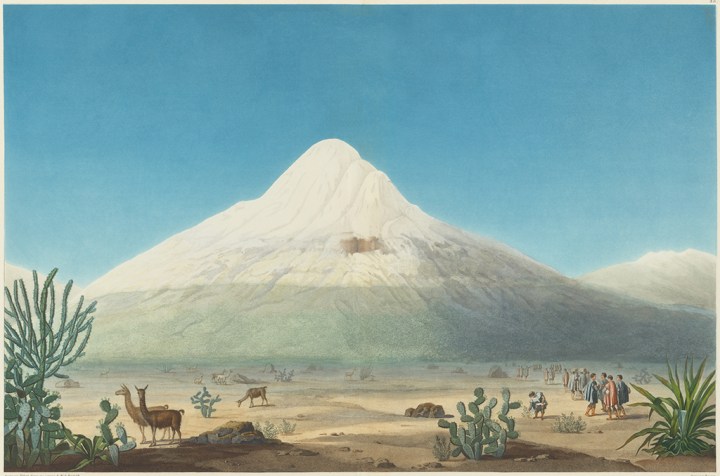
Louis Bouquet, Chimborazo Seen from the Plain of Tapia, engraving from Alexander von Humboldt, Vues des Cordillères, et monumens des peuples indigènes de l’Amérique (Paris, 1810), between pp. 200 and 201 (Getty Research Institute, 85-B1535).
Exhibition | Making Music in Early America
From the press release (11 July 2022) for the exhibition:
Making Music in Early America
DeWitt Wallace Decorative Arts Museum, Colonial Williamsburg, 20 August 2022 — December 2025
Organized by Amanda Keller

Organized piano by Longmen, Clementi & Company, London, 1799 (Colonial Williamsburg: Museum Purchase. Conservation of this instrument is made possible by a gift from Constance Tucker and Marshall Tucker in memory of N. Beverly Tucker, Jr. 2012-150).
In the 18th century, music was everywhere: in the workplace, the military campsites, the quarters of the enslaved, the church, the theater, the ballroom, and the home. Music was an essential part of life that helped foster a sense of community, whether people were accompanying the organ in song at church or enjoying an impromptu concert at home. Making Music in Early America, a new exhibition to open on August 20, 2022, in the Mark M. and Rosemary W. Leckie Gallery at the DeWitt Wallace Decorative Arts Museum, one of the Art Museums of Colonial Williamsburg, will envelop visitors in the musical world of the 18th and 19th centuries.
As told through more than 60 instruments and their accessories, the social history and material culture of early American music will be revealed. This is the first exhibition to show the full scope of Colonial Williamsburg’s musical instruments collection including some pieces that were recently acquired. It is scheduled to remain on view through December 2025. Organized in five sections featuring music in the home, in religion, in education, in public performance, and in the military, Making Music in Early America will include harps, organs, violins and other string instruments, fifes, flutes, a bassoon, a grand harmonicon, drums, horns, and much more. While the instruments are fascinating in and of themselves, the musicians who played them and their roles in society take center stage in this exhibition.
“Colonial Williamsburg has been collecting early musical instruments for more than 90 years, but we have never before had the opportunity to show the full range of the collection,” said Ronald Hurst, the Foundation’s Carlisle H. Humelsine chief curator and vice president for museums, preservation, and historic resources. “Supported by examples of original sheet music and paintings of early Americans playing their instruments, this exhibition will place these remarkable objects in their rich, historic context.”
Among the many highlights of Making Music in Early America is a barrel organ, or hand organ, made by Longman, Clementi & Co. in London, England, ca. 1789–1801. It is a hand-cranked organ that could be played inside the home on demand with no musical talent required. The organ barrels operated much like a music box and included dance music, religious music, and military marches. They produced music on demand similar to a juke box or record player, if one had the strength to crank the handle and switch out the barrels to change the tunes. In the 17 September 1767 edition of The Virginia Gazette, an item advertising a similar instrument read: “Just Imported from London, a VERY neat HAND ORGAN, in a mahogany case, with a gilt front, which plays sixteen tunes, on two barrels; it has four stops, and every thing is in the best order. The first cost as 16£ sterling, and the Lady being dead it came in for, any person inclining to purchase it may have it on very reasonable terms. Inquire at the Post Office, Williamsburg.”
“This incredibly diverse collection of musical instruments offers us ways to tell the stories of the people who lived here during the 18th and early 19th centuries by examining who interacted with these instruments and why,” said Amanda Keller, Colonial Williamsburg’s manager of historic interiors and associate curator of household accessories who organized this exhibition. “The instruments become even more fascinating when you discover who played them and what role music played in society.”
 One of the earliest hunting horns known in American collections is another featured object in the exhibition. Simple hunting horns were being made in the American colonies as early as 1765, but the majority were imported from Europe like this brass horn, made by Johannes Leichamschneider in Vienna, Austria, ca. 1715. As hunting horns were worn by the rider, they were easily battered. As a result, early hunting horns rarely survived, and this is an outstanding example that scholars come to The Colonial Williamsburg Foundation to study. Although the horn section may have been modified over time and updated, the bell is original. Only one other just like this example survives with a history of use at Mount Vernon. It is recorded that George Washington’s enslaved valet, William Lee, performed the important duties of Huntsman, tending to the horses and hounds, as well as blowing the hunting horn during fox hunts at Mount Vernon and other estates. Although the history of Colonial Williamsburg’s hunting horn is unknown, it illustrates the once-prominent role played by free and enslaved huntsmen in the early South.
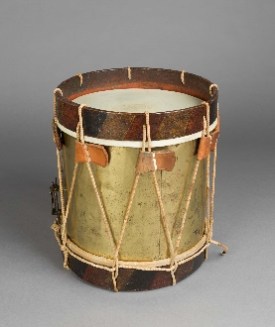 Revolutionary War military instruments are especially rare, and this brass ‘Hessian’ drum, from the Frebershausen area in the Hesse-Kassel region of what is now Germany, ca. 1770–85, is another featured object to be on view in Making Music in Early America. It was brought over by one of the many so-called Hessian units hired by the British to fight in the American Revolution and was most likely captured by American forces. Made of brass, this drum still has some secrets to reveal: Colonial Williamsburg’s experts, with the aid of colleagues across the Atlantic, are researching to which regiment it belonged and are using the painted colors around the top and bottom bands to help solve its mystery.
Also included in the exhibition will be ways for visitors to be able to hear the sounds of four of the instruments (banjo, harpsichord, organized piano, and musical glasses) as well as an opportunity to see a musician play an organized piano (the period term indicating the addition of several organ stops playable from the same keyboard).
Additionally, guests will be able to use an interactive touch screen to view an extraordinary music book in the Colonial Williamsburg collection that was owned by Peter Pelham (1721–1805), an English-born American organist, harpsichordist, teacher, and composer. Born in London, Pelham and his family immigrated to Boston in 1730. While there, Pelham’s father apprenticed him to Charles Theodore Pachelbel, son of composer Johann Pachelbel who is known for “Canon in D,” which is still popular today. Pelham followed Pachelbel to Charleston in 1736 and remained there for a number of years, studying with Pachelbel and later becoming a harpsichord teacher himself. Pelham returned to Boston in 1744 to serve as the first organist of Trinity Church. In 1750 Pelham moved to Williamsburg, to serve as organist at Bruton Parish Church. While in Williamsburg Pelham actively participated in the city’s musical life, giving concerts and teaching young ladies to play the spinet and harpsichord. Additionally, he supported himself and his family by serving as clerk to the royal governor, supervisor of the printing of money, and keeper of the Public Gaol. The music book that will be on view includes music that Pelham enjoyed as well as some of his original compositions. It has never been on view before, and although the original book is too fragile to be placed on view, this digital interactive will allow visitors to page through the book and see the music for themselves.
Making Music in Early America is generously funded by an anonymous donor.
Exhibition | Chroma: Ancient Sculpture in Color
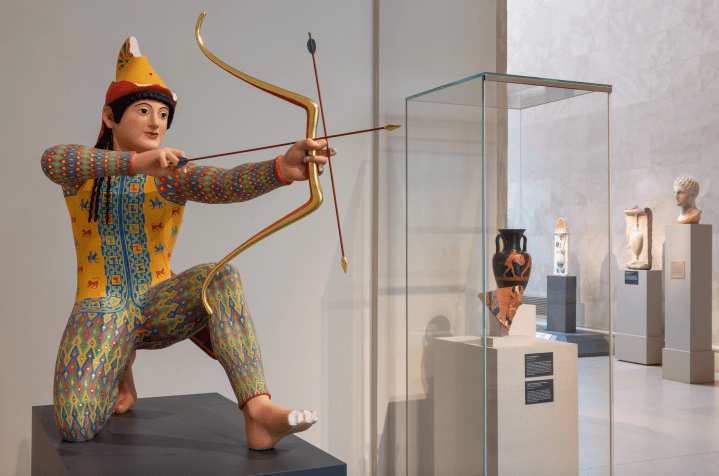
Installation view of Chroma: Ancient Sculpture in Color, on view at The Metropolitan Museum of Art
(Photo by Anna-Marie Kellen for The Met)
◊ ◊ ◊ ◊ ◊
Not explicitly an eighteenth-century exhibition, but central to eighteenth-century conversations. From The Met:
Chroma: Ancient Sculpture in Color
The Metropolitan Museum of Art, New York, 5 July 2022 — 26 March 2023
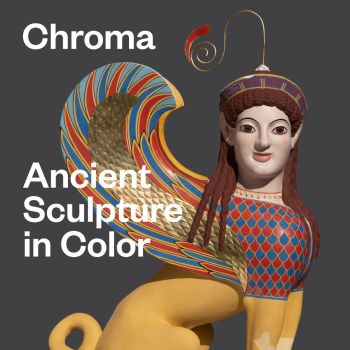 Ancient Greek and Roman sculpture was once colorful, vibrantly painted and richly adorned with detailed ornamentation. Chroma: Ancient Sculpture in Color reveals the colorful backstory of polychromy—meaning “many colors,” in Greek—and presents new discoveries of surviving ancient color on artworks in The Met’s world-class collection. Exploring the practices and materials used in ancient polychromy, the exhibition highlights cutting-edge scientific methods used to identify ancient color and examines how color helped convey meaning in antiquity, and how ancient polychromy has been viewed and understood in later periods.
The exhibition features a series of reconstructions of ancient sculptures in color by Prof. Dr. V. Brinkmann, Head of the Department of Antiquity at the Liebieghaus Skulpturensammlung, and Dr. U. Koch-Brinkmann, and introduces a new reconstruction of The Met’s Archaic-period Sphinx finial, completed by The Liebieghaus team in collaboration with The Met. Presented alongside original Greek and Roman works representing similar subjects, the reconstructions are the result of a wide array of analytical techniques, including 3D imaging and rigorous art historical research. Polychromy is a significant area of study for The Met, and the Museum has a long history of investigating, preserving, and presenting manifestations of original color on ancient statuary.
Exhibition | Beauty and Ritual: Judaica from The Jewish Museum, NY
Now on view at the MFAH:
Beauty and Ritual: Judaica from The Jewish Museum, New York
Museum of Fine Arts, Houston, 10 July — 18 September 2022
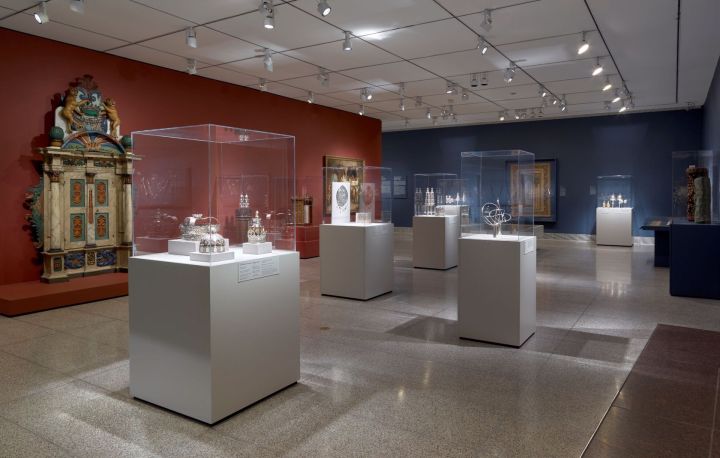
Examining Jewish ceremonial objects from antiquity to the present, Beauty and Ritual: Judaica from the Jewish Museum, New York marks the first in a series of presentations from the world-renowned collection of the Jewish Museum in New York City. The new, ongoing partnership between the MFAH and the Jewish Museum brings exceptional objects to Houston over a period of years.

Torah Ark, 18th century, pinewood: carved and painted; fabric: embroidered with metallic thread (The Jewish Museum, New York, gift of Arthur Heiman; photograph by John Parnell).
Beauty and Ritual explores the artistic, ritualistic, and cultural significance of more than 140 works. The objects on view derive from Jewish communities throughout the world, spanning Central Asia to North Africa and Western Europe. The exhibition also explores how artists—from different backgrounds—and Jewish communities have creatively adapted traditional forms of Judaica by utilizing a rich array of styles, materials, and techniques, and drawing on broader cultures. The exhibition comprises three thematic galleries: “The Art of the Synagogue: Adorning the Torah,” “A Day of Rest: The Radiance of the Sabbath,” and “Beyond the Synagogue and the Home: The Light of the Hanukkah Menorah.”
In early 2023, the Albert and Ethel Herzstein Gallery for Judaica opens at the MFAH for the ongoing presentation of objects on loan from the Jewish Museum.
From the press release (8 June 2022) from The Jewish Museum:
The Museum of Fine Arts, Houston, and The Jewish Museum, New York today announced a partnership to establish an ongoing presence for Judaica at the MFAH: In July 2022, the MFAH will open the exhibition Beauty and Ritual: Judaica from The Jewish Museum, New York, the first step in the ongoing partnership, which will bring exceptional objects from the Jewish Museum to Houston over a period of years. In early 2023, ongoing presentations centered on objects on loan from the Jewish Museum will begin when The Albert and Ethel Herzstein Gallery for Judaica opens at the MFAH. The Herzstein Gallery is a centerpiece of the World Faiths Initiative at the MFAH, a program of interfaith projects based on the museum’s collections and exhibitions and funded by the Lilly Endowment Inc.
Commented Gary Tinterow, Director, Margaret Alkek Williams Chair, of the MFAH: “The first significant piece of Judaica to enter the Museum’s collection was the Montefiore Mainz Mahzor, in 2018. Calligraphed and illustrated around 1310 in Mainz, some 150 years before Gutenberg would print his Bible in that same medieval town, the Mahzor is one of the earliest surviving illuminated Jewish prayer books from Central Europe. Now, with this significant partnership with The Jewish Museum, New York, and access to their extraordinary collections, we are able to amplify the cultural and artistic history of Judaism, first with this summer’s exhibition, Beauty and Ritual, and, beginning early next year, with presentations in the newly endowed, permanent Judaica gallery. I am enormously grateful to the Jewish Museum, New York, for their partnership, and to The Albert and Ethel Herzstein Foundation, in making possible this permanent presence for Judaica and historic Jewish traditions at the MFAH.”
“After two years of discussion and planning, I am delighted that the Museum of Fine Arts, Houston will be offering its audiences a chance to see highlights from the Jewish Museum’s renowned collection of Judaica,” commented Claudia Gould, the Helen Goldsmith Menschel Director of The Jewish Museum, New York. “There are very few general fine-arts museums in the nation that have a dedicated space for Judaica, and this exciting collaboration will have significant impact on the field. As head of the Jewish Museum in New York, which maintains a unique collection of nearly 30,000 works of art, ceremonial objects, and media including one of the world’s major Judaica collections, I am looking forward to working with the MFAH on this important initiative.”
About Beauty and Ritual: Judaica from The Jewish Museum, New York
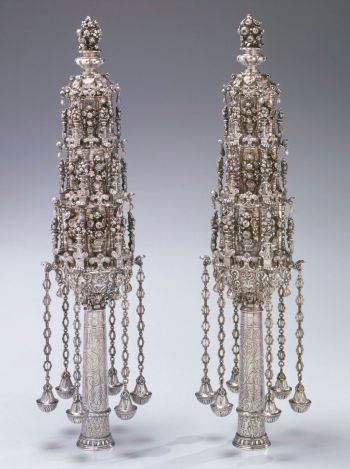
Torah Finials, early 18th century, silver: cast repousse, and engraved (The Jewish Museum, New York)
The exhibition Beauty and Ritual: Judaica from The Jewish Museum, New York is the first of a series of presentations at the MFAH from the collection of The Jewish Museum, New York. The exhibition will feature over 140 objects from the Jewish Museum’s world-renowned collection, examining Jewish ceremonial objects from antiquity to the present and exploring their artistic, ritualistic, and cultural significance.
The objects presented derive from Jewish communities throughout the world, ranging from Central Asia to North Africa and Western Europe. The exhibition also explores how artists— from different backgrounds—and Jewish communities have creatively adapted traditional forms of Judaica by utilizing a rich array of styles, materials, and techniques, and drawing on broader cultures. Three thematic galleries explore the ceremonial objects used for Jewish practice in the synagogue, in the home and beyond.
“The Art of the Synagogue: Adorning the Torah” features ceremonial objects used within the synagogue for the purpose of beautifying and protecting the Torah, the central ritual text of Judaism. One Torah ark, intended for housing the Torah, is a monumental 18th-century pinewood enclosure from Bavaria. The ark echoes the colorful, painted decorations of houses of that region, resembling an entrance to a home, and, at 10 feet in height, nearly at the same scale.
“A Day of Rest: The Radiance of the Sabbath” presents Judaica traditionally used for the Sabbath, the weekly day of rest. At the center of the gallery will be a 2012 commission for the Jewish Museum by artist Beth Lipman. In this ethereal work, Beth Lipman drew inspiration from traditional Jewish ceremonial objects in the museum’s collection, including those used for the Sabbath. The piece is a table set with an abundance of glass objects, evocative of the Baroque still life tradition of the vanitas painting in which worldly objects are shown together with symbols of mortality to prompt reflection on the inherent transience of beauty and life. The work conveys the household table as a place where festivity, family, history, and the fragile passing of time converge.
“Beyond the Synagogue and the Home: The Light of the Hanukkah Menorah,” examines the menorah, traditionally the lamp used to celebrate the holiday of Hanukkah, the eight-day festival of lights. This final gallery of the exhibition showcases the menorah’s history and visual presence as a symbol of Jewish culture to the world—from the earliest times with a fired-clay lamp from the third to the fifth century CE, to elaborate 18th- and 19th-century Italian and German metalwork, and to 20th-century depictions by modern artists Marc Chagall and Ben Shahn.
About the World Faiths Initiative at the MFAH
Funded by a grant from the Lilly Endowment Inc., the Museum of Fine Arts, Houston’s World Faiths Initiative seeks to activate themes of religion, faith and spirituality in the Museum’s encyclopedic collections through innovative programming and reimagined displays. The focus on the many expressions of faith in the collections of the MFAH seeks to honor the diverse communities of Houston and inspire connections across cultures and beliefs. The World Faiths Initiative is centered on both The Albert and Ethel Herzstein Gallery for Judaica and cross-cultural installations and public programming exploring faith and spirituality, activities that serve the Museum’s long-term goals of representing world religions within the permanent collection. The project team is being led by Aimée Froom, MFAH curator, Art of the Islamic Worlds, and Caroline Goeser, W.T. and Louise J. Moran Chair of Learning and Interpretation. The initiative is supported with grant funds from the Lilly Endowment Inc.
Display | Exploring Lines: The Drawings of Sir James Thornhill
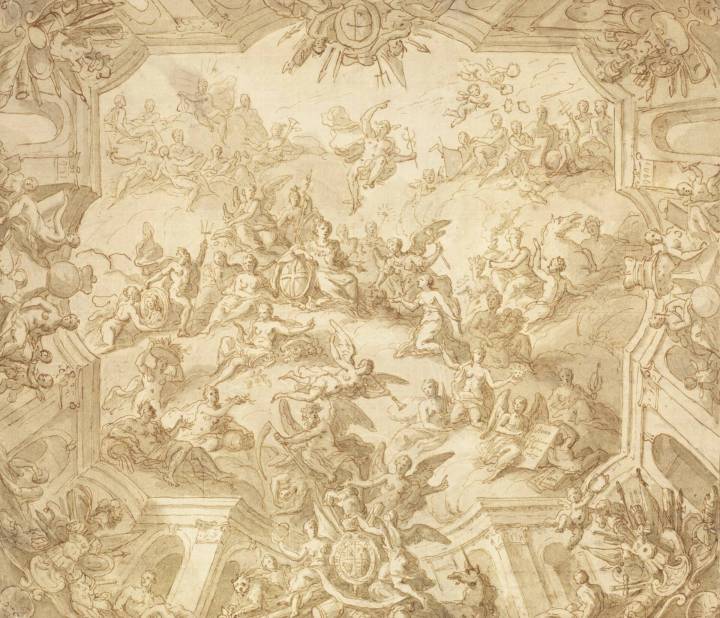
James Thornhill, Preliminary Design for the Ceiling of the Upper Hall at Greenwich, ca.1707, pen and ink with wash over pencil, squared in pencil, 34 × 38 cm (London: V&A, E.5199-1919). The drawing depicts Queen Anne at the centre, surrounded by allegorical figures representing Providence,the Virtues, the Arts and Sciences, and other emblems of Empire.
◊ ◊ ◊ ◊ ◊
Now on view at the V&A:
Exploring Lines: The Drawings of Sir James Thornhill
Victoria and Albert Museum, London, 1 July — 13 August 2022
A display illustrating the work of Sir James Thornhill, and his process of developing and drawing intricate designs for his mural paintings.
Sir James Thornhill (1675 or 1676–1734) was one of the most renowned artists of early 18th-century Britain whose mural paintings adorned the walls and ceilings of prestigious buildings throughout the country. Focusing on the role that drawing played in Thornhill’s practice, this display explores how he used sketches and more considered worked up designs to develop his creative ideas.
Exhibition | The Ceramics of Tonalá, Mexico
Now on view at SAMA:
A Legacy in Clay: The Ceramics of Tonalá, Mexico
San Antonio Museum of Art, 18 March 2022 — 19 March 2023

Earthenware Jar from Tonalá, mid-18th–late-18th century, burnished and painted earthenware, 33 inches tall (San Antonio Museum of Art, 2021.21).
The town of Tonalá, Mexico, has a long history with clay, dating back to the pre-Hispanic period and enduring to the present day. Tonalá’s contemporary dedication to ceramic arts was spurred by early modern Europeans’ obsession with the quality of the region’s clay beginning in the early sixteenth century. This exhibition highlights a selection of SAMA’s collection of Tonalá ceramics, which span from an important recent acquisition of an eighteenth-century monumental Tonalá vessel, to a variety of works from the twentieth century that demonstrate the trajectory of style in Tonala pottery. This focus exhibition offers visitors a glimpse into an important genre of SAMA’s Latin American art collection while demonstrating the breadth in styles achieved by some of Tonalá’s expert ceramicists.










 Enfilade
leave a comment