Online Exhibition | Making History: Shakespeare and the Royal Family
The exhibition is available here:
Making History: Shakespeare and the Royal Family
Online Exhibition, launching 15 July 2021

John Boyne, ‘Falstaff and his Prince’, 1783, etching showing Charles Fox as Falstaff to George’s Prince Hal.
The Shakespeare in the Royal Collection (ShaRC) project is delighted to announce a new digital exhibition, exploring the entwined stories of Shakespeare and the royal family across the centuries, launching on Thursday, 15 July 2021. Making History: Shakespeare and the Royal Family reveals how influential this relationship has been in shaping British culture.
Drawing on new archival research, the exhibition (in eight sections) explores the curious, political, and sometimes tragic connections between Shakespeare and the royal family through access to key objects in the Royal Collection and Royal Archives. A Shakespeare Folio contains handwritten annotations made by Charles I shortly before his 1649 execution. A painting by Thomas Gainsborough marks the short-lived affair of the actress and poet Mary ‘Perdita’ Robinson with George IV when Prince of Wales, casting him in the role of a dashing Prince Florizel. Digital visualisations put viewers in the audience of performances watched by Queen Victoria, bringing historical Shakespearean performances in the State Apartments at Windsor Castle vividly to life for the first time.
A wider online database, allowing users to search over 1,000 Shakespeare-related objects from the Royal Collection and Royal Archives, will also shortly be launched, and can be explored here: https://sharc.kcl.ac.uk/
Shakespeare in the Royal Collection is a three-year AHRC-funded research project led by King’s College London, in collaboration with Birkbeck University of London and The Royal Collection Trust. It investigates the Shakespeare-related holdings in the Royal Collection and Royal Archives, 1714–1945, and provides new information about a broad range of objects created, collected and displayed by generations of members of the royal family.
Exhibition | Vivre à l’antique: From Marie-Antoinette to Napoléon
The catalogue for the exhibition is published by Éditions Monelle Hayot:
Vivre à l’antique: de Marie-Antoinette à Napoléon 1er
Château de Rambouillet, 19 June — 9 August 2021
Curated by Gabriel Wick
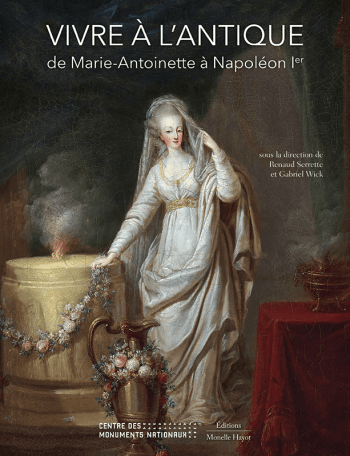 In the last three decades of the 18th century, the elites of Europe were enthralled by the constant flow of discoveries issuing forth from the excavations of buried cities, Etruscan tombs, and imperial villas in Italy. The distant past suddenly surged into the present, and architecture, furniture, and the accessories of daily life were re-imagined in its image. Nowhere in France could recount this aesthetic and cultural revolution more aptly than Rambouillet, the hunting estate and intimate retreat of the courts of Louis XVI and Napoléon I. Over the course of three months, the staterooms, intimate apartments, and dairy of Rambouillet will once again be filled with artifacts, models, and drawings from the Grand Tour and the Italian excavations, paintings by Hubert Robert, 18th– and 19th-century furnishings and decors by Jacob and Percier, and precious ceramics by Sèvres and Wedgwood. Through loans from the château of Versailles, the cité de la céramique de Sèvres, the École nationale supérieure des Beaux-Arts, the Bibliothèque des Arts décoratifs, and a number of private collections, the exhibition will explore how and why at the threshold of the modern era, distant antiquity so completely captured the imagination of the sovereigns and their courts.
Renaud Serrette and Gabriel Wick, eds., Vivre à l’antique, de Marie-Antoinette à Napoléon 1er (Saint-Remy-en-l’Eau: Éditions d’art Monelle Hayot, 2021), 200 pages, ISBN: 979-1096561315, 39€.
Online Talks | Rubens Series

Peter Paul Rubens, The Rainbow Landscape (detail), ca. 1636
(London: The Wallace Collection)
◊ ◊ ◊ ◊ ◊
The last three talks in the series address the eighteenth- and nineteenth-century reception of Rubens. From The Wallace Collection:
Rubens Talk Series
Online, The Wallace Collection, 9 June — 21 July 2021
To accompany The Wallace Collection’s new exhibition Rubens: Reuniting the Great Landscapes, this series of seven talks will explore different aspects of Rubens’s extraordinary life and achievements, the fascinating social, cultural and economic circumstances of his age, and his enduring artistic legacy.
Series talks will be presented through Zoom Webinar. Each talk duration is 1 hour, including time for Q&A with the speaker. Tickets can be purchased for individual talks or the entire series. Ticket holders will receive their Zoom link, Webinar ID, and Passcode 24 hours in advance of each talk. Series talks, excluding 21 July, will be recorded. Following each talk, ticket holders will be emailed a link to view the recording, which will be available for one week only.
◊ ◊ ◊ ◊ ◊
John Chu | ‘Equal to the Great Masters’: Landscapes by Gainsborough and Rubens
Wednesday, 7 July 2021, 19.00 BST
Thomas Gainsborough (1727–1788) had a lifelong love of Netherlandish landscape art. As his career developed so too did the range and depth of his appreciation for the ‘Great Masters’ of the Low Countries—prominent in this pantheon was Peter Paul Rubens (1577–1640). In this talk, John Chu will consider the transformative influence of Rubens’s landscapes on Gainsborough’s art, examining what he learned from his predecessor and why these paintings became such an important model. Looking more broadly, he will also explore the reputation of Rubens’s landscapes in 18th-century Britain and establish the social and artistic conditions that shaped, and made possible, Gainsborough’s fruitful encounter with the works of the Flemish master.
Dr John Chu is Senior Curator of Pictures and Sculpture at the National Trust. He has taught and published widely on 18th-century British and French painting and specialises in the art of Thomas Gainsborough and Joshua Reynolds.
◊ ◊ ◊ ◊ ◊
Christoph Vogtherr | Flemish Painting in 18th-Century French Collections
Wednesday, 14 July 2021, 19.00 BST
Flemish painting rose to a prominent role in Parisian collections only in the late 17th century. Even Rubens started to be regarded as one of the major European painters considerably later than in territories of the German Empire or in Italy. This change in perception and taste went hand in hand with new modes of picture displays. In the first decades of the 18th century, the comparison of schools and painters became the guiding principle of art presentation. Flemish painting was introduced into Parisian collections in this context of emulation and competition between the schools. In the process, Flemish and French painting gained a prominence comparable to Italian art. In this talk, Christoph Vogtherr will trace the rise of Flemish and Dutch painting in Parisian collections, its important position in picture displays and art theory, as well as its role in the formation of French 18th-century painting.
Dr Christoph Martin Vogtherr is General Director of the Stiftung Preußische Schlösser und Gärten Berlin-Brandenburg. His main research interests are the history of the Prussian Royal palaces, French 18th-century painting, and the history of art collecting in the 18th and 19th centuries. He was previously Director of the Hamburger Kunsthalle (2016–19), and before that, Curator of paintings and then Director of the Wallace Collection from 2011 to 2016. He has published widely on 18th-century French painting.
◊ ◊ ◊ ◊ ◊
Tim Barringer | British Painters and Rubens’s Poetic Pastorals
Wednesday, 21 July 2021, 19.00 BST
Tim Barringer will explore the character of Rubens’s landscapes, which blend the legacies of classical poetry with the rough and tumble of rural life in the 17th century. Erudite references mix with rustic pastimes. While Rubens’s grand historical and religious paintings, like his portraits, commanded admiration across Europe, British artists and collectors found a special affinity with his pastoral works. Painters such as Constable, Turner, and Bonington were indelibly affected by the experience of seeing Rubens’s paintings and drawings, allowing them to see the natural world anew.
Dr Tim Barringer is Paul Mellon Professor and Chair of the Department of the History of Art at Yale University. He contributed to Rubens and his Legacy, the RA’s exhibition catalogue, and has co-curated exhibitions including American Sublime: Opulence and Anxiety; Pre-Raphaelites: Victorian Avant-Garde; Picturesque and Sublime: Thomas Cole’s Trans-Atlantic Inheritance; Unto This Last: Two Hundred Years of John Ruskin; and Victorian Radicals: From the Pre-Raphaelites to the Arts & Crafts Movement.
Exhibition | Flags and Founding Documents

13-star flag featuring a ‘Great Star’ pattern, ca. 1800–25, one of the earliest American flags known to survive
(Jeff Bridgman, American Antiques)
◊ ◊ ◊ ◊ ◊
Now on view at the Museum of the American Revolution:
Flags and Founding Documents, 1776–Today
Museum of the American Revolution, Philadelphia, 11 June — 6 September 2021
The summer exhibition Flags and Founding Documents, 1776–Today showcases dozens of rare American flags alongside historic early state constitutions and the first printing of the proposed U.S. Constitution of 1787.
The flags—many of which have never been exhibited before—trace the evolution of the Stars and Stripes through the addition and subtraction of stars as new states joined the Union and the nation battled through the Civil War. The flags serve as a visual narrative of America’s national story. The flags are showcased alongside historic documents including early printings of more than 16 different state constitutions and the Choctaw Nation Constitution of 1838 to shed light on the triumphs and tensions that the United States faced as it expanded and worked toward creating a ‘more perfect Union’. By telling stories from the nation’s revolutionary roots to its continuing struggle over equal rights, Flags and Founding Documents, 1776–Today encourages visitors to consider their role in the ongoing effort to fulfill the promise of the American Revolution.
The collection of historic flags is on loan from Jeff R. Bridgman, a leading dealer of antique flags and political textiles. The documents are on loan from the Dorothy Tapper Goldman Foundation following their presentation at the New-York Historical Society in the exhibition Colonists, Citizens, Constitutions: Creating the American Republic (February 2020 — Mary 2021), curated by Dr. James F. Hrdlicka.
James Hrdlicka, with Robert McD. Parker and a foreword by Ruth Bader Ginsburg, Colonists, Citizens, Constitutions: Creating the American Republic (London: Scala Arts Publishers, 2020), 208 pages, ISBN: 978-1785512070, $45.
Exhibition | Inspiring Walt Disney
Thanks to Kimberly Chrisman-Campbell for noting via Twitter this exhibition. In addition to the general information from The Met, see coverage at D23. . .
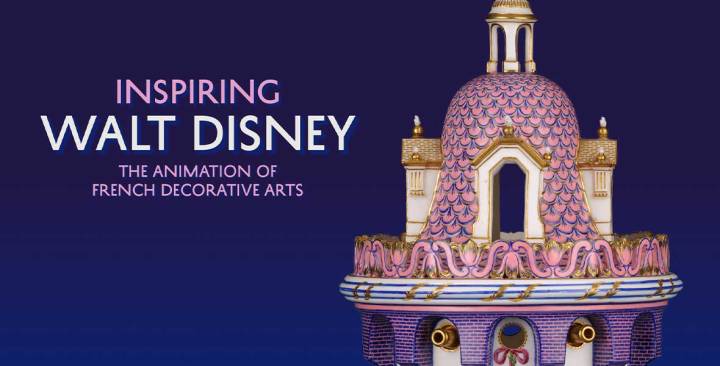
Inspiring Walt Disney: The Animation of French Decorative Arts
The Metropolitan Museum of Art, New York, 10 December 2021 — 6 March 2022
The Wallace Collection, London, 6 April — 16 October 20222
The Huntington Library, Art Museum, and Botanical Garden, San Marino, 10 December 2022 — 27 March 2023
Curated by Wolf Burchard
Pink castles, talking sofas, and a prince transformed into a teapot: what sounds like fantasies from Walt Disney Animation Studios’ pioneering animations were in fact the figments of the colorful salons of Rococo Paris. The Met’s first-ever exhibition exploring the work of Walt Disney and the Walt Disney Animation Studios’ hand-drawn animation will examine Disney’s personal fascination with European art and the use of French motifs in his films and theme parks, drawing new parallels between the studios’ magical creations and their artistic models.
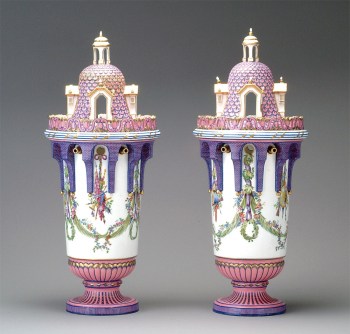
Sèvres Manufactory, pair of covered pots pourris vases in the form of towers (vases entourrés), ca. 1762; soft-paste porcelain (San Marino: The Huntington Library, Art Museum, and Botanical Gardens).
Forty works of 18th-century European decorative arts and design—from tapestries and furniture to Boulle clocks and Sèvres porcelain—will be featured alongside 150 production artworks and works on paper from the Walt Disney Animation Research Library, Walt Disney Archives, Walt Disney Imagineering Collection, and The Walt Disney Family Museum. Selected film footage illustrating the extraordinary technological and artistic developments of the studios during Disney’s lifetime and beyond will also be shown.
The exhibition will highlight references to European visual culture in Disney animated films, including nods to Gothic Revival architecture in Cinderella (1950), medieval influences on Sleeping Beauty (1959), and Rococo-inspired objects brought to life in Beauty and the Beast (1991). Marking the 30th anniversary of Beauty and the Beast’s animated theatrical release, the exhibition is organized by The Metropolitan Museum of Art and The Wallace Collection. The catalogue is distributed by Yale University Press.
The press release is available here»
Wolf Burchard, Inspiring Walt Disney: The Animation of French Decorative Arts (New York: The Metropolitan Museum of Art, 2021), 240 pages, ISBN: 978-1588397416, $50.
◊ ◊ ◊ ◊ ◊
Note (added (9 December 2021) — The posting was updated to include information for the catalogue, London dates, and the link to the press release.
Note (added 6 June 2022) — The posting was updated to include The Huntington as a venue.
Exhibition | Turner’s Modern World
Now on view at Tate Britain (with versions of the exhibition soon coming to Fort Worth and Boston). . .
Turner’s Modern World
Tate Britain, London, 28 October 2020 — 12 September 2021
Kimbell Art Museum, Fort Worth, 17 October 2021 — 6 February 2022
Museum of Fine Arts, Boston, 2022
 One of Britain’s greatest artists, J.M.W. Turner (1775–1851), lived and worked at the peak of the industrial revolution. Steam replaced sail; machine-power replaced manpower; political and social reforms transformed society. Many artists ignored these changes, but Turner faced up to these new challenges. This exhibition will show how he transformed the way he painted to better capture this new world.
Beginning in the 1790s, when Turner first observed the effects of modern life, the exhibition follows his fascination with the impact of industrialisation. It shows how he became involved in the big political questions of the time: campaigning against slavery and making paintings that expressed the horrors of the Napoleonic Wars.
This landmark exhibition will bring together major works by Turner from Tate and other collections, including The Fighting Temeraire (1839) and Rain, Steam and Speed (1844). It will explore what it meant to be a modern artist in his lifetime and present an exciting new perspective on his work and life.
David Blayney Brown, Amy Concannon, and Sam Smiles, eds., Turner’s Modern World (New York: Rizzoli Electa, 2021), 240 pages, 978-1849767132 (hardcover), £40, $55 / ISBN: 978-1849767125 (paperback) £25.
This monograph is tied to the first exhibition to highlight Turner’s contemporary imagery—the most exceptional and distinctive aspect of his work. Rather than making claims for Turner as a proto-modernist, it explores what constituted modernity during his lifetime and what it meant to be a modern artist. Turner’s career spanned the Napoleonic Wars, the rise of the British Empire, the birth of finance capitalism and modern industrialization, as well as political, scientific, and cultural advances that transformed society and shaped the modern world. While historians have long recognized that the industrial and political revolutions of the late eighteenth century inaugurated far-reaching change and modernization, these were often ignored by artists as they did not fit into established categories of pictorial representation. This publication shows Turner updating the language of art and transforming his style and practice to produce revelatory, definitive interpretations of modern subjects.
David Blayney Brown is Senior Curator, Tate Britain. Amy Concannon is Curator, Tate Britain. Sam Smiles is Emeritus Professor of Art History, University of Plymouth, and Programme Director, Art History and Visual Culture, University of Exeter.
Call for Papers | The Presence of America in Madrid
From ArtHist.net:
The Presence of America in Madrid
Real Academia de San Fernando, Madrid, 3–4 February 2022 (dates TBC)
Organized by Luisa Elena Alcalá and Benito Navarrete Prieto
Proposals due by 20 September 2021
Organized within the context of the research project AmerMad (América en Madrid: Patrimonios interconectados e impacto turístico en la Comunidad de Madrid / America in Madrid: Interconnected Patrimony and Touristic Impact in the Comunidad de Madrid), in collaboration with the Royal Academy of San Fernando, this colloquium seeks to analyze the current state of knowledge regarding viceregal art in Madrid. As is well known, during the early modern period, hundreds of objects, artworks, painted and illustrated documents, and manuscripts were sent from the Spanish viceroyalties in America to Iberian Spain. This circulation has been the object of renewed academic interest in recent years. In response to this trend, it seems necessary to better understand the particular place that Madrid, as both city (villa) and court (corte), occupied within this broader phenomenon.
The presence of objects with a Spanish American provenance in Madrid has mostly been studied through the lens of the monarchy since the crown was a primary patron, generator, and receiver of all kinds of objects and images, both of documentary and artistic value. Nonetheless, as Madrid grew and developed into a major city in the 17th and 18th centuries, it began to harbor many important institutions that offer other scenarios to explore: great convents, schools, academies, hospitals, and churches with their respective religious congregations, all of them places of productive encounters for many people involved and/or connected in some way with life on the other side of the Atlantic.
One of the aims of this colloquium is to refresh and update what we know about the Spanish American patrimony in Madrid between the 16th and the 18th centuries. Another objective is to consider the place that these works should or could occupy in a renewed narrative of the history of art in Spain that is more inclusive, transversal, and multicultural.
What stories about Madrid and its art have gone amiss? And, have they remained in the background because of traditional disciplinary divides, such as the one that separates Spanish art (or art in Spain) from Spanish American art? How can we think of Madrid as a crossroads where Iberian and colonial art met? How did objects that came from America interact or engage with local developments of taste, consumption, religious practice, devotion and identity, as well as artistic processes and projects taking place in the capital? What kinds of functions did these works have, and how can we characterize their social impact? In addition, we encourage consideration of how these objects were displayed, if they were more or less visible, and how they have been transformed by changing displays, their meanings becoming more or less relevant for Madrid´s society as times changed.
We invite proposals based on original research that can contribute to advancing the current state of knowledge and explore new questions and theoretical frameworks for our better understanding of these unique objects and works of art. Please send proposals (of 400–600 words) along with a short CV to elena.alcala@uam.es and benito.navarrete@uah.es.
• Proposals are due by 20 September 2021.
• Accepted participants will be notified by 1 October.
• Papers can be in Spanish, English, French, Italian, or Portuguese
The conference will coincide with the closing days of the exhibition Tornaviaje: Arte Iberoamericano en España (Museo Nacional del Prado, October 2021 — February 2022), and the colloquium will include a visit. Additional activities are planned to complement the conference, including a study session of the relevant holdings in the Real Academia de Bellas Artes de San Fernando, which will be coordinated by Juan Bordes and Itziar Arana as head of projects at the RABASF.
N.B. — The dates are still to be confirmed; the conference may be held 3–4 February or 10–11 February.
Woman’s Art Journal, Spring / Summer 2021
The eighteenth century in the latest issue of WAJ:
Woman’s Art Journal 42.1 (Spring / Summer 2021)

Marguerite Gérard, Portrait of a Man and Woman in an Interior, 1818 (Tulsa: Philbrook Museum of Art; Taber Art Fund, 2019.9). The painting sold at Christie’s in Paris on 28 October 2019, Sale 17655, Lot 751.
A R T I C L E S
• Sarah Lees, “Marguerite Gérard’s Portrait of a Man and a Woman in an Interior: Portraiture, Landscape, and Social Networks,” pp. 19–26.
• Alison M. Kettering, “Watercolor and Women in the Early Modern Netherlands: Between Mirror and Comb,” pp. 27–35.
R E V I E W S
• Rosie Razzall, Review of Angela Oberer, The Life and Work of Rosalba Carriera (1673–1757): The Queen of Pastel (Amsterdam University Press, 2020), pp. 44–46.
• Wendy Wassyng Roworth, Review of the exhibition catalogue, Angelica Kauffman, edited by Bettina Baumgärtel (Hirmer, 2020), pp. 46–48.
Exhibition | British Stories

Johan Zoffany, The Triumph of Venus (Vénus sur les eaux), ca. 1760, oil on canvas
(Musée des Beaux-Arts de Bordeaux). More information is available here.
◊ ◊ ◊ ◊ ◊
This summer the Musée des Beaux-Arts in Bordeaux, as part of ‘A British Year at the Museum’, presents two exhibitions: British Stories and Absolutely Bizarre! Strange Tales from the Bristol School of Artists, 1800–1840.
British Stories
Musée des Beaux-Arts de Bordeaux, 19 May — 19 September 2021
Organized by Sophie Barthélémy, Sandra Buratti-Hasan, and Guillaume Faroult
The British art collections held by the Bordeaux Museum of Fine Arts form a coherent corpus of thirty paintings, drawings, prints, and sculptures. This exhibition is an occasion to admire them all and compare them with works loaned by the Louvre.
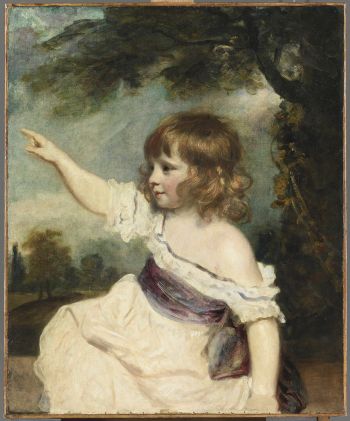
Joshua Reynolds, Portrait of Francis George Hare (1786–1842), ‘Master Hare’, ca. 1788–89, oil on canvas (Paris: Musée du Louvre, RF 1580).
A significant portion of the exhibition is dedicated to portraiture, a genre in which British painters excelled. In the 17th century, Flemish painter Anthony van Dyck was invited to stay at the Court of Charles I of England during the last decade of his career, a period that was a pivotal moment in the development of European portrait art whose conventions van Dyck reinvented (modello of the Double Portrait of the Palatinate Princes Charles Louis I and Prince Rupert, Museum of Fine Arts, Bordeaux). Among his most famous heirs we can mention Sir Joshua Reynolds, represented by his celebrated ‘Master Hare’ (Louvre) and his Portrait of Richard Robinson, Archbishop of Armagh (Museum of Fine Arts, Bordeaux). This survey of British portraiture culminates with the Portrait of John Hunter by Sir Thomas Lawrence (Museum of Fine Arts, Bordeaux).
In the history painting genre, the exhibition gives a special place to artists under-represented in French public collections, namely James Ward, with his superb Baptism of Christ (Louvre), Benjamin West (Phaeton Asking Apollo to Drive the Sun Chariot, Louvre), and Johan Zoffany (The Triumph of Venus and Venus and Adonis, Museum of Fine Arts, Bordeaux). The typically British genre, the conversation piece, is also represented, along with landscape, the latter dominated by the dramatic canvas by John Martin of Macbeth and the Three Witches (Museum of Fine Arts, Bordeaux).
The Museum of Fine Arts and its close partner the Louvre look forward to taking viewers on a fascinating journey of paintings from across the Channel, on an itinerary through the most significant works of art by generations of innovative, inquisitive, and daring artists.
Sandra Buratti-Hasan and Guillaume Faroult, British Stories: Conversations entre le musée du Louvre et des Beaux-Arts de Bordeaux (Paris: Snoeck Édition, 2021), 32 pages, ISBN: 978-9461616302, 10€.
Exhibition | A Gift to the Nation: The Hennage Collection

Tea and Coffee Service by Littleton Holland, Baltimore, ca.1800, silver and wood
(Colonial Williamsburg Foundation; bequest of Mr. and Mrs. Joseph H. Hennage)
◊ ◊ ◊ ◊ ◊
From the press release (15 June 2021) for the exhibition:
A Gift to the Nation: The Joseph and June Hennage Collection
DeWitt Wallace Decorative Arts Museum, Colonial Williamsburg, 26 June 2021 — 2023
Earlier this year, the Colonial Williamsburg Foundation announced the most significant single American decorative arts bequest in its 90-year history: The Joseph H. and June S. Hennage Collection with its more than 400 objects of various media including American furniture and miniature furniture, American silver, and Chinese porcelain that will transform Colonial Williamsburg’s already renowned collections. To celebrate this momentous bequest, an exhibition of approximately 50 highlighted objects, A Gift to the Nation: The Joseph and June Hennage Collection, will open in the Miodrag and Elizabeth Ridgely Blagojevich Gallery at the DeWitt Wallace Decorative Arts Museum, one of the newly expanded Art Museums of Colonial Williamsburg, on June 26, 2021 and remain on view through 2023. While only a fraction of the overall collection, the items selected for the exhibition will illustrate the Hennages’ exceptional taste and collecting style, the American origins and family histories of the objects and the couple’s passion for American decorative arts.
“Joe and June Hennage were remarkably generous and philanthropic,” said Ronald Hurst, the foundation’s Carlisle Humelsine chief curator and vice president for museums, preservation, and historic resources. “They wanted to ensure that these exceptional illustrations of the nation’s history and culture would be held in the public trust for everyone’s edification. Their gift to Colonial Williamsburg has done just that and we are forever in their debt.”
Collectors have many reasons for acquiring the objects they amass, but for the Hennages, who started collecting American decorative arts in the mid-1960s, the first step towards any antique purchase was ‘buying with your heart’, as June Hennage described it. The next step was studying the object for its authenticity, history and condition to determine if it was right for their collection. This method of consideration led to an assemblage of superlative examples of furniture and silver from important colonial centers including Boston, Philadelphia, New York, Baltimore, Charleston, and the Connecticut River Valley. Joe and June only acquired pieces on which they both agreed, and often the items were gifts to one another. Objects were selected both to fit within their home as well as to highlight various forms, such as tables, high chests, chairs, tea sets, and sauceboats, which represent the regional diversity in American furniture and silver. These pieces were complemented with an array of other materials, primarily Chinese export porcelain.
Colonial Williamsburg and its annual Antiques Forum played an important role in the Hennages’ collecting focus and philanthropy for more than 50 years; they received the highest honor for service to the foundation, the Churchill Bell award, in 1994. The couple’s patriotic generosity also extended to other institutions to whom they donated important American objects, including the U.S. State Department, the White House, the National Portrait Gallery, Mount Vernon, and Monticello.
Objects from the Hennage collection that were selected for this exhibition illustrate June and Joe’s collecting philosophy,” said Tara Chicirda, curator of furniture at the Colonial Williamsburg Foundation. “They specifically acquired representational objects from a variety of regions to highlight the local options in form or ornament, and they often sought out pieces with family histories or by well-known makers with signatures or labels. We have tried to show the breadth and depth of the furniture and silver collections in this exhibition as well as highlight their interest in miniature furniture and Chinese export porcelain.”
Although each object included in A Gift to the Nation is a highlight of the Hennage Collection, one exceptional piece of furniture is a high chest of drawers possibly made by Isaac Tryon in either Middletown or Glastonbury, Connecticut, located in the fertile Connecticut River Valley, between 1760 and 1790. Joe Hennage gave this piece to June as a gift, and many times over the years, the dealer who sold it to Joe offered to buy it back at a greater price. June declined to sell each time as she felt she would not be able to acquire another Connecticut high chest as nice as this example. Cabinetmakers, such as Isaac Tryon, crafted furniture for the wealthy inhabitants of the Connecticut River Valley, and the vertical, sleek lines and carved fans of this cherry high chest typify the work of makers in this region like Tryon.
Another highlight to the exhibition is a pair of French-inspired armchairs made in Philadelphia ca. 1790 and believed to have been originally owned by the wealthy Philadelphia merchant and signer of the Declaration of Independence, Robert Morris. French furniture and furniture inspired by French design became quite popular in America after the Revolution, especially in Philadelphia. Following this trend, George and Martha Washington purchased gold and white French chairs for the Presidential House there in 1790. The chairs survive with their original upholstery foundation covered in a reproduction silk of the same color as the show cloth first used.
Joe and June Hennage’s interests in American silver focused primarily on the period between 1730 and 1815 with emphasis in objects from Boston, Philadelphia, and Baltimore. Their collection of approximately 100 pieces includes tea and coffee sets, jugs, tankards, cans, goblets, porringers, sauceboats, casters, salvers, punch strainers, and ladles, many with known histories of ownership. As with the furniture and ceramics in the bequest of this collection, the silver from the Hennage collection is transforming the already important assemblage of silver in Colonial Williamsburg’s holdings.
“The Hennage silver bequest is game-changing, effectively doubling the number of American-made hollowware pieces owned by Colonial Williamsburg. It offers exciting new opportunities to interpret the diverse range of wares produced by silversmiths from New England to the South and includes important examples with distinguished pedigrees,” said Janine Skerry, Colonial Williamsburg’s senior curator of metals.
Among the highlights of the Hennage’s silver collection to be on view in A Gift to the Nation is a tea and coffee set by Littleton Holland made in Baltimore, Maryland, ca. 1800 (pictured above). Large en suite tea and coffee sets such as this example became popular by the earliest years of the nineteenth century. This set was made for the Krebs family of Baltimore and features two teapots—one for black tea and one for green—as well as a coffeepot, sugar urn, cream pot, and waste bowl. Fashioned in the late neo-classical style with broad fluted panels and bands of bright-cut engraving, this set exemplifies the end of the timeline for the silver that the Hennages collected; very few of their acquisitions date past 1810.

Pair of water bottles or guglets, Jingdezhen, China, ca. 1805 (Colonial Williamsburg Foundation; bequest of Mr. and Mrs. Joseph H. Hennage).
The Chinese export porcelain that Joe and June collected to complement their antique furniture and silver reflected their passion for American history and sense of design. The pieces to be on view in the exhibition include objects with rare American histories of ownership and those that reflect the couple’s love of vibrant color.
“The Chinese porcelain featured in the exhibition not only relays stories of the young United States, but also tells very personal stories of Joe’s and June’s love of collecting and their love of brilliant colors,” said Angelika Kuettner, associate curator of ceramics and glass at Colonial Williamsburg. “While the ceramics in this multimedia exhibit are only highlights from the collection, it’s important to note that, to date, the bequest marks the most significant addition to Colonial Williamsburg’s collection of Chinese porcelain destined for the post-Revolutionary American market.”
One such example of the Hennages’ love of vibrant color can be seen in A Gift to the Nation through their collection of a hot water dish and plates made in Jingdezhen, China, ca. 1800. These pieces made of hard-paste porcelain represent the variety of colors in which the so-called Fitzhugh pattern was available to eighteenth- and early nineteenth-century consumers. (Collectors have referred to this diaper and moth or butterfly-bordered four-paneled motif as ‘Fitzhugh’ since at least the late 19th century, and most likely the name derived from Thomas Fitzhugh who served as a British East India Company official from the 1780s until 1800.) The pattern often included a central medallion surrounding a floral sprig or a cypher. Instead of the central medallion, some pieces made specifically for export to the American market feature a splayed eagle holding within its beak a banner bearing the motto ‘E Pluribus Unum’, all representative of the Great Seal. Vibrant green, orange, yellow, and brown as well as the more common underglaze blue version were available and pieces decorated in yellow, such as the Hennages’, are among the rarest examples.
A Gift to the Nation: The Joseph and June Hennage Collection is generously funded by Cynthia Hardin and Robert S. Milligan and Mary Virginia E. and Charles F. Crone in honor of Ronald and Mary Jean Hurst.










 Enfilade
leave a comment