Exhibition | In Sparkling Company: Glass and Social Life

Pair of covered green vases, ca. 1765 and a pair of vases, 1750–75, probably from the workshop of James Giles, London, gilded copper-green lead glass (Corning, New York: Corning Museum of Glass, 2003.2.4 A-B, 54.2.4 A-B).
◊ ◊ ◊ ◊ ◊
Notice of the exhibition appeared here in February 2020, but I note it again since the show is scheduled to open (with new dates) later this month. –CH
Press release (30 October 2019) for the exhibition:
In Sparkling Company: Glass and the Costs of Social Life in Britain during the 1700s
Corning Museum of Glass, Corning, New York, 22 May 2021 — 2 January 2022
Curated by Christopher Maxwell
The Museum’s spring exhibition, In Sparkling Company: Glass and Social Life in Britain during the 1700s, will open May 9, 2020. With exhibition design by Selldorf Architects, In Sparkling Company will present the glittering costume and jewelry, elaborate tableware, polished mirrors, and dazzling lighting devices that delighted the British elite, and helped define social rituals and cultural values of the period. Through a lens of glass, this exhibition will show visitors what it meant to be ‘modern’ in the 1700s, and what it cost.
The exhibition will also include a specially created virtual reality reconstruction of the remarkable and innovative spangled-glass drawing room completed in 1775 for Hugh Percy, 1st Duke of Northumberland (1714–1786), and designed by Robert Adam (1728–1792), one of the leading architects and designers in Britain at the time. An original section of the room (which was dismantled in the 1870s), on loan from the Victoria and Albert Museum in London, will be on view in North America for the first time as part of the exhibition. It will be accompanied by Adam’s original colored design drawings for the interior, on loan from the Sir John Soane’s Museum, London.
“One medium that is often overlooked in scholarly discussions of 18th-century art, design, and material culture is glass,” said Christopher L. Maxwell, Curator of European Glass at CMoG, who has organized the exhibition. “In Britain, developments in glass formulas and manufacturing techniques resulted in new and better types of glass, from windowpanes and mirrors to heavy, clear ‘crystal’ tableware, perfectly suited to the tastes and needs of Britain’s growing urban elite whose wealth derived from new enterprises in finance, manufacture, international trade and colonial expansion. In Sparkling Company will demonstrate the many functions and meanings of glass in the exuberant social life of the 1700s.”
The smooth, ‘polished’ and reflective properties of glass perfectly embodied 18th-century ideals of sociability, in what is considered by many as the ‘age of politeness.’ As urban centers grew in size and prosperity, sociability became ever more sophisticated. The terms ‘polite’ and ‘polished’ were often used interchangeably in the numerous etiquette manuals eagerly read by those wishing to take their place in the polite world. Examples of such literature will be displayed alongside fashionable glass of the period, including embroidered costume, mirrors, a chandelier, cut glass lighting and tableware, and paste jewelry that accessorized and defined the lives of the ‘polished’ elite.
In the 1700s Britain was a prosperous and commercial nation. Its growing cities were hubs of industry, scientific advancement, trade and finance, and its colonies were expanding. British merchants navigated the globe carrying a multitude of cargoes: consumable, material, and human. Underpinning Britain’s prosperity was a far-reaching economy of enslavement, the profits of which funded the pleasures and innovations of the fashionable world, among them luxury glass. Alongside the beauty and innovation of glass during this period, the exhibition will consider the role of the material as a witness to colonization and slavery. Using artifacts and documents relating to the slave trade, it will reveal a connection that permeated all levels of British society.
From glittering costume and elaborately presented confectionery, to polished mirrors and dazzling chandeliers, glass helped define the social rituals and cultural values of the period. While it delighted the eyes of the wealthy, glass also bore witness to the horrors of slavery. Glass beads were traded for human lives while elegant glass dishes, baskets and bowls held sweet delicacies made with sugar produced by enslaved labor.
In Sparkling Company: Glass and Social Life in Britain during the 1700s will include important examples of 18th-century British glass, including:
• Glass embroidered costume: a spectacular men’s coat intricately decorated with glass ‘jewels’ made around 1780; a pair of women’s shoes covered in glass beads; shoe buckles set with glass paste jewels; jewelry and other accessories.
• Cut glass lighting and tableware, all made possible through the perfection of British lead ‘crystal’ in the late 1600s and exported throughout Europe and the British colonies in America and beyond.
• A number of large mirrors, which became the tell-tale sign of a fashionable interior, and reverse-painted glass meticulously decorated in China for the British luxury market.
• Opulent glass dressing room accessories, including a magnificent gilded silver dressing table set, with a looking glass as its centerpiece, made in about 1700 for the 1st Countess of Portland; perfume bottles, patch boxes, a dazzling cut glass washing basin and pitcher and an exquisite blue glass casket richly mounted in gilded metal, used in the ‘toilette’ a semi-public ritual of dressing which was adopted from France for men and women alike and became a feature of British aristocratic life in the 18th century.

Robert Adam, Design for the end wall of the drawing room at Northumberland House, 1770–73, pen, pencil, and colored washes, including pink, verdigris, and Indian yellow on laid paper, 52 × 102 cm (London: Sir John Soane’s Museum, SM Adam, volume 39/7; photo by Ardon Bar Hama).
◊ ◊ ◊ ◊ ◊
Glass Drawing Room for the Duke of Northumberland
Over the course of the 18th century, domestic interiors were transformed by the increasing presence of clear and smooth plate glass. A remarkable example is the lavish drawing room designed by the celebrated British architect Robert Adam for Hugh Percy, 1st Duke of Northumberland (1714–1786) and his wife, the Duchess Elizabeth Percy (1716–1776), and completed in 1775. This unique room, measuring 36 by 22 feet, was paneled between dado rail and architrave with red glass panels sprinkled on the reverse with flakes of metal foil, like large-scale glitter. Similarly spangled green glass pilasters, large French looking glasses, and intricate neo-classical ornament in gilded lead completed the dazzling scheme. The room was altered in the 1820s and finally dismantled in the 1870s, when Northumberland House was demolished. Many of the panels were acquired by the V&A Museum in the 1950s, but their poor condition meant that they could only be partially displayed. The panels on display at The Corning Museum of Glass incorporate newly-conserved elements from the V&A’s stores.
In Sparkling Company will feature a virtual reality reconstruction of the drawing room, created by Irish production house Noho. Visitors to the exhibition will be transported into the interior, experiencing the original design scheme—last seen almost 200 years ago. This will be the first virtual-reality experience ever offered at CMoG. Visitors will also be able to see Robert Adam’s design drawings, on loan from the Sir John Soane’s Museum, London, and a section of the original Northumberland House Glass Drawing Room on loan from the V&A Museum, which has never been on view in North America.
In Sparkling Company: Glass and Social Life in Britain during the 1700s will include loans from the Victoria and Albert Museum; Sir John Soane’s Museum; the Museum of London; the Fashion Museum, Bath; Royal Museums Greenwich; Los Angeles County Museum of Art (LACMA); Penn State University Library; Cleveland Museum of Art; and The Museum of Fine Arts in Boston.
The exhibition is accompanied by a catalogue, In Sparkling Company: Reflections on Glass in the 18th-Century British World (The Corning Museum of Glass, 2020). Publication contributors include Marvin Bolt, Kimberly Chrisman Campbell, Jennifer Chuong, Melanie Doderer Winkler, Christopher Maxwell, Anna Moran, Marcia Pointon, and Kerry Sinanan.
◊ ◊ ◊ ◊ ◊
Note (added 16 September 2021) — The posting has been updated to include the revised title; the original title was In Sparkling Company: Glass and Social Life in Britain during the 1700s.
The Burlington Magazine, March 2021
The eighteenth century in The Burlington (I’m catching up, gradually!) . . . –CH
The Burlington Magazine 163 (March 2021)
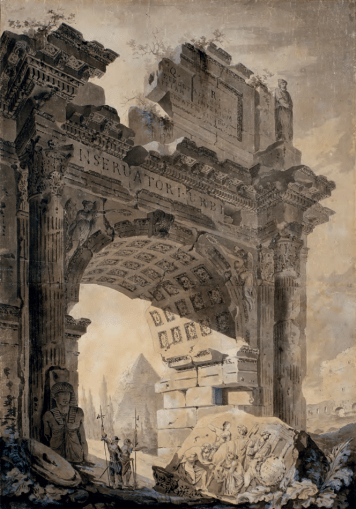
Hubert Robert, Arch of Septimius Severus, 1756; pen with grey and beige washes, 73 × 52 cm (Musée de Valence).
A R T I C L E S
• Pedro Luengo, “Spatial Rhetoric: Echoes of Madrid’s Alcázar in Palaces Overseas,” pp. 236–43.
Several key features of the Alcazar in Madrid—including the twin-courtyard plan, double staircase, and layout of the royal chapel—were replicated in royal palaces in Spain and elsewhere and in the viceregal palaces in Spain’s American empire as part of a desire to project a unified imperial image.
• Yuriko Jackall and Kari Rayner, “Becoming Hubert Robert: Some New Suggestions,” pp. 244–53.
The thin documentation of Hubert Robert’s early years makes it difficult to understand how the largely untrained student who went to Rome in 1754 emerged as a leading talent in Paris in the mid 1760s. Close examination of his art suggests that his rapid development was due to a rigorous course of study of perspective and life drawing, probably in response to criticisms of his abilities by the secretary of the Académie Royale, Charles-Nicolas Cochin.
R E V I E W S
 • Michael Hall, Review of Matthew Reeve, Gothic Architecture and Sexuality in the Circle of Horace Walpole (Pennsylvania State University Press, 2020), pp. 264–69.
• Antonio Mazzotta, Review of the exhibition Tiepolo: Venezia, Milano, l’Europa (Milan: Gallerie d’Italia, 2020–21), pp. 273–75.
• Christoph Stiegemann, Review of the exhibition Passion, Leidenschaft: Die Kunst der großen Gefühle (Münster: LWL-Museum für Kunst und Kultur, 2020–21), pp. 275–78.
• Stephen Leach, Review of Matthew Craske, Joseph Wright of Derby: Painter of Darkness (Paul Mellon Centre for Studies in British Art, 2020), pp. 297–98.
• Philippe Malgouyres, Review of Suzanne Higgott, ‘The Most Fortunate Man of his Day’: Sir Richard Wallace: Connoisseur, Collector, and Philanthropist (Wallace Collection, 2018), pp. 298–99.
• Elena Almirall Arnal, Review of Carolina Naya Franco, El joyero de la Virgen del Pilar: Historia de una colección de alhajas europeas y americanas (Institución Fernando El Católico, 2019), pp. 302–03.
• Gauvin Alexander Bailey, Review of Laura Windisch, Kunst, Macht, Image: Anna Maria Luisa de’ Medici (1667–1743) im Spiegel ihrer Bildnisse und Herrschaftsräume (Böhlau Verlag, 2019), p. 303.
O B I T U A R I E S
• Peter Cherry, Obituary of Carmen Garrido (1947–2020), pp. 305–06.
Director of the Gabinete de Documentación Técnica at the Prado for thirty years, Carmen Garrido made major contributions to the technical study of Spanish painting, in particular with her publications on Diego Velázquez.
• Ger Luijten, Obituary of David Scrase (1949–2020), pp. 306–08.
In a career spent almost entirely at the Fitzwilliam Museum, Cambridge, David Scrase was responsible for numerous significant acquisitions and exhibitions. His magnum opus his his catalogue for the museum’s Italian drawings, published in 2011.
Exhibition | American Weathervanes
This summer at the American Folk Art Museum (with the catalogue already available from Rizzoli). . .
American Weathervanes: The Art of the Winds
American Folk Art Museum, New York, 23 June 2021 — 2 January 2022
Organized by Robert Shaw and Emelie Gevalt
 American Weathervanes: The Art of the Winds is the first exhibition in more than four decades to highlight the beauty, historical significance, and technical virtuosity of American vanes fashioned between the late seventeenth and early twentieth centuries. The exhibition includes the graceful figure of Fame blowing a trumpet and standing en pointe like a celestial ballerina, attributed to well-known manufactory E.G. Washburne & Co. in New York City; a Dove of Peace designed by George Washington for his home in Mount Vernon; and an eagle possibly made in the foundry of revolutionary patrior Paul Revere. In addition to weathervanes, the exhibition will also include beautifully articulated wood sculptures by Harry Leach that functioned as patterns for weathevane molds for the Cushing & White and L.W. & Sons manufactories in Waltham, MA., watercolors of historic weathervanes painted for the Index of American Design, and rare archival materials that illuminate the development of the weathervane in the United States of America.
Robert Shaw is a critically acclaimed author, curator, and art historian who has written and lectured extensively on many aspects of American folk art. He has curated exhibitions at the Dallas Museum of Natural History, the Fenimore Art Museum, the National Gallery of Art, and the Shelburne Museum, where he served as curator from 1981 to 1994.
Robert Shaw, American Weathervanes: The Art of the Winds (New York: Rizzoli Electa, 2021), 256 pages, ISBN: 978-0847863907, $75.
Exhibition | À Table!
This summer at the National Museum of Ceramics at Sèvres, with an online version available here:
À Table! Le repas, tout un art / The Meal, a Whole Art
Sèvres — Manufacture et Musée Nationaux, 18 November 2020 — 16 May 2021 [original dates to be extended]
Organized by Anaïs Boucher and Viviane Mesqui
 The exhibition À Table! Le repas, tout un art explores the historical and cultural aspects of the art of the table and the art of French gastronomy. It reveals how the opulent and elegant banquets of the Ancien Régime became part of French culture by constituting an ideal of happiness and by transforming everyday lunches and dinners into extraordinary social occasions.
With a chronological approach, the exhibition explains the origins of popular French delicacies and how dining etiquette has evolved from antiquity to today. The selection of a variety of plates, forks, and other objects—functional or of pure fantasy—narrates the amazing stories behind familiar food customs. Sèvres porcelain is in the spotlight as it plays an important role in setting exquisite tables. This feast of Sèvres cups, plates, and glacières is our way to celebrate the 280th anniversary of the Sèvres Manufacture.
Anaïs Boucher and Viviane Mesqui, À Table! Le repas, tout un art (Montreuil: Gourcuff Gradenigo, 2020), 240 pages, ISBN: 978-2353403257, €39.
Exhibition | Joshua Johnson: Portraitist of Early American Baltimore

The exhibition opens this Saturday; from the press release:
Joshua Johnson: Portraitist of Early American Baltimore
Washington County Museum of Fine Arts, Hagerstown, Maryland, 17 April 2021 — 23 January 2022
Curated by Daniel Fulco
This exciting exhibition, organized by the Washington County Museum of Fine Arts and curated by Daniel Fulco, Agnita M. Stine Schreiber Curator, is the first monographic look at the work of the enigmatic and compelling African American artist Joshua Johnson (ca. 1763–1824) since 1988. Often considered the first professional Black artist in America, Johnson was a freed slave who achieved a remarkable degree of success as a portraitist in his lifetime by painting affluent patrons in his native Baltimore. Johnson’s subjects consisted of politicians, doctors, clergymen, merchants, and sea captains.
Joshua Johnson: Portraitist of Early American Baltimore contextualizes Johnson both historically and culturally and explores further the key forms of natural symbolism represented in his paintings. Featuring works by Johnson and his contemporaries, key loans come from the Maryland Center for History & Culture, the Baltimore Museum of Art, the Archdiocese of Baltimore, and the Bowdoin College Museum of Art. This exhibition also will include a fully illustrated scholarly interpretive catalogue and a diverse range of related educational programs. Museum Director Sarah J. Hall says, “This exhibition has been in planning for three years, and has ended up being a particularly timely investigation of both art history and Black history. Additionally, it adds to our understanding of regional history in terms of both the practice of portraiture and our understanding of those who made and commissioned portraits. Happily, the exhibition will be on view for a full six months in order to allow as many people as possible to enjoy Johnson’s work and the wide variety of related public programs scheduled.”
An artist whose ancestry was both African and European, Johnson was primarily a self-taught painter. He was especially adept at capturing his sitters’ features and the details of their clothing, which offered subtle insights into their personalities. Johnson’s attention to detail and extensive inclusion of moths, fruits, and flowers in his paintings indicate that he carefully absorbed techniques and motifs from traditional European portraiture to create symbolic meaning. Furthermore, Johnson combined these elements with the latest trends in his genre, responding closely to work of the Peales, Charles Peale Polk, and Mid-Atlantic limners such as Frederick Kemmelmeyer and Caleb Boyle.
Given his background and the era in which he lived, Johnson was impelled to overcome many racial and social hurdles in pursuing his profession and he persevered remarkably in that endeavor. As described in an advertisement in the Baltimore Intelligencer from 1798, Johnson referred to himself in the third person as “A self-taught genius, deriving from nature and industry his knowledge of the Art; and having experienced many insuperable obstacles in the pursuit of his studies, it is highly gratifying to him to make assurances of his ability to execute all commands with an effect, and in a style, which must give satisfaction.”
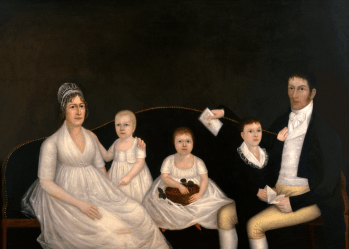
Joshua Johnson, Portrait of the James McCormick Family, 1804–05, oil on canvas, 51 × 69 inches (Collection of Maryland Center for History and Culture, Baltimore, gift of Dr. Thomas C. McCormick, 1920.6.1).
Such issues of race in Early American society still remain relevant and while a compelling and important theme to consider in relation to Johnson’s life and work, the exhibition also examines how his work engages with key developments in Maryland’s artistic heritage from approximately 1760 until 1840. Joshua Johnson: Portraitist of Early American Baltimore also explores issues related to politics, slavery, abolitionism, and society in antebellum Maryland.
As a complement to the Joshua Johnson: Portraitist of Early American Baltimore, the Museum will be installing a companion exhibition. Face to Face: Portraits from the 18th and 19th Centuries (April–October 2021), featuring European and American portraits from the permanent collection. These works expand the context of the Johnson exhibition and allow for a deeper understanding of the artist’s portraiture both before and during his lifetime.
Joshua Johnson: Portraitist of Early American Baltimore is organized by the Washington County Museum of Fine Arts. This exhibition is generously supported by grants from the National Endowment for the Arts, the Art Dealers Association of America Foundation, Heart of the Civil War Heritage Area, Maryland Marketing Partnership, and Community Foundation of Washington County Maryland, Inc. This exhibition also is made possible with the support of an anonymous donor, Mr. and Mrs. James N. Holzapfel, Dr. & Mrs. George E. Manger, Dr. and Mrs. Robert S. Strauch, and Mr. & Mrs. Thomas B. Riford.
Daniel Fulco, ed., with David Taft Terry and Mark B. Letzer, Joshua Johnson: Portraitist of Early American Baltimore (Hagerstown, MD: Washington County Museum of Fine Arts, 2021), 106 pages, ISBN: 978-09144950301 (paperback), $25 / ISBN: 978-09144950408 (ebook), $10.
Daniel Fulco is Agnita M. Stine Schreiber Curator at the Washington County Museum of Fine Arts. David Taft Terry is Associate Professor in the Department of History and Geography and Coordinator, Museum Studies & Historical Preservation Program at Morgan State University. Mark B. Letzer is President & CEO of the Maryland Center for History and Culture.
A variety of engaging complementary on-line programs are scheduled to enhance enjoyment of the exhibition, including discussions, lectures, and lesson-plans for use in classroom or at home. Check wcmfa.org, or the Museum’s social media pages for more information on registration and access.
About the Museum
Located in beautiful City Park, Hagerstown, Maryland, the Washington County Museum of Fine Arts was founded in 1931, the legacy of Hagerstown native Anna Brugh Singer and her husband, Pittsburgh-born artist William Henry Singer, Jr. Featuring a collection of more than 6,000 objects, the Museum has important holdings of American painting, Old Masters, decorative arts, and sculpture. The Museum schedules an ambitious program of exhibitions, lectures, concerts, tours, and talks featuring national and international artists, and annually organizes and hosts the Cumberland Valley Artists and Cumberland Valley Photographers exhibitions, as well as a yearly showcase of the art of K-12 students in Washington County Public Schools. Its free youth art education programs have served four generations of local families. The Washington County Museum of Fine Arts has been free to the public since 1931.
◊ ◊ ◊ ◊ ◊
Note (added 7 January 2022) — The posting was updated with the extended date; the exhibition was originally scheduled to close 24 October 2021.
Exhibition | Bound for Versailles
Opening this summer at The Morgan:
Bound for Versailles: The Jayne Wrightsman Bookbindings Collection
The Morgan Library & Museum, New York, 25 June — 26 September 2021
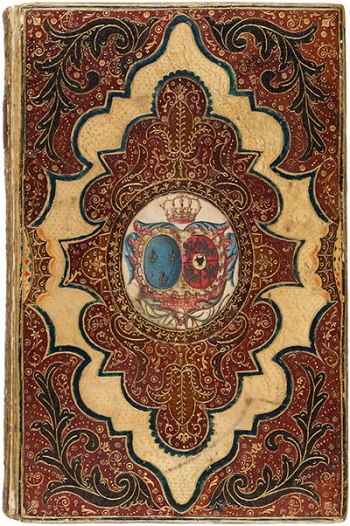
Binding by Jacques-Antoine Derome for Marie Leczinska, with the queen’s arms under mica. Le Pseautier de David, traduit en francois, avec des notes courtes, tirées de S. Augustin, & des autres Peres. Nouvelle edition, Paris: Chez Louis Josse et Charles Robustel, 1725. W 1028.
In the spring of 2019 Jayne Wrightsman bequeathed to the Morgan an exceptional collection of books bound for the highest echelons of 18th-century French society. Owned by kings, queens, dukes, and duchesses, the books are monuments of fine printing, elegant engraved illustration, and artistic binding by the most renowned craftspeople. Elaborately decorated bookbindings provided a canvas for an individual to signal their wealth and taste through bookbinders who reflected the trends and developments in contemporary artistic styles.
The books on display showcase the important role women—such as Madame Adélaïde (daughter of King Louis XV) and Queen Marie-Antoinette—had as book owners and collectors. Book illustrations by François Boucher, Jean-Baptiste Oudry, and Charles-Nicolas Cochin capture the visual ethos of the 18th century, while the artisan binders (male and female) at the workshops of Luc-Antoine Boyet, Antoine-Michel Padeloup, Nicolas-Denis Derome, and others produced bindings worthy of the shelves at Versailles. This exhibition honors Mrs. Wrightsman’s gift and her collecting acumen in recognizing the important role bookbinding played in the decorative arts and the cultural life of the Ancien Régime.
Bound for Versailles: The Jayne Wrightsman Bookbindings Collection is made possible with support from the Jamie and Maisie Houghton Fund and the Parker Gilbert Fund, and with assistance from the Malcolm Hewitt Wiener Foundation.
Exhibition | Bibiena Drawings from the Jules Fisher Collection
Opening in May at The Morgan:
Architecture, Theater, and Fantasy: Bibiena Drawings from the Jules Fisher Collection
The Morgan Library & Museum, New York, 28 May — 12 September 2021
 For nearly a century, members of three generations of the Bibiena family were the most highly sought theater designers in Europe. Their elaborate stage designs were used for operas, festivals, and courtly performances across Europe: from their native Italy to cites as far afield as Vienna, Prague, Stockholm, St. Petersburg, and Lisbon. Beyond these performances, the distinctive Bibiena style survives through their remarkable drawings. This exhibition is the first in the United States in over thirty years to celebrate these talented draftsmen and marks the promised gift to the Morgan of a group of Bibiena drawings from the collection of Jules Fisher, the Tony-winning lighting designer. These drawings demonstrate the range of the Bibienas’ output, from energetic sketches to highly finished watercolors. With representations of imagined palace interiors and lavish illusionistic architecture, this group of drawings will highlight the visual splendor of the baroque stage.
Arnold Aronson, Diane Kelder, John Marciari, and Laurel Peterson, Architecture, Theater, and Fantasy: Bibiena Drawings from the Jules Fisher Collection (London: Paul Holberton, 2021), 96 pages, ISBN: 978-1913645045, £17 / $25.
Arnold Aronson is professor of theatre in the MFA Theatre Program at the Columbia University School of the Arts. Diane Kelder is professor emerita of art history at the Graduate Center, CUNY, and consulting curator of the Fisher collection. John Marciari is the Charles W. Engelhard Curator of Drawings and Prints and curatorial chair at the Morgan Library & Museum. Laurel Peterson, formerly the Moore Curatorial Fellow at the Morgan Library & Museum, is an independent scholar.
Exhibition | Taming the Tongue in the Heyday of English Grammar
From the press release for the exhibition:
Taming the Tongue in the Heyday of English Grammar, 1711–1851
The Grolier Club, New York, 4 March — 15 May 2021
 The exhibition Taming the Tongue in the Heyday of English Grammar (1711–1851), is on display March 4 through May 15, 2021, at the Grolier Club. It offers a revelatory glimpse into a time when English grammar was taught and studied with a grim fervor unthinkable to us now. Sales of books on grammar were second only to those of the Bible. The subject was so serious that grammar books, when illustrated, often showed pictures of children being caned or whipped, perhaps for sins such as dangling their participles.
Some grammarians offered beautiful tributes to the language; others came for battle, armed with claims of invincibility against allegedly incompetent rivals. This exhibition tells the colorful story of these books and the extraordinary characters who wrote them. Highlights from the English-grammar collection of Bryan A. Garner, a grammarian, lexicographer, law professor, and Grolier member, are on view in the second-floor gallery.
The exhibition also explores issues central to our literary history. For instance, it sheds new light on the rivalry between Noah Webster, the “father of the American dictionary,” and Lindley Murray, the “father of English grammar.” One previously unknown document connects the two men in a failed business transaction in New York—a real-estate contract that Webster breached. It helps explain how the two men came to detest each other.
There’s more:
• Elizabeth Elstob, who in 1715 wrote the first Old English grammar despite being raised by an uncle who disapproved of female education. The book is an amazing feat.
• William Cobbett, a populist politician who became a grave-robber, digging up Thomas Paine’s bones in hopes of rallying the English around political reform. Passionate about linguistic correctness, he would have gone to prison (where he often found himself), had the need arisen, in defense of his grammatical views.
• Samuel Kirkham, the best-selling grammarian who inspired Abraham Lincoln. Kirkham was also a phrenologist who bequeathed his own skull to his widow, and then to his son. His obituary began with its precise measurements.
One of the grammars, by John Comly (1808), contains the first-known (now widely repudiated) prohibition of the split infinitive. Another, by Ann Fisher (1762), first laid down the still-controversial ‘rule’ that the masculine pronoun includes the feminine.
The catalogue tells some extraordinary stories, such as the member of Congress—a Pennsylvania Whig—who in 1847 wrote a grammar filled with racial animus; the Ohio gubernatorial contender who in 1835 wrote a grammar rife with plagiarism, which helped get him booted from his church; and a cult leader who, once excommunicated, decided in 1826 to write a grammar “to liberate this important branch of science from long-received errours [sic].” Then there’s the best-selling grammar with the big-print typo on the title page: “ENGISH GRAMMAR.”
This is not your father’s grammar—nor your mother’s. It’s your great-great-great-great grandparents’ grammar. And it’s all on display at the Grolier Club, accompanied by a richly illustrated catalogue from Oak Knoll Press.
Bryan Garner, Taming the Tongue in the Heyday of English Grammar, 1711–1851 (New York: The Grolier Club, 2021), 301 pages, ISBN: 978-1605830926, $45.
An online version is available here»
Exhibition | Yinka Shonibare CBE: End of Empire

Yinka Shonibare CBE, End of Empire, 2016; fiberglass mannequins, Dutch wax printed cotton textile, metal, wood, motor, globes, and leather; 116 × 201 × 39 inches.
◊ ◊ ◊ ◊ ◊
Opening this spring at the Museum der Moderne:
Yinka Shonibare CBE: End of Empire
Museum der Moderne, Salzburg, 22 May — 12 September 2021
Curated by Thorsten Sadowsky and Marijana Schneider
One of the most prominent and versatile artists working in the UK today, Yinka Shonibare CBE (b. London, 1962) makes work that scrutinizes the legacy of Western colonialism and its lingering traces. The British-Nigerian artist rose to renown with installations featuring headless life-sized figures in historic costumes tailored out of colorful batik-dyed fabrics. A self-described ‘postcolonial hybrid’, Shonibare zooms in on episodes from art and history, primarily from eighteenth- and nineteenth-century Europe, employing subversive creative strategies to visualize them in tragicomic scenes of human activity. Shonibare’s multimedia oeuvre probes constructions of race, class, and national and cultural identities through a sustained study of the historic interdependencies between Africa and Europe. The retrospective gathers ca. sixty works from the past thirty years.
The catalogue is distributed in North American by The University of Chicago Press:
Thorsten Sadowsky, ed., Yinka Shonibare CBE: End of Empire (Munich: Hirmer Publishers, 2021), 256 pages, ISBN: 978-3777435893, $45.
 Since the 1990s, the British-Nigerian artist Yinka Shonibare CBE has developed opulently executed sculptures and installations, colorful collages, and theatrically staged photographs and films. The signature material in Yinka Shonibare’s multimedia artworks, so-called African fabric, is a cipher. Originally produced in Manchester and intended for sale in Indonesia, the brightly colored fabric gained its name after British imperialists shifted their focus to colonial Africa. Featuring this product of both colonization and self-identification, Shonibare’s sculptures and installations revisit the conflicted legacy of many historical artifacts in order to explore the complex hybridity of postcolonial life with unique irony. Illustrated by two hundred full-color reproductions of his work, Yinka Shonibare CBE: End of Empire offers an up-close encounter with the tensions and history that motivate this singular artist, tracing colonialism and its consequences for leaders, worldviews, and body images in his oeuvre.
Thorsten Sadowsky is director of the Museum der Moderne in Salzburg, Austria.
Exhibition | Thomas Lawrence: Coming of Age
From The Holburne Museum:
Thomas Lawrence: Coming of Age
The Holburne Museum, Bath, 9 January — 3 May 2021 (currently closed)
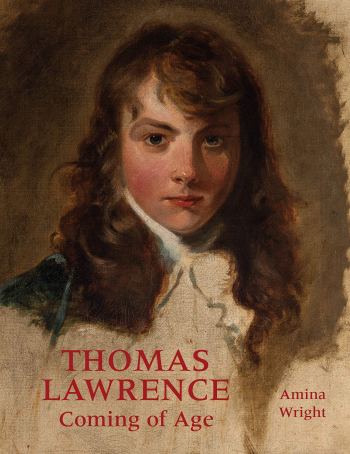 When he arrived in Bath in 1780, aged just eleven, Thomas Lawrence (1769–1830) was already being hailed as a prodigy in the mould of Renaissance masters such as Raphael, Dürer, and Michelangelo. The Holburne Museum’s new exhibition, Thomas Lawrence: Coming of Age, focuses on works made when the artist was between the ages of ten and twenty-two, giving visitors fresh insights into the early development of one of Britain’s greatest portrait painters and the range of his uniquely prodigious talent. The show includes some of Lawrence’s earliest and most brilliant works in pencil, pastel, and oil—several of which have been rarely seen in public.
When the Royal Academy’s 22nd annual exhibition opened in April 1790, its most sensational paintings included twelve portraits by Lawrence. Visitors and critics could scarcely believe that the artist was only 20 (he was due to celebrate his 21st birthday the following week); in fact, one reviewer published Lawrence’s birth certificate to prove that the creator of several of the exhibition’s most outstanding and original works had yet to come of age.
The Holburne exhibition presents fifteen works, following the future President of the Royal Academy over a period of twelve years, from childhood to his early-twenties. Seven of these years were spent in Bath, where he learned the professional skills of a portrait painter, and five in London where, despite his youth, he produced some of his most brilliant and memorable work. The show begins in 1779 as Lawrence, the Bristol-born son of an innkeeper from Devizes in Wiltshire, makes his debut as a child prodigy in Oxford. It follows him to the competitive and colourful world of Bath, where he made friends with actors such as David Garrick and writers, including the famed diarist Fanny Burney, and other influential patrons. Bath being Bath, his sitters included some of the most famous and glamorous members of British high society, including the legendary Georgiana Spencer, later Duchess of Devonshire, whose 1782 pastel on paper portrait has been kindly loaned to the exhibition by the Chatsworth House Trust. The story ends in the early 1790s shortly before his election as a full member of the Royal Academy, aged 25.
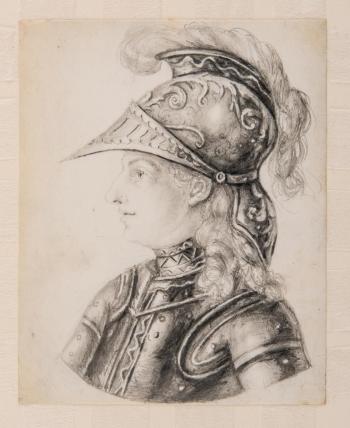
Thomas Lawrence, Head of Minerva, 1779, pencil drawing (Private Collection).
Lawrence had demonstrated an aptitude for sketching when he was around the age of four and had begun producing saleable work aged six. It is known from the few surviving early portraits that he began working in graphite pencil, drawing quick, small-scale head and shoulder profiles on vellum. Coming of Age features several such portraits: the earliest, a Head of Minerva (private collection) made in 1779 during his brief sojourn in Oxford; an accomplished and imaginative profile portrait of his sister Anne (British Museum), drawn in 1781; and a sketch of his cousin, Miss Hammond (British Museum), made in the same year, vividly capturing the young girl’s character and energy.
The artist’s father, recognising his son’s artistic gifts, had taken Thomas to Oxford and London on something of a promotional tour. It was in the capital that Lawrence met the preeminent English painter and President of the Royal Academy, Sir Joshua Reynolds, who is said to have pronounced the youngster as his successor and, according to Fanny Burney’s account from 1780: “The most promising genius he had ever met with.”
Lawrence’s father was declared bankrupt in 1779, and the family relocated to Bath, a thriving city with a wealthy and fashionable society, which would afford the putative artist ample opportunity to demonstrate his skills and make money.
Near the time of his eighteenth birthday, Lawrence moved to London where, despite his youth, he produced some of his most brilliant and memorable work, a fine example of which is the Holburne’s own preparatory sketch for a portrait (now in the Los Angeles County Museum of Art), of Arthur Atherley (1791). Five years after leaving Bath, Lawrence exhibited his final three-quarter-length portrait of Arthur Atherley at the Royal Academy. At the time, he was just three years older than his nineteen-year-old sitter, who had recently left Eton College. The Holburne portrait of Atherley is both striking and memorable, showing the determined the youngster as he launches into the adult world.

Thomas Lawrence, Portrait of Elizabeth Carter, pastel on vellum, ca. 1788–89, 35 × 30 cm (London: National Portrait Gallery).
Coming of Age charts Lawrence’s development as an artist, showing his use of different materials and burgeoning technical craft. As his ability in oil and chalk grew, he gradually abandoned pastel portraits. His last and best head in crayons is a likeness of the elderly classical scholar Elizabeth Carter (ca. 1788–89, National Portrait Gallery). Carter was renowned as a woman of exceptional intellectual powers and also possessed great warmth as a person, which Lawrence’s portrait evokes, revealing her combination of the cerebral and the grandmotherly, deftly using pastel to convey the soft plumpness of her face and the elaborately trimmed and starched cap, while her thoughtful expression suggests a mind tuned to higher things.
The Holburne’s Director, Chris Stephens, says: “Thomas Lawrence did as much as any other artist, before or after him, to define the age in which he lived. The Holburne is renowned for celebrating local creativity and bringing the best of world art to the region, and this is perfectly encapsulated in the study of Thomas Lawrence’s youthful works, a true Bath story. He is our very own answer to Raphael. The exhibition was inspired by our acquisition of one of Lawrence’s greatest works, his Portrait of Arthur Atherley, 1791. It is one of a number of portraits by Lawrence of young men, and women, in their late teens, on the cusp of adulthood. This is, perhaps, a unique phenomenon of an artist portraying young adulthood when he was, himself, not much older than the sitters. It is around this idea of young people facing a rite of passage, confronting the hopes and fears of leaving adolescence for adulthood, that we find some of the contemporary resonances in Lawrence’s art.”
◊ ◊ ◊ ◊ ◊
Amina Wright, Thomas Lawrence: Coming of Age (London: Philip Wilson Publishers, 2021), 112 pages, ISBN: 978-1781300947, £18.
C O N T E N T S
Acknowledgements
Foreword
Introduction
1 Portrait of the Artist as a Young Prodigy
2 Striking Likenesses
3 Old Masters and New Horizons
4 Risking my Reputation
5 The Most Hazardous Step
6 Gleams of Power
Notes
Select Bibliography
Image Credits
Index










 Enfilade
leave a comment