Exhibition | Canaletto: Painting Venice
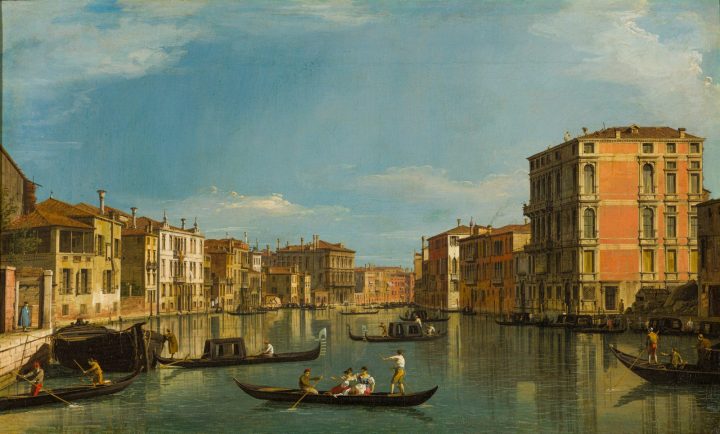
Canaletto, Grand Canal looking East from Palazzo Bembo to Palazzo Vendramin-Calergi, 1733–36
(Woburn Abbey Collection)
◊ ◊ ◊ ◊ ◊
From The Holburne Museum:
Canaletto: Painting Venice
The Holburne Museum, Bath, 22 January — 5 September 2021
National Maritime Museum, Greenwich, 1 April — 25 September 2022
In 2021, the Holburne Museum in Bath will present the most important set of paintings of Venice by Canaletto (1697–1768), which will leave their home at Woburn Abbey—one of world’s most important private art collections—for the first time in more than 70 years. This once in a lifetime exhibition will enable art lovers to enjoy and study up-close twenty-three beautiful paintings, in a fascinating exhibition that also explores Canaletto’s life and work, alongside themes of 18th-century Venice and the Grand Tour. This is one of the rare occasions that any of the successive Dukes of Bedford and Trustees of the Bedford Estates have lent the set of paintings since they arrived in Britain from Canaletto in the 1730s.
The pictures were commissioned by the 4th Duke of Bedford, who was evidently attracted by Canaletto’s burgeoning reputation for producing precise and atmospheric views of the Italian city’s most iconic views and landmarks. The Duke, then Lord John Russell, was in Venice on the Grand Tour in 1731, and presumably met Joseph Smith, Canaletto’s newly appointed agent, who was a Venetian resident and later British consul there. Three bills from Smith to the Duke survive in the family papers; dated 1733, 1735, and 1736, they add up to just over £188 (about £16,000 today), and must be incomplete, judging from what we know of the prices Canaletto commanded.
Created over a four-year period, when the artist was at the pinnacle of his career, the Woburn Abbey paintings are the largest set of paintings that Canaletto ever produced, and much the largest that has remained together. The Holburne exhibition provides a unique and unprecedented opportunity to see these exceptional paintings at viewing height, as they normally hang three high in the setting in the Dining Room they have occupied at Woburn since the late eighteenth century. The set features not only classic views of the Grand Canal and the Piazza S. Marco but also some of the city’s less well-known nooks and crannies, rarely captured by other artists and revealing new historical and cultural perspectives on Venice in its last decades as the ‘most serene Republic’.
Combining both his eye for accuracy and composition, Canaletto: Painting Venice celebrates some of La Serenissima’s most recognisable views, whilst also referring to the city’s historical importance as a trading centre, not least with the Ottoman Empire and other eastern nations.
To complement the show, the Holburne will also host Precious and Rare: Islamic Metalwork from The Courtauld, an exhibition of ten highlights from The Courtauld’s world-class collection of medieval Islamic metalwork. This exceptional group of objects date from the 13th to the 16th centuries and are some of the finest examples of this intricate craft from the Middle East. The most spectacular piece in the show is the Courtauld Bag, made in Mosul (present-day northern Iraq) in around 1300-30 for a noble lady of the Persian-Mongol court. It is recognised as one of the finest pieces of Islamic inlaid metalwork in existence and the only surviving object of its kind. The display will also include two Venetian artefacts, a dish with arms of the Giustiniani or Sagredo families (ca. 1530–50) and a pair of candlesticks (early 16th century), exploring the role of Venice as a pivotal juncture between the East and West.
“Woburn Abbey is currently undergoing its biggest refurbishment since it first opened to the public in 1955. The renovations have therefore provided an ideal opportunity for The Duke and Duchess of Bedford generously to share a selection of Woburn’s greatest treasures with a wider audience, so they can be enjoyed in a different context with new narratives,” explains the Holburne’s Director, Chris Stephens. “We are honoured that this wonderful, unrivalled set of Canaletto paintings will come to the Holburne, the perfect setting for visitors to study the paintings closely in way that has never been possible before. It is very exciting to think that they are leaving the dining room in Woburn Abbey for the first time in more than 70 years.”
◊ ◊ ◊ ◊ ◊
Note (added 5 July 2022) — The posting was updated to include Greenwich as a venue.
Print Quarterly, March 2021
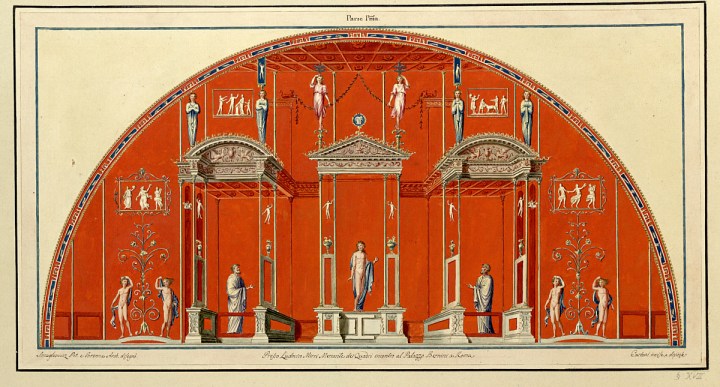
Marco Carloni, Franciszek Smuglewicz, and Vincenzo Brenna, plate nine from Vestigia delle Terme di Tito e Loro Interne Pitture, 1776–78, hand-coloured etching (London: The British Museum).
◊ ◊ ◊ ◊ ◊
The eighteenth century in the latest issue of Print Quarterly:
Print Quarterly 38.1 (March 2021)
A R T I C L E S
Francesca Guglielmini, “Ludovico Mirri’s Vestigia and Publishing in Eighteenth-Century Rome”, pp. 29–49.
This article is a detailed study of the publishing activities and business model of the erudite antiquarian, art dealer and print publisher Ludovico Mirri (1738–1786). His ambitious project Vestigia delle Terme di Tito e Loro Interne Pitture (The Remains of the Baths of Titus and Their Paintings) is discussed in detail alongside eight previous unpublished images of hand-coloured etchings of grotesque wall decorations taken from antique ruins in Rome and surroundings, now in the British Museum, here proposed as an extension of the original Vestigia. Four appendices contain a compilation of uncoloured and coloured impressions of the Vestigia etchings; a description of the contents of the Vestigia and Giuseppe Carletti’s accompanying booklet; known copies of the Vestigia in public collections; and a list of supplementary plates, including those eight mentioned in the British Museum collection.
David Stoker, “The Marshall Family’s Print Publishing Business”, pp. 50–63.
This article explores the little researched late activities of the Dicey print publishing business which was run by members of the Marshall family into the nineteenth century after Cluer Dicey (1715–1775) retired in 1770. The article discusses various publications produced by each member of the Marshall family, from Dicey’s partner Richard Marshall (d. 1779) to his grandson John II Marshall (b. 1793).
N O T E S A N D R E V I E W S
Antony Griffiths, Review of The Lost Library of the King of Portugal (2019), pp. 72–74.
This review sheds light on new research uncovered about the lost library of John V, King of Portugal, specifically archival documents. A significant portion of this review tells the fascinating story of how orders were sent to the Portuguese ambassadors in various European capitals in 1724 for an impression of every available print in those countries. These indeed happened but the various volumes of prints disappeared in the cataclysm of 1755, except for three volumes representing British, French, and Italian prints which were rediscovered in recent decades.
Domenico Pino, “Anton Maria Zanetti II and Limited Editions in Venice, c. 1734,” pp. 74–76.
This note seeks to interpret a handwritten inscription found on the verso of a print by Anton Maria Zanetti the Younger (1706–1778) in the British Museum. The inscription provides important evidence on early exploitation of limited editions in printmaking among the Zanetti clan and their contemporaries.
Antoinette Friedenthal, Review of La vita come opera d’arte: Anton Maria Zanetti e le sue collezioni (2018), pp. 108–14.
This review of an exhibition catalogue exploring Anton Maria Zanetti the Elder (1680–1767) offers an overview of his intellectual and artistic interests. His admiration for Parmigianino is discussed in detail, as well as his own reconstruction of the technique of chiaroscuro woodcuts. The review concludes with a few paragraphs on his forays into publishing.
Exhibition | The Great Divide: Footwear in the Age of Enlightenment
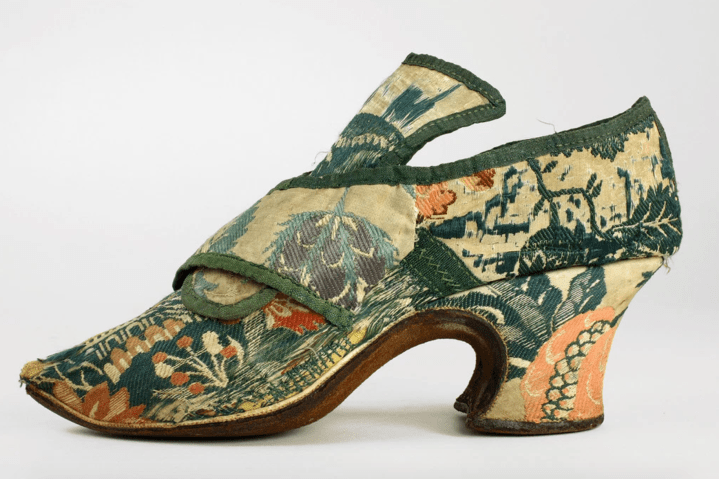
Woman’s Shoe, 1730–40, English (Toronto: Bata Shoe Museum). One way working women acquired footwear was through the cast-off clothing given to them by the people they served. These ‘gifts’ would often be altered by the new wearer. This shoe originally had thin latchets that most likely were tied with a bow over the tongue but were updated to feature more fashionable straps by a later wearer.
◊ ◊ ◊ ◊ ◊
From the press release (12 August 2020) for the exhibition at Toronto’s BSM (the museum is currently closed, but stay tuned). And a very happy International Women’s Day to everyone!
The Great Divide: Footwear in the Age of Enlightenment
Bata Shoe Museum, Toronto, 12 August 2020 — 28 February 2022
The Bata Shoe Museum is excited to announce its newest exhibition, The Great Divide: Footwear in the Age of Enlightenment. The first of three exhibitions in the museum’s 25th anniversary lineup, The Great Divide explores several timely issues from gender and race to imperialism and colonization. Featuring extraordinary 18th-century artefacts from the permanent collection, the exhibition highlights complex stories about privilege, oppression, danger, desire, revolution, and resistance that are as relevant today as they were 300 years ago.
 The Age of Enlightenment was a period in European history from the end of the 17th to the end of the 18th century when Western philosophers and scientists wrestled with concepts of ‘human nature’ and ‘natural rights’. Some argued that all people had inherent social and political rights, but many more advocated for the reordering of social hierarchies using ‘scientific’ proof to divide people through the identification of ‘natural’ differences such as gender and race. Much of the oppression and imperialism that marked the period was supported by these ideas.
“Throughout the 18th century, Western fashion, including footwear, was central to the ‘naturalization’ of difference in Europe,” says Elizabeth Semmelhack, Creative Director and Senior Curator at the Bata Shoe Museum. “Distinctions between men and women, children and adults, Europeans and ‘Others’ became increasingly codified through clothing. Yet, European fashion was also used to blur the lines between classes as social mobility and access to consumable goods grew as a result of imperialism.”
The exhibition was thoughtfully designed by the award-winning designers Arc + Co who focused on creating a space that engages with the powerful themes and issues of the 18th century explored in this gallery. With loans from Toronto’s Gardiner Museum, the design also includes a look at contemporary footwear, asking visitors to reflect on shoes and society today.
Highlights include:
• Moccasins said to have belonged to Myaamia leader Mishikinawa, also known as Little Turtle, who resisted the incursion into Myaami territory by delivering one of the worst defeats in U.S. history at the Battle of Wabash in 1791.
• Late 18th-century shoes that began as Indian jutti but were transformed into a pair of English women’s shoes that embody British Imperialism in India.
• An early 18th-century silver side-saddle stirrup made for a woman from a powerful colonial Spanish family in Peru. Roughly 85 percent of the world’s silver was mined by conscripted Indigenous people and imported enslaved Africans in Spanish-held South America.

Man’s Shoe, 1760–80, English (Toronto: Bata Shoe Museum). This shoe would have been used to express both gender and class. Its low heel conveyed that it was masculine and the expensive fabric and ostentatious bow conveyed that it was upper class. The use of pink might confuse us today, but in the 18th century pink was not gendered.
Online Talk | Fortune and Folly in 1720
Wednesday evening on Zoom, from the BGC:
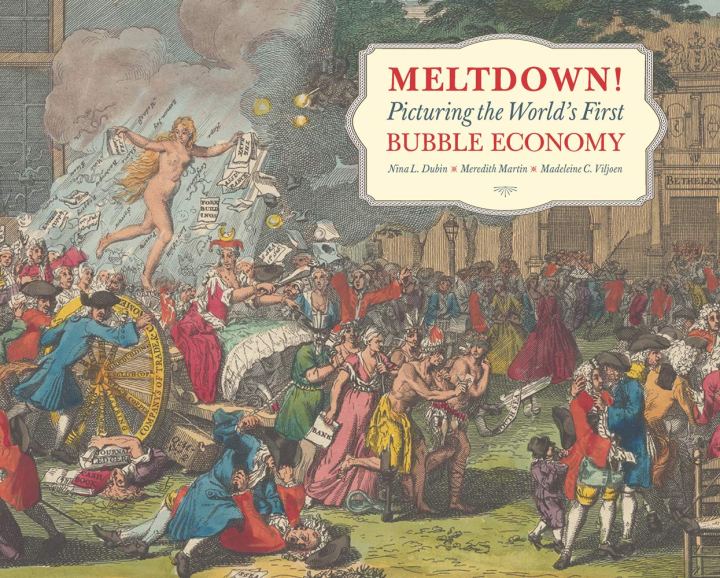
Nina Dubin, Meredith Martin, and Madeleine Viljoen | Fortune and Folly in 1720: Picturing the World’s First Bubble Economy
Françoise and Georges Selz Lectures on Eighteenth- and Nineteenth-Century French Decorative Arts and Culture
Online, Bard Graduate Center, New York, 3 March 2021, 6.00pm
This talk will explore The New York Public Library’s upcoming exhibition Fortune and Folly in 1720 (Fall 2021) and its accompanying publication Meltdown! Picturing the World’s First Bubble Economy (Harvey Miller/Brepols, 2020). Co-curated and co-authored by Dubin, Martin, and Viljoen, they tell two parallel stories: one of the spectacular rise and fall of the first bubble economy, and another of the enterprising art industry that chronicled its collapse. The Mississippi and South Sea Bubbles, spawning the invention of French banknotes as well as joint-stock companies built on fantasies of New World trade, imposed on everyday Europeans a crash course in new financial products. In turn, a bubbling print market relentlessly caricatured the meltdown of 1720, offering viewers an entertaining primer on the otherwise bewildering realities of modern economic life. Three hundred years later, our current moment offers a uniquely fitting vantage point from which to reconsider the significance of the bubbles and of the artworks that channeled the fears and desires they unleashed.
The event will be live with automatic captions. It will be held via Zoom; a link will be circulated to registrants by 3pm on the day of the event.
Nina L. Dubin is an associate professor of Art History at the University of Illinois at Chicago. Specializing in European art since 1700, she has published widely on the production of art within an economy of risk.
Meredith Martin is an associate professor of Art History at New York University and the Institute of Fine Arts. Specializing in European art of the long eighteenth century, she has published widely on gender and architectural patronage as well as maritime art, mobility, and exchange in the early modern world.
Madeleine C. Viljoen is Curator of Prints and the Spencer Collection at The New York Public Library. Responsible for the Library’s collection of prints and rare illustrated books, she has published widely on early modern printed images, with special attention to the goldsmith-engraver, the reproductive print, and ornament.
Exhibition | History in Motion: Tom Judd’s Subway Mural
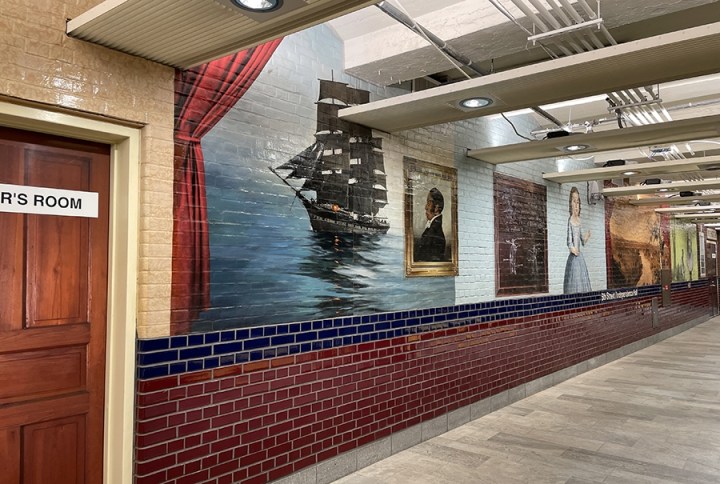
Installation photo of Tom Judd’s Portal to Discovery mural, 2020, produced for Philadelphia’s 5th Street-Independence Hall Station on the Market-Frankford Line.
◊ ◊ ◊ ◊ ◊
The Woodmere Art Museum hosts a virtual opening reception with the artist this evening (Tuesday) at 7pm, ET:
History in Motion: Tom Judd’s Subway Mural
Woodmere Art Museum, Philadelphia, 27 February — 13 June 2021
In connection with the reconstruction of Philadelphia’s 5th Street-Independence Hall Station on the Market-Frankford Line, and as part of SEPTA’s Art in Transit program, artist Tom Judd was selected to create a permanent installation for the station. Titled Portal to Discovery, Judd’s mural on the eastbound and westbound platforms presents figures who contributed to the founding of the United States as well as those who fought for “life, liberty, and the pursuit of happiness” for all. The mural includes portraits of eighteenth- and nineteenth-century Philadelphians such as Frances E. W. Harper, one of the first African American women to be published in the United States, and Absalom Jones, an African American abolitionist and clergyman who founded the Free African Society with Richard Allen in 1787. Juxtaposed with these figures are familiar landscape views of Philadelphia, windows, doors, and other architectural elements of the city. The experience is one of a great historical dreamscape that poses questions and promotes civic dialogue.
 The Museum’s exhibition includes preparatory studies for the mural as well as in-process photographs of the installation; the panels were fabricated by Ben Volta Studios and the installation was managed by James Shuster. The project was realized with help from graphic designer Wenlu Bao; David W. Seltzer, transit consultant and catalog producer; SEPTA; Burns Engineering, Inc.; Converse Winkler Architecture; and Marsha Moss, public art curator and consultant. The mural is an important addition to Philadelphia’s rich landscape of public art.
Judd grew up in Salt Lake City and attended the University of Utah from 1970 to 1972. He received his bachelor of fine arts degree in painting from the Philadelphia College of Art (now the University of the Arts). His work has been exhibited in museums and galleries across the United States, and is in the collections of numerous museums, including the Philadelphia Museum of Art, the Pennsylvania Academy of the Fine Arts, the Birmingham Museum of Art, and Woodmere Art Museum. Judd works in a variety of media, including painting, collage, photography, and installation.
Exhibition | Treasures from the Gilbert Collection

Oval green snuffbox associated with Frederick the Great, ca. 1765, Berlin; chrysoprase, gold, hardstones, and foiled diamonds
(London: V&A, The Rosalinde and Arthur Gilbert Collection)
◊ ◊ ◊ ◊ ◊
Opening this week at Antwerp’s DIVA museum for diamonds, jewellery, and silver:
Masterpieces in Miniature: Treasures from the Rosalinde and Arthur Gilbert Collection
DIVA, Antwerp, 5 March — 15 August 2021
Additional international venues to be announced
Curated by Alice Minter and Jessica Eddie
From March 5th to August 15th 2021, DIVA will host the touring exhibition Masterpieces in Miniature: Treasures from the Rosalinde and Arthur Gilbert Collection, organised by the Victoria and Albert Museum (V&A) in London. This is the first time items from all categories of the Gilbert Collection will go on display on the European continent. Some objects, such as the sixteenth-century partridge cup, are exclusive to the Antwerp exhibition. Masterpieces in Miniature is an ode to Rosalinde and Arthur Gilbert’s impressive legacy and a chance for the public to admire these treasures up close.
Visitors will make the acquaintance of Rosalinde and Arthur Gilbert and come to understand their collecting habits, traveling with them in search of exceptional craftsmanship and beauty and encountering famous historical figures such as Catharine the Great, Napoleon Bonaparte, and Queen Victoria. The showpieces include a snuffbox belonging to Frederick the Great of Prussia, made of chrysoprase, a rare gemstone mined in Silesia and set with hardstones and diamonds, the latter coloured by placing them over pale-pink, green, and lemon-coloured metal foils.
The Rosalinde and Arthur Gilbert Collection is a homage to exquisitely crafted objects, many in precious metals and often small in scale. The Gilberts spent over forty years amassing their collection of nearly 1000 items of fine silverware, gold (snuff)boxes, enamels, and mosaics made in Europe between the sixteenth and twentieth centuries. Their passion for craftsmanship and beauty resulted in a collection that is unparalleled today.
Arthur (1913–2001) and Rosalinde Gilbert (1913–1995) made their first fortune in the fashion industry in London in the 1930s. They swapped London for their newly designed villa in Beverly Hills and set up a successful property development business in America. A second success story soon followed. Their search for ‘beautiful things’ to decorate their home soon developed into a passion for collecting. The couple travelled the world looking for mosaics and the very best gold, silver, and enamel objects.
The desire to share their collection with others by putting it on public display was of real importance to the couple. In the 1970s the collection went to the Los Angeles County Museum of Art, before being transferred to Somerset House in London in 2000 and from there to its current home at the V&A. This is the first time items from all categories of the Gilbert Collection will go on display on the European continent. The collection will travel on from here to America and Asia.
Dries Otten (°1978) has been commissioned to design the set for Masterpieces in Miniature. The Antwerp-based interior architect, furniture and set designer is famous for his playful use of colour with historical references. He has already designed exhibition sets for the TextielMuseum, Bozar, and Texture.
Curators
Alice Minter, Curator of the Rosalinde and Arthur Gilbert Collection, V&A
Jessica Eddie, Assistant Curator of the Rosalinde and Arthur Gilbert Collection, V&A
Exhibition | Signed in Silk

From the press release (27 January 2021) for the exhibition:
Signed in Silk: Introducing a Sacred Jewish Textile
Saint Louis Art Museum, 19 March — 3 October 2021
Curated by Genevieve Cortinovis
The Saint Louis Art Museum presents Signed in Silk: Introducing a Sacred Jewish Textile, an exhibition highlighting an extraordinary 2019 acquisition, an 18th-century Italian Torah Ark Curtain, or parokhet. In 1755, in the port city of Ancona on the Adriatic coast, artist Simhah Viterbo (1739–1779) embroidered a dedicatory inscription across the lower edge of this magnificent textile. About 15 at the time, Viterbo was continuing in a long tradition of Italian Jewish women who created sumptuous textiles for their synagogues. Drawing upon the Museum’s rich collection of 17th- and 18th-century sacred and secular textiles, the exhibition considers how Viterbo created an object that reflected not only her Jewish heritage but also her own place and time, at the center of a major trading crossroads during an era of increasing cultural connectivity.
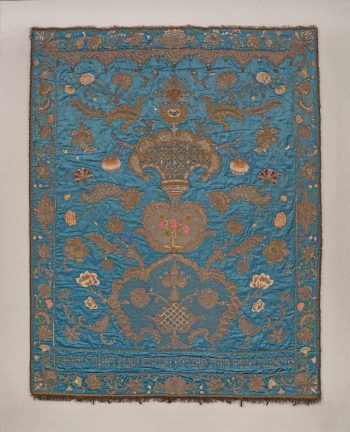
Simhah Viterbo, Torah Ark Curtain (Parokhet), 1755; silk, silk and metallic thread, vellum, metal paillettes, cotton thread, velvet, metallic fringe, linen backing; 87 × 66 inches (Saint Louis Art Museum, The Deane and Paul Shatz Endowment Fund for Judaica 2:2019).
In the 18th century, Ancona was a bustling port, home to many, including a prosperous and cosmopolitan community of Jewish traders. It was also a Papal State that since 1555 systematically had oppressed the Jewish residents, most of whom were forced into a few low-skill trades, and isolated them in ghettos, the term then used for prison neighborhoods. Paradoxically, this segregation of culturally diverse Jewish communities coincided with a flowering of Jewish ceremonial art, and this Torah Ark Curtain exemplifies the lavish sacred textiles made by Italian Jews during this period.
The prevailing decoration of 18th-century Italian Jewish textiles was floral; however, Viterbo’s design is unusual in its oversized, symmetrical central motif and narrow enclosed border. Its metal embroidery—scrolls, shells and diapered baskets—was consistent with the ornate Late Baroque and early Rococo ornament that embellished fashionable European dress, textiles and silver of the same moment. Yet the overall composition of the parokhet has more in common with a group of embroidered curtains made within the vast Ottoman Empire, which at that time included parts of the Balkans, North Africa and the Middle East.
Rare Hebrew books, printed in Venice and borrowed from Washington University’s Shimeon Brisman Collection, join with splendid examples of Italian, Greek, Ottoman, and Indian textiles to make Signed in Silk a celebration of Viterbo’s skill in having synthesized a range of decorative motifs, techniques, and forms. The exhibition explores how influences from Baroque garden design, Christian ecclesiastical embroidery, botanical naturalism, Ottoman prayer rugs, and Renaissance pattern books coalesced in the handwork of a young woman confined to a ghetto. Viterbo’s accomplished work nevertheless reveals her connection—through textiles—to networks of trade from London to the Levant.
Signed in Silk is curated by Genevieve Cortinovis, the Andrew W. Mellon Foundation Assistant Curator of Decorative Arts and Design.
Exhibition | The Search for Ancient Ionia, 1764
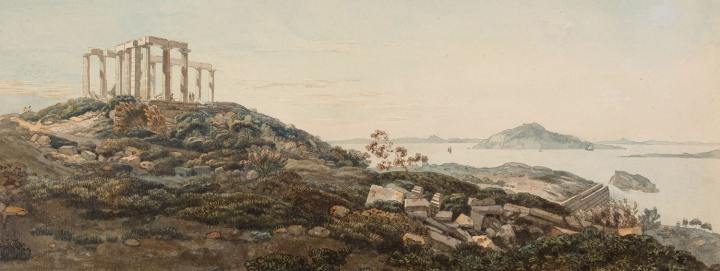
William Pars, Temple of Poseidon at Sounion, 1764, pen and grey ink with watercolour and bodycolour and some gum arabic
(London: The British Museum)
◊ ◊ ◊ ◊ ◊
From the Soane Museum:
The Romance of Ruins: The Search for Ancient Ionia, 1764
Sir John Soane’s Museum, London, 3 March – 11 July 2021
Curated by Ian Jenkins
Produced in collaboration with the British Museum, this exhibition showcases a series of powerful and poetic watercolours made on an expedition to discover the ruins of ancient Ionia (modern Turkey) in 1764. The expedition, funded by the Society of Dilettanti, included artist William Pars, antiquary Richard Chandler, and architect Nicholas Revett.
The beauty and fame of the Ionian cities—part of the Greek world from the 8th century BC and ruined in antiquity—lived on in the writings of ancient commentators such as Herodotus and Strabo. This exhibition focuses on the published accounts of the expedition, produced in lavish volumes funded by the Society of Dilettanti, and the evocative images by the brilliant young artist William Pars, placing them in dialogue with the collections and architecture of Sir John Soane, who deeply admired ancient Greek architecture. Pars’ drawings record the classical ruins encountered in Turkey and Greece, and also the living landscape–its flora and fauna, and the customs, manners and dress of the people, bringing to life extracts from Chandler’s diary account. These images represent Enlightenment themes of travel and discovery and embody melancholy reflections on the passing of the great age of antiquity and the reduction of its monuments. They capture the spirit of Edward Gibbon’s reflection on the fall of civilizations and in so doing they portray the romance of ruins.
This exhibition has been made possible thanks to the generosity of David and Molly Lowell Borthwick. The accompanying catalogue has been kindly supported by the Society of Dilettanti Charitable Trust.
◊ ◊ ◊ ◊ ◊
Ian Jenkins, ed., The Romance of Ruins: The Search for Ancient Ionia, 1764 (London: Sir John Soane’s Museum, 2021), 240 pages, ISBN: 978-1999693244, £40.
 The Romance of Ruins: The Search for Ancient Ionia, 1764 focuses on a series of highly finished watercolours by the brilliant young artist William Pars. These were based on sketches and drawings made on the spot during the Society of Dilettanti’s 1764 expedition to Ionia. This remarkable set of pictorial documents has never been fully published in spite of their beauty and cultural significance. The book includes an introduction by the exhibition’s curator, Ian Jenkins, Senior Curator at the British Museum; a series of essays by eminent scholars including Alastair Blanshard, J. Lesley Fitt, Jason M. Kelly, Philip Mansel, and Kim Sloan; and a catalogue of works in the exhibition.
Online Exhibition Tour | Exotic Switzerland?
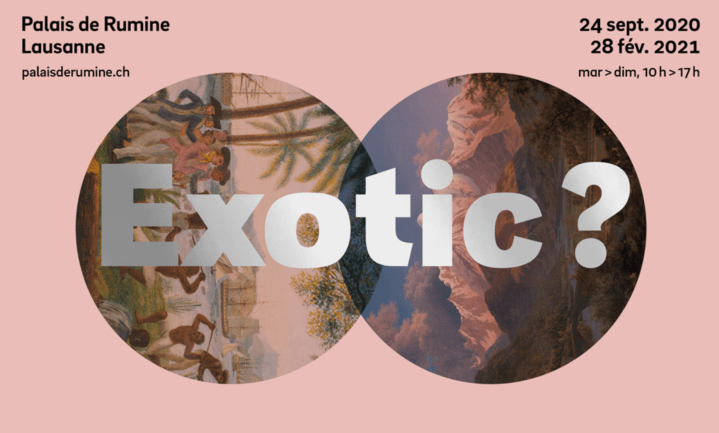
Une Suisse exotique? Regarder l’ailleurs en Suisse au siècle des Lumières
Exotic Switzerland? Looking Outward in the Age of Enlightenment
Palais de Rumine, Lausanne, 24 September 2020 — 28 February 2021
Organized by Noémie Étienne
While the exhibition was forced to close early, the Palais de Rumine is offering a series of free live guided tours, the last of which takes place (in English) on Monday, 22 February 2021, at 12.30, with Chonja Lee. Zoom link: https://lnkd.in/d8ikYnq
The virtual visit, available any time, is spectacular! –CH
New Book | Living with Architecture as Art
The exhibition is scheduled to open this spring, with the catalogue now available via Paul Holberton Publishing:
Architectural Training and Practice in Paris in the 19th and Early 20th Century:
Selected French Drawings from the Peter May Collection
New-York Historical Society, 9 April — 13 June 2021
Living with Architecture as Art: The Peter May Collection of Architectural Drawings, Models, and Artefacts (London: Ad Ilissum, 2021), 2 vols., 352 pages each, ISBN: 978-1912168194, £260 / $325.
Introduction by the collector peter may; catalogue by Maureen Cassidy-Geiger; essays by Maureen Cassidy-Geiger, Charles Hind, Basile Baudez, Matthew Wells; afterwords by architect Mark Ferguson and interior designer Bunny Williams.
 This stunning two-volume publication introduces readers to one of the largest private collections of architectural drawings in the world. Showcasing drawings and related models and artefacts dating from 1691 to the mid 20th century, this lavish tome includes both a catalogue and new texts by leading authorities and provides a fascinating look at these often very beautiful by-products of architectural training and practice.
One of the largest private collections of architectural drawings in the world has been assembled over 30 years by investor and philanthropist Peter May. Comprising more than 600 sheets that have all been carefully preserved and handsomely framed, the drawings and related models and artefacts date from 1691 to the mid 20th century. This handsome two-volume publication will introduce amateurs and specialists alike to the largely unknown collection. The book includes a catalogue and innovative texts by leading authorities that present the raison-d’être for the production and preservation of these sometimes neglected by-products of architectural training and practice that have been collected off-and-on through history by individuals and institutions.
The architectural sheets acquired for the collection are principally 19th- or early 20th-century competition or certification drawings by design students. Others are presentation drawings for public commissions, reconstruction studies or interior designs. The catalogue is arranged by category, to demonstrate May’s inclination towards specific building types such as commercial or cultural institutions, train stations and spas, landmarks and monuments, private and royal residences, and cast-iron architecture. Also included is a category for landscape designs and garden architecture, reflecting May’s experience as a gentleman farmer with a predilection for building.
Peter May informs the reader about his history as a collector and builder. Maureen Cassidy-Geiger discusses the formation of the collection and with Basile Baudez introduces the French system of architectural education, from which some of the finest drawings come. Charles Hind offers a history of design training in Britain and writes about patterns of collecting and the market for architectural drawings. Matthew Wells’s subject is the history of architectural models.
Maureen Cassidy-Geiger is a curator and scholar with special expertise in European decorative arts, patterns of collecting and display and the history of architecture, court culture, gardening and travel. Her most recent book on architecture was The Philip Johnson Glass House: An architect in the Garden (Rizzoli, 2016). Charles Hind, FSA, is Chief Curator of Drawings at RIBA in London. A Palladio specialist, he was with Sotheby’s, 1986–93, as their expert in architectural drawings and British watercolors. Basile Baudez is Assistant Professor in the Department of Art & Archaeology, Princeton University, previously at Paris-Sorbonne University, University of Pennsylvania and at the Pratt Institute. Matthew Wells is Lecturer in the Department of Architecture at the ETH (Eidgenössische Technische Hochschule) in Zurich. His dissertation “Architectural Models and the Professional Practice of the Architect, 1834–1916” was awarded the Theodor-Fischer Prize from the Zentralinstituts für Kunstgeschichte in Munich.










 Enfilade
leave a comment