Exhibition | Jacques-Louis David
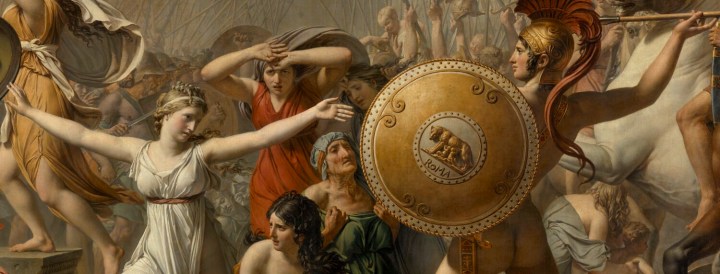
Jacques-Louis David, The Intervention of the Sabine Women, detail, 1799, oil on canvas, 3.85 × 5.22 meters
(Paris: Musée du Louvre)
◊ ◊ ◊ ◊ ◊
From the press release for the exhibition:
Jacques-Louis David
Musée du Louvre, Paris, 15 October 2025 — 26 January 2026
Curated by Sébastien Allard and Côme Fabre, with assistance from Aude Gobet
David is a towering figure. Considered the father of the French School, revered for breathing new life into painting, he produced imagery that to this day inhabits the collective imagination: from The Death of Marat to Napoleon Crossing the Alps and The Coronation of Napoleon, his paintings are the filter through which we picture the great moments of the French Revolution and the Napoleonic Empire, while his portraits bring to life the society of this period.
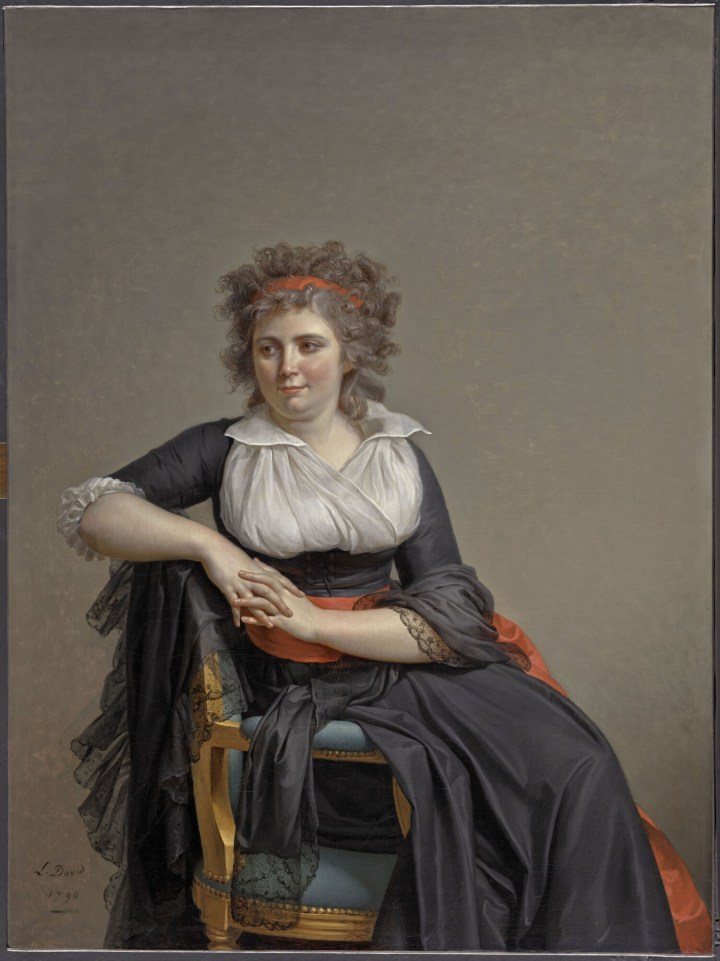
Jacques-Louis David, Portrait of Robertine Tourteau d’Orvilliers, née Rilliet (1772–1862), 1790, oil on canvas, 131 × 98 cm (Paris: Musée du Louvre / Adrien Didierjean / Sylvie Chan-Liat).
To mark the bicentennial of his death in exile in Brussels in 1825, the Musée du Louvre is offering a new perspective on a figure and body of work of extraordinary richness and diversity. The exhibition shines a light on the inventive force and expressive power of the art of Jacques-Louis David (1748–1825), whose paintings are more intensely charged with feeling than is belied by their extreme rigour. The exhibition spans the long career of an artist who witnessed six different political regimes and actively participated in the French Revolution. It gathers 100 works on special loan, including the imposing, incomplete Tennis Court Oath (Château de Versailles, long-term loan from the Musée du Louvre), and the original version of his masterpiece, the celebrated Death of Marat (Royal Museums of Fine Arts of Belgium, Brussels).
A project of such ambition could only be undertaken at the Louvre, which holds the largest existing collection of the artist’s paintings and drawings—including, first and foremost, his very large canvasses. The last major monographic exhibition devoted to David was held at the Louvre and the Château de Versailles in 1989 for bicentennial commemorations of the French Revolution. Enhanced by research conducted in the ensuing three decades, the 2025 exhibition will present a new survey revealing the unprecedented richness of David’s journey, combining artistic and political activity. Indeed, more than simply an artist observing this formative period in French history, spanning the years 1748–1825, he sought to be a prominent social actor.
The painter’s importance was unmatched in his day, for his Europe-wide artistic influence, as well as the high political offices he held in 1793–1794 alongside Robespierre, for which he suffered the consequences as a political exile after the fall of Napoleon.
The exhibition is curated by Sébastien Allard, Senior Heritage Curator, Director of the Department of Paintings, and Côme Fabre, Curator, Department of Paintings, and assisted by Aude Gobet, Head of the Department of Paintings Research Centre, Musée du Louvre. The exhibition design is by Juan-Felipe Alarcón, with graphic design by Philippe Apeloig.
Sébastien Allard, ed., Jacques-Louis David (Paris: Louvre éditions/ Hazan, 2025), 360 pages, €49.
The catalogue reflects the exhibition in offering new perspectives on David’s role and position, focusing on two essential aspects of his activity: his involvement during the French Revolution; and, after the fall of the First Empire and his exile to Brussels, his confrontation with the new generation—and Ingres, in particular—whose training he had largely overseen. The publication is divided into two parts. In the first, an essay by Sébastien Allard seeks to shift perceptions of the artist, examining his life as a coherent whole, in contrast to how historians have tended to fragment it according to the different political regimes David experienced. Sumptuous reproductions, including numerous details, help remove the proverbial dust from the image sometimes held of the painter’s work. The second part encompasses an essay by Côme Fabre on the connections between David and the Louvre; a biographical account by Aude Gobet; and a chronology of major David-related moments, from his death to today, by Morgane Weinling.
Forbidden City’s Qianlong Garden Reopens after Conservation
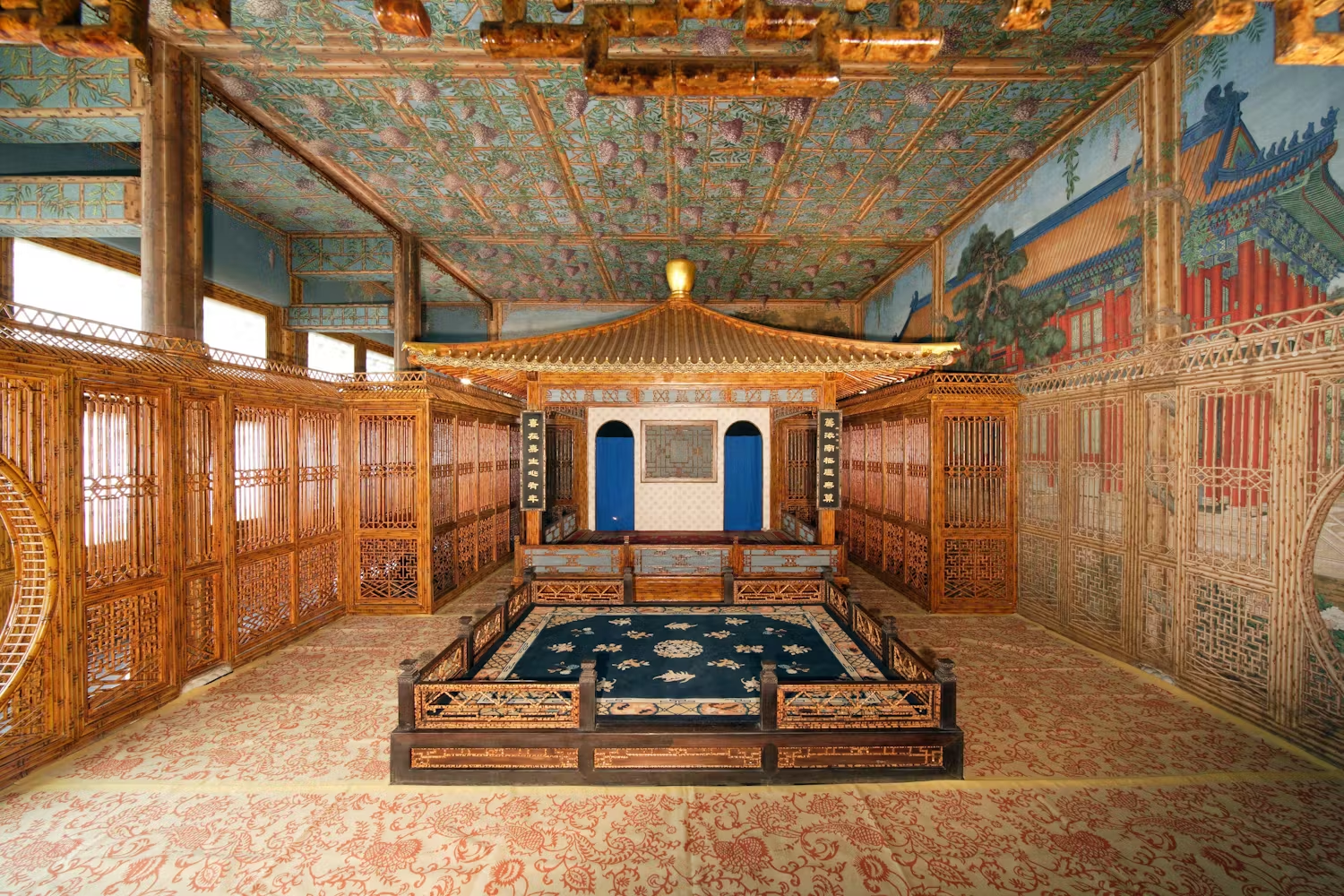
When the Qianlong Emperor abdicated in 1796, he had a retirement complex waiting for him in a 1.6-hectare space within the Forbidden City. But he never took up residence in the Palace of Tranquil Longevity, and the site has remained largely untouched ever since. It contains some of the most extraordinary examples of Chinese interior design in existence today. Pictured here, Juanqinzhai, or Studio of Exhaustion from Diligent Service, is noted for the trompe-l’oeil silk paintings on the ceiling and walls of its private theater. Its reception room also contains unusually fine bamboo thread marquetry and inner bamboo skin carvings, as well as jade inlays and sophisticated textile decorations.
◊ ◊ ◊ ◊ ◊
From the WMF press release (30 September 2025) . . .
World Monuments Fund (WMF) and the Palace Museum today announced the official public opening of the Qianlong Garden, a masterwork of 18th-century Chinese imperial design located in the northeast corner of Beijing’s Forbidden City. After a two-decade-long conservation effort, the garden has reopened. A new on-site exhibition will offer a comprehensive understanding of the Qianlong Garden’s interiors, design, and craftsmanship. The inauguration of the garden will be accompanied by the publication of the book Tranquil Longevity, Predestined Serenity: The Origins, Interpretation and Conservation of the Qianlong Garden, providing an in-depth look at the history of the Qianlong Garden and the restoration of the site.

Restored exterior of Qianlong Garden.
Constructed by the Qianlong Emperor (r. 1735–1796) as a planned retreat for his later years, the 1.6-hectare site includes 27 buildings across four courtyards, with ornate interiors that preserve original furniture, decorative finishes, and rare materials largely untouched since the 18th century. Following an extensive 25-year conservation initiative led by World Monuments Fund (WMF) in partnership with the Palace Museum, the site now features restored interiors and exteriors showcasing some of the most refined and culturally significant artistry of the Qing Dynasty. This collaboration brought together international experts and Chinese artisans to address the site’s preservation challenges, revive endangered craft techniques, and uphold the garden’s extraordinary architectural integrity.
“This is a landmark moment for heritage conservation in China,” said Hunghsi Chao, Senior Regional Director for East Asia at World Monuments Fund. “Qianlong Garden represents an unparalleled survival of imperial interior design, and its preservation requires both technical precision and deep cultural understanding. Through our work with the Palace Museum, we have not only safeguarded a historic treasure but have helped reinvigorate traditional craftsmanship and inspired new generations of conservation professionals.”
As a cornerstone of the conservation effort, WMF launched the CRAFT Educational Program (Conservation Resources for Architectural Interiors, Furniture, and Training) in 2011 to provide formal training in architectural conservation. In partnership with Tsinghua University and the Palace Museum, the program became a master’s-level conservation initiative in China to align with international standards, blending scientific methodology with traditional Chinese techniques.
“World Monuments Fund’s partnership with the Palace Museum has shown how international collaboration and local expertise can come together to achieve something truly exceptional,” said Bénédicte de Montlaur, President and CEO of World Monuments Fund. “Qianlong Garden is a living document of Qing-era craftsmanship and global influence—its preservation stands as a model for how education, science, and culture can shape the future of heritage.”

Model of the Qianlong Garden from the exhibition “Heavenly Craftsmanship: The History and Preservation of the Ningshou Palace Garden.”
A pilot project for the broader site was launched in 2002 with the restoration of Juanqinzhai (Studio of Exhaustion from Diligent Service), a pavilion known for its rare trompe l’oeil silk murals, bamboo marquetry, and theatrical stage. Conservation of Juanqinzhai revived long-lost techniques and informed all subsequent work throughout the garden. Completed interventions include the Fuwangge (Belvedere of Viewing Achievements), Zhuxiangguan (Lodge of Bamboo Fragrance), and Yucuixuan (Bower of Purest Jade), while work continues across the remaining courtyards.
“Joint projects involving the Palace Museum in China and World Monuments Fund based in the United States, beginning in 2000 and continuing to the present, have demonstrated that, in the context of globalization, different civilizations can achieve mutual understanding and respect through dialogue, communication, and cooperation, and thus jointly promote the prosperity and development of human civilization,” said Director Wang Xudong of the Palace Museum.
The inauguration ceremony welcomed representatives from the Palace Museum and World Monuments Fund, cultural leaders, and conservation experts to celebrate the public opening of the Qianlong Garden as part of the Palace Museum’s centennial. Building on the success of this project, the Palace Museum and World Monuments Fund will continue to collaborate on preservation and training initiatives throughout the Forbidden City.
Alongside the opening, the Palace Museum published Tranquil Longevity, Predestined Serenity: The Origins, Interpretation, and Conservation of the Qianlong Garden, providing an in-depth look at the storied history of Qianlong Garden. The book also details the full story of the spirit of cooperation between Chinese and American heritage professionals who faced daunting obstacles to restore the site. Readers can explore the garden and its preservation through detailed illustrations, new photography, rarely published drawings, and historic photographs of the Qianlong Garden taken during the last days of the Qing Dynasty.
The exhibition Heavenly Craftsmanship: The History and Preservation of the Ningshou Palace Garden will be on display in the garden’s Suichu Hall and the east and west side halls, presenting the historical and cultural value of the Ningshou Palace Garden and the achievements of its preservation and restoration.
Exhibition | Count Cozio and the Myth of Stradivari
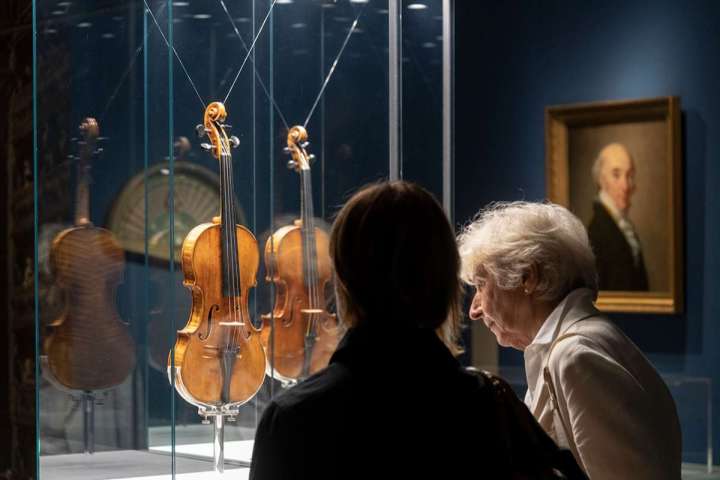
Installation of the exhibition Il conte Cozio e il mito di Stradivari: Capolavori in Piemonte tra ‘700 e ‘800 at Palazzo Madama in Torino (2025).
◊ ◊ ◊ ◊ ◊
Now on view at Palazzo Madama:
Count Cozio and the Myth of Stradivari
Masterpieces in Piedmont between the 18th and 19th Centuries
Palazzo Madama, Torino, 19 September — 23 November 2025
Curated by Giovanni Accornero and Duane Rosengard
On the occasion of the 270th anniversary of the birth of Count Ignazio Alessandro Cozio di Salabue, this exhibition celebrates and sheds light on the legacy of this remarkable collector, born in Casale Monferrato on 14 March 1755. Unlike other collectors of his time, Cozio did not merely acquire valuable stringed instruments. By studying their provenance and construction, he became a true pioneer of what we now call the modern organological approach.
 Through his collaboration with the violin maker Giovanni Battista Guadagnini, Cozio succeeded in purchasing from Paolo Stradivari twelve of his father Antonio’s violins—including the legendary ‘Messiah’, built in Cremona in 1716 and considered the most famous Stradivari violin in the world. Cozio also acquired the entire contents of Stradivari’s workshop: moulds, tools, cardboard patterns, and drawings. This invaluable heritage—a portion of which is presented in the exhibition—today stands as the historical memory of the Cremonese violin-making tradition.
The exhibition retraces Cozio’s life as a collector through seven sections, displaying 20 stringed instruments of exceptional historical importance, twelve of which once belonged to him. Many of these instruments are being shown to the public for the very first time. Among them is the 1668 violin by Nicolò Amati, inherited from Cozio’s father, which has never before been exhibited. The journey is enriched by rare plucked string instruments, representing a significant part of the production of violin makers active in Turin during the 18th and early 19th centuries.
Archival documents from Cozio’s Carteggio accompany the display, offering new insights into both the Count himself and the musical world in which his passion for string instruments flourished. A special section is dedicated to the Teatro Regio of Turin, featuring the unprecedented display of violins once owned by Piedmontese virtuosos Gaetano Pugnani (Giuseppe Guarneri ‘del Gesù’, 1736) and Giovanni Battista Viotti (Antonio Stradivari, 1718), alongside two rare portraits of the musicians. Along the exhibition path, visitors will encounter the interactive 3D installation “The Shape of Sound,” which allows them to explore a faithful 3D replica of the ‘Salabue-Berta’ violin. The ‘Salabue-Berta’ violin was built in Turin by Giovanni Battista Guadagnini in 1774 and is also presented in the exhibition. This section is further enhanced by the presence of a bench copy crafted by Luiz Amorim, a tangible bridge between historical mastery and contemporary craftsmanship.
◊ ◊ ◊ ◊ ◊
The Strad adds this bit of information about one of the portraits of Battista Viotti: “the exhibition includes the famous portrait of Viotti by the French portraitist Élisabeth Vigée Le Brun, marking its first public display. The painting recently resurfaced on the antiques market, having previously been considered lost in the early 20th century.”
Call for Papers | Switzerland between the Sublime and Picturesque
From ArtHist.net:
Switzerland between Sublime and Picturesque
Swiss Drawings and Prints in the 18th and 19th Centuries
Die Schweiz zwischen sublim und pittoresk
Forschungen zur Schweizer Zeichnung und Druckgraphik im 18. und 19. Jahrhundert
Zurich, 5 June 2026
Proposals due by 1 November 2025
Im Rahmen der Ausstellung Gletscher und Stromschnellen. Gezeichnete Schweiz um 1800 in der Graphischen Sammlung der ETH (1.4.–5.7.2026) organisiert das Kunsthistorische Institut der Universität Zürich ein Symposium zu Forschungen zu Zeichnungen und Druckgrafik in der Schweiz im 18. und 19. Jahrhundert. Die eintägige Tagung findet am Freitag, 5. Juni 2026, in Zürich statt und soll eine Plattform zur Diskussion aktueller Projekte zur Kunst in der Schweiz aus der akademischen Forschung und Museumswelt bieten.
Mit dem aufkommenden Alpentourismus in der zweiten Hälfte 18. Jahrhundert wurde eine intensive Zeichnungspraxis und vielfältige Bildproduktion in der Schweiz entwickelt. Kunstschaffende begleiteten Naturforscher auf Expeditionen, dokumentierten Gletscher, geologische Phänomene und Pflanzen, und lieferten damit unverzichtbares Bildmaterial für wissenschaftliche Publikationen. Dem gegenüber stand die wachsende Nachfrage eines breiteren Reisepublikums nach Bildern der von ihnen bereisten und neu entdeckten Orten in der Schweiz im Sinne von Souvenirs. Geschäftstüchtige Künstler wie Johann Ludwig Aberli und andere aus dem Kreis der Schweizer Kleinmeister sahen darin ihre Chance: Illustrationen zu Reisebeschreibungen und einzelne Veduten in kleinen Formaten, die sich gut transportieren liessen, waren ihre Antwort. Sie prägten nachhaltig das landschaftliche Bild der Schweiz. Gleichzeitig beflügelte diese Bildproduktion die Zusammenarbeit von Künstler:innen, Verleger:innen und Wissenschaftler:innen. Topographisch getreue Naturauffassung und künstlerische Imagination standen in enger Wechselwirkung. Dabei zeigen sich zwei Hauptstrategien: Zum einen wird eine pittoreske Landschafts- und Genremalerei etabliert, die sich besonders durch eine Idealisierung des idyllischen Schweizer Bauernlebens auszeichnet, zum anderen erfährt die Bergwelt eine Erhöhung bis hin zu einer einschüchternden Monumentalität.
Die Kunst der Schweizer Kleinmeister bot in den vergangenen Jahren Anlass für wertvolle Grundlagenforschung. Der Fokus lag dabei grösstenteils auf der Beschäftigung mit den druckgrafischen Erzeugnissen, während der Blick auf das Medium der Zeichnung bisher nur marginal vertieft wurde. Die Zeichnung war im Werkprozess der Künstler:innen jedoch zentral. Aus dem folgend umrissenen Themenspektrum freuen wir uns deshalb besonders über Vortragsvorschläge, die sich mit Zeichnungen sowie Fragen rund um Material und Technik beschäftigen. Die an der Konferenz präsentierten Projekte sollen ein Schlaglicht auf punktuelle Vertiefungen und Spezialisierungen werfen, aber auch breitere Verbindungen zur europäischen Kunst der Zeit aufzeigen. Die Vorträge sollen einerseits die oben beschriebene Kreation eines Schweizbildes und dessen Rezeption beleuchten. Andererseits sollen das Verständnis für die vielfältige künstlerische Arbeit, die Künstlerausbildung, die Netzwerke unter den Kunstschaffenden und die Handelsbeziehungen zu international tätigen Verlegern, Buch- und Kunsthändlern in der Schweiz im 18. und 19. Jahrhundert das Themenspektrum erweitern.
Es dürfen Arbeitsberichte zu aktuell laufenden sowie kürzlich abgeschlossenen Projekten vorgestellt werden. Die Einreichung von interdisziplinären und praxisorientierten Beiträgen, die sich an der Schnittstelle von Forschung, Museumsarbeit und Konservierung/Restaurierung befinden, sind explizit erwünscht.
Die Referate sollen max. 20 Minuten lang sein. Themenvorschläge können in englischer oder deutscher Sprache eingereicht werden. Bitte senden Sie ein Kurzexposé zu Ihrem Beitrag (max. 1 Seite) sowie einen kurzen tabellarischen Lebenslauf in einer einzigen PDF-Datei bis am 1. November 2025 per E-Mail an Linda Vogel, linda.vogel@khist.uzh.ch. Sie werden bis Ende Dezember 2025 über die Teilnahme informiert. Bei Bedarf kann ein Reisekostenzuschuss beantragt werden.
Im Anschluss wird ein Tagungsband publiziert. Die Beiträge sind bis am 1. September 2026 in druckreifer Form einzureichen. Weitere Informationen werden rechtzeitig kommuniziert.
Bei Fragen stehen Ihnen Dr. Michael Matile (michael.matile@uzh.ch) und Linda Vogel MA (linda.vogel@khist.uzh.ch) gerne zur Verfügung.
Exhibition | Squalor City: William Hogarth’s London
From the press release for the exhibition:
Squalor City: William Hogarth’s London
Pruzan Art Center, Wesleyan University, Middletown, Connecticut, 23 September — 13 December 2025
Curated by Miya Tokumitsu

William Hogarth, Night, 1738, etching, from the suite of four etchings The Four Times of Day (Davison Art Collection, Wesleyan University, Gift of George W. Davison (BA Wesleyan 1892), 1943.D1.102.4; photo by T. Rodriguez).
Wesleyan University’s Pruzan Art Center will highlight 18th-century British prints by William Hogarth from the Davison Art Collection, the first exhibition focused on the works of Hogarth at Wesleyan in three decades.
A peerless storyteller with great satirical flourish, William Hogarth (1697–1764) brings spectators into the raucous streets and parlors of Georgian London, at once the center of a mighty empire and, in the artist’s view, a den of grifters, social climbers, cynics, and fools. Though his images teem with references to actual personalities and places of 18th-century London, Hogarth’s concerns were more universal than specific. With a balance of humor and sincerity, his art contends with the quandaries of how to hew to a moral path within a competitive, market-driven society; how to build social institutions that serve their communities faithfully; and fundamentally, what kind of society the people of a given time and place ought to build—all questions that demand our attention in the present.
Squalor City draws from the Davison Art Collection’s deep holdings of Hogarth’s prints. It features several complete series by Hogarth, including The Harlot’s Progress, The Rake’s Progress, Marriage à la Mode, and The Four Stages of Cruelty, along with other works by the artist. The exhibition is curated by Miya Tokumitsu, the Donald T. Fallati and Ruth E. Pachman Curator of the Davison Art Collection.
Tokumitsu has found it important to highlight different strengths of the Davison Art Collection across the three previous exhibitions since the Pruzan Art Center opened in February 2024. This, the fourth exhibition in the space, will be the first show in the Goldrach Gallery dedicated wholly to historical art. “As the United States prepares to mark 250 years since the signing of the Declaration of Independence in 1776, now seems an apt time to take a measured look at the colonial power from which our state emerged—England during the Georgian era,” Tokumitsu said. “This was William Hogarth’s world, which he documented and critiqued in his art. Many of the issues Hogarth contends with remain of immediate concern.”
Tokumitsu said Hogarth was an engaging storyteller and excelled in creating serial narratives. “While each sheet in his various series is entertaining and meaningful in its own right, viewing Hogarth’s complete series allows spectators to glean the fullness of his creativity and narrative verve,” Tokumitsu said.
Tokumitsu noted that George W. Davison strove to collect canonical works of European graphic art, and that Hogarth is a towering figure in this history. “Hogarth’s prints were instrumental to the tradition of satire and caricature in print, and his influence extends to Francisco de Goya and Honoré Daumier,” Tokumitsu said. “Contemporary artists, including David Hockney, continue to find Hogarth’s work meaningful for their practice.”
The Pruzan Art Center’s Goldrach Gallery is located at 238 Church Street in Middletown, between Wesleyan’s Olin Memorial Library and the Frank Center for Public Affairs. The Davison Art Collection holds more than 25,000 works of art on paper, including prints, photographs, and drawings. The print collection is one of the foremost at a college or university in the United States. The collection supports teaching and learning in many ways, and was established at Wesleyan University with the founding gifts of George Willets Davison, class of 1892.
Exhibition | Le Petit Salon
Now on view at the Middlebury College Museum of Art:
Le Petit Salon: The Journey of an 18th-Century Room from Paris to Vermont
Middlebury College Museum of Art, 8 July — 7 December 2025
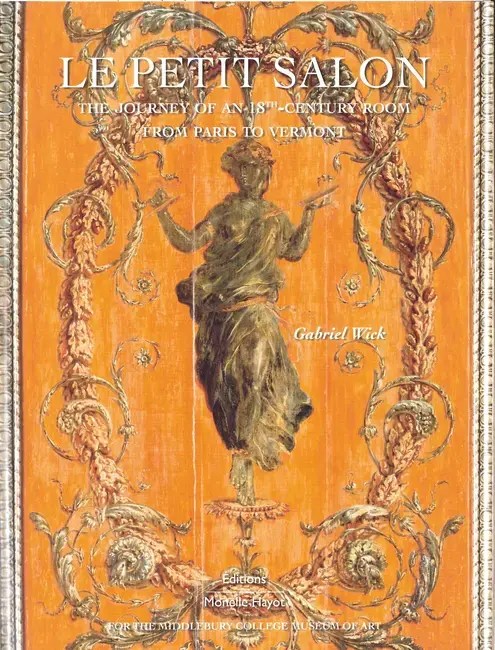 The Middlebury College Museum of Art possesses a jewel of French neoclassicism, Le Petit Salon, a delicately painted, paneled room made around 1776 for a Parisian mansion. It was designed by Pierre-Adrien Pâris ( 1745–1819), subsequently the architect of court fêtes for Louis XVI and Marie-Antoinette. His client was the duc d’Aumont, a renowned collector and patron of the arts, who had the panels installed in his Paris home, now the Hôtel de Crillon on Place de La Concorde. Gifted to Middlebury in 1959, but held in storage since the 1990s, the room will be reassembled for the first time in three decades.
The exhibition follows the journey of Le Petit Salon from Paris to Middlebury via Manhattan, where for fifty years it formed part of the decor of the Bliss family’s Gilded Age mansion. At Middlebury, the Petit Salon became part of Le Château, the college’s French language dorm, itself a fanciful recreation of a 16th-century Norman manoir. The exhibition incorporates Pâris’s 1776 exquisite watercolor elevations of Aumont’s mansion, as well as studies from his long educational sojourn in Rome and Naples. Included in the exhibition are loans from Bowdoin College, the Metropolitan Museum of Art, the Cooper-Hewitt National Design Museum, and the Fine Arts Museum of Besançon.
Gabriel Wick, Le Petit Salon: The Journey of an 18th-Century Room from Paris to Vermont (Saint-Remy-en-l’Eau: Monelle Hayot, 2025), 192 pages, €35.
Exhibition | Valkenburg — Willem de Rooij
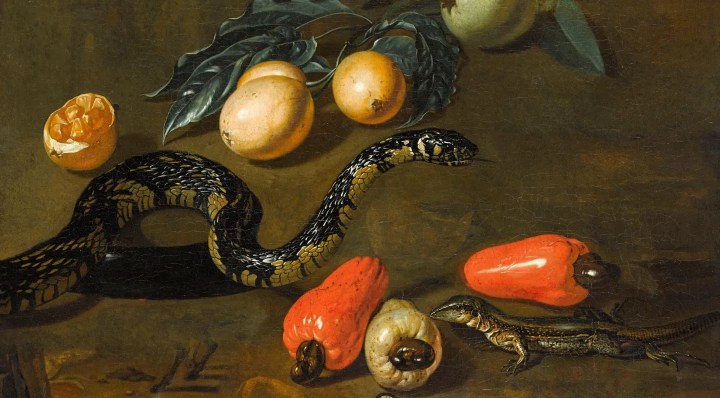
Dirk Valkenburg, Study of Cashews, Maracujas, a Tropical Chicken Snake, and an Ameiva Lizard from Suriname, detail, 1706–08, oil on canvas, 40 × 48 cm (Musée des Beaux-Arts de Quimper).
◊ ◊ ◊ ◊ ◊
Now on view at Utrecht’s Centraal Museum:
Valkenburg — Willem de Rooij
Centraal Museum Utrecht, 13 September 2025 — 25 January 2026
Dirk Valkenburg (1675–1721) was one of the first Europeans to depict Indigenous and enslaved people on Surinamese plantations, while also painting hunting still lifes and portraits of Dutch elites. The breadth of his oeuvre makes it particularly relevant for research into colonial image production and the ‘white gaze’. In this installation, Willem de Rooij displays 30 works in idiosyncratic combinations, inviting reflection on how these 18th-century Dutch elites used art to support and legitimise colonial ideology.
Since the early 1990s, Willem de Rooij (b. 1969) has created temporary installations in that explore the politics of representation through appropriation and collaboration. In 2005, he represented the Netherlands at the Venice Biennale and has since exhibited in leading museums worldwide. A distinctive feature of his practice is the reuse and rearrangement of existing images and objects, often based on in-depth art-historical and cultural research. In doing so, he creates new meanings between diverse visual elements. Recent exhibitions include King Vulture (Akademie der Künste, Vienna) and Pierre Verger in Suriname (Portikus, Frankfurt). De Rooij teaches in Frankfurt, Berlin, and Amsterdam and lectures internationally.
The exhibition will be accompanied by the first comprehensive publication on Dirk Valkenburg’s oeuvre: a catalogue raisonné developed in collaboration with the RKD–Netherlands Institute for Art History. This volume, edited by Willem de Rooij and Karwan Fatah-Black—historian and expert in Dutch colonial history, (Leiden University)—includes new essays by international scholars and thinkers from various disciplines, including art history, anthropology, postcolonial, and queer studies.
Print Quarterly, September 2025
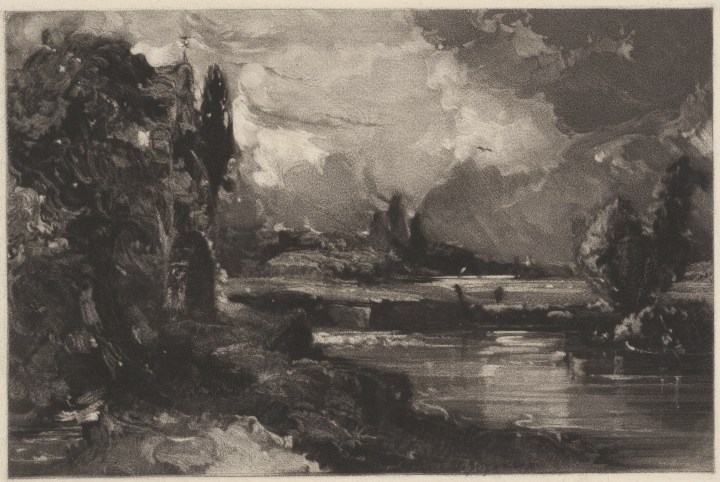
David Lucas, after John Constable, A Mill, 1829, mezzotint, 182 × 250 mm
(Cambridge, Fitzwilliam Museum, inv. P.145-1954)
◊ ◊ ◊ ◊ ◊
The long eighteenth century in the latest issue of Print Quarterly:
Print Quarterly 42.3 (September 2025)
a r t i c l e s
• Elenor Ling and Harry Metcalf, “John Constable’s Working Relationship with David Lucas on the English Landscape Series,” pp. 272–85. This article examines the collaborative partnership between John Constable (1776–1837) and his engraver David Lucas (1802–81) using the mezzotint print series English Landscape as a case study, based particularly on the technical examination of various impressions and plates.
• Niklas Leverenz, “Lithographs from Shanghai of the East Turkestan Engravings, 1890,” pp. 301–06. This short article examines the popularity of the East Turkestan engravings depicting the 1755–60 Qianlong Emperor’s conquest. Leverenz specifically discusses a set of 34 photolithographs printed in 1890 by the photographer Herman Salzwedel (active c. 1877–1904) in Shanghai.
n o t e s a n d r e v i e w s
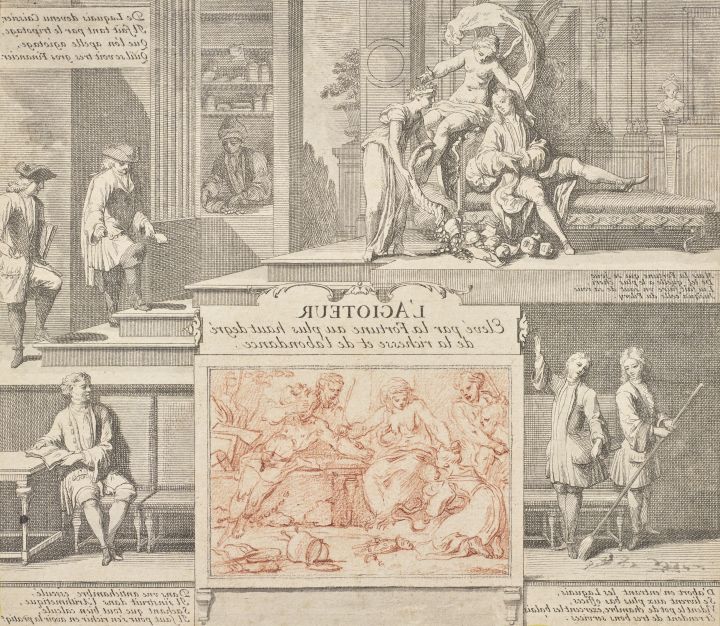
Claude Gillot, The Speculator Raised by Fortune to the Highest Degree of Wealth and Abundance, 1710–11, counterproof of engraving, with additions in red chalk, 255 × 220 mm (Paris, Private collection).
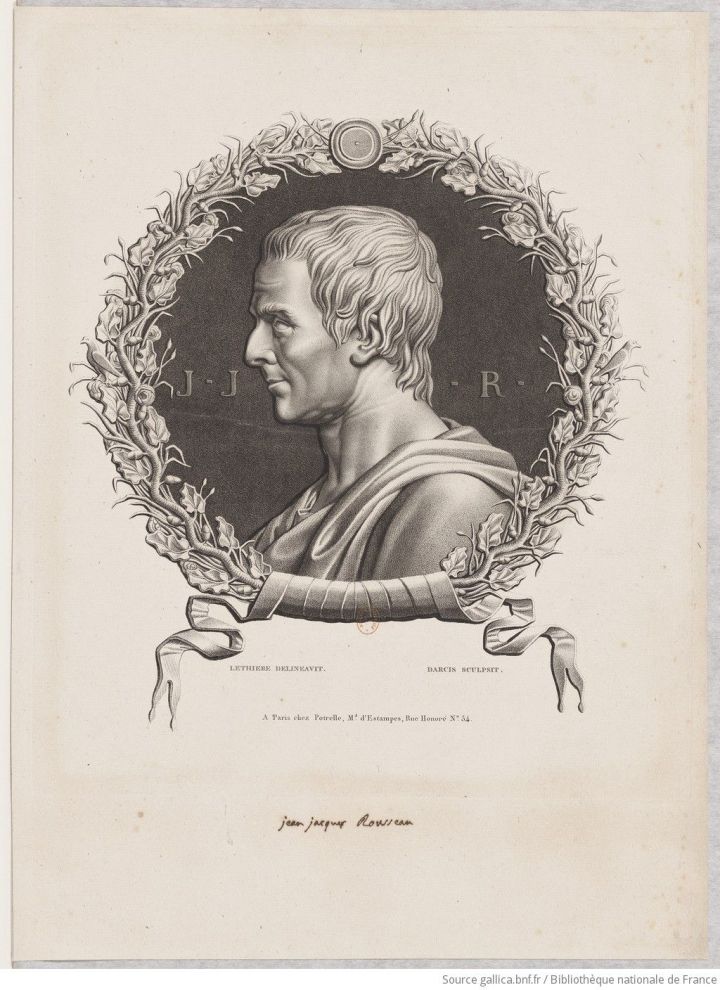
J.-Louis Darcis, after Guillaume Lethière, Portrait of Jean Jacques Rousseau, 1795, engraving, platemark 355 × 305 mm, page 440 × 320 mm (Paris, Bibliothèque Nationale de France).
• Dagmar Korbacher, Review of Andaleeb Badiee Banta, Alexa Griest and Theresa Kutasz Christiensen, eds., Making Her Mark: A History of Women Artists in Europe, 1400–1800 (Goose Lane Editions, 2023), pp. 307–10.
• Daniel Godfrey, Review of Gwendoline de Mûelenaere, Early Modern Thesis Prints in the Southern Netherlands: An Iconological Analysis of the Relationship between Art, Science, and Power (Université Catholique de Louvain, 2022), pp. 310–12.
• Meredith M. Hale, Review of Julie Farguson, Visualising Protestant Monarchy: Ceremony, Art and Politics after the Glorious Revolution, 1689–1714 (The Boydell Press, 2021), pp. 313–15.
• Rena M. Hoisington, Review of Jennifer Tonkovich, Claude Gillot: Satire in the Age of Reason (Paul Holberton, 2023), pp. 315–17.
• Michael Snodin, Review of Orsola Braides, Giovanni Maria Fara, and Alessia Giachery, eds., L’arte di tradurre l’arte: John Baptist Jackson incisore nella Venezia del Settecento (Leo S. Olschki, 2024), pp. 317–19.
• Benito Navarrete Prieto, Review of Ana Hernández Pugh and José Manuel Matilla, Del lapicero al buril. El dibujo para grabar en tiempos de Goya (Museo del Prado, 2023), pp. 320–24.
• Giorgio Marini, Review of Ilaria Miarelli Mariani, Tiziano Casola, Valentina Fraticelli, Vanda Lisanti, and Laura Palombaro, eds., La storia dell’arte illustrata e la stampa di traduzione tra il XVIII e il XIV secolo (Campisano Editore, 2022), pp. 324–28.
• Julie Mellby, Review of Roberta J. M. Olson, Audubon as Artist: A New Look at The Birds of America (Reaktion Books, 2024), pp. 328–29.
• Thea Goldring, Review of Esther Bell and Olivier Meslay, eds., Guillaume Lethière (Clark Art Institute, 2024), pp. 347–52.
Exhibition | William Blake: Burning Bright
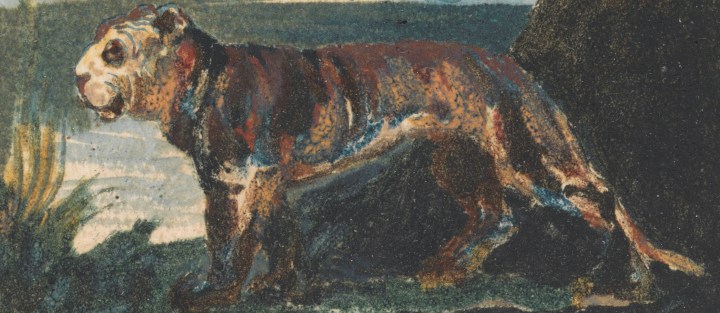
William Blake, The Tyger (Plate 42, from Songs of Innocence and of Experience), detail, 1794, color-printed relief etching with hand coloring in watercolor (New Haven: Yale Center for British Art, Paul Mellon Collection).
◊ ◊ ◊ ◊ ◊
Now on view at YCBA:
William Blake: Burning Bright
Yale Center for British Art, New Haven, 26 August — 30 November 2025
Curated by Elizabeth Wyckoff and Timothy Young
One of the most compelling figures in the history of British art and poetry, William Blake (1757–1827) developed an idiosyncratic worldview during a tumultuous era that witnessed the American and French Revolutions. He expressed his radical perspectives on religious belief, politics, and society through highly original illuminated books, watercolors, paintings, and poetry. This exhibition showcases the Yale Center for British Art’s impressive collection of works by Blake, with special focus on the inventive hand-printed publications that bring to life his poetry and prophecies.
 The YCBA’s extensive holdings include Blake’s most innovative and celebrated books, such as Songs of Innocence and of Experience (1789–94) and The First Book of Urizen (1794). Blake’s mastery of watercolor painting and his phenomenal imaginative powers are evident in the one-of-a-kind illustrations for The Poems of Thomas Gray (between 1797 and 1798) and in the only fully hand-colored version of his culminating poem, the 100-page Jerusalem (1804–20). This stunning presentation highlights the artist’s ambitious vision and skill, as well as his unparalleled contributions to art, literature, and spirituality.
Born in London at a time of major social change and upheaval, Blake aspired to be an artist and a poet from a young age. During his apprenticeship, he developed an elegant black-and-white engraving style that he deployed in both commissioned and original prints and book illustrations. He is best known for devising an unorthodox technique to create colorful illuminated books that merged his poetry and his art. His most notable innovation was a method for printing text and image from a single copper plate. Blake’s work was largely unacknowledged during his lifetime, yet today his striking imagery and stirring words are widely celebrated.
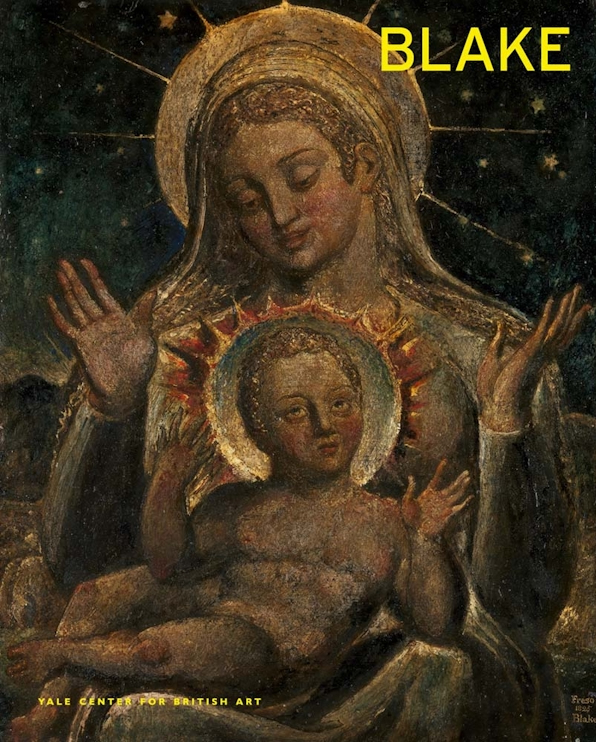
Blake, the second volume in the YCBA’s Collection Series, examines the art and methods of William Blake through the lens of one of the great collections of his work. Written by Elizabeth Wyckoff, with an essay by Sarah T. Weston, the book features exquisite reproductions of his paintings, watercolors, prints, and illustrated books, including the only hand-colored copy of his epic poem Jerusalem.
Elizabeth Wyckoff, Blake (New Haven: Yale Center for British Art, 2025), 136 pages, ISBN: 978-0300284577, $40. With an essay by Sarah Weston.
◊ ◊ ◊ ◊ ◊
Programs exploring multiple dimensions of Blake’s life, work, and legacy will accompany the exhibition. Please visit britishart.yale.edu for the most up-to-date information.
Opening Celebration
Thursday, September 4, 4pm
A conversation with exhibition curators Elizabeth Wyckoff, Curator of Prints and Drawings, and Timothy Young, Curator of Rare Books and Manuscripts, followed by gallery talks and a reception.
The Enduring Influence of William Blake
Thursday, October 30, 5pm
Author John Higgs will talk with Timothy Young, Curator of Rare Books and Manuscripts.
Songs from the Imagination: Music Inspired by the Poetry of William Blake
Thursday, November 20, 5pm
Yale Voxtet, the Institute of Sacred Music’s select group of graduate student singers, will perform in the Library Court.
Create Community: Imagined Worlds in the Art of William Blake and Hew Locke
Thursdays, October 2, 16, and 23, 5:30pm
This three-part workshop will explore William Blake: Burning Bright and Hew Locke: Passages through a close investigation of material and process. Enrollment is limited to twelve people, and preregistration is required.
Curator Tours
Thursdays, September 18, October 30, and November 20, 4pm
Docent Tours
Saturdays, 3pm
Exhibition | Nusantara: Six Centuries of Indonesian Textiles
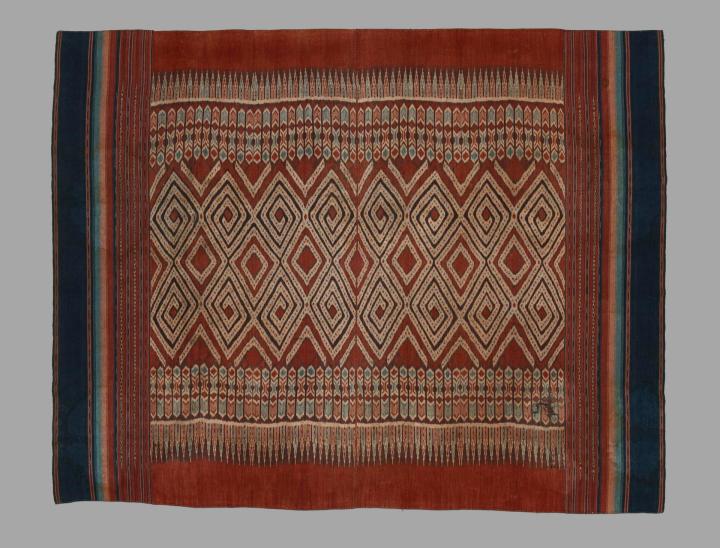
Ceremonial Weaving (Palu), late 18th–early 19th century, cotton, warp-faced plain weave, warp ikat, made in Sulawesi, Indonesia, 195 × 154 cm (New Haven: Yale University Art Gallery, Gift of Robert J. Holmgren and Anita E. Spertus, 2017.48.4).
◊ ◊ ◊ ◊ ◊
From the press release for the exhibition:
Nusantara: Six Centuries of Indonesian Textiles
Yale University Art Gallery, New Haven, 12 September 2025 — 11 January 2026
Organized by Ruth Barnes with the assistance of Arielle Winnik
Celebrating the largest collection of Indonesian textiles in the Western Hemisphere
The Yale University Art Gallery is pleased to present Nusantara: Six Centuries of Indonesian Textiles, a sweeping exhibition that celebrates the elaborate textile heritage of Indonesia and explores the ancient interisland links found in this vast maritime region. Presenting more than 100 examples of unparalleled craftsmanship and artistic innovation, the exhibition offers a singular opportunity to dive deep into the cultural and historical significance of one of the finest collections of Indonesian textiles in the Western Hemisphere.
The wide array of textiles from the 14th to the 20th century displayed in the exhibition are drawn from the Gallery’s holdings. Central to the Gallery’s Department of Indo-Pacific Art, the textile collection boasts approximately 1200 examples from Indonesia and Sarawak (Malaysia). Significant pieces include over 600 textiles originally acquired by Robert J. Holmgren and Anita E. Spertus, later presented to the Gallery by Thomas Jaffe. This group features weaving from maritime Southeast Asia, where textiles are not just artistic creations but serve an important role in ceremonies and rituals. They also embody gender roles and social status, reflecting the wearer’s identity and heritage.
The Indonesian islands of Sumatra and Sulawesi hold an important place within the Gallery’s collection, counting more than 200 and 100 examples each, respectively. The remainder of the collection encompasses textiles from regions throughout Indonesia, showcasing the country’s rich cultural diversity.
Indonesia has historically been at the crossroads of major trade routes, resulting in a blend of Indigenous and foreign influences. In the 10th and 11th centuries, Indonesian textiles began to show the Influence of Indian designs. The impact of Chinese and later Islamic cultures is also evident, yet these borrowed motifs were transformed into distinctively Indonesian traditions. Drawing its title from the original name for the Indonesian archipelago, Nusantara, the exhibition offers an unprecedented opportunity to view the full range of rich imagery and technical mastery of this remarkable art form.
The exhibition is made possible by Hunter Thompson, the National Endowment for the Arts, the Helen Frankenthaler Foundation, and the Robert Lehman, B.A. 1913, Endowment Fund. It was organized by Ruth Barnes, the Thomas Jaffe Curator of Indo-Pacific Art, with the assistance of Arielle Winnik, the Donna Torrance Assistant Curator of Indo-Pacific Art.










 Enfilade
leave a comment