Exhibition | A Grand Tour: Images of Italy from the Jundt Art Museum
From the Jundt Art Museum:
A Grand Tour: Images of Italy from the Permanent Collection of the Jundt Art Museum
Jundt Art Museum, Gonzaga University, Spokane, Washington, 18 January — 9 May 2020
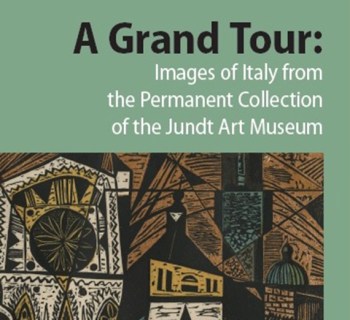 In his book Italian Hours, Henry James often commented on the tourist sites of urban Italy. In 1882, he noted, “The only way to care for Venice as she deserves it is to give her a chance to touch you often—to linger and remain and return.” James and other late-nineteenth-century Americans were continuing the British tradition of the Grand Tour in Italy, centered on its most important cultural cities and historic sites. This exhibition functions as a visual travelogue of the Italian peninsula using works of art from the collection of the Jundt Art Museum at Gonzaga University.
Both the exhibition and an accompanying book begin with sixteenth-, seventeenth-, and eighteenth-century European prints, byproducts of artists’ visits mostly to the urban centers of Rome and Florence, and conclude with twenty-first-century images. Significant portions of the objects in this exhibition result from the Bolker Collection and from the Fredrick and Genevieve Schlatter Endowed Print Fund. A Grand Tour utilizes the Jundt Art Museum’s collection to present artistic imagery of the canals of Venice, the Renaissance architecture of Florence, and the classical remains of Rome, but also sites in Milan, Pisa, Assisi, Naples, and Palermo as well as other cities and towns. We hope that this selection of 76 images of Italy will give pleasure as one introduction to a wide-ranging and astonishing topic and as an opportunity, as James writes, “to linger and remain and return.”
Exhibition | Master, Pupil, Follower

Pietro Giacomo Palmieri (1737–1804), Two Figures in a Landscape, red chalk on cream paper, 18 × 24 inches
(Collection of Jeffrey E. Horvitz, Boston, inv. no. D-I-43)
◊ ◊ ◊ ◊ ◊
From the Georgia Museum of Art:
Master, Pupil, Follower: 16th- to 18th-Century Italian Works on Paper
Georgia Museum of Art, University of Georgia, Athens, 21 December 2019 — 8 March 2020
Curated by Randy Coleman, Nelda Damiano, and Benedetta Spadaccini

Circle of the Gandolfi, Standing Academic Male Nude, Seen from the Rear, ca. 1775, charcoal on white paper with some foxing and repairs, 17 × 12 inches (Athens: Georgia Museum of Art, University of Georgia; extended loan from the collection of Giuliano Ceseri. GMOA 1995.184E).
This exhibition showcases approximately 30 drawings and prints dating from the 16th to the 18th centuries and drawn from the collections of Giuliano Ceseri of Lafayette, Louisiana, the Georgia Museum of Art, and the Jeffrey Horvitz Collection. Curators selected drawings and prints to represent specific artistic styles and Italian regional schools. An examination of the drawings has revealed some previously erroneous assumptions. In a few cases, new attributions have resulted; in others, authorship remains unresolved. The museum will publish a fully illustrated exhibition catalogue containing this scholarship and publishing important drawings by Giulio Romano, Claudio Ridolfi, Palma il Giovane, and Guercino for the first time. Other artists include Giulio Benso, Giovanni Battista Tiepolo, Giovanni Benedetto Castiglione, Salvatore Rosa, and followers of Veronese and Tintoretto. The exhibition is curated by Robert Randolf Coleman, professor emeritus, Renaissance and Baroque art history, University of Notre Dame; Nelda Damiano, Pierre Daura Curator of European Art, Georgia Museum of Art; and Benedetta Spadaccini, Biblioteca Ambrosiana, Milano.
◊ ◊ ◊ ◊ ◊
Robert Randolf Coleman, Nelda Damiano, Benedetta Spadaccini, William Eiland, Master, Pupil, Follower: 16th- to 18th-Century Italian Works on Paper (Athens: Georgia Museum of Art, University of Georgia, 2020), 138 pages, ISBN: 978-0915977185.
This catalogue accompanied the exhibition on view at and the Georgia Museum of Art at the University of Georgia from 21 December 2019 to 8 March 2020. Co-curators Robert Randolf Coleman (professor emeritus of Renaissance and baroque art history, University of Notre Dame), Nelda Damiano (Pierre Daura Curator of European Art, Georgia Museum of Art), and Benedetta Spadaccini (Biblioteca Ambrosiana, Milano) contributed entries on each of the 32 works in the exhibition, all of which are illustrated in color. Coleman also provided an introductory essay, and museum director William Underwood Eiland wrote a preface and a brief essay on collector Giuliano Ceseri, from whose collection many of these works come. Curators selected drawings and prints by artists including Giulio Benso, Giovanni Battista Tiepolo, Giovanni Benedetto Castiglione, Salvatore Rosa, and followers of Veronese and Tintoretto to represent specific artistic styles and Italian regional schools. The catalogue is organized by region. An examination of the drawings revealed some previously erroneous assumptions, resulting in new attributions in some cases. Drawings by Giulio Romano, Claudio Ridolfi, Palma il Giovane, and Guercino are published here for the first time.
◊ ◊ ◊ ◊ ◊
Note (added 16 August 2023) — The posting was updated to include information on the catalogue.
Exhibition | Classic Black: The Basalt Sculpture of Wedgwood
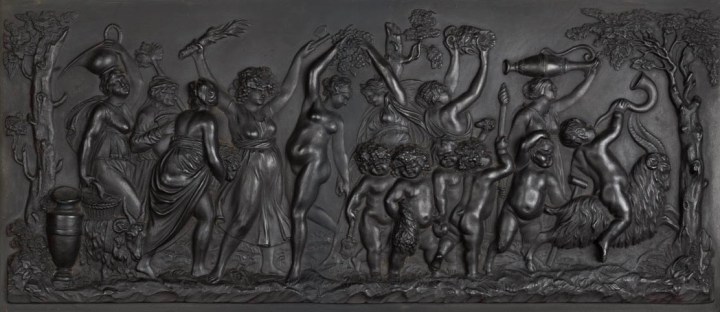
Bacchanalian Triumph, Wedgwood black basalt rectangular plaque, late eighteenth or early nineteenth century. Copied from a bas-relief by Claude Michel Clodion (1738–1814).
◊ ◊ ◊ ◊ ◊
From The Mint:
Classic Black: The Basalt Sculpture of Wedgwood and His Contemporaries
The Mint Museum Randolph, Charlotte, North Carolina, 8 February — 30 August 2020
Featuring more than 100 ceramic objects, with loans from notable public and private collections in the United States and England, this exhibition is the first to focus exclusively on the black basalt sculpture made by Josiah Wedgwood and other Staffordshire potters in late eighteenth-century England. The works of art on view include life-size portrait busts, statues, vases, and other fully three-dimensional, ornamental forms, as well as works in low relief, such as large plaques, portrait medallions, and medals.
 Among the ceramic bodies produced in great numbers in Staffordshire, England in the late eighteenth century was black basalt. Josiah Wedgwood perfected this fine-grained stoneware in 1768, creating its dark color by adding manganese and carr, a slurry rich-with-iron oxide obtained from coal mines, to the clay body. Basalt was soon produced by many other Staffordshire potters as well. Although Wedgwood and the other potters used black basalt to create so-called ‘useful wares’, such as teapots and bowls, this exhibition showcases basalt sculpture, especially works with classically inspired themes or ornament.
Many of the basalt objects on view in the galleries were copied directly from works of art made in ancient Greece and Rome, such as busts of Homer and Socrates, gems and statues depicting gods and other mythological creatures, and coins with portraits of Julius Caesar and his successors. Other basalt pieces derived from works made much later. Among the many artists represented in the exhibition by basalt versions of their creations are Michelangelo from the sixteenth century, Gian Lorenzo Bernini from the seventeenth century, and sculptor Louis François Roubiliac from the eighteenth. The Staffordshire potteries also hired modelers and other craftsmen to create new designs for their basalt wares.
Whatever the design source, the basalt sculpture made by Wedgwood and his contemporaries was well-crafted, refined, and perfectly suited for the neoclassical interiors so popular among style-conscious consumers, both in England and beyond, in the last few decades of the eighteenth century. Classic Black proudly highlights this fascinating chapter in the history of ceramics.
The catalogue is published by Giles:
Brian Gallagher, ed., with contributions by Gaye Blake-Roberts, Robin Emmerson, M.G. Sullivan, and Nancy Ramage, Classic Black: The Basalt Sculpture of Wedgwood and His Contemporaries (London: D. Giles, Ltd., 2020), 248 pages, ISBN: 978-1911282358, £45 / $60.
Classic Black explores classically inspired sculpture and other ornamental wares in black basalt. This famous stoneware was perfected by Josiah Wedgwood in 1768 and then went on to be produced by other prominent Staffordshire potters. Wedgwood, with prescience, said of his new creation, “Black is Sterling and will last forever.” This volume presents approximately 120 examples of ornamental black basalt, including portrait busts, statues, and vases, ewers and other fully three-dimensional, ornamental forms. It also features works in low relief including tablets, plaques, medallions and cameos. Essays by renowned subject specialists enhance the fully illustrated catalogue entries, which are grouped into three chapters. These each focus on an era of the design sources used by Wedgwood and his contemporaries to create their basalt wares: Classical Antiquity, the 16th and 17th centuries, and the 18th century.
Brian Gallagher is the curator of Decorative Arts at The Mint Museum. His recent projects include the publication, British Ceramics 1675–1825: The Mint Museum, which highlights over 225 examples from the Mint’s renowned British ceramics collection, and the reinstallation of that collection in a long-term display called Portals to the Past: British Ceramics 1675–1825.
Gaye Blake-Roberts is curator of the Wedgwood Museum, Barlaston.
Robin Emmerson is the former curator of Decorative Arts, National Museums, Liverpool.
Nancy H. Ramage is the Charles A. Dana Professor of the Humanities and Arts Emerita, Ithaca College.
M.G. Sullivan is an independent scholar, York University.
C O N T E N T S
Foreword by Todd Herman, President and CEO, The Mint Museum
Acknowledgments
Preface
Essays
Robin Emmerson, Classicism and the Design Business
Gaye Blake-Roberts, Wedgwood’s Customers for Ornamental Black Basalt
M.G. Sullivan, Wedgwood’s Basalt and the Sculpture Market
Catalogue by Brian Gallagher
I. Works Based on Sources from Classical Antiquity
Rome and Pompeii: Fountains of Inspiration
Introduction by Nancy Ramage
II. Works Based on 16th- and 17th-Century Sources
From Renaissance Italy to the Golden Age of the Dutch Republic and Restoration England
III. Works Based on 18th-Century Sources
Enlightened Thinkers, Contemporary Events, and New Interpretations of the Classical Past
Concordance (by Object Type)
Selected Bibliography
Index
Photography Credits
Exhibition | La Chine rêvée de François Boucher

Press release (via Art Daily) for the exhibition:
A Province of the Rococo: François Boucher’s Idealised China
Musée des beaux-arts et d’archéologie de Besançon, 9 November 2019 — 2 March 2020
Besançon’s Museum of Fine Art and Archaeology presents Une des provinces du Rococo: La Chine rêvée de François Boucher (One of the Provinces of the Rococo: François Boucher’s Idealised China), an exhibition that embarks the visitor on an enchanting voyage of discovery.

The Chinese Garden, 1742, oil on canvas (Musée des Beaux-Arts et d’Archéologie de Besançon).
The illustrious François Boucher (1703–1770) was one of the key figures of eighteenth-century painting along with Watteau and Fragonard, and was one of the artists displaying the greatest talent in his efforts to renew the decorative arts. At a time when China, an ancient and distant civilisation, was drawing closer to France thanks to the trade in objets d’art, Boucher offered a window into this fascinating world, creating numerous Chinese subjects that were almost instantly adopted as part of Parisian decorative schemes and print collections and, inevitably, in the decorative arts: porcelain, furniture, and particularly tapestries.
The Museum of Fine Art and Archaeology in Besançon—which for the last two centuries has been home to the sketches produced in 1742 for the Beauvais Manufactory, a producer of tapestries—presents an ambitious exhibition with one hundred and thirty international loaned items, offering a poetic take on a theme never before presented to the public: the creative process of an artist who successfully created an exotic and original repertoire through his outstanding curiosity and creativity and who, in the words of the Goncourts Brothers, “made China one of the provinces of the Rococo.”
Tipsy Boats
One of the exhibition’s objectives is to help the visitor understand Francois Boucher’s keen artistic eye, finely honed during his visits to Parisian traders dealing in exotic items, a trade which was booming at the time. The exhibition begins with a series of items sold by marchands-merciers around 1730–1740 (lacquered screens, wallpaper, porcelain, etc.), presented in a specially laid out scene resembling the interior of a shop.
Produced for a pair of exotic item enthusiasts, the Chinese décor created by Antoine Watteau around 1710 at the Muette hunting lodge on the edge of the Bois de Boulogne also decisively influenced the way Boucher came to view Chinese subjects as ornamental features. He was among the artists who visited the site in 1731, to etch the subjects. Dismantled in the eighteenth century, this decor is represented by twelve prints produced by Boucher and by the two surviving paintings by Watteau.
Taste’s Hidden Surprises
The research conducted for the exhibition confirms that Boucher was one of the most ambitious collectors of Asian items in his day. His collection, which was dispersed in 1771 after his death, included around 700 Asian items. It stood out from contemporary collections thanks to its size and above all its virtually boundless diversity. A selection of some fifty items matching descriptions of this collection are presented with a view to presenting its richness and variety, while at the same time giving visitors some idea of the proportions of the different categories of items and forms involved including statuettes, mounted porcelain items, lacquered butterfly-shaped boxes, locks, and musical instruments from China, etc. Very early on, Boucher used this collection as a visual meaning but also as a means of getting himself better known as an artist but also as an enthusiast. He arranged for Gabriel Huquier, the famous print merchant who went on to become his business partner in the field of chinoiseries, to publish a collection of figures drawn by himself based on items from his collection. In the exhibition, these etched prints are compared with Asian models to highlight the changes of form through which the artist succeeded in bringing his collection to life.
China in Silk
His mastery of the vocabulary of forms, something which he alone managed so effortlessly, inevitably saw Boucher emerge as the artist of choice for the tapestry cartoons from the second Chinese series. An initial series had been woven at the Beauvais Manufactory in the late seventeenth century, but the cartoons gradually became worn and their subjects outdated. Boucher was therefore asked by Oudry, the Manufactory’s manager, to supply new models. He created ten ‘mini-cartons’ converted into larger works by the painter Dumons, for the weavers in the low-warp workshops. Eight of these cartons were presented at the 1742 exhibition and six were finally used for the series. The series became one of the greatest successes in the French tapestry industry of the eighteenth century with ten follow-up works being woven between 1743 and 1775. For the first time since the eighteenth century, the exhibition brings together the six tapestry items, forming a set which is truly spectacular in terms of its size and the exotic yet lively nature of its subjects.
China’s Gallantry
Presented in an elegant and intimate atmosphere resembling an art enthusiast’s lounge, this section examines Boucher’s Chinese paintings. The artist produced no easel paintings in this register although he was perfectly able to do so. China was simply a ‘sideline’ in his painted work but a side-line of outstanding quality. It can be seen firstly through the insistent representation of Asian objets d’art like those he had the opportunity to see and collect at first hand, in four interior scenes or ‘fashion pictures’ produced in the late 1730s and put together for this exhibition. These paintings, produced in small sizes for an impeccable result, demonstrate the artist’s great familiarity with the Parisian luxury goods market, which was undergoing profound change at the time, and of which these pictures were part. Three lintel pieces also reveal another function of painting, this time a decorative one. Two of these paintings, delicate blue-and-white monochromes, are seen near the chest of drawers and corners of the Comtesse de Mailly’s blue apartment at the Château de Choisy as research suggests that they came from this same sumptuous decor designed as an outstanding blue and white symphony.
Copyright Boucher
 Even more so than through painting, Boucher’s creativity in the Chinese register is also expressed through paper: the artist is the author of almost a hundred print models, mostly distributed by the printmaker and merchant Gabriel Huquier. They both developed a significant repertoire of subjects inspired by Chinese models and adapted to European tastes, which were then reused by craftsmen for screens and for decorating porcelain or furniture. The number of prints featuring Chinese subjects produced by Boucher is extremely impressive for someone who was not a professional ornamentalist and their influence on the decorative arts in France and elsewhere was immense. The drawings and prints exhibited here therefore allow for a better understanding of the transition from one technique to the other, along with several luxury items produced by the manufactory of Vincennes Sèvres and by the best Parisian cabinetmakers, demonstrating their adaptation and use in the decoration of European objets d’art.
One hundred and thirty European and Asian works loaned by numerous museums and private collections also feature in the exhibition, as part of a poetic exhibition experience highlighting a unique approach, one which encompasses the history of art and the history of taste. Objets d’art, drawings, prints, paintings and tapestries, including some never before seen, make it possible to appreciate François Boucher’s keen eye and to demonstrate his central decisive contribution to the growing enthusiasm for China which developed in France back in his day. The manner in which this artist, collector, and enthusiast incorporates the exotic items he knows so well in his paintings and drawings suggests a link with the transformation and re-creation methods used at the same time by the marchands-merciers. We should consequently consider Boucher as an inventor and even as an entrepreneur with a highly developed awareness of the social and artistic challenges of his time, looking beyond the all too convenient label of painter or draughtsman. His idyllic China marks an incredibly creative ten-year interlude in an immense career, the effects of which left their mark on the age of Enlightenment.
The catalogue is published by In Fine éditions d’art:
Nicolas Surlapierre, Yohan Rimaud, Alastair Laing, and Lisa Mucciarelli, eds., Une des Provinces du Rococo: La Chine Rêvée de François Boucher (Paris: In Fine éditions d’art, 2019), 288 pages, ISBN: 978-2902302291, 29€. Contributors include Nicolas Surlapierre, Pierre Rosenberg, Vincent Bastien, Maël Bellec, Adrien Bossard, Stéphane Castelluccio, Claire Délery, Guillaume Faroult, John Finlay, Anne Forray-Carlier, Françoise Joulie, Alastair Laing, Lisa Mucciarelli, Jamie Mulherron, David Pullins, Béatrice Quette, Yohan Rimaud, Marie-Laure de Rochebrune, Kristel Smentek, Perrin Stein, Jean Vittet, and Sylvia Vriz.
More information on the catalogue, including the full table of contents, is available as a PDF file here»
Exhibition | Jean-Antoine Houdon’s Portraits of Americans
Now on view at the DIA:
Jean-Antoine Houdon’s Portraits of Americans in the Age of Enlightenment
Detroit Institute of Arts, 6 October 2019 — 3 May 2020

Jean-Antoine Houdon, Busts of Benjamin Franklin (left), 1778, and George Washington (right), 1786, terracotta (Paris: Musée du Louvre).
The Detroit Institute of Arts presents a dossier exhibition featuring two masterworks of French eighteenth-century portrait sculpture lent from the Musée du Louvre. Created by the greatest sculptor of the Enlightenment, Jean-Antoine Houdon (1741–1828), the portraits depict two of America’s most iconic founders, Benjamin Franklin and George Washington. As ‘Guests of Honor’, the busts are displayed in the company of selected works that similarly depict Franklin, Washington, and Robert Fulton, another early American icon, as among the first to reach celebrity status as enlightened leaders of a new nation. Drawing from the DIA’s own holdings and the important loans from the Louvre, the exhibition gives audiences a unique opportunity to explore and compare images of these very familiar personae through art in a variety of media. Presented in our gallery dedicated to the early American republic, the exhibition sets Houdon’s masterful terracotta portraits alongside painting, sculpture, textile, and work on paper, with significant examples of furniture and decorative arts already on view in the gallery providing a greater context of visual culture in the early American republic.
Exhibition | Divine Illusions: Statue Paintings
Opening next month at the Snite:
Divine Illusions: Statue Paintings from Colonial South America
Snite Museum of Art, University of Notre Dame, 18 January — 16 May 2020
Curated by Michael Schreffler
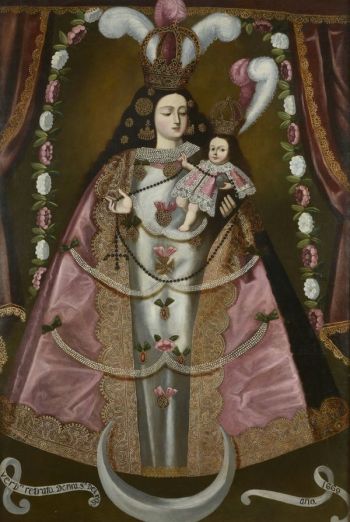
Unidentified artist, Our Lady of the Rosary of Pomata, 1669, oil on canvas (Carl & Marilynn Thoma Art Foundation, photo by Jamie Stukenberg).
In eighteenth-century Spanish America, sculpted images of the Virgin Mary were frequent subjects of paintings. Some of these ‘statue paintings’ depicted sculptures famed for miraculous intercession in medieval Spain. Others captured the likenesses of statues originating in the Americas and similarly celebrated for their divine intervention. Like the statues they portrayed, the paintings, too, were understood to be imbued with sacredness and were objects of devotion in their own right.
Drawn from the extraordinary holdings of the internationally renowned Carl & Marilynn Thoma Art Foundation, this exhibition focuses on statue paintings of the Virgin from the Viceroyalty of Peru, a part of the Spanish Empire encompassing much of Andean South America. It centers particularly on works produced in Cuzco (Peru) and artistic centers in the vicinity of Lake Titicaca and explores the European and American dimensions of the phenomenon, iconographic variations in the genre, and what these works of art reveal about sacred imagery and its operation in Spanish colonial South America. The identities of the painters and patrons of these works remain largely unknown, but certainly some of them were native Andeans.
The paintings in the exhibition cohere not only in their subject matter and place of production, but also in the painters’ meticulous treatment of the lavish dresses, mantles, jewels, and crowns that adorned the sculpted images. These details enhance their illusionistic effects, simulating the presence of the dressed statue itself. By making divine images from distant places present in colonial Peru and positioning them—through painting—in the company of sacred sculptures from the Americas, works in this genre traced a transatlantic spiritual geography conceived in eighteenth-century Spanish America and extending from the Andes to the Pyrenees and beyond.
In addition to the paintings on display, this exhibition will be supplemented with carefully selected archival and didactic materials. This landmark exhibition is curated by Michael Schreffler, Ph.D., of the University of Notre Dame’s Department of Art, Art History and Design.
The Burlington Magazine, December 2019
The eighteenth century in The Burlington:
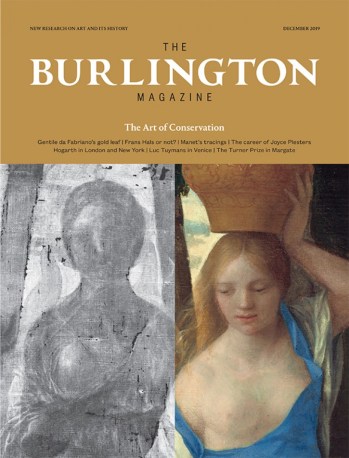
The Burlington Magazine 161 (December 2019)
 A R T I C L E S
• François Marandet, “A Modello by James Thornhill for Addiscombe House, Surrey,” pp. 1028–33. An oil sketch in the Musée des Beaux-Arts, Rouen, is here identified as James Thornhill’s modello for the ceiling painting of the staircse hall at Addiscombe House, near Croyden, begun c.1702 and demolished in the 1860s. It depicts the classical gods as an allegory of the days of the week.
R E V I E W S
• Charles Avery, Review of the exhibition Forged in Fire: Bronze Sculpture in Florence under the Last Medici (Palazzo Pitti, 2019–20), pp. 1044–47.
• David Bindman, Review of the exhibition, Hogarth: Cruelty and Humor (Morgan Library and Museum, 2019), pp. 1047–48.
• Brian Allen, Review of the exhibition Hogarth: Place and Progress (Sir John Soane’s Museum, 2019–20), pp. 1048–51.
• Emily M. Weeks, Review of the exhibition Inspired by the East: How the Islamic World Influenced Western Art (British Museum, 2019–20), pp. 1051–53.
• Xavier F. Salomon, Review of the exhibition Luigi Valadier: Splendour in Eighteenth-Century Rome (Galleria Borghese, 2019–20), pp. 1053–55.
• Clare Hornsby, Review of Robin Simon and MaryAnne Stevens, eds., The Royal Academy of Arts: History and Collections (Yale University Press, 2018) and Nicholas Savage, Burlington House: Home of the Royal Academy of Arts (Royal Academy of Arts, 2018), pp. 1060–61.
• Jörg Zutter, Review of Chris Fischer, Venetian Drawings: Italian Drawings in the Royal Collection of Graphic Art (Statens Museum fur Kunst, National Gallery of Denmark, 2018), p. 1064.
• Thomas Stammers, Review of Charlotte Guichard, La griffe du peintre: La valeur de l’art, 1730–1820 (Seuil, 2018), pp. 1066–67.
• Richard Stephens, Review of Wayne Franits, Godefridus Schalcken: A Dutch Painter in Late Seventeenth-Century London (Amsterdam University Press, 2018), p. 1074.
O B I T U A R Y
• Anthony Geraghty, Kerry Downes (1930–2019), p. 1075.
Exhibition | Luigi Valadier: Splendour in Eighteenth-Century Rome
Now on view at the Galleria Borghese . . . Of the 72 objects included, only 22 were included in the related Frick exhibition, as noted by Xavier Salomon in his review for The Burlington (December 2019), p. 1053.
Luigi Valadier: Splendour in Eighteenth-Century Rome
Galleria Borghese, Rome, 30 October 2019 — 2 February 2020
Curated by Anna Coliva
 Ma ciò che la mostra vuole esaltare è la possibilità davvero unica di ammirare le opere del grande artefice all’interno di un contesto decorativo, quale quello della Villa Borghese, capace di restituire, di per sé, quella particolare compresenza di pittori, scultori e artigiani che l’architetto Antonio Asprucci aveva diretto nel rinnovamento del Palazzo di città e della Villa voluto dal principe Marcantonio IV Borghese; artisti che, nei medesimi anni, non solo avevano condiviso molte delle principali imprese artistiche romane ma i cui rapporti diretti con Luigi Valadier sono ampiamente documentati: è il caso, solo per fare un esempio, dell’intagliatore di marmi Lorenzo Cardelli, già nella bottega di Piranesi, che con il grande orafo collaborerà tanto nell’esecuzione del camino della Sala XVI, decorato con applicazioni in bronzo di Valadier, quanto nella realizzazione di manufatti destinati alla committenza anglosassone.
La Villa, che custodisce alcuni dei capolavori, come l’Erma di Bacco e la coppia di Tavoli dodecagonali, sintetizza così il gusto dominante a Roma intorno alla metà del secolo, dove i raffinati apparati decorativi risplendono di un declinante rococò che coesiste con le nuove tendenze stilistiche ispirate all’antico. Di questo particolare contesto culturale, nel senso più ampio, Valadier è protagonista assoluto.
Se la committenza Borghese costituì il filo conduttore dell’attività di Valadier, il rango e il numero dei committenti rivelano lo straordinario successo della sua carriera di orafo e argentiere, esaltando la vastità di campo, l’originalità e l’impronta internazionale della sua produzione, che la mostra intende rappresentare con importanti testimonianze. I prestiti spaziano dalle grandi lampade d’argento per il santuario di Santiago di Compostela, al San Giovanni Battista del Battistero Lateranense, per la prima volta visibili fuori della loro collocazione originale; dal servizio per pontificale della cattedrale di Muro Lucano alle sculture della cattedrale di Monreale; e, ancora, saranno esposte le riproduzioni in bronzo di celebri statue antiche per re Gustavo III di Svezia, Madame du Barry e il conte d’Orsay; il mirabile sostegno del cammeo di Augusto, realizzato su commissione di Pio VI per il Museo Sacro e Profano in Vaticano, oltre alle straordinarie invenzioni dei superbi desert, come quello commissionato dal Balì di Breteuil e poi venduto a Caterina II di Russia, oggi a San Pietroburgo, e la ricostruzione del tempio di Iside a Pompei per Maria Carolina d’Austria.
Una importante sezione sarà dedicata ai disegni, strumento fondamentale per comprendere l’evolversi del procedimento creativo di Valadier e la sua traduzione attraverso l’attività della grande e articolata bottega. Il prezioso volume della Pinacoteca Comunale di Faenza, per la prima volta interamente catalogato in occasione della mostra, ne offre una rassegna variegata, che sarà apprezzabile anche attraverso riproduzioni digitali. I disegni offrono inoltre la testimonianza di opere oggi disperse, come il sontuoso servizio in argento dorato realizzato per i Borghese, i cui pochi oggetti giunti fino a noi saranno riuniti in questa occasione.
In mostra saranno presenti alcuni totem multimediali dedicati ai Luoghi di Luigi Valadier a Roma: siti, chiese, palazzi e ambienti che conservano le sue opere o comunque significativi, come la casa-studio in via del Babuino. Un invito a trasferire questo percorso virtuale nella realtà, per comprendere meglio quel Valadier “romano”, decoratore nella più splendida e “moderna” Villa di delizie della città eterna, ma espressione di quel gusto internazionale che da Roma partiva per diffondere un gusto ricercato e imitato in tutta Europa.
Geraldine Leardi, ed., Valadier: Splendore nella Roma del Settecento (Milan: Officina Libraria, 2019), 376 pages, 978-8833670638, 48€.
Exhibition | Fiji: Art & Life in the Pacific
Press release (19 November 2019) for the exhibition (noted previously here). . .
Fiji: Art & Life in the Pacific
Sainsbury Centre, Norwich, 15 October 2016 — 12 February 2017
Los Angeles County Museum of Art, 15 December 2019 — 19 July 2020
Peabody Essex Museum, Salem, Massachusetts, 12 September 2020 — 3 January 2021
Curated by Steven Hooper, Karen Jacobs, Katrina Igglesden, and Nancy Thomas

Double Portable Temple (bure kalou), Fiji, early 19th century; coir, wood, reed, and shells, 44 × 25 × 21 inches (Salem, Massachusetts: Peabody Essex Museum, gift of Joseph Winn Jr. in 1835, photo by Jeffrey Dykes).
The Los Angeles County Museum of Art presents Fiji: Art & Life in the Pacific, the first substantial project on the art of Fiji to be mounted in the U.S. The exhibition features over 280 artworks drawn from major international collections, including Fiji Museum, the British Museum, the Museum of Archaeology and Anthropology (Cambridge), the Smithsonian, and distinguished private collections. The exhibition includes figurative sculpture, ritual kava bowls, breastplates of pearl shell and whale ivory, large-scale barkcloths, small portable temples, weapons, and European watercolors and paintings. Additionally, Fiji: Art & Life in the Pacific showcases historical photographs from LACMA’s recently acquired Blackburn Collection, as well as a newly commissioned 26-foot double-hulled sailing canoe (drua) constructed in Fiji using traditional materials and techniques.
Fiji: Art & Life in the Pacific was organized and curated by Professor Steven Hooper, Dr. Karen Jacobs, and Ms. Katrina Igglesden at the Sainsbury Centre in Norwich, England, where it was on view October 15, 2016–February 12, 2017. The exhibition has been reformatted for the presentation at LACMA, with additional major loans from U.S. collections. The exhibition at LACMA is curated by Nancy Thomas, senior deputy director, art administration and collections at LACMA, with support from the organizing curators.
“LACMA is pleased to collaborate with Professor Steven Hooper and his colleagues from the Sainsbury Centre, Norwich,” said Nancy Thomas. “Research for the project was informed by over 40 years of collaboration with Indigenous Fijian and international scholars and support from the UK’s Arts & Humanities Research Council and the Fijian government, resulting in this deeply researched and comprehensive exhibition.”
Fiji: Art & Life in the Pacific is presented in the Lynda and Stewart Resnick Exhibition Pavilion, a major expansion of LACMA’s campus made possible through a landmark gift from trustee Lynda Resnick and Stewart Resnick, the philanthropists and entrepreneurs behind The Wonderful Company and FIJI Water. Since the Resnick Pavilion opened in 2010, its reconfigurable galleries have hosted nearly 50 significant exhibitions covering a diverse cross-section of art history. FIJI Water is the presenting sponsor of the exhibition.
“It’s an honor to be able to share the beauty of Fijian arts and culture through this stunning exhibition,” said LACMA CEO and Wallis Annenberg Director Michael Govan. “We’re pleased to present this show in the Resnick Pavilion, which has become the heart of LACMA’s campus. I’m deeply grateful to Lynda and Stewart for their commitment to bringing this important exhibition to the U.S., and for their incredible legacy benefiting the larger cultural community of Los Angeles.”
“Fiji holds a very special place in our hearts, and Stewart and I are gratified to support this exhibition,” said Lynda Resnick, vice chair and co-owner of The Wonderful Company. “It is our hope that these works from across the archipelago will help visitors fully appreciate the country’s magnificent culture.”
Following the presentation at LACMA, the exhibition will be on view at the Peabody Essex Museum in Salem, Massachusetts, from September 12, 2020 through January 3, 2021. FIJI Water is also presenting sponsor of the Peabody Essex Museum presentation. In addition, generous support from FIJI Water funded the construction of the drua and its transportation from Fiji to Los Angeles.
Consisting of an archipelago of more than 300 islands, Fiji’s landscape is rich, with fertile soils on most islands providing ample food crops and lagoons with extensive reef systems supplying fish and shellfish. The local environment produced the majority of materials represented in the exhibition, including a wide variety of timbers for housing, canoes, and weapons; plant materials for textiles, mats, roofing, ropes, and bindings; clay, bamboo, and coconuts for containers; and shells and other marine materials for adornments.
 Fiji: Art & Life in the Pacific showcases the range and quality of these artworks from the past two centuries and highlights the skill and creative adaptability of the artists and craftspeople who made them. The exhibition presents these artworks in eight thematic sections, including: Voyaging, Fiber and Textile Arts, Warfare, Embodying the Ancestors, Adorning the Body, Chiefly Objects, Respecting the Ancestors, and Fiji Life. The later section illustrates 19th-century Fiji with 22 remarkable photographs including studio portraits, landscapes, architecture, and other features of daily life.
The first section, Voyaging, focuses on the role and implements of travel by sea. Nearly 3,000 years ago, explorers likely from the current region of Vanuatu, undertook a 500-mile voyage before settling in Fiji. Subsequent migrations took place, with voyagers settling on the two main islands Viti Levu and Vanua Levu, while others inhabited outer islands where canoe transport was essential. In the 18th century, immigrant Samoan and Tongan canoe builders working for Fijian chiefs introduced a new Micronesian-style rig which led to the development of massive double-hulled canoes in the 19th century, often measuring more than 100-feet long. Fast-moving canoes were used for regional transport and for fishing, while spears and nets were the main fishing methods in Fiji in the 19th century. In addition to fishing equipment, this section features a contemporary drua (double-hulled sailing canoe). Without a fixed bow or stern, drua can sail in either direction by adjusting the mast and sail. They provided open-ocean transport and troop transportation in times of warfare. The drua featured in LACMA’s exhibition was commissioned as a heritage project in Fiji to encourage the retention of canoe-building skills. It has no metal components and is made from local timber with coconut-husk-fiber lashings, shell decorations, and a pandanus-leaf matting sail.
Fiber and textile arts were and remain today a significant aspect of Fijian culture. Masi is the Fijian word for the paper mulberry tree as well as for the cloth made from its inner bark. To produce it, the bark is stripped from young tree saplings and the inner bark is separated and soaked in water. The bark is then beaten into thin sheets, layered and folded and joined to make cloths of any size. Masi can then be decorated by stenciling, rubbing, or painting. Large presentation cloths have been made for investitures, weddings, or state gifts. A striking three-piece barkcloth attire, an example of which is on view in this section, could be worn by both men and women on important ceremonial occasions. Other textile arts included elaborate woven mats, which could be used as prestige gifts; as well as rectangular baskets and fans which showed off virtuoso weaving techniques and served as popular exchange items.
Warfare was frequent in Fiji until the mid-19th century and the country continues to maintain a proud martial tradition. More than weapons, Fijian clubs and spears are ritual objects and expressions of supreme carving and military skill. The multiple clubs on view in this section represent the widest range of their design. A club or two was the expected accoutrement for active Fijian men, and pomp and display were important aspects of military action. Combat was traditionally preceded by vigorous parading, performance, and boasting.

Double Figure Hook, Fiji/Tonga, 18th to early 19th century; sperm whale ivory, fiber, and glass beads, 5 inches (Museum of Archaeology and Anthropology, University of Cambridge, collected by Sir Arthur Gordon, Viti Levu, 1876, 1955.247).
A section of the exhibition is dedicated to works embodying the ancestors. While it seems that figures were not worshipped as deities, they were kept in temples and shrines as embodiments of deified deceased individuals, usually ancestors. Figures from the 19th century are rare from Fiji, with just a few dozen examples, some preserved in Fiji Museum, Suva. There appear to be two basic figure types, standing figures with bases or pegs, and those incorporated into hooks used for suspending offerings. This section features one of only three known surviving double-figure hooks made of whale ivory, collected in 1876 by the first resident British governor of Fiji, Sir Arthur Gordon. Field reports refer to such hooks as “the most revered of all objects.”
Adorning the body was an aspect of Fijian ceremony and expression and included necklaces, pendants, and other precious wares. Key forms of personal ornament shown in this section are whale-ivory and pearl-shell breastplates, valued for their subtle design variations and alluring reflective and color properties, which were suited for chiefly wear. Fijians themselves did not hunt whales, but obtained teeth from sperm whales stranded on local reefs and beaches and from European traders in the 19th century. As a result, whale ivory was the basis for many other forms of ‘valuables’, retained or gifted at events or occasions of social exchange. Sperm whale teeth were sawn vertically and horizontally to produce thin “tusks” which were strung closely together to create striking necklaces.
The section on chiefly objects highlights the tabua, the most significant Fijian valuable. Made from a sperm whale tooth that had been oiled, smoked, polished, and fitted with a coconut-husk fiber cord, it is presented as a gift on important occasions. At such occasions, the donors and recipients hold the tabua in their hands and make formal speeches to acknowledge the participants and explain the purpose of the offering. For Fijians, whale teeth were symbolically associated with the cosmological power of the sea and of chiefs. This section also examines the cultural importance of yaqona, an important drink known generally in the Pacific as kava. The pounded or powdered root of a species of pepperbush is mixed with fresh water in a large wooden bowl, then served with respectful formality to guests in coconut-shell cups. Though yaqona is nonalcoholic, it has relaxing properties and is still consumed by Fijians formally or socially on occasions when relatives or friends gather. Other forms of chiefly regalia are showcased in this section, including finely carved clubs and elaborate headrests.
A number of works in the exhibition provide insight into traditional Fijian Life. This section highlights implements for the making of masi, an adze for cracking of ivi nuts, a bamboo tube for the transportation of water, and an end-blown trumpet for multiple forms of communication. A key domestic object was the bar headrest, made of single or multiple pieces of wood, which offered air circulation and protection for hairdos on tropical nights for sleepers reclining on woven mats. Other works in this section include pottery such as elaborate multi-chambered vessels that often took the shape of natural forms including turtles or citrus fruits. They were rubbed with hot resin from dakua trees to achieve a glossy varnish.
Religious observance in the early 19th century focused mainly on divine ancestors to whom temples were dedicated rather than creator gods, as found in many other areas of the world. In Fiji there was a direct correlation between divine power and phenomena that affected human life, such as rain, drought, crop fertility, and especially illness. Accordingly, there was a very practical aspect to Fijian ritual, which involved prayers, chants, sacrificial offerings, obeisance, and other forms of worship in order to please the gods and elicit from them desired outcomes. The section Respecting the Ancestors features model temples which duplicate the architecture of full-scale temples and were possibly taken as portable shrines on canoe voyages. They are made of great lengths of coconut-husk-fiber cordage and their elaborate construction was a form of sacrifice and skilled sacred work. In pre-Christian ritual, yaqona was made in concentrated form for consumption by priests, who sucked it through a reed tube from a shallow dish, some of which had elaborately carved pedestals. A wide range of these dishes are included in this section, along with rare anthropomorphic bowls presenting human or animal-like characteristics.
The exhibition also presents a remarkable display of period photographs from Fiji. Nineteenth-century photographs of the Pacific were produced by foreign travelers, commercial entrepreneurs, and professional photographers, most often men from New Zealand, Australia, Canada, and Britain. Works in this section come from LACMA’s extensive collection of Pacific photography, which includes several hundred photographs, albums, cartes-de-visite, and stereographic photos of Fiji. Many images are examples of staged studio portraiture—they capture traditional dress, weapons, and hairstyles, yet impose a colonial perspective on the sitter. Additional images document landscapes and architecture or feature aspects of daily life. As photo archives are digitized and more widely shared, it is anticipated that continuing research will help others find the relatives of original subjects, to reclaim details of lost traditions, and to communicate the rich history of the region.
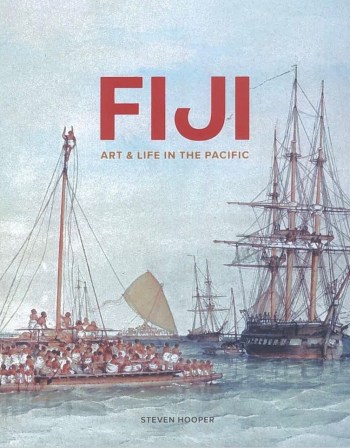
Steven Hooper, Fiji: Art & Life in the Pacific (Norwich: University of East Anglia, 2016), 288 pages, ISBN: 978-0946009701, $40.
Print Quarterly, December 2019
The eighteenth century in the current issue of Print Quarterly:
Print Quarterly 36.4 (December 2019)

Étienne Fessard and Augustin de Saint-Aubin, after Charles Natoire, Gaetano Brunetti, and Paolo Antonio Brunetti, Perspective View of the Chapel of Enfants Trouvés in Paris, 1759, etching and engraving, sheet (trimmed) 80 × 59 cm (New York, Metropolitan Museum of Art).
A R T I C L E S
Rena M. Hoisington, “Étienne Fessard’s Prints of the Chapel of the Hôpital des Enfants Trouvés in Paris,” pp. 404–25.
Soon after Charles Natoire (1700–1777) completed his cycle of paintings for the Chapel of the Hôpital des Enfants Trouvés in Paris, Fessard announced a subscription plan for a series of prints reproducing them. Often addressed merely for their documentary value, these prints are here analysed as objects in themselves. The article explores their complex publication history and assesses them in the context of Fessard’s career. Also analysed is the series’ repercussion on the reputation of the artists involved in their realization, Natoire included.
N O T E S A N D R E V I E W S
Colin Harrison, Review of Peter Whitfield, Oxford in Prints: 1675–1900 (Bodleian Library, 2016), p. 448.
The book explores how Oxford has been pictured between 1675 and 1922 by illustrating a selection of volumes in the collection of the Bodleian Library. The largest group consists of almanacks printed by the University, which took their definitive format of a topographical headpiece with a calendar beneath in the early eighteenth century.
Jean Michel Massing, Review of Cheryl Finley, Committed to Memory: The Art of the Slave Ship Icon (Princeton University Press, 2018), p. 484–88.
The book “focuses on the life, and afterlife, of famous anti-slavery icon,” the 1788 engraved Plan of an African Ship’s lower Deck with Negroes in the proportion of only one to a Ton (484). Part One “considers abolitionist slave ship prints from the period 1788 to 1900; the remainder of the book is devoted to their stature as an icon reappropriated by twentieth-century African American, British and African artists” (488).
P U B L I C A T I O N S R E C E I V E D
Mungo Campbell and Nathan Flis, eds., William Hunter and the Anatomy of the Modern Museum, exhibition catalogue (Yale Center for British Art, and The Hunterian, University of Glasgow, in association with Yale University Press, 2018), p. 472.










 Enfilade
leave a comment