Exhibition | Thomas Patch and the British Grand Tour
Opening this week at the Lewis Walpole Library:
Caricatures, Campagna, and Connoisseurs:
Thomas Patch and the British Grand Tour in Eighteenth-Century Italy
Lewis Walpole Library, Farmington, CT, 10 September — 15 December 2025
Curated by Hugh Belsey
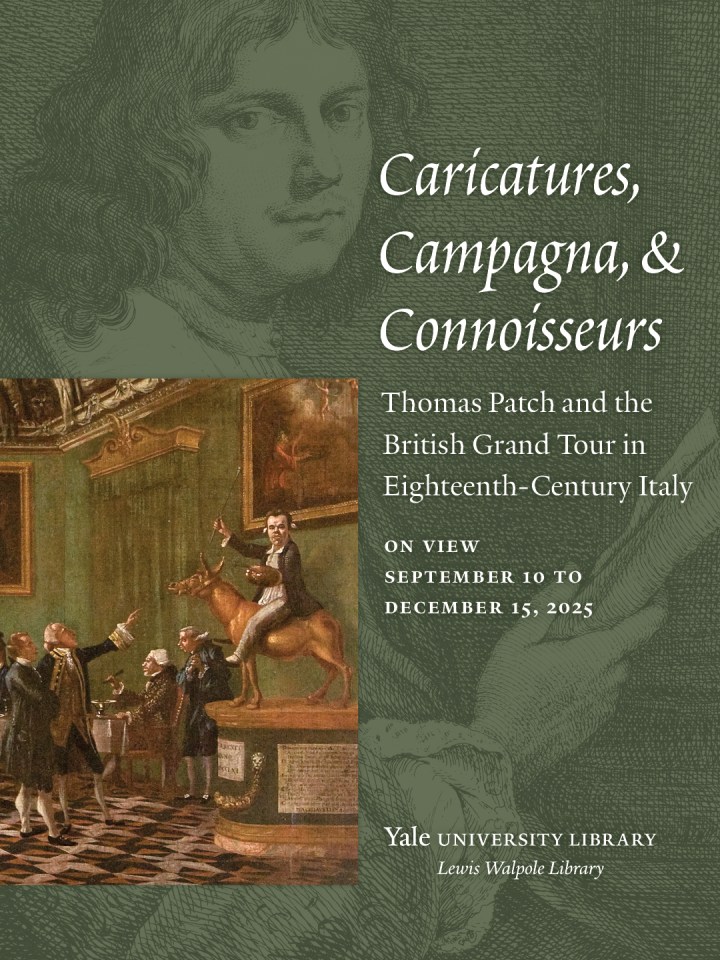 Known primarily as a caricature artist, Thomas Patch (1725–1782) in fact engaged in a much wider array of activities. He was a landscape painter, experimental printmaker, and a dealer of antiquities and old master paintings. He was also among the first scholars of early Renaissance art. This exhibition will explore the many aspects of Patch’s art, life, and associations with the British community of diplomats, tourists, artists, and collectors in Italy.
Hugh Belsey, a graduate of the Universities of Manchester and Birmingham, has lectured to groups in Europe, America, Australia, and Britain. For twenty-three years he was the curator of Gainsborough’s House in Sudbury (UK) where he formed one of the largest collections of the artist’s paintings and drawings. In 2004 he was awarded an MBE in recognition of his museum work. His long-awaited catalogue of portraits by Thomas Gainsborough was published by Yale University Press in February 2019, and was awarded the William W.B. Berger Prize for British Art History in 2020.
The exhibition brochure is available at the Library’s website»
Exhibition Lecture | Caricatures, Campagna, and Connoisseurs
Presented by Hugh Belsey, guest curator and independent scholar
Thursday, October 16, 7pm
Space is limited and advance registration is required.
Exhibition | Women Artists from Antwerp to Amsterdam, 1600–1750
Opening this month at the NMWA:
Women Artists from Antwerp to Amsterdam, 1600–1750
National Museum of Women in the Arts, Washington, DC, 26 September 2025 — 11 January 2026
Museum voor Schone Kunsten, Ghent, 7 March — 31 May 2026
Curated by Virginia Treanor and Frederica Van Dam

Maria Schalcken, Self-Portrait in Her Studio, ca. 1680, oil on panel, 17 × 13 inches (Museum of Fine Arts, Boston, 2019.2094).
Women Artists from Antwerp to Amsterdam, 1600–1750 showcases a broad range of work by more than forty Dutch and Flemish women artists, including Gesina ter Borch, Maria Faydherbe, Anna Maria de Koker, Judith Leyster, Magdalena van de Passe, Clara Peeters, Rachel Ruysch, Maria Tassaert, Jeanne Vergouwen, Michaelina Wautier, and more. Presenting an array of paintings, lace, prints, paper cuttings, embroidery, and sculpture, this exhibition draws on recent scholarship to demonstrate that a full view of women’s contributions to the artistic economy is essential to understanding Dutch and Flemish visual culture of the period.
Women were involved in virtually every aspect of artistic production in the Low Countries during the seventeenth and early eighteenth centuries. During this period, colonial exploitation and the international slave trade enriched Europe’s upper and middle classes, fueling demand for art and other luxuries. From celebrated painters who excelled in a male-dominated field to unsung women who toiled making some of the most expensive lace of the day, to wealthy patrons who shaped collecting practices, women created the very fabric of the visual culture of the era. Within a thematic presentation that considers the intertwined influences of status, family, and social expectations on a woman’s training and career choices, this exhibition demonstrates the many ways in which women of all classes contributed to the booming artistic economy of the day. Whether their work was circulated within aristocratic social circles, sold on the open market, or commissioned by patrons, women shaped and molded the world around them from Antwerp to Amsterdam.
Women Artists from Antwerp to Amsterdam, 1600–1750 is organized in partnership with the Museum of Fine Arts in Ghent, Belgium.
The press release is available here»
Virginia Treanor and Frederica Van Dam, eds., Women Artists from Antwerp to Amsterdam, 1600–1750 (Veurne: Hannibal Books, 2025), 304 pages, ISBN: 978-9493416277, $60. With contributions by Klara Alen, Frima Fox Hofrichter, Elena Kanagy-Loux, Judith Noorman, Catherine Powell-Warren, Inez De Prekel, Marleen Puyenbroek, Oana Stan and Katie Altizer Takata. Available in English and Dutch editions.
Frederica Van Dam is the Curator of Old Masters at MSK Ghent. Specializing in early modern Flemish painting, Dr. Van Dam co-curated Van Eyck: An Optical Revolution and led the first monographic show on Theodoor Rombouts (1597–1637). Virginia Treanor is the Senior Curator at the National Museum of Women in the Arts in Washington, D.C. She earned her PhD in 17th-century Dutch and Flemish art from the University of Maryland. Since joining NMWA in 2012, Dr. Treanor has curated numerous exhibitions, including multiple installments of the Women to Watch series.
Exhibition | Encounters

Cornelis Ploos van Amstel after Samuel van Hoogstraten, Boy with a Hat in a Front Door, detail, 1763, etching, roulette in brown and red (Berlin: Kupferstichkabinett, Christoph Müller Stiftung / Kilian Beutel).
◊ ◊ ◊ ◊ ◊
From the Staatliche Museen zu Berlin:
Encounters: ‘I Am All That!’ | Christoph Müller’s Gift, Part 2
Begegnungen: Das alles bin ich! | Die Schenkung Christoph Müller II
Kupferstichkabinett at the Gemäldegalerie, Berlin, 26 August — 30 November 2025
The exhibition I Am All That! presents the generous gift of some 200 works that art collector Christoph Müller has made to the Kupferstichkabinett (Museum of Prints and Drawings). The works on paper—drawings, prints, and watercolours—not only show a broad panorama of visual themes spanning five centuries, but also reflect the influences on the collector and his interests. One aspect of the collection at a time will be featured in four successive presentations. Opening on the 26 August 2025, the presentation focusses on people, interpersonal relationships, and encounters.

Anton Graff, Portrait of Provost Johann Joachim Spalding, ca. 1800, pastel (Berlin: Kupferstichkabinett, Christoph Müller Stiftung).
Portraits and plant studies, harbours and history paintings, landscapes and genre scenes: this exhibition shows the entire spectrum of an extraordinary collection. A fascinating cross-section of European art history unfolds within works from early modern history to the present. The exhibited works on paper originate from Germany, Italy, the Netherlands, and France—telling of people and nature, history and everyday life, beliefs, feelings, and the power to create. Representations of figures and nudes are on view, as well as seascapes, nature studies, animals, forests, and quite a lot more.
A selection of Müller’s generous gift will be presented to the public from 20 May 2025 to 14 June 2026 in four changing displays in the ‘Kabinett in der Galerie’ space at the Gemäldegalerie (Old Masters Paintings). The first presentation, A World of Words and Images (on view from 20 May to 24 August 2025), referenced Müller’s endeavours as a publisher and critic, as well as his passion for art and collecting.
The second presentation, Encounters, focuses on depictions of people and interpersonal relationships. Some of the featured artworks show moments of togetherness, such as social events, mutual exchange, or shared glances. The images depict romantic liaisons, domestic scenes, and social interactions, and reflect the personality of a tireless collector who nurtured numerous friendships and loved parties. These are juxtaposed with portraits, figurative representations, and detailed studies that centre the individual. Whether pictured in silent contemplation or facing the viewer, these subjects are a testament to the reality that human existence is constantly oscillating between proximity and seclusion, between moments of shared experience and periods of solitude..
Future Presentations
On Travelling and Being at Home
2 December 2025 — 8 March 2026
Leaf by Leaf: A Life with Art
10 March — 14 June 2026
Christoph Müller (1938–2024) was a German publisher, theatre and art critic, art collector, and patron, who made many generous gifts to public museums during his lifetime. As the editor-in-chief and co-publisher of the Schwäbisches Tagblatt, he shaped the German media landscape from 1969 to 2004. Müller’s passion for art is reflected in an impressive collection of works from various epochs and regions. He collected across the board, led by individual and personal preferences, as well as sound connoisseurship. His penchant was for 16th- and 17th-century Dutch art. In 2007, he gave the Kupferstichkabinett a significant collection of 370 Dutch and Flemish drawings and prints from the 16th to 18th centuries. With the current gift all collection areas of the Kupferstichkabinett’s holdings are being appreciably enhanced and enriched. Christoph Müller died in Berlin in 2024, at the age of 86. The exhibition should be understood as recognition of his impact in supporting the arts, as a sign of gratitude and an invitation to share his joy in art—a thought that continually motivated him.
Exhibition | Chardin and the Marcille Family
Opening soon at the Musée des Beaux-Arts Orléans:
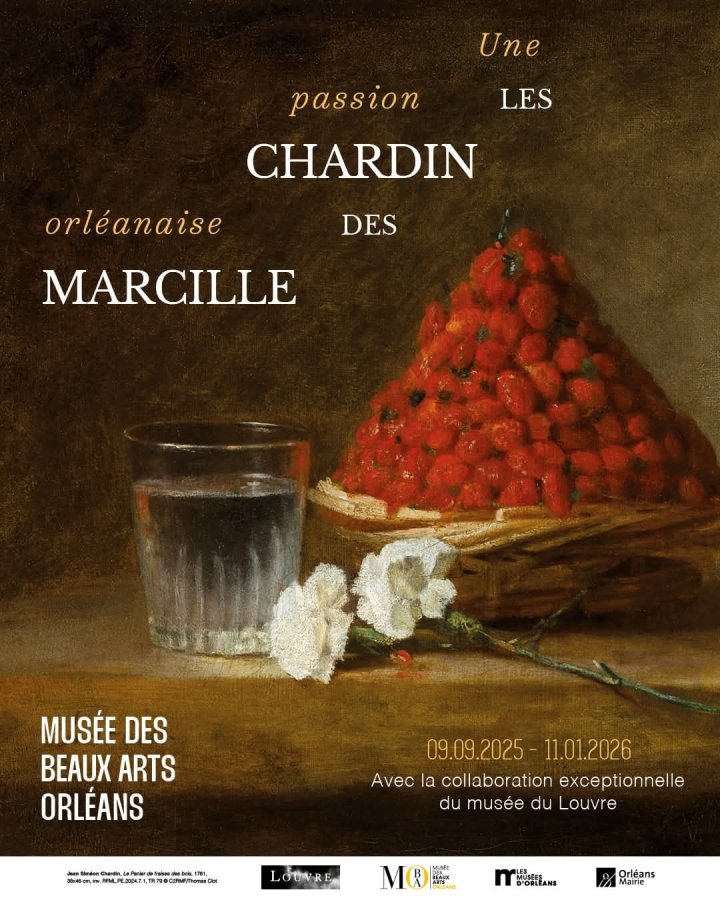
The Marcille Chardin Family: A Passion from Orléans
Les Chardin des Marcille: Une passion orléanaise
Musée des Beaux-Arts, Orléans, 9 September 2025 — 11 January 2026
Rarely has a painting aroused so much passion as Le Panier de fraises des bois (1761) by Jean Siméon Chardin, the quintessential work of French painting, put up for sale in 2022 and acquired for a record price by the Musée du Louvre after having remained in the prestigious collection of the Orléans-born Eudoxe Marcille (1814–1890) since the mid-19th century.
 His name alone evokes that of Chardin. His father, François Marcille (1790–1856), from a family of seed brokers in the Beauce region, had taken a visionary interest, as early as 1822, in all those artists from the time of Louis XV that nobody looked at anymore, to the point of assembling the largest collection of his time, with 4,500 works including dozens of Bouchers, Fragonards, Greuze, Prud’hon and Géricault… and, above all others, thirty Chardin. This consuming passion was passed on with his collection to his two sons, Eudoxe and Camille. Camille, who became curator of the Chartres museum, and Eudoxe, director of the Musée d’Orléans from 1870 to 1890, continued to promote Chardin’s work, even buying back after their father’s death, beyond the works he had designated for each, what could continue to be assembled from this ideal nucleus. Quite naturally, the Goncourt brothers, great biographers of 18th-century artists, drew on this reference collection, in which Chardin’s entire career is represented, to write the first biography of the painter of silent still lifes and pantries in 1863.
Chardin was at home in Orléans and, in a way, always had been. His friendship with Aignan Thomas Desfriches (1715–1800), the entrepreneur who had made Orléans an artistic capital in the 18th century, could be seen in the checkered scarf Chardin wears in his self-portrait, which came from Desfriches’ home. Desfriches himself owned numerous paintings by Chardin. He was followed by Casimir de Cypierre (1783–1844), son of the Intendant d’Orléans under Louis XVI, whose name a quay bears, who owned at least three. François Marcille and his son Eudoxe continued to nurture this Orléans passion. Around the exceptional loan of Panier de fraises des bois, five other Chardin paintings from the legendary Marcille collection are brought together for the first time since the 1979 retrospective. They are accompanied by the Self-portrait with bezicles (spectacles), an eventful acquisition which, in 1991, brought this artist, so dear to the heart of Orléans, into the pastel cabinet, but whose memory alone inhabited the collections. Chardin, more than ever, is at home in the Musée d’Orléans, which this family of discreet enthusiasts has helped to elevate, through François’ research and Eudoxe’s twenty years at the service of its collections, into a place of rediscovery and sharing.
With the exceptional participation of the Musée du Louvre. The exhibition benefits from exceptional loans from the Musée du Louvre, the Musée Jacquemart-André, the Musée de Picardie, private collectors, and the Marcille family descendants.
Exhibition | Flora Yukhnovich’s Four Seasons
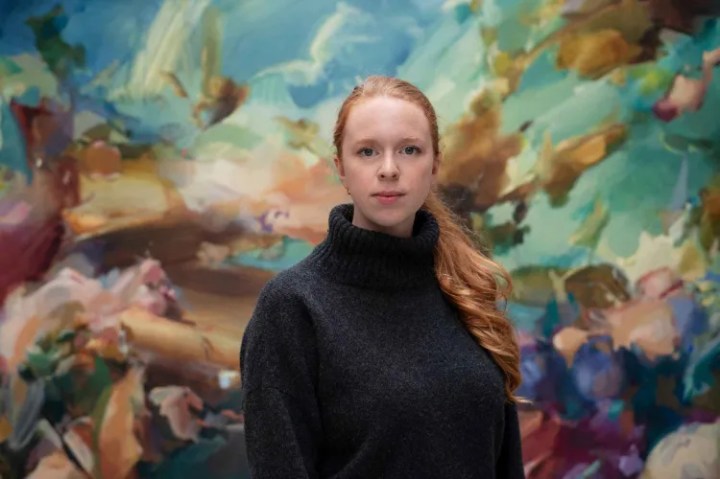
Flora Yukhnovich in Her London Studio, 2024
(Photo by Kasia Bobula © Flora Yukhnovich)
◊ ◊ ◊ ◊ ◊
Opening this week at The Frick; see the preview by Ted Loos for The New York Times (28 August 2025) . . .
Flora Yukhnovich’s Four Seasons
The Frick Collection, New York, 3 September 2025 — 9 March 2026
Taking inspiration from the French Rococo, Italian Baroque, and Abstract Expressionist movements, Flora Yukhnovich (b. England, 1990) creates works that are at once modern and timeless by translating historic compositions into contemporary abstractions. Using the Frick’s Four Seasons by François Boucher as a point of departure, Yukhnovich’s site-specific mural will cover the walls of the museum’s Cabinet. This project is accompanied by the publication of a new volume in the Frick’s acclaimed Diptych series, which highlights a single masterpiece from the permanent collection by pairing complementary essays by a curator and a contemporary artist, musician, or other cultural luminary. This volume will feature a text by Yukhnovich and an essay by Xavier F. Salomon, the Frick’s Deputy Director and Peter Jay Sharp Chief Curator, on the significance of Boucher’s beloved series.
Flora Yukhnovich’s Four Seasons is made possible by Hauser & Wirth and Victoria Miro.
Xavier Salomon and Flora Yukhnovich, Boucher’s Four Seasons (London: D. Giles, 2026), 80 pages, ISBN: 978-1913875732, $30.
Exhibition | Un/Bound: Free Black Virginians, 1619–1865
Now on view at the VMHC:
Un/Bound: Free Black Virginians, 1619–1865
Virginia Museum of History and Culture, Richmond, 14 June 2025 — 4 July 2027
 Bringing together artifacts and rich stories from across the Commonwealth, Un/Bound: Free Black Virginians, 1619–1865 tells the stories of free Black Virginians from the arrival of the first captive Africans in 1619 to the abolition of slavery in 1865. It is one of the first museum exhibitions to cover the subject in depth.
Through powerful artifacts, first-person accounts, and more than 200 years of stories, visitors will discover how Virginia’s people of color achieved their freedom, established communities, and persevered within a legal system that recognized them as free but not equal. Featured alongside artifacts spanning hundreds of years will be newly commissioned portraits by award-winning photographer Ruddy Roye, who TIME named ‘Instagram Photographer of the Year’, of some of the descendants of free Black Virginians who shared their stories and objects to help create the exhibition.
Building upon research about centuries of free Black Virginians and regional exhibitions focused on local communities, Un/Bound endeavors to encapsulate the broader, statewide story in depth and at a yet-to-be-seen scale through a collection of artifacts and rich histories told by descendants and experts. This exhibition was created by the VMHC in collaboration with subject matter experts and five institutions of higher education—Norfolk State University, Virginia State University, William & Mary, Longwood University and Richard Bland College—bringing together resources and knowledge to tell a compelling story of Virginia. The exhibition is on display alongside VMHC’s multiyear commemorative exhibitions and displays related to America’s 250th anniversary.
The accompanying book is published by D. Giles:
Cassandra Newby-Alexander, Melvin Patrick Ely, Sabrina Watson, Evanda Watts-Martinez, and Stephen Rockenbach, Un/Bound: Free Black Virginians, 1619–1865 (London: D. Giles, 2025), 176 pages, ISBN: 978-1913875619, $30.
On the eve of the Civil War, around 60,000 Black men, women and children lived free in the state of Virginia, often alongside enslaved neighbours. This volume is a history documenting the richness and variety of their lives. Although many stayed in Virginia, living, working and thriving despite serious threats to their lives, some moved north or, further still, across the Atlantic to Liberia. In studying the lives of free Black Virginians prior to emancipation, this volume explores an under-told and inspirational story of Virginia’s past. By delving into collections across the Commonwealth, whether the records of the state or testimonies left by free Black people themselves, this new volume fills a critical gap in our understanding of Virginia’s Black history.
c o n t e n t s
Foreword — James W. Dyke, Jr., Tim Sullivan, and Alvin J. Schexnider
Acknowledgments — Jamie O. Bosket
Introduction — Elizabeth M. Klaczynski
1 Black Freedom in Slaveholding Virginia — Melvin Patrick Ely
2 The Christian Faith and Legacies of Liberation in Virginia’s Free Black Society — Evanda S. Watts-Martinez
3 Free Black People in Rural Virginia: Forms of Resistance — Sabrina G. Watson
4 Joseph Jenkins Roberts, Free Black Émigrés, and the Liberian Experiment — Cassandra L. Newby-Alexander
5 Education, Politics, and the Legacy of Free Black Virginians after Emancipation — Stephen Rockenbach
Afterword — Jamie O. Bosket
Contributors
Endnotes
Index
Exhibition | Slavery and Freedom in Northampton, 1654–1783
Now on view at Historic Northampton (as noted on Philippe Halbert’s Instagram account) . . .
Slavery and Freedom in Northampton, 1654–1783
Historic Northampton, Northampton, Massachusetts, 3 July 2025 — 11 December 2026
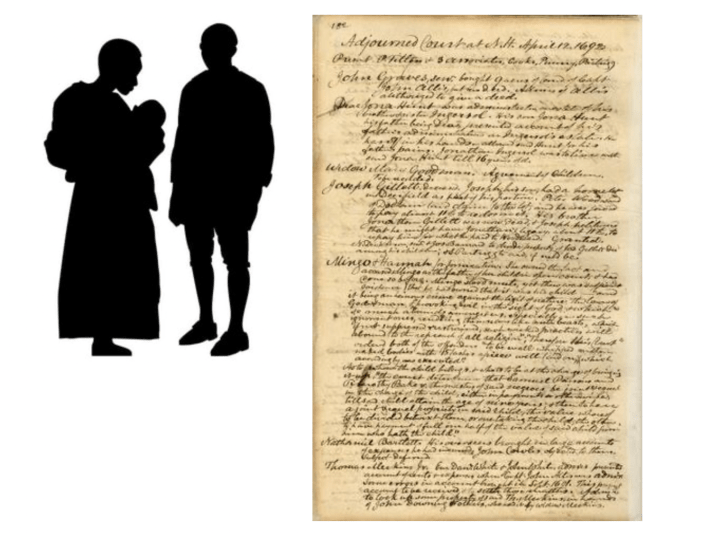
Silhouette of Hannah, her baby, and Mingo. In 1692, the court decided that the ownership of Hannah’s baby would be shared by her enslaver Timothy Baker and Mingo’s enslaver Samuel Parsons. A copy of the 1692 court document was transcribed on page 182 of the Judd Manuscript in the collection of Forbes Library, Northampton, MA.
For at least 129 years, slavery was part of the fabric of everyday life in Northampton. At least 50 enslaved individuals lived here from the town’s English settlement in 1654 until 1783 when slavery was abolished in Massachusetts. The exhibit Slavery and Freedom in Northampton, 1654–1783 features life-sized silhouettes of men, women, and children who were enslaved. On each silhouette are details about individual lives based upon information gleaned from historic documents. Their histories reveal aspects of enslavement and examples of freedom, and resistance to oppression.
The exhibit tells what we currently know about the lives of these enslaved individuals and how some gained freedom, started families, and purchased property. It also describes the ways in which Northampton enslavers exerted power and control over their lives. Included is a printmaking series, Glimmers of Past People, by artist Merisa Skinner reflecting on the local legacy of the transatlantic slave trade.

Composite image of the bill of sale of Venus to Jonathan Edwards from the collection of Yale University with a graphic silhouette of Venus by Design Division, Inc.
◊ ◊ ◊ ◊ ◊
Venus was born in West Africa and separated from her family. This bill of sale indicates that she was sold in Newport, Rhode Island by a ship captain and slave trader to Northampton’s minister Jonathan Edwards. Leah was also enslaved by Jonathan Edwards. Some historians think that Edwards renamed Venus to Leah when she was baptized. It is also possible that Venus died and Leah was a different person who replaced her.
Exhibit design by Michael Hanke of Design Division, Inc. with Historic Northampton and a team of scholars and archivists based upon research by the Northampton Slavery Research Project. Artwork for the background murals was created by artist Nancy Haver.
Exhibition | Fault Lines: Art, Imperialism, and the Atlantic World
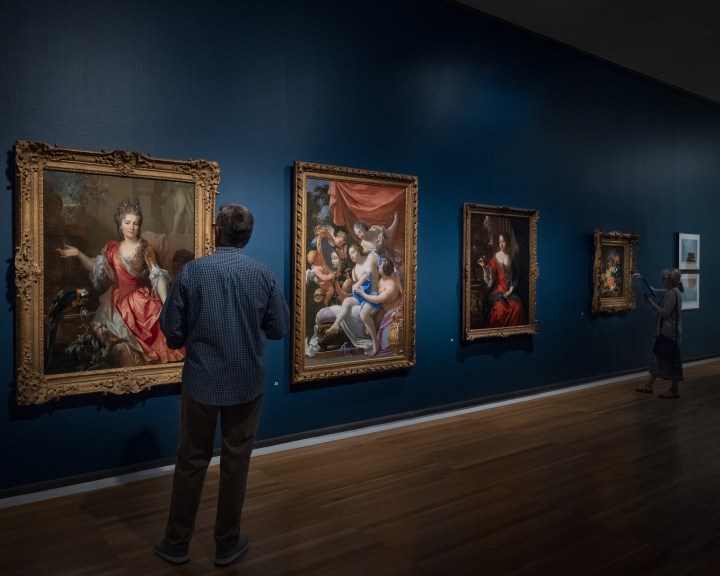
Installation view of Fault Lines: Art, Imperialism, and the Atlantic World at the Carnegie Museum of Art, 2025 (Photo by Zachary Riggleman). Paintings include from left to right: Nicolas de Largillière, Portrait of a Woman and an Enslaved Servant, 1696 (The Metropolitan Museum of Art, 03.37.2); Simon Vouet, The Toilet of Venus, ca. 1640 (Carnegie Museum of Art); and Peter Lely, Portrait of Louise Renee de Penencoet de Kerouaille, Duchess of Portsmouth, ca. 1670–1680 (Carnegie Museum of Art).
◊ ◊ ◊ ◊ ◊
Now on view at the Carnegie Museum of Art:
Fault Lines: Art, Imperialism, and the Atlantic World
Carnegie Museum of Art, Pittsburgh, 12 July 2025 — 25 January 2026
Organized by Marie-Stéphanie Delamaire
In the wake of Europe’s imperial expansion, which included the colonization of North and South America and the Caribbean in the 16th and 17th centuries, extensive military and economic activity transformed the regions that border the Atlantic Ocean. A new world—the Atlantic World—emerged, in which wars, competitive trade, and the enslavement of millions of Africans created new societies in Africa, Europe, and the Americas.
As ideas, knowledge, and beliefs moved together with people and materials across the ocean, shaping new mindsets and understandings of the world, European elite culture singled out certain objects as art, to be appreciated primarily for their beauty and emotional power. In that process, which also led to the creation of the first art museums, a rift opened between our understanding of these works of art and the political forces and transoceanic networks that made their creation possible. Acknowledging the fault lines of art history, this exhibition explores what can be imagined when works in the collection are brought in conversation with those made by artists who lived at the fluid boundaries of the Atlantic world’s entangled empires.
The exhibition is organized by Marie-Stéphanie Delamaire, curator of European and American art.
The 20-page gallery guide can be downloaded here»
Exhibition | Jean-Baptiste Greuze: Enlightening Childhood
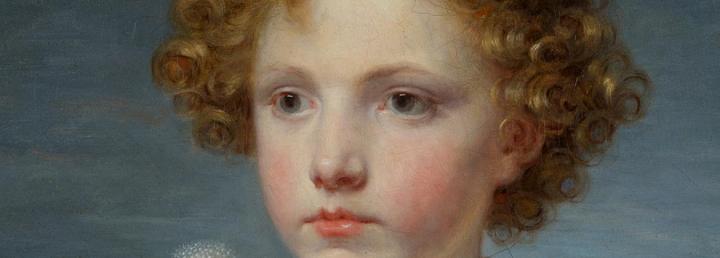
Jean-Baptiste Greuze, Young Shepherd Holding a Flower, detail, 1760–61, oil on oval canvas, 72.5 × 59.5 cm
(Paris: Petit Palais, PDUT1192)
◊ ◊ ◊ ◊ ◊
Greuze was born on this day (August 21) 300 years ago; the exhibition opens next month at the Petit Palais:
Jean-Baptiste Greuze: L’enfance en lumière
Petit Palais, Paris, 16 September 2025 — 25 January 2026
Curated by Annick Lemoine, Yuriko Jackall, and Mickaël Szanto
A little-known and misunderstood artist today, Greuze was nonetheless acclaimed by the public, adulated by critics, and sought after by the greatest collectors.
Jean-Baptiste Greuze (1725–1805) is undoubtedly one of the most important and daring figures of 18th-century France. To mark the 300th anniversary of his birth, the Petit Palais is paying tribute to this painter of portraits and genre scenes, who knew more than anyone else how to translate the human soul. This exhibition invites visitors to rediscover Greuze’s work through the prism of a central theme in his painting: childhood. Echoing the preoccupations of the philosophers Diderot, Rousseau, and Condorcet, the artist invites us to reflect on the place of the child within the family, the responsibility of parents in the child’s development, and the importance of education in shaping the child’s personality. With empathy, the artist questions the place of children in 18th-century society, their future, and their emancipation. He mirrors the major issues of his time. He also examines the transition to adulthood and the birth of love. Using the codes of his time, he tackles the theme of consent, which is strikingly topical today. Bringing together around a hundred paintings, drawings, and prints from all over the world, this exhibition is an opportunity to rediscover the singular work of this major artist of the Age of Enlightenment.
Curators
• Annick Lemoine, General Curator of Heritage, Director of the Petit Palais
• Yuriko Jackall, Director of the Department of European Art & Allan and Elizabeth Shelden Curator of European Paintings, Detroit Institute of Arts
• Mickaël Szanto, Senior Lecturer, Sorbonne University
Annick Lemoine, Yuriko Jackall, and Mickaël Szanto, Jean-Baptiste Greuze: l’enfance en lumière (Paris Musées, 2025), 304 pages, ISBN: 978-2759606177, €49.
Exhibition | Greuze, une palette d’émotions
Greuze, une palette d’émotions: Dessins du Louvre et oeuvres de Tournus
Hôtel-Dieu, Musée de Tournus, 24 May — 21 September 2025
Curated by Xavier Salmon
 To mark the 300th anniversary of the artist’s birth in 1725, the famous Burgundy town where he was born has joined forces with the Musée du Louvre to pay him a well-deserved tribute. Chosen from the rich collection of the Cabinet des Dessins, thirty of the master’s works reflect both his creative process and his desire to turn some of his most accomplished drawings into works in their own right, destined for a clientele of connoisseurs and collectors. All the master’s favorite themes are illustrated here: genre scenes, moralistic subjects, expressive heads, and portraits. They underline the extent to which Denis Diderot was right when he described Jean-Baptiste Greuze as a “delicate and sensitive soul” who had imposed himself on his century.
Jean-Baptiste Greuze: Les dessins du Louvre (Dijon: Éditions Faton, 2025), 80 pages, ISBN: 978-2878443981, €18.










 Enfilade
leave a comment