Exhibition | Goya: Visions and Inventions
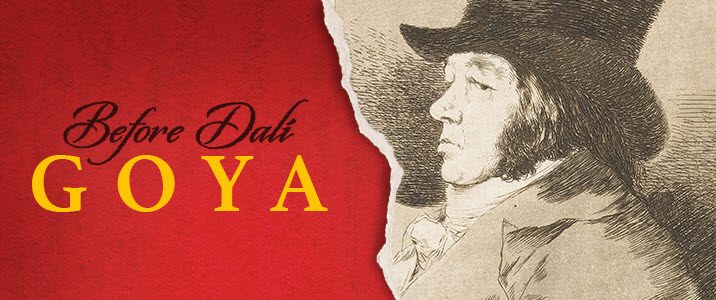
Now on view at The Dalí Museum in Florida:
Before Dali — Goya: Visions and Inventions
The Dalí Museum, St. Petersburg, 15 June — 1 December 2019

Francisco José de Goya y Lucientes, Portrait of Francisco Sabatini, ca. 1775–79, oil on canvas, 33 × 25 inches (Dallas: Meadows Museum at SMU, MM.67.03).
Francisco José de Goya y Lucientes (1746–1828) is one of the most important Spanish artists of the late eighteenth and early nineteenth centuries, celebrated for his revolutionary paintings, drawings, and engravings. Goya’s life and works deeply influenced Salvador Dali in his early years and are considered by many scholars to be the basis for ‘modern’ art, bridging classicism and romanticism. Before Dali: Goya: Visions & Inventions, sponsored by Tampa International Airport, features two alternating suites of first-edition prints, published in Goya’s lifetime, alongside three significant paintings representing unique themes of Goya’s works. The works are on loan from the Meadows Museum in Dallas, home of one of the most substantial collections of Goya.
Los Caprichos
The Dalí Museum, 15 June — 15 September 2019
One of Goya’s most famous works, Los Caprichos (1799) is a series of 80 satirical prints exploring his visions of the superstitions and societal ills of his time. Goya sought to illustrate “the innumerable foibles and follies to be found in any civilized society, and from the common prejudices and deceitful practices which custom, ignorance, or self-interest have made usual.” Witchcraft and other superstitious beliefs were a prevalent subject matter in this series that meant to ridicule and critique the arrogance of the noble class and the corruption of human virtue. Because of their sensitive subjects—including anticlerical scenes—few people saw these works during Goya’s lifetime.
La Tauromaquia
The Dali Museum, 21 September — 1 December 2019
La Tauromaquia (1816) is a suite of prints depicting the evolution and history of bullfighting on the Iberian Peninsula. Goya created La Tauromaquia between 1815 and 1816, at the age of 69. Unlike the targets of Goya’s previous satirical series Los Caprichos, bullfighting was not politically sensitive, and La Tauromaquia was published in an edition of 320—for sale individually or in sets—without incident. The latter series, however, did not meet with critical or commercial success. The artist focuses on the violent scenes that take place in the bullring and the daring movements of the bullfighters. The events are not presented as they are viewed by a viewer in the stands, but in a more direct way.
Exhibition | Stubbs (1724–1806): Anatomist
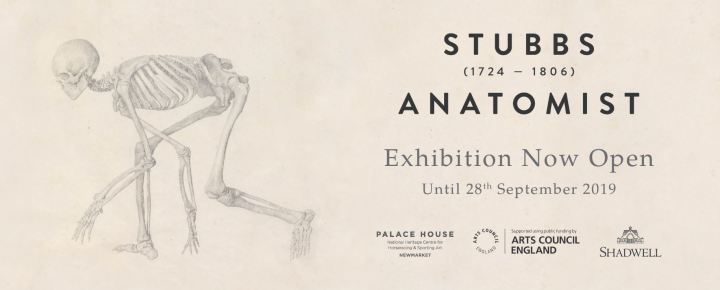
Now on view at Palace House in Newmarket:
Stubbs (1724–1806): Anatomist
National Heritage Centre for Horseracing and Sporting Art, Newmarket, 27 June — 28 September 2019
In summer 2019, Palace House, The National Heritage Centre for Horseracing and Sporting Art will display a set of unique drawings by Britain’s most renowned animal painter, George Stubbs (1724–1806). The ten works, on loan from the Yale Center for British Art, have not been seen in the UK for many years. The drawings form the core of an exhibition that illuminate aspects of Stubbs’s life and interest which have previously been underexplored and highlights the exceptional nature of his painting and drawing techniques.
Stubbs was one of the most original and pioneering artists of the 18th century. His prowess as a painter of horses is well known, but his later study of the anatomy of a wide variety of animals to compare with the human figure is less widely documented.
His great reputation as an extraordinary painter of horses was forged in a remote Lincolnshire farmhouse. In his early thirties, Stubbs relocated from York to Horkstow, near Hull and spent the next 18 months (1756–58), unflinchingly and painstakingly dissecting up to a dozen horses, documenting their musculature, veins, and skeletons. The sheer effort it took to suspend the horses by a system of hooks, ropes, and planks attached to the farmhouse’s ceiling and then injecting their veins with wax in order to preserve them can only be imagined.The result was his celebrated book, The Anatomy of the Horse—a copy of which (from the Palace House collection) will be on display in the exhibition.
Following The Anatomy of the Horse, Stubbs moved to London, where he continued his interest in dissection and anatomy, alongside his increasingly successful career as a painter. He was 71-years old when he started working on Comparative Anatomical Exposition, a study reflecting ideas about fundamental structural characteristics shared by all living things.
Stubbs didn’t seek to make direct comparisons between species, as the title might suggest, but to apply empirical methods of observation and draftsmanship among dissimilar creatures—fowl, tiger, and man—to analyse a core set of similarities from which to make key conclusions. Just as his huge undertaking at Horkstow, this was another highly ambitious project, with the aim of a major publication with sixty plates. Stubbs sadly did not complete this as he died in 1806.
Acquired by the sporting art enthusiast, Paul Mellon, the completed Comparative Anatomical Exposition drawings underpin Mellon’s collecting habits and his deep passion for this subject. The display of comparative anatomy drawings joins numerous works at the National Heritage Centre which were donated by him to the National Horseracing Museum and British Sporting Art Trust collections.
Exhibition | Deconstructed: The NSLM Sporting Screen
From the NSLM:
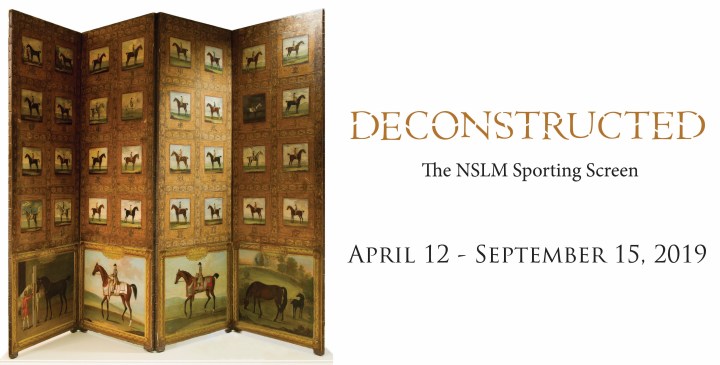
Deconstructed: The NSLM Sporting Screen
The National Sporting Library & Museum, Middleburg, Virginia, 12 April — 15 September 2019
Deconstructed: The NSLM Sporting Screen centers on a unique decorative object from the NSLM’s permanent collection. Recently conserved, the four-panel screen is comprised of paintings and prints showing 18th-century racing portraits on one side and manège training (an early form of dressage) on the other. The exhibit will cast light on a captivating era in British sport, art, and literature.
As noted in the Summer 2019 bulletin for the YCBA:
The exhibition features seven works from the Yale Center for British Art by John Vanderbank, including the painting A Young Gentleman Riding a Schooled Horse (1728–29).
Exhibition | A Tea Journey

Richard Collins, The Tea Party, 1727
(London: Goldsmiths’ Company)
◊ ◊ ◊ ◊ ◊
From Compton Verney:
A Tea Journey: From the Mountains to the Table
Compton Verney Art Gallery & Park, 6 July — 22 September 2019
Visitors will follow the tea leaf from plant to pot, beginning with its roots in Chinese culture through to its adoption and appropriation into British society. A Tea Journey raises questions about what the humble cup of tea has evolved to represent in international, social, philosophical, and visual cultures. The exhibition combines rare, historic teaware from China, Japan, and India with responses by contemporary artists including Robin Best, Adam Buick, Phoebe Cummings, Charlotte Hodes, Takahiro Kondo, Ian McIntyre, Bruce Nuske, Selina Nwulu, Bouke de Vries, Hetain Patel, Paul Scott, Julian Stair, and Edmund de Waal. Visitors are also invited to explore The Tea Sensorium, which offers a multi-sensory appreciation of tea, from the leaf itself and art inspired by tea, as well as becoming a sight for artist-led workshops and discussions.
Exhibition | Cost of Revolution: The Life and Death of an Irish Soldier
Press release (15 May 2019) for the exhibition:
Cost of Revolution: The Life and Death of an Irish Soldier
Museum of the American Revolution, Philadelphia, 28 September 2019 — 17 March 2020
Exploring the toll of war and revolution through the eyes of Irish soldier Richard St. George

Thomas Gainsborough, Portrait of Richard St. George, 1776 (Melbourne: National Gallery of Victoria).
Tickets are now on sale for the upcoming special exhibition Cost of Revolution: The Life and Death of an Irish Soldier, which opens on 28 September 2019 and runs through 17 February 2020 at the Museum of the American Revolution, the exhibition’s exclusive venue. Based on new discoveries made by the Museum’s curators, Cost of Revolution presents the untold story of Richard St. George, an Irish soldier and artist whose personal trauma and untimely death provide a window into the entangled histories of the American Revolution and the ensuing Irish Revolution of 1798.
“You may not have heard the name Richard St. George before, but you’ll be astonished by what his life can tell us about America and Ireland in the Age of Revolutions,” said Dr. R. Scott Stephenson, President and CEO of the Museum of the American Revolution. “This exhibit extends the Museum’s internationally acclaimed story-driven approach onto the global stage to examine the broader influence of the American Revolution through St. George’s remarkable personal journey.”
As a young officer in the British Army, Richard St. George crossed the Atlantic in 1776 to try and stop the growing American Revolution. He returned home to Ireland after surviving a severe head wound at the Battle of Germantown, near Philadelphia, in 1777. Back in Ireland, he found his native country roiled by the effects of the revolutionary spirit sweeping across America and Europe. St George became an outspoken critic of the growing movement to establish an Irish republic independent from the British Empire in the 1790s. A few months before the outbreak of the Irish Revolution of 1798, St. George’s tenants ambushed and killed him.
The 5,000-square-foot exhibition will chronicle St. George’s dramatic journey with more than 100 artifacts, manuscripts, and works of art from Australia, Ireland, England, and the United States, many of which will be on display in America for the first time. It will also present one of the largest collections of objects from Ireland’s 18th-century revolutionary history and war for independence ever displayed in Philadelphia.
Five portraits of Richard St. George—created over the span of 25 years—are known to survive and will be reunited in this exhibit for the first time since they left the possession of St. George’s descendants more than a century ago. Every known piece of surviving artwork by St. George himself—including cartoons, sketches from his military service in America, and a self-portrait—also will be assembled for the first time in this exhibit. Together, the portraits, cartoons, and sketches reveal the physical and emotional toll of revolution.
Key Artifacts

Xavier della Gatta, Painting of the Battle of Germantown, 1782 (Philadelphia: Museum of the American Revolution).
• A portrait of Richard St. George by Thomas Gainsborough (1776) depicting him just before he shipped out for New York to fight against the growing American Revolution, on loan from Australia’s National Gallery of Victoria (Melbourne).
• Three portraits of Richard St. George by Irish artist Hugh Douglas Hamilton (1790s) that show St. George as he struggled to manage the pain of the traumatic headwound he received during the American Revolutionary War. One of the portraits, on loan from the National Gallery of Ireland in Dublin, depicts him grief-stricken, mourning at his wife’s tomb. Hamilton painted this portrait as a movement for Irish independence, which St. George opposed, was on the rise.
• A signed self-portrait of Richard St. George, recently donated to the Museum, that depicts him in a forlorn landscape wearing a silk head wrap to cover the scars of his head wound. This portrait is a rare example of art created by a veteran of the American Revolutionary War that refers to personal pain sustained during the War.
• Paintings of the Battles of Paoli and Germantown by Italian artist Xavier della Gatta that St. George helped to create in 1782 to reflect on his participation in those battles. The paintings are in the Museum’s permanent collection.
• The British Army uniform coat and pistol that belonged to Richard St. George’s grandfather, on loan from the National Army Museum in London.
• The 1775 bound maps of the estate of Richard St. George in County Galway, on loan from the Galway County Council Archives in Galway, Ireland.
• A trephine, or skull saw, of the type that was used to operate on Richard St. George’s head following the Battle of Germantown, on loan from the Mütter Museum of the College of Physicians of Philadelphia.
• American illustrator Howard Pyle’s 1898 painting The Attack upon the Chew House, which depicts the carnage of the Battle of Germantown, on loan from the Delaware Art Museum.
• The red uniform coat worn by British Army Lieutenant Ely Dagworthy on loan from Dumbarton House and the National Society of The Colonial Dames of America.
• The August 24, 1776 Leinster Journal, one of the first printings of the American Declaration of Independence in an Irish newspaper, on loan from the National Library of Ireland in Dublin, Ireland.
• A green uniform coat worn by Irish Revolutionary Henry Joy McCracken and a pike head carried by the United Irishmen during Ireland’s fight for independence from Great Britain in 1798, on loan from the National Museums of Northern Ireland (Ulster Museum) in Belfast.
• A rare silk flag carried by the Delaware militia that the British light infantry captured during the Philadelphia Campaign of 1777, on loan from the Delaware Historical Society.
• Richard St. George’s personal sketches from the American Revolutionary War, on loan from a private collection. One sketch depicts St. George being carted off the battlefield following his wounding at the Battle of Germantown in 1777.
• Lord Edward Fitzgerald’s ribbon and Theobald Wolfe Tone’s membership certificate from the United Irishmen, on loan from the National Museum of Ireland in Dublin. Both Fitzgerald and Wolfe Tone died while helping to lead the United Irishmen in their struggle for Irish independence from Great Britain in 1798. The ribbon, taken from Fitzgerald’s body after his death, served as a memento of the Irish Revolution and was used to inspire later Revolutionaries in South America.
Programming Highlights
• Saturday, September 28 and Sunday, September 29, the exhibit’s opening weekend, the Museum’s flagship living history event, Occupied Philadelphia, will bring together dozens of costumed interpreters to recreate the 1777–78 British occupation of Philadelphia on the Museum’s outdoor plaza.
• Tuesday, October 1, the Museum will host an evening lecture by Martin Mansergh, a collateral descendant of Richard St. George and a noted historian who is a former Irish Fianna Fáil politician and played a key role in the Northern Ireland peace process.
• Friday, October 3 through Sunday, October 5, the Museum will host the 2019 International Conference on the American Revolution in partnership with the Pritzker Military Museum and Library. This event will bring noted historians, writers, and curators from Ireland, Scotland, England, and the United States together to explore military, political, social, and artistic themes from the Age of Revolutions.
• The exhibition will come to life with special events and daily programs exploring the artistic and cultural traditions of Richard St George’s world. Highlights include musical and theatrical performances, artisan workshops and demonstrations, talks by noted historians as part of the Museum’s Read the Revolution series, and tours of the exhibition.
Deborah Sampson, Her Diary, and Women in the American Revolution
As reported this week by in The New York Times:
Alison Leigh Cowan, “The Woman Who Sneaked into George Washington’s Army,” The New York Times (2 July 2019). A rediscovered diary, now at the Museum of the American Revolution, sheds light on the life of Deborah Sampson, who fought in the Continental Army.
Hers has always been one of the more astonishing, if little-known, tales of the American Revolution: a woman who stitched herself a uniform, posed as a man and served at least 17 months in an elite unit of the Continental Army. Wounded at least twice, Deborah Sampson carried a musket ball inside her till the day she died in 1827.
While historians agree that Sampson served in uniform and spilled blood for her country, gaps in the account have long led some to wonder whether her tale had been romanticized and embellished — possibly even by her.
Did she fight in the decisive Battle of Yorktown, as she later insisted on multiple occasions? And how did she keep her secret for the many months she served in Washington’s light infantry?
Now, scholars say the discovery of a long-forgotten diary, recorded more than 200 years ago by a Massachusetts neighbor of Sampson, is addressing some of the questions and sharpening our understanding of one of the few women to take on a combat role during the Revolution.
“Deb Sampson, her story is mostly lost to history,’’ said Dr. Philip Mead, the chief historian and director of curatorial affairs of the Museum of the American Revolution in Philadelphia. “So, finding a little piece of it is even more important than finding another piece of George Washington’s history.”
The museum bought the diary for an undisclosed sum after Dr. Mead spotted it at a New Hampshire antiques show last summer. He plans to showcase it next year with other items about the role American women played in the Revolution, as part of a larger celebration of the 100th anniversary of the 19th Amendment. . . .
The full article is available here»
Exhibition | Three Centuries of Chinese Reverse Glass Painting
Now on view in Switzerland at the Vitromusée Romont:
Reflets de Chine: Trois siècles de peinture sous verre chinoise
Vitromusée Romont, 16 June 2019 — 1 March 2020
 As a museum entirely dedicated to the glass arts, the Vitromusée Romont houses a collection of more than 1300 reverse glass paintings—in addition to stained glass, glass containers, graphic works and tools related to glass arts. No museum in Switzerland or abroad, nor any private collection, holds such an important collection of this particular art in terms of quality, variety and quantity.
For its next temporary exhibition, the museum will highlight a form of artistic production little known to date, that of Chinese reverse glass painting. This will be the first exhibition in Switzerland devoted exclusively to this art created in China between 1750 and 1950, retracing its long history: from its conception in the 18th century with the successful artistic encounter between Chinese painting and that of Europe, to its subsequent ‘globalization’ before becoming a widespread popular art within China.
More information is available as a PDF file here»
Exhibition | Chic Emprise: Art and Culture of Tobacco
Now on view at the Museum of the New World in La Rochelle, from the press release:
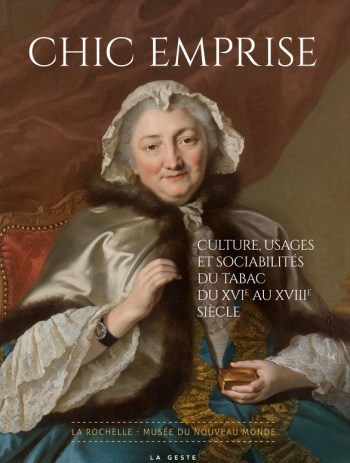
Chic emprise: Culture, usages et sociabilités du tabac du XVIe au XVIIIe siècle
Musée du Nouveau Monde, La Rochelle, 22 June — 23 September 2019
Curated by Maxime Georges Métraux and Annick Notter
 De l’Amérique du Nord en passant par les Caraïbes jusqu’au royaume du Kongo, le tabac est une plante incontournable de l’époque moderne (XVIe–XVIIIe siècle). À la fois produit de consommation, plaisir addictif et marqueur social, il s’est enraciné durablement dans l’ensemble des strates de la société en imprégnant aussi bien les mœurs aristocratiques et bourgeoises que populaires. Originaire d’Amérique, le tabac est rapidement importé avec succès en Europe où il a immédiatement entraîné de vifs débats entre ses défenseurs et ses opposants. Aujourd’hui discréditée et blâmée pour ses effets sur la santé, cette plante bénéficiait alors d’un statut différent, ses prétendues vertus curatives ont parfois été louées au point d’être l’objet de véritables discours de médicalisation. Le tabac véhicule un puissant imaginaire artistique et visuel comme en témoigne la vaste sélection d’œuvres présentées. Par ses multiples usages et son rôle éminemment social, la célèbre « herbe à Nicot » constitue un sujet idéal pour comprendre que l’époque moderne, et plus particulièrement le XVIIIe siècle, est l’un des moments de bascule d’une « civilisation de la rareté et de l’économie stationnaire à celle du développement et de l’abondance[1] ». Outre sa production et sa circulation, cette substance a engendré la fabrication de nombreux objets dédiés à ses diverses utilisations allant des pipes en pierre de Nouvelle-France jusqu’aux précieuses tabatières parisiennes. À l’instar du sucre et des boissons exotiques que sont le thé, le café et le chocolat, cette plante permet de saisir pleinement les processus coloniaux et leurs fonctionnements. L’essor de son commerce s’accompagne de la mise en place d’une imagerie promotionnelle massive dont les enseignes des marchands de tabacs constituent un précieux témoignage. À la croisée de l’histoire naturelle, de l’art et de la culture visuelle, cette exposition se propose d’étudier le tabac selon différentes approches afin d’en souligner son exceptionnelle richesse.
Cette exposition est l’occasion de présenter une grande sélection d’objets grâce à l’aide de plusieurs prêteurs publics (musée du Louvre, BnF, musée du Tabac de Bergerac, MAD Paris, Petit Palais, cité de la céramique de Sèvres, etc.) mais également du soutien de collectionneurs privés.
[1] Daniel Roche, Histoire des choses banales : naissance de la consommation dans les sociétés traditionnelles, XVIIe–XIXe siècle (Paris: Fayard, 1997), p. 14.
◊ ◊ ◊ ◊ ◊
Un catalogue a également été publié par les éditions La Geste:
Chic emprise: Culture, usages et sociabilités du tabac du XVIe au XVIIIe siècle (La Crèche: La Geste Editions, 2019), 256 pages, ISBN: 979-1035304669, €29.
L’ouvrage est richement illustré et composé d’une douzaine d’essais dont voici le sommaire :
1 La production de tabac en Amérique du Nord
• Elodie Peyrol-Kleiber, Les hommes aux pouces verts : cultiver le tabac dans la baie de Chesapeake
• Philippe Hrodej, Le cycle du tabac dans la partie française de Saint Domingue au XVIIe siècle
2 Les pratiques tabagiques
• Samir Boumediene, Du bon usage des choses. Les métamorphoses du tabac entre rites, savoir médicaux et pratiques de consommation
• Catherine Ferland, Usages du tabac au Canada, XVIe–XVIIIe siècle : la rencontre interculturelle
• Anton Serdeczny, De la fumée pour le mort : le tabac entre pratiques médicales et imaginaires culturels
3 Production et circulation des objets du fumeur
• Bernard Clist, Premières mondialisations de l’économie : témoignages par les pipes à fumer du royaume du Kongo de la fin du XVe siècle à la fin du XVIIIe siècle
• Marie-Hélène Daviau, Travailler la pierre pour faire naître la fumée : la pipe de pierre en Nouvelle-France
• Michèle Bimbenet-Privat, Les tabatières parisiennes : un luxe à la pointe de la mode
4 Le tabac et ses représentations
• Agnès Lugo-Ortiz, Des routes du démoniaque : tabac, commerce et culture visuelle aux Caraïbes et leurs axes transatlantiques
• Marianne Volle, La Nicotinia fait un tabac : du récit de voyage au livre botanique, XVIIe–XVIIIe siècles
• Pascale Cugy, ‘Agréable Tabac, charmant amuzement…’ Fumeurs, priseurs et râpeurs dans la gravure de mode sous Louis XIV
• Maxime Georges Métraux, Les enseignes des marchands de tabac au XVIIIe siècle : iconographie coloniale et culture visuelle de la consommation
At Sotheby’s | Treasures from Chatsworth: The Exhibition

Thomas Smith, View of Chatsworth from the Southwest, 1740–44, oil on canvas
(Chatwsorth)
◊ ◊ ◊ ◊ ◊
From Chatsworth:
Treasures from Chatsworth: The Exhibition
Sotheby’s New York, 28 June — 18 September 2019
Highlights from the Devonshire Collection have made their way to New York as part of Sotheby’s Treasures from Chatsworth: The Exhibition, open from 28 June to 18 September 2019 at Sotheby’s New York. Forty-three masterworks were selected to represent the remarkable breadth of the Devonshire Collection—fine art from Rembrandt van Rijn to Lucian Freud, furniture and decorative objects from the 16th century to 21st-century design, and exceptional jewels, garments, and archival materials commemorating historic occasions will all be on view.
Coinciding with Sotheby’s 275th anniversary, as well as the opening of the expanded and reimagined New York galleries, Treasures from Chatsworth is designed by the award-winning creative director David Korins, whose work includes the set designs for the Broadway musical phenomena Hamilton and Dear Evan Hansen, as well as past Sotheby’s exhibitions.
Presenting Treasures from Chatsworth in America is a step towards realising our ambition to share the Devonshire Collection with the world and a wonderful opportunity to engage new audiences with the stories of Chatsworth and the work of the Chatsworth House Trust. To help meet this ambition, Chatsworth in America, Inc—a US non-profit corporation—has been set up by and for Americans with an interest in the historic significance of Chatsworth. You can support Chatsworth in America as a US taxpayer with a tax deductible donation.
From Sotheby’s:
Inspired by Chatsworth: A Selling Exhibition
Sotheby’s New York, 28 June — 18 September 2019
Inspired by Chatsworth: A Selling Exhibition will present a carefully curated group of artworks and objects of exceptional quality that draw inspiration from the country-house aesthetic, as exemplified by the magnificent collection assembled by the Dukes of Devonshire over centuries at Chatsworth. On view alongside Treasures from Chatsworth: The Exhibition, the private selling exhibition will be on display in the newly expanded and reimagined galleries at Sotheby’s New York. The exhibitions will be open simultaneously and their visual parallel will provide the opportunity to celebrate collecting and collectors, of which Chatsworth and the Cavendish family are amongst the greatest examples in history. Inspired by Chatsworth: A Selling Exhibition will also provide today’s collectors with the opportunity to begin or enrich their collections with works of outstanding quality in the Chatsworth taste.
Exhibition | Curieux Antiquaires: Les débuts de l’archéologie à Bavay
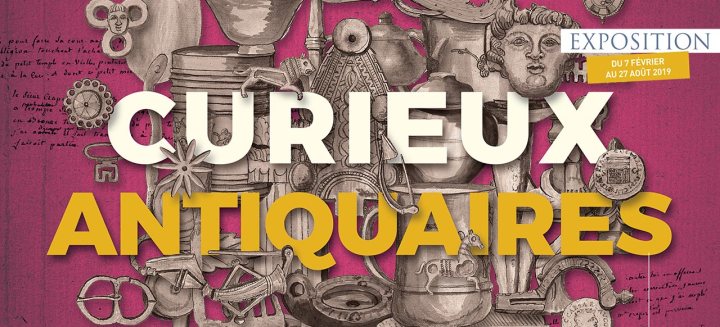
From the Forum Antique de Bavay:
Curieux Antiquaires: The Origins of Archaeology in Bavay in the 18th and 19th Centuries
Forum Antique, Bavay (Nord), 7 February — 27 August 2019
L’antiquaire est par définition un grand collectionneur… Mais, celui que nous connaissons aujourd’hui et celui des XVIIIe et XIXe siècles sont bien différents. Un antiquaire dans les années 1700 et 1800 est en réalité un précurseur de l’archéologie, il se passionne pour la collection d’objets antiques et s’intéresse à leur passé pour raconter notre Histoire. Avec l’exposition Curieux antiquaires, les débuts de l’archéologie à Bavay aux XVIIle et XIXe siècles, pénétrez au coeur du passé antique de Bavay avec les yeux de ces amateurs éclairés. Découvrez des érudits hauts en couleurs à travers leurs méthodes de travail, réseaux, collections et dessins.
Cette exposition grand public a pour but de faire part aux visiteurs des avancées dans la connaissance de l’histoire de l’archéologie à Bavay en mettant d’une part en avant des portraits des acteurs de cette histoire (l’abbé Carlier, J.B. Lambiez, Antoine Niveleau, Parent) et d’autre part leurs publications (Recueil de dessins de Carlier, Histoire monumentaire du Nord des Gaules de Lambiez, Bavay ancien et nouveau de Niveleau …). Il est aussi question de faire prendre conscience au public du fait que la manière de construire l’image de l’Antiquité est conditionnée par l’époque.
Curieux Antiquaires: Les débuts de l’archéologie à Bavay aux XVIIIe et XIXe siècles (Paris: Snoeck, 2019), 200 pages, ISBN: 978-9461614711, 22€.
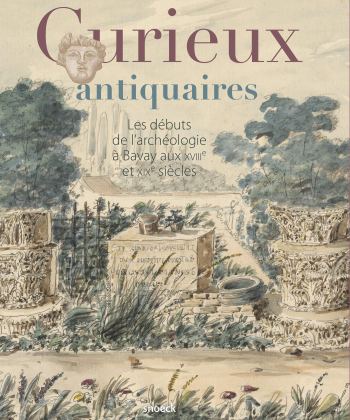 Si l’histoire de l’antique Bagacum est bien connue, la manière dont celle-ci s’est construite l’est moins. Curieux antiquaires, les débuts de l’archéologie à Bavay aux XVIIIe et XIXe siècles permet d’appréhender le patrimoine bavaisien sous un nouvel angle. Offrant une mise en perspective tant géographique que chronologique, ce catalogue apporte une vision nouvelle sur les premiers antiquaires bavaisiens. A travers les contributions d’Odile Parsis-Bazubé et d’Alain Schnapp, c’est la construction de l’antiquariate et de l’archéologie en France aux XVIIIe et XIXe siècles qui est mise en lumière. Plus loin, Véronique Beirnaert-Mary, Delphine Morana-Burlot et Véronique Krings détaillent l’exemple de Bavay. La première dresse le paysage bavaisien en présentant les acteurs locaux et leurs actions. Delphine Morana-Burlot propose ensuite une réflexion autour de la question du faux, Enfin, Véronique Krings ouvre une fenêtre sur la période du début du XXe siècle en s’attachant à relater la correspondance entre Franz Cumont et Raoul Warocqué autour des objets bavaisiens. Richement illustré, cet ouvrage rassemble toutes les pièces présentées à l’occasion de l’exposition. Des documents inédits sont ici publiés pour la première fois. La juxtaposition des objets archéologiques et de leur représentation dessinée est elle aussi inédite.










 Enfilade
leave a comment