A-Levels in Art History to End in 2018
From Apollo:
Ben Street, “Make No Mistake, Art History Is a Hard Subject. What’s Soft Is the Decision to Scrap It,” Apollo (15 October 2016).
So: art history A-level is to be scrapped in 2018. However much they protest the fact, the decision taken by the exam board AQA seems related to the Conservative government’s policy of ranking subjects by perceived relative difficulty, using an analogy of ‘soft’ and ‘hard’ that seems designed to belittle students and teachers who’ve apparently taken the easy way out. AQA deny this. Their claim is that art history—ditched along with archaeology and classical civilisation, whose demise has raised much less of a public fuss, for which you can provide your own punchline—is too difficult to mark successfully in an exam setting. It’s too ‘complex and specialist’, apparently. Too ‘hard’, in other words. . . .
Call for Papers | Trashed: Rejection and Recovery
From Boston University:
Trashed: Rejection and Recovery in the History of Art and Architecture
33rd Annual Boston University Graduate Symposium in the History of Art and Architecture
Boston University, 24–25 March 2017
Proposals due by 21 November 2016
What happens to the ideas and materials that end up in the scrap bin of history? While some projects are laid to waste, others are repurposed or reimagined. The 33rd Annual Boston University Graduate Symposium in the History of Art and Architecture invites submissions that explore themes of dispensability and resourcefulness.
Possible subjects include, but are not limited to, the following: spolia; creative use of recycled materials; deletions and deaccessioned objects; abandoned or reclaimed architectural spaces; drafts, drawings, or models for unrealized works; and the impact of unfavorable reception, as dictated by time, place, or audience. We welcome submissions from graduate students at all stages of their studies, working in any area or discipline.
Papers must be original and previously unpublished. Please send an abstract (300 words or less), a paper title, and a CV to bugraduatesymposiumhaa@gmail.com. The deadline for submissions is Monday, November 21, 2016. Selected speakers will be notified before January 1, 2017 and are expected to accept or decline the offer within a week of notification. Papers should be 20 minutes in length and will be followed by a question and answer session.
The Symposium will be held Friday, March 24 – Saturday, March 25, 2017, with a keynote lecture (TBD) on Friday evening at the Boston University Art Gallery at the Stone Gallery and graduate presentations on Saturday in the Riley Seminar Room of the Museum of Fine Arts, Boston.
This event is generously sponsored by The Boston University Center for the Humanities; the Boston University Department of History of Art & Architecture; the Museum of Fine Arts, Boston; the Boston University Graduate Student History of Art & Architecture Association; and the Boston University Art Gallery at the Stone Gallery.
Research Project | Sir Hans Sloane’s Catalogues
From the project announcement:
Enlightenment Architectures: Sir Hans Sloane’s Catalogues of His Collections
Leverhulme Trust Research Project, Autumn 2016 — 30 September 2019
Applications due by 31 October 2016
We are delighted to be able to announce the inception of Enlightenment Architectures: Sir Hans Sloane’s Catalogues of His Collections, a new research project based at the British Museum in collaboration with the Department of Information Studies at University College London. Enlightenment Architectures will start on 3 October 2016 and will run for three years until 30 September 2019.
The project has received generous funding from the Leverhulme Trust in the form of a Research Project Grant totalling £332,552 awarded to the British Museum, where Dr Kim Sloan is the Principal Investigator. The Co-Investigator on the project is Dr Julianne Nyhan and the Senior Research Assistant is Dr Martha Fleming. The grant will also accommodate two Post Doctoral Research Assistantships and one Doctoral Studentship. The call for applications for the PDRA positions are live now on the British Museum jobs website. The call for applications for the Doctoral Studentship will appear shortly on the University College London jobs website.
The objective of Enlightenment Architectures: Sir Hans Sloane’s Catalogues of His Collections is to understand the intellectual structures of Sloane’s own manuscript catalogues of his collections and with them the origins of the Enlightenment disciplines and information management practices they helped to shape. The project will employ a pioneering interdisciplinary combination of curatorial, traditional humanities and Digital Humanities research to examine Sloane’s catalogues which reveal the way in which he and his contemporaries collected, organised and classified the world, through their descriptions, cross-references and codes. The project will draw on the research framework that emerged from the 2012 AHRC-funded Sloane’s Treasures workshops, and findings will make significant contributions to histories of information science, histories of collections, and philosophy of knowledge, and will benefit a wide range of other disciplines as well.
Six manuscript catalogues created from 1680 to 1753 and selected from across the three institutions now holding Sloane’s materials—the British Museum, the British Library, and the Natural History Museum—will be transcribed and closely analysed by the interdisciplinary research team with the assistance of curatorial support from those three institutions. Regular workshops between curators, humanities researchers, and digital humanities practitioners will produce a deeper understanding of the structure and content of the catalogues. This will be disseminated through
• scholarly publications and conference contributions
• focused workshops and a project website
• a prototype linked data ontology for use in digital analysis of early modern collections
We look forward to communicating with you about our work, and welcome contributions from the wide-ranging scholarly communities whose disciplines will participate in and benefit from this research. We ask you to assist us in disseminating the announcements for the two Post Doctoral Research Associateships and the Doctoral Studentship and would ask you to alert colleagues and students who are eligible and appropriate to apply. As this is a Leverhulme Grant, the Doctoral Studentship is open to the EU as well as to UK applicants. The Research Associateships are open to international applicants.
With very best regards,
Dr Kim Sloan and Dr Julianne Nyhan
Partners
The British Museum
University College London Centre for Digital Humanities
Project Team
Kim Sloan is Curator of British Drawings and Watercolours before 1880 and the Francis Finlay Curator of the Enlightenment Gallery at the British Museum.
Julianne Nyhan is Senior Lecturer (Associate Professor) in Digital Information Studies at UCL’s Department of Information Studies.
Martha Fleming is a specialist in collections-based research and an historian of science.
2017 ISECS Seminar for Early Career Scholars: Cities and Citizenship
From H-ArtHist:
2017 ISECS Seminar for Early Career Scholars
Cities and Citizenship in the Enlightenment / Cité et citoyenneté des Lumières
Université du Québec, Montreal, 11–15 September 2017
Proposals due by 30 January 2017
The International Society for Eighteenth-Century Studies (ISECS) is pleased to announce the 2017 International Seminar for Early-Career Eighteenth-Century Scholars. Colleagues from all fields of eighteenth-century studies are invited to submit abstracts for this one-week event. Formerly called the East-West Seminar, the International Seminar for Early-Career Eighteenth-Century Scholars brings together young researchers from a number of countries each year. The 2017 meeting will take place in Montreal, Canada and will be organized by the University of Quebec in Montreal (UQAM) and the Research Group on the History of Sociabilities (RGHS).
The seminar will be held from Monday, September 11 to Friday, September 15, 2017 in Montreal, under the direction of Pascal Bastien (History, UQAM), Marc André Bernier (Literature, UQTR), Sébastien Charles (Philosophy, UQTR), Peggy Davis (Art History, UQAM), Benjamin Deruelle (History,UQAM), Geneviève Lafrance (Literature, UQAM), Laurent Turcot (History, UQTR).
The seminar will also be an opportunity to pay tribute to Professor Robert Darnton (Harvard University), former president of ISECS as well as co-founder, with Jochen Schlobach (1938–2003), of the East-West Seminar.
The theme this year’s seminar will be Cities and Citizenship in the Enlightenment. The ISECS International Seminar for Early Career Scholars will engage discussions on the forms, representations and modalities of political action and social and political identities in the eighteenth century. ‘Citizenship’ in the eighteenth century did not yet encompass the notions of property rights, equality before the courts, or even the electoral system of political representation. The result of a process rather than a status, urban citizenship can be understood as an appropriation of the urban space, the sociabilities found therein, and, fundamentally, civic culture within a civil society. The study of citizenship should not, therefore, be restricted to nationality and naturalization. Is the public space strictly an urban space? How should we understand political dynamics, collective emotions and urban citizenship in eighteenth-century cities?
If the Marxist undertones of the Habermas model have been questioned over the years, the notion of ‘public space’ still retains its significance and relevance. The questions surrounding language, verbal exchanges, and discourse in general remain at the center of the reflections by historians of society and class consciousness. At the crossroad of texts, discourses and practices, sociability is the field of enquiry for those who wish to grasp the different forms of public opinion and citizen commitment, especially within eighteenth-century urbanization. A detailed description of this theme is available online.
The seminar is limited to 15 participants. The proposals (approx. 2 pages, single spaced) should be based on an original research project (e.g. a doctoral dissertation) which addresses one of the aspects mentioned above. Because this is a seminar rather than a conference, each participant will be given approximately one hour to present the texts and questions that will then form the basis of a group discussion. Preference will be given to scholars who are at the beginning of their academic career (PhD or equivalent for less than six years). The official languages are French and English.
Accommodation costs will be covered in full by the organizers, who will be responsible for reserving hotel rooms. Other travel costs are currently under evaluation for a grant from the Government of Canada. If the seminar should benefit from such funding, airline tickets and other living expenses (lunches and dinner) may also be covered.
As it is the case each year, the proceedings of the seminar will be published by Honoré Champion (Paris) in the Lumières internationales series.
Applications should include the following information: a brief curriculum vitae with date of PhD (or equivalent); a list of principal publications and scholarly presentations; a brief description of the proposed paper (approx. 2 pages, single-spaced); and one letter of recommendation. Colleagues are invited to submit proposals by January 30, 2017. Please send abstracts by e-mail to Pascal Bastien: bastien.pascal@uqam.ca.
Exhibition | Character Mongers
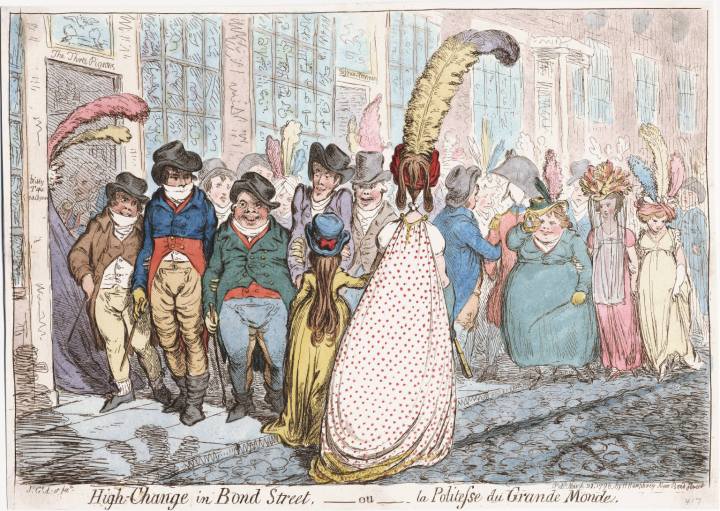
James Gillray, High Change in Bond Street, ou, La Politesse du Grande Monde, published March 27th 1796 by H. Humphrey, etching with hand coloring (The Lewis Walpole Library, 796.03.27.01+).
◊ ◊ ◊ ◊ ◊
From The Lewis Walpole Library:
Character Mongers, or, Trading in People on Paper in the Long 18th Century
The Lewis Walpole Library, Farmington, CT, 10 October 2016 — 27 January 2017
Curated by Rachel Brownstein and Leigh-Michil George
In the course of the long eighteenth century—the Age of Caricature, and of The Rise of the Novel—the British reading public perfected the pastime of savoring characters. In a flourishing print culture, buying and selling likenesses of people and types became a business—and arguably an art. Real and imaginary characters—actual and fictional people—were put on paper by writers and graphic artists, and performed onstage and off. The exigencies of narrative, performance, and indeed of community conspired to inform views of other people—friend and foe, fat and thin—as tellingly, characters. “For what do we live,” Jane Austen’s Mr. Bennet would ask rhetorically in 1813, “but to make sport for our neighbours and laugh at them in our turn?”
This exhibit will feature images by William Hogarth, James Gillray, Thomas Rowlandson, Thomas Patch, Edward Francis Burney, Francis Grose, and G.M. Woodward, excerpts from novels by Jane Austen, Frances Burney, Henry Fielding, and Laurence Sterne, and examples of graphic collections published by Matthew and Mary Darly and Thomas Tegg that marketed caricature as entertainment.
◊ ◊ ◊ ◊ ◊
Public Talk | Eating People
Rachel Brownstein (Professor Emerita, Brooklyn College and The Graduate Center, CUNY)
The Lewis Walpole Library, Farmington, CT, Wednesday, 16 November 2016, 7:00pm
Offered in collaboration with the Farmington Libraries. Advance registration required.
◊ ◊ ◊ ◊ ◊
Graduate Student Seminar | Character and Caricature
Rachel Brownstein (Professor Emerita, Brooklyn College and The Graduate Center, CUNY)
The Lewis Walpole Library, Farmington, CT, Friday, 18 November 2016
Caricature relies on a double take: you recognize both the person represented and the artist’s critical, comic view, register both the familiar and the strange. Basic to what E.H. Gombrich called “the cartoonist’s arsenal” is the contrast between extremes, differences in scale (fat and thin, short and tall) that define a character in relation to another (the thing it is not). Pairings proliferate, sometimes by accident, always by design.
History has a hand in the process. The fathers of Charles James Fox and William Pitt were also political rivals, and Fox in fact was plump and Pitt skinny. But as Simon Schama imagines it, the artist James Gillray, commissioned in 1789 to produce a formal portrait of Pitt, could not but see him with a caricaturist’s eye, as “angular where Fox was sensual, repressed where Fox was spontaneously witty, … the upper lip stiff as a board, where both of Fox’s were fat, shiny cushions.” Schama speculates, “How could he resist? He didn’t. The ‘formal portrait’ looked like a caricature, or at the very least a ‘character.’” Is the one a version of the other?
Coming with different questions from different disciplines, we will consider caricatures by Gillray and others, bringing fresh perspectives to the questions they raise about the relation of caricature to character and to being ‘a character,’ as well as to the trick of contrast, to historical context, and to point of view.
The program is open by application. Preference will be given to graduate students. For further details contact Cynthia Roman, cynthia.roman@yale.edu. Yale Shuttle to and from New Haven. Accommodation at the Library’s Timothy Root House may be available at no charge upon inquiry.
◊ ◊ ◊ ◊ ◊
Talk with Edward Koren
Edward Koren (Cartoonist, The New Yorker Magazine)
Sterling Memorial Library Lecture Hall, New Haven, 13 December 2016, 5:30pm
“In my cartoon drawings, I like getting things right… What captures my attention is all the human theater around me. I can never quite believe my luck in stumbling upon riveting minidramas taking place within earshot (and eyeshot), a comedy of manners that seem inexhaustible. And to be always undercover makes my practice of deep noticing more delicious. I can take in all the details as long as I appear inattentive—false moustache and dark glasses in place. All kinds of wonderful moments of comedy happen right under my nose…”
On Cartooning, by Edward Koren
Edward Koren’s iconic images record the comedy of manners in society and politics that have captured his attention for decades. In this talk, he will reflect on his career as a New Yorker artist, and on the many and diverse influences that have contributed to the development of his thinking and drawing.
◊ ◊ ◊ ◊ ◊
The Art of Observational Satire: A Conversation
Rachel Brownstein and Edward Koren, moderated by Cynthia Roman
Beinecke Rare Book and Manuscript Library, New Haven, Friday, 14 December 2016, 2:00pm
Edward Koren, a long-time cartoonist, and Rachel Brownstein, a literary scholar, will reflect on the enduring tradition of social satire. Space is limited. Please register in advance.
Note (added 17 October 2016) — The original posting incorrectly listed the 13 December talk as scheduled for mid-afternoon. My apologies for any confusion –CH.
2015 Dissertation Listings from CAA
From caa.news (1 August 2016) . . .
caa.reviews has published the authors and titles of doctoral dissertations in art history and visual studies—both completed and in progress—from American and Canadian institutions for calendar year 2015. You may browse by listing date or by subject matter. Each entry identifies the student’s name, dissertation title, school, and advisor. Once a year, each institution granting the PhD in art history and/or visual studies submits dissertation titles to CAA for publication.
◊ ◊ ◊ ◊ ◊
The index for 2015 lists ten ‘eighteenth-century art’ dissertations completed, including:
• Katherine Arpen, “Pleasure and the Body: The Bath in Eighteenth-Century French Art and Architecture” (UNC Chapel Hill, M. Sheriff)
• Julie Boivin, “Horrid Beauty: Rococo Ornament and Contemporary Visual Culture” (Toronto, M. Cheetham)
• John Cooper, “Imperial Balls: The Arts of Sex, War, and Dancing in India, England, and the Caribbean, 1780–1870” (Yale, T. Barringer; R. Thompson)
• Meredith Gamer, “‘The Sheriff’s Picture Frame’: Art and Execution in Eighteenth-Century Britain” (Yale, T. Barringer)
• Elizabeth Lee Oliver, “Mercantile Aesthetics: Art, Science, and Diplomacy in French India (1664–1761)” (Northwestern, S. H. Clayson)
◊ ◊ ◊ ◊ ◊
and forty-four ‘eighteenth-century art’ dissertations in progress, including:
• Franny Brock, “Drawing the Amateur: Draftsmanship and the Amateur in Eighteenth-Century France” (UNC Chapel Hill, M. Sheriff)
• Ashley Bruckbauer, “Dangerous Liaisons: Ambassadors and Embassies in Eighteenth-Century French Art” (UNC Chapel Hill, M. Sheriff)
• Emily Casey, “Waterscapes: Representing the Sea in the American Imagination, 1760–1815” (Delaware, W. Bellion)
• Bernard Cesarone, “Redeeming Virgins and Heterodox Images in Enlightenment New Spain” (UIUC, O.Vázquez)
• Kathryn Desplanque, “Art, Commerce, and Caricature: Satirical Images of Artistic Life in Paris, 1750–1850” (Duke, N. McWilliam)
• Monica Hahn, “Go-Between Portraits and the Imperial Imagination, circa 1800” (Temple, T. Cooper)
• Joshua Hainy, “John Flaxman: Beyond the Line” (Iowa, D. Johnson)
• Alexandra Morrison, “Copying at the Louvre” (Yale, C. Armstrong)
• Sarah Sylvester Williams, “Dining Scenes by Nicolas Lancret” (Missouri, Columbia, M. Yonan)
PhD Studentship | Hans Sloane’s Books: An Early Enlightenment Library
From H-ArtHist:
AHRC Collaborative Doctoral Partnership
Hans Sloane’s Books: An Early Enlightenment Library and Its Material Relationships
London, 3 October 2016 — 30 September 2019
Applications due by 6 July 2016
Queen Mary University of London and the British Library intend to make a PhD studentship appointment under the AHRC Collaborative Doctoral Partnership scheme (CDP) from autumn 2016.
The project will investigate the intellectual significance of the library of Sir Hans Sloane (1660–1753) to the gathering and dissemination of medical and scientific knowledge in the Enlightenment period. It will focus on Sloane’s library (now housed within the British Library) in relation to his wider collection of natural and artificial specimens, now divided between the Natural History and British Museums. The research will be co-supervised by the British Library and Queen Mary. The project offers privileged access to Sloane’s books at shelf as well as extensive curatorial support in their study and interpretation, in addition to the standard academic doctoral training and supervision.
The project is open to either full-time or part-time students. Studentships are awarded for 3 years (or part-time equivalent) initially, at RCUK rates and subject to standard eligibility criteria for RCUK training grants. Additional Student Development Funding is available to allow time for further training and skills development opportunities that are agreed as part of the PhD programme. If required, this may be used to extend the studentship by up to six months (or part-time equivalent). The British Library also offers the student generous research expenses funding, specialist training, and access to work-space within its curatorial offices.
Application guidelines and a detailed description of the project are available here. Candidates with interests in bibliography, book history, the material book, the history of science and medicine, early-modern scientific literary writing, exchange networks, and the history of collections will be especially welcome. Once recruited, the successful PhD candidate will contribute to the development of the final agreed research topic. Potential candidates are welcome to contact Professor Claire Preston (Queen Mary – c.preston@qmul.ac.uk) and Dr Karen Limper-Herz (the British Library – Karen.limper-herz@bl.uk) for further details.
Symposium | IFA and The Frick Host History of Art Symposium
This weekend’s symposium includes two papers on the eighteenth century; the full program is available as a PDF file here. Details are also available from The Frick Collection.
A Symposium on the History of Art
The Institute of Fine Arts of New York University (Friday) and The Frick Collection (Saturday), 15–16 April 2016
Friday, 15 April, 3:20pm, “‘An Event Like a Ritual’: Representative Fictions in The Declaration of Independence by John Trumbull” Abigail Glogower, University of Rochester
Saturday, 16 April, 10:00am, “Seductive Surfaces in Anne Vallayer Coster’s Still Life with Seashells and Coral (1769)” Kelsey Brosnan, Rutgers University
Exhibition | James Gillray’s Hogarthian Progresses
From The Lewis Walpole Library:
James Gillray’s Hogarthian Progresses
The Lewis Walpole Library, Farmington, CT, 6 April — 16 September 2016
Curated by Cynthia Roman
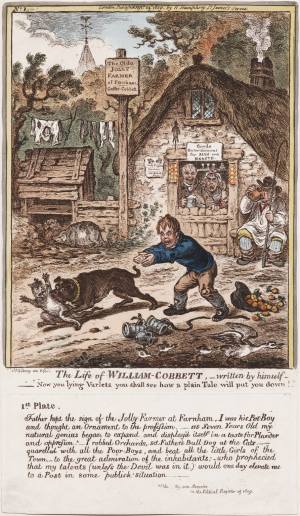
James Gillray, The life of William-Cobbett, written by himself. : Now you lying varlets you shall see how a plain tale will put you down! / Js. Gillray inv. & fec. Published in London, 29 September 1809 (Lewis Walpole Library).
Sequential narration in satiric prints is most famously associated with the ‘modern moral subjects’ of William Hogarth (1697–1764): Harlot’s Progress (1732), A Rake’s Progress (1735), Marriage A-la-Mode (1745), and Industry and Idleness (1747) among others. Less well-known is the broad spectrum of legacy ‘progresses’ produced by subsequent generations drawing both on Hogarth’s narrative strategies and his iconic motifs. James Gillray (1756–1815), celebrated for his innovative single-plate satires, was also among the most accomplished printmakers to adopt Hogarthian sequential narration even as he transformed it according to his unique vision. This exhibition presents a number of Gillray’s Hogarthian progresses alongside some selected prints by Hogarth himself.
P R O G R A M S
Study Day
James Gillray’s Experimental Printmaking
Organized by Esther Chadwick, History of Art, Yale University and Cynthia Roman, The Lewis Walpole Library, Yale University, 10 June 2016
Graduate Student Seminar
Collecting the Graphic Work of William Hogarth
Sheila O’Connell, Former Curator of Prints, British Museum, 14 June 2016
Graduate Student Seminar
Connoisseurship: Graphic Satire from William Hogarth to James Gillray
Andrew Edmunds, Collector and Dealer, 15 June 2016
Master Class for Graduate Students
A Contest of Two Genres: Graphic Satire and British History Painting in the Long Eighteenth Century
Mark Salber Phillips, Professor of History at Carleton University, Ottawa, and Cynthia Roman, Curator of Prints, Drawings, and Paintings at the Lewis Walpole Library, 22–26 August 2016
Master Class for Graduate Students
The Comic Image 1800–1850: Narrative and Caricature
Brian Maidment, Professor of the History of Print, Liverpool John Moores University
Cynthia Roman, Curator of Prints, Drawings, and Paintings at the Lewis Walpole Library, 14—16 September 2016
Göttingen Summer School | Academic Collecting and Knowledge
From H-ArtHist:
Göttingen Spirit Summer School
Academic Collecting and the Knowledge of Objects, 1700–1900
Lichtenberg-Kolleg, Historic Observatory, University of Göttingen, 5–10 September 2016
Applications due by 1 May 2016
Experts/Speakers
Anne Mariss, University of Tuebingen
Maria Rentetzi, National Technical University of Athens, Lise Meitner fellow, University of Vienna
Kim Sloan, British Museum London
Emma Spary, University of Cambridge
Early modern cabinets of curiosities/Wunderkammern can be considered as an important space especially for those developing sciences that wanted to transcend text based scholasticism and base their knowledge solely on experience. Scholarly engagement with collections laid the foundations for knowledge production that was based on experiment and research with and on objects. Since this development took shape during the 17th century, collecting, storing, ordering, and the presentation of objects has become a strong concern for many academic disciplines.
Accordingly, technologies that transformed things into objects of knowledge and rendered them accessible and sustainable are equally practical as well as epistemological techniques. Current research in the history of science and knowledge focuses increasingly on practices of collecting, ordering and presenting. Thus highlighting how scientific research and its results are intertwined with and rely upon different cultures of materiality and the handling of objects is the main concern of the summer school.
In addition to questions concerning the role of objects and collections in the processes of knowledge production, we would also like to address the state and development of object based research in the humanities. How can humanities research be enhanced by engaging with objects? Which methods and theories can be successfully employed in order to achieve meaningful knowledge about these processes on a medium and larger scale? Each day of the summer school will be dedicated to a specific topic where four PhD candidates will present their research and give an introduction to their projects, with one expert commenting and leading the discussion for each project.
As we acknowledge the epistemic value of engaging with objects, visits to the relevant academic collections at the University of Göttingen are an integral part of the program. Two of our experts, Kim Sloan and Emma Spary, will also give keynote lectures on Monday and Wednesday respectively. On Thursday evening, Anne Mariss will introduce her recent book ‘A World of New Things’: Praktiken der Naturgeschichte bei Johann Reinhold Forster (Johann Reinhold Forster and the Practices of Natural History), thereby reflecting on her process of writing a thesis on praxeological aspects of knowledge production and engaging with material culture.
The four thematic sections are:
From encyclopaedic to specialised collecting: Practices of collecting and exhibiting, the role of collectors and things // Kim Sloan, British Museum
During the two centuries between 1700 and 1900, a far-reaching transformation took place that influenced both the scientific practices related to objects and the role of collectors. Burgeoning university collections differed considerably from most private or courtly cabinets of curiosities regarding their claims to establish order, classification and systematic comparison: the typical and the ordinary gradually replaced the rare and the unique, and the learned collector became the collecting scholar. The 18th century can be seen as a period of transition and the nineteenth 19th century was a threshold in the process of the differentiation of academic disciplines. This also influenced the collections, which were separated as well and thereby shed new light on the objects and thus eventually led to new ways of knowledge production. Accordingly, we especially invite presentations that address continuities and discontinuities in practices of collecting and the role of the collectors, as well as the actual order, presentation and spatial distribution of objects in the collections. Additionally, presentations that engage with wider epistemological, cultural, social and political contexts are equally welcome.
‘Putting nature in a box’ The material order of things: shelves, cabinets, boxes and other furniture of order // Maria Rentetzi, NTU Athens, University of Vienna
Furniture that helps to order and to store collections is an important part of the social world of collecting and is embedded in the epistemic practices surrounding collections as well. Material appliances influence the rules of the handling of objects and permit as well as prohibit certain practices. Thus, they are not neutral vessels but material conditions of possibilities regarding what and what cannot be known at a particular time and space. Which role do these vessels play concerning the development of object centred sciences in the18th and 19th century, especially concerning the production of knowledge and its contents? How did cabinets and other storage systems help natural historians to organise knowledge, and how did they help to create knowledge about the natural world? How did boxes become multifunctional tools in transferring the collected material into systematics? Could this furniture be regarded as a kind of laboratory that decontextualized and re-contextualised objects in changing spatial-systematic vicinities?
Networks, actors and objects // Emma Spary, Cambridge University
Current research in the history of science and knowledge no longer focuses solely on individual collectors and well-known collections, but also on complex and far-reaching networks of collecting that mobilised and thereby often transformed objects, actors and inscriptions. This approach lead to the decentralisation of the persona of the collector and collections were conceptualised in the Latourian framework as ‘centres of calculation’. Special emphasis was laid on the analysis of the diverse spaces within which objects of knowledge were constituted and circulated. This panel wants to address the complicated movements of objects, materials, specimen and living creatures (both humans and other animals) within these wide and heterogeneous networks. Studies that address their itineraries between various spaces of encounter, e.g. academic collections, the marketplace, the scholars’ houses, lecture halls, hospitals, etc. are especially welcome. Additionally, we are interested in the multitude and diversity of the actors in these spaces. Extending the research beyond the scholar as the classical focus in the history of science, we want to know about artisans, merchants and, very importantly, the members of the source communities from where the objects originated. It will be interesting to see if these diversities also produced different kinds of knowledge. Besides well-studied analytical and systematic forms of knowledge, other kinds, especially corporeal, implicit and tacit knowledge as well as technological, practical and artisanal competence—that all of these actors applied in one way or another—will be the focus of this panel. Calculation, Ordering and Classification are only three possible practices that would highlight these processes, and we are equally looking forward to presentations addressing further practices.
The long road to the image: strategies of visualisation in collections // N.N.
Images are also part of the transformation processes surrounding objects but they exemplify a special form of inscription in their claim to be mimetic. Current history of science and interdisciplinary visual culture studies have shown that the road from object to image is not as straightforward and simple as previously acknowledged. In order to understand the visual representation of collections, objects, and collectors, the manifold processes that lead from object/subject to image have to be analysed thoroughly. Traditions and conventions of image making have to be studied in order to show how social, epistemic and affective contexts of image production and presentation have influenced these processes.
Applications and selection procedure
The summer school will be held in English and welcomes PhD candidates or advanced postgraduates to apply. Up to 16 applicants will be admitted. Interested applicants are asked to send a cover letter, a CV and a research exposé (1500–2000 words/approx. 3–5 pages) preferably via e-mail as one pdf file to summerschool@kustodie.uni-goettingen.de by 1st of May 2016. The cover letter should address to which of the four sections the project would correspond to. Ideally, it should already mention a special interest in one or more academic collections from Göttingen, as well as contain a short explanation why the certain collection(s) would be interesting for the PhD or postgraduate project. The selection will be conducted by the convenors, the experts and the academic advisory board of the Zentrale Kustodie. Successful candidates will be informed early in June, and will then be asked to send in a more developed research exposé (up to 8000 words/approx. 15–20 pages) within 6 weeks of the invitation. These texts will be circulated among all participants of the summer school and will be the basis for the experts‘ commentaries and the discussions during the summer school. We ask all applicants to address not only the research content of their projects but also to include references to concepts and methodologies and an explication of their research agenda and the sources employed. A discussion on how objects and collections feature in the research project is very much appreciated.
Thanks to the generous support of the Goettingen Spirit Summer School program at the University of Göttingen, we are able to provide board and lodging for all participants. The participation fee is 50€. For further information and questions, please contact Christian Vogel (summerschool@kustodie.uni-goettingen.de).
Convenors
Marie Luisa Allemeyer (Zentrale Kustodie, University of Göttingen)
Dominik Hünniger (Lichtenberg-Kolleg, University of Göttingen)
Christian Vogel (Zentrale Kustodie, University of Göttingen)
◊ ◊ ◊ ◊ ◊
M O N D A Y , 5 S E P T E M B E R 2 0 1 6
5:00 Arrival and registration
6:30 Keynote lecture by Kim Sloan
8:00 Opening dinner
T U E S D A Y , 6 S E P T E M B E R 2 0 1 6
From encyclopaedic to specialised collecting: Practices of collecting and exhibiting, the role of collectors and things / Kim Sloan
9:30 Presentation of the chair
10:00 Two project presentations
1:30 Visit of a collection
4:00 Two project presentations
6:30 Guided tour Historic Observatory
8:00 Dinner
W E D N E S D A Y , 7 S E P T E M B E R 2 0 1 6
‘Putting nature in a box’: The material order of things: shelves, cabinets, boxes and other furniture of order / Maria Rentetzi
9:30 Presentation of the chair
10:00 Two project presentations
1:30 Visit of a collection
4:00 Two project presentations
6:30 Keynote lecture by Emma Spary
8:00 Dinner
T H U R S D A Y , 8 S E P T E M B E R 2 0 1 6
Networks, Actors and Objects / Emma Spary
9:30 Presentation of the chair
10:00 Two project presentations
1:30 Visit of a collection
4:00 Two project presentations
6:30 Book presentation by Anne Mariss
8:00 Dinner
F R I D A Y , 9 S E P T E M B E R 2 0 1 6
The long road to the image: strategies of visualisation in collections / N. N.
9:30 Presentation of the chair
10:00 Two project presentations
1:30 Visit of a collection
4:00 Two project presentations
6:30 Anthropology performance
8:00 Dinner










 Enfilade
leave a comment