9th Annual Ricciardi Prize from Master Drawings
From Master Drawings:
Ninth Annual Ricciardi Prize from Master Drawings
Submissions due by 15 November 2026
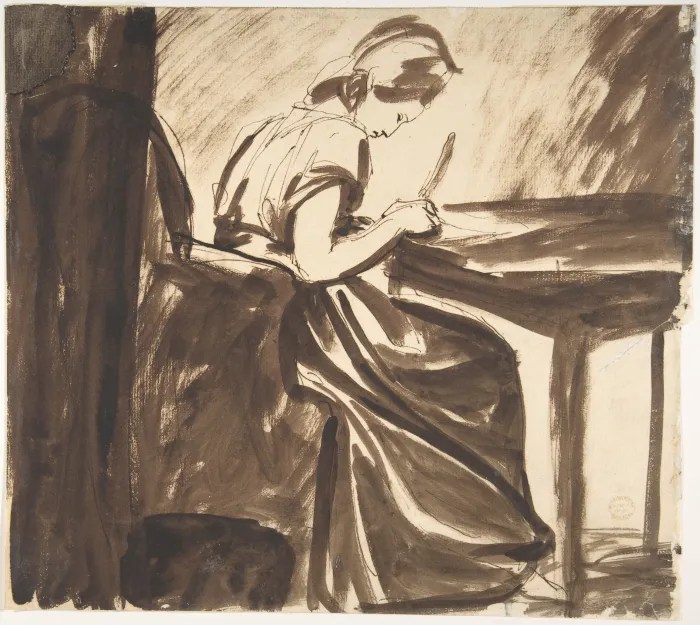
George Romney, Lady Seated at a Table (recto); pen and brown ink, brush and brown wash (NY: The Metropolitan Museum of Art, 11.66.3).
Master Drawings is now accepting submissions for the 9th Annual Ricciardi Prize of $5000. The award is given for the best new and unpublished article on a drawing topic (of any period) by a scholar under the age of 40. Candidates are also eligible for a $1000 runner-up prize and publication. Prize winners are eligible for reimbursement of costs associated with obtaining image publication permissions. They will be invited to present their research at a symposium held during Master Drawings Week in New York (January 2027). Information about essay requirements and how to apply can be found here. Information about past winners and finalists is available here.
The average length is between 2500 and 3750 words, with five to twenty illustrations. Submissions should be no longer than 7500 words and have no more than 75 footnotes. All submissions must be in article form, following the format of the journal. Please refer to our Submission Guidelines for additional information. We will not consider submissions of seminar papers, dissertation chapters, or other written material that has not been adapted into the format of a journal article. Written material that has been previously published, or is scheduled for future publication, will not be eligible. Articles may be submitted in any language. Please be sure to include a 100-word abstract outlining the scope of your article with your submission.
Call for Articles | A Passion for Porcelain
From the Call for Papers:
A Passion for Porcelain: Volume in Honour of Dame Rosalind Savill
The French Porcelain Society Journal, Volume 11
Proposals due by 1 April 2026; completed articles will be due by 1 October 2026
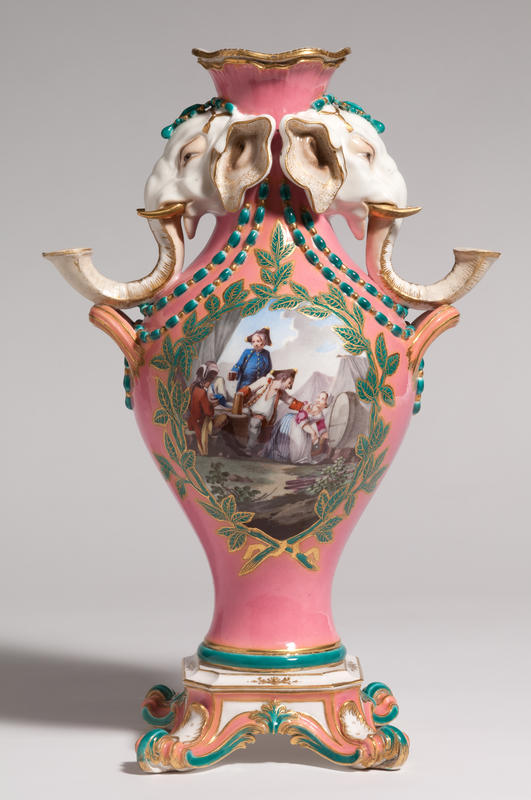
Vase à têtes d’éléphant, Sèvres Porcelain Manufactory, ca. 1760, purchased by Louis XV in December 1760 (Waddesdon Manor, no. 3013; photo by Mike Fear).
The French Porcelain Society Journal is the leading academic, peer-reviewed English-language publication on European ceramics and their histories, illustrated in full colour. After celebrating its 40th anniversary in 2024 with the publication of an issue focused on the work of twentieth-century scholars, collectors, and dealers who have contributed to advancing the study of European ceramics, the French Porcelain Society would like to honour the life and work of Dame Rosalind Savill (1951–2024), who served as President of the Society for 24 years, from 1999 until 2023. Dame Rosalind (‘Ros’) Savill was a leading expert in the production of the Vincennes/Sèvres factory during the eighteenth century and on Madame de Pompadour, one of the factory’s most prominent clients and advocates. Her internationally acclaimed research was published in The Wallace Collection Catalogue of Sèvres Porcelain (1988)—the institution that she directed from 1992 until 2011—and in the more recent Everyday Rococo: Madame de Pompadour and Sèvres Porcelain (2021), as well as in articles and contributions to other books, catalogues, academic journals, and specialist publications such as The Burlington Magazine. Ros’s indefatigable thirst for knowledge was illustrated by her interest in other topics beyond that of French eighteenth-century porcelain, from music, horticulture and birds, to furniture and arms and armour. Above all, Ros’s passion for ceramics was communicated in any conversation with her, be it in front of a museum display or around the dinner table. The next issue of The French Porcelain Society Journal wants to commemorate that passion for European ceramics with contributions that can range from object-focused case studies to articles with an academic or historiographic approach to the subject.
Topics for consideration may include but are not limited to the following:
• Insights into the production of porcelain at the Vincennes/Sèvres factory and stories relating to its personnel, agents, and collectors during the eighteenth and nineteenth centuries
• New research on specific objects or groups of objects within the remit of European ceramics, with a particular interest in French eighteenth-century faience and porcelain productions
• Contributions to the study of European ceramic factories, their histories, establishment, running and, if appropriate, disappearance
• Research on collectors of European ceramics
Submissions in the first instance should be a summary of no more than 400 words, with a brief description of the argument, a historiography, and a note of the research tools and sources used. Articles must be original; we do not accept modified versions of articles published elsewhere electronically or in print. Please include a brief biography. Articles will be peer reviewed by the editorial board and the FPS Committee of academic and museum specialists. Submissions should be between 3,000 and 6,000 words in length excluding endnotes and a house style sheet will be provided. Up to 15 high-resolution images per article will be accepted. Authors are responsible for obtaining copyright clearance. Please send abstracts as an email attachment to the FPS Journal Editorial Board (fpsjournal@gmail.com) by 1 April 2026. If your abstract is accepted, articles and images will be due by 1 October 2026. Publication is provisional on satisfactory peer review.
Journal18, Fall 2025 — Clean
The latest issue of J18:
Journal18, Issue #20 (Fall 2025) — Clean
Issue edited by Maarten Delbeke, Noémie Etienne, and Nikos Magouliotis
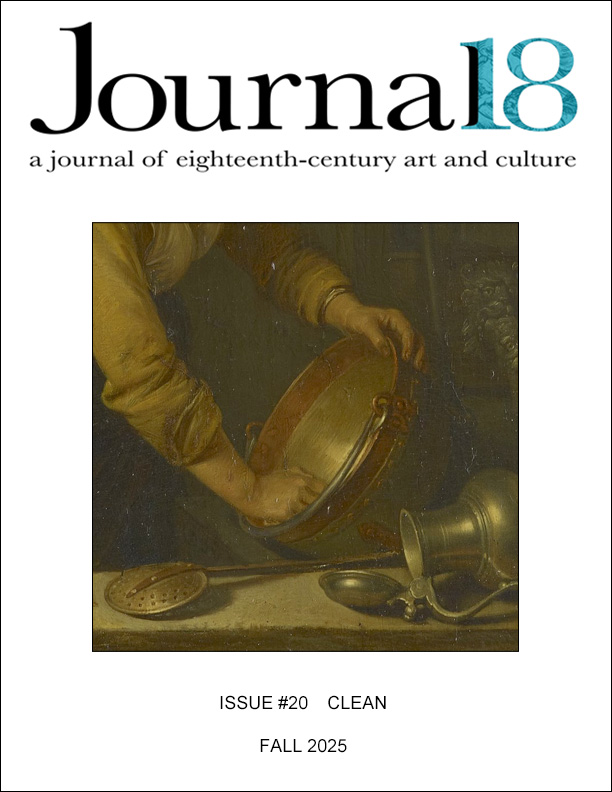 Cleaning is never a neutral act. In the eighteenth century, acts of cleaning became a way to decide what counted as disorder, to separate asserted purity from designated pollution, and to display authority over matter, space, and people. From the forecourt of Paris’s Notre-Dame to the Ganges river in Varanasi to Scotland’s filthy privies, practices of cleaning have shaped political order. Racial issues, colonization, and the management of public space revolved around the idea and implementation of cleaning, which could also involve the deliberate relocation or erasure of human beings.
a r t i c l e s
Economies of Waste: Revolutionary Administration and the Afterlives of the Kings of Notre-Dame — Demetra Vogiatzaki
‘Beneath the Waters of a Universal Ocean’: Containing, Contaminating, and Cleaning the Ganges River in Varanasi — Ushma Thakrar
Piss, Poison, and other Paths between Scotland and England in Caricature since 1745 — Laura Golobish
c o n v e r s a t i o n p i e c e
The Grammar of Cleaning: A Conversation — Maarten Delbeke, Noémie Etienne, and Nikos Magouliotis
All articles are available for free here, along with recent notes & queries:
r e c e n t n o t e s a n d q u e r i e s
Marie Antoinette Style: An Exhibition Catalogue Review — Madeleine Luckel
Room for the Lost Paradise: A Symposium — Jason M. Kelly
Reflections on Mai, Joshua Reynolds, and Eighteenth-Century Art — A Roundtable
Colonial Crossings: A Review — Juan Manuel Ramírez Velázquez
Print Quarterly, December 2025
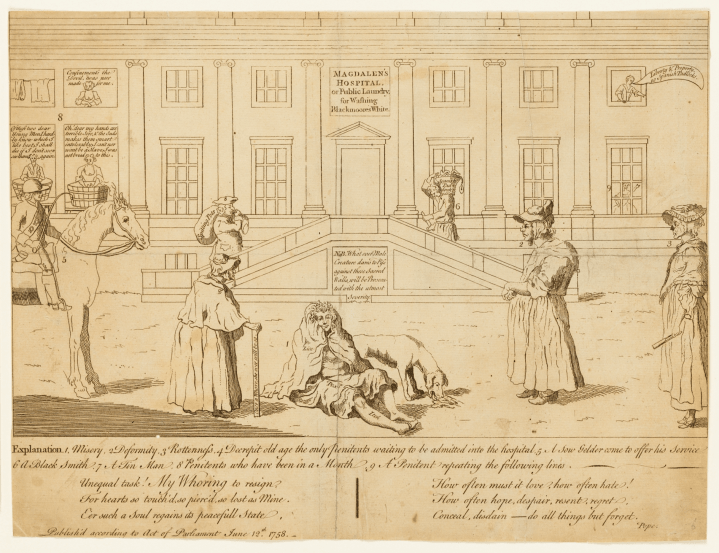
Anonymous artist, Magdalen’s Hospital, or Public Laundry for Washing Blackmoores White, 1758, etching, trimmed within the platemark, 232 × 307 mm (Oxford, Ashmolean Museum).
◊ ◊ ◊ ◊ ◊
The long eighteenth century in the latest issue of Print Quarterly:
Print Quarterly 42.4 (December 2025)
a r t i c l e s
• Xanthe Brooke, “Spaignolet’s Drawing Book: An Album with Ribera Prints at Knowsley Hall,” pp. 379–89. This article focuses on an unpublished album containing 28 prints mainly by or after Jusepe de Ribera (1591–1652). Brooke seeks to identify the sources and publishers of each impression, explores how the Earl of Derby used the album, and traces the growing taste for Ribera’s work among English collectors in the late seventeenth and the first decades of the eighteenth century.
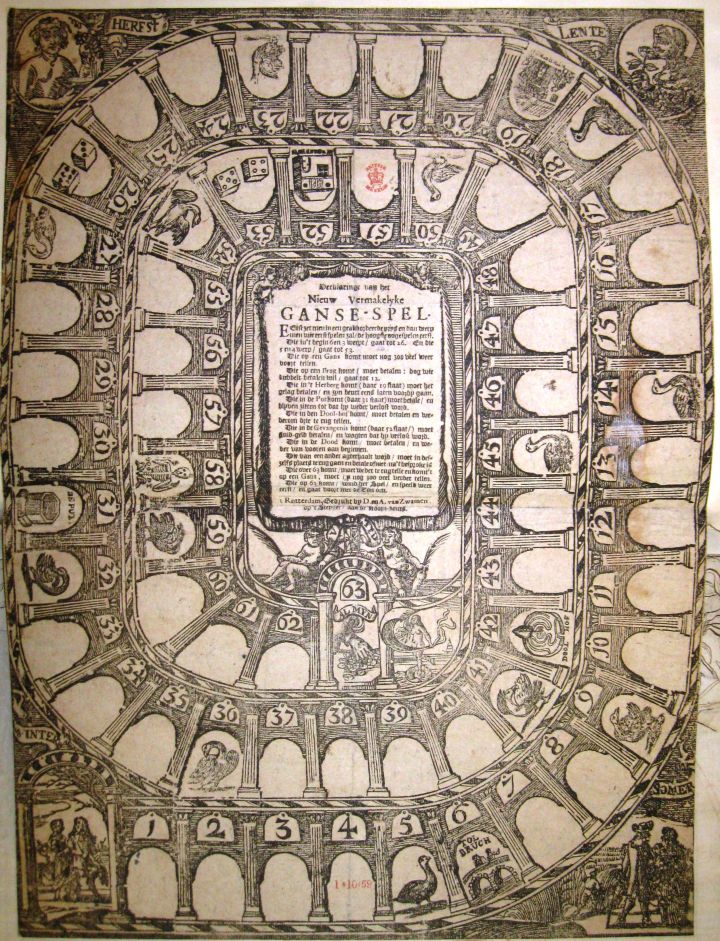
Anonymous artist, The New and Entertaining Game of the Goose, ca. 1759–87, woodcut, 470 × 360 mm (London: British Library, Creed Collection volume 8).
• Emma Boyd, “The Advent of the Magdalen Hospital: A Rare Satirical Print,” pp. 390–401. This article examines an anonymous etching in the Ashmolean Museum depicting the Magdalen Hospital, a charity for ‘penitent prostitutes’. The author discusses the print’s satirical commentary in relation to the charity’s controversial formation and the debates surrounding it. She also examines the print’s authorship within the context of other satirical prints and depictions of London street figures.
• Susan Sloman, “Gainsborough’s Cottage Belonging to Philip Thicknesse near Landguard Fort,” pp. 426–31. This short article contextualises an early etching by Thomas Gainsborough (1727–1788) from the 1750s, which the author proposes may have served as a subscription ticket for the engraving Landguard Fort, published in August 1754 by Thomas Major (1719–1799). The author also suggests that a painting by Gainsborough long assumed lost never existed.
• Felicity Myrone and Adrian Seville, “Two Unreported Games of the Goose in the Creed Collection in the British Library,” pp. 432–36. This short article describes two unknown examples of the Game of the Goose, one in printed form and the other in manuscript form. The provenance from the collection of London printseller Giles Creed (1798–1858), who specialized in ‘the history of ancient and modern inns, taverns, and coffee-houses’, is briefly traced.
n o t e s a n d r e v i e w s
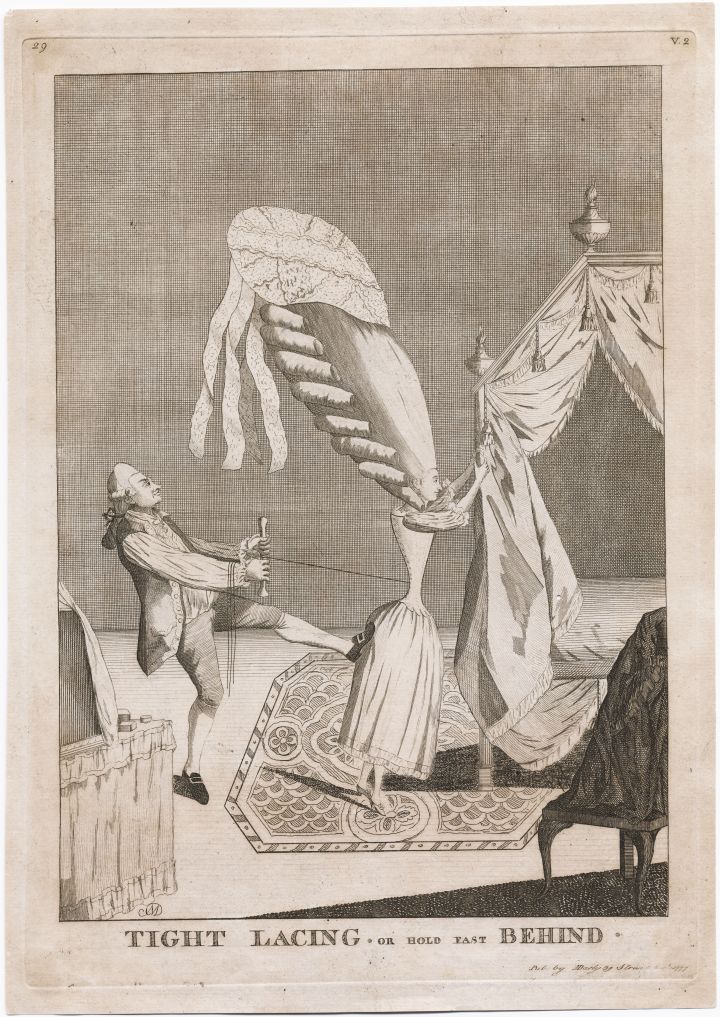
Anonymous artist, published by Matthew and Mary Darly, Tight Lacing, or, Hold Fast Behind, 1 March 1777, etching and engraving, 351 × 247 mm (Farmington, CT: Lewis Walpole Library, Yale University).
• Andaleeb Badiee Banta, Review of Cristina Martinez and Cynthia Roman, Female Printmakers, Printsellers, and Print Publishers in the Eighteenth Century: The Imprint of Women, c. 1700–1830 (Cambridge University Press, 2024), pp. 445–47.
• Jean Michel Massing, Review of Anna Lafont, L’art et la race: L’Africain (tout) contre l’œil des Lumières (Les presses du réel, 2019), pp. 447–48.
• Einav Rabinovitch-Fox, Review of Elizabeth Gernerd, The Modern Venus: Dress, Underwear, and Accessories in the Late 18th-Century Atlantic World (Bloomsbury Visual Arts, 2024), pp. 448–49.
• Mathilde Semal, Review of Rolf Reichardt, Éventails symboliques de la Révolution. Sources iconographiques et relations intermédiales (Presses universitaires de Rennes, 2024), pp. 450–52.
• Robert Felfe, Review of Matthew Zucker and Pia Östlund, Capturing Nature: 150 Years of Nature Printing (Princeton Architectural Press, 2022), pp. 452–54.
• Sarah Thompson, Review of Timothy Clark, ed., Late Hokusai: Society, Thought, Technique, Legacy (British Museum, 2023), pp. 479–83.
H-France Salon 17.1 (2025): The Myth of French Taste
The following articles are all available free of charge . . .
H-France Salon 17.1 (2025) — The Myth of French Taste
Edited by Oliver Wunsch
The concept of goût français has been central to French national identity since at least the late seventeenth century, yet the centuries since have yielded no clear consensus on its meaning. Does ‘French taste’ signify the cosmopolitanism of a nation whose defining feature is its role as a cultural crossroads? Or does it name the very quality that shields France from foreign influence and the pressures of globalization?
The essays in this special issue of H-France Salon show how the idea of French taste has, for over three hundred years, mediated between these opposing visions of France’s place in the world. From the luxury trades of the ancien régime to postwar debates over abstraction, ‘French taste’ has been invoked as a unifying principle precisely when the conception of France itself was most in flux. Yet a closer look at its history reveals the limits of its power to reconcile the antipodes of cosmopolitan universalism and nationalistic chauvinism.
c o n t e n t s
• The Vexations of French Taste — Oliver Wunsch (Boston College)
• French Taste, Absolutism, and Economic Competition in the Eighteenth Century — Natacha Coquery (University of Lyon 2, LARHRA)
• From le Goût Universel to le Goût de Terroir: ‘French Taste’ in Modern Gastronomic Discourse — Benjamin Poole (Texas Tech University)
• Was (and Is) ‘French Fashion’ Just a Myth? — Sophie Kurkdjian (American University of Paris)
• Toying with Taste: Play and Aesthetic Education in Modern France — Shana Cooperstein (School of Humanities, IE University)
• Expressionist Abstraction and the Tradition Française — Linda Stratford (Asbury University)
• Globalizing French Luxury: The Comité Colbert and L’Art de Vivre, 1983–2025 — Grace Allen (The College Preparatory School in Oakland, California)
Call for Articles | Markers, Journal for Gravestone Studies
From the Association for Gravestone Studies:
Markers: Annual Journal of the Association for Gravestone Studies, 2027 Issue
Submissions due by 1 January 2026
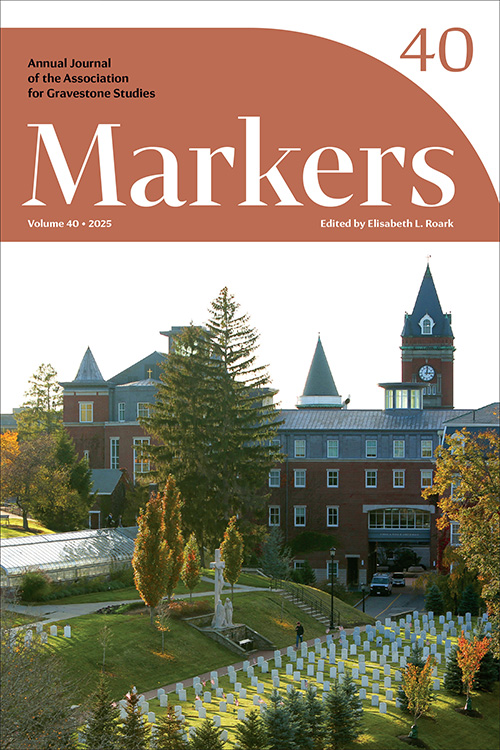 We are currently seeking article submissions for the 2027 issue of Markers, the scholarly journal of the Association for Gravestone Studies. The subject matter of Markers is defined as the analytical study of gravemarkers, monuments, tombs, and cemeteries of all types and encompassing all historical periods and geographical regions. Markers is of interest to scholars in anthropology, historical archaeology, art and architectural history, ethnic studies, material culture studies, American studies, folklore and popular culture studies, linguistics, literature, rhetoric, local and regional history, cultural geography, sociology, and related fields. Articles submitted for publication in Markers should be scholarly, analytical, and interpretive, not merely descriptive or entertaining, and should be written in a style appropriate to both a wide academic audience and an audience of interested non-academics.
Authors are encouraged to consult the “Notes for Contributors to Markers and Markers Style Guide.” Submissions for 2027 should be sent to Editor Elisabeth Roark, Professor of Art History and Museum Studies at Chatham University, at roark@chatham.edu, before 1 January 2026.
The Burlington Magazine, September 2025
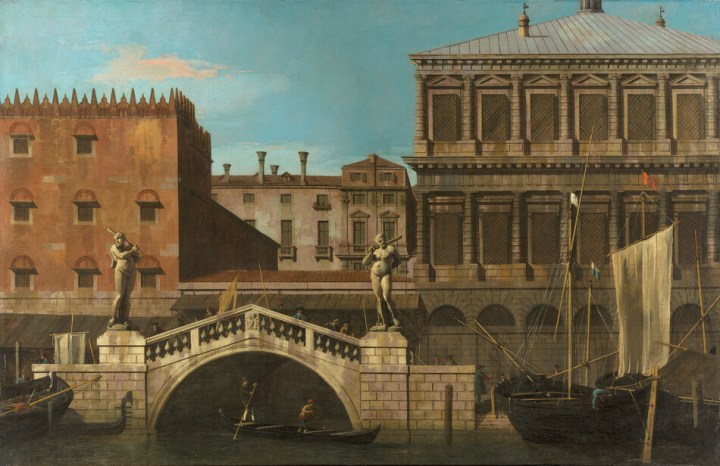
Canaletto, Cappriccio: The Ponte della Pescaria and Buildings in the Quay, Showing Zecca on the Right, 1744(?), oil on canvas, 84 × 130 cm
(Royal Collection Trust, © His Majesty King Charles III 2025)
◊ ◊ ◊ ◊ ◊
The long 18th century in the September issue of The Burlington:
The Burlington Magazine 167 (September 2025) | Italian Art
a r t i c l e s
• Gregorio Astengo and Philip Steadman, “Canaletto’s Use of Drawings of Venetian Buildings by Antonio Visentini,” pp. 896–905.
The use by Canaletto of measured drawings by Antonio Visentini and his assistants is fully considered here for the first time. He ingeniously utilised them at different points in his career to provide images of buildings in both his ‘vedute’ and ‘capricci’. This creative borrowing was possible because both painters formed part of the same successful network of artists, scientists, and patrons.
r e v i e w s
 • Philippe Bordes, Review of the exhibition Duplessis (1725–1802): The Art of Painting Life / L’art de peindre la vie (Inguimbertine, Carpentras, 2025), pp. 924–27.
• Colin Bailey, Review of Katie Scott and Hannah Williams, Artists’ Things: Rediscovering Lost Property from Eighteenth-Century France (Getty Research Institute, 2024), pp. 946–48.
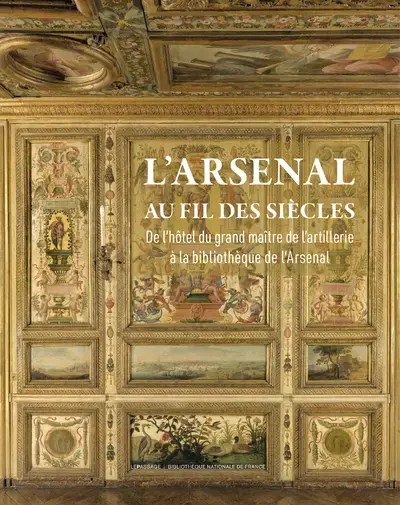
• Karl-Georg Pfändtner, Review of Olivier Bosc and Sophie Guérinot, eds., L’Arsenal au fil des siècles: De l’hôtel du grand maître de l’Artillerie à la bibliothèque de l’Arsenal (Le Passage / BNF, 2024), pp. 951–52.
• Timothy Revell, Review of Lieke van Deinsen, Bert Schepers, Marjan Sterckx, Hans Vlieghe, and Bert Watteeuw, eds., Campaspe Talks Back: Women Who Made a Difference in Early Modern Art (Brepols: 2024), pp. 952–53.
• Jonathan Yarker, Review of Katherine Jean McHale, Ingenious Italians: Immigrant Artists in Eighteenth-Century Britain (Brepols, 2024, p. 953.
• Conal McCarthy, Review of Deidre Brown, Ngarino Ellis, and Jonathan Mane-Wheoki, Toi Te Mana: An Indigenous History of Māori Art (University of Chicago Press, 2025), pp. 953–54.
Call for Articles | Queerness in 18th- and 19th-C. European Art
From ArtHist.net and Arts:
Queerness in 18th- and 19th-Century European Art and Visual Culture, 2nd Edition
Special issue of the journal Arts, guest edited by Andrew Shelton
Abstracts due by 15 January 2025; final manuscripts will be due by 1 July 2026
Essays regarding a wide variety of topics that subvert or disrupt heteronormative interpretations of the art and visual culture of this period are welcome, including the works of art produced by or under the auspices of personages who can plausibly be identified as attracted to members of the same sex; works or creative situations that can be construed as expressing or eliciting same-sex sexual desire or attraction; works or creative situations in which the heteronormative polarity of the processes of identification and desire can be perceived as having been collapsed or scrambled; works or creative situations that involve gender-bending or gender fluidity; works or creative situations that either deepen or complicate our understanding of sexuality and/or sexual identity during the 18th and 19th centuries; and works that eroticize individuals or situations that are normally regarded as lying outside the realm of the erotic.
Arts is an international, peer-reviewed, open access journal promoting significant research on all aspects of the visual and performing arts, published bimonthly online by MDPI.
Submission Planning
• Abstracts due by 15 January 2025, submission link for abstracts.
• Final manuscripts due by 1 July 2026, submission link for full articles.
Submission Criteria
• Abstract and a short biography should be sent to Andrew Shelton (shelton.85@osu.edu) and Sylvia Hao (sylvia.hao@mdpi.com).
• Final articles, in English only, should be at least 4000 words long; a 150-word abstract and 5 keywords should also be submitted.
• Authors can include image files (tables, maps, graphs, photographs …) in ..jpg; they should ensure that images are free of rights (or that rights have been obtained).
• Each article will be peer-reviewed by at least two anonymous referees.
For inquiries, please contact: Sylvia Hao (sylvia.hao@mdpi.com) and Editorial Office of Arts (arts@mdpi.com).
Print Quarterly, September 2025
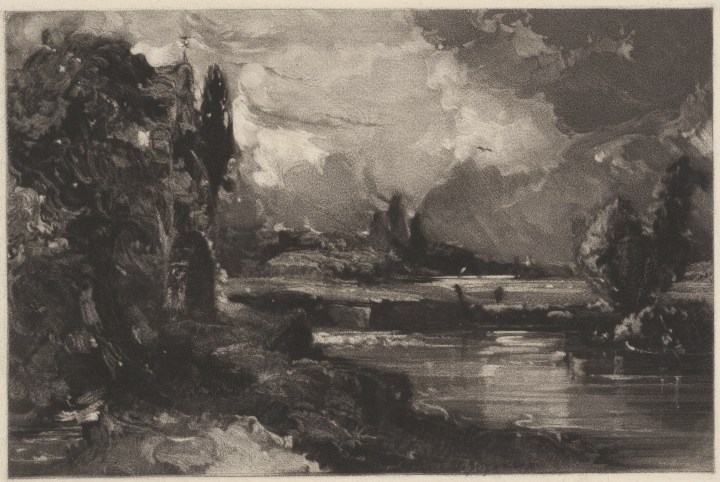
David Lucas, after John Constable, A Mill, 1829, mezzotint, 182 × 250 mm
(Cambridge, Fitzwilliam Museum, inv. P.145-1954)
◊ ◊ ◊ ◊ ◊
The long eighteenth century in the latest issue of Print Quarterly:
Print Quarterly 42.3 (September 2025)
a r t i c l e s
• Elenor Ling and Harry Metcalf, “John Constable’s Working Relationship with David Lucas on the English Landscape Series,” pp. 272–85. This article examines the collaborative partnership between John Constable (1776–1837) and his engraver David Lucas (1802–81) using the mezzotint print series English Landscape as a case study, based particularly on the technical examination of various impressions and plates.
• Niklas Leverenz, “Lithographs from Shanghai of the East Turkestan Engravings, 1890,” pp. 301–06. This short article examines the popularity of the East Turkestan engravings depicting the 1755–60 Qianlong Emperor’s conquest. Leverenz specifically discusses a set of 34 photolithographs printed in 1890 by the photographer Herman Salzwedel (active c. 1877–1904) in Shanghai.
n o t e s a n d r e v i e w s
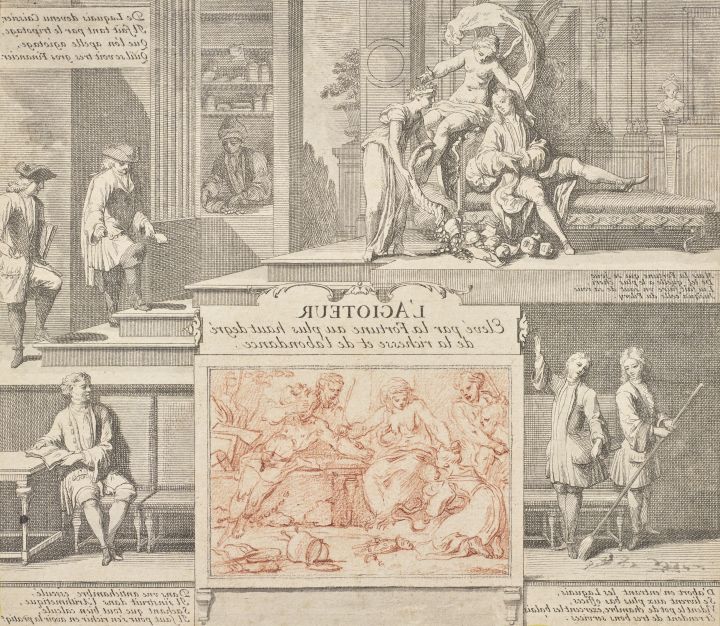
Claude Gillot, The Speculator Raised by Fortune to the Highest Degree of Wealth and Abundance, 1710–11, counterproof of engraving, with additions in red chalk, 255 × 220 mm (Paris, Private collection).
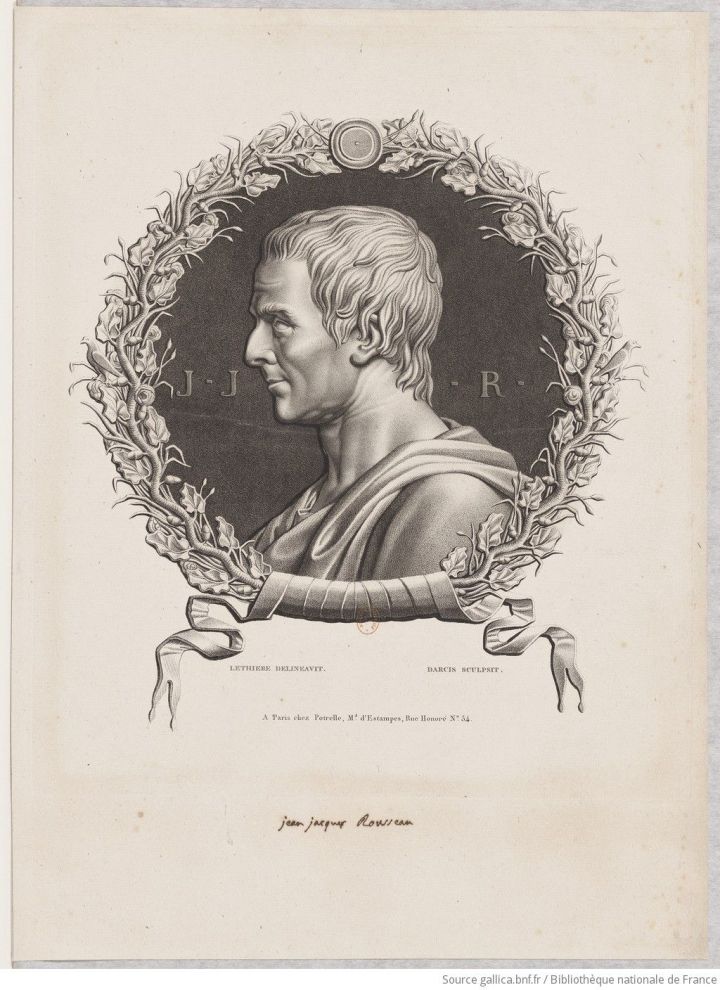
J.-Louis Darcis, after Guillaume Lethière, Portrait of Jean Jacques Rousseau, 1795, engraving, platemark 355 × 305 mm, page 440 × 320 mm (Paris, Bibliothèque Nationale de France).
• Dagmar Korbacher, Review of Andaleeb Badiee Banta, Alexa Griest and Theresa Kutasz Christiensen, eds., Making Her Mark: A History of Women Artists in Europe, 1400–1800 (Goose Lane Editions, 2023), pp. 307–10.
• Daniel Godfrey, Review of Gwendoline de Mûelenaere, Early Modern Thesis Prints in the Southern Netherlands: An Iconological Analysis of the Relationship between Art, Science, and Power (Université Catholique de Louvain, 2022), pp. 310–12.
• Meredith M. Hale, Review of Julie Farguson, Visualising Protestant Monarchy: Ceremony, Art and Politics after the Glorious Revolution, 1689–1714 (The Boydell Press, 2021), pp. 313–15.
• Rena M. Hoisington, Review of Jennifer Tonkovich, Claude Gillot: Satire in the Age of Reason (Paul Holberton, 2023), pp. 315–17.
• Michael Snodin, Review of Orsola Braides, Giovanni Maria Fara, and Alessia Giachery, eds., L’arte di tradurre l’arte: John Baptist Jackson incisore nella Venezia del Settecento (Leo S. Olschki, 2024), pp. 317–19.
• Benito Navarrete Prieto, Review of Ana Hernández Pugh and José Manuel Matilla, Del lapicero al buril. El dibujo para grabar en tiempos de Goya (Museo del Prado, 2023), pp. 320–24.
• Giorgio Marini, Review of Ilaria Miarelli Mariani, Tiziano Casola, Valentina Fraticelli, Vanda Lisanti, and Laura Palombaro, eds., La storia dell’arte illustrata e la stampa di traduzione tra il XVIII e il XIV secolo (Campisano Editore, 2022), pp. 324–28.
• Julie Mellby, Review of Roberta J. M. Olson, Audubon as Artist: A New Look at The Birds of America (Reaktion Books, 2024), pp. 328–29.
• Thea Goldring, Review of Esther Bell and Olivier Meslay, eds., Guillaume Lethière (Clark Art Institute, 2024), pp. 347–52.
Journal of the History of Collections, July 2025
The long eighteenth century in the latest issue:
Journal of the History of Collections 37.2 (July 2025)
a r t i c l e s
• Christian Huemer and Tom Stammers, “Perspectives on the Study of the Art Market,” pp. 215–20.
As interest in art-market studies continues to grow, the editorial team of the Journal of the History of Collections decided to interview Christian Huemer, director of the Belvedere Research Center in Vienna, and editor of the Brill series Studies in the History of Collecting & Art Markets; and Tom Stammers, who is leading the new MA in Art and Business at the Courtauld Institute of Art in London, to find out more about the subject and how it does and does not overlap with the study of collecting.
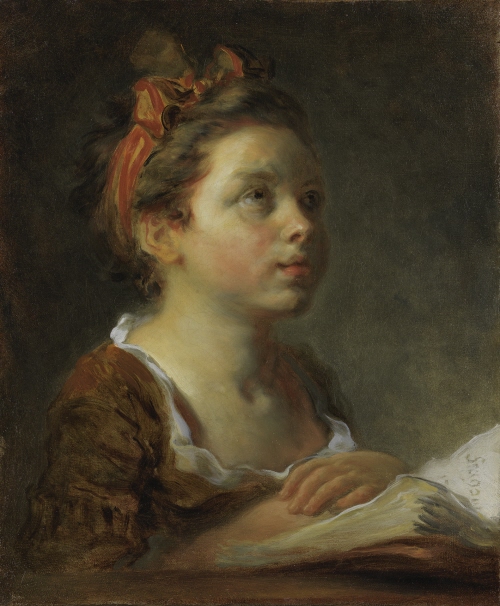
Jean-Honoré Fragonard, Girl Reading a Book, ca. 1770s, oil on canvas (London: The Wallace Collection).
• Yuriko Jackall, “French Art / English Taste: Richard Wallace’s Fragonards,” pp. 269–82.
Although an active collector of a broad range of objects, Sir Richard Wallace is more commonly known for his taste in nineteenth-century pictures, arms and armour, Renaissance maiolica and Kunstkammer objects than for his interest in eighteenth-century French painting. Nonetheless, he did add two significant works by Jean-Honoré Fragonard, Girl Reading a Book and A Boy as Pierrot, to the large and distinguished collection of rococo art that he had inherited from his supposed father, the 4th Marquess of Hertford. This paper focuses on these two acquisitions, and suggests that their purchase represents a calculated move by Wallace to enhance the existing holdings of his collection. By adding these two paintings, he sought not only to augment the art-historical value of the collection that it was now his responsibility to shepherd, but also to improve its appeal within the context of late nineteenth-century British taste.
• Ollie Croker, “The Architect as Agent: Charles Heathcote Tatham at Woburn Abbey and Castle Howard,” pp. 359–72.
The acquisition of Classical antiquities by the British nobility in the late eighteenth and early nineteenth centuries occurred within a complex social network. While the activities of prominent figures within this network have been well documented, those of lesser-known agents remain overlooked. This discussion focuses on Charles Heathcote Tatham (1772–1842), an architect involved in acquiring vases and sculptures for display at Woburn Abbey and Castle Howard. Acquisitions for both houses coincide with Tatham’s work designing galleries for these two estates. This suggests a means of collecting that has been less often studied: an architect is commissioned to acquire objects specifically for the interior decoration of his own architectural creations. Tatham’s dual role as architect and agent raises questions about the nature of these acquisitions, and the cultural associations his clients aimed to establish.
r e v i e w s
 • Wu Yunong, Review of Becky MacGuire, Four Centuries of Blue and White: The Frelinghuysen Collection of Chinese and Japanese Export Porcelain (Ad Ilissvm, 2023), pp. 391–92.
• Adriana Turpin, Review of Ulrike Müller, Private Collectors in Brussels, Antwerp, and Ghent, ca.1780–1914: Between Public Relevance and Personal Pleasure (Brepols, 2024), pp. 392–94.
• Marjorie Schwarzer, Review of Jonathan Conlin, The Met: A History of a Museum and its People (Columbia University Press, 2024), pp. 394–96.
• Jonathan Conlin, Review of Erica Ciallela and Philip Palmer, eds., Belle da Costa Greene: A Librarian’s Legacy (DelMonico Books, 2024) and Vanessa Sigalas and Jennifer Tonkovich, eds., Morgan―The Collector: Essays in Honor of Linda Roth’s 40th Anniversary at the Wadsworth Atheneum Museum of Art (Arnoldsche Verlagsanstalt, 2023), pp. 396–97.










 Enfilade
leave a comment