Journal18, Spring 2026 — Revolutions
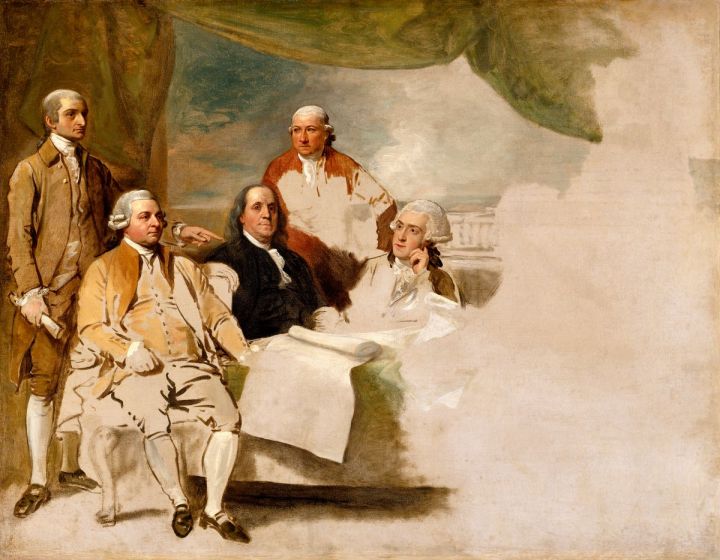
Benjamin West, American Commissioners of the Preliminary Peace Negotiations with Great Britain, 1783–1820, oil on canvas, 72 × 92 cm (Winterthur Museum, Garden & Library).
◊ ◊ ◊ ◊ ◊
The latest issue from J18:
Journal18, Issue #21 (Spring 2026) — Revolutions
Issue edited by Wendy Bellion and Kristel Smentek
Published in alignment with the 250th anniversary of the United States Declaration of Independence, the three articles and four shorter re-presentations explore the material and visual cultures of this and subsequent eighteenth-century Atlantic revolutions: the French Revolution (1789–99), the Haitian Revolution (1791–1804), the United Irishmen’s Rebellion (1798), and the Latin American Wars of Independence (1808–26).
a r t i c l e s
Emily C. Casey — Revolution’s Ends: American War, Patriotism, and Culture in a Dilating Eighteenth Century
Matthew Gin — The Revolution’s Sanctuary: Designing the La Réole Temple of Reason, Year II
Monica Anke Hahn — Three-Fingered Jack: Staging Resistance in the Toy Theater
r e – p r e s e n t a t i o n s
Zara Anishanslin — Finding William Lee: A Black Founder in Early American Portraiture
Daniella Berman — Contingent Truths of the French Revolution: Representing the Abolition of Slavery of 1794
Firelei Báez in conversation with J. Cabelle Ahn — ‘My interventions project back what has been erased’
Thomas Crow — Jacques-Louis David at the Louvre with Keith Michael Baker, Jean-Paul Marat: Prophet of Terror: A Review
◊ ◊ ◊ ◊ ◊
Reflections on a Decade of Journal18
Virtual Event in the HECAA Great Conversations Series
7 May 2026, 9.30am PDT / 12.30pm EDT / 5.30pm BST
Join the Journal18 editorial team for a reflection on the creation and aims of J18 and how it has developed over time, as well as an open-ended discussion about future possibilities. We are excited to come together for conversation about a decade of J18 and to look ahead. Registration is available here.
ASECS 2026 Prize Winners
Exemplary work in art history as recognized by this year’s recently announced ASECS awards:
Gottschalk Prize
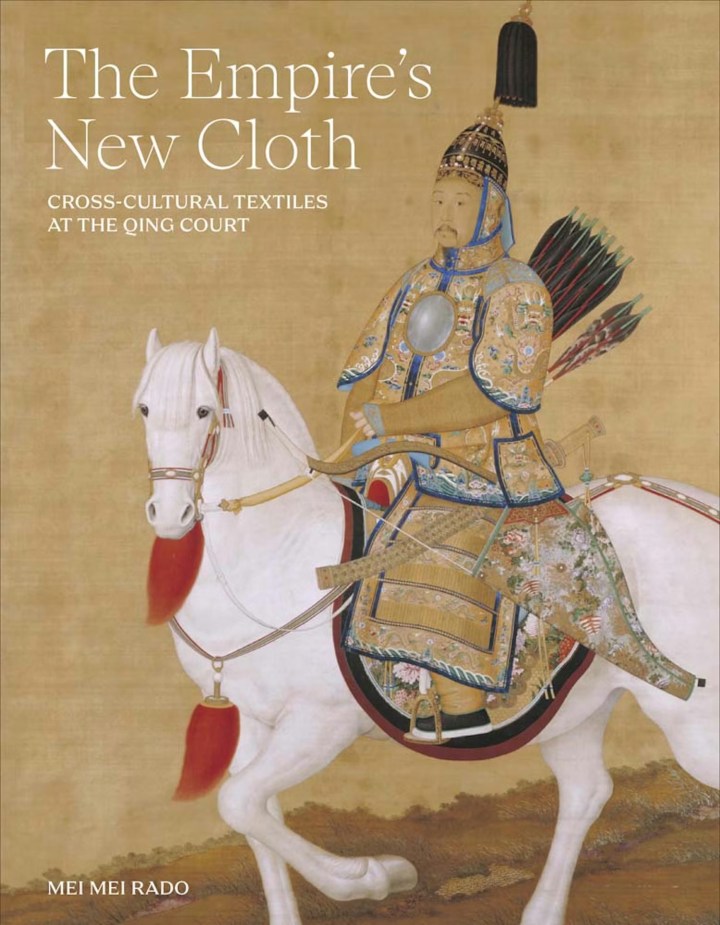
Mei Mei Rado, The Empire’s New Cloth: Cross-Cultural Textiles at the Qing Court (Yale UP, 2025).
Dan Edelstein, The Revolution to Come: A History of an Idea from Thucydides to Lenin (Princeton UP, 2025).
For an outstanding historical or critical study
Chair, Amelia Rauser, with Logan Connors and Rachel Carnel
 This year the prize is split between two very different, yet equally impressive and important books.
Mei-Mei Rado’s The Empire’s New Cloth dazzles with its deep research into textiles and their cross-cultural uses in both Asia and Europe, demonstrating mastery of different languages, cultures, and archives in both China and France, as well as the technical aspects of silk manufacture and tapestry weaving. She rewrites the received understanding of Orientalism, arguing instead that chinoiserie is a shared, fluid, global style “floating back and forth between China and Europe, evoking in each place something foreign and exotic while also adapting to local cultural desires and expectations.” Rado synthesizes impressive archival research with close readings of visual and literary sources, situating material practices within broader debates about race, labor, and sovereignty. The book’s argument reframes familiar narratives of empire by foregrounding material practices that linked plantation economies, powerful empires, artisanal production, and elite display. The result is a study that speaks across disciplines while remaining focused on such a diverse and unique corpus.
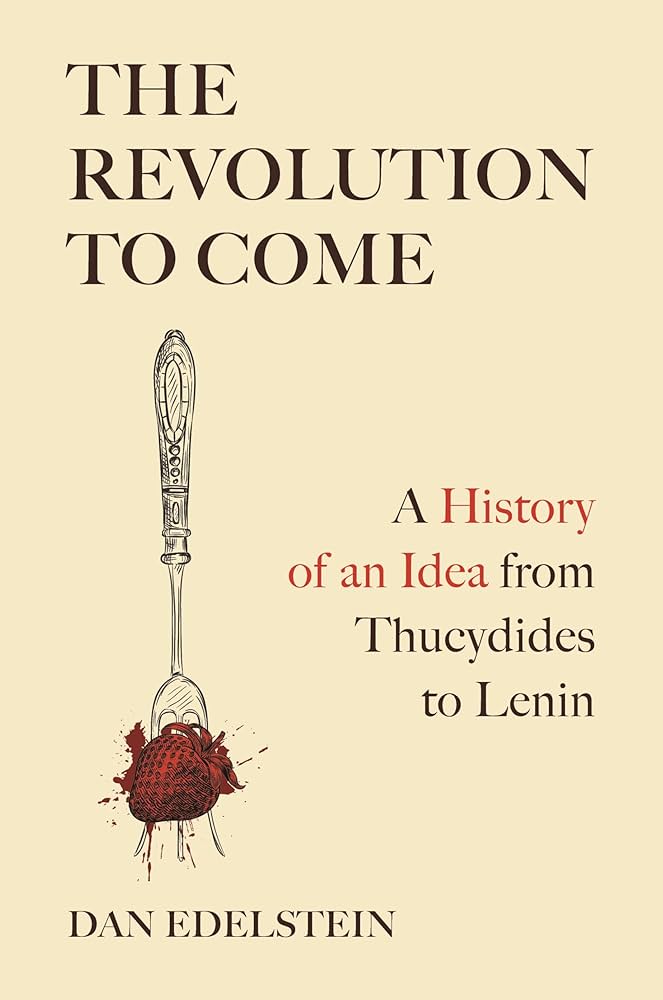 Dan Edelstein’s The Revolution to Come is a tour de force across time and space. Its central insight is that revolutions are conceptual, not sociological, events—thus, it is also a potent defense of the history of ideas. By mapping the circulation of ideas about sovereignty, rights, and regeneration, he shows how Enlightenment thinkers created a horizon of anticipation that reoriented political time. The book situates canonical figures alongside lesser-known writers to reveal the broader discursive field in which revolutionary futures were articulated. The book is a timely reminder of the limits of political moderation as well as a caution against jumping at every revolutionary call. It is breathtaking in its temporal and geographic scope while all the while grounding the fundamental traits of modern revolution in the eighteenth century. Most important are his powerful concluding observations about how a regime shifts seamlessly from democracy to dictatorship. He ends the book with a prescient warning: “Our biggest fear should be that no one even notices the revolution to come.”
Together, these two books stand up for the importance of ideas and proclaim the eighteenth century’s enduring centrality in our understanding of modernity, even as they remind us of the globally interconnected nature of our period. They also represent research excellence of two very different types: archival understanding and close study of material objects on the one hand; and synthetic mastery of a vast corpus of texts and ideas on the other. Between them, they truly represent the best of our field.
◊ ◊ ◊ ◊ ◊
James Clifford Prize
Oliver Wunsch, “The Aesthetic Redemption of the Black Body in Eighteenth-Century France,” Art History 48.1 (February 2025): 14–44.
For an outstanding article
Chair, Masano Yamashito, with Douglas Fordham and Terry Robinson
In his essay, Oliver Wunsch adeptly demonstrates “how the differing goals of artists and philosophers yielded divergent forms of engagement with Blackness.” Wunsch argues that the aesthetic aims of painters, focused on producing ‘visual pleasure’, introduce a disjuncture between a social discourse that would at times marginalize or demean Black subjects and the formal qualities involved in capturing Blackness. Wunsch calls this phenomenon the ‘aesthetic redemption’ of the Black body. Wunsch wonderfully captures of the uniqueness of painting as a discursive field. The article, which complicates “the dichotomy of artistic humanisation and stereotypical objectification” in curatorial assessments of eighteenth-century portraits of Black subjects, is valuable (essential?) reading for anyone interested in visual art, aesthetic theory, natural philosophy, historiography, and exhibition curation.
◊ ◊ ◊ ◊ ◊
Annibel Jenkins Prize
Janis Tomlinson, Goya: A Portrait of the Artist (Princeton UP, 2020).
Awarded every other year for an outstanding book-length biography
Chair, David Alff, with Rebecca Haidt and Robert Paulett
This rigorous account of a landmark visual artist impressed the committee with its ability to immerse readers in the politics, patronage, and courtly intrigue of eighteenth- and nineteenth-century Spain. We especially appreciated Tomlinson’s skill in recovering Goya as a professional painter rather than as a Byronic hero or clandestine revolutionary, as he is sometimes sketched. The resulting portrait raises complex questions of career ambition, artistic expression, and moral complicity that remain evergreen today.
◊ ◊ ◊ ◊ ◊
Women’s Caucus, Catharine Macaulay Prize
Faith Barringer, “The Delineated Breast: Race and the Maternal Body in French Eighteenth-Century Portraiture.”
Graduate Student Paper Prize
Committee: Jacob Myers, Natasha Shoory, Fauve Vandenberghe
Faith Barringer examines the visualization of whiteness in French depictions of breastfeeding women to understand racial stereotypes surrounding motherhood in the eighteenth century. The essay argues that French art rarely depicted Blackness or French colonial realities directly, but instead reinforced racial categories by idealizing white motherhood and marginalizing Black women’s maternal roles. Through meticulous analysis of portraits of breastfeeding women, Barringer reveals how visual representations contributed to stereotypes about motherhood and racial identity, excluding Black women from the ideal of nurturing maternal care. The committee found the paper to be exceptionally well-written and compelling, with a particularly strong analysis of the construction of whiteness in French art and an innovative contribution to current debates about gender and colonialism.
Print Quarterly, March 2026
The long eighteenth century in the latest issue of Print Quarterly:
Print Quarterly 43.1 (March 2026)
a r t i c l e s
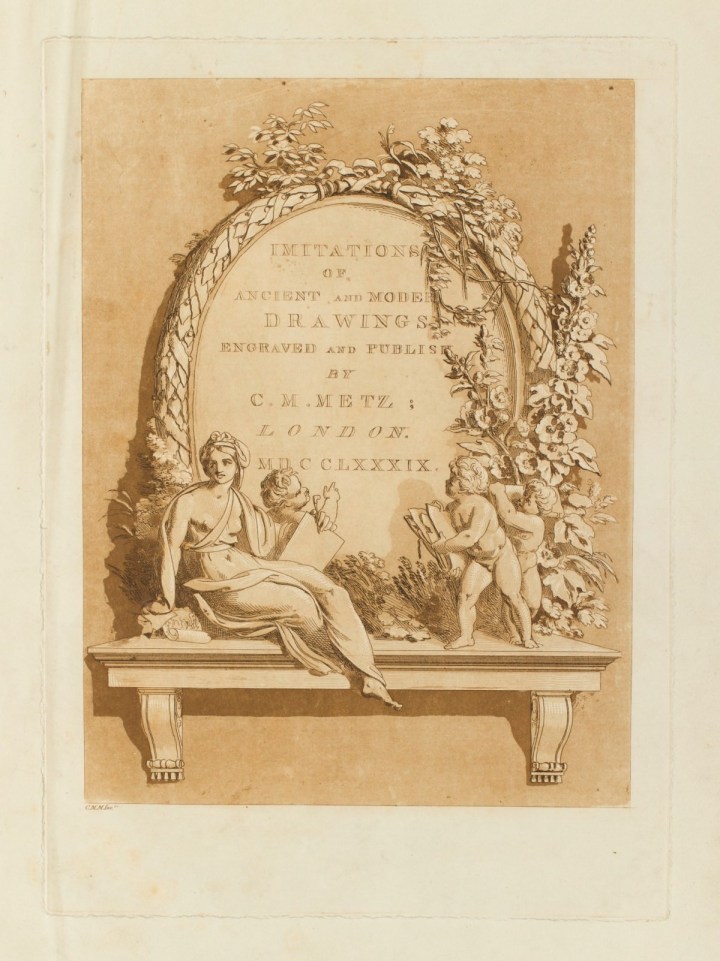
Conrad Martin Metz, Frontispiece, from Imitations of Ancient and Modern Drawings Engraved and Published by C. M. Metz, 1789, etching and aquatint printed in colour, 360 × 256 mm (London, British Museum).
• Elania Pieragostini, “Conrad Martin Metz and his Imitations of Ancient and Modern Drawings,” pp. 14–26. This article examines the origins, development, and targeted audience of Conrad Martin Metz’s (1749–1827) decade-long project to reproduce drawings held in British collections, aiming to show how art developed over time, starting from Cimabue. Its programmatic introduction addresses key issues such as the disegno–colore debate, the preference for preliminary sketches and the differences between originals and copies. The author summarizes the various collections accessed by Metz, the techniques used to replicate the effects of drawn media, and his business operations and clientele. The project is further discussed in relation to similar print projects of the time.
• Dominika Cora, “New Facts about Russia’s Imperial Portrait Series, 1745–77,” pp. 36–43. This shorter notice discusses the chronology and publication of Johann Stenglin’s (1710/15–76) mezzotints depicting Russian emperors, one of his earliest commissions. The two appendices show how the prints were once believed to be published in six ‘sets’, and how they are organized now in accordance with the new research. The new findings also allow for the correct attribution of the monogram ‘AST’ found on the portraits of Peter the Great, Anna Petrovna, and Catherine I.
n o t e s a n d r e v i e w s
• Armin Kunz, Review of Bryony Bartlett-Rawlings and Naomi Lebens, eds., Placing Prints: New Developments in the Study of Print, 1400–1800 (Brill, 2025), pp. 44–47. Includes an essay by Donato Esposito on Joshua Reynolds’s print collection.
• Andrew Robison, Review of Felix Reuße, Hans Hubert, and Viktoria Gont, eds., Giovanni Battista Piranesi: Vedute di Roma (Städtische Museen Freiburg and Michael Imhof, 2024), pp. 63–65.
• Ellis Tinios, Review of Andreas Marks, Hiroshige’s One Hundred Famous Views of Edo: The Definitive Collector’s Edition (Tuttle Publishing, 2024), pp. 65–67.
• Gervase Rosser, Review of Erin Giffin, Early Modern Replicas of the Holy House of Loreto: Translating Space (Routledge, 2025), pp. 83–86.
• Ellis Tinios, Review of John Fiorillo, Hokuei: Master of Osaka Kabuki Prints (Ludion, 2024), pp. 86–89.
o b i t u a r y
David Bindman (1940–2025), pp. 76–77.
9th Annual Ricciardi Prize from Master Drawings
From Master Drawings:
Ninth Annual Ricciardi Prize from Master Drawings
Submissions due by 15 November 2026
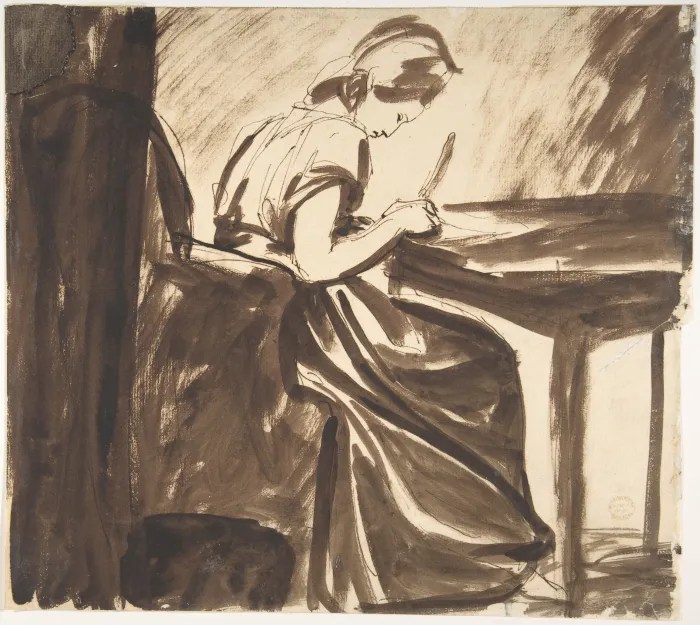
George Romney, Lady Seated at a Table (recto); pen and brown ink, brush and brown wash (NY: The Metropolitan Museum of Art, 11.66.3).
Master Drawings is now accepting submissions for the 9th Annual Ricciardi Prize of $5000. The award is given for the best new and unpublished article on a drawing topic (of any period) by a scholar under the age of 40. Candidates are also eligible for a $1000 runner-up prize and publication. Prize winners are eligible for reimbursement of costs associated with obtaining image publication permissions. They will be invited to present their research at a symposium held during Master Drawings Week in New York (January 2027). Information about essay requirements and how to apply can be found here. Information about past winners and finalists is available here.
The average length is between 2500 and 3750 words, with five to twenty illustrations. Submissions should be no longer than 7500 words and have no more than 75 footnotes. All submissions must be in article form, following the format of the journal. Please refer to our Submission Guidelines for additional information. We will not consider submissions of seminar papers, dissertation chapters, or other written material that has not been adapted into the format of a journal article. Written material that has been previously published, or is scheduled for future publication, will not be eligible. Articles may be submitted in any language. Please be sure to include a 100-word abstract outlining the scope of your article with your submission.
Call for Articles | A Passion for Porcelain
From the Call for Papers:
A Passion for Porcelain: Volume in Honour of Dame Rosalind Savill
The French Porcelain Society Journal, Volume 11
Proposals due by 1 April 2026; completed articles will be due by 1 October 2026
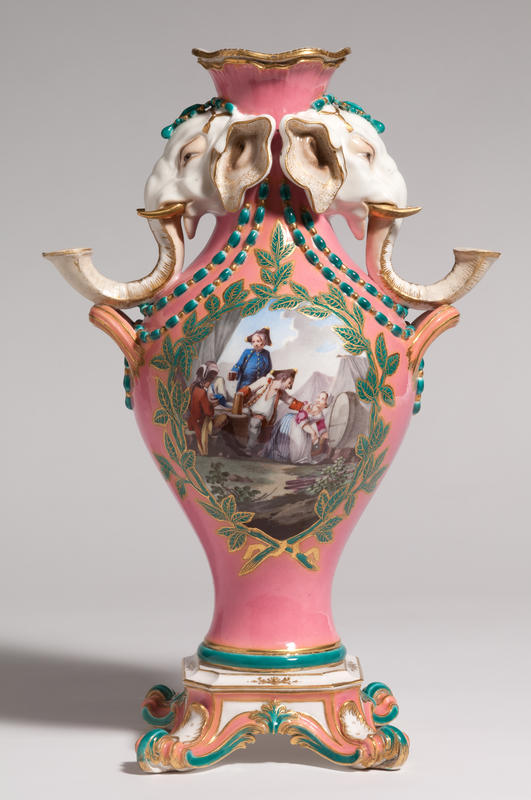
Vase à têtes d’éléphant, Sèvres Porcelain Manufactory, ca. 1760, purchased by Louis XV in December 1760 (Waddesdon Manor, no. 3013; photo by Mike Fear).
The French Porcelain Society Journal is the leading academic, peer-reviewed English-language publication on European ceramics and their histories, illustrated in full colour. After celebrating its 40th anniversary in 2024 with the publication of an issue focused on the work of twentieth-century scholars, collectors, and dealers who have contributed to advancing the study of European ceramics, the French Porcelain Society would like to honour the life and work of Dame Rosalind Savill (1951–2024), who served as President of the Society for 24 years, from 1999 until 2023. Dame Rosalind (‘Ros’) Savill was a leading expert in the production of the Vincennes/Sèvres factory during the eighteenth century and on Madame de Pompadour, one of the factory’s most prominent clients and advocates. Her internationally acclaimed research was published in The Wallace Collection Catalogue of Sèvres Porcelain (1988)—the institution that she directed from 1992 until 2011—and in the more recent Everyday Rococo: Madame de Pompadour and Sèvres Porcelain (2021), as well as in articles and contributions to other books, catalogues, academic journals, and specialist publications such as The Burlington Magazine. Ros’s indefatigable thirst for knowledge was illustrated by her interest in other topics beyond that of French eighteenth-century porcelain, from music, horticulture and birds, to furniture and arms and armour. Above all, Ros’s passion for ceramics was communicated in any conversation with her, be it in front of a museum display or around the dinner table. The next issue of The French Porcelain Society Journal wants to commemorate that passion for European ceramics with contributions that can range from object-focused case studies to articles with an academic or historiographic approach to the subject.
Topics for consideration may include but are not limited to the following:
• Insights into the production of porcelain at the Vincennes/Sèvres factory and stories relating to its personnel, agents, and collectors during the eighteenth and nineteenth centuries
• New research on specific objects or groups of objects within the remit of European ceramics, with a particular interest in French eighteenth-century faience and porcelain productions
• Contributions to the study of European ceramic factories, their histories, establishment, running and, if appropriate, disappearance
• Research on collectors of European ceramics
Submissions in the first instance should be a summary of no more than 400 words, with a brief description of the argument, a historiography, and a note of the research tools and sources used. Articles must be original; we do not accept modified versions of articles published elsewhere electronically or in print. Please include a brief biography. Articles will be peer reviewed by the editorial board and the FPS Committee of academic and museum specialists. Submissions should be between 3,000 and 6,000 words in length excluding endnotes and a house style sheet will be provided. Up to 15 high-resolution images per article will be accepted. Authors are responsible for obtaining copyright clearance. Please send abstracts as an email attachment to the FPS Journal Editorial Board (fpsjournal@gmail.com) by 1 April 2026. If your abstract is accepted, articles and images will be due by 1 October 2026. Publication is provisional on satisfactory peer review.
Journal18, Fall 2025 — Clean
The latest issue of J18:
Journal18, Issue #20 (Fall 2025) — Clean
Issue edited by Maarten Delbeke, Noémie Etienne, and Nikos Magouliotis
 Cleaning is never a neutral act. In the eighteenth century, acts of cleaning became a way to decide what counted as disorder, to separate asserted purity from designated pollution, and to display authority over matter, space, and people. From the forecourt of Paris’s Notre-Dame to the Ganges river in Varanasi to Scotland’s filthy privies, practices of cleaning have shaped political order. Racial issues, colonization, and the management of public space revolved around the idea and implementation of cleaning, which could also involve the deliberate relocation or erasure of human beings.
a r t i c l e s
Economies of Waste: Revolutionary Administration and the Afterlives of the Kings of Notre-Dame — Demetra Vogiatzaki
‘Beneath the Waters of a Universal Ocean’: Containing, Contaminating, and Cleaning the Ganges River in Varanasi — Ushma Thakrar
Piss, Poison, and other Paths between Scotland and England in Caricature since 1745 — Laura Golobish
c o n v e r s a t i o n p i e c e
The Grammar of Cleaning: A Conversation — Maarten Delbeke, Noémie Etienne, and Nikos Magouliotis
All articles are available for free here, along with recent notes & queries:
r e c e n t n o t e s a n d q u e r i e s
Marie Antoinette Style: An Exhibition Catalogue Review — Madeleine Luckel
Room for the Lost Paradise: A Symposium — Jason M. Kelly
Reflections on Mai, Joshua Reynolds, and Eighteenth-Century Art — A Roundtable
Colonial Crossings: A Review — Juan Manuel Ramírez Velázquez
Print Quarterly, December 2025
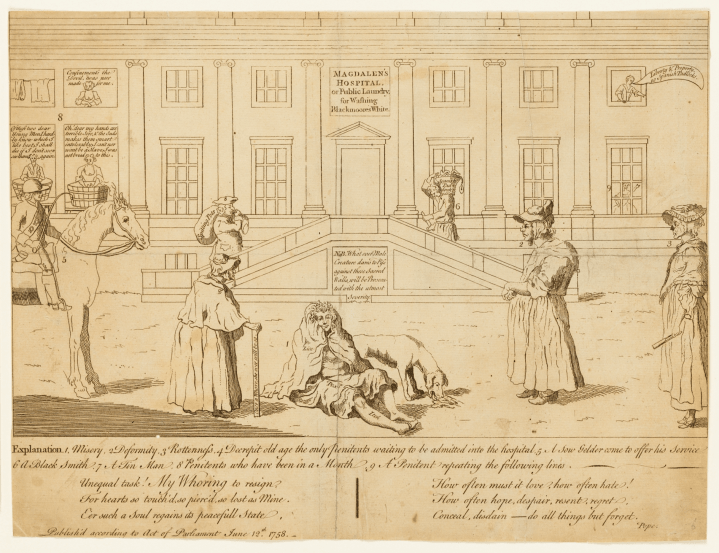
Anonymous artist, Magdalen’s Hospital, or Public Laundry for Washing Blackmoores White, 1758, etching, trimmed within the platemark, 232 × 307 mm (Oxford, Ashmolean Museum).
◊ ◊ ◊ ◊ ◊
The long eighteenth century in the latest issue of Print Quarterly:
Print Quarterly 42.4 (December 2025)
a r t i c l e s
• Xanthe Brooke, “Spaignolet’s Drawing Book: An Album with Ribera Prints at Knowsley Hall,” pp. 379–89. This article focuses on an unpublished album containing 28 prints mainly by or after Jusepe de Ribera (1591–1652). Brooke seeks to identify the sources and publishers of each impression, explores how the Earl of Derby used the album, and traces the growing taste for Ribera’s work among English collectors in the late seventeenth and the first decades of the eighteenth century.
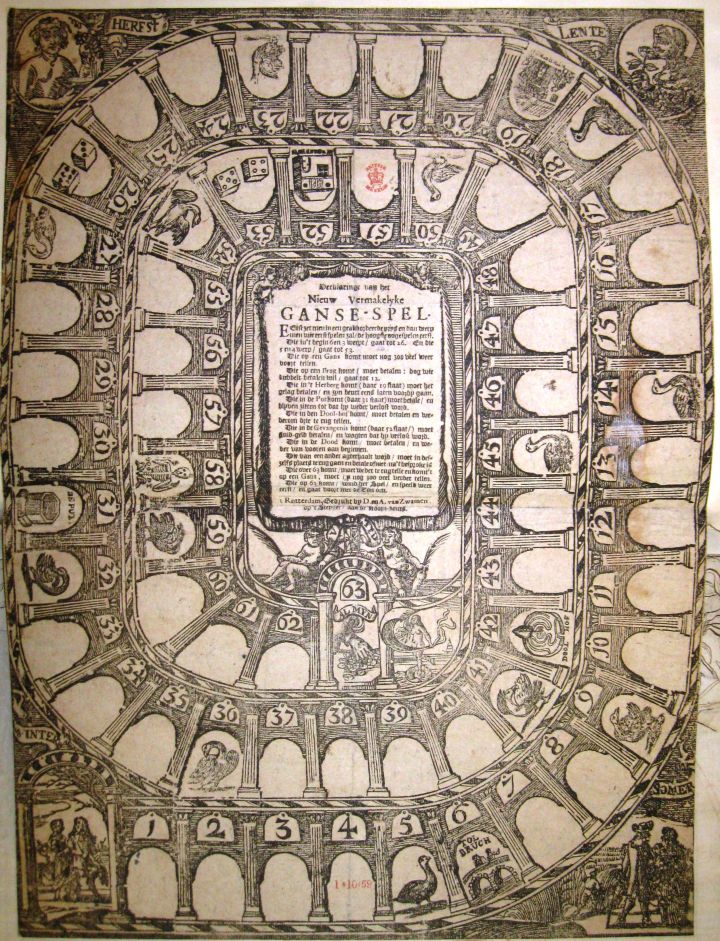
Anonymous artist, The New and Entertaining Game of the Goose, ca. 1759–87, woodcut, 470 × 360 mm (London: British Library, Creed Collection volume 8).
• Emma Boyd, “The Advent of the Magdalen Hospital: A Rare Satirical Print,” pp. 390–401. This article examines an anonymous etching in the Ashmolean Museum depicting the Magdalen Hospital, a charity for ‘penitent prostitutes’. The author discusses the print’s satirical commentary in relation to the charity’s controversial formation and the debates surrounding it. She also examines the print’s authorship within the context of other satirical prints and depictions of London street figures.
• Susan Sloman, “Gainsborough’s Cottage Belonging to Philip Thicknesse near Landguard Fort,” pp. 426–31. This short article contextualises an early etching by Thomas Gainsborough (1727–1788) from the 1750s, which the author proposes may have served as a subscription ticket for the engraving Landguard Fort, published in August 1754 by Thomas Major (1719–1799). The author also suggests that a painting by Gainsborough long assumed lost never existed.
• Felicity Myrone and Adrian Seville, “Two Unreported Games of the Goose in the Creed Collection in the British Library,” pp. 432–36. This short article describes two unknown examples of the Game of the Goose, one in printed form and the other in manuscript form. The provenance from the collection of London printseller Giles Creed (1798–1858), who specialized in ‘the history of ancient and modern inns, taverns, and coffee-houses’, is briefly traced.
n o t e s a n d r e v i e w s
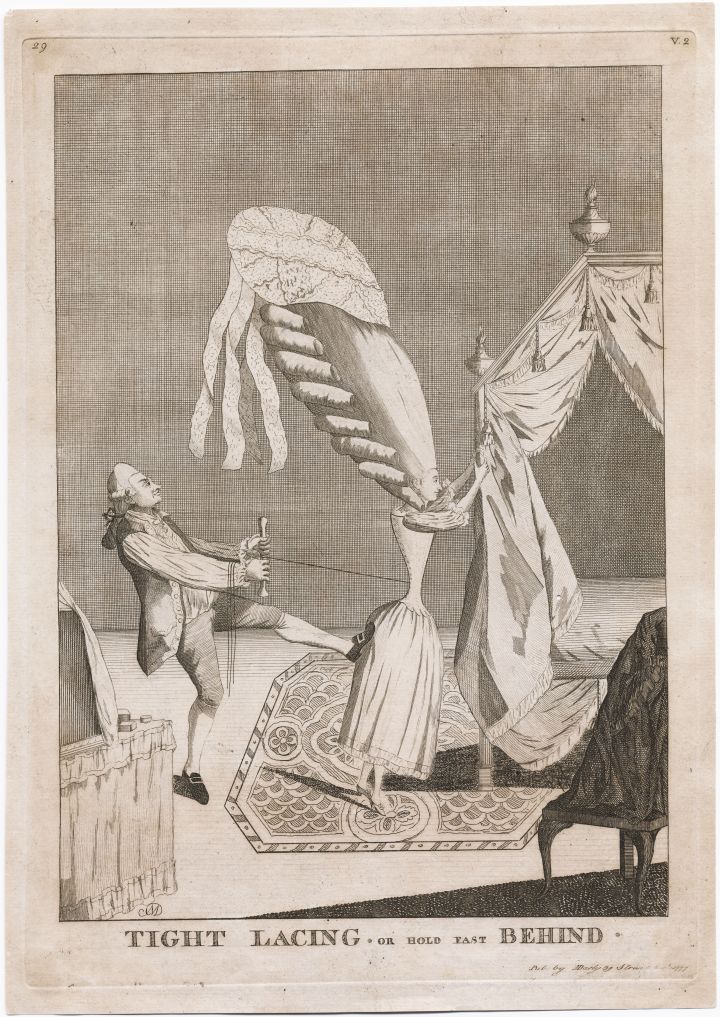
Anonymous artist, published by Matthew and Mary Darly, Tight Lacing, or, Hold Fast Behind, 1 March 1777, etching and engraving, 351 × 247 mm (Farmington, CT: Lewis Walpole Library, Yale University).
• Andaleeb Badiee Banta, Review of Cristina Martinez and Cynthia Roman, Female Printmakers, Printsellers, and Print Publishers in the Eighteenth Century: The Imprint of Women, c. 1700–1830 (Cambridge University Press, 2024), pp. 445–47.
• Jean Michel Massing, Review of Anna Lafont, L’art et la race: L’Africain (tout) contre l’œil des Lumières (Les presses du réel, 2019), pp. 447–48.
• Einav Rabinovitch-Fox, Review of Elizabeth Gernerd, The Modern Venus: Dress, Underwear, and Accessories in the Late 18th-Century Atlantic World (Bloomsbury Visual Arts, 2024), pp. 448–49.
• Mathilde Semal, Review of Rolf Reichardt, Éventails symboliques de la Révolution. Sources iconographiques et relations intermédiales (Presses universitaires de Rennes, 2024), pp. 450–52.
• Robert Felfe, Review of Matthew Zucker and Pia Östlund, Capturing Nature: 150 Years of Nature Printing (Princeton Architectural Press, 2022), pp. 452–54.
• Sarah Thompson, Review of Timothy Clark, ed., Late Hokusai: Society, Thought, Technique, Legacy (British Museum, 2023), pp. 479–83.
H-France Salon 17.1 (2025): The Myth of French Taste
The following articles are all available free of charge . . .
H-France Salon 17.1 (2025) — The Myth of French Taste
Edited by Oliver Wunsch
The concept of goût français has been central to French national identity since at least the late seventeenth century, yet the centuries since have yielded no clear consensus on its meaning. Does ‘French taste’ signify the cosmopolitanism of a nation whose defining feature is its role as a cultural crossroads? Or does it name the very quality that shields France from foreign influence and the pressures of globalization?
The essays in this special issue of H-France Salon show how the idea of French taste has, for over three hundred years, mediated between these opposing visions of France’s place in the world. From the luxury trades of the ancien régime to postwar debates over abstraction, ‘French taste’ has been invoked as a unifying principle precisely when the conception of France itself was most in flux. Yet a closer look at its history reveals the limits of its power to reconcile the antipodes of cosmopolitan universalism and nationalistic chauvinism.
c o n t e n t s
• The Vexations of French Taste — Oliver Wunsch (Boston College)
• French Taste, Absolutism, and Economic Competition in the Eighteenth Century — Natacha Coquery (University of Lyon 2, LARHRA)
• From le Goût Universel to le Goût de Terroir: ‘French Taste’ in Modern Gastronomic Discourse — Benjamin Poole (Texas Tech University)
• Was (and Is) ‘French Fashion’ Just a Myth? — Sophie Kurkdjian (American University of Paris)
• Toying with Taste: Play and Aesthetic Education in Modern France — Shana Cooperstein (School of Humanities, IE University)
• Expressionist Abstraction and the Tradition Française — Linda Stratford (Asbury University)
• Globalizing French Luxury: The Comité Colbert and L’Art de Vivre, 1983–2025 — Grace Allen (The College Preparatory School in Oakland, California)
Call for Articles | Markers, Journal for Gravestone Studies
From the Association for Gravestone Studies:
Markers: Annual Journal of the Association for Gravestone Studies, 2027 Issue
Submissions due by 1 January 2026
 We are currently seeking article submissions for the 2027 issue of Markers, the scholarly journal of the Association for Gravestone Studies. The subject matter of Markers is defined as the analytical study of gravemarkers, monuments, tombs, and cemeteries of all types and encompassing all historical periods and geographical regions. Markers is of interest to scholars in anthropology, historical archaeology, art and architectural history, ethnic studies, material culture studies, American studies, folklore and popular culture studies, linguistics, literature, rhetoric, local and regional history, cultural geography, sociology, and related fields. Articles submitted for publication in Markers should be scholarly, analytical, and interpretive, not merely descriptive or entertaining, and should be written in a style appropriate to both a wide academic audience and an audience of interested non-academics.
Authors are encouraged to consult the “Notes for Contributors to Markers and Markers Style Guide.” Submissions for 2027 should be sent to Editor Elisabeth Roark, Professor of Art History and Museum Studies at Chatham University, at roark@chatham.edu, before 1 January 2026.
The Burlington Magazine, September 2025
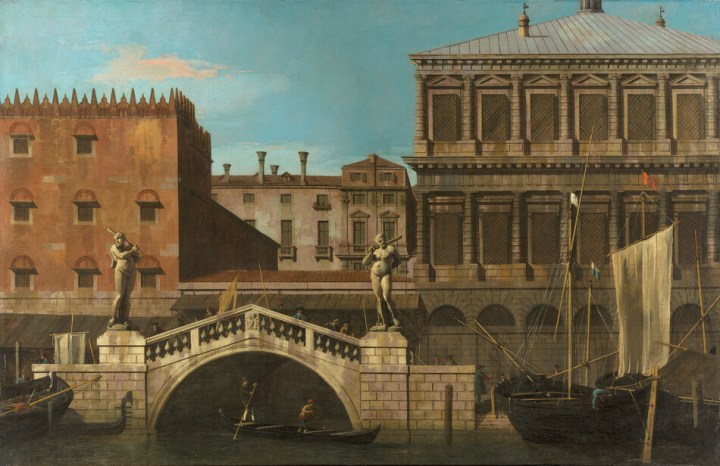
Canaletto, Cappriccio: The Ponte della Pescaria and Buildings in the Quay, Showing Zecca on the Right, 1744(?), oil on canvas, 84 × 130 cm
(Royal Collection Trust, © His Majesty King Charles III 2025)
◊ ◊ ◊ ◊ ◊
The long 18th century in the September issue of The Burlington:
The Burlington Magazine 167 (September 2025) | Italian Art
a r t i c l e s
• Gregorio Astengo and Philip Steadman, “Canaletto’s Use of Drawings of Venetian Buildings by Antonio Visentini,” pp. 896–905.
The use by Canaletto of measured drawings by Antonio Visentini and his assistants is fully considered here for the first time. He ingeniously utilised them at different points in his career to provide images of buildings in both his ‘vedute’ and ‘capricci’. This creative borrowing was possible because both painters formed part of the same successful network of artists, scientists, and patrons.
r e v i e w s
 • Philippe Bordes, Review of the exhibition Duplessis (1725–1802): The Art of Painting Life / L’art de peindre la vie (Inguimbertine, Carpentras, 2025), pp. 924–27.
• Colin Bailey, Review of Katie Scott and Hannah Williams, Artists’ Things: Rediscovering Lost Property from Eighteenth-Century France (Getty Research Institute, 2024), pp. 946–48.
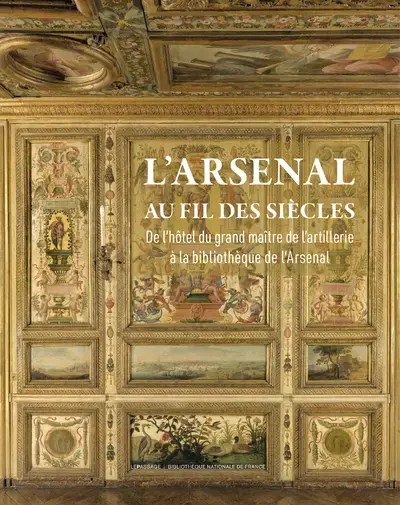
• Karl-Georg Pfändtner, Review of Olivier Bosc and Sophie Guérinot, eds., L’Arsenal au fil des siècles: De l’hôtel du grand maître de l’Artillerie à la bibliothèque de l’Arsenal (Le Passage / BNF, 2024), pp. 951–52.
• Timothy Revell, Review of Lieke van Deinsen, Bert Schepers, Marjan Sterckx, Hans Vlieghe, and Bert Watteeuw, eds., Campaspe Talks Back: Women Who Made a Difference in Early Modern Art (Brepols: 2024), pp. 952–53.
• Jonathan Yarker, Review of Katherine Jean McHale, Ingenious Italians: Immigrant Artists in Eighteenth-Century Britain (Brepols, 2024, p. 953.
• Conal McCarthy, Review of Deidre Brown, Ngarino Ellis, and Jonathan Mane-Wheoki, Toi Te Mana: An Indigenous History of Māori Art (University of Chicago Press, 2025), pp. 953–54.










 Enfilade
leave a comment