Zeitschrift für Kunstgeschichte 80.4 (2017), Penser le rococo
The current issue of Zeitschrift für Kunstgeschichte focuses on the theme ‘Reconsidering the Rococo’, the subject of a November 2015 conference at the University of Lausanne. Abstracts (in English) are available as a PDF file here.
Zeitschrift für Kunstgeschichte 80.4 (2017), Penser le rococo
Guest edited by Carl Magnusson and Marie-Pauline Martin
A R T I C L E S
• Carl Magnusson, “Le rococo, une construction historiographique: introduction”
• Marie-Pauline Martin, “‹Rococo›: du jargon à la catégorie de style”
• Catherine Thomas-Ripault, “Evasion temporelle et fantaisie créatrice: usage des peintures du xviiie siècle dans les fictions romantiques”
• Etienne Tornier , “‹This new-born word is rococo›: Généalogie et fortune du rococo aux États-Unis”
• Jean-François Bédard, “La vitalité du décor : Fiske Kimball, du rococo au Colonial Revival”
• Carl Magnusson, “Le rococo est-il décoratif ?”
• David Pullins, “‹Quelques misérables places à remplir›: Locating Shaped Painting in Eighteenth-Century France
• Bérangère Poulain, “Rococo et fugacité du regard: émergence et modifications de la notion de ‹papillotage›”
R E V I E W S
• Paul Williamson, Review of Laurence Terrier Aliferis, L’imitation de l’Antiquité dans l’art médiéval, 1180–1230 (Répertoire iconographique de la littérature du Moyen Âge, Études du RILMA, vol. 7, 2016).
• Christoph Martin Vogtherr, Review of Jérôme Delaplanche, Un tableau n’est pas qu’une image: La reconnaissance de la matière de la peinture en France au XVIIIe siècle (2016).
• Martin Dönike, Review of Johann Joachim Winckelmann, Monumenti antichi inediti spiegati ed illustrati, Roma 1767, edited by Adolf H. Borbein and Max Kunze (2011) | Johann Joachim Winckelmann, Monumenti antichi inediti spiegati ed illustrati, Roma 1767, edited by Adolf H. Borbein, Max Kunze, and Axel Rügler (2015).
• Anna Degler, Review of Guillaume Cassegrain, La coulure: Histoire(s) de la peinture en mouvement, XIe–XXIe siècles (2015).
The Burlington Magazine, January 2018
The eighteenth century in The Burlington, which includes, as noted last week, mention of HECAA and J18 in the editorial in connection with the new scholarship:
The Burlington Magazine 160 (January 2018)
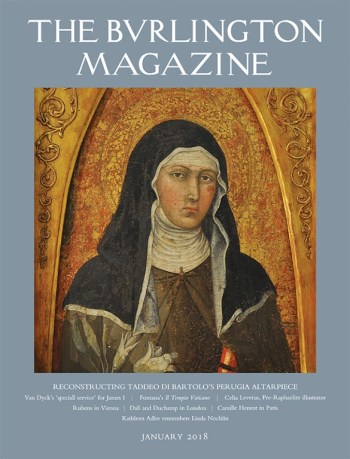 E D I T O R I A L
“The Burlington Magazine Scholarship for the Study of French Eighteenth-Century Fine and Decorative Art,” p. 3. This month The Burlington Magazine launches an annual scholarship for the study of French eighteenth-century fine and decorative art. Initiated and funded by Richard Mansell-Jones, a trustee of The Burlington Magazine Foundation, the scholarship offers £10,000 to a student based anywhere in the world who has embarked or is about to embark on an M.A. or Ph.D. or is undertaking research in a post-doctoral or independent capacity. The full review is available here (also see below).
A R T I C L E S
• Aloisio Antinori, “New Light on the Production of Il Tempio Vaticano,” pp. 22–30.
R E V I E W S
• Susan Walker, Review of Elizabeth Bartman, The Ince Blundell Collection of Classical Sculpture, Volume 3: The Ideal Sculpture (Liverpool University Press, 2017), pp. 64–5.
• Elizabeth Savage, Review of Mark Stocker and Phillip Lindley, eds., Tributes to Jean Michel Massing: Towards a Global Art History (Harvey Miller, 2016), p. 74. [The volume includes Robin Middleton’s essay, “A Cautionary Tale: The History of Eighteenth-Century Architecture in France.”]
• Jeremy Warren, Review of Giovanna Baldissin Molli and Elda Martellozzo Forin, eds., Gli inventari della Sacrestia della Cattedrale di Padova, secoli XIV–XVIII (Il Prato Publishing House, 2016), p. 75.
◊ ◊ ◊ ◊ ◊
The Burlington Magazine Scholarship for the Study of French Eighteenth-Century Fine and Decorative Art
Applications due by 1 March 2018
The Burlington Magazine is pleased to announce the launch of The Burlington Magazine scholarship for the study of French 18th-century fine and decorative art. The scholarship has been created to provide funding over a 12-month period to those engaged in the study of French 18th-century fine and decorative art to enable them to develop new ideas and research that will contribute to this field of art historical study.
Applicants must be studying, or intending to study, for an MA, PhD, post-doctoral or independent research in the field of French 18th-century fine and decorative arts within the 12-month period the funding is given. Applications are open to scholars from any country. A grant of £10,000 will be awarded to the successful applicant.
More information is available here»
J18 | Mary Sheriff on Casanova, Art, and Eroticism
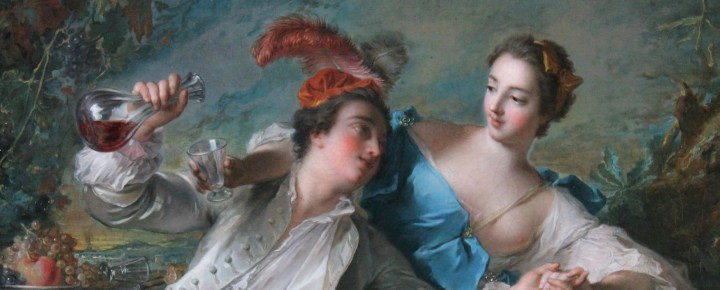
Jean-Marc Nattier, The Lovers, detail, 1744, oil on canvas
(Munich: Alte Pinakothek)
◊ ◊ ◊ ◊ ◊
Trusting that readers regularly visit J18 (always available through the link to the right), I only occasionally note content here at Enfilade. But this contribution from Mary Sheriff is worth highlighting. It’s also worth noting, incidentally, that Journal18 and HECAA are mentioned in the editorial of the January 2018 issue of The Burlington Magazine! I imagine Mary would have been thrilled. –CAH
From Journal18:
Mary D. Sheriff, “Casanova, Art, and Eroticism,” Journal18 (January 2018).
Mary D. Sheriff, one of the most brilliant and beloved scholars of eighteenth-century European art, died on October 19, 2016. Among her last essays was a playful and erudite encounter with Casanova’s memoirs, seen through the prism of eighteenth-century European painting. She originally wrote it for the catalogue to the exhibition Casanova: The Seduction of Europe, connecting paintings in the show with episodes from Casanova’s erotic intrigues. This explains the choices behind some of the artworks she discusses. Due to late changes in the exhibition’s checklist, however, Mary’s essay did not appear in the catalogue. We wanted to publish it in Journal18 so that her vivid insights into Casanova’s libertine text and like-minded artworks could be shared with our scholarly community. The essay is yet another testament to Mary’s unique talent for bringing eighteenth-century art to life and for making us think about it in a new way, as well as her own seductive powers of analysis and wordplay. We are grateful to Keith Luria and Melissa Hyde for making final revisions to the essay and for permitting us to publish it in Journal18.
The essay is available here»
Print Quarterly, December 2017
The eighteenth century in the current issue of Print Quarterly:
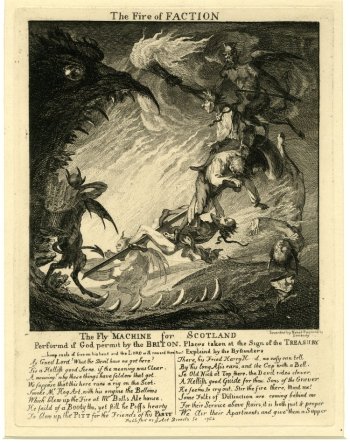
Paul Sandby, The Fire of Faction. The Fly Machine for Scotland, 1762, etching (London: The British Museum).
Print Quarterly 34.4 (December 2017)
A R T I C L E S
• Aaron M. Hyman, “Patterns of Colonial Transfer: An Album of Prints in Mexico City,” pp. 393–99.
“The rediscovery of an album of European prints in Mexico City promises to fill in some of the scholarly gaps by bringing to roughly 500 the number of extant, loose-leaf European prints in Mexico that survive from the colonial period—vastly more than scholars were aware of only a decade ago. . . The album is loosely organized chronologically and by national schools, with the earliest prints appearing at the beginning, followed by the eighteenth-century material that constitutes most of it.”
• Ann V. Gunn, “The Fire of Faction: Sources of Paul Sandby’s Satires of 1762–63,” pp. 400–18.
“On 23 September 1762, ‘The Butifyer, a touch on the times. Also a poor man loaded with mischief, or John Bull and his sister Peg . . . Likewise the Fire of Faction’ were announced in The Public Advertiser, the first of three of a series of seven satirical prints created by Paul Sandy (1731–1809) in late 1762 during the negotiations for the Treaty of Paris that ended the Seven Years’ War . . . This group, however, has never been examined as a whole before. This article discusses the context within which these prints were made and identifies the imagery and literary sources employed in them.”
N O T E S A N D R E V I E W S
• Louis Marchesano, Review of Kristina Deutsch, Jean Marot: Un graveur d’architecture à l’époque de Louis XIV (Berlin: De Gruyter, 2015), pp. 437–38.
• James Grantham Turner, Review of an issue of Casabella 856 (December 2015), dedicated to the Fondazione Querini Stampalia’s 2016 exhibition Giulio Romano’s I Modi and the Modi of of Carlo Scarpa and Alvaro Siza, which featured drawings by two modern architects with sexually explicit Italian prints from the sixteenth to nineteenth centuries, pp. 441–42.
• Antony Griffiths, Review of the exhibition catalogue Freyda Spira and Peter Parshall, The Power of Prints: The Legacy of William M. Ivins and A. Hyatt Mayor (New Haven: Yale University Press, 2016), pp. 468–70.
P U B L I C A T I O N S R E C E I V E D
• Sharon Liberman Mintz, Shaul Seidler-Feller, and David Wachtel, eds., The Writing on the Wall: A Catalogue of Judaica Broadsides from the Valmadonna Trust Library (London: Valmadonna Trust Library, 2015), p. 462.
• Christien Melzer, ed., Im Zeichen der Lilie: Französische Druckgraphik zur Zeit Ludwigs XIV (Bremen: Kunstverein Bremen, 2017), pp. 462–63.
• Petra Zelenková, Jan Kupecký a ‘černé umění’ / Johann Kupezky (1666–1740) and ‘The Black Art’ (Prague: National Gallery, 2016), p. 463.
• Anna Schultz, Johann Gottlieb Glume (1711–1778): Das Druckgraphische Werk (Berlin: Galerie Bassenge, 2016), p. 463.
• Laura Moretti, Recasting the Past: An Early Modern ‘Tales of Ise’ for Children (Leiden: Brill, 2016), p. 463.
The Burlington Magazine, November 2017
The eighteenth century in The Burlington:
The Burlington Magazine 159 (November 2017)
 A R T I C L E S
• Oronzo Brunetti, “A Nymphaeum for the Villa Salviati at Ponte alla Badia in Florence,” pp. 893–99.
R E V I E W S
• Jeremy Warren, Review of Mark Gregory d’Apuzzo, La collezione dei bronzi del Museo Civico Medievale di Bologna (Libro Co. Italia, 2017), pp. 912–13.
• François Marandet, Review of Hannah Williams, Académie Royale: A History in Portraits (Ashgate, 2015), pp. 918–19.
• Peter Murray, Review of Jane Fenlon, Ruth Kenny, Caroline Pegum, and Brendan Rooney, eds., Irish Fine Art in the Early Modern Period: New Perspectives on Artistic Practice, 1620–1820 (Irish Academic Press, 2016), p. 923.
• David Cowan, Review of the exhibition Bonnie Prince Charlie and the Jacobites (National Museum of Scotland, Edinburgh, 2017), pp. 930–31.
• Xavier F. Salomon, Review of the exhibition Caroline Murat, Sister of Napoleon, Queen of the Arts / Caroline, Soeur de Napoléon, Reine des Arts (Palais Fesch, Musée des Beaux-Arts, Ajaccio, Corsica, 2017), pp. 940–41.
The Burlington Magazine, October 2017
The eighteenth century in The Burlington:
The Burlington Magazine 159 (October 2017)
 A R T I C L E S
• Gauvin Alexander Bailey, “Rococo in Eighteenth-Century Beijing: Ornament Prints and the Design of the European Palaces at Yuanming Yuan,” pp. 778–88.
• J. P. Losty, “Eighteenth-Century Mughal Paintings from the Swinton Collection,” pp. 789–99.
R E V I E W S
• Rose Kerr, Review of John Ayers, Chinese and Japanese Works of Art in the Collection of Her Majesty The Queen (Royal Collection Trust, 2016), pp. 822–23.
• Marjorie Trusted, Review of Alan Chong, ed., Christianity in Asia: Sacred Art and Visual Splendour (Asian Civilizations Museum, 2016), pp. 823–24.
• Milo Beach, Review of Terence McInerney, Divine Pleasures: Painting from India’s Rajput Courts: The Kronos Collections (The Metropolitan Museum of Art, 2016), pp. 824–25.
• Aida Yuen Wong, Review of Petra ten-Doesschate Chu and Ning Ding, eds., Qing Encounters: Artistic Exchanges Between China and the West (Getty Publications, 2015), p. 826.
• David Bindman, Review of Elizabeth Einberg, William Hogarth: A Complete Catalogue of the Paintings (The Paul Mellon Centre for Studies in British Art, 2016), pp. 827–29.
• Robert O’Byrne, Review of Mark Clark, The Dublin Civic Portrait Collection: Patronage, Politics, and Patriotism, 1603–2013 (Four Courts Press, 2016), p. 832.
• Charles Beddington, Review of the exhibition Eyewitness Views: Making History in Eighteenth-Century Europe (The Getty Center, Los Angeles, 2017; Minneapolis Institute of Art, 2017; and The Cleveland Museum of Art, 2018), pp. 856–58.
Print Quarterly, September 2017
The eighteenth century in the current issue of Print Quarterly:
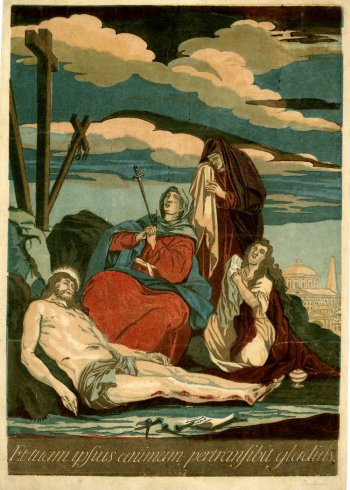
John Baptist Jackson, Lamentation over the Body of Christ, ca. 1740–44, woodcut with embossing (London: The British Museum).
Print Quarterly 34.3 (September 2017)
A R T I C L E S
• Evelyn Wöldicke, “John Baptist Jackson’s Woodcuts and the Question of Embossing,” pp. 298–310.
• Freyda Spira, “Micrographic Allegories by Johann Michael Püchler and Matthias Buchinger,” pp. 310–16.
R E V I E W S
• Adriano Aymonino, Review of the exhibition catalogue, Maria Rosaria Nappi, ed., Immagini per il Grand Tour: L’attività della Stamperia Reale Borbonica (Edizioni Scientifiche Italiane, 2015), pp. 328–31.
• Rolf Reichardt, Review of Philippe de Carbonnières, La Grande Aarmée de papier: Caricatures napoléoniennes (Presses Universitaires de Rouen et du Havre, 2015), pp. 331–33.
• Perrin Stein, Review of Kristel Smentek, Mariette and the Science of the Connoisseur in Eighteenth-Century Europe (Ashgate, 2014), pp. 340–44.
The Burlington Magazine, August 2017
The eighteenth century in The Burlington:
The Burlington Magazine 159 (August 2017)
 E D I T O R I A L
• “Reflected Glory: University Art Collections in Britain,” p. 599.
O B I T U A R I E S
• Simon Jervis, “Rudolf Hermann Wackernagel (1933–2017),” p. 639. His great article, “Carlton House Mews: The State Coach of the Prince of Wales and of the Later Kings of Hanover, A Study in the Late-Eighteenth-Century ‘Mystery’ of Coach-Building, in Furniture History 31 (1995) remains the most authoritative statement on London coach building in the late eighteenth century. But his crowning achievement was the massive two-volume Staats- und Galawagen der Wittelsbacher (Stuttgart, 2002). This is a catalogue of the wonderful collection of the Marstallmuseum at Schloss Nymphenburg, outside Munich, where he generously deposited part of his own extensive and systematic archive on coaches and carriages…
R E V I E W S
• Gauvin Alexander Bailey, Review of Christine Casey, Making Magnificence: Architects, Stuccatori and the Eighteenth-Century Interior (Yale University Press, 2017), pp. 642–43.
• Ayla Lepine, Review of Julian Holder and Elizabeth McKellar, eds., Neo-Georgian Architecture, 1880–1970: A Reappraisal (Historic England, 2016), pp. 643–44.
• Michael Hall, Review of Pauline Prévost-Marcilhacy, ed., Les Rothschild: une dynastie de mécènes en France, 1873–2016 (Somogy éditions d’Art, 2016), pp. 644–46.
• Francis Russell, Review of the exhibition Canaletto and the Art of Venice (London: The Queen’s Gallery, Buckingham Palace, 2017), pp. 651–52.
• Matthi Forrer, Review of the exhibition Hokusai: Beyond the Great Wave (London, The British Museum; and Osaka: Abeno Harukas Art Museum, 2017), pp. 652–53.
•Eric Zafran, Review of the exhibition America Collects Eighteenth-Century French Painting (Washington: D.C.: National Gallery of Art, 2017), pp. 669–70.
R E C E N T A C Q U I S I T I O N S
Recent acquisitions (2007–17) by regional university collections in Britain
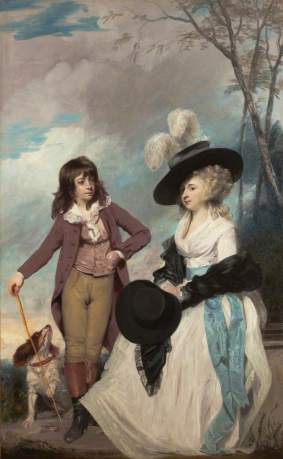
Joshua Reynolds, Maria Marow Gideon and Her Brother, William, 1786–87 (Birmingham: The Barber Institute of Fine Arts), January 2013.
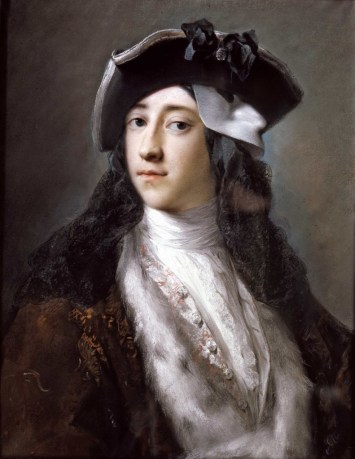
Rosalba Carriera, Portrait of Gustavus Hamilton, 2nd Viscount Boyne, ca. 1730–31; pastel, heightened with white bodycolour on paper (Birmingham: The Barber Institute of Fine Arts), 2009.
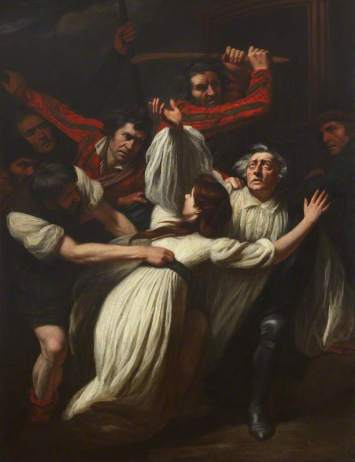
John Opie, The Death of Archbishop Sharpe, 1797; oil on canvas (University of St Andrews), 2008.
The Burlington Magazine, July 2017
The eighteenth century in The Burlington:
The Burlington Magazine 159 (July 2017), Decorative Arts

E D I T O R I A L
• “Furniture History: The Digital Future,” p. 519.
On the eve of the 300th anniversary of the birth of Thomas Chippendale in 2018, the editorial addresses the British and Irish Furniture Makers Online Project (BIFMO), which updates the The Dictionary of English Furniture Makers 1660–1840, edited by Geoffrey Beard and Christopher Gilbert and published by the Furniture History Society in 1986. The BIFMO—a collaboration between the FHS and the Centre for Metropolitan History (CMH) at the Institute of Historical Research, University of London—is an open-access searchable database of all the entries from The Dictionary, together with the names of furniture makers from Laurie Lindey’s recent PhD thesis (Lindey, as a post-doctoral research fellow is overseeing the project at the IHR with Mark Merry of the CMH). The first phase of the BIFMO’s launch is scheduled for 30 September.
A R T I C L E S
• Koenraad Brosens and Astrid Slegten, “Creativity and Disruption in Brussels Tapestry, 1698–1706: New Data on Jan van Orley and Judocus de Vos,” pp. 528–35.
• Francesco Morena, “The Emperor of Mexico’s Screen: Maximilian I’s ‘Biombo’ in Trieste,” pp. 536–43.
R E V I E W S
• Simonetta Prosperi Valenti Rodinò, Review of Sabina de Cavi, ed., Dibujos y ornamento: Trazas y Dibujos de Artes decorativas entre Portugal, España, Italia, Malta y Grecia: Estudio en honor de Fuensanta García de la Torre (De Luca Editori d’Arte, 2015), pp. 559–60.
• Pierre Terjanian, Review of A. V. B. Norman and Ian Eaves, Arms & Armour in the Collection of Her Majesty The Queen, European Armour (Royal Collection Trust, 2016),” pp. 560–61.
• Robin Hildyard, Review of Brian Gallagher, Barbara Stone Perry, Letitia Roberts, Diana Edwards, Pat Halfpenny, Maurice Hillis and Margaret Ferris Zimmerman, British Ceramics, 1675–1825: The Mint Museum (D. Giles, 2015), pp. 561–62.
• Gauvin Alexander Bailey, Review of Christopher M.S. Johns, China and the Church: Chinoiserie in Global Context (University of California Press, 2016) and Marco Musillo, The Shining Inheritance: Italian Painters at the Qing Court, 1699–1812 (Getty Publications, 2016),” pp. 562–63.
• Philippa Glanville, Review of James Rothwell, Silver for Entertaining: The Ickworth Collection (Philip Wilson, 2017), pp. 563–64.
• Humphrey Wine, Review of the exhibition Le Baroque des Lumières: Chefs-d’œuvre des églises parisiennes au XVIIIe siècle (Paris: Petit Palais, 2017), pp. 572–73.
• Patrick Bade, Review of the exhibition La Quête de la ligne: Trois siècles de dessin en Allemagne (Hamburg: Kunsthalle, 2016 and Paris: Fondation Custodia, 2017), pp. 574–75.
• Jamie Mulherron, Review of the exhibition Marie Madeleine: La Passion révélée (Bourg-en-Bresse: Monastère Royal de Brou; Carcassonne: Musée des Beaux Arts; and Douai: Musée de la Chartreuse, 2017), pp. 577–79.
• Elsje van Kessel, Review of the newly refurbished gallery of Portuguese painting and sculpture at the Museu Nacional de Arte Antiga (MNAA), pp. 579–80.
• Philippe Bordes, Review of the exhibition Charles Percier: Architecture and Design in an Age of Revolutions (New York, Bard Graduate Center Gallery; and Château de Fontainebleau, 2016–17), pp. 583–84.
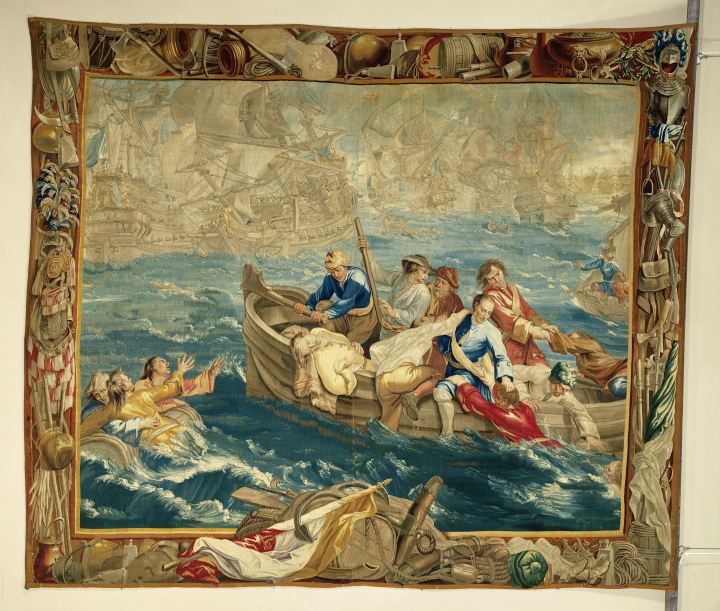
Judocus de Vos, after Lambert de Hondt, Lucas Achtschellinck, and Jan van Orley, Naval Battle from the Art of War series, ca. 1715–20; wool and silk, 344 × 400 cm (Amsterdam: Rijksmuseum).
Print Quarterly, June 2017
The current issue of Print Quarterly includes several items relevant to the long eighteenth century:
Print Quarterly 34.2 (June 2017)
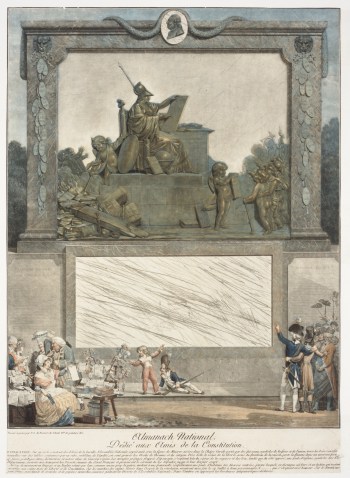
Philibert-Louis Debucourt, National Almanac Dedicated to the Friends of the Constitution, 1790, aquatint and etching, 42.5 × 33.5 cm (Paris, Archives Nationales).
A R T I C L E S
• Lucia Simonato, “Cornelis Bloemaerts’s Estate Inventory and his Final Years,” pp. 150–61.
N O T E S
• Deborah L. Crohn, “Festival Prints (The Edible Monument),” pp. 199–201.
• Elmer Kolfin, “Coloured Prints (Afsetters en meester–afsetters: De kunst van het kleuren 1480–1720),” pp. 203–05.
• Deborah Howard, “Lost in Translation: Reinterpretation of Architectural Treatises (Traduire l’architecture),” pp. 207–09.
• Christiane Wiebel, “Karoline Luise von Baden as Collector,” pp. 209–11.
• John E. Moore, “Piranesi’s Published Books,” pp. 211–14.
• Kristel Smentek, “Ephemera in Revolutionary France (The Politics of the Provisional),” pp. 214–16.
• Martin Myrone, “William Blake (1757–1827),” pp. 217–18.
• Katarina Klaric, “Adam Buck (1759–1833),” pp. 218–21.
R E V I E W S
• Sheila O’Connell, “The Land of Cockayne and the Joys of Matrimony,” pp. 231–34.
A full contents list is available here»










 Enfilade
leave a comment