British Art Studies, Autumn 2015
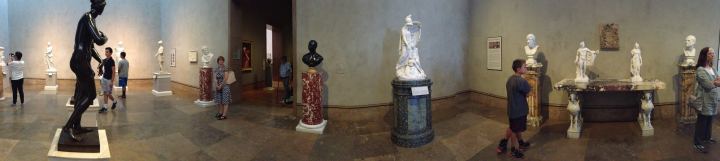
Ken Gonzales-Day, Panorama of Museum West Pavilion, 2015, chromogenic print, 20.32 x 99 cm, taken in the West Pavilion, J. Paul Getty Museum, Los Angeles, ©Ken Gonzales-Day.
◊ ◊ ◊ ◊ ◊
British Art Studies recently launched with an impressive premier issue and an exemplary commitment to free and open access, as detailed in the initial issue’s editorial statement. Congratulations! –CH
British Art Studies is free and open access: there are no subscriptions, no passwords, and no fees to pay. All content will be preserved as a free-to-use resource. The ethos of open access is one that YCBA and PMC have adopted for all their digital efforts, in the recognition that conventional proprietary models represent a major obstacle to scholarship. It is published under a Creative Commons CC BY-NC licence, meaning that you are free to share and re-use its contents for non-commercial purposes, provided that appropriate credit is given to the author/s. No permissions are needed. . . .
◊ ◊ ◊ ◊ ◊
The eighteenth century in BAS 1:
British Art Studies 1 (Autumn 2015)
Conversation Piece coordinated by Richard Johns, “There’s No Such Thing as British Art.”
‘Conversation Piece’ is a British Art Studies series that draws together a group of contributors to respond to an idea, provocation or question. The conversation will develop as more respondents enter the debate. Readers can also join in by adding a response.

Thomas Gainsborough, Charity Relieving Distress, ca. 1784, oil on canvas, 127.6 x 102.2 cm (Indianapolis Museum of Art).
Georgina Cole, “ ‘A Beautiful Assemblage of an Interesting Nature’: Gainsborough’s Charity Relieving Distress and the Reconciliation of High and Low Art.”
In the competitive environment of the eighteenth-century London art scene, Thomas Gainsborough and Sir Joshua Reynolds were often perceived as great rivals. While they shared patrons, sitters, and a stake in the future of British art, their differing artistic approaches caused considerable friction, indeed Gainsborough seceded from the Royal Academy of Art in 1784, boycotting its exhibitions and activities. This essay, however, argues that Gainsborough’s Charity Relieving Distress, painted in the year of his secession, proposes a charitable resolution of their aesthetic attitudes. The complex interrelation of allegorical and anecdotal form is interpreted as a pictorial attempt to reconcile their approaches through the concept of charity, a virtue of powerful artistic lineage in the western tradition, and of contemporary social importance.
Cyra Levenson and Chi-ming Yang, with a photo-essay by Ken Gonzales-Day, “Haptic Blackness: The Double Life of an 18th-Century Bust.”
‘One Object’ is a British Art Studies series that uses an object from a collection as a starting point for collaborative research. Cyra Levenson and Chi-ming Yang have co-authored this essay which is followed by a photo-essay by artist Ken Gonzales-Day and an interview between him and the authors.
The Burlington Magazine, November 2015
The eighteenth century in The Burlington:
The Burlington Magazine 157 (November 2015)

Interior of the Church of Santiago de Surco, Lima, Peru, attributed by Gauvin Alexander Bailey to Johann Rehr and Santiago Rosales, before 1759–1773.
A R T I C L E S
• Gauvin Alexander Bailey, “The Fantastical Rococo Altarpieces of Santiago de Surco, Peru,” pp. 769–75.
R E V I E W S
• Simon Swynfen Jervis, Review of Giuseppe Beretti and Alvar González-Palacios, Giuseppe Maggiolini: Catalogo ragionato dei disegni (In Limine, 2014) and Michael Sulzbacher, Peter Atzig, Sabine Schneider, and Karsten Hommel, Friedrich Gottlob Hoffmann (Grassi Museum, 2014), pp. 790–91.
• David Bindman, Review of William Pressly, James Barry’s Murals at the Royal Society of Arts: Envisioning a New Public Art (Cork University Press, 2014), pp. 791–92.
• Richard Green, Review of Christopher Wright, The Schorr Collection of Old Master and Nineteenth-Century Paintings (The Schorr Collection, 2014), pp. 792–93.
• David Pullins, Review of Carolyn Weekley, Painters and Paintings in the Early American South (Yale University Press, 2013), p. 795.
New Essays | Corrélations: les objets du décor au siècle des Lumières
A presentation of the book is scheduled for Wednesday, November 18, in Paris at the Institut national d’histoire de l’art (INHA) in conjunction with the seminar Penser le décor : quelques hypothèses sur ses fonctions dans l’histoire de l’art, which will run from noon to 4:00. From the book flyer and Éditions de l’Université de Bruxelles:
Anne Perrin Khelissa, ed., Corrélations: les objets du décor au siècle des Lumières (2015), 264 pages, ISBN 978-2800415857, 28€ [Études sur le XVIIIe siècle 43 (Octobre 2015)].

D’après Jean-Baptiste Oudry, La jeune veuve. Fable cxxiv, gravure illustrant Jean de La Fontaine, Fables choisies, Paris, chez Desaint et Saillant, 1755, t. ii, Bibliothèque municipale de Toulouse, Res A xviii 1(2) (Bibliothèque municipale de Toulouse)
Expositions, nouvelles présentations muséographiques, colloques internationaux, programmes de recherche, travaux universitaires, publications : les arts du décor connaissent ces dernières années un vaste regain d’intérêt. Le présent volume répond à une actualité. Il entend également porter un regard renouvelé sur l’ameublement des demeures, en interrogeant la qualité artistique et technique des objets, mais aussi leurs significations sociales et culturelles. Autour d’une réflexion commune, professeurs des universités et jeunes chercheurs, conservateurs, spécialistes des arts décoratifs, de peinture, d’architecture, de littérature et d’histoire du genre font le point sur les mutations épistémologiques récentes et ouvrent la discussion.
Loin d’être un amas désaccordé de bibelots, les intérieurs du xviiie siècle proposent un système unitaire co- hérent, où arts manufacturés et beaux-arts cohabitent. Quels liens ces artefacts de nature et de statut hétérogènes entretiennent-ils entre eux et avec leur environ- nement ? Comment le principe d’harmonie fonctionne- t-il et s’adapte-t-il à la variété des aménagements et à la succession rapide des goûts ? Quel écart existe-t-il entre ce que les traités et la critique esthétique du temps préconisent et ce qu’attendent les commanditaires et les acheteurs ? Telles sont les questions que soulèvent les auteurs du recueil, à partir d’exemples célèbres ou méconnus de décors réalisés en France, en Grande-Bretagne, en Italie et en Suisse, entre la fin du xviie siècle et le début du xixe siècle.
◊ ◊ ◊ ◊ ◊
T A B L E D E S M A T I È R E S
 • Roland Mortier et les Études, Hervé Hasquin
• Pour une mise en corrélation des arts et des savoirs : introduction à l’étude des intérieurs domestiques, Anne Perrin Khelissa
I Principes et logiques structurants
• Le système d’ameublement des élites françaises au xviiie siècle, Christian Michel
• Decorated Interiors : Gender, Ornament, and Moral Values, Mary Sheriff
• L’appartement au xviiie siècle : un espace diversifié au service d’une convivialité nouvelle, Claire Ollagnier
II Normes et pratiques sociales
• Une application de la théorie du décorum : le décor textile de la chambre du roi au palais de l’archevêché de Reims, le jour du sacre de Louis xv, Pascal-François Bertrand
• Declaring an interest : the decoration of Norfolk House, London (1748–1756), Sarah Medlam
• « Trop doré pour la Suisse » : canon parisien et convenance neuchâteloise, Carl Magnusson
III Dispositions et assemblages plastiques
• Le cabinet du Régent au château de Saint-Cloud : un décor pour une collection de petits bronzes. Essai de reconstitution, Michaël Decrossas
• Du « tact flou et séduisant des couleurs » chez Jullienne ou l’art de marier tableaux, porcelaines, laques, statuettes, meubles, et autres effets, Isabelle Tillerot
• La rencontre des matériaux au service de l’harmonie du décor ? L’exemple du salon Martorana du palais Comitini à Palerme (1765–1770), Sandra Bazin-Henry
IV Imaginaires et incarnations sensuels
• « L’amour égalisait tout » : l’unité du décor des intérieurs libertins du roman des Lumières, Fabrice Moulin
• Le succès du boudoir au xviiie siècle ou les prestiges de l’intime, Alexia Lebeurre
• La nature dans le boudoir, Bérangère Poulain
Bibliographie générale
Notices biographiques des auteurs
◊ ◊ ◊ ◊ ◊
Une présentation du livre est organisée le mercredi 18 novembre à l’INHA (salle Walter Benjamin) dans le cadre du séminaire « Penser le décor : quelques hypothèses sur ses fonctions dans l’histoire de l’art » qui se déroulera de 12 h à 16 h.
Coming Soon: A New Journal for 18th-Century Art
We are delighted to announce the launch of Journal18—a new digital publication entirely dedicated to eighteenth-century art and material culture.
Journal18 is an online, open access, peer-reviewed journal devoted to art and culture of the long eighteenth century from around the globe. Inspired by the rich and exciting state of the field of eighteenth-century art history, Journal18 has been founded as a scholarly forum to support and extend that richness. Taking form as a digital publication, Journal18 embraces the accessibility and flexibility of its format, seeking the widest possible engagement with the latest research in the field.
Journal18 will be the first journal dedicated to the field of eighteenth-century art history, and one of the few online and fully open access journals for the discipline of art history more broadly. Appearing twice a year, Journal18 will publish thematic issues of articles investigating all aspects of eighteenth-century visual and material culture. Throughout the year, Journal18 will also offer a forum for intellectual exchange in the Notes & Queries section: a space for short notes, reviews, archival discoveries, or scholarly musings.
Journal18 will launch in Spring 2016 with Issue #1—Multilayered. This inaugural issue of Journal18 will explore the multilayered nature of eighteenth-century art. Contributions will focus on artworks that bear traces of multiple hands as a result of workshop production, cross-cultural exchange, re-use, restoration, vandalism, or other factors.
We are currently accepting submissions for Notes & Queries, but we are no longer accepting submissions for Issue #1—Multilayered. For all inquiries including proposals for contributions to Notes & Queries please contact the editors at: editor@journal18.org. Keep up to date with Journal18 by following us on Twitter @Journal18 and Facebook.
J18 Founding Editors
Noémie Etienne (Getty Research Institute)
Meredith Martin (NYU and Institute of Fine Arts)
Hannah Williams (Queen Mary University of London)
Editorial Board
Nebahat Avcioglu (Hunter College/CUNY); Finbarr Barry Flood (Institute of Fine Arts/NYU); Esther Bell (Fine Arts Museums of San Francisco); Daniela Bleichmar (University of Southern California); Jeffrey Collins (Bard Graduate Center, New York); Thomas Crow (Institute of Fine Arts, New York); Craig Hanson (Calvin College); Anne Higonnet (Barnard College/Columbia University); Kristina Kleutghen (Washington University, St Louis); Anne Lafont (INHA, Paris); Ewa Lajer-Burcharth (Harvard University); Mark Ledbury (University of Sydney); Katie Scott (Courtauld Institute of Art); Charlotte Vignon (Frick Collection); Michael Yonan (University of Missouri)
The Burlington Magazine, July 2015
The eighteenth century in The Burlington:
The Burlington Magazine 157 (July 2015)
 A R T I C L E S
• Peter Lindfield, “New Light on Chippendale at Hestercombe House,” pp. 452–56.
• Susan Owens, “A Note on Jonathan Richardson’s Working Methods,” pp. 457–59.
• Peter Moore and Hayley Flynn, “John Collett’s Temple Bar and the Discovery of a Preparatory Study,” pp. 460–64.
• Alycen Mitchell and Barbara Pezzini, “‘Blown into Glittering by the Popular Breath’: The Relationship between George Romney’s Critical Reputation and the Art Market,” pp. 465–73.
R E V I E W S
• Charles Truman, Review of Gerhard Röbbig, ed., Meissen Snuffboxes of the Eighteenth Century (Hirmer Verlag, 2013), p. 484.
• Maureen Cassidy-Geiger, Review of Haydn Williams, Turquerie: An Eighteenth-Century European Fantasy (Thames & Hudson, 2014), p. 487.
• J.V., Review of Ian Warrell, Turner’s Sketchbooks (Tate Publishing, 2014), p. 488.
• Robert O’Byrne, Review of the exhibition, Ireland: Crossroads of Art and Design, 1690–1840, p. 509–10.
Catherine Roach, “Working-Class Interpreters of Elite Collections”
From the latest posting at Homes Subjects:
Catherine Roach, “Working-Class Interpreters of Elite Collections,” Home Subjects: A Working Group Dedicated to the Display of Art in the Private Interior, c. 1715–1914 (4 June 2015).

A Greenwich Pensioner showing the Thornhill decorations in the Painted Hall to a family of visitors. Coloured etching by T. Rowlandson after [J. N.] Esq, 1807
(London: The Wellcome Institute)
Historic collections (and their present-day avatars, historic homes) are seductive. This field of study offers imaginative possession of desirable ensembles. In this, we are all like Eliza Bennet at Pemberley, imagining what we could have been mistress of, if things had been different. But, as curators of historic homes have come to realize in recent years, history need not be sanitized to interest visitors, or to interest us. Displays in historic homes have begun, haltingly but laudably, to grapple with the social systems that made such dwellings possible, including the enslavement of millions of people. The history of collecting can do the same. . . .
Catherine Roach is Assistant Professor of the History of Art at Virginia Commonwealth University. Her first book, Pictures-within-Pictures in Nineteenth-Century Britain, is forthcoming from Ashgate Press. She is currently working on a history of the British Institution.
The full posting is available here»
The Art Bulletin, June 2015
The eighteenth century in The Art Bulletin:
The Art Bulletin 97 (June 2015)
A R T I C L E S
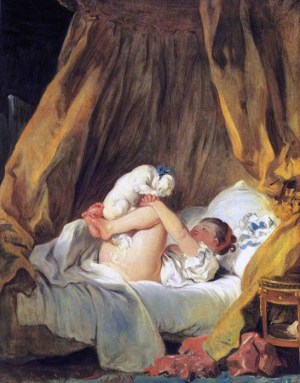
Jean-Honoré Fragonard, Young Girl in Bed Making Her Dog Dance, ca. 1768 (Munich: Alte Pinakothek)
• Jennifer Milam, “Rococo Representations of Interspecies Sensuality and the Pursuit of Volupté,” pp. 192–209.
Enlightenment writers proposed the existence of an animal soul, refuting the Cartesian beast-machine. Arguments credit the caresses of a dog to its master as direct visual evidence of the capacity of an animal to feel and show emotion. A focus on paintings by Jean-Honoré Fragonard sets the Rococo representation of lapdogs within the context of changing ideas about the relationship between animal and human. Eroticized images of lapdogs are related to radical materialist theories that assert the role of physical pleasure in human motivation.
Free access to the article is available here for the first fifty clicks (please don’t click if you already have access to the journal).
R E V I E W S
• Vittoria Di Palma, Review of Hanneke Grootenboer, Treasuring the Gaze: Intimate Vision in Late Eighteenth-Century Eye Miniatures (The University of Chicago Press,
2013), pp. 229–30.
The Art Bulletin, March 2015
The eighteenth century in The Art Bulletin:
The Art Bulletin 97 (March 2015)
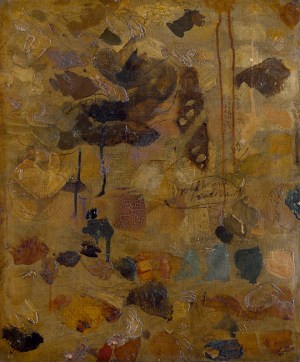
Joshua Reynolds, Studio Experiments in Colour and Media, ca. 1770–1790? (London: Royal Academy of Arts)
A R T I C L E S
• Matthew C. Hunter, “Joshua Reynolds’s ‘Nice Chymistry’: Action and Accident in the 1770s,” pp. 58–76.
The first president of Britain’s Royal Academy of Arts, Joshua Reynolds was described by contemporaries as a dangerously misguided chemist. Using a secretive laboratory of fugitive materials, he crafted visually striking images that came together quickly and stopped audiences dead in their tracks. But, just as rapidly, those paintings began to deteriorate as objects—flaking, discoloring, visibly altering in time. When framed around the “nice chymistry” he prescribed for aspiring artists in his famous Discourses, Reynolds’s risky pictorial enterprise can be situated within a broader problematic of making and thinking with temporally evolving chemical images in the later eighteenth century.
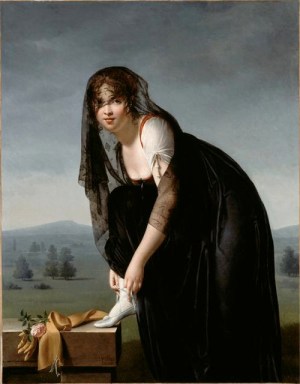
Marie-Denise Villers, Une étude de femme d’après nature, 1802 (Paris: Louvre)
• Susan L. Siegfried, “The Visual Culture of Fashion and the Classical Ideal in Post-Revolutionary France,” pp. 77–99.
In her little-known painting A Study of a Woman after Nature (1802), Marie-Denise Villers exploited a conjuncture between masculine-inflected ideals of Neoclassical art and feminine-inflected ideas of fashionability in the post-Revolutionary period in France by making a feature of female dress while emulating the standards of history painting. The artist’s confident synthesis of idioms is examined in the context of Albertine Clément-Hémery’s memoir of a women’s art studio. Walter Benjamin’s notion of gestus is enlisted as a means of understanding how the quite different image cultures invoked in this work communicated social ideas.
The Burlington Magazine, May 2015
The eighteenth century in The Burlington:
The Burlington Magazine 157 (April 2015)
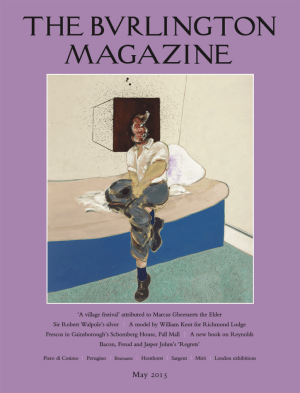 A R T I C L E S
• Tessa Murdoch, “Power and Plate: Sir Robert Walpole’s Silver,” pp. 318–24.
• Julius Bryant, “Queen Caroline’s Richmond Lodge by William Kent: An Architectural Model Unlocked,” pp. 325–30.
R E V I E W S
• Duncan Robinson, Review of Mark Hallet, Reynolds: Portraiture in Action (The Paul Mellon Centre for Studies in British Art, 2014), pp. 341–47. Available at The Burlington website for free.
• Stephen Lloyd, Review of Cory Korkow with Jon Seydl, British Portrait Miniatures: The Cleveland Museum of Art (D. Giles, Ltd., 2013), pp. 349–50.
• Richard Wolfe, Review of the exhibition Shifting Patterns: Pacific Barkcloth Clothing (British Museum, 2015), pp. 361–62.
• Jamie Mulherron, Review of two exhibitions: Charles de La Fosse: Le Triomphe de la Couleur (Versailles and Nantes, 2015) and Bon Boullogne (1649–1717): Un chef d’école au Grand Siècle (Dijon, 2014–15), pp. 365–67.
The Burlington Magazine, April 2015
The eighteenth century in The Burlington:
The Burlington Magazine 157 (April 2015)
 A R T I C L E S
• Marie-Anne Dupuy-Vachey, “Fragonard’s ‘Fantasy Figures’: Prelude to a New Understanding,” pp. 241–47.
• Yuriko Jackall, John K. Delaney, and Michael Swicklik, “Portrait of a Woman with a Book: A Newly Discovered ‘Fantasy Figure’ by Fragonard at the National Gallery of Art, Washington,” pp. 248–54.
R E V I E W S
• Richard Wrigley, “Reassessing François-André Vincent,” — Review of recent exhibitions of Vincent’s work at Montpellier, Tours, and Paris and two books: Jean-Pierre Cuzin, François-André Vincent, 1746–1816: Un Peintre entre Fragonard et David (Arthéna, 2013) and Elizabeth Mansfield, The Perfect Foil: François-André Vincent and the Revolution in French Painting (University of Minnesota Press, 2012), pp. 265–68.
• François Marandet, Review of Christian Michel, L’Académie Royale de Peinture et de Sculpture (Librairie Droz, 2012), p. 276.
• Julia Poole, Review of Joanna Gwilt, Vincennes and Early Sèvres Porcelain from the Belvedere Collection (V&A Publishing, 2014), pp. 276–77.
• Stephen Duffy, Review of France Nerlich and Alain Bonnet, eds., Apprendre à Peindre: Les ateliers Privés à Paris, 1780–1863 (Université Francois Rabelais, 2013), p. 277.
• Reinier Baarsen, Review of the exhibition Eighteenth Century, Birth of Design, Furniture Masterpieces, 1650–1789 / 18e, aux sources du design, chefs-d’œuvre du mobilier 1650 à 1790 (Château de Versailles, 2014–15), pp. 285–86.
• Gauvin Alexander Bailey, Review of the exhibition With Body and Soul / Mit Leib und Seele (Munich: Kunsthalle, 2014–15), pp. 286–88. Available at The Burlington website for free.
• Xavier Salomon, Review of the exhibition Goya’s Tapestry Cartoons in the Context of Court Painting / Goya en Madrid: Cartones para Tapices (Madrid: Prado, 2014–15), pp. 290–91.
• Catherine Whistler, Review of the exhibition, The Poetry of Light: Venetian Drawings from the National Gallery of Art, Washington / La Poesia della Luce: Disegni Veneziani dalla National Gallery of Art di Washington (Venice: Museo Correr, 2014–15), pp. 293–94.










 Enfilade
3 comments