The Burlington Magazine, March 2014
The (long) eighteenth century in The Burlington:
The Burlington Magazine 156 (March 2014)
 A R T I C L E S
• François Marandet, “The Pool of Bethesda by Louis Chéron: A Modello Discovered at the Wellcome Library, London,” pp. 162–63.
An oil-sketch by Louis Chéron in the Wellcome Library, London, is identified as a study for the large painting of the Pool of Bethesda (1683) in S. Pantaleone, Venice.
• Massimo Favilla and Ruggero Rugolo, “A Portrait of a Baby Girl by Lorenzo Tiepolo,” pp. 164–69.
An attribution to Lorenzo Tiepolo of a Portrait of a Baby Girl in a High Chair (c.1770–76).
R E V I E W S
• Jocelyn Anderson, Review of Geoffrey Tyack, ed., John Nash: Architect of the Picturesque (English Heritage, 2013), pp. 175–76.
• Uta Christina Koch, Review of the exhibition Fragonard: Poetry and Passion / Poesie und Leidenschaft, pp. 194–95.
• Francis Russell, Review of the exhibition Pietro Bellotti: Another Canaletto, pp. 198–99.
March 2014 Issue of RIHA Journal
The latest issue of RIHA Journal, the open access journal of the International Association of Research Institutes in the History of Art (RIHA), addresses the theme “When Art History Meets Design History.” Here are the eighteenth-century offerings:
Katie Scott, “Persuasion: Nicolas Pineau’s Designs on the Social,” RIHA Journal (March 2014).
This essay offers a Latourian account of the wood sculptor Nicolas Pineau’s design process via a reading of Jean-François Bastide’s [1758] novella La petite maison. It argues that the conventional form assumed by his drawings or ‘inscriptions’—the indications of scale, the delineation of options, the signatures and marginal notes—can be read as traces of seduction that helped ‘translate’ potential patrons to a taste for Rococo. The essay further suggests that the activation of the taste at the point of commission was kept alive in the designs executed by the bi-modal asymmetry that is characteristic of the goût pittoresque because its exercise was considered a mark of refinement.
Matthew Craske, “Model Making and Anti-Competitive Practices in the Late Eighteenth-Century London Sculpture Trade,” RIHA Journal (March 2014).
This article concerns the generation of anti-competitive practices, and the associated discontents, that rose to the fore in the London sculpture trade in the late eighteenth century (1770–1799). It charts the business strategies and technical procedures of the most economically successful practitioners, whose workshops had some of the characteristics of manufactories, and whose critics accused them of conducting a “monopoly” trade. Small-scale practitioners lost out in the competition for great public contracts on account of their design processes and their inability to represent any manifestation of “establishment.” A combination of three factors increased the gap between a handful of powerful “manufacturers” and the rest of the trade: the foundation of the Royal Academy, shifts in the ways designs were evaluated, and a growing number of very lucrative contracts for public sculpture. I conclude that such were the discontents within the London trade that by the 1790s, there was a marked tendency for practitioners who were not manufacturers to be attracted to democratic political movements, to the Wilkite call for liberty and the rise of civic radicalism in the merchant population of London.
Anne Puetz, “Drawing from Fancy: The Intersection of Art and Design in Mid-Eighteenth-Century London,” RIHA Journal (March 2014).
This paper attempts to bring the world of mid-eighteenth-century British design into fruitful conversation with contemporary art theory and practice. Taking the neighbourhood and milieu of the St Martin’s Lane area in London as a starting point, I investigate connections between British “rococo” design and William Hogarth’s Analysis of Beauty in terms of shared formal values and contemporary implications of “modernity.” I argue for a mutual indebtedness rather than “art” directing “design.”
The Netherlands Yearbook for History of Art (NKJ) Now Online
◊ ◊ ◊ ◊ ◊
The Netherlands Yearbook for History of Art / Nederlands Kunsthistorisch Jaarboek (NKJ) is now available online via subscription with access to all 62 volumes dating back to 1947. The online version gives this unique and high quality publication an extra dimension. NKJ, reflecting the variety and diversity of approaches to the study of Netherlandish art and culture, is now even more accessible and easy to use. Each NKJ volume is dedicated to a particular theme. The latest volume (62) is dedicated to Meaning in Materials 1400–1800. For details see www.brill.com/nkjo or contact marketing@brill.com.
Journal of the History of Collections 26 (March 2014)
The eighteenth century in the current issue of the Journal of the History of Collections:
Journal of the History of Collections 26 (March 2014)
A R T I C L E S
José Saporiti Machado and Miguel Telles Antunes, “Aniceto Rapozo’s Cabinet at the Lisbon Academy of Sciences: A Window into Brazilian Eighteenth-Century Timber Resources,” pp. 21–33.
From the end of the eighteenth until the beginning of the nineteenth century, wood samples were regularly sent to the Royal Army Arsenal in Lisbon for testing. The large number and variety of samples, as well as increasing interest on Brazil, explain why, in 1805, the Prince Regent of Portugal commissioned the preparation of four collections containing 1,213 timber specimens from Brazil and twelve from other origins. One of these collections, housed in a cabinet at the Lisbon Academy of Sciences, is now being studied in order to reveal its origins and to identify the wood samples. Botanical identifications will provide valuable information about the wood resources and the species used by furniture-makers in the late eighteenth and early nineteenth centuries.
Arthur MacGregor, “Patrons and Collectors: Contributors of Zoological Subjects to the Works of George Edwards (1694–1773),” pp. 35–44.
Through his lavishly illustrated and eminently accessible Natural History of Uncommon Birds (1743–51) and Gleanings of Natural History (1758–64), George Edwards became one of the most influential naturalists and illustrators of mid-eighteenth-century England. The specimens on which he relied – either alive, stuffed, or in spirits – were generally in the ownership of others and his practice of carefully acknowledging the source of each of his subjects sheds considerable light on the extent to which exotic birds and animals were to be found in the possession of a range of owners from wealthy grandees to humble citizens, as well as specialist traders who emerged to supply this growing market. Edwards’s texts are drawn upon here to chart the degree to which exotic species, alive or dead, had begun to penetrate households great and small by the mid 1700s, particularly in the London area; an online appendix lists and identifies those who supplied him with specimens.
Debora J. Meijers, “An Exchange of Paintings between the Courts of Vienna and Florence in 1792–1793: A Logical Step Taken at the Right Moment,” pp. 45–61.
It may come as a surprise that in the turbulent political period of spring 1792 a decision was taken at the courts of Vienna and Florence to carry out an exchange of paintings, the aim of which was ‘to complete’ the collections of the Emperor and the Grand Duke, each ‘with the profusion of the other’. There are, however, signs that this step originated in the recent past of both galleries and further that it related to the developments of that particular historical moment. The exchange can be interpreted as a logical consequence of the recently introduced taxonomic division into schools, the advancement of which would lead to an unprecedented level of ‘completeness’. Besides being a perfect seed-bed for emerging artists, the presentation of ‘all’ the schools could also be seen as a metaphor for political power. But in this time of war with France the exchange served mainly as a bond between two brothers who were pursuing very different political courses.
R E V I E W S
• David Howarth, Review of Christopher Rowell, ed., Ham House: 400 Years of Collecting and Patronage (2013), pp. 117–19.
• Rosemary Sweet, Review of Noah Heringman, Sciences of Antiquity: Romantic Antiquarianism: Natural History and Knowledge Work (2013), pp. 119–20.
• Arthur MacGregor, Review of Glyn Williams, Naturalists at Sea: Scientific Travellers from Dampier to Darwin (2013), pp. 120–22.
• Mark A. Roglán, Review of Shelley M. Bennett, The Art of Wealth: The Huntingtons in the Gilded Age (2013), p. 125.
• Fiona Savage, Review of Sarah Longair and John McAleer, eds., Curating Empire: Museums and the British Imperial Experience (2012), pp. 125–26.
• Francesco Paolo de Ceglia, Review of Medical Museums: Past, Present, Future (2013), pp. 126–27.
Design History 27 (March 2014)
A selection of offerings from the latest issue of Design History:
Design History 27 (March 2014).
Julie Bellemare, “Design Books in the Chinese Taste: Marketing the Orient in England and France, 1688–1735,” pp. 1–16.
 This article examines design books replicating Asian and Asian-inspired imagery in seventeenth- and eighteenth-century England and France. Often created to provide craftsmen with new sets of decorative patterns, the designs compiled in these books served to imitate a range of new manufactured products imported from Asia, for which local demand was growing at a steady pace. Design books provide a particularly fruitful entry point into the European conception of the ‘orient’ by synthesising exotic images from a variety of pictorial sources into convenient formats. The present discussion focuses on two specific books: A Treatise of Japaning and Varnishing, by John Stalker and George Parker, published in London and Oxford in 1688, and Livre de desseins chinois, tirés d’après des originaux de Perse, des Indes, de la Chine et du Japon by Jean-Antoine Fraisse, which appeared in Paris in 1735. Using these case studies, I argue that not all patterns found in design books were intended to be replicated on real objects; some also circulated independently as images available to a broader consumer base than previously thought. I examine the books’ contents, publishing history and the marketing strategies employed for reaching wide audiences and generating a desire for the ‘orient’.
R E V I E W S
• Deborah Sugg Ryan, Review of Tatiana C. String and Marcus Bull, eds., Tudorism: Historical Imagination and the Appropriation of the Sixteenth Century (2011); and Andrew Ballantyne and Andrew Law, Tudoresque: In Pursuit of the Ideal Home (2011), pp. 97–101.
• Susan House Wade, Review of Liza Antrim, Family Dolls’ Houses of the 18th and 19th Centuries (2011), pp. 103–04.
• Galen Cranz, Review of Anne Massey Chair (2011), pp. 104–06.
• Dominique Grisard, Review of Chris Horrocks, ed., Cultures of Colour: Visual, Material, Textual (2012), pp. 106–08.
C F P : S P E C I A L I S S U E S
Beyond Dutch Design: Material Culture in the Netherlands in an Age of Globalization, Migration and Multiculturalism, p. 114.
Articles due by 1 December 2014 (more…)
View: A Festival of Art History
London’s View: A Festival of Art History (7–9 February 2014) is the latest example of events that slip by me. For anyone interested, the good news is that events were filmed and could be available online in the near future. Plans are also underway for 2015. Here’s the coverage from Apollo Magazine’s blog, The Muse Room. -CH
◊ ◊ ◊ ◊ ◊
Digby Warde-Aldam, “Great View: The UK’s First Art History Festival,” The Muse Room from Apollo Magazine (19 February 2014).
 The venue is a large room in London’s Institut français, its windows looking out over the crazed Victorian skyline of South Kensington. French academic Frédéric Ogée looks slightly taken aback by the crowd, a mix of all ages that has just filled up every available seat—indeed, staff are starting to turn away latecomers to the lecture he is about to give, a fascinating half-hour examination of ‘Englishness’ in English art. At the end of the talk, Ogée is forced to cut short the barrage of questions from the audience in order to clear the room for the next speaker on the bill of the Institut’s View Festival.
The public interest in the talk shouldn’t really be surprising. The View, which had its first edition this month, is Britain’s first art history festival—which, taking into account the fact that the UK has festivals dedicated to everything from Heavy Metal to knitting comes as something of a surprise. Given London’s position as a global art capital, it seems bizarre that nothing like this has ever taken place in the city before. . .
The full review is available here»
Eighteenth-Century Studies 47 (Winter 2014)
Eighteenth-Century Studies 47 (Winter 2014) | Special Issue: Eighteenth-Century Easts and Wests
A R T I C L E S
Chi-ming Yang, “Eighteenth-Century Easts and Wests: Introduction,” pp. 95–101.
 The essays in this “Eighteenth-Century Easts and Wests” issue of Eighteenth-Century Studies inaugurate the journal’s institutional relocation from California to New Haven, by way of India, China, Russia, and the Levant. Far from peripheral, the histories and perspectives that emerge from these sites are central to their interdisciplinary remapping of traditional eighteenth-century encounters of enlightenment and of imperialism. The virtues of a collection that is organized at this moment in time by an East-West rubric are several: it signals a regional, relational, and critical orientation that at once refuses the catchall, and too often Eurocentric, categories of the “exotic” or the “global,” and yet invites questions of comparison across and between cultures. Although seemingly axiomatic, it also calls into question its own bipartite structure of analysis by foregrounding the heterogeneity of the Easts and Wests under consideration here. The vector of a Pondichéry, Morocco, Andalusia, or Kiakhta shifts in relation to the particular local or intra-regional network of exchange in which it is situated. At the same time, the attention to place, and the importance of place to textual and archival analysis, keeps us attuned throughout to the larger structures of European and Asian states, companies, and institutions, as well as the continuing role of Western institutions in structuring the distinctions between Orient and Occident that open up fields of inquiry even as they push Asia to the margins of the modern academic mainstream. . . .
Matthew W. Mosca, “The Qing State and Its Awareness of Eurasian Interconnections, 1789–1806,” pp. 103–16.
This article examines the response of the Qing state to two instances in its foreign relations that required long-distance coordination between overland and maritime frontiers: the implementation of a rhubarb embargo in 1789 and the emergence between 1792 and 1806 of clear links between affairs at Kiakhta and Canton. It argues that Qing emperors and minsters had the intelligence capabilities to perceive that their empire was encircled within global networks of economic exchange and political rivalry. Unlike their Russian and British competitors, however, they pursued their interests primarily by seeking to break rather than forge these connections, designing their frontier as a series of discrete sectors rather than one integrated entity.
Kristina Kleutghen, “Chinese Occidenterie: The Diversity of ‘Western’ Objects in Eighteenth-Century China,” pp. 117–35.
The eighteenth-century Chinese taste for European things was met less by importing foreign goods than by domestically producing occidentalizing works of art, a diverse category of objects that can be termed “occidenterie.” This essay redirects the previous consideration of occidenterie from the Jesuit mission and imperial court painting toward a diversity of examples that span geography, material, format, and social class. The various ways in which Chinese occidenterie produced in different places and for different audiences employed elements connoting the West, thereby acquiring their foreign or exoticizing auras, more accurately reflects the empire-wide complexity of this phenomenon.
Danna Agmon, “The Currency of Kinship: Trading Families and Trading on Family in Colonial French India,” pp. 137–55.
In the French colony of Pondichéry, French and local actors alike drew on the shared idiom of kinship to strategically advance their political and commercial agendas. Recent scholarship has shown that the structures of family underlay early modern European state building and imperial expansion. This essay deploys this insight in the colonial context, to examine how indigenous families in the Tamil region entered into the European colonial project. For native commercial brokers, involvement with European newcomers could actually strengthen local family ties. Simultaneously, French employees of the Compagnie des Indes were eager to insert themselves into Tamil networks and did so by deploying public and inscribed performances of kinship.
Suzanne Marchand, “Where Does History Begin?: J. G. Herder and the Problem of Near Eastern Chronology in the Age of Enlightenment,” pp. 157–75.
This essay treats the very long set of debates concerning biblical and oriental chronology in early modern Europe down to the time of J. G. Herder and William Jones in the later eighteenth century. It shows that sacred chronology remained a burning issue for Herder; controversy about dating “oriental” texts did not wane, even as a series of newly-readable, original texts made their way westward. What did happen in Herder’s lifetime, however, was that a more specialized classical philology began to set the standards for what counted as wissenschaftlich, making it more difficult for scholarly “orientalists” to make the case that the cultures that they studied really had been at the forefront of cultural developments.
Nabil Matar, “Christians in the Eighteenth-Century Ottoman Mashriq,” pp. 177–94.
The article examines a selection of writings and icons by and about the Christian Arabs of the Middle East. Living under Ottoman rule, from Syria to Egypt, they became aware of an Arabic linguistic identity that helped them write and translate numerous chronicles, disputations, theological commentaries, sermons, and histories, in verse and prose. At the same time, they engaged the larger Muslim population in dialogue. While their legal status was that of second class dhimmis, they enjoyed their own religious space, by far more secure than was allowed minorities in the European World of expanding empires.
Srinivas Aravamudan, “East-West Fiction as World Literature: The Hayy Problem Reconfigured,” pp. 195–231.
This article focuses on the reception history of translations of Ibn Tufayl’s Hayy ibn Yaqzan and how natural theodicy, empiricist experimentalism, and philosophical fiction influenced eighteenth-century England. Discussing the status of Ibn Tufayl’s ideas in relation to Edward Pococke, John Locke, Robert Boyle, and Daniel Defoe allows scholars to go beyond the East-West dichotomy and instead create an opening from eighteenth-century studies onto recent debates around world literature. Using Hayy as a prism, we can understand the opportunities as well as the drawbacks of a world literature paradigm, as theorized by Wolfgang von Goethe, Erich Auerbach, and more recent scholars.
R E V I E W A R T I C L E S
Ruth P. Dawson, “Actress Images, Written and Painted, Famed and Defamed, British and German,” pp. 233–35.
Review of Mary Helen Dupree, The Mask and the Quill: Actress-Writers in Germany from Enlightenment to Romanticism (2011); Laura Engel, Fashioning Celebrity: Eighteenth-Century British Actresses and Strategies for Image Making (2011); and Gill Perry with Joseph Roach and Shearer West, The First Actresses: Nell Gwyn to Sarah Siddons (2011).
Suzanne Desan, “Gender, Intimacy, and Politics in the French Revolutionary Era,” pp. 236–40.
Review of Andrew Cayton, Love in the Time of Revolution: Transatlantic Literary Radicalism and Historical Change, 1793–1818 (2013); Lindsay Parker, Writing the Revolution: A French Woman’s History in Letters (2013); and Annie Smart, Citoyennes: Women and the Ideal of Citizenship in Eighteenth-Century France (2011).
« Livraisons d’histoire de l’architecture » 26 (2013)
From the Centre André Chastel:
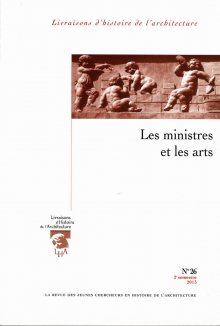
“Les Ministres et les arts,” numéro thématique des Livraisons d’histoire de l’architecture 26 (2013), €23.
 Basile Baudez, “Le comte d’Angiviller, directeur de travaux : le cas de Rambouillet”
Alexandre Burtard, “Sur la piste des orientations artistiques de Nicolas Frochot, premier préfet de la seine sous le Consulat et l’Empire”
Rose-Marie Chapalain, “L’abbé Terray, seigneur de la Motte-Tilly”
Marie-Claude Chaudonneret, “Les ministres de l’intérieur et les arts sous le Directoire”
Hélène Drutinus, “Jean Naigeon, conservateur du Luxembourg sous le Consulat : les rapports d’un conservateur avec le Sénat et le ministre de l’intérieur”
Dominique Massounie, “Philibert Orry et l’embellissement du territoire autour de l’Instruction de 1748 : genèse d’un paysage routier et urbain”
Gabriele Quaranta, “Deux générations à côté du pouvoir : quelques remarques sur les arts chez les de Fourcy”
Aleth Tisseau des Escotais, “Finances et arts pendant la Révolution et le Premier Empire : l’exemple du Garde-Meuble”
Summaries for a selection of the articles are available as a PDF file here»
Oxford Art Journal, December 2013
From the latest issue of the Oxford Art Journal:
 • Tim Ingold, “Lines in Time / Review of Daniel Rosenberg and Anthony Grafton, Cartographies of Time: A History of the Timeline (2010),” Oxford Art Journal 36 (December 2013): 463–64.
• Mechthild Fend, “Allegory and Fantasy: Portraiture Beyond Resemblance / Review of Sarah Betzer, Ingres and the Studio: Women, Painting, and History (2012) and Melissa Percival, Fragonard and the Fantasy Figure: Painting and Imagination (2012),” Oxford Art Journal 36 (December 2013): 465–67
• Richard Taws, “Ruins and Reputations / Review of Nina Dubin, Futures and Ruins: Eighteenth-Century Paris and the Art of Hubert Robert (2010) and Elizabeth Mansfield, The Perfect Foil: François-André Vincent and the Revolution in French Painting (2012),” Oxford Art Journal 36 (December 2013): 467–70.
The Burlington Magazine, December 2013
The (long) eighteenth century in The Burlington:
The Burlington Magazine 155 (December 2013)
E D I T O R I A L
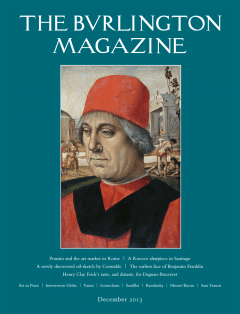
• Richard Shone, “Home is Where the Art Is,” p. 807.
 Houses once occupied by distinguished residents are a special strand of the heritage industry that increasingly dominates a nation in thrall to all aspects of the past. We are constantly being exhorted to save and preserve this or that—a factory, a view, a manor house, a pier, a site of outstanding natural beauty, the historic habitat of wildlife, or, indeed, of the famous dead. Some of the shrines we visit are more larded with authenticity than others. Inevitably, the further back in time the illustrious lives were lived, the fewer objects there are likely to be which were familiar to the inhabitants. Was this her chair; was this really his easel? The aspic of preservation continually wobbles between the authentic and the fake. We do not always know—are not always told—whether something is ‘of the same period’ or ‘similar to’ or a ‘replica of’ what may or may not have been originally there, under the eye, the hand, the bottom or the feet of the presiding genius. Much depends on the piety of heirs and descendants, the
changing ownership of the house and the fluctuating stakes of fame. . . .
The latest appeal for an artist’s house has much to recommend it and should attract supporters beyond British shores. It concerns the restoration and preservation of J.M.W. Turner’s rural retreat at Twickenham, west London. This is an exceptional project and not simply a matter of tidying up and putting a blue plaque on the front. Turner designed this house himself, and plans for it abound in sketchbooks of c.1810–12, after he had purchased two plots of land near the Thames. The intention is to remove later additions (not serious) and reveal its compact interior, obviously influenced by his friend John Soane’s house in Lincoln’s Inn Fields. For Turner, Sandycombe Lodge was for rest and recreation such as fishing (when he could ‘angle out the day’) and hosting friends on excursions for picnics, rather than for long residence and staying guests. Turner sold the house in 1826 and the adjoining meadow in 1848 (to the Windsor, Staines and South Western Railway). Under the auspices of the Turner’s House Trust, the appeal for £2 million is well underway, with support already assured from the Heritage Lottery Fund, among many other organisations and private donors, although further funding is still needed.2 It is expected that the public will be able to visit in 2016.
2. For an entertaining and informative account of the house, see C. Parry-Wingfield, with Foreword by A. Wilton: J.M.W. Turner. The Artist and his House at Twickenham, London 2012. Donations can be sent to the Trust at 11 Montpelier Row, Twickenham, tw1 2nq, or at www.turnerintwickenham.org.uk.
The full editorial is available here»
A R T I C L E S
• Gauvin Alexander Bailey and Fernando Guzmán, “The Rococo Altarpiece of St Ignatius: Chile’s Grandest Colonial Retable Rediscovered,” pp. 815–20.
An examination of the Rococo altarpiece of St Ignatius in Santiago, Chile, and of the European influences on this great retablo.
• David Pullins, “Dating and Attributing the Earliest Portrait of Benjamin Franklin,” pp. 821–22.
A re-evaluation of a painting now found to be the earliest known portrait of Benjamin Franklin, added to an earlier figure of a man by Robert Feke (c.1746–48).
R E V I E W S
• Elizabeth Goldring, Review of Laura Houliston, ed., The Suffolk Collection: A Catalogue of Paintings (English Heritage, 2012), p. 835.
• Michael Rosenthal, Review of Leo Costello, J.M.W. Turner and the Subject of History (Ashgate, 2012), p. 836.
• Basile Baudez, Review of the exhibition Soufflot: Un architecte dans la lumière, pp. 850–51.
• Xavier F. Salomon, Review of the exhibition Il Gran Principe Ferdinando de’ Medici (1663–1713) collezionista e mecenate, pp. 851–53.
• Angela Delaforce, Review of the exhibition Da Patriarcal à Capela Real de São João Baptista, pp. 855–56.
• Jamie Mulherron, Review of the exhibition Interwoven Globe: The Worldwide Textile Trade, 1500–1800, pp. 856–58.










 Enfilade
leave a comment