Journal of the History of Collections 27 (March 2015)
In addition to the following articles related to the eighteenth century in the current issue of the Journal of the History of Collections , I would draw your attention to Stefan Krmnicek’s article on coins from the Tux Collection and Jessica Priebe’s article on Boucher, both of which have been published online but will also appear as part of forthcoming issues in the coming months. They serves as a useful reminder that with the advantages of digital advance access, ‘current issue’ no longer tells the whole story. –CH
◊ ◊ ◊ ◊ ◊
Stefan Krmnicek, “‘Nummus aliquantulum suspectus’: The Counterfeit Coins of the Tux Collection (1715–1798) at the University of Tübingen,” Journal of the History of Collections, first published online: 8 February 2015.
The coin collection of the Institute of Classical Archaeology at the University of Tübingen contains some fifty counterfeits, imitations and fabrications of ancient coins which can be traced back to the bequest of the Stuttgart senior civil servant (Regierungsrat) Carl Sigmund Tux (1715–1798) at the ducal court of Württemberg. These coins are of particular historical value, for all fabrications in the Tux collection are fixed with a terminus ante quem through the bequest of 1798. A selection of the most interesting counterfeit specimens is presented and discussed against the background of the history of the Tux collection and the early development of numismatics at the University of Tübingen. Additionally, Tux’s descriptions of the counterfeit coins provide first-hand insight into the abilities, knowledge and limitations in ancient numismatics of the most passionate coin collector and leading coin specialist at the ducal court of Württemberg in the Baroque period.
Jessica Priebe, “The Artist as Collector: François Boucher (1703–1770),” Journal of the History of Collections, first published online: 28 January 2015.
The name François Boucher is synonymous with the visual and material culture of luxury in mid eighteenth-century France. His paintings are filled with desirable objects that informed the tastes of collectors. What is less known is that Boucher was a prolific collector of art and nature, with more than 13,000 different objects in his collection at the time of his death in 1770. Despite this, a formal study of his collection is almost entirely absent from the existing field of historical scholarship. This article aims to bring to light Boucher’s activities as a collector, in particular his interest in natural objects for which he was especially well known. It also considers the extent to which Boucher’s passion for collectable objects had an impact on his practice as an artist.
◊ ◊ ◊ ◊ ◊
Journal of the History of Collections 27 (March 2015)
A R T I C L E S
Rachel Finnegan, “The Travels and Curious Collections of Richard Pococke, Bishop of Meath,” pp. 33–48.
This article examines the collecting career of the Revd Richard Pococke (1704–1765), some time Bishop of Ossory and subsequently Bishop of Meath, who travelled extensively in Europe and the Eastern Mediterranean from 1733–41 and accumulated a modest yet important collection of antiquities, coins, medals and natural curiosities. Using evidence from his recently published Grand Tour correspondence, together with other contemporary sources such as letters and sale catalogues, this article considers his foreign travels and mode of collecting and also the scholarly uses to which his foreign collections were put, including his contribution to learned societies, and the publication of his eastern travels.
Leanne Zalewski, “Fine Art for the New World: Thomas Jefferson, Collecting for the Future,” pp. 49–55.
Of Thomas Jefferson’s many accomplishments—President of the United States, co-author of the Declaration of Independence, and founder of the University of Virginia—his art collection fails to top the list. However, Jefferson’s vision for the developing nation involved a strong interest in the arts. As such, he assembled his own art collection and planned an ideal, but ultimately unrealized, sculpture gallery. His collection, neither vast nor impressive, included portraits, busts, engravings, and copies after Old Master paintings. Although it included not a single work of European or American art could be called a masterpiece or canonical work, yet his collection was the first significant art collection in the United States. Why? This article examines the legacy of his trailblazing assemblage through an analysis of his fine art collection both real and ideal within the broader context of the history of collecting in the United States.
Richard Scully, “A Serious Matter: Erwin D. Swann (1906–1973) and the Collection of Caricature and Cartoon,” pp. 111–122.
This paper explores the origins and development of the Swann Collection of Caricature and Cartoon, begun by Erwin D. Swann in 1966, and currently held by the Library of Congress in Washington, dc. One of the world’s few collections dedicated to the preservation of original comic art by caricaturists and cartoonists from the eighteenth to the twentieth century, Swann’s collection also transcends national boundaries, and embraces comic art as one of the ‘universal folk expressions’. An established art collector, Swann sought to give caricature and cartoon the same status as ‘high’ art, and worked hard to achieve this prior to his death in 1973. His work has been continued, and his collection maintained, in subsequent years. A closer investigation of the collection’s genesis, and the intentions of Swann himself, sheds light on the significance of this unique archive, and its utility for the continuing, ‘serious’ scholarship of comic art worldwide.
R E V I E W S
• Elizabeth Williams, Review of Tessa Murdoch and Heike Zech, eds., Going for Gold. Craftsmanship and Collecting of Gold Boxes (Eastbourne: Sussex Academic Press, 2014), pp. 124–25.
• Tom Stammers, Review of Alexandra Stara, The Museum of French Monuments 1795–1816: ‘Killing Art to Make History’ (Farnham: Ashgate Publishing, 2013), pp. 125–26.
• Tom Stammers, Review of Andrea Meyer and Bénédicte Savoy, eds., The Museum is Open: Towards a Transnational History of Museums, 1750–1940 (Berlin: De Gruyter, 2014), pp. 127–28.
• Clare Barlow, Review of Rosie Dias, Exhibiting Englishness: John Boydell’s Shakespeare Gallery and the Formation of a National Aesthetic (New Haven and London: Yale University Press, 2013), pp. 128–29.
The Art Bulletin, December 2014
The eighteenth century in The Art Bulletin:
The Art Bulletin 96 (December 2014)
A R T I C L E S
• Cheng-hua Wang, “Whither Art History? A Global Perspective on Eighteenth-Century Chinese Art and Visual Culture,” pp. 379–94.

The Chang Gate (left), 1734, and Three Hundred and Sixty Trades (right), woodblock prints produced in Suzhou, ink and colors on paper; each is 43 x 22 inches (Hiroshima: Umi-Mori Art Museum)
Here, I endeavor to engage the global turn by exploring the connectedness of the world in art that drew China and Europe together in the eighteenth century. My main purpose is to highlight the new scholarship on the art and visual culture of the High Qing dynasty (ca. 1680s–1795). These recent studies reveal that the extent to which the globalized situation was engaged in the art production of the High Qing court and local societies far exceeds previous expectations. Notwithstanding the revered legacy of traditional research on Sino-European artistic interactions of the early modern period, it did not pay much attention to the multiple routes, channels, and contact zones within a global context, nor did it make in-depth explorations into the agency of the Qing emperors, painters, printmakers, and consumers on the issue of how Qing art adopted European styles. Consequently, these new lines of thought have, on the one hand, increased the importance of the comparatively marginal subfield of early modern Sino-European artistic interactions in the studies of Chinese art and, on the other, generated a major revision—not merely a fine-tuning—of the dominant narrative of High Qing art and visual culture (379) . . .
• Nóra Veszprémi, “The Emptiness behind the Mask: The Second Rococo in Painting in Austria and Hungary,” pp. 441–62.
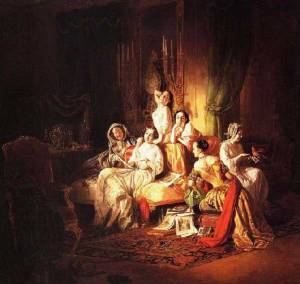
József Borsos, The Morning after the Masquerade (Girls after the Ball) 1850 (Budapest, Hungarian National Gallery)
At the time of its revival in mid-nineteenth-century Austria, the Rococo style was suffused with often contradictory meanings. Regarded as both outdated and fashionable, Austrian and French, simple and pompous, superficial and full of spiritual value, it prompted musings on time, history, and national identity. Closely connected to both the decorative arts and the imagery of popular prints, paintings of the Rococo revival often evoked contemporary concerns about the commodification of art in the industrialized modern world. The ambiguous responses engendered by the Rococo gained special significance in the context of the political tension between Austria and Hungary.
R E V I E W S
• Rebecca Zorach, Review of Andrea Feeser, Maureen Daly Goggin, and Beth Fowkes Tobin, eds., The Materiality of Color: The Production, Circulation, and Application of Dyes and Pigments, 1400–1800 (Ashgate, 2012); and Jeffrey Jerome Cohen, ed., Prismatic Ecology: Ecotheory beyond Green (University of Minnesota Press, 2013), pp. 489–91.
• Brian Kane, Review of Whitney Davis, A General Theory of Visual Culture (Princeton University Press, 2011), pp. 491–93.
The Burlington Magazine, January 2015
The eighteenth century in The Burlington:
The Burlington Magazine 157 (January 2015)
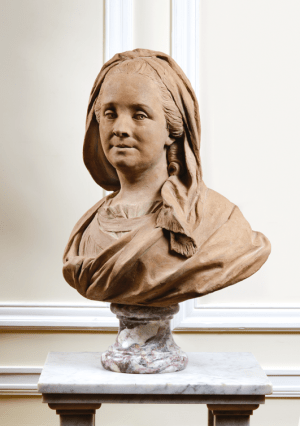
Jean-Baptiste Lemoyne, Portrait of Marie Leszczyńska, terracotta, approx 43 cm high, ca. 1750 (Paris: Fondation Custodia). The bust was acquired in 2013.
A R T I C L E S
• Marie-Noëlle Grison, “A Newly Discovered Bust of a Woman by Jean-Baptiste Lemoyne,” pp. 9–13.
R E V I E W S
• Giles Waterfield, Review of James Anderson Winn, Queen Anne: Patroness of Arts (Oxford University Press, 2014), p. 35.
• Jörg Garms, Review of Robin Thomas, Architecture and Statecraft: Charles of Bourbon’s Naples, 1734–1759 (Penn State University Press, 2013), pp. 35–36.
• Martin Postle, Review of Diana Donald, The Art of Thomas Bewick (Reaktion Books, 2013), pp. 36–37.
New Journal | Royal Studies Journal
We are delighted to announce that the first issue of the Royal Studies Journal is out now. This issue features articles by Carole Levin, Cinzia Recca, and Nadia van Pelt as well as six book reviews of recent publications in the field of royal studies.
The Royal Studies Journal is a peer-reviewed, open access, interdisciplinary and international journal for the field of Royal Studies and will be published twice a year. Articles can be submitted in French, Spanish, Portuguese, and German, although English is preferred. Book reviews will also be featured. Shorter notices, news items, and conference reports will be on our official blog.
Please visit our website to find out more about the journal and how to submit articles to the RSJ. If you wish to contact us with any queries about the journal, suggestions of upcoming/recent works in the field to review or the submissions process, please email us at info.rsj@winchester.ac.uk.
◊ ◊ ◊ ◊ ◊
Royal Studies Journal 1.1 (2014)
Articles
Carole Levin, “Elizabeth’s Ghost: The Afterlife of the Queen in Stuart England”
Cinzia Reccia, “Maria Carolina and Marie Antoinette: Sisters and Queens in the Mirror of Jacobin Public Opinion”
Nadia Therese van Pelt, “Teens and Tudors: The Pedagogy of Royal Studies”
Book Reviews
Carey Fleiner, “Review: Lott, Death and Dynasty in Early Imperial Rome”
Stephen Donnachie, “Review: Perry, John of Brienne: King of Jerusalem”
Sean McGlynn, “Review: Richardson, The Field of Cloth of Gold”
Elena Woodacre, “Review: Cruz and Galli (eds.), Early Modern Hapsburg Women”
Estelle Paranque, “Review: Knecht, Hero or Tyrant? Henri III, King of France”
Charlotte Backerra, “Review: Aikin, A Ruler’s Consort in Early Modern Germany”
West 86th, Fall–Winter 2014
The eighteenth century in the current issue of West 86th:
West 86th: A Journal of Decorative Arts, Design History, and Material Culture 21 (Fall–Winter 2014).
Charles Alan Watkins, “The Tea Table’s Tale: Authenticity and Colonial Williamsburg’s Early Furniture Reproduction Program,” pp. 155–91.

The CW-8 Tea Table as it appeared in Kittinger’s 1940 catalogue Colonial Williamsburg Incorporated Approved Reproductions of Furniture by Kittinger Company.
In July 1936 Tomlinson of High Point, a mid-priced North Carolina furniture manufacturer, began a franchising and marketing concept called the Williamsburg Galleries that gained broad national acceptance in stores and among consumers. Outraged by Tomlinson’s actions and unwilling to abandon the retail market to those it felt were interlopers, Colonial Williamsburg set up a subsidiary corporation, Williamsburg Craftsmen, Inc., that licensed manufacturers to create reproductions of objects owned by the Restoration. Furniture was the most important part of the plan, and Williamsburg licensed the Kittinger Company of Buffalo, New York, as the manufacturer. Selected department stores were encouraged to build sales spaces that were period replicas of Raleigh Tavern rooms, and craft shops were developed in the historic area to promote the work of the various manufacturers. Because a number of stores sold both Tomlinson and Kittinger products, Williamsburg developed the concept of ‘authenticity’ to distinguish the copies being made by Kittinger from Tomlinson’s generic eighteenth-century adaptations. Virtually handmade, said the Restoration, these Kittinger pieces were line-by-line reproductions, inside and out, of originals on display in Williamsburg, Virginia. Regardless of what Colonial Williamsburg said and believed, however, recent examination of individual pieces of Kittinger furniture made for the Restoration reveals that the New York factory relied far more on modern machine production methods than on craft methods of the eighteenth century.
Charles Alan Watkins holds a PhD in American cultural history and museum studies from the University of Delaware. Until his recent retirement from teaching, he was professor and coordinator of Salve Regina University’s Cultural and Historic Preservation Program in Newport, Rhode Island, and, prior to that, was the director of the graduate and undergraduate public history programs at Appalachian State University in Boone, North Carolina.
◊ ◊ ◊ ◊ ◊
Alain Schnapp, as translated by Martina Dervis, “The Birth of the Archaeological Vision: From Antiquaries to Archaeologists,” pp. 216–29.

Greek antiquities of Anne Claude Philippe, Comte de Caylus, Recueil d’antiquités égyptiennes, étrusques, grecques et romaines, vol. 1 (Paris: Desaint & Saillant, 1761), facing p. 85. INHA, Paris.
Focused on a series of French scholars and travelers, this article proposes that a distinct approach to history and antiquarianism developed in France during the seventeenth and eighteenth centuries emphasizing the importance of artifacts as bearers of historical evidence. Beginning with the circle around Nicolas-Claude Fabri de Peiresc, the article introduces aspects of the work of the Marquis de Nointel, Jacob Spon, Bernard de Montfaucon, Michel Fourmont, the Comte de Caylus, and the scholars who accompanied Napoleon’s expedition to Egypt in 1798. The article concludes with a discussion of Abel Blouet’s expedition to the Peloponnese (Morea) in Greece in 1829–31 that, in its scientific management of fieldwork, can be regarded as a landmark in the development of modern archaeological research.
Alain Schnapp is professor of Greek archaeology at the University of Paris 1 (Panthéon-Sorbonne). In 1999, he was the founding director of the Institut national d’histoire de l’art (INHA), the premier research center for art history in France. He has held many visiting professorships, including those at the universities of Princeton, Naples, Cambridge, and Heidelberg. The history of archaeology is one of his primary interests, on which he has published widely, including La conquête du passé: Aux origines de l’archéologie (Paris: Éditions Carré, 1993), which was translated into English as The Discovery of the Past (London: British Museum Press, 1994).
The Burlington Magazine, December 2014
The eighteenth century in The Burlington:
The Burlington Magazine 156 (December 2014)
 A R T I C L E S
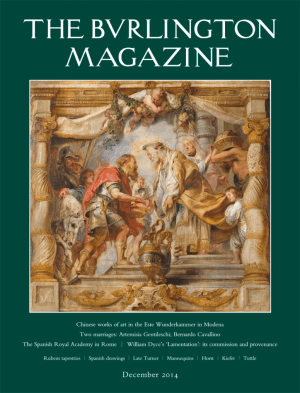
• Pilar Dies del Corral, “The Beginnings of the Real Academia de España in Rome: Felipe de Castro and Other Eighteenth-Century Pioneers,” pp. 805–10.
R E V I E W S
• Marjorie Trusted, Review of David Bindman, Warm Flesh, Cold Marble: Canova, Thorvaldsen and their Critics (Yale University Press, 2014), pp. 824–25.
• Todd Longstaffe-Gowan, Review of Beth Fowkes Tobin, The Duchess’s Shells: Natural History Collecting in the Age of Cooke’s Voyages (The Paul Mellon Centre for Studies in British Art, 2013), pp. 827–28.
• James Ayres, Review of the exhibition Silent Partners: Artist and Mannequin from Function to Fetish (The Fitzwilliam Museum, Cambridge, 14 October 2014 — 25 January 2015; and Musée Bourdelle, Paris, 31 March — 12 July 2015), pp. 840–41.
• Xavier F. Salomon, Review of three Veronese exhibitions in the Veneto, including Veronese Inciso: Stampe da Veronese dal XVI al XIX Secolo (Museo della Stampa Remondini, Bassano del Grappa,14 September 2014 — 19 January 2015), pp. 842–43.
The Art Bulletin 96 (September 2014)
In the current issue of The Art Bulletin:
 • Claudia Mattos, “Whither Art History? Geography, Art Theory, and New Perspectives for an Inclusive Art History,” pp. 259–64.
• Aaron Wile, “Watteau, Reverie, and Selfhood,” pp. 319–37.
Watteau’s fêtes galantes break with key aspects of academic art theory in early eighteenth-century France—particularly as put forward by Roger de Piles—to elicit an experience of reverie in the spectator. Watteau’s formal innovations inaugurated a new relationship between painting and beholder that opened up a new sphere of subjective experience, linking the artist’s enterprise with the rise of modern interiority.
• Ebba Koch, Review of Santhi Kavuri-Bauer, Monumental Matters: The Power, Subjectivity, and Space of India’s Mughal Architecture (Duke UP, 2011), pp. 362–65.
New Book | Mr Kilburn’s Calicos
From WoI:
Ros Byam Shaw, “Mr Kilburn’s Calicos,” The World of Interiors (October 2014): 112–18.
A scuffed little album discovered by Gabriel Sempill among her late mother’s possessions contains exquisite watercolour patterns by the esteemed 18th-century textile designer William Kilburn. Now, a facsimile of this rare find, complete with a variety of juvenilia added by a later hand, plus modern takes on Kilburn’s repeats, is published.
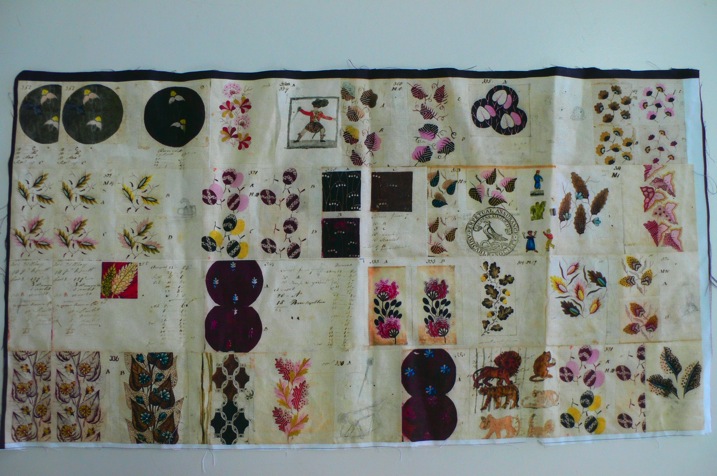
Detailed pattern units from William Kilburn’s
album, as a composite image.
◊ ◊ ◊ ◊ ◊
From Fleece Press:
Gabriel Sempill and Simon Lawrence, Mr Kilburn’s Calicos: William Kilburn’s Fabric Printing Patterns from the Year 1800 (London: Fleece Press, 2014), ISBN: 978-0992741051, £175.
Printed, bound and published at breakneck speed to coincide with The World of Interiors’ extensive feature on this book (October 2014 issue, with five pages reproduced), this is the full reproduction of a very important pocket book once owned by the great fabric designer and printer, William Kilburn (1745–1818). Hitherto known only for his highly elaborate and sumptuous chintz designs which are in the Victoria and Albert Museum, this pocket book includes 62 basic units for patterns which could be built up and repeated on a larger scale for dress material. It is a most exciting find, and Kilburn included notes of variant colourways and orders; the notebook’s subsequent use by a great grandson as a child’s scrapbook ensured its survival.
The book comprises a letterpress introduction, with the entire notebook being reproduced in the second half. There is a separate booklet of 16 patterns printed full-page, made up from Kilburn’s original units by Sholto Drumlanrig, and both the book and booklet are housed in a solander box. There are three variant bindings of quarter cloth with one of three different Kilburn patterned papers over boards.
Sweden’s Nationalmuseum Launches Free Online Journal, Volume 20
Press release (3 September 2014) from the Nationalmuseum:
 Stockholm’s Nationalmuseum has launched its first digital journal, available online to download and read free of charge. The Art Bulletin of Nationalmuseum Stockholm contains academic articles on art history relating to Nationalmuseum’s collections. The journal is moving to digital-only format and will be available through the DiVA portal (a Swedish publishing system for academic research and student theses) and the museum’s own website. The Art Bulletin of Nationalmuseum Stockholm is an annual publication containing academic articles on art history relating to Nationalmuseum’s collections. The journal has existed in print form since 1996, but is now switching to digital-only format, starting with volume 20. The journal’s established graphic design will be enhanced through the addition of digital media features such as metadata, live links to chapter headings and page references, and high-resolution images.
“For an art institution like Nationalmuseum, it’s important to offer our readers high-quality images that do full justice to the works,” said Janna Herder, editor of the Art Bulletin of Nationalmuseum Stockholm. “Readers therefore have the option of downloading the entire journal in low-resolution format or individual articles in high-resolution format.”
Nationalmuseum expects to attract a larger and wider readership now that the journal and its articles are freely available and searchable via Google and other search engines. As a member of the DiVA portal, the museum is able to distribute the publication more effectively in the academic community. “This is a further step in the digital evolution of Nationalmuseum and a key initiative in fulfilling our mandate to improve access to and awareness of our collections,” said Magdalena Gram, the museum’s head of research, library and archives and the journal’s editor-in-chief. “Another aspect of our mandate involves collaboration with other institutions such as universities and colleges. Offering an established publication like the Art Bulletin of Nationalmuseum Stockholm in digital format through the DiVA portal marks a breakthrough in terms of our ability to make specialized knowledge and information freely available.”
◊ ◊ ◊ ◊ ◊
Articles related to the eighteenth century (visit the Nationalmuseum website for the full contents) . . .
Art Bulletin of Nationalmuseum Stockholm 20 (2013).
A C Q U I S I T I O N S
Carina Fryklund, “Three 17th-Century Paintings from the Collection of Gustaf Adolf Sparre (1746–94),” pp. 11–16.
Magnus Olausson, “Roslin’s Self-Portrait with his Wife Marie Suzanne Giroust Painting a Portrait of Henrik Wilhelm Peill (1767),” pp. 17–18.
Magnus Olausson, “Wertmüller’s Portrait of Henri Bertholet-Campan with the Dog Aline (1786),” pp. 19–20.
Guilhem Scherf, “Une Statuette en Terre Cuite de Jean-Baptiste Stouf au Nationalmuseum,” pp. 27–36.
Magnus Olausson, “Madame Lefranc Painting a Portrait of her Husband Charles Lefranc (1779): A Miniature by Adélaïde Labille-Guiard,” pp. 37–8.
Anders Bengtsson, “A Unique Plate Warmer,” pp. 39–40.
Anders Bengtsson, “A Chair Fit for a Prince,” pp. 41–2.
Acquisitions 2013: Exposé, pp. 61–96.
A R T I C L E S O N T H E H I S T O R Y A N D T H E O R Y O F A R T
Martin Olin, “An Italian Architecture Library under the Polar Star: Nicodemus Tessin the Younger’s Collection of Books and Prints,” pp. 109–18.
Magnus Olausson, “Louis Gauffier’s Portrait of Gustaf Mauritz Armfelt (1793): A Political or a Conspiratorial Painting?,” pp. 119–22.
Ulf Cederlöf, “An Exceptionally Protracted Affair: The Nationalmuseum’s Acquisition of Sergel’s Collections of Drawings and Prints, 1875–76,” pp. 123–34.
S H O R T E R N O T I C E S
Görel Cavalli-Björkman and Margaretha Rossholm-Lagerlöf, “A Source-Critical Comment on Roger de Robelin’s “On the Provenance of Rembrandt’s The Conspiracy of the Batavians under Claudius Civilis,” 135–36.
Roger de Robelin, “Response to “A Source-Critical Comment etc.,” pp. 137–38.
R E P O R T
Helen Evans and Helena Kåberg, “The Nationalmuseum Lighting Lab,” pp. 139–46.
The Baroque in the Construction of a National Culture in Francoist Spain
From Taylor & Francis:
Bulletin of Spanish Studies: Hispanic Studies and Researches on Spain, Portugal and Latin America 91.5 (2014).
Special issue on ‘The Baroque in the Construction of a National Culture in Francoist Spain’, edited by Paula Barreiro López, Carey Kasten and Tobias Locker.
The baroque was both praised and attacked by critics for overwhelming the viewer through art. Yet its indisputable importance in Hispanic tradition and its characteristic intensity made the baroque an important element of culture during the regime of Francisco Franco (1939–1975). Not only did the baroque anchor official Francoist culture, its influence was also apparent in the regime’s politics, which used the baroque as an ideological legitimising tool in intellectual discourses. This interdisciplinary special issue is the first single volume to examine the influence of baroque tradition on Francoist Spain, analyzing cultural and political examples of twentieth-century reinterpretations of the baroque. For example, the concept of hispanidad, which underpinned Spain’s foreign policy and influenced international perceptions of the country, contained many baroque elements. By analysing its imprint on Spain’s culture industry both at home and abroad this special issue demonstrates the essential role the baroque played in the creation of a national and cultural identity during the dictatorship in Spain.
• Tobias Locker, “The Baroque in the Construction of a National Culture in Francoist Spain: An Introduction,” pp. 657–71.
• Till Kössler, “Education and the Baroque in Early Francoism,” pp. 673–96.
• Carey Kasten, “Staging the Golden Age in Latin America: José Tamayo’s Strategic Ascent in the Francoist Theatre Industry,” pp. 697–714.
• Paula Barreiro López, “Reinterpreting the Past: The Baroque Phantom during Francoism,” pp. 715–34.
• Noemi De Haro-García and Julián Díaz-Sánchez, “Artistic Dissidence under Francoism: The Subversion of the Cliché,” pp. 735–54.
• Johannes Großmann, ” ‘Baroque Spain’ As Metaphor. Hispanidad, Europeanism and Cold War Anti-Communism in Francoist Spain,” pp. 755–71.
• Julio Montero and María Antonia Paz, “Lo barroco en la televisión franquista: tipos y temas; actores y escenarios,” pp. 773–92.










leave a comment