London’s Rare Book Fair | Revolution
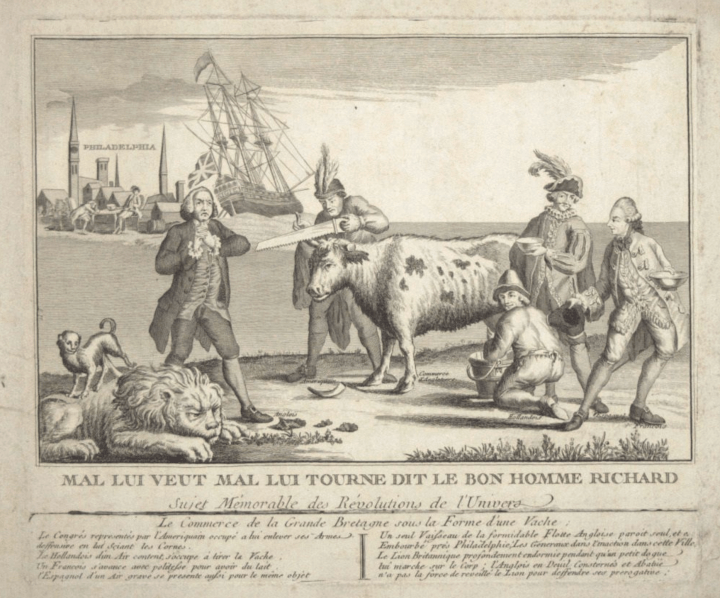
Mal Lui Veut mal Lui Tourne dit le Bon Homme Richard. Sujet Mémorable des Révolutions de l’Univers. Le Commerce de la Grande Bretagne sous la forme d’une Vache, engraving 225 × 265mm. A cow representing Britain’s commerce is having its horns cut off by an American, as a Dutchman milks it and a Spaniard and Frenchman wait with bowls. An Englishman wrings his hands. A British lion lies asleep as a pug urinates on it. In the background brothers Admiral Richard Howe and General William Howe sit at a table at Philadelphia, with Admiral Howe’s flagship Eagle in dry dock, the two bogged down in the occupation of the city (abandoned after 266 days on June 18th 1788). A reverse copy of a satire published in the Westminster Magazine, 1 March 1788 (BM 5472). See BM Satires 5727. Offered by Grosvenor Prints, £950.
◊ ◊ ◊ ◊ ◊
From the press release for the book fair:
Revolution | Firsts: London’s Rare Book Fair
Saatchi Gallery, London, 14–17 May 2026
This year’s Firsts: London’s Rare Book Fair will take place at the Saatchi Gallery in Chelsea from 14 to 17 May. The theme for 2026 is ‘Revolution’, highlighting books, manuscripts, maps, and ephemera relating to all types of revolutions—whether political, cultural, social, or scientific—from approximately 100 international booksellers.
American Revolution
A letter by one of the Founding Fathers of the United States, Thomas Paine (1737–1809), whose publication of Common Sense and other pamphlets in the 1770s proved crucial in building support for independence, will be offered by Shapero Rare Books for a six figure sum. Paine was a French Revolutionary, inventor, political philosopher, and statesman, and this letter is from January 1797, written in Paris to Colonel John Fellows (1735–1808), who participated in several major battles during the American Revolutionary War. In this letter he discusses his publications and shares his view that George Washington should retire as president. A first American edition of Adam Smith’s Theory of Moral Sentiments with an asking price of £15,000 will also be available.
Daniel Crouch will be bringing several Revolutionary War maps including a Plan of Boston and its Environs, which “reflects the true situation of His Majesty’s Army and also those of the Rebels.” It was drawn by an engineer in Boston in October 1775 and carries a price of £45,000. Quaritch is offering the first edition in book form of The Federalist Papers, the single most important work of American political philosophy, making the case for ratifying the US Constitution in the wake of the Revolution. This copy is preserved in its original boards, as issued, uncut and largely unopened.
A copper engraving by Edinburgh-born engraver and reform-leaning Whig Malcolm Rymer (1775–1835), printed on a vivid yellow silk ‘handkerchief’ from 1812 maps the Age of Revolutions during the Reign of George III, including the American Revolution. This visually arresting and minutely detailed chronology presents two concentric spirals radiating from a central portrait of George III, offering a spectacular timeline of a half-century of conflict and “various administrations formed during his reign” embellished with portraits of the King, Pitt, Fox, Nelson, and Wellington. It is available at Peter Harrington Rare Books for £2,500.
French Revolution
Harrison-Hiett Rare Books will be selling a first edition of the scarce album Patrioty, Album politique et allégorique de 1850. It bears the arms of Guillaume Gabriel Pavée de Vendeuvre (1779–1870). Pavée de Vendeuvre was a deputy representing Aube, an industrialist, and noted bibliophile. He owned a Faience and a glass factory. The caricatures here would have appealed to him. Having served as an auditeur under Napoléon, he sat in constitutional opposition and notably signed the “Adresse des 221” that challenged Charles X (£1,150).
Fold the Corner Books offers a handwritten letter from a British spy during the French Revolution, recounting the events on the streets of Paris in January 1791. The first edition of Mary Wollstonecraft’s history of the French Revolution, will be available at Quaritch. The book is based in-part on her own observations in Paris in the 1790s—she was at first sympathetic to the cause but later appalled by the excesses of the Terror. This copy is annotated by William Michael Rossetti, and includes advertisements for Wollstonecraft’s own revolutionary work, A Vindication of the Rights of Woman.
Thomas Heneage Art Books is bringing a fascinating record of the systematic looting—or ‘extraction’ as the French called it—of Italy during the Napoleonic conquest, printed prior to the looting of Florence and Naples in Venice in 1799. Page twelve alone lists the removal of the Apollo Belvedere and Laocoön from the Vatican and the four horses from St. Marks, Venice. The removal of art and antiquities began from the spring of 1796 until the Congress of Vienna ordered the restitution of the works in 1815. Over 110 artworks were brought to France from Italy in 1796 alone.
Camden Lock Books specialises in miniature books and among them is a beautifully bound work of a profoundly influential 19th-century Italian revolutionary called Silvio Pellico, a writer, poet, dramatist, and patriot active in the Italian unification. His activism led him to be arrested on the charge of being a member of a secret revolutionary society or carbonari, and was imprisoned for 15 years in Austrian dungeons for conspiring against Habsburg rule. ‘Mes Prisons’ is his memoir of that experience. As a seminal piece of prison literature, it connected the ‘inside’ of confinement to the ‘outside’ world, highlighting the power of writing as resistance. It is priced at £255.
Communist Revolutions
Quaritch will bring a copy of Zritel’, the literary and artistic journal printed, and indeed suppressed during the 1905 Revolution in Russia. It has striking illustrations printed in three colours, with its cover illustration depicting the alliance between workers, soldiers, and sailors and was confiscated by the authorities and shut down soon after this issue.
A fantastic association copy of Cuban revolutionary Fidel Castro’s conversations on religion with Dominican friar Frei Betto from 1985, warmly inscribed by Castro to the female revolutionary Asela de los Santos, is available at Fold the Corner Books for £2,000.
Other Revolutionary Items
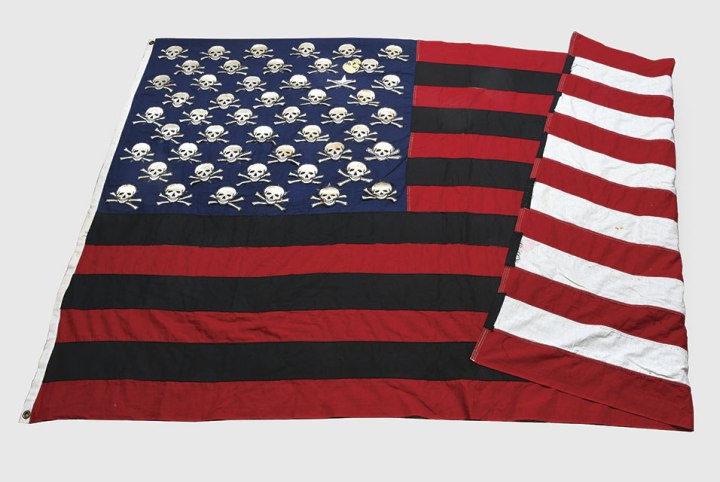
Peter Harrington Rare Books is offering an original flag produced in late 1960s San Francisco to protest American state-sanctioned violence, especially the war in Vietnam. It was probably created by staff of the left-wing magazine Ramparts, who used it as the cover image for their May 1968 issue (£2,750).
In 1901, Mark Twain published a satirical essay in the North American Review titled “To the Person Sitting in Darkness,” which attacked American violence and imperialism in the Philippines. He concluded it by suggesting a new American flag, “with the white stripes painted black and the stars replaced by the skull and crossbones.” A Ramparts article by Twain critic Maxwell Geismar suggested that, had Twain been listened to, “the new century might have been spared 50 years… of what is essentially a race war under the guise of such ambiguous and shifting concepts of nationalism and capitalism” (p. 65). Peter Harrington Rare Books is offering an original flag produced in late 1960s San Francisco to protest American state-sanctioned violence, especially the war in Vietnam. It was probably created by staff of the left-wing magazine Ramparts, who used it as the cover image for their May 1968 issue (£2,750).
Lucius Books will bring the original album cover artwork for the U.S. issue of Jimi Hendrix’s 1968 masterpiece, Electric Ladyland. This album fundamentally changed the landscape of rock music and studio production and pushed the boundaries of psychedelic rock, blues, and experimental soundscapes to new, futuristic heights. It was a groundbreaking album introducing audiences to a style of psychedelic rock rooted in the blues. There will be several dealers bringing items relating to the revolutionary movements during the 1960s and 1970s.
Among the scientific revolution items will be a first edition of Richard Dawkins’s debut book The Selfish Gene, which was published in 1976 and introduced the idea that evolution is best understood from the perspective of genes trying to replicate, rather than organisms struggling to survive. It debunked the then-popular idea that animals behave “for the good of the species,” providing a clear, logical alternative centered on individual gene survival. On its 50th anniversary a copy will be available at Ashton Rare Books for £2,250.
Finally, Butler Rare Books will show the earliest ‘Book of the Dead’ currently in private hands. All other pieces from this manuscript are now housed in museums. It is a large piece of Egyptian papyrus scroll from around 1,500 BCE with hieroglyphics and paintings of Anubis and Horus supervising the weighing of the heart against the figure of Maat.
The fair’s charity partner for 2026 is the Senate House Library and some of the library’s huge archive of materials relating to the theme of revolution in all its forms—from Civil War to the Suffragettes will be on view during Firsts.
Dame Mary Beard, an Honorary Graduate and supporter of Senate House Library, says: “Revolutionary works on paper don’t just recount history—they create it. They show the courage of writers who reshaped ideas and overturned conventions, while imagining better futures. Firsts London celebrates these extraordinary treasures. It gives everyone—not only scholars—a chance to thrill to the dangerous power of words that changed the world.”










 Enfilade
leave a comment