Hand Fans, Goose Necks, and Archery Contests
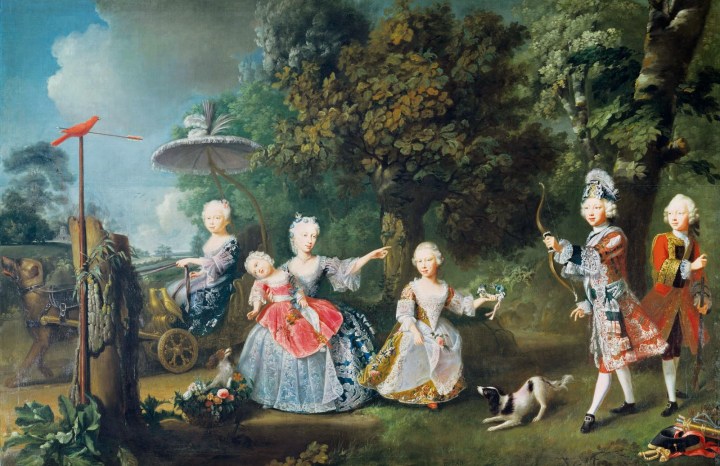
Barthélemy du Pan, The Children of Frederick, Prince of Wales, 1746
Royal Collection Trust/© Her Majesty Queen Elizabeth II 2014
◊ ◊ ◊ ◊ ◊
Pierre-Henri Biger’s website dedicated to the history of fans, Place de l’Eventail, recently published a notice related to seventeenth- and eighteenth-century target contests, commonly held in mid-August, involving a live goose (or more precisely, the goose’s neck, cou de l’oie).1 Biger quotes from Paul Sébillot’s Le Folklore de France (Paris, 1906), to make sense of a mis au rectangle (pictured at the website):
In Grez-Doiceau, in the Walloon Brabant, the second day of the fair, a live goose was hanging from a rope which brought together the upper ends of two long poles stuck in the ground. A man perched on a trestle remembered all the calamities which had hit the town during the past year, and accused the goose to be the cause. . .2
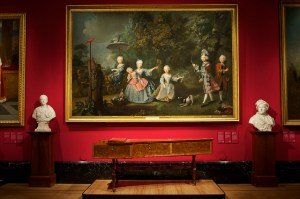
Installation view of The First Georgians, The Queen’s Gallery, Buckingham Palace, 2014.
With The First Georgians exhibition (on view at The Queen’s Gallery in London until October 12) still fresh in my memory, it’s hard to not to think of Barthélemy du Pan’s 1746 large-scale portrait of The Children of Frederick, Prince of Wales (Royal Collection), which depicts the future George III as having just struck a wooden popinjay.3 The prince wears the tartan of the Royal Company of Archers—which, as a British regimental uniform, was exempt from the 1745 ban on Scottish national dress. Bearing in mind Desmond Shawe-Taylor’s suggestion that we understand the picture as “an early example of the process by which Scottish identity became something manly and romantic, rather than threatening and rebellious,” I wonder if rustic traditions of shooting a living bird as part of a celebration with ‘atonement/scapegoat’ undertones might add another layer of relevant associations.4 I’m not sure how far I would push the point: the two contests weren’t the same thing (particularly from an animal rights perspective), and with folk festivals, it’s difficult to pin down specifics (times, places, meanings, &c.). Still, Biger’s piece, at the very least, suggests a larger context for archery contests and their pictorial representation in the eighteenth century and might encourage us to look to fans for useful points of comparison.
–Craig Ashley Hanson
1. Pierre-Henri Biger’s piece is available in both English and French. On the topic generally, see Biger’s recent article, “Introduction à l’éventail européen aux XVIIe et XVIIIe siècles,” Seventeenth-Century French Studies 36 (July 2014): 84–92. The issue, edited by Katherine Ibbett, is dedicated to the topic of fans. The table of contents is available as a PDF file here.
2. Paul Sébillot, Le Folklore de France (Paris, 1906), volume 3, pp. 247–48.
3. The Royal Collection’s online entry for Barthélemy du Pan’s The Children of Frederick, Prince of Wales is available here.
4. Desmond Shawe-Taylor makes the point in the entry for the painting from the exhibition catalogue, which he also edited, The First Georgians: Art & Monarchy, 1714–60 (London: Royal Collection Trust, 2014), p. 366.
The Art Bulletin, June 2014
The eighteenth century in the current issue of The Art Bulletin:
The Art Bulletin 96 (June 2014)
 Marcia Pointon, “Casts, Imprints, and the Deathliness of Things: Artifacts at the Edge,” pp. 170–95.
The practice of making death masks was extensive throughout Europe in the eighteenth and nineteenth centuries, yet their interest to scholars has been confined to their preparatory role in the production of portrait sculpture, the dissemination of phrenology, and as a figure for the indexicality of photographic images. The meanings generated, past and present, by casts of faces and other body parts can be investigated by addressing their materiality. As three-dimensional artifacts, positives deriving from negatives, casts have been understood as deathly in that they present an absence. In what does this deathliness consist, and how is it communicated?
Joanne Rappaport, Review of Daniela Bleichmar, Visible Empire: Botanical Expeditions and Visual Culture in the Hispanic Enlightenment (The
University of Chicago Press, 2012), pp. 241–43.
The Burlington Magazine, July 2014
The eighteenth century in The Burlington:
The Burlington Magazine 156 (July 2014)
 A R T I C L E S
• Conor Lucey, “Bas-reliefs after Angelica Kauffman,” pp. 440–44.
Plaster reliefs for interiors in Ireland based on designs of the 1770s by Angelica Kaufmann.
• Paul Hetherington and Jane Bradney, “The Architect and the Philhellene: Newly Discovered Designs by John Nash for Frederick North’s London House,” pp. 445–52.
John Nash’s designs (c.1813) for Frederick North’s unrealised house on what is now Waterloo Place, London, are published here for the first time.
R E V I E W S
• Todd Longstaffe-Gowan, Review of Elizabeth McKellar, Landscapes of London: The City, the Country, and the Suburbs, 1660–1840 (Paul Mellon Centre for Studies in British Art, 2013), pp. 467–68.
• Xavier F. Salomon, Review of Denis Tod, Giambattista Crosato: Pittore del Rococò Europeo (Scripta Edizioni, 2013), pp. 468–69.
• Philippe Malgouyres, Review of Anne-Lise Desmas, Le Ciseau et la Tiare: Les Sculpteurs dans la Rome des Papes, 1724–1758 (Collection de l’Ecole Française de Rome, 2012), p. 469.
• Richard Edgcumbe, Review of Charles Truman, The Wallace Collection: Catalogue of Gold Boxes (Wallace Collection, 2013), p. 470.
Journal of the History of Collections, July 2014
The eighteenth century in the Journal of the History of Collections (though other pieces for periods both earlier and later will likely also be of interest) . . .
Journal of the History of Collections 26 (July 2014)
A R T I C L E S
Alexander Echlin, “Dynasty, Archaeology and Conservation: The Bourbon Rediscovery of Pompeii and Herculaneum in Eighteenth-Century Naples,” pp. 145–59 (first published online 1 April 2014).
The rediscovery of the ancient sites of Pompeii and Herculaneum in the eighteenth century attracted a huge response from contemporary commentators. Many of these, as well as almost all subsequent judgements from historians, are very critical of the Bourbon excavators. Charles, King of Naples, and his team of antiquaries have been depicted as charlatans, treating ancient artefacts and the sites poorly, interested in them only in so far as they glorified their kingdom. In this article it is argued that, with an understanding of contemporary approaches to antiquity and conservation, this verdict on the Bourbons seems unduly harsh. Their archaeological methods and treatment of classical art were typical for the eighteenth century and were, in some ways, progressive. In support of this harsh judgement of Charles, Winckelmann has been portrayed as a savage critic of the excavations; in reality he was kinder to the Bourbons than historians have believed.
Julia Lenaghan, “The Cast Collection of John Sanders, Architect, at the Royal Academy, ” pp. 193–205 (first published online 4 November 2013).
John Sanders (1768–1826) was an architect and a Fellow of the Society of Antiquaries of London. He was the first student and a life-long friend of Sir John Soane. In 1817 in retirement he travelled to the Continent, where he studied and recorded with academic zeal the architectural monuments of the classical world which had so influenced his mentor and his world. In Rome he amassed a comprehensive and original collection of plaster casts of ‘architectural’ details. This collection was purchased by the Royal Academy in 1830, and much of it remains today part of the permanent collection of the Academy. This article presents the history and use of this early, non-figural, collection of plaster casts.
Paulo Oliveira Ramos, “The Royal Decree of 1721 and the Ephemeral Archaeological Collection of the Royal Academy of Portuguese History,” pp. 223–27 (first published online 22 January 2014).
In the great Lisbon earthquake of 1755, the palace of the Dukes of Braganza collapsed and its priceless treasures were lost forever. Although the content of its archaeological collection—said to constitute the first Portuguese museum of archaeology—is almost impossible to recover in detail today, the process behind its formation can be glimpsed in the documentary record. Two main aspects have emerged in the course of the present research: on the one hand, the relevance of the Royal Decree of 1721 as a crucial moment in the history of heritage preservation in Portugal and in Europe—and also as the inspiration for the archaeological collection; and, on the other hand, the antiquarian commitment of the Marquis of Abrantes.
Stephen Clarke, “Rosamond’s Bower, The Pryor’s Bank, and the Long Shadow of Strawberry Hill,” pp. 287–306 (first published online 4 March 2014).
The influence of Horace Walpole’s Strawberry Hill is traced in the little-known collections created in the 1830s and early 1840s at Rosamond’s Bower by the writer and antiquary Thomas Crofton Croker (joint author of the Gooseberry Hall satire of the Strawberry Hill sale of 1842) and by Thomas Baylis and Lechmere Whitmore at The Pryor’s Bank, both at Fulham. They were active purchasers at the sale (particularly Baylis), and Walpole’s Description of Strawberry Hill is a continuing presence behind Croker’s accounts of both collections. Both houses were social spaces, presented for antiquarian display, and in the case of The Pryor’s Bank in particular that display was played out in entertainments and Dickensian amateur theatricals. An under-explored element in this combination of collecting, antiquarianism, and jocularity is the Noviomagian Society, an antiquarian dining club of which Croker was a founder and which has connections to both houses.
R E V I E W S
• Jeremy Coote, Review of Holophusicon: The Leverian Museum – An Eighteenth-Century English Institution of Science, Curiosity, and Art,” pp. 317–18 (first published online 18 April 2014).
• Jörg Zutter, Review of Houghton Revisited: The Walpole Masterpieces from Catherine the Great’s Hermitage, pp. 319–21 (first published online 11 June 2014).
• Arthur MacGregor, Review of Natural Histories: Extraordinary Rare Book Selections from the American Museum of Natural History Library, pp. 322–23 (first published online 8 May 2014).
• Peter Mason, Review of Historias Naturales: Un Proyecto de Miguel Ángel Blanco, pp. 323–24 (first published online 16 May 2014).
• Charles Sebag-Montefiore, Review of Provenance: An Alternate History of Art, pp. 324–25 (first published online 18 April 2014).
Summer 2014 Issue of the CODART eZine
The 4th issue of the CODART eZine focuses on the eighteenth-century:
CODART eZine 4 (Summer 2014)

Jan Ekels, A Writer Sharpening His Pen, 1784
(Amsterdam: Rijksmuseum)
• Tom van der Molen, “Editor’s Note: Eighteenth-Century Art”
• Gerdien Verschoor, “Welcome: CODART Director Dies under Avalanche of Books”
• Virginie D’haene, “Bruges Artists Abroad: Neoclassicist Drawings in the Printroom of the Groeningemuseum”
• Stefaan Hautekeete, “A Cabinet of the Most Delightful Drawings: Eighteenth-Century Netherlandish Drawings from the Collection of Jean de Grez, To Be Exhibited at the Koninklijke Musea voor Schone Kunsten van België (Royal Museums of Fine Arts in Belgium) in 2016”
• René Dessing, “Historic Country Houses in the Netherlands”
• Silke Gatenbröcker, “Duke Anton Ulrich of Braunschweig-Wolfenbüttel: One of the First Collectors of Dutch Paintings outside the Netherlands”
• Jacek Tylicki, “Collecting at the Court of Poland-Lithuania and the Activities of King Stanislaus II August”
• Curator’s Interview: Paul Knolle interviewed by Andrea Rousová
• Friends: Brian Capstick interviewed by Gerdien Verschoor
• Rebecca Long, “CODART ZEVENTIEN Congress Review”
About CODART
CODART—the international council for curators of Dutch and Flemish art—aims to further the study, care, accessibility and display of art from the Low Countries in museums around the globe. It serves as a platform for exchange and cooperation between curators from different parts of the world, with different levels of experience, and from different types and sizes of institutions. Our organization stimulates international inter-museum cooperation through a variety of activities, including congresses, focus meetings, publications and our website. By these means CODART strives to solidify the cultural ties between the Netherlands and Flanders, and to make the artistic heritage of these countries accessible to the international art-loving public.
Teixeira’s Topographia de la Villa de Madrid in The Art Bulletin

◊ ◊ ◊ ◊ ◊
In the latest issue of The Art Bulletin (which I’m just now catching up on). . .
Jesús Escobar, “Map as Tapestry: Science and Art in Pedro Teixeira’s 1656 Representation of Madrid,” The Art Bulletin 96 (March 2014): 50–69.
Abstract: Pedro Teixeira’s Topographia de la Villa de Madrid is arguably the greatest representation of a city in the Spanish Habsburg world. Measuring nearly six feet high and more than nine feet wide, the map is a remarkable scientific achievement as well as a sophisticated art object. An exploration of the map’s text and ornament details the efforts of a scientist working in a court setting to shape a grandiose picture of the Spanish capital. Displayed on a wall, Topographia de la Villa de Madrid rivaled paintings and tapestries in their ability to exalt the image of a powerful ruler.
◊ ◊ ◊ ◊ ◊
Though dating to the the mid-seventeenth century, the map caught my attention for Enfilade because of this statement and footnote toward the end of the article:
As testament to the map’s legacy, a derivative map at a smaller scale than Teixeira’s was engraved in four plates in 1683 by the Dutch-Spanish artist Gregorio Fosman (1635–1713) and printed in the Madrid studio of Santiago Ambrona.107 (66).
107. Molina Campuzano, Planos de Madrid, 283–89, notes that the depiction of the city in Fosman’s map is approximately one-seventh the size of Teixeira’s. Fosman’s image would, in itself, serve as a model for a number of eighteenth-century maps of Madrid engraved by foreign artists in Paris, Amsterdam, and Augsburg. . . (69).
If anyone is looking then for the equivalent for Madrid of Giambattista Nolli’s 1748 map of Rome, Teixeira’s Topographia de la Villa de Madrid would seem to be at least part of the answer. -CH
The Burlington Magazine, June 2014
The eighteenth century in The Burlington:
The Burlington Magazine 156 (June 2014)
 A R T I C L E S
• Meredith M. Hale, “Amsterdam Broadsheets as Sources for a Painted Screen in Mexico City, c. 1700,” pp. 356–64.
European print sources for a twelve-panel screen made in Mexico City (c. 1697–1701).
• Alvar González-Palacios, “Giardini and Passarini: Facts and Hypotheses,” pp. 365–75.
New documents on the gold- and silversmith Giovanni Giardini (1646–1721).
• Koenraad Brosens and Guy Delmarcel, “Raphael’s Acts of the Apostles: Italians in the Service of the Habsburg Monarchy and the Leyniers Tapestry Workshop, 1725–55,” pp. 376–81.
A seven-part series of tapestries made by Daniel Leyniers (1752–54) in the Villa Hugel, Essen, based on Raphael’s Acts of the Apostles (woven 1516–21).
R E V I E W S
• Simon Jervis, Review of the exhibition William Kent: Designing Georgian Britain, pp. 391–94.
• Christopher Baker, Review of Christopher Rowell, ed., Ham House: 400 Years of Collecting and Patronage (The Paul Mellon Centre for Studies in British Art and the National Trust, 2013), pp. 398–99.
• Kate Retford, Review of the exhibition catalogue Moira Goff et al, Georgians Revealed: Life, Style, and the Making of Modern Britain (British Library, 2013), p. 401.
• David Pullins, Review of the exhibition From Watteau to Fragonard: Les Fêtes Galantes, pp. 408–10.
• Philippe Bordes, Review of the exhibition Le Goût de Diderot, pp. 413–15.
Candle-lit Theater
Michael Hawcroft’s article in the current issue of French Studies should be useful for anyone thinking about candles and early modern lighting conditions, particularly in the theater. At a more immediately experiential level, The Globe’s new Wanamaker Playhouse (opened since January) serves as the ideal venue.

Les Farceurs italiens et français, ca. 1670
(Paris: Collections Comédie-Française)
◊ ◊ ◊ ◊ ◊
Michael Hawcroft, “New Light on Candles on the Seventeenth-Century French Stage,” French Studies 68 (2014): 180–92.
Abstract: Modern accounts of the seventeenth-century French stage have repeatedly asserted that plays were divided into short acts of some twenty to thirty minutes in performance because the candles that lit the theatres had to be snuffed at frequent intervals. This article claims that there is no evidence for this assertion and aims to evoke the technological constraints of candle usage at the time so as to suggest that candles could be managed in such a way that they did not actually dictate dramaturgical practice. The article considers seventeenth-century theoretical discussion of the division of plays into acts: such discussion never alludes to candles, but refers to historical precedent and spectator attention spans as perceived explanations for the phenomenon of act division. It aims to adduce compelling evidence against the traditional view and concludes that the snuffing of candles took advantage of the opportunity offered by act division, but was never its cause.
◊ ◊ ◊ ◊ ◊

The Wanamaker Playhouse as described by Andrew Dickson for The Guardian:
Andrew Dickson, “New Globe Playhouse Draws Us inside Shakespeare’s Inner Space,” The Guardian (7 January 2014).
Crafted from oak and lit by candles, the Globe’s new playhouse isn’t just a jewel box of a theatre—it’s also a time machine
The new Sam Wanamaker Playhouse—an offshoot of the modern Globe, named in memory of its founder—aims to bring the work of Shakespeare and his contemporaries in from the cold, creating an indoor playhouse closely modelled on the one his company began to use in 1608, across the Thames at Blackfriars. Although it’s not the first time someone has attempted the feat—US scholars constructed a rival Blackfriars in the unlikely setting of a small city in Virginia 13 years ago—this will be the most authentic version yet, accurate (or as close as is possible) down to every hollow-bored oak pillar and trompe-l’oeil fresco. The whole project has cost £7.2m: one reason it’s taken the Globe nearly two decades to get around to building it. . . .
The first shock, after descending from the attic, is how tiny the auditorium feels: while the Globe can accommodate 1,500 people, with up to 700 jostling on foot, the Playhouse seats just 340. But this only makes it more intimate, says academic Farah Karim-Cooper, who chairs the research group that has steered the project. “The proximity is unbelievable,” she says. “You can get intimacy in the Globe—and when that happens it’s beautiful. But here, it’s really something.” . . .
But the greatest indoor breakthrough was something we now take for granted: control over light, impossible in the open air until the invention of gas lighting in the late 18th century. The Playhouse will be illuminated exclusively by candles, with artificial electronic daylight filtering through internal ‘windows’. The team hopes this will be the new space’s true revelation. The Jacobeans used candles made from animal fat, but the Globe have gone for pure beeswax, costing up to £500 per show. . .
The Burlington Magazine, March 2014
The (long) eighteenth century in The Burlington:
The Burlington Magazine 156 (March 2014)
 A R T I C L E S
• François Marandet, “The Pool of Bethesda by Louis Chéron: A Modello Discovered at the Wellcome Library, London,” pp. 162–63.
An oil-sketch by Louis Chéron in the Wellcome Library, London, is identified as a study for the large painting of the Pool of Bethesda (1683) in S. Pantaleone, Venice.
• Massimo Favilla and Ruggero Rugolo, “A Portrait of a Baby Girl by Lorenzo Tiepolo,” pp. 164–69.
An attribution to Lorenzo Tiepolo of a Portrait of a Baby Girl in a High Chair (c.1770–76).
R E V I E W S
• Jocelyn Anderson, Review of Geoffrey Tyack, ed., John Nash: Architect of the Picturesque (English Heritage, 2013), pp. 175–76.
• Uta Christina Koch, Review of the exhibition Fragonard: Poetry and Passion / Poesie und Leidenschaft, pp. 194–95.
• Francis Russell, Review of the exhibition Pietro Bellotti: Another Canaletto, pp. 198–99.
March 2014 Issue of RIHA Journal
The latest issue of RIHA Journal, the open access journal of the International Association of Research Institutes in the History of Art (RIHA), addresses the theme “When Art History Meets Design History.” Here are the eighteenth-century offerings:
Katie Scott, “Persuasion: Nicolas Pineau’s Designs on the Social,” RIHA Journal (March 2014).
This essay offers a Latourian account of the wood sculptor Nicolas Pineau’s design process via a reading of Jean-François Bastide’s [1758] novella La petite maison. It argues that the conventional form assumed by his drawings or ‘inscriptions’—the indications of scale, the delineation of options, the signatures and marginal notes—can be read as traces of seduction that helped ‘translate’ potential patrons to a taste for Rococo. The essay further suggests that the activation of the taste at the point of commission was kept alive in the designs executed by the bi-modal asymmetry that is characteristic of the goût pittoresque because its exercise was considered a mark of refinement.
Matthew Craske, “Model Making and Anti-Competitive Practices in the Late Eighteenth-Century London Sculpture Trade,” RIHA Journal (March 2014).
This article concerns the generation of anti-competitive practices, and the associated discontents, that rose to the fore in the London sculpture trade in the late eighteenth century (1770–1799). It charts the business strategies and technical procedures of the most economically successful practitioners, whose workshops had some of the characteristics of manufactories, and whose critics accused them of conducting a “monopoly” trade. Small-scale practitioners lost out in the competition for great public contracts on account of their design processes and their inability to represent any manifestation of “establishment.” A combination of three factors increased the gap between a handful of powerful “manufacturers” and the rest of the trade: the foundation of the Royal Academy, shifts in the ways designs were evaluated, and a growing number of very lucrative contracts for public sculpture. I conclude that such were the discontents within the London trade that by the 1790s, there was a marked tendency for practitioners who were not manufacturers to be attracted to democratic political movements, to the Wilkite call for liberty and the rise of civic radicalism in the merchant population of London.
Anne Puetz, “Drawing from Fancy: The Intersection of Art and Design in Mid-Eighteenth-Century London,” RIHA Journal (March 2014).
This paper attempts to bring the world of mid-eighteenth-century British design into fruitful conversation with contemporary art theory and practice. Taking the neighbourhood and milieu of the St Martin’s Lane area in London as a starting point, I investigate connections between British “rococo” design and William Hogarth’s Analysis of Beauty in terms of shared formal values and contemporary implications of “modernity.” I argue for a mutual indebtedness rather than “art” directing “design.”










leave a comment