December 2012 Issue of the ‘Oxford Art Journal’
In the current issue of the Oxford Art Journal:
Clare Walcot, “Hogarth’s The South Sea Scheme and the Topography of Speculative Finance,” Oxford Art Journal 35 (December 2012): 413-32.
 William Hogarth’s elaborate graphic satire The South Sea Scheme (1721) stages a moral tale of speculation run riot and a capital in thrall to ‘mony’s magick power’. Published in response to the failure of the eponymous scheme, Hogarth offers a satirical commentary on all forms of government-sanctioned speculation and illicit gambling. The scene is set in an imagined topography comprised of London landmarks, public buildings and temporary structures; places of authority, commerce and finance. His rearrangement of the Monument to the Great Fire and Guildhall brings into conjunction sites of cultural memory, which allude to the tense relationship between City and Crown during the post-Restoration period and rebuilding of the capital after 1666. Hogarth draws on the links these sites have with the theatre of the street, in the form of popular protest and pageantry, as it appeared on the ground and on paper. This essay examines the spectacular use of urban space and how it shaped Hogarth’s early graphic satire, as well as continental imports adapted to a London market, such as Bernard Baron’s (after Bernard Picart) A Monument Dedicated to Posterity (1721), often taken to be the model for The South Sea Scheme.
Clare Walcot’s research interests focus on financial innovation in the eighteenth century and its impact on the visual arts, and develop out of her PhD thesis entitled ‘Figuring Finance: London’s New Financial World and the Iconography of Speculation, c. 1689–1763’ (University of Warwick, 2003).
The Burlington Magazine, November 2012
The eighteenth century in The Burlington:
The Burlington Magazine 154 (November 2012)
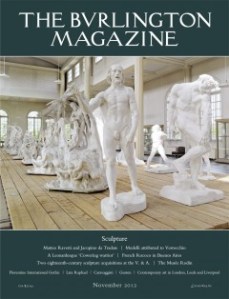 A R T I C L E S
• Marjorie Trusted, “Two Eighteenth-Century Sculpture Acquisitions for the Victoria and Albert Museum, London,” pp. 773-79. Two marble sculptures, a Crouching Venus by John Nost (1702) and a relief of Julius Caesar Invading Britain by John Deare (1796), have been acquired by the Victoria and Albert Museum, London.
• Gauvin Alexander Bailey, “French Rococo Prints and Eighteenth-Century Altarpieces in Buenos Aires,” pp. 780-85. French Rococo designs used in altarpiece decorations in eighteenth-century Buenos Aires.
R E V I E W S
• Philip Ward-Jackson, Review of Stefano Grandesso and Laila Skjøthaug, Bertel Thorvaldsen, 1770–1844 (Milan: Silvana, 2010), pp. 798-99.
• Mark Stocker, Review of Mary Ann Steggles and Richard Barnes, British Sculpture in India: New Views and Old Memories (Kirstead, Norfolk: Frontier Publishing, 2011), pp. 800-01.
• Christopher Baker, Review of the exhibition and catalogue The English Prize: The Capture of the Westmorland, an Episode of the Grand Tour (2012), pp. 817-18.
June 2012 Issue of ‘The Court Historian’
Eighteenth-century topics in the current issue of The Court Historian 17 (June 2012) . . .
Articles
• Clarissa Campbell Orr, “Popular History, Court Studies, and Courtier Diaries,” pp. 1-15.
• Robin Thomas, “Building the Monarchy: The Teatro di San Carlo in Naples, 1737,” pp. 35-60
• Neil Jeffares, “Between France and Bavaria: Louis-Joseph d’Albert de Luynes, Prince de Grimberghen,” pp. 61-85.
Reviews
• Clare Hornsby, Review of David Marshall, Susan Russell, and Karin Wolfe, eds., Roma Britannica: Art Patronage and Cultural Exchange in Eighteenth-Century Rome (London: British School at Rome, 2011), pp. 91-93.
• Wolf Burchard, Review of Christina Strunck and Elisabeth Kieven, eds., Europäische Galeriebauten: Galleries in a Comparative European Perspective (1400-1800), Römische Studien der Bibliotheca Hertziana 29 (Munich: Hirmer Verlag, 2010); and Mathieu da Vinha and Claire Constans, eds., Les grandes galeries européennes XVIIe-XIXe siècles (Paris: Éditions de la Maison des sciences de l’homme, 2010), pp. 95-104.
Conference Reports
• Antonio Ernesto Denunzio, “Aristocratic Residences in Naples: The Palazzo Zevallos Stigliano and Arts Patronage by the Nobility from the 16th to the 20th Centuries” (Naples, October 2011), pp. 113-14.
• Charles C. Noel, “The Court in Europe: Politics and Religion, 1500-1800,” (Madrid, December 2010), pp. 117-20.
September 2012 Issue of ‘The Art Bulletin’
In the current issue of The Art Bulletin, the “Notes from the Field” feature addresses the theme of contingency. Making a strong case for the proposition that it is possible to say something worthwhile in less than two pages, many of the essays are insightful and stimulating. The following two particularly address the eighteenth century. -CH
Gloria Kury, “On Contingency,” The Art Bulletin 94 (September 2012): 352-54.
Invoking Charles Le Brun, Emma and William Hamilton (“the first spell-binding teacher of art history was . . . a husband-wife duo”), and Dr. James Graham (famous for his sexual prescriptions involving the Celestial Bed at his Temple of Health and Hymen), Kury urges “scholars to start giving due heed to the significance of the spellbinding lecturer and / or master of the slide show, from the Hamiltons through Leo Steinberg and T. J. Clark, in the establishment and vitality of their discipline” . . . (354).
Mark Ledbury, “On Contingency,” The Art Bulletin 94 (September 2012): 354-55.
Addressing the “brilliant, but infuriating essay,” Charles Baudelaire’s “The Painter of Modern Life,” Ledbury draws readers’ attention to the critic’s coupling of “the contingent” with “the other half of art . . . the eternal and the immovable,” arguing that, in fact, modernity “has no monopoly over the contingent: wherever specialists look, the eternal and the immutable are thin on the ground” (354). Turning his attention then to eighteenth-century France (with reference to Richard Rorty’s Contingency, Irony, and Solidarity), Ledbury contends “that compelling history is always aware of the gravitational forces of contingency tugging it from its lofty heights. . . . Certainly, in my own scholarship, to even begin to chart the fortunes of the Neoclassical generation is to appreciate both the force and unpredictability of contingency in the making of lives, works, and careers” . . . (355).
ARIAH Prize for Online Publishing
From the Association of Research Institutes in Art History (ARIAH) . . .
ARIAH Prize for Online Publishing
Nomination due by 1 September 2012
 ARIAH looks for new initiatives to promote art historical research throughout the world, and invites nominations and self-nominations for the ARIAH Prize for Online Publishing. This award, which carries a $1,000 prize, seeks to encourage and promote high scholarly standards in online publishing in all fields of art history. The prize will be awarded annually to the author(s) of a distinguished article or essay published online in the past three years in the form of an e-journal or other short-form e-publication which advances the study of art history and visual culture. The article should either appear exclusively online, or should be substantially distinct from any print version, creatively capitalizing on the potential of digital publishing.
The competition is open to anyone, with the exception of delegates to ARIAH. Entries may be submitted by the author(s), or by others nominating authors for the prize, including publishers. Entries must be accompanied by the ARIAH Prize Entry Form.
Online publications must have appeared within three years of the submission date. All languages will be considered, but non-English submissions must also provide an English translation. Closing date for entries: September 1, 2012. Prize-winners will be notified by December 1, 2012. Please direct any questions to ARIAHprize@ariah.info
Articles and projects should contain substantial original scholarship and research, and enrich our understanding of art history and visual culture. Submissions will be considered that contribute new ideas and innovative approaches to the online presentation of information, and which exploit the potential offered by digital technology. Entries will be judged by a committee of ARIAH members.
August 2012 Issue of ‘Past & Present’
In the latest issue of Past and Present (August 2012), Michael Sonenscher responds to a recent article by William H. Sewell, “The Empire of Fashion and the Rise of Capitalism in Eighteenth-Century France,” Past and Present 206 (February 2010): 81-120. Sewell then weighs in with his own reply (access to full texts will require institutional subscriptions).
◊ ◊ ◊ ◊ ◊
Michael Sonenscher, “Debate: The Empire of Fashion and the Rise of Capitalism in Eighteenth-Century France,” Past and Present 216 (2012): 247-58.
[Full Text] [PDF]
 ‘Fashionable consumption’, Bill Sewell writes, ‘played a constitutive role in the development of French capitalism not only in the eighteenth century but also over the long term’. The claim goes with the grain of the many recent publications on eighteenth-century French trade and manufacturing industry that Sewell has expertly synthesized. But two further aspects of his article invite fuller comment. The first is an examination of the relationship between fashionable consumption and capitalist development that involves a modified version of Marx’s concept of surplus value. The second is a suggestion about the bearing of this fashion-oriented characterization of French capitalism on the subject of the origins and attributes of the French Revolution. Together they add up to an ambitious argument about the history of consumption as the way to overcome the neglect of social and economic considerations that, according to Sewell, has been one of the effects of the revisionist historiography of the French Revolution. . . .
◊ ◊ ◊ ◊ ◊
William H. Sewell, “Reply to Michael Sonenscher,” Past and Present 216 (2012): 259-67.
[Full Text] [PDF]
I would like to thank Michael Sonenscher for his learned and respectful comments on my article. In his comments he has filled out an aspect of the topic of ‘fashion’s empire’ that I made no sustained effort to cover in my own essay: varying contemporary opinions about the economics of fashion and about fashion’s relationship to France’s monarchical and aristocratic constitution. However, I think that his reflections on these eighteenth-century (or, in the case of Jean-Baptiste Say, early nineteenth-century) arguments about fashion have little bearing on what I take to be the central points of my essay. These are: (1) that fashion played a central role in French (and European) capitalist development in the eighteenth century; (2) that the dynamism of the fashion sector was based to a significant extent on harnessing the desires and labour of consumers; and (3) that certain consequences of the rise of fashion in eighteenth-century France ‘were … conducive to notions of equality of the sort specified in the Declaration of the Rights of Man and Citizen in 1789’ and were therefore ‘a key source’ of the French Revolution’s ‘epochal political and cultural transformations’. . .
July 2012 Issue of the Journal of the History of Collections
The following selection of articles from the current issue address the eighteenth century (access to full texts will require institutional subscriptions).
◊ ◊ ◊ ◊ ◊
Journal of the History of Collections 24 (July 2012)
A R T I C L E S
 Thomas Ketelsen and Christien Melzer, “The Gottfried Wagner Collection in Leipzig: Insights into a Middle-Class Private Collection of c. 1700,” pp. 199-218.
[Abstract] [Full Text] [PDF]
Cristiano Giometti, “‘Per accompagnare l’antico’: The Restoration of Ancient Sculpture in Early Eighteenth-Century Rome,” pp. 219-30.
[Abstract] [Full Text] [PDF]
David A. Wisner, “French Neo-Classical Artists and Their Collections,” pp. 231-42.
[Abstract] [Full Text] [PDF]
B O O K R E V I E W S
Nicholas Tromans, “Review of Spanish Art in Britain and Ireland, 1750-1920: Studies in Reception in Memory of Enriqueta Harris Frankfort, edited by Nigel Glendinning and Hilary Macartney (2010),” pp. 276-77.
[Full Text] [PDF]
CAA Joins JSTOR Register & Read Program
As noted at CAA News (2 July 2012):
 CAA has joined JSTOR’s new Register & Read program, which offers free, read-online access to a wide-range of academic journals to independent scholars and researchers. The service is designed to make scholarship available to those not affiliated with a subscribing institution by allowing them to register for a MyJSTOR account.
CAA is pleased to contribute the full back run of The Art Bulletin and Art Journal, through 2008, to an expanding, eclectic list that includes BOMB Magazine, Film Quarterly, Modern Law Review, and American Journal of Sociology. All articles from The Art Bulletin and Art Journal during this time will be available for individuals to read and, in some instances, to download and purchase as a PDF file.
Since JSTOR launched Register & Read in January 2012, approximately forty publishers have contributed material from seventy-seven journals to the beta site. The user-friendly program mimics the experience of a library by allowing visitors to store up to three articles on a virtual shelf for two weeks before exchanging items. Feedback is key to improving the borrowing service that Register & Read provides. JSTOR plans to perfect the functionality of the program and enlarge its scope to meet the unique research needs of the scholarly community.
The 2012 Issue of ‘The Walpole Society’
The Walpole Society 74 (2012)
• Rodney Griffiths, “The Life and Works of Edward Haytley (1713-1762),” pp. 1-60.
• Jason M. Kelly, “Letters from a Young Painter Abroad: James Russel in Rome, 1747-53,” pp. 61-164.
• Andrew Graciano, “The Memoir of Benjamin Wilson FRS (1721-1788): Painter and Electrical Scientist,” 165-244.
• Hugh Brigstocke, “The Journals and Accounts of James Irvine in Italy (1802-1806): Art Dealing and Speculation for William Buchanan, Arthur Champernowne and Alexander Gordon,” 245-432.
General information about The Walpole Society is available here»
In the May 2012 Issue of ‘Apollo Magazine’
From the current issue of Apollo Magazine:
◊ ◊ ◊ ◊ ◊
Elizabeth Angelicoussis, “An Olympiad’s Portrait,” Apollo Magazine (May 2012)
During excavations at Hadrian’s Villa at Tivoli the archaeologist Gavin Hamilton unearthed a classical statue of Hermes. Hamilton’s conservation of the sculpture transformed its identity to create an 18th-century image of an Olympic victor inspired by the ideals of ancient Greece
 In the late 18th century, the 1st Marquess of Lansdowne, William Petty-Fitzmaurice (1737–1805), assembled the most impressive collection of classical marbles in the British Isles, which he displayed in Lansdowne House, in London’s Berkeley Square.1 Many prime specimens were sold at a Christie’s auction in London in 1930, but at a Sotheby’s sale in New York in 1972, a very perceptive buyer purchased one choice piece that deserves examination.2
The sculpture represents a life-size youth with a smooth complexion and flawless features (Figs. 1–4).3 The nose is straight and large; from its bridge the razor-sharp ridges of the eyebrows flare out horizontally. The thin-lidded eyes are unmarked and only the rightwards torsion and the slightly parted lips animate the face. The coif is unfinished: at the crown, thick hair clusters, coarsely carved into spiral curls, lack drill holes to define their centres, while the hair at the back is roughly modelled into two large masses divided by a deep furrow. A lump of marble protrudes from the hair at the right, while a branch chiselled into the tresses above the left ear divides into two sprigs bearing a lanceolate leaf and tiny berries – the genus of the foliage remains undetermined. A wide groove encircles the head. The nude bust is ancient, and the uneven fracture around the neck argues for an original connection between the two parts.4 . . .
Elizabeth Angelicoussis specialises in ancient sculptures in private British museums.
__________________________
1/ This article is an offshoot from my project of the reconstruction of the Lansdowne collection of classical marbles. For surveys of the Lansdowne collection and the construction of Lansdowne House, with further bibliography, see Adolph Michaelis, Ancient Marbles in Great Britain, Cambridge, 1882, pp. 103–06, 453–71; Jonathan Scott, The Pleasures of Antiquity: British Collectors of Greece and Rome, New Haven and London, 2003, pp. 160–68; Ilaria Bignamini and Clare Hornsby, Digging and Dealing in Eighteenth-Century Rome, New Haven and London, 2010, vol. I, pp. 321–26. For more on the Marquess, see Oxford Dictionary of National Biography, online edn. May 2010, http://www.oxforddnb.com/view/article/22070 (J. Cannon).
2/ Catalogue of the Celebrated Collection of Ancient Marbles, the Property of the Most Honourable the Marquess of Lansdowne, 5 March 1930, p.77, lot 60; Sotheby’s Sales Catalogue of Egyptian, Western Asiatic, Greek, Etruscan and Roman Antiquities, 4 December 1972, p. 30, lot 122.
3/ See Michaelis op cit., Ancient Marbles in Great Britain, Cambridge, 1882, p. 452, no. 62. The restorations include the tip of nose, a section of the left brow and a piece of the right side of the neck at the front.
4/ There is a diagonal break running from the back across the chest. The repairs of the bust include the base and index plate, the patchwork of the spine, and the left breast. The inside and the rim of the support have been smoothed over. . . .
◊ ◊ ◊ ◊ ◊
The full article is available here»










 Enfilade
leave a comment